Extraction of Building in Satellite image THR using
Features Detection
Zaaj Ibtissam
PhD.Std, Laboratory of
industrial and computer
engineering, National School of
Applied Sciences, Ibn Zohr
University
Agadir, Morocco
Chaouki Brahim El khalil
Prof, Laboratory of industrial
and computer engineering.
National School of Applied
Sciences, Ibn Zohr University
Agadir, Morocco
Masmoudi lhoussaine
Prof, Geomat Laboratory,
Physics Dept. Faculty of
Science, Mohammed V
University
Rabat, Morocco
ABSTRACT
Edge detection is a critical stage in many computer vision systems as image segmentation and object detection. As it is difficult to detect image edges with precision and with low complexity, it is appropriate to find new methods for edge detection. In this paper, we take advantage of Corner detection to detect edges in a multi-scale way with low complexity, and we propose a novel corner feature. The principle of Corner detectors is always the same; it looks for a quick change of direction of the contour. In the first part, this principle has been used to detect the corners of our image since the general objective is to detect buildings from THR satellite images based on the geometrical shape of buildings. Histogram has too been used as a next step to analyze R in order to set the number of points of interest. The second part of this work used to detect the edges points with canny, choosing different thresholds to view the problem of canny to the automation of the threshold. Finally, an automatic method has been proposed to partly answer the problem of the operator of Harris and Canny; by combining the results of the first part with the result of the second part. The contribution is to choose the Harris operator as the selected threshold determiner. The effectiveness of the proposed method is supported by the experimental results that prove that the method is faster than many competing state-of-the-art approaches and can be used in real-time applications.
General Terms
Image processing
Keywords
Detection of building, Edge detection, Interest point
1.
INTRODUCTION
Nowadays, satellite images have become an indispensable segment in many applications such as medical imaging, remote sensing, crime prevention, education, multimedia, data mining...). These applications require satellite images as a source for various processes like segmentation, interest point, edge detection, object recognition, tracking, and others. According to rapidly growing urbanization and municipal regions, automatic detection of buildings from remote sensing images is a hot topic and an active field of research in Morocco.
Detection of low-dimensional features (edges, corners) plays an important role in computer vision applications, mostly building detection. There are many competing algorithms for detecting corners and edges in images. Ever since, Harris detector [1] has been widely used in corner detection [2,3] and image segmentation [4]. It is one of the most well-known
algorithms in detecting feature points of interest, because it provides an excellent repeatability under rotation and various illuminations.
Being the most prevailing algorithm, Harris corner detection algorithm has witnessed a series of attempts to improve it. Telle and Aldon [5] redefined the Corner Response Function. Nassif et al.[6] considered corner location easurement. Mikolajczyk [7] improved Harris corner detection algorithm by making it adapted to scale and affine change. The variations along the adaptive vertical and tangent axes are used for corner detection [8].
Edge detection is a fundamental step in image segmentation and one of the most important steps to recognize the features of objects. Concerning the algorithms for detecting edges, there are a lot to know. Marr and Hildreth [9] and Canny [10] introduced more complex methods. In the last years, many edge detection methods have been proposed. Wavelet filtering [11, 12], neural networks [13], statistics [14], rule bases [15], fuzzy concepts [16] are different approximations used for this objective.
[17] Using canny edge operator based on anisotropic and Genetic algorithm, the said algorithm searches for higher and lower threshold values as used in canny operator and is quite a difficult task to identify the accurate value. In[18], author proposes an efficient algorithm by improving traditional Canny edge detection algorithm for satellite images.
After giving a literature review on feature (corners and edges) for satellite images, we arrived at detecting the limits of each method. The method of edge detection suffers from threshold automation problem. The second method, Corner detection algorithm, contains a lot of false corners and the positioning accuracy for these complex corners is low [19–21]. So an improved method based on Harris detector and canny edge detection is proposed in this paper. Firstly, we extract the interest point by Harris, followed by an analysis of R (R means the number of points of interest) with the histogram. Secondly, Canny edge detection is used to detect the edges existing in the satellite image, Finally, a combination of the results found by the first two parties closed the research concern of the current study.
2.
PROPOSED APPROACH
24 With the canny detector, some edges points have not been
detected. Some pixels detected as edge points are not real, so it gives an incorrect detection (detection superfluous pixels, missing pixels). The Harris algorithm was used to overcome this problem. The Harris's characteristic is to add thresholds as a validation parameter.
[image:2.595.65.286.166.585.2]Our approach is to solve the canny threshold automation problem.
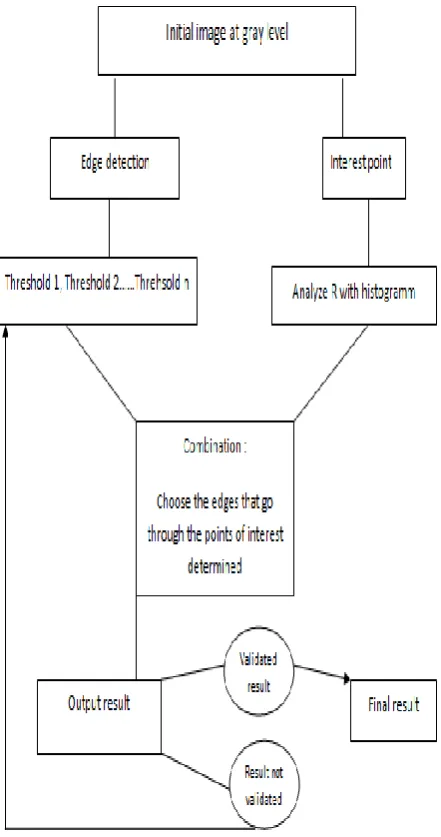
Fig 1: Graphical abstract
2.1
Corner detection
Among intensity gradient based methods, Harris [1] corner detector is the most popular one which identifies corners in an image by using a small Gaussian smooth window which shifts in vertical and horizontal directions along with pixel ordinates. When brightness distribution of a window varies significantly, its center pixel then is defined as corner.
The Harris operator is defined very simply. It is based on the Eigen values of the second moment matrix. The definition requires a window region to be defined and averages are taken over this whole window. For this reason, the following matrix has been computed:
𝑀 = 𝑥, 𝑦
𝑥𝑦𝐼
𝑥2𝐼
𝑥𝐼
𝑦𝐼
𝑥𝐼
𝑦𝐼
𝑦2 (1)Where
I
x andI
y are the derivatives of pixel intensity in the x and y directions in point x, the M(x, y) is the window at position (x, y). Eigen values of the matrix M can help to determine the suitability of a window.R = Det M
-K(Trace M)
2 (2)The score is calculated for each window,
where:
Det M =
λ
1λ
2, Trace M =λ
1+λ
2 and K is a constant. The typical value of the constant k is equal to 0.04 [23]. All windows that have the score R greater than a certain value are corners (interest points).Harris corner’s detection algorithm is a kind of effective feature point algorithm, but also insufficient: [24] algorithm can only detect corner feature in single scales. The effect of the corner detection will be entirely dependent on the threshold set while implementing the non–maxima suppression and determining the local maximum value. The corner information will be lost when threshold set is too large. The current study’s contribution is to solve this problem.
The general objective of the proposed approach either is to serve the detection of buildings from satellite images with the view that the buildings always take geometric shape rectangles or squares. Based on the information, a pertinent look was taken at the points that have a double variation of gradient in X and Y.
The next step goes through two parts:
• Finding points with large corner response function R
(R > threshold) using the histogram.
• Taking the points of locally maximum R as the detected feature points.
Fig2: A part of Computation of the response of the Harris detector at each pixel
Fig3: Histogramm of initial Image Fig4: Histogramm after analyzing R values
Edge detection requires a variation in either x or y, but the Harris operator for corner detection (interest point) requires a double variation in x and y at the same time. This information helped us to easily distinguish between a corner and an edge.
2.2
Edge detection
Image edge is an important feature for computer vision algorithms. Several edge detection operators have been developed, such as Roberts, Prewitt, Kirsch, Sobel, Robinson and Canny [25]. Compared to the other edge detection algorithms, Canny edge detection can provide much better and more reliable edge detection results, and it has become the criterion for evaluating other methods.
The fundamental characteristics of Canny Edge Detection algorithm are:
1. Smoothing the image with a Gaussian filter.
2. Computing the gradient magnitude and orientation using finite-difference approximations for the partial derivatives.
3. Applying non-maxima suppression to the gradient magnitude.
4. Using the double thresholding algorithm to detect and link edges.
Fig5: Initial Ima Fig6: Initial image at gray level
Fig7: Threshold 1 Fig8:Threshold 2 Fig9: Threshold 3
The results of the canny detector lack precision it did not provide a response perfectly suited to our needs; Some edges points have not been detected and some pixels detected as contour points are not (threshold automation problem). To correct this error or problem we have added the Harris operator as a threshold determinant. the process of validating the threshold is as follows:
We have set a threshold 1 and the combined with the result found by Harris; if we find a satisfactory result (edges points go through all the points of interest determined) we stop, or else we will increase the threshold or decrease it, until a remarkable result is obtained.
2.3
Validation of threshold
The objective of this step as the title indicated is to have the three thresholds chosen combined with the result found when analyzing the number of points R with histogram.
Having used just canny outline to detect objects from urban scenes is not enough, especially when the global task is to extract the buildings from the satellite images.
The edge detector from Canny's approach is used at high-resolution, providing edges having the distinction of being well located in the areas not noisy and un-textured image, but remain too numerous on the other hand .
The proposed method retains the advantage of good localization transitions avoiding the usual compromise between good localization and good edge detection. Indeed, over-detection in the noisy or textured areas is removed or validated by the result found by analyzing R.
Our contribution is to use Harris operator as a chosen threshold determinant. The three chosen thresholds are combined with the result of Harris. After the representation of the results of three-threshold edges detections, each threshold is combined with Harris result (after the analysis of R with histogram).
26 Diagram that represents the approach of our contribution
Table 1. The validation rate of our approach Thresholds The validation
rate
The acquisition time
Threshold 1
46%
3.s
Threshold 2
53%
3.s
¦¦
65%
3.s
¦¦
79%
3.s
¦¦
83%
3.s
Threshold 3
98.2%
3.s
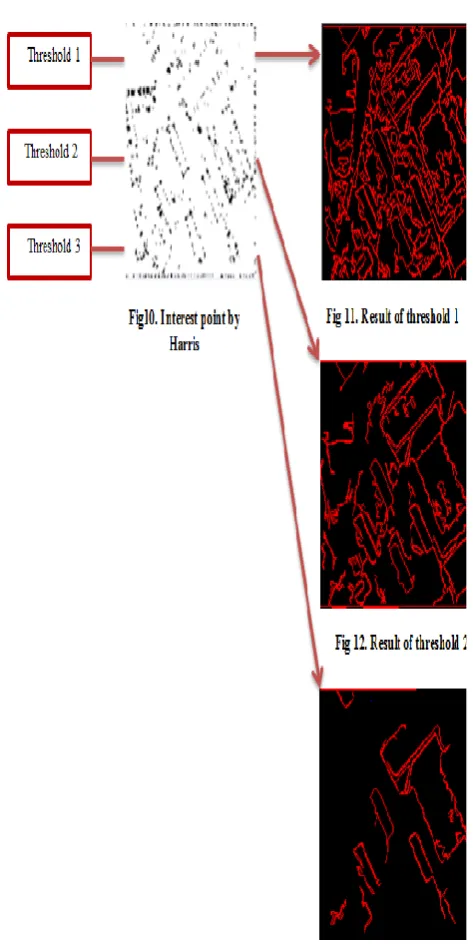
The figures show the result after combination.
Figure 11 above shows the result of the combination with the threshold1 which is the lowest. Since the image contains a lot of details, the first combination was not adequate. The image displays the edges that pass through points of interest and others that do not. Therefore, the first threshold is not adaptable with the number of points of interest found. the validation rate of the first combination is 46%, which explains why another threshold must be chosen to improve this rate.
Figure 12 presents the result of the combination with the threshold 2. It has shows all the interest points with the absence of half of the edges points. The validation rate for this combination is 53%. With more improvement (threshold increase), we could arrive at a more reasonable rate.
Figure 13 presents the result of combination with threshold3, after a set of threshold settings we found that the higher threshold gives more effective results in our combination compared to the low threshold. The final result starts to take its way. The interest points go through all the most significant edges points or go through the edges that have a double variation on x and y, with a rite reaches 98.2%.
The figures above present the results of the combination of different thresholds realized: threshold1, threshold2 and threshold 3 .After the description of each result obtained from the combination, it is noticed that the last combination of the threshold is the most appropriate combination, which validates our contribution. Our contribution is to have chosen the Harris operator as a determinant threshold. The selected result represents a rate of 98.2%.It manages the detection of all objects in a geometric form of a rectangle or square.
3.
RESULTS & DISCUSSION
Detection Features (edges, corners) can be used to improve the detection of buildings from satellite images. Harris operator is used to find the canny thresholds best suited to improve the detection of buildings and reduce the false detections of Canny. This is clearly seen from the results found, as shown in the figures 7, 8 and 9.The three figures show canny edges detection with different thresholds: Threshold1, Threshold2 and Threshold N. From the threshold that gave less detection until to the most adaptable threshold with our approach.
Figure 7: features extraction (edges by canny). In this step, a first database is prepared. The features used for detecting the edges in the satellite imagery at the low threshold. We noticed from the image, the low threshold gives more details the searched objects and the other noisy objects.
Figure 8, in the second threshold, was chosen to improve a little bit the threshold. The results show that there is a change from the first threshold amounting to a disappearance of a few objects of small sizes.
Figure 9, which is a high threshold compared to the first two ones shows fading of most of the noise.
According to these results of thresholds found, it is necessary to choose a suitable threshold with our objective. The choice was not be random or manually. It added or combined the result of Harris with these thresholds, to find the best possible combination.
[image:4.595.49.283.606.749.2]were eliminated. To reiterate, Harris operator has been used as a threshold validation tool.
4.
CONCLUSION
Extraction of urban information from satellite images has become a hot topic in remote-sensing studies. This paper presents a novel building extraction method. The study of the detection features of satellite images THR is particularly rich. We saw how this detection is different from object to object, and from a noisy zone to an area that is not. Detection features are given to characterize these different situations. The applications of this study are numerous.
Edges detection with Canny is used to precisely extract the borders of objects. In the presence of noise or useless objects, the extraction of contours will be more difficult. This requires the addition of another algorithm to correct these defects. That is why Harris operator was chosen due to its reliability in extracting corners. The fusion of these detectors (Canny and Harris) leads to the construction of an automatic method that makes it possible to extract the buildings. We have shown the applicability of this method on several images. We discussed in detail the extraction results and showed the special case. The parameterization of the detectors plays an important role in extraction of the building (choice of threshold). The distinction between a building of rectangular or square geometrical shape and other objects of the same form (for example ground ...) will be the subject of future work.
5.
REFERENCES
[1] C. Harris, M. Stephens.1988, “A combined corner and edge detector,” presented at the In: Proc. 4th Alvey Vision Conf.
[2] H. Moravec.1980, Obstacle Avoidance and Navigation in the Real World by a Seeing Robot Rover, Robotics Institute, Carnegie-Mellon University.
[3] L. Yi-bo, L. Jun-jun, Harris corner detection algorithm based on improved contourlet transform, Proc. Eng. 15 (0) (2011) 2239–2243.
[4] A. Kovacs, T. Sziranyi.2012, Harris function based active contour external force for image segmentation, Pattern Recogn. Lett. 33 (9) 1180–1187.
[5] B. Telle, M.J. Aldon.2002, Interest points detection in color images, in: Proc IARP Workshop on Machine Vision Applications, pp. 550–553.
[6] S. Nassif, D. Capson, A. Vaz.1997, Robust real-time corner location measurement, in: IEEE Instrumentation and Measurement Technology Conference, pp. 106–111.
[7] K. Mikolajczyk, C. Schmid.2004, Scale and affine invariant interest point detectors, Int. J. Comput. Vis. 60 (1) 63–86.
[8] S.C. Pei, J.J. Ding.2005, New corner detection algorithm by tangent and vertical axes and case table, in: International Conference on Image Processing, pp. 365– 368.
[9] D. Marr, E.1980. Hildreth, Theory of edge detection, Proceedings of the Royal Society of London 207 (1167) (1980) 187–217.
[10]J. Canny.1986, A computational approach to edge detection, IEEE Transactions Pattern Analysis and Machine Intelligence 8 (1986) 679–698.
[11]C. Ducottet, T. Fournel, C. Barat.2004, Scale-adaptive detection and local characterization of edges based on wavelet transform, Signal Processing 84 (2004) 2115– 2137.
[12]K.N. Le, K.P. Dabke, G.K. Egan.2006, On mathematical derivations of auto-term functions and signal-to-noise ratios of Choi–Williams, first- and nth-order hyperbolic kernels, Digital Signal Processing 16 (2006) 84–104.
[13]S. Lu, Z. Wang, J. Shen.2003, Neuro-fuzzy synergism to the intelligent system for edge detection and enhancement, Pattern Recognition 36 (2003) 2395–2409.
[14]R. Rakesh, P. Chaudhuri, C.A. Murthy.2004, Thresholding in edge detection: a statistical approach, IEEE Transactions on Image Processing 13 (2004) 927– 936.
[15]J. Bezdek, R. Chandrasekhar, Y. Attikouzel.1998, A geometric approach to edge detection, IEEE Transactions on Fuzzy Systems 6 (1998) 52–75.
[16]D.-S. Kim, W.-H. Lee, I.-S.2004. Kweon, Automatic edge detection using 3 3 ideal binary pixel patterns and fuzzy-based edge thresholding, Pattern Recognition Letters 25 (2004) 101–106.
[17]M. Wang, J.S. Jin, Y. Jing, X. Han, L. Gao, L. Xiao.2016, The improved Canny edge detection algorithm based on an anisotropic and genetic algorithm, Chinese Conference on Image and Graphics Technologies, Springer, Singapore, 2016, pp. 115–124.
[18]R. Gupta.2016, Enhanced edge detection technique for satellite images, International Conference on Cloud Computing and Security, Springer International Publishing, pp. 273–283.
[19]O. Cheng, W. Guangzhi, Z. Quan, K. Wei, D. Hui.2005, Evaluating Harris method in camera calibration, in: Proceedings of the 2005 IEEE Engineering in Medicine and Biology 27th Annual Conference, pp. 6383–6386.
[20]Q. Zhu, B.Wu, N.Wan, A sub-pixel location method for interest points by means of the Harris interest strength, Photogram. Rec. 22 (120) (2007) 321–335.
[21]I.R. Peter, Performance assessment of feature detection algorithms a methodology and case study on corner detectors, IEEE Trans. Image Process. 12 (12) (2003) 1668–1676.
[22]F. Shi, X. Huang, and Y. Duan.2009, “Robust harris-laplace detector by scale multiplication,” in Advances in Visual Computing, ser. Lecture Notes in Computer Science, vol. 5875. Springer Berlin / Heidelberg, pp. 265–274.