Ontology Mapping Representations:
a Pragmatic Evaluation
Hendrik Thomas, Declan O’Sullivan and Rob Brennan
Knowledge & Data Engineering Group, School of Computer Science and Statistics, Trinity College Dublin, Ireland Email: {Hendrik.Thomas, Declan.OSullivan , Rob.Brennan}@cs.tcd.ie
Abstract— A common approach to mitigate the effects of ontol-ogy heterogeneity is to discover and express the specific corre-spondences (mappings) between different ontologies. An open research question is: how should such ontology mappings be represented? In recent years several proposals for an ontology mapping representation have been published, but as yet no for-mat is officially standardised or generally accepted in the com-munity.In this paper we will present the results of a systematic analysis of ontology mapping representations to provide a pragmatic state of the art overview of their characteristics. In particular we are interested how current ontology mapping representations can support the management of ontology map-pings (sharing, re-use, alteration) as well as how suitable they are for different mapping tasks.
I. INTRODUCTION
Ontologies are an important component for implemen-tation of the semantic web vision [1]. The promise of on-tologies is to enable the sharing of a common understand-ing of a domain that can be flexibly communicated be-tween users and applications [2,3]. However, the actual conceptualisation of a domain and the subsequent explica-tion in an ontology language is a very heterogeneous process [4]. For example conceptual heterogeneity arises due to the natural human diversity involved in modelling a domain [5], e.g. two ontologies could differ because they provide a more (or less) detailed description or could re-flect different viewpoints of the same domain. These dif-ferent levels of heterogeneities [6] are major obstacles to the promise of interoperability based on ontologies [7].
A common approach to mitigate the effect of heteroge-neity is to discover the specific correspondences between the different ontologies and to document these correspon-dences using an appropriate ontology mapping expression [8,9]. We define ontology mapping as the task of relating the vocabulary of two ontologies sharing a domain in such a way that the structure of ontological signatures and their intended interpretations are respected [10].
One aspect, which is still open to discussion, is: how should ontology mappings be represented [6,8,11]? In this paper we define an ontology mapping representation as an explicit specification of the correspondence between on-tologies to improve their interoperability. In recent years several proposals and recommendations for such an ontol-ogy mapping representation have been published but as yet no representation specific format is standardised or even generally accepted in the semantic web community [8,12]. Thus an ontology engineer, when confronted with the need to merge or align multiple ontologies has a choice between multiple currently available ontology mapping representations, each with their individual strengths and weaknesses for a specific mapping task.
Publications focusing on representations of ontology mapping are relatively rare compared to the huge number focusing on other related questions for matching and mapping, e.g. matching algorithms to identify mapping candidates [13]. However, some previous studies on on-tology matching and mapping systems provide some in-sight [10,11,12]. Most of these previous evaluations focus primarily on the technical capabilities of matching and mapping tools [12,14] and less on applicability of map-pings representations [6]. In addition, only sparse informa-tion has been published on the support of reusability and management of mappings, e.g. specification of supporting meta-data [11]. Finally, the evaluation processes and crite-ria sets used in previous work have been quite heteroge-neous which makes it difficult to identify trends and im-provements over time. In summary, a detailed evaluation framework as well as a comprehensive and up-to-date evaluation focusing on the capabilities of current ontology mapping representations is currently missing.
In this paper we present the results of a systematic analysis of ontology mapping representations to provide a pragmatic state of the art overview of their characteristics. In particular we are interested how the ontology mapping representations can support the management of ontology mappings (sharing, re-use, alteration) as well as how suit-able they are for different mapping tasks. The results of this evaluation will be of interest for understanding ontol-ogy mapping interoperability issues and will also support ontology engineers in choosing the most suitable mapping representation for their application.
II. EVALUATIONFRAMEWORK
A. Methodology
B. Evaluation Goals, Questions and Metrics
[image:2.612.315.535.98.425.2]Turning to the literature of ontology mappings it can be observed that instances of mapping relations can be quite heterogeneous, ranging from simple equivalence relations or mathematical conversions to complex structural map-pings [5,11,12]. Therefore one of the fundamental goals of ontology mapping representations is (G1) the ability to express a mapping relation. Relevant for this goal are the ontology elements which can be addressed as well as the different kinds of mapping relation types which are sup-ported. In addition we need to consider the supported op-erators and functions for the expression of conversion and structural mappings. Table I gives an overview of all de-duced criteria for this goal [16].
TABLE I GOAL 1:ABILITY TO EXPRESS A MAPPING RELATION
Criteria Type Examples
Question 1: Which kind of ontology elements can be addressed?
Single ontology element yes|no OWL class, property
Ontology fragment yes|no SELECT ?x WHERE {?x ?y ?z} Ontology as a whole yes|no http://kdeg.org/nembes.owl
Question 2: Which relations types are predefined?
Count of predefined types 0..X 3
List of predefined types list equivalence, subsumption Extensibility yes|no add a “neighbor” relation
Question 3: Which function for conversion mappings are supported?
Numerical function yes|no add, subtract, multiply String functions yes|no delete leading white spaces Date functions yes|no 2006/12/31 to 31/12/2006
Question 4: Which function for structural mappings are supported?
Add / remove classes yes|no remove class town Add / remove instances yes|no add instance Dublin Add remove relation yes|no add Dublin is-part-of Ireland Add remove attributes yes|no remove a variant name
The second aspect is that (G2) ontology mapping repre-sentation should be computationally efficient to process [7,11] in order to support the pragmatic concerns of im-plementing ontology interoperability solutions. Table III gives an overview of all deducted criteria for this goal.
TABLE II GOAL 2:COMPUTATIONALLY EFFICIENT TO PROCESS
Criteria Type Examples
Question 1: How is the compatibility of the representation?
Implementation independent yes|no MAFRA format
Syntax yes|no XML, RDF, OWL
Question 1: Which tool support the mapping representation?
Creation & editing tools List Ontology Alignment API
Sharing tools List CVS
Management tools List COMA++
Mapping visualization tools List MAFRA
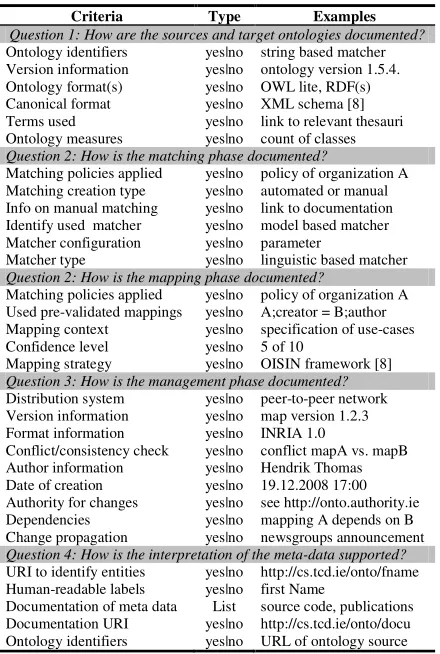
Besides these aspects we need to consider that the con-struction of a specific ontology mapping can be complex and time-consuming [12]. Instead of creating the same or similar mappings repeatedly it is important to have a goal (G2) to enable sharing and reuse of existing mappings to reduce the effort involved in the creation of mappings [7,8]. To decide if an ontology mapping can be reused, it is essential to understand how the mapping was created. An analysis of the life cycle of an ontology mapping [7] is helpful for identification of relevant decisions and infor-mation, e.g. which matching algorithms have been used [8,18]. Meta-data documenting this lifecycle is needed to facilitate sharing and reuse of mappings. An ontology mapping representation should provide suitable place-holders to make this information retrievable in a structured and predictable way. Previously we have defined a map-ping lifecycle [8] and based on that we identified meta-data to document the source and target ontologies, the matching phase to identify mapping candidates, the
[image:2.612.79.300.217.381.2]map-ping phase as well as the management phase. Table II gives an overview of all deduced criteria for this goal.
TABLE III GOAL 3:SHARING &REUSING OF EXISTING MAPPINGS
Criteria Type Examples
Question 1: How are the sources and target ontologies documented?
Ontology identifiers yes|no string based matcher Version information yes|no ontology version 1.5.4. Ontology format(s) yes|no OWL lite, RDF(s) Canonical format yes|no XML schema [8] Terms used yes|no link to relevant thesauri Ontology measures yes|no count of classes
Question 2: How is the matching phase documented?
Matching policies applied yes|no policy of organization A Matching creation type yes|no automated or manual Info on manual matching yes|no link to documentation Identify used matcher yes|no model based matcher Matcher configuration yes|no parameter
Matcher type yes|no linguistic based matcher
Question 2: How is the mapping phase documented?
Matching policies applied yes|no policy of organization A Used pre-validated mappings yes|no A;creator = B;author Mapping context yes|no specification of use-cases Confidence level yes|no 5 of 10
Mapping strategy yes|no OISIN framework [8]
Question 3: How is the management phase documented?
Distribution system yes|no peer-to-peer network Version information yes|no map version 1.2.3 Format information yes|no INRIA 1.0
Conflict/consistency check yes|no conflict mapA vs. mapB Author information yes|no Hendrik Thomas Date of creation yes|no 19.12.2008 17:00 Authority for changes yes|no see http://onto.authority.ie Dependencies yes|no mapping A depends on B Change propagation yes|no newsgroups announcement
Question 4: How is the interpretation of the meta-data supported?
URI to identify entities yes|no http://cs.tcd.ie/onto/fname Human-readable labels yes|no first Name
Documentation of meta data List source code, publications Documentation URI yes|no http://cs.tcd.ie/onto/docu Ontology identifiers yes|no URL of ontology source
Another relevant issue for this evaluation framework is: which ontology mapping representations should be in-cluded in the evaluation? Currently there are several non-ontology based (e.g. Text, XML) and non-ontology based (e.g. RDF, OWL [1]) languages used to express mappings [7]. The problem is that there is no consistent usage of these languages or formats. In fact, many mapping tools use the same languages to express mapping results (e.g. RDF is very common) but in different ways and as a consequence they support different functions and operators to express mappings [7,8]. From a pragmatic point of view it is therefore not enough to evaluate a representation language like OWL in isolation. In fact, it is important to under-stand which specific instances of ontology mapping repre-sentations are supported by the individual mapping tools.
III. EVALUATION RESULTS
[image:2.612.79.299.447.529.2]A. Results for G1 Ability to Express a Mapping Relation The first aspect we analyzed in our evaluation was the expressiveness of the application in terms of which opera-tors and functions are supported to express mappings. We noticed that all analysed tools are limited to addressing individual ontology elements as subjects of mappings (Q1). Thus none of the evaluated applications is able to address ontology fragments which is quite odd because mappings of complex statements need to consider more than one concept and could easily be addressed with cur-rent querying languages (e.g. SPARQL) [7]. Considering the support for mapping correspondences, we ask which predefined types are supported (Q2). Our data showed that majority of analysed applications (61%) support only the equivalence relation. Other popular mapping types are subsumption and incompatible. The majority of applica-tions (> 64%) don’t support the extensibility of pre-defined mapping types (Q3). Only analyzed APIs (e.g. FOAM [25], Alignment API [26]) could (at least theoreti-cally) be extended to support other mapping types. How-ever, that isn’t a flexible and user-friendly approach. An-other aspect is the support of functions to express complex mapping. Our data showed that no mapping instance sup-ports conversion functions (G3), e.g. numerical, string or date. An exception is RIMOM [27], which support basic numerical functions to manipulate attributes, e.g. <user> #addr+#zip=#ci</user>. Also most representation in-stances (> 76%) don’t support functions for structural re-arrangements. Only MAFRA [18], OMT, RIMOM [27] support adding of instances and attributes. Overall com-plex mappings can not be represented with the analyzed tools. Please note that Alignment API provides an export in XSLT, which supports complex transformations but in the current version none are supported.
B. Results of G2: Computationally Efficient to Process On examination of the compatibility of the ontology mapping representation (Q1) we note that 68 % of the representations are implementation independent because they are based on common standard technologies like XML or RDF. Only 27 % of the applications use a pro-prietary format (text files). The majority of representa-tions (> 36.5 %) are based on RDF. In particular 5 of these 8 mapping representation instances are based n the RDF based INRIA format [26]. This shows that INRIA is still not a de-facto standard but a most popular method for representing mappings. However, this popularity is sup-ported by the fact that the Ontology Alignment Contest demands that all results are delivers in the INRIA format [24]. Considering the tool support (Q2), to the best of our knowledge the majority of mapping representations can only be edited and visualized in their original tools. The only exception is the INRIA format which can be proc-essed by different mapping tools, e.g. Lily, FOAM, Ri-MOM. Also, as far as we know none of the analyzed ap-plications provide any sophisticated management or shar-ing tools for mappshar-ing information. One exception is COMA++ which provides functions for the manipulation of previous confirmed mapping results, e.g. invert domain or difference analysis [19]. Also worth mentioning is the OMT which supports the automatic testing of mappings to ensure that a given set of source instances translate into the expected set of target instances. However, many tools are based on standard languages like XML or RDF and these can be processed by other common applications.
C. Results of G3: Enable Sharing and Reuse of Existing Mappings
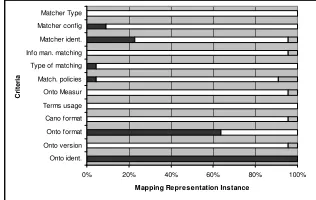
The third goal analyzed was: how mapping representa-tions instances support the sharing and reuse of previous mappings [7,8]. In particular we analyzed how the ontol-ogy mapping life cycle is documented. The first question was: what meta-data is supported to document the source and target ontologies (Q1). The first finding is that all mapping representations contain an ontology identifier, e.g. URI, file paths or labels. This is not surprising be-cause a basic requirement for any mappings is the ability to identify the source and target ontology. Furthermore, none of the analyzed representations provide any informa-tion on the version of the processed ontologies. This is quite odd because ontologies can be very dynamic (re-views, updates) and the validity of mappings must be checked for any new version of the ontology. For the processing and especially the applicability of automated matching algorithms it is important to know the ontology format. However, only 64 % of the representations pro-vide such information and in the majority the format can only be deduced by the file extension. This is ambiguous because “.owl” could indicate an OWL DL or OWL Full ontology, e.g. which is essential for a reasoning based matcher. Only the INRIA format [12] and the XML for-mat used by OMT explicitly specify the forfor-mat which is more appropriate for users and applications. None of the analyzed mapping representations contained information on the used canonical format, the terms usage as well as ontology measurements.
The second question is: how is the mapping phase documented (Q2)? It is important to understand how matching candidates were created to decide if a mapping can be reused. Most applications don’t provide any infor-mation on the applied matching policies. Only in FOAM [25], an individual classifier can be defined to model sim-ple matching policies. Considering information on the applied type of matcher we must note that only FOAM explicitly specifies if an automated or manual matching was applied. This is quite odd given the fundamental dif-ference between automatic and manual matching relating to quality and quantity [11,17]. In addition no representa-tions provided details on the manual matching process (e.g. who, when) which makes a validation almost impos-sible. On the other side at least 23 % of the mapping for-mats specified the applied matching algorithm but com-monly by a unambiguous labels, e.g. “Value Algorithm” in Ontobuilder. In common quite different parameters are used to configure automated matchers [11] and it is sur-prising that only 9 % of the representations specify the applied matcher configuration. Also none of the formats contain information on the specific type of automated matching algorithm, e.g. string or structure based.
0% 20% 40% 60% 80% 100%
Onto ident. Onto version Onto format Cano format Terms usage Onto Measur Match. policies Type of matching Info man. matching Matcher ident. Matcher config Matcher Type
C
ri
te
ri
a
[image:3.612.343.501.605.705.2]Mapping Representation Instance
The next question was: how is the mapping phase documented in the mapping representation? (Q3). Our results showed that most mapping representation instances don’t provide information on applied mapping policies. Only in MAFRA is it possible to define simple mapping conditions. In addition, most formats don’t provide infor-mation on pre-validated user mappings. Only the resentation used by FOAM provides an explicit link to pre-validated user mappings. Also no information is available on the context in which the mapping was created. This is especially problematic because many decisions made in the mapping life cycle are based on external factors and therefore the context is essential for a validation of map-pings. The majority of representations (59 %) provide a confidence level for each mapping pair. In common this is a normalized measure of the strength of the relation pro-vided by the applied matching methods [11]. However, it is problematic that no information is available about, how these individual ratios are calculated and should be inter-preted. Also the documentation of the applied mapping strategy is very limited. Only FOAM and RIMOM pro-vide a placeholder for a mapping strategy.
0% 20% 40% 60% 80% 100%
Q2 Map policies Q2 pre-vali maps. Q2 Map context Q2 Conf i. level Q2 Map. strategy
C
ri
te
ri
a
[image:4.612.117.260.289.367.2]Mapping Representation Instance
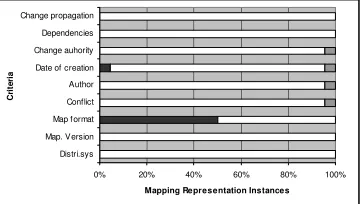
Fig. 2. Results for Q2 Documentation of Mapping Phase In conclusion we asked: how is the management phase documented in the mapping representation? (Q4). None of the analyzed mapping representations provided any in-formation on the distribution system and therefore it is difficult to find the newest version of the mappings. Also no information on the version of the mapping itself is pro-vided as well as no information on possible conflicts. Really surprising was that no representation contained information on the author or the date of creation. The only exception is RIMOM which at least stores a creation date but it is unclear how the value should be interpreted. To know which specific mapping format used is essential for processing, but only 50 % of the mapping representations instances explicitly specify their format. In addition none of the formats provide any information on the authority for changes, relevant dependencies or the method for change propagation. Overall this is a major problem be-cause it makes the management and sharing of mappings over time or in a different context challenging especially if the source and target ontologies evolve over time. As a result, current mapping phase relies on external change management and consistency systems.
0% 20% 40% 60% 80% 100%
Distri.sys Map. Version Map f ormat Conflict Author Date of creation Change auhority Dependencies Change propagation
C
ri
te
ri
a
Mapping Representation Instances
Fig. 3. Results for Q3 Documentation of Management Phase
The last question was: how is the interpretation of the meta-data supported? (Q4). Our data showed that the ma-jority of representations (> 73%) use URIs to identify elements in the mapping representation. However, URIs are commonly established but they are not consistently used in all implementations. Thus not always an unambi-guous identification is provided, e.g. only 68 % of the source and target ontologies are identified by a URI, the rest only by file paths and simple labels. In addition, in all mapping representations human-readable labels can be found which helps users to interpret the mapping repre-sentations. However, only 59 % of the applications pro-vide a documentation which is commonly very rudimen-tary. Also none of the URI’s refer to a explaining web resource.
IV. SUMMARY AND FUTURE WORK
In this paper we have presented an evaluation of ontol-ogy mapping representations. In summary, our evaluation revealed three insights. Firstly, when the heterogeneity of mapping use-cases [28] is considered, the level of sup-ported expressiveness in mapping applications and repre-sentations is still too low and can not be extended flexibly. The majority of representations support only equivalence relation and no complex mappings. This result is not sur-prising because most applications are designed as match-ing tools and their main purpose is the identification of equivalence relations. However, this study is limited to actual implementations but other more generic and ex-pressive mapping languages have been designed, e.g. C-OWL [29]. Such languages may be more powerful but they are not currently used or supported by tools.
Secondly, our evaluation showed that all phases of the ontology mapping lifecycle are very poorly documented and as a result management and reuse of mappings is in-sufficiently supported by current mapping representations. The lack of meta-data makes it impossible to identify the provenance of the mappings, the latest version of the mappings or the context in which they were created or used. Also disappointing is the common lack of sufficient documentation which makes correct and consistent inter-pretation of the representations difficult or impossible. Another disadvantage is that currently all meta-data is stored in single attributes only. However, most meta-data elements have a complex knowledge structure and a sim-plified model is not enough for a practical reuse, e.g. an authors name is not enough to contact him. Recently, so-phisticated technologies have been evolved to model complex meta-data, e.g. FOAF for contact details. Such common and established technologies are currently not used in mapping representations but could support the creation of richer knowledge models and interoperability of lifecycle meta-data.
[image:4.612.100.281.600.702.2]The reasons for this are the multitude of map-ping/matching approaches available, e.g. different match-ing algorithms, matchmatch-ing types etc. Each approach has unique requirements for mapping representation, simply because different information and structures need to be represented to express a correspondence. The design of a mapping representation which fulfils all those require-ments might be too complex or could lead to a format which represents only the smallest common denominator. For example INRIA is generic but, compared to proprie-tary formats (e.g. FOAM) less detailed. Multiple mapping representations may be unavoidable because for different mapping scenarios, different representations of the map-ping correlations are suitable. In contrast, meta-data which documents the mapping lifecycle is more uniform and for most correlation representations are available. As a result we propose that it is more beneficial to develop the con-cept of a flexible enrichment of existing and future ontol-ogy mapping representations in order to augment their usage, reuse and management. In particular, in an ontol-ogy based meta-layer a common vocabulary for modelling life-cycle meta-data could be established and linked to the individual formats representing mapping correlations [20]. Established mapping formats and tools don’t need to be changed but available meta-data can still be stored and retrieved in a structured, documented and predictable way. In conclusion, the remarkable efforts to support the creation of ontology mappings are just the first step. Fur-ther research is needed to develop more powerful concepts for the management, sharing and reuse of ontology map-pings to even begin to support the flexible communication of a common understanding of a domain at a scale large enough to control the overall information glut [1].
ACKNOWLEDGEMENTS
This work is partially funded through the Science Founda-tion Ireland FAME project (award No. 08/SRC/I1408).
REFERENCES
[1] Antoniou, G., van Harmelen, F., A Semantic Web Primer (Co-operative Information Systems),The MIT Press, 2004.
[2] Gruber, T. A, Transistional Approach to Portable Ontology Speci-fications, Knowledge Acquisition, 5, pp. 199-220, 1993. [3] Fensel, D., Ontologies Silver Bullet for Knowledge Management
and Electronic Commerce, 2nd edition, Berlin, 2003.
[4] Corcho, O. A declarative approach to ontology translation with knowledge preservation, Volume 116 Frontiers in A.I., 2005. [5] Euzenat, J., An API for ontology alignment, in: Proceedings of the
International Semantic Web Conference (ISWC 2004), Springer, Berlin, Germany, 2004. pp. 698-712.
[6] Pepijn, R. S. V., Dean, M. J., Bench-capon, T. J. M. , Shave, M., An analysis of ontological mismatches: Het-erogeneity versus in-teroperability, AAAI, Spring Sympo-sium on Ontological Engi-neering, Stanford, USA, 1997.
[7] Bouquet, P., Ehrig, M., Euzenat, J. et al., D2.2.1 Specification of a common framework for characterizing alignment, http://www.inrialpes.fr/exmo/cooperation/kweb/heterogeneity/deli /kweb-221.pdf, 2005.
[8] O’Sullivan, D., Wade, V., Lewis, D. Understanding as We Roam, in IEEE Internet Computing, 11, (2), 2007, p26 - 33 DOI: http://doi.ieeecomputersociety.org/10.1109/MIC.2007.50 [9] Hameed, A, Preece, A., Sleeman, D., Ontology Reconciliation,
Handbook of ontologies, in: Stabb S. and Suder R. (eds) Interna-tional Handbooks on Information Systems, Springer Verlag, Ber-lin, Germany, 2004, pp 31-250.
[10] Kalfoglou, Y., Schorlemmer, M. Ontology mapping: the state of the art. in The Knowledge Engineering Review, 18(1):1–31, 2003.
[11] Euzenat et al. D2.2.3: State of the art on ontology alignment, ftp://ftp.inrialpes.fr/pub/exmo/reports/kweb-223.pdf, 2004. E04b [12] Euzenat et al. D2.2.6: Specification of the delivery alignment
format, 2006. http://www.inrialpes.fr/exmo/cooperation/kweb/ heterogeneity/deli/kweb-226.pdf
[13] Shvaiko, P., Euzenat J., A Survey of Schema-based Matching Approaches, in DIT Technical Report DIT-04-87, 2004. [14] Noy, N., Semantic Integration A Survey of Ontology-Based
Ap-proaches, in Special Issue on Semantic Integra-tion, SIGMOD Re-cord, Volume 33, Issue 4, pages 65-70, December 2004.No04 [15] Basili, V. R., Caldiera, G., Rombach, H. D., Goal Question Metric
Approach, ftp://ftp.cs.umd.edu/pub/sel/papers/ gqm.pdf, 2000. [16] Thomas, H., O'Sullivan, D., Brennan, R.: Evaluation of Ontology
Mapping Representations. In: Workshop on Matching and Mean-ing, Edinburgh, 2009
[17] Falconer, S., Storey, M.-A., A cognitive support framework for ontology mapping. In Proc. of the 6th Int. Semantic Web Confer-ence, http://iswc2007.semanticweb.org/papers/113.pdf, 2007. [18] Maedche, A., Motik, B., Silva, N. et al. MAFRA - A MApping
FRAmework for Distributed Ontologies, in: Proc. of the 13th Int. Conf. on Knowledge Engineering and Knowledge Management. Ontologies and the Semantic Web, 2002, pp. 235 - 250. Ma02c [19] Aumüller, D. et al. Schema and Ontology Matching with
COMA++. In: Proc. of the ACM SIGMOD Int. Conference on Management of Data, 2005; pp. 906-908.
[20] Thomas, H., Redmann, T., Markscheffel, B. Controlled semantic tagging, in: Shoniregun, C. A., Logvynovskiy, A.: Proc. of the In-ternational Conference on Information Society, 2007, pp. 346-352. [21] Beigi, M., Calo, S., Verma, D., Policy Transformation Techniques in Policy-based Systems Management, in: Proc. of IEEE Policy 2004, NY, June 2004.
[22] Smith, B., Ontology and Information Systems, Lecture Text, http://ontology.buffalo.edu/ontology(PIC).pdf, 2000.
[23] Garshol, L.M., Moore, G. ISO/IEC JTC1/SC34, Information Technology, http://www.isotopicmaps.org/sam/sam-model/ (2006) [24] Wang,P.Xu,B.Lily.Proc.ofthe3rd
int.workshoponOntology Matching,08,http://dit.unitn.it/~p2p/OM2008/oaei08_paper7.pdf [25] Ehrig, M, Sure, Y. FOAM - Framework for Ontology Alignment
and Mapping; In: Ashpole, B, et al: Proceedings of the Workshop on Integrating Ontologies, volume 156, pp. 72-76. October 2005. [26] Euzenat J., An API for ontology alignment, Int. Semantic Web
Conference 2004, Springer, Berlin, Germany, 2004, pp 698-712. [27] Caracciolo, C., et al.Results of the Ontology Alignment
Evalua-tion Initiative 2008. Proc. 3rd
int. workshop on Ontology Matching, 2008. http://www.dit.unitn.it/~p2p/OM-008/oaei08_ paper0.pdf. [28] Giunchiglia, F., Shvaiko, P., Semantic matching, in: proc. of the
Workshop on ontologies & distributed systems,pp. 193-146, 2003. [29] Bouquet P. et al. C-OWL: Contextualization Ontologies. In proc.
of the 2nd
Semantic Web Conf. 2003, pp. 164-179
APPENDIX AOVERVIEW OF EVALUATED APPLICATIONS
Application Link
Alignment API http://alignapi.gforge.inria.fr/ Anchor-PROMPT http://protege.stanford.edu/plugins/
prompt/prompt.html
COMA++ http://dbs.uni-leipzig.de/Research/coma Context Matching
Algo-rithm (CtxMatch)
http://dit.unitn.it/~zanobini/ downloads.html
CROSI Mapping System http://www.aktors.org/crosi/ Falcon-AO http://iws.seu.edu.cn/projects/matching/
projects.jsp Framework for Ontology
Alignment & Mapping (FOAM)
http://www.aifb.uni-karlsruhe.de/ WBS/meh/foam/
Lily http://ontomappinglab.googlepages.com/ lily.htm
MAFRA http://mafra-toolkit.sourceforge.net MapOnto http://www.cs.toronto.edu/
semanticweb/maponto/
OntoBuilder http://iew3.technion.ac.il/OntoBuilder Ontology Mapping Tool s http://www.wsmx.org/