Original Article
Evaluation of the modified severity of obstetrical illness
scoring system for predicting the outcome of
critically ill obstetric patients
Jianrong Wang1*, Lixia Qi1*, Hui Gao2, Aihua Liu1
1Department of Obstetrics and Gynecology, Dongying People’s Hospital, Dongying, China; 2Department of
Hematology, Dongying People’s Hospital, Dongying, China. *Equal contributors.
Received October 29, 2015; Accepted February 29, 2016; Epub August 15, 2016; Published August 30, 2016
Abstract: Objective: To evaluate of the modified severity of obstetrical illness scoring system for predicting the
outcome of critically ill obstetric patients. Methods: A total of 165 critically ill obstetric patients were enrolled. The
modified severity of obstetrical illness score and acute physiology and chronic health evaluation (APACHE II) were
used to evaluate the severity of obstetrical illness. Deaths and organ dysfunctions were recorded. Results: Severity
of obstetrical illness scores of dead patients was significantly higher than survival patients and the higher scores indicated the higher death rate. Conclusion: The modified severity of obstetrical illness scoring system was efficient
on the evaluation of the severity of obstetrical illness and predicting the outcome of critically ill obstetric patients.
Keywords: Maternal, acute critical illness, APACHE II, multiple organ dysfunction syndrome
Introduction
The critically ill obstetric patients pose a num-ber of management problems to the intensive care physician. The physiological changes of pregnancy, diagnoses specific to the pregnant state and the presence of a fetus complicate their assessment and management. Outcome is influenced by the precipitous deterioration which can occur and the equally rapid recovery which may follow delivery. The need for accu-rate assessment of the severity of disease in critically ill obstetric patients would not only contribute to the assessment of the quality of patient care, but would also enhance risk strati-fication of pregnant women in the evaluation of new therapies.
Several severity of obstetrical illness scoring systems [1-3] can be used to predict the out-come of the critically ill obstetric patients [4-7], such as acute physiology and chronic health evaluation (APACHE II), simplified acute physiol -ogy score (SAPS II) and mortality probability models (MPM II). Although APACHE II was found to underestimate intensive care unit (ICU) ma-ternal mortality [8], it was the most commonly
used scoring system for predicting the outcome of critically ill obstetric patients at present. We modified APACHE II based on the features of obstetrics. In this study, we compared the effec-tiveness of APACHE II and the modified severity scoring of illness system in predicting the out-come of critically ill obstetric patients.
Methods
Patients
A total of 165 critically ill obstetric patients from January 2006 to December 2012 were enrolled in a retrospective study. The patients (age range 19-43 years; mean age 29.84±4.85 years) included 93 primiparas and 72 multipa-ras. The modified severity of obstetrical illness score and acute physiology and APACHE II were used to evaluate the severity of obstetrical ill-ness. Deaths and organ dysfunctions were re- corded.
Medical Association Declaration of Helsinki ethical principles and the study was approved by the local Ethics Committee.
Severity of obstetrical illness scoring system
APACHE II score was derived from 12 physiolog-ic measurements: temperature (T), mean arte-rial pressure (MAP), heart rate (HR), respiratory rate (RR), arterial pH, oxygenation, serum sodi-um (Na), sersodi-um potassisodi-um (K), and sersodi-um cre-atinine (Cr), hematocrit (HCT), white blood cell count (WBC), and Glasgow coma scale (GCS) score, in addition to the age and the chronic health status of the patients [9].
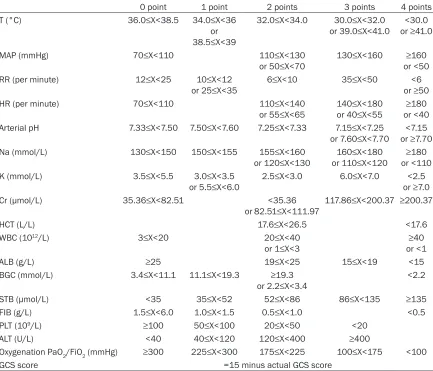
The modified severity of obstetrical illness scor -ing criteria was shown in Table 1. Eighteen physiological indexes were collected from the
patients to evaluate the severity of obstetrical illness, including T, MAP, RR, HR, arterial pH, Na, K, Cr, HCT, WBC, albumin (ALB), blood glu-cose concentration (BGC), serum total bilirubin (STB), plasma fibrinogen (FIB), platelet (PLT), alanine transaminase (ALT), oxygenation and GCS.
Statistical analysis
[image:2.612.90.523.85.456.2]SPSS 13.0 was used for statistical analysis. The continuous variables following normal dis-tribution were presented as mean ± SD (_x±s) and were compared using t test. The continu-ous variables of non-normal distribution were presented as median and interquartile range and compared using rank sum test. P<0.05 indicated significant differences.
Table 1. The modified severity of illness scoring criteria
0 point 1 point 2 points 3 points 4 points
T (°C) 36.0≤X<38.5 34.0≤X<36
or
38.5≤X<39
32.0≤X<34.0 30.0≤X<32.0
or 39.0≤X<41.0 or ≥41.0<30.0
MAP (mmHg) 70≤X<110 110≤X<130
or 50≤X<70 130≤X<160 or <50≥160
RR (per minute) 12≤X<25 10≤X<12
or 25≤X<35 6≤X<10 35≤X<50 or ≥50<6
HR (per minute) 70≤X<110 110≤X<140
or 55≤X<65 140≤X<180or 40≤X<55 or <40≥180 Arterial pH 7.33≤X<7.50 7.50≤X<7.60 7.25≤X<7.33 7.15≤X<7.25
or 7.60≤X<7.70 or ≥7.70<7.15
Na (mmol/L) 130≤X<150 150≤X<155 155≤X<160
or 120≤X<130 or 110≤X<120160≤X<180 or <110≥180
K (mmol/L) 3.5≤X<5.5 3.0≤X<3.5
or 5.5≤X<6.0 2.5≤X<3.0 6.0≤X<7.0 or ≥7.0<2.5 Cr (μmol/L) 35.36≤X<82.51 <35.36
or 82.51≤X<111.97 117.86≤X<200.37 ≥200.37
HCT (L/L) 17.6≤X<26.5 <17.6
WBC (1012/L) 3≤X<20 20≤X<40
or 1≤X<3 or <1≥40
ALB (g/L) ≥25 19≤X<25 15≤X<19 <15
BGC (mmol/L) 3.4≤X<11.1 11.1≤X<19.3 ≥19.3
or 2.2≤X<3.4 <2.2 STB (μmol/L) <35 35≤X<52 52≤X<86 86≤X<135 ≥135
FIB (g/L) 1.5≤X<6.0 1.0≤X<1.5 0.5≤X<1.0 <0.5
PLT (109/L) ≥100 50≤X<100 20≤X<50 <20
ALT (U/L) <40 40≤X<120 120≤X<400 ≥400
Oxygenation PaO2/FiO2 (mmHg) ≥300 225≤X<300 175≤X<225 100≤X<175 <100
GCS score =15 minus actual GCS score
T, temperature; MAP, mean arterial pressure; RR, respiratory rate; HR, heart rate; Na, serum sodium; K, serum potassium; Cr, serum creatinine; HCT, hematocrit; WBC, white blood cell count; ALB, albumin; BGC, blood glucose concentration; STB, serum
Results
Scores of dead patients were significantly higher than survival patients
Three patients died in this study and 162 patients survived. Scores of dead patients were significantly higher than survival patients no matter using APACHE II or the modified severity of obstetrical illness scoring system (P<0.01,
Table 2). It indicated that APACHE II and the modified severity of obstetrical illness scoring system were both effective methods to predict the death of critically ill obstetric patients.
The higher scores indicated the higher death rate
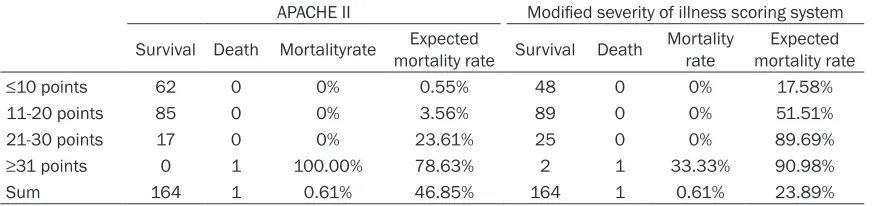
Critically ill obstetric patients with the higher scores would have the higher death rate either using APACHE II or the modified severity of obstetrical illness scoring system. Patients with more than 35 points of the modified severity of obstetrical illness score would have a death rate of 100%. Patients would 100% survival
85.33%, diagnostic efficiency (DE) was 0.8464 and diagnostic index (DI) was 169.79. Patients with more than 35 points of the modified sever -ity of obstetrical illness score would have a death rate of 100%. Patients would 100% sur-vival when their scores were less than 10 points.
The correlation of the modified severity of ob-stetrical illness scores and organ dysfunctions
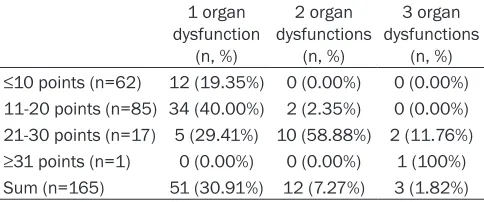
As the results in Table 5, critically ill obstetric patients with the modified severity of obstetri -cal illness scores between 21 and 30 points had higher risk of organ dysfunctions than patients with scores between 11 and 20 points (P<0.051). Critically ill obstetric patients whose scores were more than 31 points had higher risk of two organ dysfunctions (P<0.05) and three organ dysfunctions (P<0.01).
Discussion
[image:3.612.90.524.84.134.2]In this study, scores of dead patients were sig-nificantly higher than survival patients and the risk of death for critically ill obstetric patients
Table 2. The comparison of scores in different prognosis patients
Survival group (n=164) Dead group (n=1) t P
APACHE II 16.97±6.66 27.96±6.46 12.84 <0.01
Modified severity of illness scoring system 19.03±7.23 32.05±7.63 13.85 <0.01
[image:3.612.90.526.175.278.2]APACHE II, acute physiology and chronic health evaluation.
Table 3. The prognosis of patients with scores in the different ranges
APACHE II Modified severity of illness scoring system
Survival Death Mortalityrate mortality rate Survival DeathExpected Mortality rate mortality rateExpected
≤10 points 62 0 0% 0.55% 48 0 0% 17.58%
11-20 points 85 0 0% 3.56% 89 0 0% 51.51%
21-30 points 17 0 0% 23.61% 25 0 0% 89.69%
≥31 points 0 1 100.00% 78.63% 2 1 33.33% 90.98%
Sum 164 1 0.61% 46.85% 164 1 0.61% 23.89%
[image:3.612.88.398.352.417.2]APACHE II, acute physiology and chronic health evaluation.
Table 4. The sensitivity, specificity, false positive rate (FPR) and false negative rate (FNR) of the modified severity of illness scoring when us -ing different points as the cut-off value
35 points 31 points 26 points 21 points 16 points 10 points Sensitivity (%) 100.00 61.33 85.33 94.67 97.33 100.00
Specificity (%) 0.00 93.92 84.46 61.15 36.82 6.42
FPR (%) 0.00 6.08 15.54 38.85 63.18 93.58
FNR (%) 0.00 38.67 14.67 5.33 2.67 0.00
when their scores were less than 10 points (Ta- ble 3).
increased with the increase of severity of obstetrical illness scores. Our modified severi-ty of obstetrical illness scoring system could reflect the severity of obstetrical illness well, since the patients with higher scores had worse conditions and more risk of death. It could be applied to predicting the outcome of critically ill obstetric patients.
APACHE II was designed for ICU and it was effi -cient on the evaluation of the conditions of criti-cally ill patients. However, for patients in the special group APACHE II could not be very accu-rate to predict the outcome of patients [10]. Studies suggested that APACHE II was not effi -cient on predicting the outcome of some spe-cial cases, such as trauma patients, patients undergoing total parenteral nutrition, serious surgery patients, patients with acute myocardi-al infarction, patients with severe congestive heart failure and elderly patients. APACHE II was rarely used in critically ill obstetric patients [11]. Bhagwanjee et al. [12] found that APACHE II without GCS score had little value for predict-ing the outcome of patients with pre-eclam- psia.
Severe obstetric hemorrhage, placental abrup-tion, amniotic fluid embolism and gestational hypertension disease usually involved coagula-tion disorders. Indexes in the modified severity of obstetrical illness scoring system, such as FIB, PLT and HCT could reflect the coagulation of patients [13, 14].
Liver disease easily occurs in pregnancy, such as acute fatty liver of pregnancy, viral hepatitis in pregnancy and intrahepatic cholestasis of pregnancy. It might result in hepatic failure and a bad prognosis, imperiling patients’ lives [15]. STB, ALB and ALT would reflect the liver func -tion. The modified severity of obstetrical illness
evaluate the severity of obstetrical illness and predict the risk of death for critically ill obstetric patients quickly and accurately. It might help critically ill obstetric patients prevent the illness from becoming worse and reduce mortality. The modified severity of obstetrical illness scores had a close relation to the severity of illness. The critically ill obstetric patients with higher scores had worse conditions and more risk of death. Less than 10 points indicated that patients’ conditions were stable. Eleven to 20 points meant that changes of vital signs should be monitored for patients. Patients got 21 to 30 points should be admitted to senior ward or ICU and patients scored more than 26 points should receive multimodality therapy in ICU. When patients had scores more than 31, they would have a mortality risk of 78.63%. A critical condition notice might be issued, multi-modality treatment should be used, and the prevention and control of disseminated intra-vascular coagulation (DIC), shock and infection must be strengthen. More than 35 points pre-dicted an expected mortality rate of 98.99% and a critical condition notice should be issued, multimodality treatment should be used, and a contingency plan should be started.
In conclusion, the modified severity of obstetri -cal illness scoring system with 18 physiologi-cal indexes was efficient on the evaluation of the severity of obstetrical illness and predicting the outcome of critically ill obstetric patients.
Disclosure of conflict of interest
None.
[image:4.612.91.333.98.199.2]Address correspondence to: Jianrong Wang, De- partment of Obstetrics and Gynecology, Dongying People’s Hospital, No. 317, South First Road, Table 5. Organ dysfunctions of patients with scores in
the different ranges
1 organ dysfunction
(n, %)
2 organ dysfunctions
(n, %)
3 organ dysfunctions
(n, %)
≤10 points (n=62) 12 (19.35%) 0 (0.00%) 0 (0.00%) 11-20 points (n=85) 34 (40.00%) 2 (2.35%) 0 (0.00%) 21-30 points (n=17) 5 (29.41%) 10 (58.88%) 2 (11.76%)
≥31 points (n=1) 0 (0.00%) 0 (0.00%) 1 (100%) Sum (n=165) 51 (30.91%) 12 (7.27%) 3 (1.82%)
Dongying District, Dongying 257091, China. E-mail: [email protected]
References
[1] Knaus WA, Draper EA, Wagner DP and Zimmerman JE. APACHE II: a severity of
dis-ease classification system. Crit Care Med
1985; 13: 818-829.
[2] Le Gall JR, Lemeshow S and Saulnier F. A new
Simplified Acute Physiology Score (SAPS II)
based on a European/North American multi-center study. JAMA 1993; 270: 2957-2963. [3] Lemeshow S, Teres D, Klar J, Avrunin JS,
Gehlbach SH and Rapoport J. Mortality Pro- bability Models (MPM II) based on an interna-tional cohort of intensive care unit patients. JAMA 1993; 270: 2478-2486.
[4] Cerra FB, Negro F and Abrams J. APACHE II score does not predict multiple organ failure or mortality in postoperative surgical patients. Arch Surg 1990; 125: 519-522.
[5] Fedullo AJ, Swinburne AJ, Wahl GW and Bixby KR. APACHE II score and mortality in respira-tory failure due to cardiogenic pulmonary ede-ma. Crit Care Med 1988; 16: 1218-1221. [6] Godeau B, Boudjadja A, Dhainaut JF,
Schlemmer B, Chastang C, Brunet F and Le Gall JR. Outcome of patients with systemic rheumatic disease admitted to medical inten-sive care units. Ann Rheum Dis 1992; 51: 627-631.
[7] Schein M and Gecelter G. APACHE II score in massive upper gastrointestinal haemorrhage from peptic ulcer: prognostic value and poten-tial clinical applications. Br J Surg 1989; 76: 733-736.
[8] Lewinsohn G, Herman A, Leonov Y and Klinowski E. Critically ill obstetrical patients: outcome and predictability. Crit Care Med 1994; 22: 1412-1414.
[9] Johnson CD, Toh SK and Campbell MJ. Com- bination of APACHE-II score and an obesity score (APACHE-O) for the prediction of severe acute pancreatitis. Pancreatology 2004; 4: 1-6.
[10] Liu H, Wang Y, Xu Z, Chen D, Qiu G and She R.
Application of acute physiology and chronic health evaluation II for critically ill obstetric pa-tients admitted to CICU. Chin J Clin Obstet Gynecol 2005; 116: 428-431.
[11] Gilbert TT, Smulian JC, Martin AA, Ananth CV, Scorza W, Scardella AT and Critical Care Obstetric T. Obstetric admissions to the inten-sive care unit: outcomes and severity of ill-ness. Obstet Gynecol 2003; 102: 897-903. [12] Bhagwanjee S, Paruk F, Moodley J and Muckart
DJ. Intensive care unit morbidity and mortality from eclampsia: an evaluation of the Acute Physiology and Chronic Health Evaluation II score and the Glasgow Coma Scale score. Crit Care Med 2000; 28: 120-124.
[13] Main EK. Maternal mortality: new strategies for measurement and prevention. Curr Opin Obstet Gynecol 2010; 22: 511-516.
[14] Keizer JL, Zwart JJ, Meerman RH, Harinck BI, Feuth HD and van Roosmalen J. Obstetric in-tensive care admissions: a 12-year review in a tertiary care centre. Eur J Obstet Gynecol Reprod Biol 2006; 128: 152-156.