Proceedings of the 55th Annual Meeting of the Association for Computational Linguistics, pages 1701–1711 Vancouver, Canada, July 30 - August 4, 2017. c2017 Association for Computational Linguistics Proceedings of the 55th Annual Meeting of the Association for Computational Linguistics, pages 1701–1711
Vancouver, Canada, July 30 - August 4, 2017. c2017 Association for Computational Linguistics
Active Sentiment Domain Adaptation
Fangzhao Wu†, Yongfeng Huang†∗, and Jun Yan‡ †Department of Electronic Engineering, Tsinghua University
‡Microsoft Research Asia, Beijing, China
[email protected], [email protected], [email protected]
Abstract
Domain adaptation is an important techno-logy to handle domain dependence pro-blem in sentiment analysis field. Existing methods usually rely on sentiment classi-fiers trained in source domains. Howe-ver, their performance may heavily decline if the distributions of sentiment features in source and target domains have signifi-cant difference. In this paper, we propose an active sentiment domain adaptation ap-proach to handle this problem. Instead of the source domain sentiment classifiers, our approach adapts the general-purpose sentiment lexicons to target domain with the help of a small number of labeled samples which are selected and annota-ted in an active learning mode, as well as the domain-specific sentiment similarities among words mined from unlabeled sam-ples of target domain. A unified model is proposed to fuse different types of senti-ment information and train sentisenti-ment clas-sifier for target domain. Extensive expe-riments on benchmark datasets show that our approach can train accurate sentiment classifier with less labeled samples.
1 Introduction
Sentiment classification is widely known as a domain-dependent problem (Liu,2012;Pang and Lee,2008;Blitzer et al., 2007; Pan et al.,2010). This is because different domains usually have many different sentiment expressions. For exam-ple, “lengthy” and “boring” are popularly used in
Bookdomain to express negative sentiment. Ho-wever, they are rare inKitchen appliancedomain. Moreover, the same word or phrase may convey
∗Corresponding author.
different sentiments in different domains. For in-stance, “unpredictable” is frequently used to ex-press positive sentiment in Movie domain (e.g., “The plot of this movie is fun and unpredictable”). However, it tends to be used as a negative word inKitchen appliancedomain (e.g., “Even holding heat is unpredictable. It is just terrible!”). Thus, every domain has many domain-specific sentiment expressions, which cannot be captured by other domains. The performance of directly applying a general sentiment classifier or a sentiment classi-fier trained in other domains to target domain is usually suboptimal.
Since there are a large number of domains in user-generated content, it is impractical to ma-nually annotate enough samples for each dom-ain to trdom-ain an accurate domdom-ain-specific sentiment classifier. Thus, sentiment domain adaptation, which transfers the sentiment classifier trained in a source domain with sufficient labeled data to a target domain with no or scarce labeled data, has been widely studied (Blitzer et al.,2007;Pan et al.,
2010;He et al.,2011;Glorot et al.,2011). Existing sentiment domain adaptation methods are mainly based on transfer learning techniques. Many of them try to learn a new feature representation to augment or replace the original feature space in order to reduce the gap of sentiment feature distri-butions between source and target domains (Pan et al., 2010; Glorot et al., 2011). For example,
Blitzer et al.(2007) proposed to learn a latent re-presentation for domain-specific words from both source and target domains by using pivot features as bridge. The advantage of these methods is that no labeled data in target domain is needed. Howe-ver, when the distributions of sentiment features in source and target domains have significant diffe-rence, the performance of domain adaptation will heavily decline (Li et al., 2013). In some cases, the performance of adaptation is even lower than
that without adaptation, which is usually known as
negative transfer(Pan and Yang,2010).
In this paper, we propose an active sentiment domain adaptation approach to handle this pro-blem by incorporating both general sentiment in-formation and a small number of actively selected labeled samples from target domain. More specifi-cally, in our approach the general sentiment infor-mation extracted from sentiment lexicons is adap-ted to target domain using domain-specific senti-ment similarities among words. The general sen-timent information is regarded as a “background” domain to transfer. The word similarities are ex-tracted from unlabeled samples of target domain using both syntactic rules and co-occurrence pat-terns. Then we actively select and annotate a small number of informative samples from target dom-ain in an active learning manner. These labeled samples are incorporated into our approach to im-prove the performance of sentiment domain adap-tation. A unified model is proposed to incorporate different types of sentiment information to train sentiment classifier for target domain. Extensive experiments were conducted on benchmark data-sets. The experimental results show that our ap-proach can train accurate sentiment classifiers and reduce the manual annotation effort.
2 Related Work
2.1 Sentiment Domain Adaptation
Sentiment classification is well known as a highly domain-dependent task, and domain adaptation is widely studied in sentiment analysis field to handle this problem (Blitzer et al.,2007;Pan et al.,
2010;He et al.,2011;Glorot et al.,2011). Existing sentiment domain adaptation methods are mainly based on transfer learning technique (Pan and Yang,2010), where sentiment classifiers are trai-ned in one or multiple source domains with suf-ficient labeled samples, and then applied to target domain where there is no or only scarce labeled samples. In order to reduce the gap of sentiment feature distributions between source and target domains, many sentiment domain adaptation met-hods try to learn a new feature representation to augment or replace the original feature space. For example, Pan et al.(2010) proposed a sentiment domain adaptation method based on spectral fea-ture alignment (SFA) algorithm. They first manu-ally selected several domain-independent features and computed the associations between
domain-specific features and domain-independent featu-res. After that they built a bipartite graph where domain-independent and domain-specific featu-res were regarded as two types of nodes. Then domain-specific features were grouped into se-veral clusters using spectral clustering algorithm. These clusters were used to augment the original feature representations.Glorot et al.(2011) propo-sed a sentiment domain adaptation method bapropo-sed on a deep learning technique, i.e., Stacked Denoi-sing Autoencoders. They learned the parameters of neural networks using unlabeled samples from both source and target domains, and used the hid-den nodes of the neural networks as the latent fe-ature representations of both domains. Then they trained sentiment classifiers using source domain labeled data in this new feature space and app-lied it to target domain. The advantage of these sentiment domain adaptation methods is that they do not rely on the labeled data in target dom-ain. However, they have a common shortcoming, i.e., when the distributions of sentiment features in source and target domains have significant diffe-rence, the performance of domain adaptation will heavily decline (Li et al., 2013). In some cases,
negative transfermay happen (Blitzer et al.,2007;
Li et al., 2013), which means the performance of adaptation is worse than that without adapta-tion (Pan and Yang,2010). Different from many existing sentiment domain adaptation methods, in our approach we adapt the general sentiment in-formation in sentiment lexicons to target domain with the help of a small number of labeled samples which are selected and annotated in an active lear-ning mode. Since the sentiment words in general-purpose sentiment lexicons usually convey con-sistent sentiment polarities in different domains, and the actively selected labeled samples contain rich domain-specific sentiment information of tar-get domain, our approach can effectively reduce the risk of negative transfer.
The usefulness of labeled samples from target domain in sentiment domain adaptation has been observed by previous research works (Choi and Cardie, 2009; Chen et al., 2011;Li et al., 2013;
Wu et al.,2016). For example, Choi and Cardie
labeled samples used in these methods are rand-omly selected, while in our approach we actively select informative samples from target domain to annotate. Thus, our approach has the potential to reduce the manual annotation effort.
2.2 Active Learning
Active learning is a useful technique in scena-rios where unlabeled data is abundant but their labels are difficult or expensive to obtain (Tong and Koller, 2002;Settles, 2010). By actively se-lecting informative samples to label, active lear-ning can effectively reduce the annotation effort, and improve the classification performance with limited budget (Li et al., 2012). An important problem in active learning is how to evaluate the informativeness of unlabeled samples (Fu et al.,
2013). Different methods have been applied to se-lect informative samples, such as uncertainty sam-pling (Zhu et al.,2010;Yang et al.,2015), query-by-committee (Freund et al.,1997;Li et al.,2013) and so on. In our approach, uncertainty combined with density is used to measure the informative-ness of samples. A major difference between our approach and existing active learning methods is that in existing methods the parameters of the ini-tial classifier are either iniini-tialized as zero ( Cesa-Bianchi et al.,2006) or learned from a set of rand-omly selected samples (Settles,2010). In contrast, the initial sentiment classifier in our approach is constructed by adapting the general sentiment in-formation to target domain via the domain-specific sentiment similarities among words.
There are a few works that apply active learning methods to sentiment domain adaptation task (Rai et al., 2010; Li et al., 2013). For example, Rai et al.(2010) proposed an online active learning al-gorithm for sentiment domain adaptation. They started with a sentiment classifier trained on the labeled samples of a source domain. Then they sequentially selected informative samples in target domain to annotate with a probability positively related to classification uncertainty. The newly an-notated samples were used to update the sentiment classifier in an online learning manner. Li et al.
(2013) proposed another active learning method for cross-domain sentiment classification. In their method they trained two sentiment classifiers, one on the labeled samples of source domain, and the other one on the labeled samples of target domain. Then query-by-committee strategy was used to
se-lect the informative instances from target domain. Different from these methods, our approach does not rely on the labeled data of source domains. Instead, in our approach the general sentiment in-formation in sentiment lexicons is actively adapted to target domain, which usually has better genera-lization ability in various domains than the senti-ment classifier trained in a source domain. In ad-dition, our approach can incorporate the domain-specific sentiment similarities among words mined from unlabeled samples of target domain, which are not considered in these methods.
3 Active Sentiment Domain Adaptation
3.1 Notations
First we introduce several notations that will be used in remaining part of this paper. Denote the general sentiment information extracted from a general-purpose sentiment lexicon asp ∈ RD×1,
whereDis the vocabulary size. If theithword is
labeled as positive (or negative) in the sentiment lexicon, thenpi = +1(orpi = −1). Otherwise, pi = 0. Following many previous works in
senti-ment classification field (Blitzer et al.,2007;Pan et al.,2010), here we select linear classifier as sen-timent classifier, and denote the linear classifica-tion model as w ∈ RD×1. We use f(x
i, yi,w)
to represent the loss of classifying the ith
labe-led sample in target domain under the classifica-tion model w, where f is the classification loss
function,xi ∈ RD×1 is the feature vector of this
sample andyi is its sentiment label. In this paper
we focus on binary sentiment classification and
yi ∈ {+1,−1}. In addition, we select log loss for f. Thus,f(xi, yi,w) = log(1 + exp(−yiwTxi)).
Besides, we useS∈RD×Dto represent the
senti-ment similarities among words extracted from un-labeled samples of target domain.
addition, if two words are connected by adversa-tive conjunction “but” and have the same POS-tag, then they are assumed to have opposite sentiment polarities. DenoteSr ∈ RD×D as the sentiment
similarities extracted from unlabeled samples ac-cording to syntactic rules, and the similarity score between wordsiandjis defined as:
Sri,j=
Ns i,j−Ni,jo
Ns
i,j+Ni,jo +α1
, (1)
whereNi,js andNi,jo are the frequencies of words iandjhaving the same or opposite sentiments
re-spectively according to the syntactic rules, andα1
is a positive smoothing factor. If two words have much higher frequency of sharing the same senti-ment than opposite sentisenti-ments, then they will have a larger positive sentiment similarity score. Note thatSi,jr can be negative according to Eq. (1). Here
we focus on sentiment similarity rather than dissi-milarity, and set all the negative values in Sr to zero. The range ofSi,jr is[0,1].
The second type of sentiment similarities are extracted according to the co-occurrence patterns among words. It is inspired by the observation that words frequently co-occurring with each ot-her not only have a high probability to have simi-lar semantics, but also tend to share simisimi-lar senti-ments (Turney,2002;Velikovich et al.,2010; Yo-gatama and Smith, 2014;Tang et al., 2015; Ha-milton et al.,2016). In this paper, we compute the co-occurrence between words in the context of do-cument. DenoteDas the set of all documents, and
Ndi as the frequency of wordiappearing in
docu-mentd. Then, the sentiment similarity score
bet-ween wordsiandjbased on their co-occurrence patterns is defined as:
Sci,j= P
d∈Dmin{N
i d, Ndj} P
d∈Dmax{Ndi, N j d}+α2
, (2)
where α2 is a positive smoothing parameter. If
two words frequently co-occur with each other in many documents, then they will have a high sen-timent similarity score according to Eq. (2). The range of Sci,j is also [0,1]. Denote Sc ∈ RD×D
as the set of all sentiment similarities extracted ac-cording to co-occurrence patterns.
The sentiment similarities extracted according to syntactic rules are usually of high accuracy. However, their coverage is limited, because the word pairs detected by these syntactic rules are sparse. In contrast, the coverage of sentiment si-milarities extracted from co-occurrence patterns is
quite wide because document is a long context, while their accuracies are not as high as the simi-larities based on syntactic rules. Thus, we pro-pose to combine these two types of sentiment si-milarities to obtain a balance between accuracy and coverage. Denote S ∈ RD×D as the final sentiment similarities among words, and Si,j = θSi,jr + (1−θ)Si,jc , whereθ∈[0,1]is the combi-nation coefficient. In this paper we set θ to 0.5,
which means that we regard these two types of sentiment similarities as equally important.
3.3 Initial Sentiment Classifier Construction In this section, we introduce the construction of the initial sentiment classifier to start the active le-arning process. Existing active lele-arning methods usually randomly select a set of unlabeled sam-ples to annotate and then train the initial classifier on them (Settles,2010). However, these randomly selected samples may be redundant and not infor-mative enough. In this paper, we propose to build the initial sentiment classifier by adapting the ge-neral sentiment information to target domain via domain-specific sentiment similarities as follows:
w0= arg min
w −
D X
i=1
piwi+α D X
i=1
X
j6=i
Si,j(wi−wj)2,
(3) where w0 ∈ RD×1 is the initial sentiment
clas-sifier,α is a positive regularization coefficient,pi
is the prior sentiment polarity of word i in sen-timent lexicons, and Si,j is the sentiment
simila-rity score between words iandj. Eq. (3) is
mo-tivated by (Bengio et al.,2006), and the quadratic cost criterion is equivalent to label propagation. In Eq. (3),−PDi=1piwi means that if a wordiis
la-beled as a positive (or negative) word in a general-purpose sentiment lexicon, i.e.,pi>0(orpi<0),
then we constrain that its sentiment weight in the sentiment classifier is also positive (or negative). Otherwise, a penalty will be added to the objective function. In addition,PD
i=1
P
j6=iSi,j(wi−wj)2
“great” to “easy”. In this way, the general senti-ment information can be adapted to many domain-specific sentiment expressions in target domain.
3.4 Query Strategy
Active learning methods iteratively select the most informative instances to label and add them to the training set (Settles,2010). Thus, an important is-sue in these methods is how to measure the infor-mativeness of unlabeled samples. In this paper, we select classification uncertainty as the informative-ness measure, which has been proven effective in many active learning methods (Zhu et al., 2010;
Yang et al., 2015). Since we focus on binary sentiment classification and the classification loss function is log loss, the classification uncertainty of an unlabeled instancexis defined as:
U(x) = 1−
1−1 + exp(2−wTx)
, (4)
wherewis the linear sentiment classification mo-del. The range ofU(x)is[0,1]. If|wTx|is large, which means that current sentiment classifier is confident in classifying this instance, then the un-certainty ofx(i.e.,U(x)) will be low. If|wTx|is close to 0, then the sentiment classifier is very un-certain about this instance, probably because the sentiment expressions in this instance are not co-vered by current sentiment classifier, and the un-certainty of the instance x will be high. In this case, annotating this instance and adding it to the training set are beneficial, because it can provide the information of unknown sentiment expressions and has the potential to quickly improve the qua-lity of target domain sentiment classifier.
However, many researchers have found that un-labeled instances with high uncertainties can be outliers, whose labels are useless and even misle-ading (Settles,2010;Zhu et al.,2010). Thus, here we combine uncertainty with representativeness to avoid outliers. Density is proven to be an effective measure of representativeness in active learning methods (Zhu et al.,2010;Hajmohammadi et al.,
2015). Here we use thek-nearest neighbour based
density proposed by Zhu et al. (2010) as the re-presentativeness measure, which is formulated as:
D(x) = 1
k
X
xi∈N(x)
xTxi
kxk2· kxik2
, (5)
whereN(x)is the set ofkmost similar instances
ofx. The final informativeness score of an unlabe-led sample is a linear combination of uncertainty
and density which is formulated as follows:
I(x) =η(t)U(x) + (1−η(t))D(x), (6)
where η(t) ∈ [0,1] is the combination coeffi-cient at thetth iteration. In this paper, we select
a monotonically increasing function forη(t), i.e.,
η(t) = 1
1+exp(2−4Tt)
, whereT is the total number
of iterations. It means that at initial iterations we put more emphasis on instances with high repre-sentativeness, because the initial sentiment classi-fier built by adapting the general sentiment infor-mation via the domain-specific sentiment simila-rities is relatively weak, and we prefer to select instances with more popular sentiment expressi-ons to annotate. As more and more labeled sam-ples are added to the training set and the sentiment classifier becomes stronger, we gradually focus on more difficult instances, i.e., those having higher classification uncertainty scores.
3.5 Active Domain Adaptation
domain-specific sentiment similaritiesSas follows:
arg min
w −
D X
i=1
piwi+α D X
i=1
X
j6=i
Si,j(wi−wj)2
+β X
xi∈L
log(1 + exp(−yiwTxi)) +λkwk22,
(7)
where α, β, and λ are nonnegative coefficients.
By the term −PDi=1piwi we constrain that the
target domain sentiment classifier learned by our approach is consistent with the general sentiment information. Through this way, the general sen-timent information extracted from sensen-timent lex-icons can be adapted to target domain. The term PD
i=1
P
j6=iSi,j(wi−wj)2 is motivated by label
propagation (Bengio et al., 2006). If two words tend to have high sentiment similarity with each other according to many unlabeled samples of tar-get domain, then we constrain that their senti-ment weights in the target domain sentisenti-ment clas-sifier are also similar. The term Pxi∈Llog(1 + exp(−yiwTxi))means that we hope to minimize
the empirical classification loss on labeled sam-ples of target domain. By this term the sentiment information in the labeled samples is incorporated into the learning of target domain sentiment clas-sifier. TheL2-norm regularization term is
introdu-ced to control model complexity. The sentiment classifier trained in Eq. (7) is further used at the next iteration of active sentiment domain adapta-tion until all the budget of manual annotaadapta-tion has been used. Then we obtain the final sentiment classifier of target domain. The complete algo-rithm of our active sentiment domain adaptation (ASDA) approach is summarized in Algorithm1.
Algorithm 1Active sentiment domain adaptation. 1: Input:The set of unlabeled samplesU, the general sen-timent informationp, the domain-specific sentiment si-milaritiesS, and the total annotation budgetN. 2: Output:Target domain sentiment classifierw. 3: Train the initial sentiment classifierw0(Eq. (3)).
4: Compute the density of each samplexiinU(Eq. (5)).
5: Initialize the set of labeled samplesL=∅, the iteration numbert= 0, and the sentiment classifierw=w0.
6: whilet < Ndo 7: t=t+ 1.
8: Compute the uncertainty score of each samplexi
inU(Eq. (4)).
9: Compute the informativeness score of each sample xiinU(Eq. (6)).
10: Selectx∗fromUwhich has the highest informati-veness score.
11: Annotatex∗and obtain its sentiment labely. 12: L=L+{x∗, y}, U=U −x∗.
13: Update sentiment classifierwaccording to Eq. (7). 14: end while
4 Experiments
4.1 Datasets
The dataset used in our experiments is the Amazon product review dataset1collected byBlitzer et al.
(2007), which is widely used in sentiment analysis and domain adaptation research (Pan et al.,2010;
Bollegala et al.,2011). This dataset contains pro-duct reviews in four domains, i.e., Book, DVD,
Electronics, andKitchen appliances. In each dom-ain, 1,000 positive and 1,000 negative reviews as well as a large number of unlabeled samples are included. The detailed statistics of this dataset are summarized in Table1.
Book DVD Electronics Kitchen positive 1,000 1,000 1,000 1,000 negative 1,000 1,000 1,000 1,000 unlabeled 973,194 122,438 21,009 17,856
Table 1: The statistics of the Amazon dataset.
Following many previous works (Blitzer et al.,
2007; Bollegala et al., 2011), unigrams and bi-grams were used to build feature vectors in our experiments. We randomly split the labeled sam-ples in each domain into two parts with equal size. The first part was used as test data, and the second part was used as the pool of “unlabeled” samples to perform active learning. The general sentiment information was extracted from Bing Liu’s senti-ment lexicon2(Hu and Liu,2004), which is one of
the state-of-the-art general-purpose sentiment lex-icons. The domain-specific sentiment similarities among words were extracted from the large-scale unlabeled samples. The total number of samples actively selected by our approach to annotate was set to 100. The values ofα,β, andλwere set to
0.1, 1, and 1 respectively. We repeated each ex-periment 10 times independently and the average results were reported.
4.2 Algorithm Effectiveness
First we conducted several experiments to explore the effectiveness of our active sentiment domain adaptation (ASDA) approach. We hope to answer two questions via these experiments: 1) whether the domain-specific sentiment similarities among words mined from unlabeled samples of target
1https://www.cs.jhu.edu/˜mdredze/ datasets/sentiment/
Book DVD Electronics Kitchen 0.5
0.55 0.6 0.65 0.7 0.75 0.8 0.85
Accuracy
Lexicon Lexicon+SentiSim Lexicon+SentiSim+Label
Figure 1: The performance of our approach with different combinations of sentiment informa-tion. Lexicon, SentiSim, and Label represent the general-purpose sentiment lexicon, the domain-specific sentiment similarities among words, and a small number of actively selected and annotated samples in target domain respectively.
domain are useful for adapting the general senti-ment information to target domain; 2) whether a small number of samples which are actively se-lected and annotated in target domain can help improve the domain adaptation performance. In our experiments, we implemented different versi-ons of ourASDAapproach using different combi-nations of sentiment information. The first one is
Lexicon, which means only using the general sen-timent information and no domain adaptation is conducted. It serves as a baseline. The second one isLexicon+SentiSim, which means adapting gene-ral sentiment information to target domain using domain-specific sentiment similarities, but labe-led samples of target domain are not incorporated. The third one isLexicon+SentiSim+Label, which is the completeASDAapproach. The experimental results are summarized in Fig.1.
According to Fig.1, the performance ofLexicon
is suboptimal. This is because the general senti-ment lexicons cannot capture the domain-specific sentiment expressions in target domain (Choi and Cardie,2009). Lexicon+SentiSimperforms signi-ficantly better than Lexicon, which validates that the sentiment similarities among words extracted from unlabeled samples of target domain contain rich domain-specific sentiment information, and can help propagate the general sentiment informa-tion to many domain-specific sentiment expressi-ons. Besides, after incorporating a small number of labeled samples which are actively selected and annotated by our approach in an active learning mode, the performance of our sentiment
dom-Book DVD Electronics Kitchen
0.7 0.75 0.8 0.85
Accuracy
[image:7.595.339.490.68.184.2]ASDA_Random ASDA_Constant ASDA_Dynamic
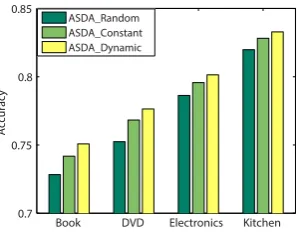
Figure 2: The performance of our approach with labeled samples selected by different strategies.
ain adaptation approach is significantly improved. This is because although these labeled samples are in limited size and cannot cover all the sentiment expressions in target domain, they can provide sentiment information of popular domain-specific sentiment expressions, which can be propagated to other sentiment expressions in target domain du-ring the domain adaptation process. Thus, above experimental results validate the effectiveness of our approach.
We also conducted several experiments to ve-rify the advantage of the actively selected samples over randomly selected samples and validate the effectiveness of our active learning algorithm. We also compared the dynamic weighting scheme for combining uncertainty and density with the con-stant weighting scheme. The experimental results are summarized in Fig.2. According to Fig.2, our approach with actively selected samples performs better than that with randomly selected samples. It indicates that these actively selected samples are more informative than randomly selected samples for sentiment domain adaptation. In addition, our approach with dynamic weighting scheme in com-bining uncertainty and density outperforms that with constant weighting scheme, which implies that it is beneficial to emphasize representative samples at initial iterations and gradually focus on difficult samples at later iterations. Thus, the ex-perimental results validate the effectiveness of our active learning algorithm.
4.3 Performance Evaluation
[image:7.595.103.255.71.184.2]i.e., MPQA (Wilson et al.,2005) and Bing Liu’s lexicon (Hu and Liu, 2004) for sentiment clas-sification following the suggestions in (Hu and Liu, 2004); 2) SVM, LS, and LR, three popular supervised sentiment classification methods, i.e., support vector machine (Pang et al., 2002), le-ast squares (Hu et al., 2013) and logistic regres-sion (Wu et al.,2015); 3)ZIAL, the zero initiali-zed active learning method (Cesa-Bianchi et al.,
2006); 4) LIAL, the active learning method ini-tialized by randomly selected labeled data ( Sett-les,2010); 5)SCLandSFA, two famous sentiment domain adaptation methods proposed in (Blitzer et al.,2007) and (Pan et al.,2010) respectively; 6)
ILP, adapting sentiment lexicons to target domain via integer linear programming (Choi and Cardie,
2009); 7)AODA, the active online domain adapta-tion method (Rai et al.,2010); 8)ALCD, the active learning method for cross-domain sentiment clas-sification (Li et al., 2013); 9) ASDA, our active sentiment domain adaptation approach. For above methods, if labeled target domain samples are nee-ded in training, the number of labeled samples was set to 100, and if source domain labeled samples are needed in training, the number of labeled sam-ples was set to 1,000. The parameters in baseline methods were tuned via cross-validation. The ex-perimental results are summarized in Table2.
Book DVD Electronics Kitchen Acc Fscore Acc Fscore Acc Fscore Acc Fscore MPQA 0.5953 0.5673 0.6149 0.5936 0.6150 0.6070 0.6392 0.6258 BingLiu 0.6015 0.6048 0.6539 0.6604 0.6248 0.6320 0.6765 0.6930 SVM 0.6580 0.6511 0.6688 0.6652 0.7138 0.7129 0.7386 0.7412 LS 0.6543 0.6542 0.6692 0.6687 0.7194 0.7185 0.7479 0.7465 LR 0.6606 0.6582 0.6774 0.6742 0.7257 0.7226 0.7492 0.7480 RIAL 0.6693 0.6663 0.6850 0.6821 0.7310 0.7299 0.7574 0.7568 LIAL 0.6756 0.6731 0.6866 0.6838 0.7374 0.7360 0.7599 0.7595 SCL 0.7233 0.7201 0.7469 0.7438 0.7768 0.7730 0.8099 0.8095 SFA 0.7307 0.7285 0.7513 0.7485 0.7846 0.7812 0.8174 0.8153 ILP 0.6942 0.6931 0.7153 0.7124 0.7463 0.7445 0.7793 0.7768 AODA 0.6928 0.6912 0.7172 0.7165 0.7518 0.7512 0.7698 0.7690 ALCD 0.7237 0.7221 0.7369 0.7364 0.7768 0.7788 0.7979 0.7970 ASDA 0.7508 0.7501 0.7764 0.7759 0.8014 0.8011 0.8329 0.8328
Table 2: Sentiment classification performance of different methods in different domains. Acc and
Fscore represent accuracy and macro-averaged Fscore respectively.
According to Table 2, the performance of di-rectly applying sentiment lexicons to target dom-ain is suboptimal. This is because there are many domain-specific sentiment expressions that are not covered by these general-purpose sentiment lex-icons (Choi and Cardie, 2009). In addition, the performance of supervised sentiment classifica-tion methods such as SVM, LS, and LR is also
200 400 600 800 1000 0.65
0.7 0.75 0.8 0.85
Number of labeled samples
Accuracy
[image:8.595.338.485.68.184.2]ASDA SVM
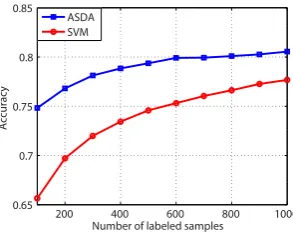
Figure 3: The performance of ASDA and SVM
with different numbers of labeled samples.
limited, because the labeled samples for training are extremely scarce. The active learning met-hods such asZIAL(Cesa-Bianchi et al.,2006) and
LIAL(Settles,2010) perform relatively better, be-cause they can actively select informative samples to annotate and learn. Our approach can outper-form both of them. This is because besides the labeled samples, our approach also adapts the ge-neral sentiment information in sentiment lexicons to target domain and incorporates it into the le-arning of target domain sentiment classifier. Our approach also performs better than state-of-the-art domain adaptation methods such as SCL(Blitzer et al., 2007) and SFA (Pan et al., 2010). It im-plies that a small number of actively selected la-beled samples from target domain are beneficial for sentiment domain adaptation. ILP(Choi and Cardie, 2009) tries to adapt a sentiment lexicon to target domain, which is similar with our ap-proach. ILPrelies on labeled samples to extract the relations among words and relations between words and sentiment expressions. However, labe-led samples in target domain are usually limited and the sentiment information in many unlabeled samples is not exploited inILP. Thus, our appro-ach can outperform it. Similar with our approappro-ach,
−4 −3 −2 −1 0 0.72
0.74 0.76 0.78 0.8 0.82 0.84
log10(α)
Accuracy
Kitchen Electronics DVD Book
(a) Parameterα.
−2 −1.5 −1 −0.5 0 0.5 1 0.7
0.75 0.8 0.85
log10(β)
Accuracy
Kitchen Electronics DVD Book
[image:9.595.80.282.72.161.2](b) Parameterβ.
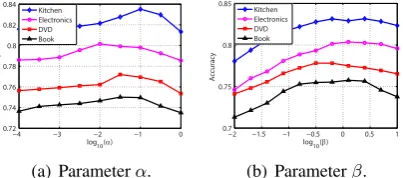
Figure 4: The influence of the parameter settings ofαandβon the performance of our approach.
We further conducted several experiments to validate the advantage of our approach in trai-ning accurate sentiment classifier for target dom-ain with only a few labeled samples. We varied the annotation budget, i.e., the number of labeled sam-ples, from 100 to 1,000. The learning curve of our
ASDAapproach inBookdomain is shown in Fig.3. We also included a purely supervised sentiment classification method, i.e.,SVM, in Fig.3as a ba-seline for comparison. Fig.3shows that ourASDA
approach can consistently outperformSVM when the same number of labeled samples are used. The performance advantage of our approach is more significant when labeled samples are scarce. For example, the performance of our approach with only 200 labeled samples is similar toSVM with more than 800 labeled samples. Thus, the expe-rimental results validate that by adapting the ge-neral sentiment information to target domain and selecting the most informative samples to annotate and learn, our approach can effectively reduce the manual annotation effort, and can train accurate sentiment classifier for target domain with much less labeled samples.
4.4 Parameter Analysis
In this section, we conducted several experiments to explore the influence of parameter settings on the performance of our approach. αandβare the
two most important parameters in our approach, which control the relative importance of domain-specific sentiment similarities and the actively se-lected samples in training sentiment classifier for target domain. The experimental results of para-metersαandβare summarized in Fig.4.
According to Fig. 4, when α and β are too
small, the performance of our approach is not op-timal. This is because the useful sentiment infor-mation in domain-specific sentiment similarities mined from unlabeled samples and the actively
selected labeled samples of target domain is not fully exploited. Thus, the performance of our ap-proach improves when these parameters increase from a small value. However, when these para-meters become too large, the performance of our approach starts to decline. This is because when
β is too large the sentiment classifier learned by
our approach is mainly decided by the limited la-beled samples, and the general sentiment informa-tion extracted from sentiment lexicons is not fully exploited. When α is too large, the information
in domain-specific sentiment similarities is over-emphasized, and many different words will have nearly the same sentiment weights. Thus, the per-formance of our approach in these scenarios is also not optimal. A moderate value ofαandβis most
suitable for our approach.
5 Conclusion
In this paper we present an active sentiment dom-ain adaptation approach to trdom-ain accurate senti-ment classifier for target domain with less labe-led samples. In our approach, the general senti-ment information in sentisenti-ment lexicons is adapted to target domain with the help of a small number of labeled samples which are selected and anno-tated in an active learning mode. Both classifica-tion uncertainty and density are considered when selecting informative samples to label. In addi-tion, we extract domain-specific sentiment simila-rities among words from unlabeled samples of tar-get domain based on both syntactic rules and co-occurrence patterns, and incorporate them into the domain adaptation process to propagate the gene-ral sentiment information to many domain-specific sentiment words in target domain. We also pro-pose a unified model to incorporate different types of sentiment information to train sentiment clas-sifier for target domain. Experimental results on benchmark datasets show that our approach can train accurate sentiment classifier and at same time reduce the manual annotation effort.
Acknowledgements
References
Yoshua Bengio, Olivier Delalleau, and Nicolas Le Roux. 2006. Label propagation and quadratic
criterion. Semi-supervised learning10.
John Blitzer, Mark Dredze, Fernando Pereira, et al.
2007. Biographies, bollywood, boom-boxes and
blenders: Domain adaptation for sentiment clas-sification. In ACL. volume 7, pages 440–447.
http://aclweb.org/anthology-new/P/P07/P07-1056.
Danushka Bollegala, David Weir, and John Carroll.
2011. Using multiple sources to construct a
sen-timent sensitive thesaurus for cross-domain senti-ment classification. InACL:HLT. pages 132–141.
http://aclweb.org/anthology/P11-1014.
Nicolo Cesa-Bianchi, Claudio Gentile, and Luca Zani-boni. 2006. Worst-case analysis of selective
sam-pling for linear classification. Journal of Machine
Learning Research7(Jul):1205–1230.
Minmin Chen, Kilian Q Weinberger, and John Blitzer.
2011. Co-training for domain adaptation. InNIPS.
pages 2456–2464.
Yejin Choi and Claire Cardie. 2009.
Adap-ting a polarity lexicon using integer linear programming for domain-specific sentiment classification. In EMNLP. pages 590–598.
http://aclweb.org/anthology/D09-1062.
Yoav Freund, H. Sebastian Seung, Eli Shamir,
and Naftali Tishby. 1997. Selective
sam-pling using the query by committee algo-rithm. Machine Learning 28(2-3):133–168.
http://dx.doi.org/10.1023/A:1007330508534.
Yifan Fu, Xingquan Zhu, and Bin Li. 2013. A
sur-vey on instance selection for active learning. Kno-wledge and Information Systems 35(2):249–283.
https://doi.org/10.1007/s10115-012-0507-8.
Xavier Glorot, Antoine Bordes, and Yoshua Bengio. 2011. Domain adaptation for large-scale sentiment
classification: A deep learning approach. InICML.
pages 513–520.
Mohammad Sadegh Hajmohammadi, Roliana Ibrahim,
Ali Selamat, and Hamido Fujita. 2015. Combination
of active learning and self-training for cross-lingual sentiment classification with density analysis of un-labelled samples. Information sciences317:67–77.
http://dx.doi.org/10.1016/j.ins.2015.04.003.
William L. Hamilton, Kevin Clark, Jure
Le-skovec, and Dan Jurafsky. 2016. Inducing
domain-specific sentiment lexicons from un-labeled corpora. In EMNLP. pages 595–605.
http://aclweb.org/anthology/D/D16/D16-1057.
Vasileios Hatzivassiloglou and Kathleen R
McKe-own. 1997. Predicting the semantic
orienta-tion of adjectives. In ACL. pages 174–181.
http://aclweb.org/anthology/P/P97/P97-1023.
Yulan He, Chenghua Lin, and Harith Alani. 2011.
Automatically extracting polarity-bearing topics for cross-domain sentiment classification. InACL:HLT.
pages 123–131.
http://aclweb.org/anthology/P11-1013.
Minqing Hu and Bing Liu. 2004. Mining and
summa-rizing customer reviews. InKDD. pages 168–177.
http://doi.acm.org/10.1145/1014052.1014073.
Xia Hu, Lei Tang, Jiliang Tang, and Huan Liu. 2013.
Exploiting social relations for sentiment analysis in microblogging. In WSDM. pages 537–546.
http://doi.acm.org/10.1145/2433396.2433465.
Sheng Huang, Zhendong Niu, and Chongyang Shi.
2014. Automatic construction of domain-specific
sentiment lexicon based on constrained label pro-pagation. Knowledge-Based Systems 56:191–200.
http://dx.doi.org/10.1016/j.knosys.2013.11.009.
Lianghao Li, Xiaoming Jin, Sinno Jialin Pan, and
Jian-Tao Sun. 2012. Multi-domain active learning
for text classification. InKDD. pages 1086–1094.
http://doi.acm.org/10.1145/2339530.2339701.
Shoushan Li, Yunxia Xue, Zhongqing Wang, and Guo-dong Zhou. 2013. Active learning for cross-domain
sentiment classification. In IJCAI. pages 2127–
2133.
Bing Liu. 2012. Sentiment analysis and opinion
mi-ning. Synthesis Lectures on Human Language
Technologies5(1):1–167.
Sinno Jialin Pan, Xiaochuan Ni, Jian-Tao Sun,
Qi-ang YQi-ang, and Zheng Chen. 2010.
Cross-domain sentiment classification via spectral fea-ture alignment. In WWW. ACM, pages 751–760.
http://doi.acm.org/10.1145/1772690.1772767.
Sinno Jialin Pan and Qiang Yang. 2010. A survey
on transfer learning. TKDE 22(10):1345–1359.
http://dx.doi.org/10.1109/TKDE.2009.191.
Bo Pang and Lillian Lee. 2008. Opinion
mi-ning and sentiment analysis. Foundations and trends in information retrieval 2(1-2):1–135.
http://dx.doi.org/10.1561/1500000011.
Bo Pang, Lillian Lee, and Shivakumar Vaithyanathan.
2002. Thumbs up?: sentiment classification using
machine learning techniques. InEMNLP. pages 79– 86.https://doi.org/10.3115/1118693.1118704.
Piyush Rai, Avishek Saha, Hal Daum´e III, and
Su-resh Venkatasubramanian. 2010. Domain
adap-tation meets active learning. In Proceedings of the NAACL HLT 2010 Workshop on Active Lear-ning for Natural Language Processing. pages 27– 32.http://aclweb.org/anthology/W10-0104.
Burr Settles. 2010. Active learning literature survey.
Jian Tang, Meng Qu, and Qiaozhu Mei.
2015. Pte: Predictive text embedding
through large-scale heterogeneous text net-works. In KDD. ACM, pages 1165–1174.
http://doi.acm.org/10.1145/2783258.2783307.
Simon Tong and Daphne Koller. 2002.
Sup-port vector machine active learning with ap-plications to text classification. The Jour-nal of Machine Learning Research 2:45–66.
http://dx.doi.org/10.1162/153244302760185243.
Peter D Turney. 2002. Thumbs up or thumbs down?:
semantic orientation applied to unsupervised clas-sification of reviews. In ACL. pages 417–424.
http://dx.doi.org/10.3115/1073083.1073153.
Leonid Velikovich, Sasha Blair-Goldensohn, Kerry
Hannan, and Ryan McDonald. 2010. The viability
of web-derived polarity lexicons. InNAACL. pages
777–785.
http://www.aclweb.org/anthology/N10-1119.
Theresa Wilson, Janyce Wiebe, and Paul Hoffmann.
2005. Recognizing contextual polarity in
phrase-level sentiment analysis. In EMNLP. pages 347– 354. http://dx.doi.org/10.3115/1220575.1220619.
Fangzhao Wu and Yongfeng Huang. 2016. Sentiment
domain adaptation with multiple sources. In ACL.
pages 301–310.
http://aclweb.org/anthology/P16-1029.
Fangzhao Wu, Yangqiu Song, and Yongfeng Huang. 2015. Microblog sentiment classification with
con-textual knowledge regularization. In AAAI. pages
2332–2338.
Fangzhao Wu, Sixing Wu, Yongfeng Huang,
Son-gfang Huang, and Yong Qin. 2016. Sentiment
domain adaptation with multi-level contextual sen-timent knowledge. InCIKM. ACM, pages 949–958.
https://doi.org/10.1145/2983323.2983851.
Yi Yang, Zhigang Ma, Feiping Nie, Xiaojun Chang, and Alexander G. Hauptmann. 2015.
Multi-class active learning by uncertainty sam-pling with diversity maximization. Internatio-nal JourInternatio-nal of Computer Vision 113(2):113–127.
http://dx.doi.org/10.1007/s11263-014-0781-x.
Dani Yogatama and Noah A. Smith. 2014. Making the most of bag of words: Sentence regularization with alternating direction method of multipliers. In
ICML. pages 656–664.
Jingbo Zhu, Huizhen Wang, Benjamin K Tsou,
and Matthew Ma. 2010. Active learning with
sampling by uncertainty and density for data an-notations. IEEE Transactions on Audio, Speech, and Language Processing 18(6):1323–1331.