Document-Wide Decoding for
Phrase-Based Statistical Machine Translation
Christian Hardmeier Joakim Nivre J¨org Tiedemann Uppsala University
Department of Linguistics and Philology Box 635, 751 26 Uppsala, Sweden [email protected]
Abstract
Independence between sentences is an as-sumption deeply entrenched in the models and algorithms used for statistical machine trans-lation (SMT), particularly in the popular dy-namic programming beam search decoding al-gorithm. This restriction is an obstacle to re-search on more sophisticated discourse-level models for SMT. We propose a stochastic lo-cal search decoding method for phrase-based SMT, which permits free document-wide de-pendencies in the models. We explore the sta-bility and the search parameters of this method and demonstrate that it can be successfully used to optimise a document-level semantic language model.
1 Motivation
In the field of translation studies, it is undisputed that discourse-wide context must be considered care-fully for good translation results (Hatim and Mason, 1990). By contrast, the state of the art in statistical machine translation (SMT), despite significant ad-vances in the last twenty years, still assumes that texts can be translated sentence by sentence under strict independence assumptions, even though it is well known that certain linguistic phenomena such as pronominal anaphora cannot be translated cor-rectly without referring to extra-sentential context. This is true both for the phrase-based and the syntax-based approach to SMT. In the rest of this paper, we shall concentrate on phrase-based SMT.
One reason why it is difficult to experiment with document-wide models for phrase-based SMT is that the dynamic programming (DP) algorithm
which has been used almost exclusively for decod-ing SMT models in the recent literature has very strong assumptions of locality built into it. DP beam search for phrase-based SMT was described by Koehn et al. (2003), extending earlier work on word-based SMT (Tillmann et al., 1997; Och et al., 2001; Tillmann and Ney, 2003). This algorithm con-structs output sentences by starting with an empty hypothesis and adding output words at the end until translations for all source words have been gener-ated. The core models of phrase-based SMT, in par-ticular the n-gram language model (LM), only de-pend on a constant number of output words to the left of the word being generated. This fact is ex-ploited by the search algorithm with a DP technique calledhypothesis recombination(Och et al., 2001), which permits the elimination of hypotheses from the search space if they coincide in a certain number of final words with a better hypothesis and no future expansion can possibly invert the relative ranking of the two hypotheses under the given models. Hypoth-esis recombination achieves a substantial reduction of the search space without affecting search optimal-ity and makes it possible to use aggressive pruning techniques for fast search while still obtaining good results.
The downside of this otherwise excellent ap-proach is that it only works well with models that have a local dependency structure similar to that of an n-gram language model, so they only de-pend on a small context window for each target word. Sentence-local models with longer dependen-cies can be added, but doing so greatly increases the risk for search errors by inhibiting hypothesis recombination. Cross-sentence dependencies can-not be directly integrated into DP SMT decoding in
any obvious way, especially if joint optimisation of a number of interdependent decisions over an entire document is required. Research into models with a more varied, non-local dependency structure is to some extent stifled by the difficulty of decoding such models effectively, as can be seen by the problems some researchers encountered when they attempted to solve discourse-level problems. Consider, for in-stance, the work on cache-based language models by Tiedemann (2010) and Gong et al. (2011), where error propagation was a serious issue, or the works on pronominal anaphora by Le Nagard and Koehn (2010), who implemented cross-sentence dependen-cies with an ad-hoc two-pass decoding strategy, and Hardmeier and Federico (2010) with the use of an external decoder driver to manage backward-only dependencies between sentences.
In this paper, we present a method for decoding complete documents in phrase-based SMT. Our de-coder uses a local search approach whose state con-sists of a complete translation of an entire document at any time. The initial state is improved by the ap-plication of a series of operations using a hill climb-ing strategy to find a (local) maximum of the score function. This setup gives us complete freedom to define scoring functions over the entire document. Moreover, by optionally initialising the state with the output of a traditional DP decoder, we can en-sure that the final hypothesis is no worse than what would have been found by DP search alone. We start by describing the decoding algorithm and the state operations used by our decoder, then we present em-pirical results demonstrating the effectiveness of our approach and its usability with a document-level se-mantic language model, and finally we discuss some related work.
2 SMT Decoding by Hill Climbing
In this section, we formally describe the phrase-based SMT model implemented by our decoder as well as the decoding algorithm we use.
2.1 SMT Model
Our decoder is based on local search, so its state at any time is a representation of a complete translation of the entire document. Even though the decoder op-erates at the document level, it is important to keep
track of sentence boundaries, and the individual op-erations that are applied to the state are still confined to sentence scope, so it is useful to decompose the state of a document into the state of its sentences, and we define the overall stateS as a sequence of sentence states:
S=S1S2. . .SN, (1)
whereN is the number of sentences. This implies that we constrain the decoder to emit exactly one output sentence per input sentence.
Letibe the number of a sentence andmithe num-ber of input tokens of this sentence, p andq(with 1≤ p≤q≤mi) be positions in the input sentence and[p;q]denote the set of positions frompup to and includingq. We say that [p;q]precedes [p0;q0], or [p;q]≺[p0;q0], ifq<p0. LetΦi([p;q])be the set of
translations for the source phrase covering positions [p;q]in the input sentenceias given by the phrase table. We call A=h[p;q],φi an anchored phrase
pairwith coverageC(A) = [p;q]ifφ∈Φi([p;q])is
a target phrase translating the source words at posi-tions[p;q]. Then a sequence ofni anchored phrase pairs
Si=A1A2. . .Ani (2) is a valid sentence state for sentenceiif the follow-ing two conditions hold:
1. The coverage setsC(Aj) for j in 1, . . . ,ni are mutually disjoint, and
2. the anchored phrase pairs jointly cover the complete input sentence, or
ni
[
j=1
C(Aj) = [1;mi]. (3)
Let f(S)be a scoring function mapping a stateS
to a real number. As usual in SMT, it is assumed that the scoring function can be decomposed into a linear combination ofKfeature functionshk(S), each with a constant weightλk, so
f(S) = K
∑
k=1
λkhk(S). (4)
The problem addressed by the decoder is the search for the state ˆSwith maximal score, such that
ˆ
S=arg max S
The feature functions implemented in our baseline system are identical to the ones found in the popular Moses SMT system (Koehn et al., 2007). In particu-lar, our decoder has the following feature functions:
1. phrase translation scores provided by the phrase table including forward and backward conditional probabilities, lexical weights and a phrase penalty (Koehn et al., 2003),
2. n-gram language model scores implemented with the KenLM toolkit (Heafield, 2011),
3. a word penalty score,
4. a distortion model with geometric decay (Koehn et al., 2003), and
5. a feature indicating the number of times a given distortion limit is exceeded in the current state.
In our experiments, the last feature is used with a fixed weight of negative infinity in order to limit the gaps between the coverage sets of adjacent anchored phrase pairs to a maximum value. In DP search, the distortion limit is usually enforced directly by the search algorithm and is not added as a feature. In our decoder, however, this restriction is not required to limit complexity, so we decided to add it among the scoring models.
2.2 Decoding Algorithm
The decoding algorithm we use (algorithm 1) is very simple. It starts with a given initial document state. In the main loop, which extends from line 3 to line 12, it generates a successor state S0 for the current stateS by calling the function Neighbour, which non-deterministically applies one of the oper-ations described in section 3 of this paper toS. The score of the new state is compared to that of the pre-vious one. If it meets a given acceptance criterion,
S0 becomes the current state, else search continues from the previous state S. For the experiments in this paper, we use thehill climbing acceptance cri-terion, which simply accepts a new state if its score is higher than that of the current state. Other accep-tance criteria are possible and could be used to en-dow the search algorithm with stochastic behaviour.
The main loop is repeated until a maximum num-ber of steps (step limit) is reached or until a maxi-mum number of moves are rejected in a row ( rejec-tion limit).
Algorithm 1Decoding algorithm
Input: an initial document stateS;
search parametersmaxstepsandmaxrejected Output: a modified document state
1: nsteps←0 2: nrejected←0
3: whilensteps<maxstepsand nrejected<maxrejecteddo
4: S0←Neighbour(S)
5: ifAccept(f(S0), f(S))then
6: S←S0 7: nrejected←0 8: else
9: nrejected←nrejected+1 10: end if
11: nsteps←nsteps+1 12: end while
13: return S
A notable difference between this algorithm and other hill climbing algorithms that have been used for SMT decoding (Germann et al., 2004; Langlais et al., 2007) is its non-determinism. Previous work for sentence-level decoding employed asteepest as-cent strategy which amounts to enumerating the complete neighbourhood of the current state as de-fined by the state operations and selecting the next state to be the best state found in the neighbourhood of the current one. Enumerating all neighbours of a given state, costly as it is, has the advantage that it makes it easy to prove local optimality of a state by recognising that all possible successor states have lower scores. It can be rather inefficient, since at every step only one modification will be adopted; many of the modifications that are discarded will very likely be generated anew in the next iteration.
sen-tence, even though this is not guaranteed to be true in the presence of cross-sentence models. We there-fore adopt a first-choice hill climbing strategy that non-deterministically generates successor states and accepts the first one that meets the acceptance cri-terion. This frees us from the necessity of gener-ating the full set of successors for each state. On the downside, if the full successor set is not known, it is no longer possible to prove local optimality of a state, so we are forced to use a different condition for halting the search. We use a combination of two lim-its: The step limit is a hard limit on the resources the user is willing to expend on the search problem. The value of the rejection limit determines how much of the neighbourhood is searched for better successors before a state is accepted as a solution; it is related to the probability that a state returned as a solution is in fact locally optimal.
To simplify notations in the description of the in-dividual state operations, we write
Si−→S0i (6)
to signify that a state operation, when presented with a document state as in equation 1 and acting on sen-tencei, returns a new document state of
S0=S1. . .Si−1S0iSi+1. . .SN. (7)
Similarly,
Si:Aj. . .Aj+h−1−→A01. . .A
0
h0 (8)
is equivalent to
Si−→A1. . .Aj−1A01. . .A0h0 Aj+h. . .Ani (9)
and indicates that the operation returns a state in which a sequence ofhconsecutive anchored phrase pairs has been replaced by another sequence of h0
anchored phrase pairs.
2.3 Efficiency Considerations
When implementing the feature functions for the de-coder, we have to exercise some care to avoid re-computing scores for the whole document at every iteration. To achieve this, the scores are computed completely only once, at the beginning of the de-coding run. In subsequent iterations, scoring func-tions are presented with the scores of the previous
iteration and a list of modifications produced by the state operation, a set of tupleshi,r,s,A01. . .A0h0i, each indicating that the document should be modified as described by
Si:Ar. . .As−→A01. . .A0h0. (10)
If a feature function is decomposable in some way, as all the standard features developed under the con-straints of DP search are, it can then update the state simply by subtracting and adding score components pertaining to the modified parts of the document. Feature functions have the possibility to store their own state information along with the document state to make sure the required information is available. Thus, the framework makes it possible to exploit de-composability for efficient scoring without impos-ing any particular decomposition on the features as beam search does.
To make scoring even more efficient, scores are computed in two passes: First, every feature func-tion is asked to provide an upper bound on the score that will be obtained for the new state. In some cases, it is possible to calculate reasonable upper bounds much more efficiently than computing the exact feature value. If the upper bound fails to meet the acceptance criterion, the new state is discarded right away; if not, the full score is computed and the acceptance criterion is tested again.
to avoid LM lookups altogether for states that will be rejected anyhow because of low scores from the other models, e. g. because the distortion limit is vi-olated.
Model score updates become more complex and slower as the number of dependencies of a model in-creases. While our decoding algorithm does not im-pose any formal restrictions on the number or type of dependencies that can be handled, there will be practical limits beyond which decoding becomes un-acceptably slow or the scoring code becomes very difficult to maintain. These limits are however fairly independent of the types of dependencies handled by a model, which permits the exploration of more varied model types than those handled by DP search.
2.4 State Initialisation
Before the hill climbing decoding algorithm can be run, an initial state must be generated. The closer the initial state is to an optimum, the less work remains to be done for the algorithm. If the algorithm is to be self-contained, initialisation must be relatively unin-formed and can only rely on some general prior as-sumptions about what might be a good initial guess. On the other hand, if optimal results are sought after, it pays off to invest some effort into a good starting point. One way to do this is to run DP search first.
For uninformed initialisation, we chose to imple-ment a very simple procedure based only on the ob-servation that, at least for language pairs involving the major European languages, it is usually a good guess to keep the word order of the output very sim-ilar to that of the input. We therefore create the ini-tial state by selecting, for each sentence in the docu-ment, a sequence of anchored phrase pairs covering the input sentence in monotonic order, that is, such that for all pairs of adjacent anchored phrase pairs
AjandAj+1, we have thatC(Aj)≺C(Aj+1).
For initialisation with DP search, we first run the Moses decoder (Koehn et al., 2007) with default search parameters and the same models as those used by our decoder. Then we extract the best output hypothesis from the search graph of the decoder and map it into a sequence of anchored phrase pairs in the obvious way. When the document-level decoder is used with models that are incompatible with beam search, Moses can be run with a subset of the mod-els in order to find an approximation of the solution
which is then refined with the complete feature set.
3 State Operations
Given a document stateS, the decoder uses a neigh-bourhood functionNeighbour to simulate a move in the state space. The neighbourhood function non-deterministically selects a type of state operation and a location in the document to apply it to and returns the resulting new state. We use a set of three opera-tions that has the property that every possible docu-ment state can be reached from every other state in a sequence of moves.
Designing operations for state transitions in lo-cal search for phrase-based SMT is a problem that has been addressed in the literature (Langlais et al., 2007; Arun et al., 2010). Our decoder’s first-choice hill climbing strategy never enumerates the full neighbourhood of a state. We therefore place less emphasis than previous work on defining a com-pact neighbourhood, but allow the decoder to make quite extensive changes to a state in a single step with a certain probability. Otherwise our operations are similar to those used by Arun et al. (2010).
All of the operations described in this paper make changes to a single sentence only. Each time it is called, the Neighbour function selects a sentence in the document with a probability proportional to the number of input tokens in each sentence to en-sure a fair distribution of the decoder’s attention over the words in the document regardless of varying sen-tence lengths.
3.1 Changing Phrase Translations
The change-phrase-translation operation
re-places the translation of a single phrase with a ran-dom translation with the same coverage taken from the phrase table. Formally, the operation selects an anchored phrase pairAj by drawing uniformly from the elements ofSi and then draws a new translation
φ0uniformly from the setΦi(C(Aj)). The new state is given by
Si:Aj−→ hC(Aj),φ0i. (11)
3.2 Changing Word Order
The swap-phrases operation affects the output
It exchanges two anchored phrase pairsAjandAj+h, resulting in an output state of
Si:Aj. . .Aj+h−→Aj+hAj+1. . .Aj+h−1Aj. (12)
The start location jis drawn uniformly from the el-igible sentence positions; the swap range h comes from a geometric distribution with configurable de-cay. Other word-order changes such as a one-way move operation that does not require another move-ment in exchange or more advanced permutations can easily be defined.
3.3 Resegmentation
The most complex operation isresegment, which allows the decoder to modify the segmentation of the source phrase. It takes a number of anchored phrase pairs that form a contiguous block both in the input and in the output and replaces them with a new set of phrase pairs covering the same span of the input sentence. Formally,
Si:Aj. . .Aj+h−1−→A01. . .A
0
h0 (13)
such that
j+h−1 [
j0=j
C(Aj0) =
h0
[
j0=1
C(A0j0) = [p;q] (14)
for some p and q, where, for j0 = 1, . . . ,h0, we have that A0j0 =h[pj0;qj0],φj0i, all [pj0;qj0] are mu-tually disjoint and eachφj0 is randomly drawn from
Φi([pj0;qj0]).
Regardless of the ordering of Aj. . .Aj+h−1, the
resegment operation always generates a sequence
of anchored phrase pairs in linear order, such that
C(A0j0)≺C(A0j0+1)for j0=1, . . . ,h0−1.
As for the other operations, j is generated uni-formly andhis drawn from a geometric distribution with a decay parameter. The new segmentation is generated by extending the sequence of anchored phrase pairs with random elements starting at the next free position, proceeding from left to right until the whole range[p;q]is covered.
4 Experimental Results
In this section, we present the results of a series of experiments with our document decoder. The
goal of our experiments is to demonstrate the be-haviour of the decoder and characterise its response to changes in the fundamental search parameters.
The SMT models for our experiments were cre-ated with a subset of the training data for the English-French shared task at the WMT 2011 work-shop (Callison-Burch et al., 2011). The phrase ta-ble was trained on Europarl, news-commentary and UN data. To reduce the training data to a manage-able size, singleton phrase pairs were removed be-fore the phrase scoring step. Significance-based fil-tering (Johnson et al., 2007) was applied to the re-sulting phrase table. The language model was a 5-gram model with Kneser-Ney smoothing trained on the monolingual News corpus with IRSTLM (Fed-erico et al., 2008). Feature weights were trained with Minimum Error-Rate Training (MERT) (Och, 2003) on the news-test2008 development set using the DP beam search decoder and the MERT implementation of the Moses toolkit (Koehn et al., 2007). Experi-mental results are reported for the newstest2009 test set, a corpus of 111 newswire documents totalling 2,525 sentences or 65,595 English input tokens.
4.1 Stability
An important difference between our decoder and the classical DP decoder as well as previous work in SMT decoding with local search is that our decoder is inherently non-deterministic. This implies that re-peated runs of the decoder with the same search pa-rameters, input and models will not, in general, find the same local maximum of the score space. The first empirical question we ask is therefore how dif-ferent the results are under repeated runs. The re-sults in this and the next section were obtained with random state initialisation, i. e. without running the DP beam search decoder.
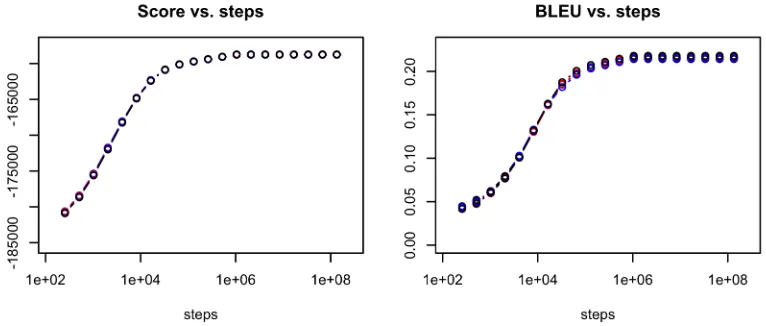
Figure 1 shows the results of 7 decoder runs with the models described above, translating the news-test2009 test set, with a step limit of 227and a rejec-tion limit of 100,000. Thex-axis of both plots shows the number of decoding steps on a logarithmic scale, so the number of steps is doubled between two adja-cent points on the same curve. In the left plot, the
Figure 1: Score stability in repeated decoder runs
state against a reference translation is displayed.
We note, as expected, that the decoder achieves a considerable improvement of the initial state with diminishing returns as decoding continues. Be-tween 28 and 214 steps, the score increases at a roughly logarithmic pace, then the curve flattens out, which is partly due to the fact that decoding for some documents effectively stopped when the max-imum number of rejections was reached. The BLEU score curve shows a similar increase, from an initial score below 5 % to a maximum of around 21.5 %. This is below the score of 22.45 % achieved by the beam search decoder with the same models, which is not surprising considering that our decoder ap-proximates a more difficult search problem, from which a number of strong independence assump-tions have been lifted, without, at the moment, hav-ing any stronger models at its disposal to exploit this additional freedom for better translation.
In terms of stability, there are no dramatic differ-ences between the decoder runs. Indeed, the small differences that exist are hardly discernible in the plots. The model scores at the end of the decod-ing run range between−158767.9 and−158716.9, a relative difference of only about 0.03 %. Final BLEU scores range from 21.41 % to 21.63 %, an in-terval that is not negligible, but comparable to the variance observed when, e. g., feature weights from repeated MERT runs are used with one and the same SMT system. Note that these results were obtained with random state initialisation. With DP initialisa-tion, score differences between repeated runs rarely
exceed 0.02 absolute BLEU percentage points. Overall, we conclude that the decoding results of our algorithm are reasonably stable despite the non-determinism inherent in the procedure. In our sub-sequent experiments, the evaluation scores reported are calculated as the mean of three runs for each ex-periment.
4.2 Search Algorithm Parameters
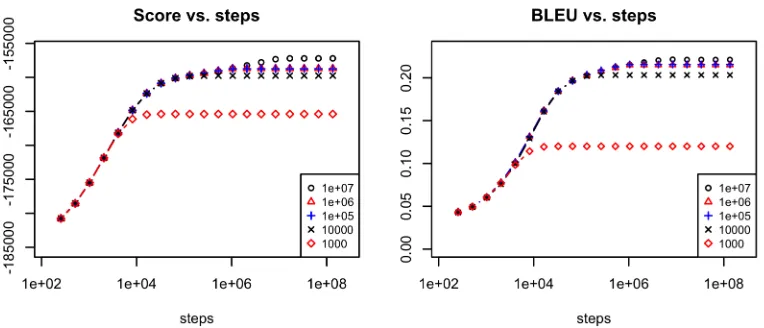
The hill climbing algorithm we use has two param-eters which govern the trade-off between decoding time and the accuracy with which a local maximum is identified: The step limit stops the search pro-cess after a certain number of steps regardless of the search progress made or lack thereof. Therejection limitstops the search after a certain number of un-successful attempts to make a step, when continued search does not seem to be promising. In most of our experiments, we used a step limit of 227≈1.3·108 and a rejection limit of 105. In practice, decoding terminates by reaching the rejection limit for the vast majority of documents. We therefore examined the effect of different rejection limits on the learning curves. The results are shown in figure 2.
Figure 2: Search performance at different rejection limits
evidenced by the fact that a rejection limit of 106 does not give a large improvement over one of 105, while one of 107 does. The continued model score improvement also results in an increase in BLEU scores, and with a BLEU score of 22.1 % the system with rejection limit 107is fairly close to the score of 22.45 % obtained by DP beam search.
Obviously, more exact search comes at a cost, and in this case, it comes at a considerable cost, which is an explosion of the time required to decode the test set from 4 minutes at rejection limit 103to 224 min-utes at rejection limit 105 and 38 hours 45 minutes at limit 107. The DP decoder takes 31 minutes for the same task. We conclude that the rejection limit of 105 selected for our experiments, while techni-cally suboptimal, realises a good trade-off between decoding time and accuracy.
4.3 A Semantic Document Language Model
In this section, we present the results of the applica-tion of our decoder to an actual SMT model with cross-sentence features. Our model addresses the problem oflexical cohesion. In particular, it rewards the use of semantically related words in the trans-lation output by the decoder, where semantic dis-tance is measured with a word space model based on Latent Semantic Analysis (LSA). LSA has been applied to semantic language modelling in previous research with some success (Coccaro and Jurafsky, 1998; Bellegarda, 2000; Wandmacher and Antoine, 2007). In SMT, it has mostly been used for domain adaptation (Kim and Khudanpur, 2004; Tam et al.,
2007), or to measure sentence similarities (Banchs and Costa-juss`a, 2011).
The model we use is inspired by Bellegarda (2000). It is a Markov model, similar to a stan-dard n-gram model, and assigns to each content word a score given a history ofnpreceding content words, wheren=30 below. Scoring relies on a 30-dimensional LSA word vector space trained with the S-Space software (Jurgens and Stevens, 2010). The score is defined based on the cosine similarity be-tween the word vector of the predicted word and the mean word vector of the words in the history, which is converted to a probability by histogram lookup as suggested by Bellegarda (2000). The model is structurally different from a regular n-gram model in that word vector n-grams are defined over content words occurring in the word vector model only and can cross sentence boundaries. Stop words, identi-fied by an extensive stop word list and amounting to around 60 % of the tokens, are scored by a different mechanism based on their relative frequency (undis-counted unigram probability) in the training corpus. In sum, the score produced by the semantic docu-ment LM has the following form:
h(w|h) =
punigr(w) ifwis a stop word, else
αpcos(w|h) ifwis known, else
ε ifwis unknown,
(15)
where α is the proportion of content words in the
training corpus and ε is a small fixed probability.
training the feature weights of document-wide fea-tures, its weight was selected by grid search over a number of values, comparing translation perfor-mance for the newstest2009 test set.
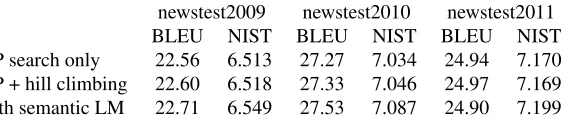
In these experiments, we used DP beam search to initialise the state of our local search decoder. Three results are presented (table 1): The first table row shows the baseline performance using DP beam search with standard sentence-local features only. The scores in the second row were obtained by run-ning the hill climbing decoder with DP initialisation, but without adding any models. A marginal increase in scores for all three test sets demonstrates that the hill climbing decoder manages to fix some of the search errors made by the DP search. The last row contains the scores obtained by adding in the seman-tic language model. Scores are presented for three publicly available test sets from recent WMT Ma-chine Translation shared tasks, of which one (news-test2009) was used to monitor progress during de-velopment and select the final model.
Adding the semantic language model results in a small increase in NIST scores (Doddington, 2002) for all three test sets as well as a small BLEU score gain (Papineni et al., 2002) for two out of three cor-pora. We note that the NIST score turned out to re-act more sensitively to improvements due to the se-mantic LM in all our experiments, which is reason-able because the model specifically targets content words, which benefit from the information weight-ing done by the NIST score. While the results we present do not constitute compelling evidence in favour of our semantic LM in its current form, they do suggest that this model could be improved to realise higher gains from cross-sentence seman-tic information. They support our claim that cross-sentence models should be examined more closely and that existing methods should be adapted to deal with them, a problem addressed by our main contri-bution, the local search document decoder.
5 Related Work
Even though DP beam search (Koehn et al., 2003) has been the dominant approach to SMT decoding in recent years, methods based on local search have been explored at various times. For word-based SMT, greedy hill-climbing techniques were
advo-cated as a faster replacement for beam search (Ger-mann et al., 2001; Ger(Ger-mann, 2003; Ger(Ger-mann et al., 2004), and a problem formulation specifically tar-geting word reordering with an efficient word re-ordering algorithm has been proposed (Eisner and Tromble, 2006).
A local search decoder has been advanced as a faster alternative to beam search also for phrase-based SMT (Langlais et al., 2007; Langlais et al., 2008). That work anticipates many of the features found in our decoder, including the use of local search to refine an initial hypothesis produced by DP beam search. The possibility of using models that do not fit well into the beam search paradigm is mentioned and illustrated with the example of a re-versed n-gram language model, which the authors claim would be difficult to implement in a beam search decoder. Similarly to the work by Germann et al. (2001), their decoder is deterministic and ex-plores the entire neighbourhood of a state in order to identify the most promising step. Our main con-tribution with respect to the work by Langlais et al. (2007) is the introduction of the possibility of han-dling document-level models by lifting the assump-tion of sentence independence. As a consequence, enumerating the entire neighbourhood becomes too expensive, which is why we resort to a “first-choice” strategy that non-deterministically generates states and accepts the first one encountered that meets the acceptance criterion.
More recently, Gibbs sampling was proposed as a way to generate samples from the posterior distri-bution of a phrase-based SMT decoder (Arun et al., 2009; Arun et al., 2010), a process that resembles local search in its use of a set of state-modifying operators to generate a sequence of decoder states. Where local search seeks for the best state attainable from a given initial state, Gibbs sampling produces a representative sample from the posterior. Like all work on SMT decoding that we know of, the Gibbs sampler presented by Arun et al. (2010) assumes in-dependence of sentences and considers the complete neighbourhood of each state before taking a sample.
6 Conclusion
newstest2009 newstest2010 newstest2011
BLEU NIST BLEU NIST BLEU NIST
[image:10.612.171.454.57.118.2]DP search only 22.56 6.513 27.27 7.034 24.94 7.170 DP + hill climbing 22.60 6.518 27.33 7.046 24.97 7.169 with semantic LM 22.71 6.549 27.53 7.087 24.90 7.199
Table 1: Experimental results with a cross-sentence semantic language model
are independent of one another, and discourse con-text has been largely neglected. Several factors have contributed to this. Developing good discourse-level models is difficult, and considering the modest trans-lation quality that has long been achieved by SMT, there have been more pressing problems to solve and lower hanging fruit to pick. However, we argue that the popular DP beam search algorithm, which deliv-ers excellent decoding performance, but imposes a particular kind of local dependency structure on the feature models, has also had its share in driving re-searchers away from discourse-level problems.
In this paper, we have presented a decoding pro-cedure for phrase-based SMT that makes it possi-ble to define feature models with cross-sentence de-pendencies. Our algorithm can be combined with DP beam search to leverage the quality of the tradi-tional approach with increased flexibility for models at the discourse level. We have presented prelimi-nary results on a cross-sentence semantic language model addressing the problem of lexical cohesion to demonstrate that this kind of models is worth explor-ing further. Besides lexical cohesion, cross-sentence models are relevant for other linguistic phenomena such as pronominal anaphora or verb tense selection. We believe that SMT research has reached a point of maturity where discourse phenomena should not be ignored any longer, and we consider our decoder to be a step towards this goal.
References
Abhishek Arun, Chris Dyer, Barry Haddow, Phil Blun-som, Adam Lopez, and Philipp Koehn. 2009. Monte carlo inference and maximization for phrase-based translation. InProceedings of the Thirteenth Confer-ence on Computational Natural Language Learning (CoNLL-2009), pages 102–110, Boulder, Colorado, June. Association for Computational Linguistics. Abhishek Arun, Barry Haddow, Philipp Koehn, Adam
Lopez, Chris Dyer, and Phil Blunsom. 2010. Monte
Carlo techniques for phrase-based translation. Ma-chine translation, 24(2):103–121.
Rafael E. Banchs and Marta R. Costa-juss`a. 2011. A se-mantic feature for Statistical Machine Translation. In Proceedings of Fifth Workshop on Syntax, Semantics and Structure in Statistical Translation, pages 126– 134, Portland, Oregon, USA, June. Association for Computational Linguistics.
Jerome R. Bellegarda. 2000. Exploiting latent semantic information in statistical language modeling. Proceed-ings of the IEEE, 88(8):1279–1296.
Chris Callison-Burch, Philipp Koehn, Christof Monz, and Omar Zaidan. 2011. Findings of the 2011 Work-shop on Statistical Machine Translation. In Proceed-ings of the Sixth Workshop on Statistical Machine Translation, pages 22–64, Edinburgh, Scotland, July. Association for Computational Linguistics.
Noah Coccaro and Daniel Jurafsky. 1998. Towards bet-ter integration of semantic predictors in statistical lan-guage modeling. InProceedings of the 5th Interna-tional Conference on Spoken Language Processing, Sydney.
George Doddington. 2002. Automatic evaluation of ma-chine translation quality using n-gram co-occurrence statistics. In Proceedings of the second Interna-tional conference on Human Language Technology Research, pages 138–145, San Diego.
Jason Eisner and Roy W. Tromble. 2006. Local search with very large-scale neighborhoods for optimal per-mutations in machine translation. In Proceedings of the HLT-NAACL Workshop on Computationally Hard Problems and Joint Inference in Speech and Language Processing, pages 57–75.
Marcello Federico, Nicola Bertoldi, and Mauro Cettolo. 2008. IRSTLM: an open source toolkit for handling large scale language models. In Interspeech 2008, pages 1618–1621. ISCA.
Ulrich Germann, Michael Jahr, Kevin Knight, Daniel Marcu, and Kenji Yamada. 2004. Fast and optimal de-coding for machine translation. Artificial Intelligence, 154(1–2):127–143.
Ulrich Germann. 2003. Greedy decoding for Statis-tical Machine Translation in almost linear time. In Proceedings of the 2003 Human Language Technol-ogy Conference of the North American Chapter of the Association for Computational Linguistics.
Zhengxian Gong, Min Zhang, and Guodong Zhou. 2011. Cache-based document-level Statistical Ma-chine Translation. InProceedings of the 2011 Confer-ence on Empirical Methods in Natural Language Pro-cessing, pages 909–919, Edinburgh, Scotland, UK., July. Association for Computational Linguistics.
Christian Hardmeier and Marcello Federico. 2010. Mod-elling Pronominal Anaphora in Statistical Machine Translation. In Proceedings of the seventh Inter-national Workshop on Spoken Language Translation (IWSLT), pages 283–289.
Basil Hatim and Ian Mason. 1990. Discourse and the Translator. Language in Social Life Series. Longman, London.
Kenneth Heafield. 2011. KenLM: faster and smaller language model queries. InProceedings of the Sixth Workshop on Statistical Machine Translation, pages 187–197, Edinburgh, Scotland, July. Association for Computational Linguistics.
Howard Johnson, Joel Martin, George Foster, and Roland Kuhn. 2007. Improving translation quality by dis-carding most of the phrasetable. InProceedings of the 2007 Joint Conference on Empirical Methods in Nat-ural Language Processing and Computational Natu-ral Language Learning (EMNLP-CoNLL), pages 967– 975, Prague, Czech Republic, June. Association for Computational Linguistics.
David Jurgens and Keith Stevens. 2010. The S-Space package: An open source package for word space models. In Proceedings of the ACL 2010 System Demonstrations, pages 30–35, Uppsala, Sweden, July. Association for Computational Linguistics.
Woosung Kim and Sanjeev Khudanpur. 2004. Cross-lingual latent semantic analysis for language model-ing. In IEEE international conference on acoustics, speech, and signal processing (ICASSP), volume 1, pages 257–260, Montr´eal.
Philipp Koehn, Franz Josef Och, and Daniel Marcu. 2003. Statistical phrase-based translation. In Pro-ceedings of the 2003 conference of the North Ameri-can chapter of the Association for Computational Lin-guistics on Human Language Technology, pages 48– 54, Edmonton.
Philipp Koehn, Hieu Hoang, Alexandra Birch, et al. 2007. Moses: open source toolkit for Statistical Ma-chine Translation. In Annual meeting of the Associ-ation for ComputAssoci-ational Linguistics: DemonstrAssoci-ation session, pages 177–180, Prague.
Philippe Langlais, Alexandre Patry, and Fabrizio Gotti. 2007. A greedy decoder for phrase-based statistical machine translation. In TMI-2007: Proceedings of the 11th International Conference on Theoretical and Methodological Issues in Machine Translation, pages 104–113, Sk¨ovde.
Philippe Langlais, Alexandre Patry, and Fabrizio Gotti. 2008. Recherche locale pour la traduction statistique par segments. In TALN 2008, pages 119–128, Avi-gnon, France, June. ATALA.
Ronan Le Nagard and Philipp Koehn. 2010. Aiding pro-noun translation with co-reference resolution. In Pro-ceedings of the Joint Fifth Workshop on Statistical Ma-chine Translation and MetricsMATR, pages 252–261, Uppsala, Sweden, July. Association for Computational Linguistics.
Franz Josef Och, Nicola Ueffing, and Hermann Ney. 2001. An efficient A* search algorithm for Statisti-cal Machine Translation. InProceedings of the Data-Driven Machine Translation Workshop, 39th Annual Meeting of the Association for Computational Linguis-tics (ACL), pages 55–62, Toulouse.
Franz Josef Och. 2003. Minimum error rate training in Statistical Machine Translation. InProceedings of the 41st annual meeting of the Association for Computa-tional Linguistics, pages 160–167, Sapporo (Japan). Kishore Papineni, Salim Roukos, Todd Ward, and
Wei-Jing Zhu. 2002. BLEU: a method for automatic eval-uation of Machine Translation. InProceedings of the 40th annual meeting of the Association for Computa-tional Linguistics, pages 311–318, Philadelphia. ACL. Yik-Cheung Tam, Ian Lane, and Tanja Schultz. 2007. Bilingual LSA-based adaptation for Statistical Ma-chine Translation. Machine Translation, 21(4):187– 207.
J¨org Tiedemann. 2010. To cache or not to cache? Ex-periments with adaptive models in Statistical Machine Translation. In Proceedings of the ACL 2010 Joint Fifth Workshop on Statistical Machine Translation and Metrics MATR, pages 189–194, Uppsala, Sweden. As-sociation for Computational Linguistics.
Christoph Tillmann and Hermann Ney. 2003. Word re-ordering and a Dynamic Programming beam search al-gorithm for Statistical Machine Translation. Compu-tational linguistics, 29(1):97–133.
Computational Linguistics, pages 289–296, Madrid, Spain, July. Association for Computational Linguis-tics.