warwick.ac.uk/lib-publications
Manuscript version: Working paper (or pre-print)
The version presented here is a Working Paper (or ‘pre-print’) that may be later published elsewhere.
Persistent WRAP URL:
http://wrap.warwick.ac.uk/81582 How to cite:
Please refer to the repository item page, detailed above, for the most recent bibliographic citation information. If a published version is known of, the repository item page linked to above, will contain details on accessing it.
Copyright and reuse:
The Warwick Research Archive Portal (WRAP) makes this work by researchers of the University of Warwick available open access under the following conditions.
Copyright © and all moral rights to the version of the paper presented here belong to the individual author(s) and/or other copyright owners. To the extent reasonable and practicable the material made available in WRAP has been checked for eligibility before being made available.
Copies of full items can be used for personal research or study, educational, or not-for-profit purposes without prior permission or charge. Provided that the authors, title and full
bibliographic details are credited, a hyperlink and/or URL is given for the original metadata page and the content is not changed in any way.
Publisher’s statement:
Please refer to the repository item page, publisher’s statement section, for further information.
1
Digital Trust and Peer-to-Peer Collaborative Consumption
Platforms: A Mediation Analysis
Mareike Möhlmann
New York University Stern School of Business First Version: January 2015
This Version: July 2016
This paper investigates the nature of digital trust in the context of P2P collaborative consumption platforms.
We have analyzed data from the website Trustpilot.com (N=5,606), survey data from users of the online
sharing platform Airbnb (N=232), and data retrieved from an online experiment conducted among current
non-users of a fictitious online sharing platform (N=462). The findings reveal that trust in P2P collaborative
consumption platforms (Airbnb, Lyft, and Uber) is lower than trust in P2P exchange first generation
platforms (Ebay), as well as large online retail services and non-P2P platforms (Walmart, Zappos,
Amazon). Furthermore, we find that the three trust-building management measures: ‘reliable insurance
cover’, ‘simultaneous reviews’, and a ‘large network: many offers worldwide’ had a positive effect on ‘trust
in the platform provider’. The findings confirm the hierarchical nature of the two-fold trust construct,
meaning that ‘trust in the platform provider’ has a positive effect on the ‘trust in peers’ sharing on this
platform. A mediation analysis reveals that ‘trust in the platform’ fully mediates all statistically significant
effects of trust-building measures on the ‘trust in peers’ variable.
2
Over the last couple of years, collaborative consumptioni which is often associated with the sharing
economy has become an emerging trend, radically changing consumer behavior and the service landscape
on a large scale (Avital et al. 2015, Botsman and Rogers 2010, Möhlmann 2015). Many collaborative
consumption services are facilitated via peer-to-peer (P2P) online platforms (Botsman and Rogers 2010,
Fraiberger and Sundararajan 2015, Horton and Zeckhauser 2016, Sundararajan 2016). Examples include
short-distance transportation such as Uber and Lyft, city-to-city ridesharing services such as BlaBlaCar,
P2P car renting such as Getaround or RelayRides, or platforms for household tasks such as TaskRabbit.
One successful example that has been discussed in popular media more recently is Airbnb, an online sharing
platform where private people can connect with each other to temporarily rent accommodations. The
international portfolio of Airbnb counts for more than two million offers that range from rooms or
apartments in large cities such as New York, houseboats in Amsterdam, to cottages in England on more
than 190 countries worldwide (Airbnb 2016).
However, more recently, several incidents discussed in popular media in the context of
collaborative consumption have included theft, rape, and even willful damage. This adds to the low trust
and confusion about the legal institutional arrangements associated with P2P collaborative consumption
platforms. For instance, the short-distance transportation company Uber faced heavy protests when trying
to establish itself in Europe. Uber drivers do not always have transportation licenses, like the ones issued
to official taxi drivers. As such, using Uber cars is still considered a rather ‘grey’ legal area in many
countries. Other horror stories reported include those about Airbnb guests damaging apartments because of
toilet overflows, burning kitchens, and escalating parties. On the P2P level researchers have made reference
to the ‘moral hazard problem’. This is the concern about potential damages of the unit of transaction based
on unobservable actions of the peers one is sharing with (Weber 2014). The underlying assumption is that
P2P sharing is conducted by rational and self-interested individuals (Johar et al. 2011).
There is increasing interest of the research community on topics related to P2P collaborative
3
introduced a track called “Crowdsourcing, Crowdfunding, Blockchain and the Sharing Economy”.
However, academic research on the antecedents to digital trust and the nature of the trust construct in the
particular context of P2P collaborative consumption platforms is still extremely rare. Thereby, existing
research on trust in information systems management can be challenged (see below for detailed discussion).
We aim to answer three research questions:
RQ1: Is digital trust in P2P collaborative consumption platforms different from trust in services provided
by conventional platforms?
RQ2: Which management measures have a positive effect on digital trust in P2P collaborative
consumption platforms?
RQ3: Is digital trust a hierarchical construct, meaning, does trust in the platform act as a mediator for
all the effects of trust-building management measures on trust in peers of P2P collaborative consumption
platforms?
Insights from our results might assist managers of P2P collaborative consumption platform
providers to develop targeted marketing strategies (Lamberton and Rose 2012), practice effective
acquisition of new customers, and to strategically manage trust. A better understanding of this new form of
consumption might also hold value for competitors to sharing economy services, such as hotel chains, car
services or retail associated with conventional service offers (Belk 2014). As they are in danger of being
replaced by such new forms of consumption, traditional industries need to grasp major transformations in
consumer behavior.
THEORETICAL PART
Following the logic of our three research questions, the theoretical part contains three parts. First, we discuss
how digital trust in the context of P2P collaborative consumption platforms is different from other
4
collaborative consumption platforms. Third, we discuss the hierarchical and mediating nature of digital
trust in this context.
1. DIGITAL TRUST IN THE CONTEXT OF P2P COLLABORATIVE CONSUMPTION
PLATFORMS IS DIFFERENT
Platforms evolve over time and create diverse logics, resulting in inter- and intra-platform differences
(Henfridsson and Bygstad 2013, Tiwana 2015, Yoo et al. 2010). Based on this assumption, we argue that
building and managing digital trust in the context of P2P collaborative consumption platforms is different
(and much more difficult) compared to other contexts. With these other contexts, we refer to the (first
generation) of P2P exchange platforms (e.g., Ebay), as well as online retail services and non-P2P platforms
(e.g., Walmart, Zappos, Amazon). We identify four contextual characteristics of differentiation. We discuss
how each of these characteristics challenges prior research on trust. By doing so we introduce the research
contributions this paper has to offer:
First, the dyad of relationships known from many conventional service exchanges in e-commerce
is extended to a triad of relationships.In difference to traditional retail services, at least three parties are
involved in each transaction. These are the users of a service, the provider of the online sharing platform
(intermediary), as well as the peers one is sharing with on a respective platform (the latter often labelled as
the ‘crowd’) (Hagiu and Spulber 2013, Parker and Van Alstyne 2005, Pavlou and Gefen 2004, Sundararajan
2016, Weber 2014). In this regard, many acts of collaborative consumption via online sharing platforms
can be classified as ‘firm-market hybrids’. Providers of online sharing platforms solely facilitate frame
conditions, for instance through the supply of branded service offers. Thereby, the principle element of the
service is delivered by a network of private people in the form of peers conducting sharing activities on
these platforms. The boundaries between the provision of private and professional services are blurring
(Sundararajan 2016). This characteristic challenges prior research on trust, because it requires the
necessity to differentiate between trust in the provider of the collaborative consumption online platform,
5
made in current research when addressing trust (see next chapter for more details). In addition we argue
that repeated interaction with a platform does not necessarily mean that there is repeated interaction with a
peer acting on this platform. Thus, we cannot simply transfer knowledge we have about initial or repeated
interaction from other e-commerce settings (e.g., Fang et al. 2014, McKnight et al. 2002a) to the context
assessed in this paper.
Second, the intensity of social interaction among peers is stronger in many collaborative
consumption contextscompared to the more or less anonymous transactions carried out via conventional
platforms such as Ebay. In the latter case, most often packages are sent and transaction partners have never
meet each other in person. However, in many collaborative consumption settings, even face-to-face
interaction takes place among peers, for instance when handing over the keys to an apartment booked via
Airbnb or when renting a car from a peer via Getaround and Turo (previously RelayRides). As a result,
users are literally entering the personal space of others (e. g. their apartment or car) and thus interact on a
more advanced social level. This characteristic challenges prior research on trust. Given the fact that the
social dimension becomes more relevant in collaborative consumption contexts, one could argue that “old
-fashioned” forms of trust identified from offline contexts might experience a rebound. In the particular case
of collaborative consumption, it might be valuable to use sociology (Zucker 1986), or a “human-based”
(Lankton et al. 2015) approaches to trust. In difference to economists, sociologist are more interested in
underlying framework conditions, as well as how personal character traits (e.g., a person’s propensity to
trust) shape trust relationships (Zucker 1986).
Third, in comparison to most conventional services, the underlying principle of collaborative
consumption is a recurring short-term rental rather than a resale of goods(Fraiberger and Sundararajan
2015, Horton and Zeckhauser 2016), indicating a preference for access over possession (Bardhi and
Eckhardt 2012). This characteristic challenges prior research on trust. In this specific context, trust refers
to the pickup of the object of temporary exchange, but also the treatment by the user during the rental
6
higher risk, since the duration of interaction is longer and the quality of previously used services is harder
to predict.
Fourth, in comparison to most conventional services, the unit of exchange is most often a service,
rather than a good. Certainly, a shift from a goods-based to service-based exchange relationship is evident
in information systems (Lusch and Nambisan 2015). This characteristic challenges prior research on
trust. In comparison to an exchange of goods taking place on online platforms such as eBay, we know from
the basics of service theory that during a service transaction, additional factors such as punctuality,
cleanliness, and reliability become central. Given that there are many more factors of relevance associated
with a collaborative consumption services, one could argue that (again) there is a higher risk associated
with using them because there is ‘more that can go wrong’. It might be harder to assess aspects of the quality
of a service, such as the coziness of an apartment based on information provided via an online platform
compared to the quality of a physical object (good), such as a chair bought via Ebay.
Based on the argument that the management of trust on P2P collaborative consumption platforms
is much more difficult than the management of trust in services provided by conventional P2P platforms or
service enabled by digital technology, we provide empirical results to get a better understanding on these
trust differences in the following.
2. TRUST-BUILDING MANAGEMENT MEASURES IN THE CONTEXT OF P2P
COLLABORATIVE CONSUMPTION PLATFORMS
In the last couple of years, many new options to introduce innovative management measures to customers
became available for managers. Many of them have previously been discussed by researchers in the context
of online marketplaces or e-commerce or technology enabled applications (e. g., Benbasat et al. 2010,
Bolton et al. 2012, Son et al. 2006 etc.). These include, for instance, manifold possibilities for mutual peer
ratings (e. g., points, running text, categories), sufficient possibility to describe the listing (e. g., descriptions
7
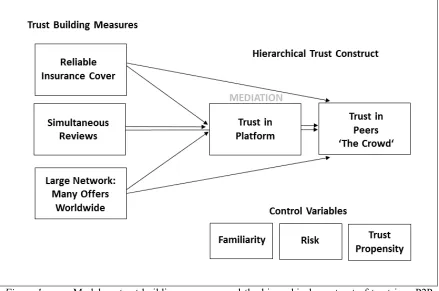
Unlike these well accepted digital trust-building management measures, we aim to understand the
potential effects of more innovative measures that are not extensively researched yet: reliable insurance
cover, simultaneous reviews, and a large network: many offers available worldwide (Figure 1). For each
one, we discuss why we believe that they are particularly relevant in the context of P2P collaborative
consumption platforms. By referring to the explicit examples, we aim at taking a practice-based view:
Reliable insurance cover: As a consequence of negative media coverage followinga case of Airbnb guests
vandalizing an apartment in San Francisco in 2011, Airbnb announced that they had implemented a $50
thousand guarantee for their guests. Since then, the sum covered by the insurance has grown incrementally.
By now, the Airbnb insurance covers up to $1 million in case of damage in countries based in North
America, Europe, and some Asian countries (Airbnb 2016). In implementing such practices, Airbnb became
the role model for many other collaborative consumption services. Indeed, other services such as Turo, one
of the largest peer-to-peer car lending companies worldwide, offers similar insurance cover to their
customers.
By building on previous research, we argue that insurance cover can be traded as an innovative
management measure to build digital trust in the particular context of P2R collaborative consumption
platforms. Indeed, Tang et al. (2003) found that many people affirm insurance to positively affect trust in
internet settings, since it is a tool to minimize uncertainty in contexts where users rarely know each other
(Son et al. 2006, Tang et al. 2003). Insurance cover can be considered as some sort of ‘structuralassurance’:
structures that are in place to create an environment that feels safe and secure (McKnight et al. 2002a and
2002b). This idea also builds on the thoughts of Zucker (1986) who considers trust to be an institutional
construction.
The management measure ‘insurance cover’ seems to be particularly important in the context of
collaborative consumption platforms. The financial risk associated with accommodation sharing such as
8
incidents such as bursting pipes and burning kitchens (compared to probably lower financial risks of buying
an average good via Ebay). In general, we argue that insurance cover seems specifically relevantin many
cases of P2P collaborative consumption platforms due to the fact that services rather than goods are
provided by private people rather than professionals (Sundararajan 2016). This leads to situations in which
no trained staff is available to handle exceptional and potentially dangerous situations.
Simultaneous reviews: Airbnb implemented simultaneous reviews (also so-called double blind reviews)
in July 2014 (Zervas et al. 2015). This means that users have the opportunity to mutually rate each other,
while both sets of feedback are revealed simultaneously after being submitted from both parties. This
approach is supposed to prevent reciprocal feedback, the potential retaliation of negative ratings, and social
desirability bias (Bolton et al. 2012). Indeed, P2P review system in the context of collaborative consumption
have been shown to be not very reliable due to biased review behavior of peers: they might feel bad when
leaving a negative review, even though the service experience was not satisfying to them (Slee 2016).
Simultaneous reviews can be considered as a progression of conventional peer based reviews – a
tool that has been previously addressed as one major measure affecting trust in online platforms (Bolton et
al. 2012, Slee 2013). Indeed, review systems provide information on the previous performance of a user,
facilitate the easy documentation of deviant behavior, and build reputation capital (Bolton et al. 2012,
Keymolen 2013). Researchers have been using social capital theory to understand how reviews can build
trust. The basic assumption is that individuals are better off building a digital trust profile in the long term,
rather than seeking short-term benefits that might results in bad digital trust scores that might have negative
long-term effects.
The management measure ‘simultaneous reviews’ seems to be particularly important in the
context of collaborative consumption platforms. Indeed, simultaneous reviews are in particular relevant in
a P2P context. Collaborative consumption platforms are characterized by the fact that peers are sharing
9
fact that services are characterized by a high degree of social interaction (see more detailed discussion
above). Thus, biased review behavior is even more likely than in other contexts (Slee 2016, Zervas et al.
2015), where social interaction might be less evident. No wonder Airbnb has implemented this measure.
Large network: many offers available worldwide: The Airbnb is the largest accommodations online
sharing platform worldwide. Currently the Airbnb network is offering space in more than 34,000 cities in
almost all countries worldwide. Since its formation in 2008, it has attracted more than 25 million user
bookings (Airbnb 2016).
Network effects on two-sided platforms are generally known to lead to higher utility levels. Indeed,
there is higher value for users such as buyers the more sellers there are and vice versa (Hagiu and Spulber
2013, Parker and Van Alstyne 2005, Sundararajan 2016). In line with this, disclosing an e-marketplaces
size (Son et al. 2006) or the perceived size of an internet store (Jarvenpaa et al. 2000) have been associated
with higher trust levels.
The management measure ‘large network: many offers worldwide’ seems to be particularly
important in the context of collaborative consumption platforms. As mentioned previously, it is
characterized by the fact that the dyad of relationships known from many conventional service exchanges
is extended to a triad of relationships. Next to the platform provider itself, these are the peers sharing on
these collaborative consumption websites (Pavlou and Gefen 2004). Picture a scenario where several peers
offer one room via Airbnb for a duration of three weeks each year. You would need about 17 peers each
year (52 weeks per annum divided by 3 weeks) to host as many people via Airbnb as one single hotel room
could accommodate, assuming the hotel room is available all year. That would be equivalent to 1700 peers
each year compared to one hotel with a capacity of 100 rooms. Since private people usually offer services
on a small scale compared to commercial providers, a large network is necessary to assure that demand and
10
Figure 1: Model on trust-building measures and the hierarchical construct of trust in a P2P collaborative consumption online sharing platform
Control variables: In addition, it is controlled for three variables, which have intensively been discussed
in theory and in prior literature addressing trust. First, building on the sociologist Luhmann, who states that
trust can only be constructed in a familiar environment (Luhmann 1979), familiarity (Bhattacherjee 2002)
is conceptualized to be one control variable. Thereby, familiarity has been described as a ‘cumulative
process’ (Burt 2000:4), meaning that trust is increasing with every positive experience made, and stable if
that positive experience is made over and over again. Second, many authors have been emphasizing the
concept of trust and of risk to be closely linked (Mayer et al. 1995, Pavlou and Gefen 2004, Schlosser et al.
2006). Third, many authors theorize trust propensity to be an important factor in trust relationships (Lee
and Turban 2001, Mayer et al. 1995). With this variable, it is referred to the propensity of people to trust a
person or thing. The level of trust propensity is anticipated to differ in different cultural settings (Lee and
Turban 2001). Again, in the previous chapter, reasons are presented as to why an analysis of these control
11
3.THE HIERARCHICAL AND MEDIATING NATURE OF DIGITAL TRUST IN THE CONTEXT
OF P2P COLLABORATIVE CONSUMPTION PLATFORMS
Researchers constitute trust to be of high importance in interpersonal and exchange relationships, and
therefore to be a key variable in customer relationship management. Consequently, Mayer et al. (1995:712)
define trust as a behavioral intention or the ‘willingness of a party to be vulnerable to the actions of another
party based on the expectations that the other will perform a particular action important to the trustor,
irrespective of the ability to monitor or control that other party. Trust has, in particular, been discussed to
be of key relevance for transactions embedded in online settings (Bhattacherjee 2002, Dimoka 2010,
McKnight et al. 2002b, Pavlou and Gefen 2004, Steward 2003).
Mayer, Davis, and Schoorman (1995) argue that parties involved in a trust relationship, respectively
the trustor (trusting party) and the trustee (to be trusted), should be specified in detail, rather than turning
towards the measurement of generalized trust expectations. Such specification is necessary to appropriately
assess the explicit relationship which is the unit of analysis.
While trust has been conceptualized as a one-dimensional construct in many research contributions
addressing e-commerce (Bhattacherjee 2002), more lately, some researchers have considered the two-fold
nature of the trust construct. They differentiate between trust in the platform and trust in peers (Chai et al.
2011-2012, Chai and Kim 2010, Pavlou and Gefen 2004). This logic builds on literature focusing on
two-sided platforms (Hagiu and Spulber 2013, Parker and Van Alstyne 2005). It is argued that such logic might
also be evident in the context of collaborative consumption services facilitated via online based sharing
platforms (Hawlitschek, et al. 2016).
Given the fact that a network of private people or ‘peers’ deliver the principle part of the service,
while the platform facilitates the frame conditions of the transaction (Sundararajan 2016), a distinct
consideration of these two stakeholder groups seems only logical. Thus, on the one hand, users might trust
that the platform provider does facilitate all sharing transactions well. On the other hand, users might trust
12
Indeed, there is a strong theoretical background addressing the hierarchy of trust dimensions.
Steward (2003) uses the label ‘trust transfer’ to theorize the phenomenon that trust might be transferred
from one source to another in a hierarchical order (Steward 2003). Luhmann (1979) captures this
relationship from a sociological systems-theoretic perspective. In his work, an interdependent link between
system trust and personal trust is theorized. The system refers to underlying norms, rules, and principles.
System trust is trust in the every function of the system environment. Thereby, personal trust relationships
are embedded in such systems. Personal trust refers to trust between individuals and in the transactions
between individuals (Gilbert and Behnam 2013, Jalava 2006). Zucker takes an institutional theory point of
view and argues that trust is an institutional production (1986:57-58). She defines two major components
of trust. The first one is background expectations, common understandings and general attitudes of daily
life, expected to be shared by all members of a community. The second component is constitutive
expectations, referring to rules valid in situational contexts. These are influenced by inter-subjective
meaning and mutual expectations. Among others based on Zucker’s work, several authors have applied an
institution-based trust logic in e-commerce or online auction platform settings (Fang et al. 2014, Pavlou
and Gefen 2004). Pavlou and Gefen (2004) emphasize that trust-based transactions between peers on online
platforms is based on the very existence of stable institutional frameworks. Institution-based trust is the
user’s perception on the implementation of conditions by a third-party to facilitate transactions. This third
party, respectively the platform provider, determines the setting in which peers conduct sharing activities
with each other.
In this regard, we differentiate between two constructs: trust in the platform and trust in peers. By
placing digital trust within a context of antecedents, the hierarchy of trust dimensions becomes evident in
the form of mediation effects (Figure 1). This is a novel approach. Previous research that first differentiated
between those two trust dimensions (e. g., Pavlou and Gefen 2004) did not conceptualize or test potential
13 EMPIRICAL PART
In study one, we aim to address research question one by drawing on data available via Trustpilot.com
(N=5,606). Research question two and three are addressed in study two and three. In study two, we conduct
a survey among users of the online sharing platform Airbnb (N=232) and in study three, an online
experiment among current non-users/or potential users of a fictitious online sharing platform (N=462).
1. STUDY ONE: DESCRIPTIVE TRUST-DATA FROM DIFFERENT ONLINE PLATFORMS
Data Collection and Sample: We retrieved publically available data from the online platform
Trustpilot.com and used the data to get a better understanding of the different trust levels between P2P
collaborative consumption platforms (Airbnb, Lyft, and Uber) and services provided by conventional
platforms. Trustpilot.com describes itself as a community that uses peer reviews to build trust between
business and users. Indeed, while users often have the opportunity to rate other users, this service seeks to
display ratings on the trustworthiness of business in form of platform providers. We directly harvested the
data from the web interface of the website.
Measurement and Data Analysis: We retrieved all numeric trustworthiness ratings available from
well-known P2P collaborative consumption platforms (Airbnb, Lyft, and Uber), P2P exchange first generation
platforms (Ebay), as well as large online retail services and non-P2P platforms (Walmart, Zappos, Amazon)
(all .com domains) available on Trustpilot.com in July 2016. This resulted in N=5,606 data points in total.
Users could rate trust in those platforms on a 5-point Likert scale. The data was pooled in three categories
to be able to compare different sorts of platforms with each other. Descriptive results were calculated.
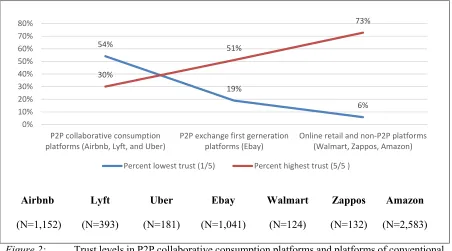
Results: Figure 2 displays the percentage of users rating different platforms with the lowest level of trust
(1/5 on a 5 point Likert scale), as well as the highest level of trust (5/5 on a 5 point-Likert scale). The
findings show that half (54%) of the users rated their trust in P2P collaborative consumption platforms
(Airbnb, Lyft, and Uber) to be on the lowest level, while 19% of users of P2P exchange platforms of the
14
Zappos, Amazon). While 73% of users rated their trust in large online retail services and non-P2P platforms
to be on the highest level, 51% of users of P2P exchange platforms of the first generation did so, and 30%
of users of P2P collaborative consumption platforms.
Airbnb Lyft Uber Ebay Walmart Zappos Amazon
[image:15.595.70.522.189.440.2](N=1,152) (N=393) (N=181) (N=1,041) (N=124) (N=132) (N=2,583)
Figure 2: Trust levels in P2P collaborative consumption platforms and platforms of conventional service provision (N=5,606)
Discussion: The results indicate that P2P collaborative consumption platforms (Airbnb, Lyft, and Uber)
are facing severe trust challenges. Trust levels in these platforms were found to be much lower than in P2P
exchange first generation platforms (Ebay), as well as large online retail services and non-P2P platforms
(Walmart, Zappos, Amazon). The results indicate that trust in the context of P2P collaborative consumption
might be different from trust in more conventional forms of consumption (Belk 2014), as argued in the
theoretical part of this paper.
Since we use data available via Trustpilot.com, we can only display data capturing trust in a
platform provider not in the products or services provided on these platforms. This might have been
confusing because ratings on Airbnb focus on peers offering their apartment, while ratings on Amazon
focus on certain products and dealers alike, and several dealers might offer the same product (we conducted 54%
19%
6% 30%
51%
73%
0% 10% 20% 30% 40% 50% 60% 70% 80%
P2P collaborative consumption platforms (Airbnb, Lyft, and Uber)
P2P exchange first gerneration platforms (Ebay)
Online retail and non-P2P platforms (Walmart, Zappos, Amazon)
15
such more detailed analysis in study2 and study 3 where we distinguish between trust in the platform and
trust in peers in the specific context of P2P collaborative consumption platforms).
2. STUDY TWO: MEDIATION ANALYSIS (THREE MULTIPLE LINEAR REGRESSIONS)
Data Collection and Sample: To assess the potential effects of the management measures reliable
insurance cover, simultaneous reviews, and a large network: many offers worldwide on trust, as well as to
analyze potential mediating effects of trust in the platform, a survey was launched in late December 2014
(a pretest was conducted previously to the main study). It addressed users of the online sharing platform
Airbnb, where private people connect to each other to temporarily rent accommodations (Airbnb 2016).
The links to the web interface of the study were distributed via a mailing list to undergraduate and graduate
students by a commissioned research laboratory of a large German University. Participants were offered
the opportunity to enter a prize draw of vouchers valued at 50 Euros. Whilst the distribution of vouchers
was random, the research laboratory made sure that the overall value of vouchers distributed to the
participants equaled 10 Euros per hour of summed up response effort by students. Finally, a sample of
N=232 Airbnb users was collected. The sample characteristics are illustrated in Appendix 1. Due to the fact
that users of collaborative consumption services tend to be located in a rather young age group, mainly
ranging from teenagers to the age group of mid-thirties (Owyang et al. 2014), one can argue that the sample
is adequate to be used in this study.
Measurement and Data Analysis: First, a filter question was used to identify users of the Airbnb platform.
Non-users were excluded from the study, because they would not be able to make a statement on whether
a trust-building management measure is implemented or not (potential users/current non-users were subject
to study two). To capture the perceived implementation of the three conceptualized trust-building measures
from a user’s point of view, respondents were asked to which extent they agree that respective measures
are well implemented by Airbnb (or not). Each management measure represents a manifest/observed
single-item variable because it captures the implementation of one specific management measure from the
16
measured as latent variables (trust in the platform, trust in peers, etc.). All variables used in this study were
collected on a 7 point Likert scale anchoring 1=´strongly disagree´ to 7=´strongly agree´. They are displayed
[image:17.595.76.525.188.461.2]in Appendix two.
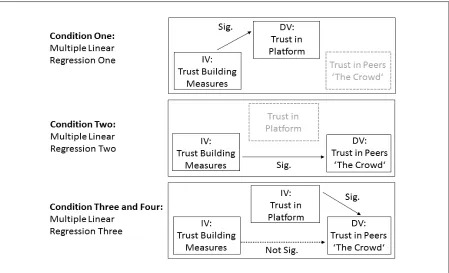
Figure 3: Mediation Analysis based on Baron and Kenny (1986)
Multiple regression analyses were conducted to focus on the potential effects of the trust-building measures
on the two-fold trust construct, while controlling for the familiarity, risk, and trust propensity variables. In
addition, a mediation analysis based on the well-cited guidelines by Baron and Kenny (1986) was
conducted. Thus, in order to test if trust in the platform is mediating all statistically significant effects of
trust-building measures on the trust in peers variable, four conditions of mediating effects as proposed by
Baron and Kenny in their well-cited work from 1986 were tested (Figure 3). To do so, it is necessary to
conduct three hierarchical multiple linear regression analyses. To satisfy the first condition (see hierarchical
multiple linear regression one), the theorized independent variables (trust-building measures and control
variables) must statistically and significantly influence the theorized mediator (trust in the platform). To
17
variables (trust-building measures and control variables) must statistically and significantly influence the
theorized dependent variable (trust in peers). To test the third and fourth condition, an analysis (see
hierarchical multiple regression three) with the theorized independent variables (trust-building measures
and control variables) and the theorized mediator (trust in the platform) on the theorized dependent variable
(trust in peers) needs to be conducted. To verify a full mediation, the effect of the theorized mediator (trust
in the platform) in the dependent variable (trust in peers) must be significant while the effect of the
independent variables (trust-building measures and control variables) on the dependent variable (trust in
peers) must be insignificant.
Prior to the analyses, the means of trust in the platform, trust in peers, familiarity, risk and trust
propensity were calculated to include these multi-scale variables accumulated into the hierarchical multiple
regression (Chudoba et al. 2005). With regard to the parametric nature of the data, it can be reported that a
test of the z-values for skewness and kurtosis revealed data to be of parametric nature to a satisfying level.
Only a few of the items showed values slightly under the recommended thresholds (±1.96) while the impact
of normality effectively diminishes when sample sizes reach 200 cases or more like in this study (Hair et
al. 2010). A check of Pearson’s correlations of all single- and multiple-item constructs revealed that the
highest coefficient was measured between the variables trust in the platform and trust in peers
(0.67/p≤0.000). This is a value well below the threshold. While only values starting from 0.7 might have
an impact on the estimation of regression analysis results, values starting from 0.9 are considered to
illustrate high correlations (Hair et al. 2010). Collinearity is not an issue, since all VIF factors are well
below the common accepted threshold of ≤ 3-10 (in this data set all values are below 1.5).
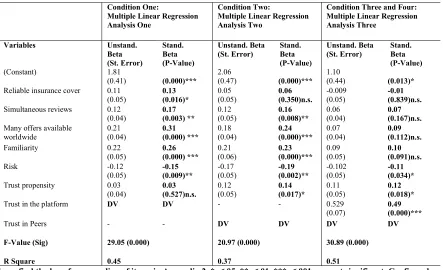
Results: The results of the hierarchical multiple regression analyses one, two, and three are displayed in
Table 1. Condition one (multiple linear regression analysis one): The findings show that all three
trust-building measures were identified to statistically significant influence the dependent variable trust in the
platform. This applies to reliable insurance cover (0.13, p≤0.016*), simultaneous reviews (0.17,
18
control variables familiarity(0.26, p≤0.000***) and risk (-0.15, p≤0.009**) had effects on trust in the
platform. Thereby, those values capturing the effects of trust propensity were not significant (0.03,
p≤0.527n.s). Almost half of the variance of trust in the platform is explained by its predictor variables
(R²=0.45), which shows that the model is well conceptualized. The F-value shows a satisfying level (29.05,
p≤0.000) (Cohen et al. 2003, Hair et al. 2010).
Condition two (hierarchical multiple linear regression analysis two): In this regression, the
dependent variable was trust in peers. Simultaneous reviews(0.16, p≤0.008**), as well as a large network:
many offers worldwide(0.24, p≤0.000***) were found to have a statistically significant effect on trust in
peers. Surprisingly, the values capturing reliable insurance cover (0.06, p≤0.350) were not significant. In
contrast to regression one, all three control variables are shown to influence trust in peers: familiarity (0.23,
p≤0.000***), risk (-0.19, p≤0.002**), as well as trust propensity (0.14, p≤0.017*). The R squared of model
two shows a value of R²=0.37, thus 37 percent of the variance of trust in the peers is accounted for by the
trust-building measures and control variables. The F-value of 20.97 (p≤0.000) indicates the model to be
statistically significant (Cohen et al. 2003, Hair et al. 2010).
Condition three and four (hierarchical multiple linear regression analysis three): In this regression,
trust in peers serves as the dependent variable and all other theorized variables as illustrated in the model
(Figure 1), including trust in the platform, as independent variables. In line with the assumption made by
Baron and Kenny (1986), none of the three conceptualized trust-building management measures had a
statistically significant effect on trust in peers. The same applies to the variable familiarity. Thereby, risk
(-0.11, p≤0.034*), as well as trust propensity (0.12, p≤0.018*) showed statistically significant effects. A
strong coefficient (0.49, p≤0.00) was estimated, revealing a highly positive, statistically significant
relationship between the two theorized elements of the trust construct trust in the platform and trust in
peers. The R square is R²=0.51. The F-value (30.89, p≤0.000) demonstrates that the model shows statistical
19 Condition One:
Multiple Linear Regression Analysis One
Condition Two:
Multiple Linear Regression Analysis Two
Condition Three and Four: Multiple Linear Regression Analysis Three
Variables Unstand.
Beta (St. Error) Stand. Beta (P-Value) Unstand. Beta (St. Error) Stand. Beta
(P-Value)
Unstand. Beta (St. Error) Stand. Beta
(P-Value)
(Constant) 1.81
(0.41) (0.000)***
[image:20.595.77.520.104.374.2]2.06 (0.47) (0.000)*** 1.10 (0.44) (0.013)*
Reliable insurance cover 0.11 (0.05) 0.13 (0.016)* 0.05 (0.05) 0.06 (0.350)n.s. -0.009 (0.05) -0.01 (0.839)n.s.
Simultaneous reviews 0.12 (0.04) 0.17 (0.003) ** 0.12 (0.05) 0.16 (0.008)** 0.06 (0.04) 0.07 (0.167)n.s.
Many offers available worldwide 0.21 (0.04) 0.31 (0.000) *** 0.18 (0.04) 0.24 (0.000)*** 0.07 (0.04) 0.09 (0.112)n.s.
Familiarity 0.22
(0.05) 0.26 (0.000) *** 0.21 (0.06) 0.23 (0.000)*** 0.09 (0.05) 0.10 (0.091)n.s.
Risk -0.12
(0.05) -0.15 (0.009)** -0.17 (0.05) -0.19 (0.002)** -0.102 (0.05) -0.11 (0.034)*
Trust propensity 0.03 (0.04) 0.03 (0.527)n.s. 0.12 (0.05) 0.14 (0.017)* 0.11 (0.05) 0.12 (0.018)*
Trust in the platform DV DV - - 0.529
(0.07)
0.49 (0.000)***
Trust in Peers - - DV DV DV DV
F-Value (Sig) 29.05 (0.000) 20.97 (0.000) 30.89 (0.000)
R Square 0.45 0.37 0.51
Please find the long form wording of items in Appendix 2. *p≤.05, **p≤.01, ***p≤.001, n.s. not significant. Confirmed mediation effects marked in grey.
Table 1: Results of Multiple Regression Analyses One, Two, and Three (Mediation Analysis)
Discussion: All three trust-building management measures reliable insurance cover, simultaneous reviews,
as well as large network: many offers worldwide had a positive effect on trust in the platform. The latter
measure, large network: many offers worldwide, showed the highest standardized beta coefficient, and thus
the strongest positive effect on trust in the platform compared to all other management measures. While
simultaneous reviews, as well as large network: many offers worldwide had a positive effect on trust in
peers, no such effects were found for the trust-building management measures reliable insurance cover.
The results revealed a highly positive, statistically significant relationship between the two theorized
elements of the trust construct trust in the platform and trust in peers.
The results concerning the control variables indicate the following: While familiarity and risk had
considerable effects on both dependent variables tested (trust in the platform and trust in peers), trust
20
Concerning the analysis of mediation effects, the results show that all four conditions as proposed
by Baron and Kenny (1986) are fulfilled in several cases: The relationship between simultaneous reviews,
as well as a large network: many offers worldwide on trust in peers is fully mediated by the trust in the
platform variable. The third management measure reliable insurance cover was not identified to be a
mediator, because there were no statistically significant effects measured on trust in peers. Thus, we can
conclude that trust in the platform is mediating all statistically significant effects of trust-building measures
on the trust in peers’ variable.
Results concerning the control variables reveal that a mediation effect is evident for the variable
familiarity, but not for the other variables. This makes perfect sense, because this variable captures
familiarity with the Airbnb platform itself. Thus, it only seems logical that trust in Airbnb acts as a mediator
in this context.
3. STUDY THREE: ONLINE EXPERIMENT AND ONE-WAY ANALYSIS OF VARIANCE
Data Collection and Sample: To verify the directions of effects found in study two in a different setting,
a second study was conducted to reveal the relationship between the level of trust in the platform and trust
in peers (independent from the first study). An online experiment was carried out among potential
users/current non-users (because a fictitious online sharing platform was presented) at the beginning of
December 2014 (a pretest was conducted previously to the main study). Similar to study one, the link to the
online experiment, which was accessible via an online interface, was distributed via a mailing list to
undergraduate and graduate students by a commissioned research laboratory of a large German University,
resulting in N=462. Because demand of students to participate in the study was very high, access to the
questionnaire had to be closed shortly after the announcement. Following the same procedure as in study
one, participants were offered the opportunity to enter a prize draw of vouchers valued at 50 Euros. Again,
the distribution of vouchers was random, while the research laboratory made sure that the overall value of
21
collected data was only used in this study and in no other research. Please find information on the sample
characteristics in Appendix 1.
Measurement and Data Analysis: A single-factor between-subject-design with three conditions was
supposed to manipulate trust in the platform (control, positive, and negative) of an online sharing platform
and to compare the effects of this manipulation on the level of trust in peers conducting sharing activities
on this platform (see all experimental conditions displayed in Appendix 3).
In the online experiment, participants were first exposed to a brief introduction of the study. Then,
they were randomly assigned to one of the three conditions. The conditions were presented to the
respondents in the form of pictures and a short text, describing the fictitious online sharing platform
ShareNow.com from the point of view of a third party (the online website “review”).To assure consistency
with the logic of study two, it was decided to introduce a fictitious accommodation-sharing platform. The
platform was said to connect private people who wish to lend and rent accommodations for a short period
of time. It was mentioned that ShareNow.com would often be used as an alternative to a hotel booking. All
three texts clearly distinguished between ShareNow.com being the provider of the platform, and peers,
acting on the platform. Three different conditions were developed (Appendix 3). Each condition showed
the same pictures of accommodation. The first condition introduced ShareNow.com and its basic features
but did not make any judgmental statements. It served as the control group condition. The second condition
contained a description that was intended to manipulate trust in the platform ShareNow.com positively
while information on peers acting on ShareNow.com remained neutral. On the contrary, the third condition
was supposed to influence trust in the platform ShareNow.com negatively, while information on peers
acting on ShareNow.com remained neutral. To do so, the descriptions in the positive manipulation were
inverted. After being exposed to one of these conditions, each of the participants was asked to answer items
measuring trust in the platform ShareNow.com(Pavlou and Gefen 2004), trust in peers conducting sharing
22
Two one-way analyses of variance (ANOVA) were conducted, one to verify manipulation checks
and one to test the research question. Because Levene’s test (p<.000) did not verify homogeneity of variance
in both cases, the authors chose to conduct Tamhane’s T2 tests for post-hoc comparisons. This is a
conservative pairwise comparison procedure, which is particularly feasible in case the population of
variance is of heterogonous nature (Field and Hole 2003).
Prior to the analyses, the means of all four items to measure trust in the platform (Pavlou and Gefen
2004) and of all four items to measure trust in peers (Pavlou and Gefen 2004) were calculated for all three
experimental conditions. A check of the z-values for skewness and kurtosis revealed data to be of a
parametric nature to a satisfying level, as only a few items showed values slightly underneath the
recommended thresholds (±1.96) and ANOVA is considered to be quite robust against normality
assumption, in particular if violations are modest (Hair et al. 2010). A check of Pearson’s correlation
between the multi-item variables trust in the platform and trust in peers revealsa coefficient of 0.74 (p≤.01).
This is still acceptable because only values starting from 0.9 are considered to indicate high correlations
(Hair et al. 2010).
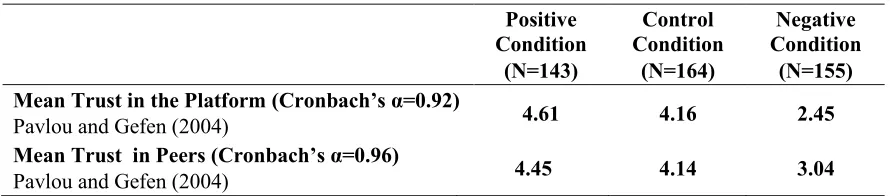
Positive Condition
(N=143)
Control Condition
(N=164)
Negative Condition
(N=155) Mean Trust in the Platform (Cronbach’s α=0.92)
Pavlou and Gefen (2004) 4.61 4.16 2.45
Mean Trust in Peers (Cronbach’s α=0.96)
[image:23.595.74.519.468.566.2]Pavlou and Gefen (2004) 4.45 4.14 3.04
Table 2: Means of Trust in the Platform and Trust in Peers Items for each Condition
Results: Manipulation Checks (see Table 2): The results reveal a significant difference among conditions.
The group exposed to the positive trust in the platform manipulation showed the highest mean value of
M=4.61 (SD=1.16) followed by a value of M=4.16 (SD=0.77) for the control condition, and M=2.45
(SD=1.06) for the condition with the negative trust manipulation (F2,459 = 195.87, p≤.00, η²=0.46). Results
23
test confirms a statistically significant difference between the mean of all groups (each test p≤.00). Thus,
all conditions were manipulated as intended.
Main findings: The second ANOVA analysis revealed a statistically significant difference of the trust in
peers values among all three conditions (F2,459 = 71.07, p≤.00, η²=0.24). Results indicate that 24 percent of
the total variance is accounted for by the treatment effect. The trust in peers level showed a mean of M=4.14
(SD=0.94) measured in the control group, a mean of M=3.04 (SD=1.18) in the group previously exposed
to the negative manipulation, and a mean of M=4.45 (SD=1.11) in the group exposed to the positive
manipulation. Tamhane’s T2 test shows that the means of all groups are statistically and significantly
different from each other. The group with a low level of trust in the platform was found to perceive the
level of trust in peers as significantly lower compared to those exposed to the control condition (p≤.00) and
the group with a high level of trust in the platform (p≤.00). Furthermore, the group with a high level of trust
in the platform showed significantly higher levels oftrust in peers compared to those exposed to the control
condition (p=.03) and the group with a low level of trust in the platform(p≤.00).
Discussion: Study three replicates the effect as shown in study two for users in the setting of an online
experiment and among potential users/current non-users of a fictitious accommodation-sharing platform.
In fact, this experimental study reveals a statistically significant relationship between the two variables trust
in the platform and trust in peers. Thus, these findings support the fact that trust in the context of
collaborative consumption is a hierarchical, two-fold construct, as theorized.
It is interesting to notice that the levels of trust in the platform measured in the control group
differed considerably stronger to the group previously exposed to the negative manipulation than to the
positive manipulation. Thus, it can be concluded that it is much easier to manipulate trust in the platform
negatively than to manipulate it positively. In other words, users’ perceptions are strongly influenced by
negative rather than by positive information on the trustworthiness of a provider. Thus, negative
24
OVERALL DISCUSSION OF RESULTS AND IMPLICATIONS FOR RESEARCH AND MANAGEMENT
Summary of results in a nutshell: Research question one addresses the difference of digital trust in P2P
collaborative consumption platforms compared conventional platforms and services. Drawing on relevant
theory, we identify four factors of differentiation between these different services. We then use data
available via Trustpilot.com (N=5,606). The findings indicate that trust in P2P collaborative consumption
platforms (Airbnb, Lyft, and Uber) is much lower than in P2P exchange first generation platforms (Ebay),
as well as large online retail services and non-P2P platforms (Walmart, Zappos, Amazon). We conclude
that the management of trust in the context of in P2P collaborative consumption platforms is a real
challenge.
In research question two, we were curious about the effects of the management measures reliable
insurance cover, simultaneous reviews, and a large network: many offers worldwide on digital trust in the
context of P2P collaborative consumption platforms. We introduce theoretical thoughts on the potential
trust-building power of these management measures and argue that they seem particularly important in the
context of P2P collaborative consumption platforms. To address research question two, we conducted a
survey among users of the online sharing platform Airbnb (N=232). We found that all three trust-building
management measures had a positive effect on trust in the platform, which in this context refers to trust in
Airbnb. Thereby, the management measure large network: many offers worldwide showed by far the
strongest effects on trust in the platform. In addition, we found that two management measures positively
influenced trust in peers. This refers to simultaneous reviews, as well as a large network: many offers
worldwide. The control variables had surprisingly high effects on the dependent variables.
With research question three, we refer to the potential hierarchical nature of the digital trust
construct, and potential mediating effects of trust in the provider in the context of P2P collaborative
consumption platforms. We introduce a theoretical background arguing that trust is a twofold and
25
two and from study three. In study two, a survey among users of the online sharing platform Airbnb (N=232)
was conducted, and in study three, an online experiment among current non-users/or potential users of a
fictitious online sharing platform (N=462). Findings revealed a highly positive, statistically significant
relationship between the two theorized elements of the trust construct trust in the platform and trust in
peers. The online experiment confirms this relationships to be causal. A mediation analysis based on Baron
and Kenny (1986) reveals that the relationship between simultaneous reviews, as well as a large network:
many offers worldwide on trust in peers is fully mediated by the trust in the platform variable. This means
that trust in the platform is mediating all statistically significant effects of trust-building measures on the
trust in peers’ variable. These findings support the fact that trust in the context of collaborative consumption
is a hierarchical, two-fold construct.
Research and Theory Implications: Platforms evolve and create different logics over time. This leads to
intra- and inter-platform differences (Henfridsson and Bygstad 2013, Tiwana 2015, Yoo et al. 2010).
Theoretical and empirical findings let us assume that P2P collaborative consumption platforms have
different characteristics compared to the (first generation) of P2P exchange platforms (e.g., Ebay), as well
as online retail services and non-P2P platforms (e.g., Walmart, Zappos, Amazon). Thus, existing knowledge
about digital trust might not simply be transferred to novel contexts such as P2P collaborative consumption
platforms, but needs to be adjusted.
In this regard, we tested three potential trust-building management measures, which seem
particularly important in the context of P2P collaborative consumption platforms. They were all found to
positively influence trust in the platform provider. The strongest effect had the measure large network:
many offers worldwide. Indeed, the connection between a large size of a marketplace and trust been made
previously (Jarvenpaa et al. 2000, Son et al. 2006) (even though not frequently). It seems like in this
particular context, network effect become even more crucial (Sundararajan 2016). The dyad of relationships
known from many conventional service provision is extended to a triad of relationships (this is in line with
26
respective collaborative consumption platforms (Pavlou and Gefen 2004), sometimes labeled as ‘the crowd’
(Sundararajan 2016). Due to the fact that private people usually offer services on a much smaller scale
compared to commercial providers (such as one private person, one room on Airbnb, for three weeks a
year), a larger network is crucial to assure that demand and supply are matched successfully. This is one
major difference between P2P collaborative consumption and other platforms.
Furthermore, we argue that social aspects and individual characteristics become more relevant in
this particular context. This is, among others, supported by the fact that trust propensity, which refers to the
general propensity of people to trust a person or thing (Lee and Turban 2001, Mayer et al. 1995), as well as
the other control variables empirically tested in this paper had strong effects. Furthermore, the need to
implement simultaneous reviews on collaborative consumption platforms might be more relevant since
biased peer review behavior seems more likely in a context, in which people build social relationships.
Indeed, users of P2P collaborative consumption services often meet in person and the intensity of social
interaction among peers is stronger in many collaborative consumption contexts compared to the more or
less anonymous transactions carried out via conventional services such as Ebay.
Furthermore, one can derive interesting theory and research implications from the findings
concerning the two-fold and hierarchical nature of the trust construct, as well as the fact that trust in the
platform acts as a mediator: While much of previous research has been addressing the co-production or the
co-creation of value (Lang et al. 2015, Vargo and Lusch 2004), most researchers have been assessing the
links between these concepts to the organizational benefits of the firm (Mende and Van Doorn 2014). There
is very little research addressing forms of consumption that do take place among a network of peers (or ‘the
crowd’), while the provider (or firm) has the role to facilitate the frame conditions (Bardhi and Eckhardt
2012). While one might have assumed that trust in other peers might be the most relevant construct in the
model, the findings presented here surprisingly indicate that trust in the platform is the focal and central
construct. One might conclude that a valuable trust infrastructure does not solely build on a community of
27
collaborative consumption services provided by the government or legal environment probably might be a
key explanation. Based on our knowledge that individuals are seeking some form of institutional security
(Fang et al. 2014, Zucker 1986), we can argue that this might be the reason that there is a shift towards a
consumer’s need for institutional arrangements in P2P collaborative consumption. In this study it becomes
evident as trust in the platform provider.
While some economists tend to use the concepts ‘trust’ and ‘P2P ratings’ interchangeably, this
research indicates that the platform provider plays a crucial role in the trust-building process (Slee 2016).
We argue that trust is more than ‘P2P ratings’. Reducing digital trust solely to the P2P level is too simple.
This is in line with previous research of Zervas et al. (2015). The authors find that almost 95% of Airbnb
listing show an average ‘P2P rating’ of either 4.5/5 or 5/5 stars. In case ‘P2P ratings’ would be the only
indicator for trust, this would mean that there is total trust in almost all peers acting on Airbnb. The authors
argue that social bias might play a role in review behavior of Airbnb guests and hosts (Zervas et al. 2015)
(this is another argument for the fact that simultaneous reviews should be implemented). In line with this,
we argue it might be important to use alternative forms of trust measurement (see Appendix 2 for all trust
measures) and to consider all parties involved in a transaction (including the platform provider) when
aiming at understanding digital trust in the context of collaborative consumption (Slee 2016).
Management Implications: One can derive interesting implications for managers of P2P collaborative
consumption platforms from our findings on the trust-building management measures. They provide
hands-on knowledge and support managers in implementing effective marketing activities (Lamberthands-on and Rose
2012) to address different stakeholder groups, including current users, and potential users/current non-users.
Indeed, all three trust-building management measures should be implemented to foster the trust of users
and potential users in them as a platform provider. As study two captures the perceived implementation of
measures from a user’s point of view, managers should recognize that in some cases it might not be
sufficient to implement a respective measure, but to communicate it in an easily and visible manner on the
28
simultaneous reviews should be actively marketed on the website. By now, users only gain awareness about
how these measures are implemented during the booking process. Most importantly, we found that network
effects have extremely strong effects on the trust construct. Building a large network, by acquiring and
maintaining users that would like to book accommodation, as well as those who would like to offer
accommodation to peers (or other sorts of services) is crucial. Since we found mediation effects, managers
of collaborative consumption services might think about actively marketing the platform to increase the
user base.
Furthermore, one can derive interesting management implications from the findings concerning the
two-fold and hierarchical nature of the trust construct: managers might profit from the strategic
management of spill-over effects from trust in them as a provider to trust in peers. In fact, results indicate
that users might perceive a feeling of high trust when conducting sharing activities, even though not all
peers on the sharing platform seem trustworthy to them (Gilbert and Behnam 2013). Furthermore, these
results suggest that users might trust using a certain online sharing platform first, for instance, compared to
another online sharing platform, or to a conventional non-sharing service. Once they do so, they might visit
the online sharing platform and review different offers by different peers in a second step. Thus, one can
assume that brand effects of the platform provider play an important role in the trust-building context
(Sundararajan 2016). Managers must focus on building a strong brand, as the trust in the brand of their
success is the key to success.
In addition, findings reveal that consumers are strongly influenced by negative information, rather
than positive information on the trustworthiness of a sharing platform provider. Thus, managers should
prioritize management solutions aimed at the prevention of any negative trust experience, as these might
lead to severe impacts and the long-term refusal of respective collaborative consumption services.
Recently, one can identify many start-ups that serve the interface of online sharing platforms and
29
TrustCloud.com and Trusttribe.com aim at the pooling of reputational capital of peers using online sharing
platforms. In contrast, Trustpilot.com (we used their data in study one) offers the possibility to strategically
manage customer relationships based on trust by focusing on a rating system on the level of whole
organizations or P2P platform providers, rather than solely on individual users or peers. These
developments reflect the demand for more information to be able to build trust in platform providers and
not solely in peers. It is crucial consider all parties involved in the digital trust-building process.
One should also pay attention to the important implications that findings hold for managers of
conventional services, being threatened by arising competitors or service offers of collaborative
consumption. In the context of online accommodation-sharing platforms, this might apply to large hotel
chains. In the context of ride-sharing services such as Lyft or Uber, this applies to official cab companies.
Managers in these industries can take advantage of their knowledge about the power of trust in platform
providers and effectively market the trust advantage that might be evident to them as conventional service
providers.
Limitations and Future Research: Even though this study holds important contributions and implications
for researchers and managers alike, some limitations need to be discussed. First, in study two and study
three, collaborative consumption services in the form of online sharing accommodation platforms have
been evaluated. Future research should assess trust-building measures and the trust concept and in different
industries. This research solely investigated measures that can be implemented on a manager’s
responsibility. In regard to simultaneous reviews, future research might investigate the impact of the actual
content and nature of these ratings on trust, which is the responsibility of the peers of a sharing platform.
Based on the essential role of trust in the context of collaborative consumption, further research conducted
30
APPENDIX 1: Sample Characteristics Study Two and Study Three
Variable Specification Study Two
Airbnb (N = 232) Fictitious Accommodation Study Three Sharing Platform (N = 462)
Gender Male 51.6 45.0
Female 48.4 55.0
Age 18-20 6.4 7.4
21-25 53.2 49.1
26-30 32.6 35.0
31+ 7.8 8.5
Education (Highest Degree)
None or High School 44.5 43.7
Apprenticeship 4.8 9.3