Towards Secure and Practical MACs for Body Sensor Networks
∗Zheng Gong1, Pieter Hartel1, Svetla Nikova1,2 and Bo Zhu3 1Distributed and Embedded Security Group, Faculty of EWI,
University of Twente, The Netherlands
{z.gong, pieter.hartel, s.nikova}@utwente.nl
2Katholieke Universiteit Leuven, Dept. ESAT/SCD-COSIC, Kasteelpark Arenberg 10, B-3001 Heverlee, Belgium
3Department of Computer Science and Engineering, Shanghai Jiaotong University, China
Abstract
Wireless sensor network (WSN) commonly requires lower level security for public informa-tion gathering, whilst body sensor network (BSN) must be secured with strong authenticity to protect personal health information. First in this paper, some practical problems with the Mes-sage Authentication Codes (MACs), which are suggested in the current security architectures for WSN, are reconsidered. The analysis exploits the fact that the recommended MACs for WSN, e.g., TinySec (CBC-MAC), MiniSec (OCB-MAC), and SenSec (XCBC-MAC), are not exactly suitable for BSN. Particularly a dedicated attack is elaborated on the XCBC-MAC. Considering the hardware limitations of BSN, we propose a tunable lightweight MAC based on thePRESENT block cipher, which is namedTuLP. A 128-bit variantTuLP-128is proposed for a higher resis-tance against internal collisions. Compared to the existing schemes, our lightweight MACs show better performance and higher energy-efficiency at lower memory usage.
Key words.Message authentication code, Body sensor network, Resource-constrained implementation.
1 Introduction
Body sensor network (BSN, also called wireless medical sensor network) [34], which can be devel-oped from wireless sensor network (WSN), is a key technology for long term monitoring of biological events or any abnormal condition of patients for realizing the Ambient Assisted Living (AAL) vision [1]. Although the fact that large groups of patients already carry individually implantable or wearable monitoring equipments, a biosensor array (also implantable or wearable) offers a more accurate status than one isolated device. To offer more personalized health care to elderly or disabled patients, the gathered health information will instantly be sent to the server of a clinic or hospital, which will be monitored by doctors (or nurses) to prevent the occurrence of fatal events. Since BSN nodes are either
∗The first author acknowledges the financial support of SenterNovem for the ALwEN project, grant PNE07007. The last author is supported by NSFC (No.60803146) and National Basic Research Program (973) of China (No.2007CB311201).
worn or implanted by a patient, the power consumption should be low to minimize radiation and max-imize durability. Moreover, BSN sensors also have limited computational ability and memory. These factors are important not only in the implantable but also in the external sensor settings because they determine how “hidden” and “pervasive” the sensors are. Table 1 shows the specifications of typical BSN nodes in practice.
Traditional WSNs are used to collect public information in the environment, such as temperature, humidity, fire alarm, etc. Since monitored health data from a person with BSN will be a part of per-sonal Electronic Health Record (EHR), a higher level of assessment and protection is required for BSN communications. The existing EHR standards (ISO 27001, 27799, openEHR/ISO 18308, etc.) oblige BSN to be secured with strong cryptography. However, strong cryptography entails more resources. Considering the highly constrained resources that a BSN node can have, a better trade-off has to be found such that the security is maximized, while minimizing the resources. Unfortunately, because of the heterogeneity of BSN, the secure protocols for static networks might not applicable for BSN. Also the methods proposed forad hoc networks such as asymmetric cryptography techniques would be costly for BSN applications. Due to the constraints in power consumption and computational ability, it remains a great challenge to design secure and practical cryptographic primitives which are both time and resource efficient for BSN applications.
TI Node1 MICAz Node2 MyriaNed3
CPU 16bit, 8MHz 8bit, 16MHz 16bit, 32MHz
RAM 2KB 4KB 8KB
Flash Memory 64KB 128KB 128KB
Voltage 1.8∼3.6v 2.7∼3.3v 1.6∼3.6v
OS TinyOS TinyOS MyriaCore
Table 1: The specifications of typical BSN nodes.
Related Work. To ensure the authenticity and integrity of WSN communication, security protocols via different Message Authentication Codes (MACs, different from the term “Medium Access Con-trol”) are proposed. MAC is a symmetric-key primitive that inputs a key-message pair to produce a unique tag. The integrity and the authenticity of the message are protected by the tag and the key respectively. One widely used method is the Security Protocol for Sensor Networks (SPINS) [29], which consists ofµTESLA (micro version of the Timed, Efficient, Streaming, Loss-tolerant Authen-tication) and SNEP (Secure Network Encryption Protocol) for broadcasting messages. Following SPINS, many lightweight security architectures have been proposed for WSN, e.g., TinySec [22], SenSec [25] and MiniSec [26]. All these architectures considered which MAC will be suitable in the WSN packet/message authentication. For instance, TinySec and MiniSec recommend the well-known CBC-MAC [22] and OCB-MAC [26] respectively, whilst SenSec uses a novel scheme called XCBC-MAC [25]. All the recommended XCBC-MACs are based on the operation modes of block cipher, and suggest 32-bit length tag for WSN. In contrast, since dedicated hash functions (such as MD5 and SHA-1) are primarily designed to be collision resistant for preventing forgery of digitally signed documents, it was exploited that MACs based on hash functions (e.g., HMAC [3]) might be less competitive than
1Texas Instruments. http://focus.ti.com/lit/ds/symlink/msp430f149.pdf.
2Crossbow. http://www.xbow.com/products/Product pdf files/Wireless pdf/MICAZ Datasheet.pdf. 3ALwEN project. http://www.atmel.com/products/AVR/default xmega.asp.
block-cipher-based ones for highly constrained devices [14]. Nevertheless, it is recognized by the BSN research community that authentication in BSN protocols is usually for short messages [18] in network processing. This property implies that the candidates of MACs, which focus more on the one-wayness than on the collision-resistance, will be more practical for BSN applications.
Since typical BSN nodes have limited resources, an appropriate security level should be imposed to realize authenticity and confidentiality in applications. Intuitively, 32-bit security level for WSN is not suitable even for the one-wayness of the transmitted data in BSN. As a comparable case for sensitive data authenticity, the authentication of Electronic Funds Transfer in the US Federal Reserve System uses a 64-bit CBC-MAC, and additionally a secret value for IV is daily changed and safely kept by the member banks. In other applications, certain authorities even recommended to implement a MAC with a longer length of 128-bit. Although an appropriate security level for BSN applications will be ensured case by case, but 64-bit security bound is widely-accepted for resisting sensible threats in such constrained devices. As power and RAM are normally the most constrained resources on a BSN node, the design of a MAC should consider applicable trade-offs towards time and resource effi-ciency in practice.
Our Contributions. The contributions of this work are three-fold. Firstly, we describe some prac-tical problems of the MACs recommended in popular security architectures for WSN, such as Tiny-Sec (CBC-MAC), MiniTiny-Sec (OCB-MAC) and SenTiny-Sec (XCBC-MAC). Especially we demonstrate an existential forgery attack on XCBC-MAC, which implies that the authenticity of SenSec is broken. Secondly, a performance comparison is presented on efficient MACs from different design principles, e.g., CBC-MAC, OCB-MAC, ALPHA-MAC [16]. Thirdly, taking into account the requirements for authenticity in BSN, we propose a tunable lightweight MAC based on thePRESENTblock cipher [13], which is namedTuLP. The structure ofTuLPis inspired by the generic construction ALRED [16]. A 128-bit variantTuLP-128 is proposed for the higher resistance against internal collisions. Compared to the existing schemes, our lightweight MACs show a better performance on MICAz node with less memory usage in ROM/RAM, and also energy-efficient in the level of gate equivalents. Organization. The remainder of this paper is organized as follows. Section 2 describes some defi-nitions and notions which will be used throughout the paper. The problems with the MACs recom-mended in the proposed security architectures for WSN are described in Section 3. Section 4 gives a performance comparison of some efficient MACs for BSN authenticity. The designs ofTuLPand
TuLP-128follow in Section 5 along with a detailed analysis of the security and the performance. Section 6 concludes the paper.
2 Preliminaries
Here we review some definitions and primitives which will be used in the following sections. Exclusive-or (xExclusive-or) will be denoted by⊕.a||bdenotes the concatenation of two stringsaandb. LetMandKbe the message and key spaces respectively.
2.1 Cryptographic Primitives
ALRED.The ALRED construction is a generic MAC design introduced by Daemen and Rijmen [16]. The ALRED construction consists of the following steps:
1. Initialization: Fill the state with an all-zero block and encrypt it with a full encryptionEwith an authentication keyk.
2. Chaining: For each message, iteratively perform an injection layout to map the bits of the message to the same dimensions as a sequence ofrround keys ofE. Then apply a sequence of
rtimes round function ofEto the state by using the output of the injection layout as the round keys.
3. Finalization: Apply a full encryptionEwith the authentication keykto the final state. The tag is the first`mbits of the output.
Based on the ALRED construction, Daemen and Rijmen also presented two paradigms called ALPHA-MAC [16] and Pelican [17], by using AES as the underlying block cipher. Recently, many papers exploited that ALPHA-MAC and Pelican might be threatened under the internal collisions [21], the side-channel attack [9] and the impossible differential analysis [33]. We note that all those crypt-analyses are based on the internal structures of ALPHA-MAC and Pelican, which do not endanger the security of the generic construction of ALRED.
PRESENT.At CHES 2007, Bogdanov et al. proposed an ultra-lightweight block cipher which is namedPRESENT[13]. PRESENTis an example of an SP-network and consists of 31 rounds. The block length is 64 bits and two key lengths of 80 and 128 bits are supported. The hardware require-ments forPRESENTare competitive. Using theVirtual Silicon(VST) standard cell library based on UMC L180 0.18µm 1P6M Logic Process (UMCL18G212T3), PRESENT-80 and PRESENT-128 are estimated to require 1570 and 1886 gate equivalents, respectively [13]. Since Bogdanovet al. do not expect the 128-bit key version to be used until a rigorous analysis is given, the termPRESENT
means 80-bit key version in hereafter. A high-level algorithm of the round function ofPRESENT
is depicted in Figure 1: First, 64-bit input of the round function is xored with the subkey ki. The total32subkeys (k32for whitening after the final round) are derived from the key schedule algorithm over an 80-bit secret key. Next, 16 identical4×4-bit S-boxesSare used in parallel as the non-linear substitution layer. Finally, a bit-oriented permutation, which will be extremely hardware-efficient, is executed to provide diffusion.
Figure 1: Round function of PRESENT [13].
Further details about the specification ofPRESENTcan be found in Bogdanovet al. [13], in-cluding basic results of the differential and linear cryptanalyses, which can be summarized as follows. Theorem 1 Any five-round differential characteristic of PRESENThas a minimum of 10 active S-boxes.
Theorem 2 Let ²4R be the maximal bias of a linear approximation of four rounds of PRESENT. Then²4R≤2−7.
Based onPRESENT, Bogdanovet al. [14] propose some low-energy block-cipher-based hash functions (e.g., single and double block length constructionDM-PRESENTandH-PRESENT re-spectively) which are more practical than dedicated or AES-based hash functions in highly constrained devices, such as RFID tags. Recently, many cryptanalysis results have been given on the PRESENT block cipher. Wang [32] presents a new differential attack on 16-roundPRESENT with the com-plexities of about264 chosen plaintexts, 232 6-bit counters, and264 memory accesses. Collard and Standaert [15] show a statistical saturation attack against 24PRESENT-80. The saturation attack depends on a simplified key schedule algorithm such that the same subkey should be used in each round.O¨zenet al. [27] provide a related-key rectangle attack on 17-roundPRESENT-128. However the known attacks on full PRESENT with 80-bit keys, without any simplification, so far are bounded with 16 rounds [32].
2.2 Authentication Modes in BSN
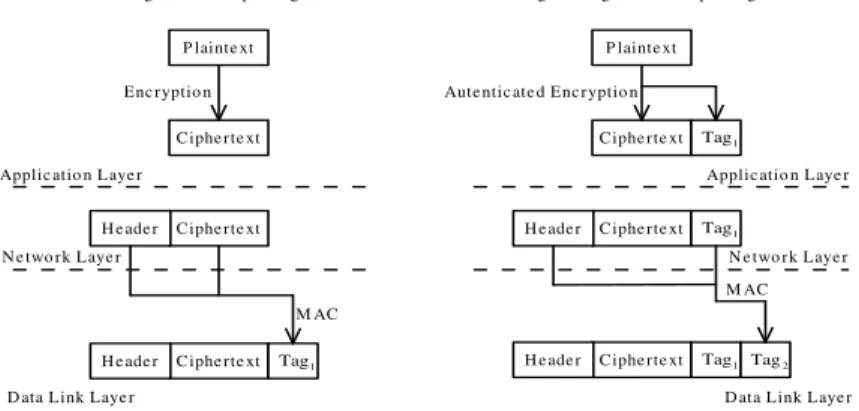
A typical BSN involves three kinds of communication: off-body communication, on-body commu-nication, and in-body communication. For protecting both authenticity and confidentiality, the data payload of each packet in a BSN should be encrypted, and then authenticated with the header (includes nonce, source, destination and group ID, etc.) by the sender before it is sent to the receiver. Figure 2 shows two different paradigms to build up a secure packet with the properties of authenticity and con-fidentiality. The left paradigm is borrowed from Rogaway’sAuthenticated Encryption with Associate Data[30]. If the message is long, the authentication includes the full ciphertext will be costly.
P lainte xt
C iphe rte xt Tag1 Aute ntic ate d Enc ryptio n
C iphe rte xt Tag1 H e ade r
C iphe rte xt Tag1 Tag2 M AC Applic atio n Laye r
N e two rk Laye r
D ata Link Laye r H e ade r P lainte xt C iphe rte xt Enc ryptio n C iphe rte xt H e ade r
C iphe rte xt Tag1 M AC Applic atio n Laye r
N e two rk Laye r
D ata Link Laye r H e ade r
Sho rt m e s s age e ffic ie nt paradigm Lo ng m e s s age e ffic ie nt paradigm
Figure 2: Two authentication paradigms for BSN.
The right paradigm trades off the overhead on an extra tag to avoid the authentication costs on the full ciphertext. Letkbe an authentication key shared by a sender and a receiver. When a packet has arrived, the receiver first checks if MAC(k,Header,Tag1) =Tag2. If it does not hold, the receiver will just ignore the packet without decryption. Otherwise the receiver checks the validity of the ciphertext through the equation MAC(k,Ciphertext) =Tag1, and then decrypts it to obtain the valid plaintext. If the underlying authentication encryption and MAC function are secure, Tag2protects the authenticity and integrity of the header and Tag1, whilst Tag1 protects the original plaintext.
A widely-known result [6] states that communicating a single bit of data consumes several orders of magnitude more power than executing a basic 32-bit arithmetic instruction. If the message is short, one can choose Rogaway’sAuthenticated Encryption with Associate Dataparadigm since the communication costs on the extra tag will be larger than the authentication which includes the full ciphertext. Otherwise, the right paradigm might be efficient since both the sender and the receiver require less computation on authenticating with a long ciphertext. No matter what authentication mode is opted, the security and performance of the underlying MAC function will play a pivotal role for BSN security.
3 Problems with the MACs Recommended for WSN
For ensuring the security of the communication in WSN, many schemes have been proposed for the different layers of WSN. Basically, data link layer security is fundamental for other security prop-erties in the higher layers, e.g., secure routing in network layer and non-repudiation in application layer. In practice, there exist three widely-cited schemes for the security of data link layer, which are TinySec [22], SenSec [25], and MiniSec [26]. For confidentiality, all the three schemes suggest using a lightweight block cipher for data encryption. But for authenticity, three totally different MAC functions are recommended, which are claimed to be suitable for WSN. In this section, we will give a comparative analysis of the three recommended MAC functions in the three schemes [22, 25, 26]. CBC-MAC. In TinySec [22], Karlof et al. suggest to use CBC-MAC [4] as the underlying MAC function. CBC-MAC uses a cipher block chaining construction for computing and verifying MACs. The first advantage of CBC-MAC is simplicity, as it relies on a block cipher which minimizes the number of cryptographic primitives that must be implemented on BSN nodes with a limited memory. CBC-MAC is provably secure as well [8]. For BSN applications, the disadvantage of CBC-MAC is that independent keys should be used for encryption and authentication. Furthermore, the standard CBC-MAC construction is not secure for variable length messages. Adversaries can forge a MAC for certain messages. To preserve the provable security for variable length messages, a variant of CBC-MAC uses three different keys for the authentication [11]. The three-key construction solves the variable length message problem, and avoids unnecessary message padding, but it raises another typical risk with respect to the key management in BSN. Compared to the one-key constructions, the extra keys will impose a heavy burden on the key generation, distribution and storage, which indicates that CBC-MAC might be less practical for BSN applications.
XCBC-MAC.The XCBC-MAC algorithm proposed by Liet al. in [25] is part of the authenticated encryption mode for SenSec. LetkAandkE be the authentication key and the encryption key, respec-tively. Let messageM =m1||m2||...||mt. Figure 3 depicts the construction of XCBC-MAC. In gen-eral, the XCBC-MAC algorithm can be viewed as a variant of the two-key CBC mode. Unfortunately, we have found a practical existential forgery on XCBC-MAC by implementing a chosen-message at-tack. One can easily build two different messages with the same tag under the XCBC mode. The forgery can be described in the following steps:
E E E E
) IV ( E k E 1 m 1 c E k kE kE kA IV m2 2 c Padding Tag E E k t c t m
Figure 3: The XCBC algorithm proposed in SenSec [25].
2. Next,Arequests the encryptions on the two different blocksEkE(IV)⊕m1andEkE(IV)⊕m01
in the XCBC mode. The ciphers will beEkE(m1)⊕IV andEkE(m01)⊕IV.AobtainsEkE(m1)
andEkE(m0
1)by xoring the ciphers withIV.
3. Finally,Aarbitrarily chooses a padding messageM0, and then outputs two different messages
M1, M2, whereM1 =EkE(IV)⊕m1||EkE(m1)||M0andM2 =EkE(IV)⊕m10||EkE(m01)||M0. E E E E
) IV ( E k E 1 ) IV ( m E E k ) ( IVEkE m1 E k kE kE kE IV EkE(m1) 1 m 0 0Figure 4: An existential forgery under the XCBC-MAC.
Based on the above attack, the two different messages M1 andM2 will have the same MAC since both the prefixesEkE(IV)⊕m1||EkE(m1) andEkE(IV) ⊕m01||EkE(m01) produce the same
zero output to the next step. The attack is difficult to detect since the prefixes are computationally indistinguishable from a randomized query. The attack on XCBC-MAC cannot be avoided by a ran-domized IV, since IV should be a public-known value and all nodes use the same IV. If IV is frequently changed, all nodes should be synchronized, otherwise the receiver cannot correctly decrypt the packet from the sender. Since synchronization is costly in BSN, it is impractical for an IV to be distributed just for one-time usage. Due to the above attack, the XCBC-MAC algorithm proposed in SenSec [25] is insecure under the chosen message attack and should be abandoned in any circumstance of authen-tication.
OCB-MAC. In MiniSec [26], Luket al. suggest using the OCB mode [31], which is an efficient authenticated encryption scheme, as the MAC function for message authenticity and integrity. Since its publication OCB has received some attention, but little cryptanalysis. We believe this has two reasons. First, a proof of security seems to imply that cryptanalysis is useless. The proof is quite complicated and analysis of the proof details is restricted to those people who are well-versed in formal proof techniques. Second, the OCB mode has been patented. There is a significant cost, both directly and indirectly, associated with using a patented algorithm. The last reason is the main reason for the lack of rigorous cryptanalysis. Spending time on OCB will only help the patent-holders to sell their licenses without any further compensation to the cryptanalyst. Moreover, Ferguson also presents a collision attack on OCB with arbitrary length messages [19]. To keep adequate authentication security of OCB, one has to limit the amount of data that the MAC algorithm processes. Since the offset values used in OCB require extra time/memory costs with respect to the message length, the area and the power consumption will be increased for the computation and storage. The above reasons are relevant to real-life applications on BSN, and cast doubts on the wisdom of using OCB.
4 A Comparison of Some Practical MACs for BSN
We have shown that the MAC functions proposed for WSN in the literature are not exactly suitable for BSN. Many different MAC Functions have been proposed in the past decades. Driven by the highly constrained resources of BSN node, the performance and security of those candidates should be rigorously examined before they are implemented. Basically, there are three approaches towards designing MAC functions. The first is to design a new primitive from scratch, such as UMAC [10]. The second is to define a new mode of operation for existing primitives. Such as variants of encryption modes of block ciphers: CBC-MAC [4] and OCB-MAC [31]; Or variants mode of hash functions: HMAC/NMAC [3, 7]. The third approach, which can be viewed as a hybrid of the first and the second approach, is to design new MAC functions using components of existing primitives, such as ALPHA-MAC [16].
Based on the security and performance requirements of BSN, we will give a detailed compar-ison of some popular MAC candidates, which are claimed to be efficient from the three different approaches. To be fair, all MACs based on block cipher use AES-128 as the underlying block cipher, as well as input messages can be of arbitrary length. The timing of the keysetup and the message processing are estimated from the performance data given by the NESSIE consortium [5] (Pentium III/Linux Platform), such that the message processing time is measured in cycles/byte, while the key-setup and keykey-setup + finalization are measured in cycles. The area ingate equivalents(GE) can be calculated from two parts: the area of the underlying component or primitive, and the area for internal operations and storages. In order to compare the area requirements independently it is common to state the area in GE, where one GE is equal to the area which is required by two-input NAND gate with the lowest driving strength of the appropriate technology [28]. By following the same method [14, 18], we also use theVirtual Silicon (VST) standard cell library based onUMC L180 0.18µm 1P6M Logic Process(UMCL18G212T3) to estimate each area in GE of the candidates. According to the related experiments [18], the area GE for AES-128 encryption is estimated to be 3400 GE, as well as 64-bit storing and exclusive-or require 512 GE and 170 GE, respectively.
For chips built with CMOS technology, the power consumption is the sum of two parts: the static and the dynamic costs. The static part is roughly proportional to the area, namely the larger size of the chip the larger energy costs, whilst the dynamic part is proportional to the operating frequency. For
CBC-MAC [11] OCB-MAC [31] ALPHA-MAC [16] HMAC/SHA-1 [3] Based on cipher mode cipher mode AES components hash mode
Keysetup 616 644 1032 1346
Finalization 1440 1444 416 3351
Message processing 26 31 10.6 15
Area in GE (estimate) 4764 6812 4424 8120 [18]
Table 2: The comparison of some practical MAC functions.
the devices with a lower operating frequency, the static power consumption is the most significant. For this reason, the area of gate equivalents is often used as a simplified benchmark for energy efficiency. The comparison in Table 2 shows that ALPHA-MAC has merits on both of the message processing speed and the area of GE, which indicates that one could also build a time and energy efficient MAC from the ALRED construction by using a lightweight block cipher.
5 Two New Lightweight MACs from ALRED
In this section, first we will propose a lightweight MAC variant from a modification of the ALRED construction, which is namedTuLP. To raise the security bound of resisting internal collisions, we also give a wide-pipe version ofTuLP, which is calledTuLP-128. Both our schemes use the experiences of ALPHA-MAC [16] and Pelican [17]. Next, a security analysis of our schemes will be given. Finally, the performance of our lightweight schemes will be analyzed. Compared to the results in Table 2, our new MAC functions are time-efficient with less memory usage, and also energy-efficient in the number of gate equivalents.
5.1 TuLP and TuLP-128
By using the components of the block cipher PRESENT [13], first a new MAC function TuLP is built from the ALRED construction. TuLPis a lightweight MAC function with an 80-bit key length at maximum and 64-bit block length, which consists of the following steps:
1. Padding. Letkbe an authentication key such that|k| ≤ 80bits. If|k|is less than 80 bits, it should be iteratively padded with1or0as10101· · ·. First padMwithλ(M, k)whereλ(M, k)
returns the concatenation of bitwise lengths ofM andk. Then pad the concatenated string to a multiple of 64 bits, e.g., appending a single bit1followed by necessarydbits0. Finally Split the resultpad(M)into 64-bit blocksm1, m2,· · ·, mt, t= |pad64(M)|, such that
pad(M) =M||λ(M, k)||10d.
2. Initialization. Apply one full-roundPRESENTencryptionE to the initial value IV with the (padded) authentication keyk, such that
s0=Ek(IV). Obtain the outputs0as the initial state.
3. Compression. For each message blockmi wherei ∈ {1,2,· · · , t}, xor mi with the current statesias the 64 most significant bits of the keykifor currentrtimesPRESENTround function
ρ. The rest 16 bits of the keykiis derived from the 16 most significant bits of the authentication key k(denote by MSB16(k)). By executing the same key schedule algorithm ofPRESENT, applyrPRESENTround functions on the statesi−1, such that
si =ρrmi⊕si−1||MSB16(k)(si−1).
4. Finalization. Apply one full-roundPRESENTencryption to the statestunder the keyk, and then truncate the first`mbits of the final statest+1as the tag of the messageM.
st+1=Ek(st), tagM =Trunc`m(st+1).
Since the width of the intermediate state of TuLPis only 64 bits, it is not enough to resist the birthday attack on internal states for key non-recovery forgery. Although this “weakness” is not fatal in some applications of BSN, we still provide a wide-pipe version, which is calledTuLP-128, to increase the state and the maximum tag length to be 128-bit length. The key length ofTuLP-128is up to 160 bits. We note that the design principle is inspired by MDC-2 and the padding rule is identical toTuLP.
1. Padding. Letkbe an authentication key such that|k| ≤ 160bits. If|k|is less than 160 bits, it should be iteratively padded with1or0as10101· · ·. First padMwithλ(M, k)whereλ(M, k)
returns the concatenation of bitwise lengths ofM andk. Then pad the concatenated string to a multiple of 64 bits, e.g., appending a single bit1followed by necessarydbits0. Split the result
pad(M)into 64-bit blocksm1, m2,· · · , mt, t= |pad64(M)|, such that
pad(M) =M||λ(M, k)||10d.
2. State Initialization. Splitted the (padded) authentication keykinto two 80-bit keykl||kr. Then apply one full-round PRESENTencryption to two 64-bit different initial values IV1 and IV2 underklandkr, respectively. Obtain the outputs as theleftandrightinitial statessl,0andsr,0.
sl,0 =Ekl(IV1), sr,0=Ekr(IV2).
3. Compression. For each message blockmiwherei∈ {1,2,· · · , t}, first split the last left and right states sl,i−1 andsr,i−1 into four 32-bit blocks, exchange the least significant 32 bits of the left state (denoted by LSB32(.)) with the most significant 32 bits of the right state. The exchanged input states are denoted bysˆl,i−1 andsˆr,i−1. Then applyr PRESENTround func-tions with the left and right input states, respectively. The left and right pipes execute the same compression inTuLPindependently.
ˆ
sl,i−1 = MSB32(sl,i−1)||MSB32(sr,i−1),
ˆ
sr,i−1 = LSB32(sl,i−1)||LSB32(sr,i−1);
sl,i = ρrmi⊕sl,i−1||MSB16(k
l)(ˆsl,i−1),
sr,i = ρrmi⊕sr,i−1||MSB16(k
M 80-bit Key k PRESENT Encryption r PRESENT Round 64 bits IV Padding the message under the rules Splitting into 64 bits blocks 1 m
r PRESENT Round
2 m r PRESENT Round
1 t m PRESENT Encryption Truncation Tag ... ... ... r PRESENT Round
t mFigure 5: The illustration ofTuLP.
kl PRESENT Encryption r PRESENT Round 64 bits IV1 1 m
r PRESENT Round
2 m r PRESENT Round
1 t m PRESENT Encryption 64bits Truncation Tag ... ... ... r PRESENT Round
PRESENT Encryption r PRESENT Round 64 bits IV2 r PRESENT Round PRESENT Encryption 64bits ... r PRESENT Round r PRESENT Round kr 1 m
m2
1 t m ... ...
|| t m t m4. Finalization.Apply one full-roundPRESENTencryptions to the left and the right states under the splitted keysklandkr respectively. Then truncate the first`m bits of the concatenation of the final states as the tag of the messageM.
ˆ sl,t = MSB32(sl,t)||MSB32(sr,t), ˆ sr,t = LSB32(sl,t)||LSB32(sr,t); sl,t+1 = Ekl(ˆsl,t), sr,t+1=Ekr(ˆsr,t); tagM = Trunc`m(sl,t+1||sr,t+1).
Figure 5 and 6 depict the high-level algorithms ofTuLPandTuLP-128, respectively. Referring to the issues of ALPHA-MAC and Pelican [9, 14, 33], the advantages of our schemes are as follows.
• In ALPHA-MAC [16], all message blocks directly become the round keys after the message injections, so the attacker can execute side-channel attacks in the known message scenario. Biryukov et al. [9] present a side-channel attack on ALPHA-MAC, which relies on the fact that the round keys of ALPHA-MAC are public-known by the attacker. InTuLP, round keys are not computed from a deterministic function of input message blocks. Thus, a side-channel attack is unlikely to make a hypothesis on any intermediate states of the algorithm. The xor operation between the state and the input message block can resist the attacker to implement similar side-channel attacks [9] onTuLPandTuLP-128.
• Like in Pelican [17], the message injection layer is also removed inTuLPandTuLP-128for simplicity. Because it can hardly improve the resistance against linear and differential attacks. In Pelican, the message block is xored with the last output state as the input for current round. But in our schemes, the message block is xored with the state as a part of the subkey for next round. We note that the iteration ofEk⊕m(k)is proven to be collision and preimage resistant in the black-box analysis by Blacket al.[12].
• The bitwise lengths of message and key are appended to the end of the message. This message padding rule can avoid some trivial attacks on the internal collision and the extension. ALPHA-MAC and Pelican only pad message with a single 1 followed by the minimum number of 0 bits to suffice a block.
• Benefit from the ALRED construction, the security of our schemes can be reduced to the secu-rity ofPRESENTif internal collisions are not involved. The proofs are provided in the security analysis of Section 5.2. Since the compressions inTuLPandTuLP-128are different from the
PRESENTencryption, encryption and authentication can use the same secret key.
• TuLPis designed for rapid message processing. The computational costs of the message pro-cessing is equivalent to r
31 of onePRESENTencryption. WhilstTuLP-128provides a wider intermediate state and maximum 128-bit tag length for collision resistance, such that the costs of message processing only requires 2·31r of onePRESENTencryption.
• The choice ofrroundsPRESENTin the compression istunableby consideration of the prac-tical balance of security and performance. Since key management in sensor network is expen-sive on computation and energy, the length of authentication key istunablesince the message padding rules considered dynamic key length. To give practical instances for the analysis in the following section, we will considerr = 16in the compression ofTuLPandTuLP128, where IV=IV1=0123456789ABCDEFand IV2 =FEDCBA9876543210.
5.2 Security Analysis
In this section, we first prove thatTuLPis as strong as thePRESENTblock cipher with respect to key recovery and existential forgery attacks without internal collisions. Then we give a synthetic analysis ofTuLPwhen internal collisions are considered.
Since the ALRED construction has a similar internal structure with the CBC mode, which typi-cally implies the security between the construction and the underlying cryptographic primitives. De-rived from the provability results of the ALRED construction in [16], it is easy to derive a similar result onTuLPas follows.
Theorem 3 Any key recovery attack onTuLPrequiringt(adaptively) chosen messages, can be con-verted to a key recovery attack on the PRESENT block cipher requiring t+ 1adaptively chosen plaintexts.
Proof. LetA be a successful attacker requiringttag values corresponding tot(adaptively) chosen messagesmiyielding the keyk, wherei∈ {1,2,· · ·, t}. Then we derive a key recovery attack on the
PRESENTblock cipher as follows. 1. Request the first states0=Ek(IV).
2. Fori= 1tot, compute the intermediate statesi =χ(s0, mi), whereχdenotes the compression function ofTuLP.
3. Fori= 1tot, requesttagi =Trunc(Ek(si)). 4. Submitttag values toAto recover the keyk.
The above attack requirestchosen messages and one chosen message on Ek(IV). So the theorem
follows. ¤
Similar to Theorem 3, the provability ofTuLPcan be extended to the existential forgery attack and the fixed point attack as follows.
Lemma 1 Any existential forgery attack onTuLPwithout internal collisions requiringt(adaptively) chosen messages, can be converted to a ciphertext guessing attack on thePRESENT block cipher requiringt+ 1adaptively chosen plaintexts.
Proof. Let A be a successful attacker requiring t tag valuestagi corresponding to t (adaptively) chosen messagesmi yielding another tagtag0 under messagem0, wherei∈ {1,2,· · ·, t}. Then we derive a ciphertext guessing attack on thePRESENTblock cipher as follows.
1. Request the first states0=Ek(IV).
2. Fori= 1tot, computesi=χ(s0, mi), whereχdenotes the compression function ofTuLP. 3. Fori= 1tot, requesttagi =Trunc(Ek(si)).
4. Submitttag values toAto obtain an existential forgerytag0,tag0should also be a valid cipher-text on the messagem0.
The above attack requirestchosen messages and one chosen message onEk(IV). So the lemma
fol-lows. ¤
Lemma 2 Any existential forgery attack onTuLP with a fixed point {(m, s)|Em⊕s(s) = s, m ∈
M, s ∈ K} requiring t (adaptively) chosen messages, can be converted to a fixed point attack
{(m0, k)|E
m0(k) = k, m∈ M, k ∈ K}on thePRESENTblock cipher requiringt+ 1adaptively
chosen plaintexts.
Proof. LetA be a successful attacker requiringttag values corresponding tot(adaptively) chosen messagesmi yielding a fixed pointf p, wherei∈ {1,2,· · · , t}. Then we derive a fixed point attack on thePRESENTblock cipher as follows.
1. Request the first states0=Ek(IV).
2. Fori= 1tot, computesi=χ(s0, mi), whereχdenotes the compression function ofTuLP. 3. Fori= 1tot, requesttagi =Trunc(Ek(si)).
4. Submitttag values toAto obtain a fixed point such thatEk(si) =si.
The above attack requirestchosen messages and one chosen message onEk(IV). So the lemma
fol-lows. ¤
Now we analyze the security with respect to internal collisions. The reason why we choose
r = 16in the compression ofTuLP (andTuLP-128) to resist the internal collisions from the linear and differential cryptanalysis are briefly described as follows.
Theorem 4 Consider r = 16in the compression ofTuLP. The minimum extinguishing differential inTuLP imposes a differential characteristic of about2−64. Whilst the maximum bias of the linear analysis with the probability of about2−28with256known plaintext/ciphertext pairs.
Proof. Based on the differential and the linear cryptanalyses that are given by Bogdanovet al. [13], any 5 rounds differential characteristic ofPRESENThas a minimum of 10 active S-boxes. One round
PRESENThas one S-box, all 31 rounds use the same. For differential cryptanalysis, we have: 1. One S-box provides maximum2−2possibility for differential characteristic, thus 16 rounds
pro-vide a lower bound(2−2)r∗10/5 ≈2−64for the probability of a characteristic. The probability is not greater than the birthday attack on the intermediate states (2−32and2−64forTuLPand
TuLP-128respectively).
2. This differential cryptanalysis would require the memory complexity of about264known plain-text/ciphertext pairs.
For linear cryptanalysis, we have:
1. Any 4 rounds provide the maximal bias of a linear approximation²4R≤2−7. Hence 16 rounds provide maximum bias of a linear approximation(2−7)r/4= 2−28.
2. This linear cryptanalysis would require the memory complexity of about1/(2−28)2 = 256(219 TB) known plaintext/ciphertext pairs.
So the theorem follows. ¤
Consider a typical BSN application consisting of 100 nodes. If each node transfers an 8-byte message per 15 seconds for monitoring, the time consumption of obtaining256 plaintext/ciphertext pairs for the linear analysis would be impractical.
By using multi-collisions, Knudsenet al. [23] provide a collision attack and preimage attacks on the MDC-2 construction with the time complexities of about(log2(n)/n)·2n and2nwhere the block length isn. The preimage attacks make new trade-offs so that the most efficient attack requires time and memory of about2n. Whilst the meet-in-the-middle attack on MDC-2 [24] requires time and memory about23n/2and2n. Based on the security analysis of the MDC-2 construction andTuLP, the security ofTuLP-128with the internal collisions is as follows.
Theorem 5 Considerr = 16in the compression ofTuLP-128. The internal collision and preimage attacks onTuLP-128have the complexties of about261.3and264, respectively.
Proof. The proof is based on the security ofr = 16in the compression ofTuLP-128. One S-box provides a maximum 2−2 possibility for differential characteristic, 16PRESENT round functions provide a lower bound2−64 for the probability of a characteristic. The minimum extinguishing dif-ferential inTuLP-128imposes a differential characteristic of about2−64in the left state and the same in the right state. 16 rounds provide a maximum bias of a linear approximation2−28. But both the differential analysis and the linear cryptanalysis require a memory complexity no less than256known plaintext/ciphertext pairs, which is impractical in BSN. SincePRESENTis an SP-network block ci-pher and the iteration ofEk⊕m(k) is proven to be collision and preimage resistant in the black-box analysis by Blacket al.[12], andTuLP-128has a MDC-2 like construction. Each round of the com-pression inTuLP-128exchanges the right most 32 bits of the left state with the left-most 32 bits of the right state. Due to Knudsenet al.’s cryptanalysis of MDC-2 [23], the internal collision attack and the preimage attack onTuLP-128would require the time complexity of about(log2(64)/64)·264≈261.3 and264, respectively. Therefore, the complexity of an internal collision is about2−61.3 via the multi-collision attack with a negligible memory requirement. Whilst the preimage attack requires time and
memory of about264. So the theorem follows. ¤
Although TuLP-128 doesn’t achieve the ideal upper bounds of collision and preimage resis-tances, the MDC-2 like structure inTuLP-128also yields practical advantages. For example, sym-metric left and right pipes can minize the area, and the simple permutation layer between left and right states saves extra logical gates. Nevertheless, a261.3 level of time complexity on finding an in-ternal collision is still beyond the computational bound in practice. Now we consider the security of
TuLP-128without internal collisions.
Theorem 6 Any key recovery attack onTuLP-128requiringt(adaptively) chosen messages, can be converted to a key recovery attack onPRESENTrequiringt+ 2adaptively chosen plaintexts. Proof.Consider the situation thatkl =kr =k. LetAbe a successful attacker requiringttag values corresponding tot(adaptively) chosen messagesmiyielding the keyk, wherei∈ {1,2,· · ·, t}. Let
ρbe the compression function of TuLP. MSB32(·)and LSB32(·) denote the truncation of the most and the least significant 32 bits, respectively. Then we derive a key recovery attack on thePRESENT
block cipher as follows.
1. Request the first left and right statessl,0 =Ek(IV1)andsr,0 =Ek(IV2).
2. For i = 1 tot, compute the left intermediate statesl,i = χ(MSB32(sl,i)||MSB32(sr,i), mi), and the right intermediate state sr,i = χ(LSB32(sl,i)||LSB32(sr,i), mi), whereχ denotes the compression function ofTuLP.
3. Fori= 1tot, requesttagi =Trunc(Ek(sl,i)||Ek(sr,i)). 4. Submitttag values toAto recover the keyk.
The above attack needstchosen messages exceptEk(IV1)andEk(IV2). So the theorem follows. ¤ Based on the proofs of Lemma 1 and Lemma 2, it is easy to obtain the following lemmas on
TuLP-128. The proofs are omitted here for brevity.
Lemma 3 Any existential forgery attack onTuLP-128without internal collisions of requiringt (adap-tively) chosen messages, can be converted to a ciphertext guessing attack onPRESENTrequiring
t+ 2adaptively chosen plaintexts.
Lemma 4 Any existential forgery attack onTuLP-128with a fixed point of requiringt(adaptively) chosen messages, can be converted to a fixed point attack onPRESENTrequiringt+ 2adaptively chosen plaintexts.
5.3 Performance
Before we study the performance ofTuLPandTuLP-128, first we realize an optimized implemen-tation of PRESENT by using 1K bytes look-up table on MICAz nodes. Our implementation of PRESENT is the first software result in the literature. From our performance experiments, we find that the bit permutation ofPRESENTis costly in software implementation. Compared to the best known result of AES software implementation on MICAz nodes [20], our optimized implementation ofPRESENT still shows a competitive speed and lower memory costs. SincePRESENT has al-ready been proven to be a better choice than AES in hardware implementation [14], our optimized implementation shows thatPRESENTis also practical in software.
Software (MICAz) Hardware [14]
Algorithm RAM ROM Processing speed per block Logic process Cycles per block Area in GE
AES [14, 20] 1915 12720 1.46ms 0.35µm 1032 3400
PRESENT-80 1040 1926 1.82ms 0.18µm 32 1570
Table 3: The comparison of the implementations of AES andPRESENT.
Subsequently, we choose theDM-PRESENT[14], which is derived from the Davies-Meyer con-struction and thePRESENTwith an 80-bit key, as the underlying hash function to build up a compa-rable algorithm from the HMAC [3]. We also choosePRESENT-based CBC-MAC as a benchmark
for comparability. The area in GE is estimated by using theVirtual Silicon(VST) standard cell library based onUMC L180 0.18µm 1P6M Logic Process (UMCL18G212T3). All experiments are based the MICAz nodes (TinyOS version 2.10), which are popular in both of WSN and BSN. The results in the entries of processing speed (in milliseconds) are averaged by iterating 100 times experiments with/without the optimization in the keysetup.
TuLP TuLP-128 CBC-MAC (PRESENT) HMAC (DM-PRESENT)
Key Length (bits) 80 160 80 80
Intermediate State (bits) 64 128 64 64
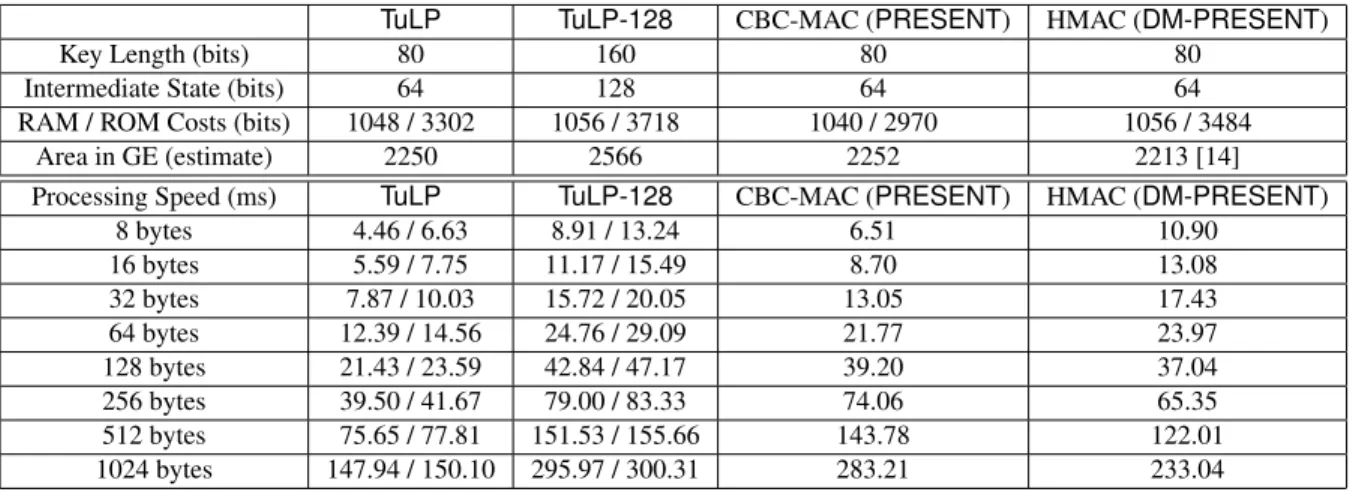
RAM / ROM Costs (bits) 1048 / 3302 1056 / 3718 1040 / 2970 1056 / 3484
Area in GE (estimate) 2250 2566 2252 2213 [14]
Processing Speed (ms) TuLP TuLP-128 CBC-MAC (PRESENT) HMAC (DM-PRESENT)
8 bytes 4.46 / 6.63 8.91 / 13.24 6.51 10.90 16 bytes 5.59 / 7.75 11.17 / 15.49 8.70 13.08 32 bytes 7.87 / 10.03 15.72 / 20.05 13.05 17.43 64 bytes 12.39 / 14.56 24.76 / 29.09 21.77 23.97 128 bytes 21.43 / 23.59 42.84 / 47.17 39.20 37.04 256 bytes 39.50 / 41.67 79.00 / 83.33 74.06 65.35 512 bytes 75.65 / 77.81 151.53 / 155.66 143.78 122.01 1024 bytes 147.94 / 150.10 295.97 / 300.31 283.21 233.04
Table 4: The comparison amongst somePRESENT-based MAC functions.
If we choose r = 16 in the compression of TuLP, TuLP will be about 2 times faster than
PRESENT encryption in message processing. Table 4 shows that TuLP approaches 1.6 and 1.8
times faster than HMAC withDM-PRESENTandPRESENT-based CBC-MAC respectively, where message length from 8 bytes to 1024 bytes. The keysetup costs in our schemes, which require one (or two)PRESENT encryption(s) to generate an encrypted IV, mainly lacks TuLP (orTuLP-128) in processing the messages shorter than 32 bytes. We note that the keysetup costs can be optimized by precomputing the encrypted IV before the authentications with the same keys, and the values can be reused in the latter authentication with the same keys. Same optimization can be implemented inTuLP-128 to boost the processing of short messages. We note that HMAC also can precompute the initialization values for optimization, but the values must be treated and protected (128 bits for a certain key inDM-PRESENT) in the same manner as secret keys [3]. While the optimization for our schemes only increases a smaller storage (one encrypted IV is 64-bit) and no need to be insulated. Al-though the lengths of intermediate state and output are doubled, the performance ofTuLP-128is still comparable toPRESENT-based CBC-MAC. Obviously,TuLP-128will be faster than HMAC with
PRESENTin a double block length construction. Nevertheless, if a higher security bound is required, one can tune the rounds in the compressions ofTuLPandTuLP-128. For instance, increase 16 rounds to 20 will cost about4/16 = 25%performance in message processing. Whilst a 20-round differential characteristic ofPRESENTstill has a probability2−50, and the linear approximation would require of about270known plaintext/ciphertext with a bias2−35.
6 Conclusion
By considering the restrictions of BSN, two lightweight MACsTuLPandTuLP-128have been pro-posed. The security of our schemes is analyzed with respect to the cryptanalyses on ALRED and
the results onPRESENT. The statistics strongly support thatTuLPandTuLP-128will be efficient and low-energy costs in devices with constrained resources. The provability of our schemes depends on the quality of the cryptanalysis that has been previously performed on those building blocks. The key length and the number of round functions in the compression are parameterized in our lightweight MACs, which support tunable tradeoffs between security and performance in BSN applications. Since bothPRESENTand ALRED are new proposals, we suggest that rigorous analysis should be imposed to avoid any potential weakness inside the cryptosystems based on them.
Acknowledgement.We would like to thank Vicent Rijmen, Xuejia Lai for their advice on the design ofTuLPandTuLP-128. And also thanks many anonymous reviews for their valuable comments to improve the presentation of this paper.
References
[1] The Ambient Assisted Living (AAL) Joint Programme. European Union. http://www.aal-europe.eu/about-aal. Jan 2008.
[2] M. Albrecht and C. Cid. Algebraic Techniques in Differential Cryptanalysis. In: O. Dunkelman (Ed.)FSE 2009, LNCS 5665, Springer, pp. 193-208, 2009.
[3] Federal Information Processing Standard 198, The Keyed-Hash Message Authentication Code (HMAC), NIST, U.S. Department of Commerce, March 2002.
[4] ISO/IEC 9797-1, Information technology - Security Techniques - Message Authentication Codes (MACs) - Part 1: Mechanisms using a block cipher, ISO 1999.
[5] Performance of optimized implementations of the NESSIE primitives, version 2.0, The NESSIE Consortium, 2003, https://www.cosic.esat.kuleuven.be/nessie/deliverables/D21-v2.pdf.
[6] K.C. Barr and K. Asanovic. Energy aware lossless data compression. ACM Transactions on Computer Systems, Volume 24, Issue 3, pp. 250-291, August 2006.
[7] M. Bellare, R. Canetti and H. Krawczyk. Keying Hash functions for message authentication. Advances in Cryptology-Crypto’96, LNCS 1109, Springer-Verlag, pp. 1-15, 1996.
[8] M. Bellare, J. Kilian and P. Rogaway. The security of the cipher block chaining message authen-tication code.Journal of Computer and System Sciences, 61(3):362-399, December 2000. [9] A. Biryukov, A. Bogdanov, D. Khovratovich and T. Kasper. Collision Attacks on AES-Based
MAC: Alpha-MAC. In: P. Paillier and I. Verbauwhede (Eds.) CHES 2007, LNCS 4727, pp. 166-180, 2007.
[10] J. Black, S. Halevi, H. Krawczyk, T. Krovetz and P. Rogaway. UMAC: Fast and Secure Massage Authentication.Advances in Cryptology-Crypto’99, LNCS 1666, Springer-Verlag, pp. 216-233, 1999.
[11] J. Black and P. Rogaway. CBC MACs for Arbitrary-Length Messages: The Three-Key Construc-tions.Journal of Cryptology, vol. 18, no. 2, pp. 111-131, 2005.
[12] J. Black, P. Rogaway and T. Shrimpton. Black-Box Analysis of the Black-Cipher-Based Hash-Function Constructions from PGV. In Advances in Cryptology-CRYPTO’02, LNCS 2442, pp. 320-335, 2002.
[13] A. Bogdanov, L.R. Knudsen, G. Leander, C. Paar, A. Poschmann, M.J.B. Robshaw, Y. Seurin, and C. Vikkelsoe. PRESENT: An Ultra-Lightweight Block Cipher. In: P. Paillier and I. Ver-bauwhede (Eds.)CHES 2007. LNCS 4727, Springer, Heidelberg, pp. 450-466, 2007.
[14] A. Bogdanov, G. Leander, C. Paar, A. Poschmann, M.J.B. Robshaw, and Y. Seurin. Hash Func-tions and RFID Tags: Mind the Gap.CHES 2008, LNCS 5154, Springer, pp. 283-299, 2008. [15] B. Collard and F.-X. Standaert. A Statistical Saturation Attack against the Block Cipher
PRESENT. In: M. Fischlin (Ed.)CT-RSA 2009, LNCS 5473, pp. 195-210, 2009.
[16] J. Daemen and V. Rijmen. A New MAC Construction ALRED and a Specific Instance ALPHA-MAC.FSE’05, LNCS 3557, Springer, pp. 1-17, 2005.
[17] J. Daemen and V. Rijmen. The Pelican MAC Function. Unpublished manuscript, Available at http://eprint.iacr.org/2005/088.
[18] M. Feldhofer and C. Rechberger. A Case Against Currently Used Hash Functions in RFID Pro-tocols. InOTM 2006 Workshops, LNCS 4277, Springer, pp. 372-381, 2006.
[19] N. Ferguson. Collision attacks on OCB. Feb 2002.
[20] M. Healy, T. Newe and E. Lewis. Analysis of Hardware Encryption Versus Software Encryption on Wireless Sensor Network Motes. In: S.C. Mukhopadhyay, G.S. Gupta (Eds.)Smart Sensors and Sensing Technology, Springer, 2008.
[21] J. Huang, J. Seberry and W. Susilo. On the internal Structure of ALPHA-MAC. In: P.Q. Nguyen (Ed.)VIETCRYPT 2006, LNCS 4341, pp. 271-285, 2006.
[22] C. Karlof, N. Sastry and D. Wagner. TinySec: A Link Layer Security Architecture for Wireless Sensor Networks. InSenSys’04, November 3-5, 2004, Baltimore, Maryland, USA.
[23] L. Knudsen, F. Mendel, C. Rechberger and S. Thomsen. Cryptanalysis of MDC-2. In EURO-CRYPT 2009, LNCS 5479, pp. 106-120, 2009.
[24] X. Lai and J. Massey. Hash Functions Based on Block Ciphers. InEUROCRYPT’92, LNCS 658, pp. 474-494, 1993.
[25] T. Li, H. Wu, X. Wang and F. Bao. SenSec Design.I2R Sensor Network Flagship Project (SNFP: security part): Technical Report-TR v1.0, February, 2005.
[26] M. Luk, G. Mezzour, A. Perrig and V. Gligor. MiniSec: A Secure Sensor Network Communica-tion Architecture. InIPSN’07, April 25-27, 2007, Cambridge, Massachusetts, USA.
[27] O.O¨zen, K. Varici, C. Tezcan and C¸. Kocair. Lightweight Block Ciphers Revisited: Cryptanal-ysis of Reduced Round PRESENT and HIGHT. InACISP 2009, LNCS 5594, pp. 90-107, 2009.
[28] C. Paar, A. Poschmann and M. Robshaw. New Designs in Lightweight Symmetric Encryption. In: P. Kitsos, Y. Zhang (Eds.)RFID Security: Techniques, Protocols and System-on-Chip De-sign. Springer, pp. 349-371, 2008.
[29] A. Perrig, R. Szewczyk , V. Wen , D. Culler and J. D. Tygar. SPINS: security protocols for sensor networks. InProceedings of the 7th annual international conference on Mobile computing and networking, pp.189-199, July 2001, Rome, Italy.
[30] P. Rogaway. Authenticated-Encryption with Associated-Data. In ACM CCS’02, pp.98-107, ACM, 2002.
[31] P. Rogaway, M. Bellare and J. Black. OCB: A block-cipher mode of operation for efficient au-thenticated encryption.ACM Transactions on Information and System Security (TISSEC), Vol-ume 6, Issue 3, pp.365-403, August 2003.
[32] M. Wang. Differential Cryptanalysis of Reduced-Round PRESENT. InAFRICACRYPT 2008, LNCS 5023, pp. 40-49, 2008.
[33] W. Wang, X. Wang and G. Xu. Impossible Differential Cryptanalysis of PELICAN, MT-MAC-AES and PC-MAC-MT-MAC-AES. Available at http://eprint.iacr.org/2009/005.
![Figure 3: The XCBC algorithm proposed in SenSec [25].](https://thumb-us.123doks.com/thumbv2/123dok_us/10972802.2985337/7.918.222.702.126.342/figure-xcbc-algorithm-proposed-sensec.webp)