Password Authenticated Keyword Search
Kaibin Huang
Department of Computer Science National Chengchi University
Taiwan
Email: [email protected]
Mark Manulis
Surrey Centre for Cyber Security University of Surrey
United Kingdom Email: [email protected]
Liqun Chen
Surrey Centre for Cyber Security University of Surrey
United Kingdom Email: [email protected]
Abstract—In this paper we introduce Password Authenticated Keyword Search (PAKS), a cryptographic scheme where any user can use a single human-memorizable password to outsource encrypted data with associated keywords to a group of servers and later retrieve this data through the encrypted keyword search procedure. PAKS ensures that only the legitimate user who knows the initially registered password can perform outsourcing and re-trieval of the encrypted data. In particular, PAKS guarantees that no single server can mount an offline attack on the user’s pass-word or learn any information about the encrypted keypass-words. The concept behind PAKS protocols extends previous concepts behind searchable encryption by removing the requirement on the client to store high-entropy keys, thus making the protocol device-agnostic on the user side. In this paper we model three security requirements for PAKS schemes (indistinguishability against chosen keyword attacks, authentication and consistency) and propose an efficient direct construction in a two-server setting those security we prove in the standard model under the Decisional Diffie-Hellman assumption. Our efficiency comparison shows that the proposed scheme is practical and offers high performance in relation to computations and communications on the user side.
I. INTRODUCTION
Searchable encryption. Using protocols for Searchable Encryption[1]–[4] clients with limited computing and storage resources can outsource encrypted data to a server or a collection of servers, perform search over the encrypted data (typically using encrypted keywords) and eventually retrieve searched data while preserving its privacy against the servers. Existing searchable encryption schemes can be broadly split into those where the keyword search procedure requires either high-entropy shared keys such as Symmetric Searchable En-cryption (SSE) schemes from [3], [5], [6] or a private-public key pair such asPublic Key Encryption with Keyword Search (PEKS)schemes from [1], [2], [6]–[10] on the user side.
In practice, the requirement to maintain high-entropy keys on the user side results in less flexibility when it comes to the use of multiple, different devices for outsourcing and retrieval of data. The user is effectively prevented from using different devices unless the private key is made available to every such device.
Password Authenticated Keyword Search (PAKS). The idea of basing searchable encryption solely on passwords, proposed in this paper, helps to avoid costly and risky key management on the user side and enables the whole process to be device-agnostic. This, however, comes with challenges
considering that both passwords and keywords typically have low entropy. Amongst the core security properties of PAKS there is a need to guarantee that only the legitimate user, who knows the password, can outsource, search and retrieve data. Hence, basing security of searchable encryption schemes on passwords introduces the need for a distributed server environment where trust is spread across at least two non-colluding servers, as is also the case in many password-based protocols for authentication and secret sharing, e.g. [11]–[19]. While a more general secret sharing architecture with t -out-of-n servers would be applicable as well, the use of two servers can be seen as the most practical scenario and the minimum requirement to achieve protection against offline dictionary attacks. The use of two servers is required not only to protect passwords but also to prevent keyword guessing attacks, like those demonstrated in [10] for (public key-based) PEKS schemes.
We model PAKS as a cryptographic scheme where users can register their passwords with the servers and then re-use these passwords for multiple sessions of the outsource and retrieval protocols. In each outsource session the user can outsource encrypted keywords along with some (encrypted) document to both servers. The retrieval protocol realises the search procedure based on the keyword that the user inputs to the protocol and provides the user with all documents associated with that keyword allowing the user to also verify the integrity of the retrieved documents. We define security of the PAKS scheme using BPR-like models [20], [21] that have been widely used for password-based protocols. We define privacy of PAKS keywords throughindistinguishability against chosen keyword attacks (IND-CKA)while considering active adversaries, possibly in control of at most one server, who can also register own passwords in the system. While IND-CKA security protects against the adversary who does not know the password from successfully retrieving outsourced data, we additionally require authentication to protect the outsourcing operation itself, thus preventing the adversary from outsourcing data on behalf of the user; this requirement must also hold even if the adversary controls one of the servers. Our third PAKS requirement,consistency, akin to [1], ensures the correctness of the retrieval process, in particular prevents cases where one keyword is used to outsource data that can then be retrieved using a different keyword.
following more general approach that combines ideas behind
Password Authenticated Secret Sharing (PASS) [11]–[17] and SSE [3], [5], [6]. In the registration phase, the user picks a password π and a high-entropy symmetric key K that will be used to encrypt keywords and secret-shares K protected withπacross both servers. In order to outsource keywords the user engages into the PASS reconstruction protocol to obtain
K and then into the SSE outsource protocol to outsource the keywords. In order to search for keywords and retrieve data the user again reconstructs K using PASS and performs the keyword search using SSE. We stress however that our construction is direct and does not use PASS and SSE as generic building blocks. A generic construction from these two primitives remains currently out of reach due to significant differences in the syntax, functionality and security amongst the existing PASS protocols. First, PASS protocols do not separate registration from secret sharing phase and therefore do not enforce user authentication upon secret sharing which would be required for the outsourcing protocol in PAKS. Existing PASS protocols were proven in different security models, e.g. BPR-like in [11], [15] and UC-based in [12], [16], [17], and do not necessarily follow the same functionality and syntax, which makes it hard to use PASS as a generic building block in PAKS without revising the syntax and security models of those PASS protocols. While we could update the syntax of PASS protocols to allow for a generic usage in PAKS such update would introduce changes to the original PASS protocols and require new security proofs. Moreover, generic construc-tions often lead to less efficient instantiaconstruc-tions than directly constructed schemes. For all the aforementioned reasons we are not formally proposing a generic PAKS construction in this paper and opt for a direct and efficient scheme (cf. Section IV) based on well-known assumptions in the standard model.
Paper organization.We introduce preliminaries and build-ing blocks in Section II. The syntax and security of the PAKS scheme are formalized in Section III. Our direct PAKS con-struction (along with efficiency considerations and comparison with prior work) is proposed in Section IV and its security is analysed in Section V.
II. PRELIMINARIES ANDBUILDINGBLOCKS Pedersen commitments [22]. Let g, h be two generators in a multiplicative cyclic group G with order q, and the discrete logarithm betweenhandgis unknown. For a message
m∈Z∗q, the Pedersen commitment is computed asc←g rhm
where r←$ Z∗
q and is opened by providing (r, m). We recall
that Pedersen commitments offer computational binding based the discrete logarithm problem, i.e. assuming AdvDL
A(κ) is
negligible, and provide perfect hiding.
Pseudorandom function (PRF)[23], [24]. Letk∈ KPRFbe
a high min-entropy key in thePRFkey space. A pseudorandom functionPRFis called(t, q, (κ))-secure if for any PPT algo-rithm A running in time t with at most q oracle queries the probabilityAdvPRF
A (κ)≤(κ)for distinguishing the outputs of PRF(k, m)from the outputs of a truly random function f of the same length, assuming thatAhas oracle access toOPRF(·)
which contains either PRF(k,·) or f(·) and which cannot be queried onm.
Key derivation function (KDF) [25]. Let Σ be a source of key material. A key derivation function KDF is called
(t, q, (κ))-secure with respect toΣif for any PPT algorithmA
running in timetwith at mostqoracle queries the probability
AdvKDF
A (κ)≤(κ) for distinguishing the output of KDF(k, c)
from uniformly drawn random strings of the same length, assuming that (k, α)←Σwherek is the secret key material andαis some side information. It is assumed that A knows
α, has control over the context information c and has oracle access toKDF(k,·)which cannot be queried onc.
Message authentication code[26]. A message authentica-tion code(KGen,Tag,Vrfy)is comprised of the algorithms
• KGen(κ): on input security parameterκoutput keymk← {0,1}κ.
• Tag(mk, m): on input a keymkand a messagem, output tagµ←Tag(mk, m).
• Vrfy(mk, m, µ): on input a key mk, a message m and a tagµ outputs1 ifµis valid or 0 otherwise.
AMAC is secure if any PPT algorithmA without knowledge of mk has only negligible probability AdvMAC
A (κ) to forge a
tag µ∗ for some message m∗.Ahas access to the tag oracle
OTag(·)which returnsµ←Tag(mk, m)on inputm. The only
restriction is that m∗ is never queried toOTag(·).
III. PASSWORDAUTHENTICATEDKEYWORDSEARCH: SYNTAX ANDDEFINITIONS
In this section we provide definitions for the functionality of PAKS and its security properties.
A. Syntax of PAKS
After initialization, the functionality of PAKS is defined by three protocols. These protocols are themselves defined as interactive algorithms executed by the protocol participants.
Functionality of PAKS.Our PAKS functionality allows any user Uto perform initial registration procedure with any two servers S0 and S1 in the system and then use the registered
passwordπ(from some dictionaryD) to outsource and retrieve data based on associated keywordsw ∈ W. Each server Sd, d∈ {0,1} maintains its own database where for each user it records the associated secret informationinfod obtained
dur-ing the registration procedure and the outsourced data(C,ix)
obtained from multiple executions of the outsource protocol;
C represents ciphertexts for the keywords whereas ixstands for the outsourced (and typically encrypted) document that is associated with the encrypted keywords. Similar to other searchable encryption schemes (e.g. [1]) we do not explicitly model the encryption of outsourced documents and use indices
ix∈III as placeholders instead.
• Setup(1κ) is an initialisation algorithm that on input a security parameter κ ∈ N generates public parameters
parof the scheme.
• Register is a registration protocol executed between some user U (running interactive algorithmRegisterU) and two serversS0andS1(running interactive algorithms
RegisterSd, d ∈ {0,1}) according to the following
specification:
– RegisterU(par, π,S0,S1): on input parand some
password π ← D, this algorithm interacts with
RegisterSd, d ∈ {0,1} and outputs a flag s ∈ {succ,fail}. If (s = succ), the user remembers
πand forgets all other informations.
– RegisterSd(par,U,S1-d): on input par this
al-gorithm interacts with RegisterU (and possibly
RegisterS1-d) and at the end of successful
interac-tion stores some secret informainterac-tioninfodassociated
withUatSd.
• Outsourceis an outsourcing protocol executed between some userU(running interactive algorithmOutsourceU) and two serversS0andS1(running interactive algorithms OutsourceSd, d ∈ {0,1}) according to the following
specification:
– OutsourceU(par, π, w,ix,S0,S1): on input π, a
keyword w, and some index ix this algorithms interacts withOutsourceSd,d∈ {0,1} and outputs
a flag s∈ {succ,fail}.
– OutsourceSd(par,U,infod): on input infod
this algorithm upon successful interaction with
OutsourceU (and possibly OutsourceS1-d) stores
a record(C,ix)in its databaseCCCd.
• Retrieveis a retrieval protocol executed between some user U (running interactive algorithm RetrieveU) and two servers S0 and S1 (running interactive algorithms RetrieveSd, d ∈ {0,1}) according to the following
specification:
– RetrieveU(par, π, w,S0,S1): on inputπand a
key-word w this algorithm upon successful interaction withRetrieveSd,d∈ {0,1} outputs setIII
contain-ing all ixassociated withw.
– RetrieveSd(par,U,infod): on input infod this
algorithm interacts with RetrieveU (and pos-sibly RetrieveS1-d) and outputs a flag s ∈ {succ,fail}.
Correctness. The PAKS scheme is correct if for all κ ∈
N,ix∈ I, w ∈ W, π∈ D,par←Setup(1κ)the probability
Pr[ix∈III] = 1iff
hsucc,info0,info1i ← hRegisterU(par, π,S0,S1), RegisterS0(par,U,S1),RegisterS1(par,U,S0)i; hsucc,(C,ix),(C,ix)i ← hOutsourceU(par, π, w,ix,S0,S1), OutsourceS0(par,U,info0),OutsourceS1(par,U,info1)i; hIII,succ,succi ← hRetrieveU(par, π, w,S0,S1), RetrieveS0(par,U,info0),RetrieveS1(par,U,info1)i;
In other words, the user should always be able to retrieve
all indices ix that were previously outsourced under some keyword was long as this user is registered and has used its registered passwordπin those outsourcing and in the retrieval protocol sessions.
ExpIND-CKA-b
PAKS,A (κ)
τττ ← ∅; i∗←(−1);j←0;
Set← ∅;par←Setup(1κ);
b0← AChind(b,·,·,·,·),Reg(·),Out(·,·,·),Ret(·,·),RetS(·)(par); returnb0
ExpAuth PAKS,A(κ)
τττ ← ∅; j←0; Set← ∅;par←Setup(1κ);
(i∗, w∗,ix∗)← AReg(·),Out(·,·,·),OutS(·),Ret(·,·)(par); hIII,succ,succi ←Ret(i∗, w∗);
if (((i∗, w∗,ix∗)6∈Set)∧(ix∗∈III))return1
else return 0 ExpCon
PAKS,A(κ)
τττ ← ∅; i∗←(−1);j←0;
Set← ∅;par←Setup(1κ);
w1← AChcon(·,·,·),Reg(·),Out(·,·,·),Ret(·,·),RetS(·)(par); hIII,succ,succi ←Ret(i∗, w1);
if (((i∗, w1,ix∗)6∈Set)∧(ix∗∈III))return1
else return 0
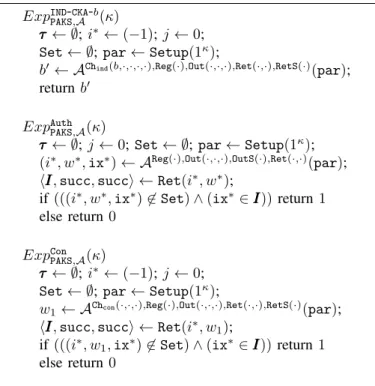
Fig. 1. PAKS security experiments. The oracles are defined in Section III-B.
B. Security definitions of PAKS
We define security of PAKS using three main requirements: indistinguishability against chosen keyword attacks (IND-CKA), authentication and consistency. We adopt a BPR-like modeling approach [21] for password-based cryptographic protocols and define security through experiments (cf. Figure 1) where a PPT adversaryAhas full control over the communication channels and can interact with parties (controlled by a simulator) through the set of oracles defined in the following.
Adversary model and oracles.For each user U we allow
Ato take full control over at mostoneof the two serversS0
andS1 that were chosen byUduring the registration phase to
capture the required distributed trust relationship. We mostly use Sd to denote the uncorrupted server and S1-d to denote
the server controlled by the adversary. The oracles allowAto invoke interactive algorithms for all protocols of PAKS which will be executed (honestly) by the simulator. A can interact with these algorithms and by this participate in the protocol. In particular, we allow A to participate in outsourcing and retrieval protocols on behalf of some corrupted server and also as some (illegitimate) user who tries to guess the registered password during the execution of the protocol.
Let τττ be an initially empty array that will be populated with tuples of the formτττ[j]←(d, π,infod)at the end of each successfulj-th registration session such thatπis the registered password andinfodis the secret data stored at the serverSdat
the end of that session. We also use variablesi∗∈Z,ix∗∈ I
and a set Set that are maintained by the experiments. The adversaryAcan access the following oracles.
• Challenge oracle Chind(b,·,·,·,·): on input (i, w0, w1, ix∗), the oracle aborts if((i∗≥0)∨(i≥j)∨((i, w0)∈
Set)∨((i, w1)∈ Set)). Otherwise, it sets i∗ ← i and invokes oracleOut(i∗, wb,ix∗). Note that this oracle will
be used to model IND-CKAsecurity of PAKS.
• Challenge oracle Chcon(·,·,·): on input (i, w0,ix∗), the
oracle aborts if ((i∗ ≥0)∨(i ≥j)). Otherwise, it sets
i∗ ← i and invokes oracle Out(i∗, w0,ix∗). Note that
this oracle will be used to model consistency of PAKS.
• Registration oracleReg(·): on inputd∈ {0,1}, the exper-iment first initializesCCCd,j← ∅as a database for session j. Then, it randomly picks fresh(π← D$ )∧((i, π,·)6∈τττ)
for all i∈[0, j−1]. TheRegisterprotocol is executed withAwhere the oracle plays the roles of honestUand
Sd executing algorithms RegisterU(par, π,S0,S1) and RegisterSd(par,U,S1-d), respectively, andAplays the
role of corruptedS1-d. After interactions, the experiment
recordsτττ[j]←(d, π,infod), deliversj to the adversary and increasesj←j+ 1.
• Outsource oracle Out(·,·,·): on input (i, w,ix), the oracle aborts if i ≥ j; or otherwise, it ob-tains (d, π,infod) ← τττ[i]. The Outsource pro-tocol is then executed with A where the ora-cle plays the roles of honest U and Sd
execut-ing algorithms OutsourceU(par, π, w,ix,S0,S1) and OutsourceSd(par,U,infod), respectively, and Aplays the role of maliciousS1-d. In bothAuth andCon
exper-iments, the oracle additionally computes Set← Set∪ (i, w,ix).
• Outsource oracle (server only)OutS(·): on inputi, the or-acle aborts ifi≥j; otherwise, it obtains(d, π,infod)← τττ[i]. The Outsource protocol is then executed with A
where the oracle plays the role of honest Sd executing
algorithm OutsourceSd(par,U,infod)andAplays the roles of (illegitimate)Uand corruptedS1-d. Note that this
oracle will be used to model authentication of PAKS.
• Retrieve oracle Ret(·,·): on input (i, w), the oracle aborts if i ≥ j. In the IND-CKA experiment, the or-acle also aborts if ((i = i∗) ∧ (w ∈ {w0, w1})).
Otherwise, it obtains the parameters (d, π,infod) ← τττ[i]. The Retrieve protocol is then executed with A
where the oracle plays the roles of honest U and Sd
executing algorithms RetrieveU(par, π, w,S0,S1) and RetrieveSd(par,U,infod), respectively, and A plays
the role of corrupted S1-d. In the IND-CKA experiment,
if (i∗ = −1) the oracle additionally computes Set ← Set∪(i, w).
• Retrieve oracle (server only)RetS(·): on inputi, the ora-cle aborts ifi≥j; otherwise, it obtains(d, π,infod)← τττ[i]. The Retrieve protocol is then executed with A
where the oracle plays the role of honest Sd executing
algorithm RetrieveSd(par,U,infod) and A plays the roles of (illegitimate)Uand corruptedS1-d. Note that this
oracle will be used to modelsIND-CKAandCon-security of PAKS.
Indistinguishability against Chosen Keyword Attacks (IND-CKA). TheIND-CKAproperty for PAKS is defined through
the experiment ExpIND-CKA-b
PAKS,A (κ) (cf. Figure 1) and is closely
related to [5] except that our setting is based on passwords.A
is given the public parametersparand permitted to adaptively access oracles Chind(b,·,·,·,·), Reg(·), Out(·,·,·), Ret(·,·)
and RetS(·) at most1, qr, qo, qt andqs times, respectively.
In particular, ourIND-CKAexperiment captures the following ways thatAmay try to retrieve data: (i) from interaction with an honest userUand the honest serverSd playing the role of
corruptedS1-d(which is captured through the oracleRet(·,·)),
or (ii) from interaction with the honest server Sd playing the
role of illegitimate user, e.g. trying to guess the registered password, and the corrupted server S1-d (which is captured
through the oracleRetS(·)). LetAdvIND-CKA
PAKS,A(κ) def
= Pr[b0=b:b0 ←ExpIND-CKA-b
PAKS,A (κ)]− 1 2
denote the advantage ofAin theIND-CKAsecurity experiment. A PAKS scheme is called IND-CKA-secure if the probability
AdvIND-CKA PAKS,A(κ)≤
qs
|D|+(κ)where|D| is the dictionary size
and(κ) is negligible in the security parameterκ. Note that probability qs
|D| relates to the use of oracleRetS(·)that models
on-line dictionary attacks and assumes uniform distribution of passwords withinD, as is also common in BPR-like models. Authentication (Auth).The property of authentication for PAKS is defined using experimentExpAuth
PAKS,A(κ)in Figure 1. Ais given the public parametersparand permitted to access oraclesReg(·),Out(·,·,·),OutS(·)andRet(·,·)with at most
qr,qo,qsandqttimes, respectively. Our experiment effectively
captures attacks whereAtries to outsource some dataix∗ on behalf of some userUwithout knowing the registered password (via OutS(·) oracle), possibly after having interacted with U
and the honest serverSd. In its attack on authenticationAcan
play the role of a corrupted serverS1-dand also mount
man-in-the-middle attacks on sessions ofOutsource andRetrieve
protocols involving user U.
A PAKS scheme provides authentication if for all PPT A
the probability AdvAuth
PAKS,A(κ) = Pr[1 ← ExpAuthPAKS,A(κ)] ≤ qs
|D|+(κ). As in theIND-CKAcase, we again need to account
for the possibility of online guessing attacks via the oracle
OutS(·).
Consistency (Con). We define consistency of PAKS using experiment ExpCon
PAKS,A(κ) in Figure 1, adapting this notion
from [1] to the PAKS setting. The property aims to rule out false positives when performing the keyword search. A
is given the public parameters par and permitted to access oracles Chcon(·,·,·), Reg(·),Out(·,·,·), Ret(·,·)andRetS(·)
with at most 1, qr, qo, qt and qs times, respectively. In
particular, A should not be able to come up with different keywordsw0andw1from whichw0will be used by an honest
user to outsource some data ix∗ (via Chcon(·,·,·) oracle)
and w1 used to retrieve this data later. A PAKS scheme is
called consistent if the probability AdvCon
PAKS,A(κ) = Pr[1 ← ExpCon
PAKS,A(κ)]≤ qs
|D|+(κ).
IV. OUR DIRECTPAKSCONSTRUCTION
In this section we propose a direct and efficient construction of PAKS. It follows our general idea of combining suitable
public inputs: G, q, g, h, H,KDF1,KDF2,PRF,MAC UserU(π, w,ix) ServerSd(xd, gr1, gr2, Cπ, Kd,mkd) a←$ Z∗q,A←gahπ A sd, yd $ ←Z∗q,Yd←gyd Rd←(gr2)yd,cd←gsdhH(Yd,Rd) cd c1-d on inputc1-d Yd, Rd, sd if(c1-d=gs1-dhH(Y1-d,R1-d)) Y1-d, R1-d, s1-d Y ←Y0Y1,R←R0R1 e← {$ 0,1}κ Z d←Kd(CπA-1)yd(gr1R)-xd on input(Y, Z0, µ0),(Y, Z1, µ1) Y, Zd, µd µd←Tag(mkd,(A, Y, Zd)) K←Z0Z1Ya else abort; for alld∈ {0,1} mkd←KDF1(K,Sd,‘1’) if(Vrfy(mkd,(A, Y, Zd), µd) = 0) abort; t←KDF2(K, w),v←PRF(t, e) mku←KDF1(K,U,‘0’) µc←Tag(mku,(e, v,ix)) skd←KDF1(mkd, A, Y,‘2’) skd←KDF1(mkd, A, Y,‘2’) C←(e, v, µc),µskd←Tag(skd,(C,ix)) (C,ix), µskd if(Vrfy(skd,(C,ix), µskd) = 1) store(C,ix)onCCCd else abort;
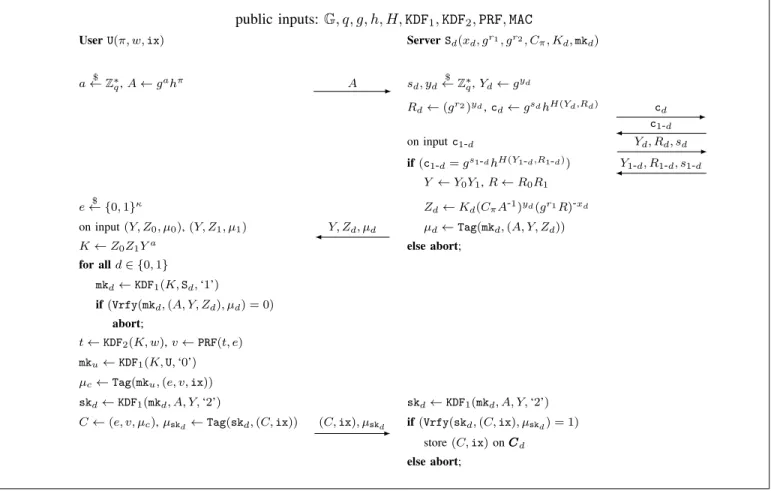
Fig. 2. TheOutsourceprotocol betweenUandSd. The server-side algorithm includes communication between serversSdandS1-d.
password-authenticated secret sharing with symmetric search-able encryption techniques. In the introduction we explained the difficulties behind an attempt to construct PAKS generi-cally using PASS and SSE schemes and motivated our choice for a direct construction.
High-level idea. Our PAKS protocol is inspired by the techniques used in the recent password-authenticated secret sharing protocol from [15] which we modified to address the functionality and requirements of PAKS and extended with a suitable mechanism for symmetric searchable encryption of keywords. In particular, we define a new registration protocol
Register upon which the user registers its password π en-crypted inCπwith both servers and also picks a symmetric key Kfor which it computes appropriate sharesK0andK1which
are then sent to the corresponding servers. The reconstruction of K is protected by π and MAC codes µd are used to
ensure the validity ofKupon its reconstruction. The protocols
Outsource and Retrieve proceed according to the similar pattern. First, the user reconstructs K using its password π
after communication with both servers. Then, in Outsource
protocolUusesKin combination with its keywordwto derive a trapdoor t ← KDF2(K, w) and a fresh randomness e to
derive verifier v ← PRF(t, e). The pair (e, v) becomes part of the outsourced ciphertext C which is bound to some data
ix. During the Retrieve protocol the user can recompute the trapdoor t for a given keyword w and then send it to the servers who can the find all outsourced ciphertextsC for whichv←PRF(t, e)holds and hence identify which data ix
needs to be returned. In order to prevent servers from creating their own pairs(e, v)for a giventthe outsourced ciphertextC
additionally includes a MAC tagµcwhich authenticates(e, v)
and also ix and which can only be computed and verified using K. During the Retrieveprotocol the user will ensure that it final search result contains only data that passes this integrity and authenticity check. In addition both protocols make use of MACs to ensure authenticity of messages, where the MAC keys are derived from K on the user side. We emphasis that our PAKS construction is in the password-only setting where servers are not required to possess any public keys for the security of the PAKS scheme. However, if the registration protocol Registeris performed remotely over a public network then this protocol needs to be executed over server-authenticated secure-channels (e.g. TLS). In order to enable reconstruction of K by the user and to protect this phase with the password both servers communicate with each other as part of the Outsource and Retrieve protocols. While in practice this communication between the two servers will likely be protected using a secure channel (e.g. TLS) we
public inputs: G, q, g, h, H,KDF1,KDF2,PRF,MAC UserU(π, w) ServerSd(xd, gr1, gr2, Cπ, Kd,mkd) a←$ Z∗q,A←gahπ A sd, yd $ ←Z∗q,Yd←gyd Rd←(gr2)yd,cd←gsdhH(Yd,Rd) cd c1-d on inputc1-d Yd, Rd, sd if(c1-d=gs1-dhH(Y1-d,R1-d)) Y1-d, R1-d, s1-d Y ←Y0Y1,R←R0R1 Zd←Kd(CπA-1)yd(gr1R)-xd on input(Y, Z0, µ0),(Y, Z1, µ1) Y, Zd, µd µd←Tag(mkd,(A, Y, Zd)) K←Z0Z1Ya else abort; for alld∈ {0,1} mkd←KDF1(K,Sd,‘1’) if(Vrfy(mkd,(A, Y, Zd), µd) = 0) abort; AAAd← ∅ skd←KDF1(mkd, A, Y,‘2’) skd←KDF1(mkd, A, Y,‘2’) t←KDF2(K, w),µskd←Tag(skd, t) t, µskd if(Vrfy(skd, t, µskd) = 1) for all(C,ix)∈CCCd (e, v, µc)←C mku←KDF1(K,U,‘0’) if(v=PRF(t, e)) A A A←AAA0∪AAA1,III← ∅ AAAd AAAd←AAAd∪(C,ix)
for all(C,ix)∈AAA else abort;
(e, v, µc)←C
if(v=PRF(t, e)∧Vrfy(mku,(e, v,ix), µc) = 1)
III←III∪ix returnIII
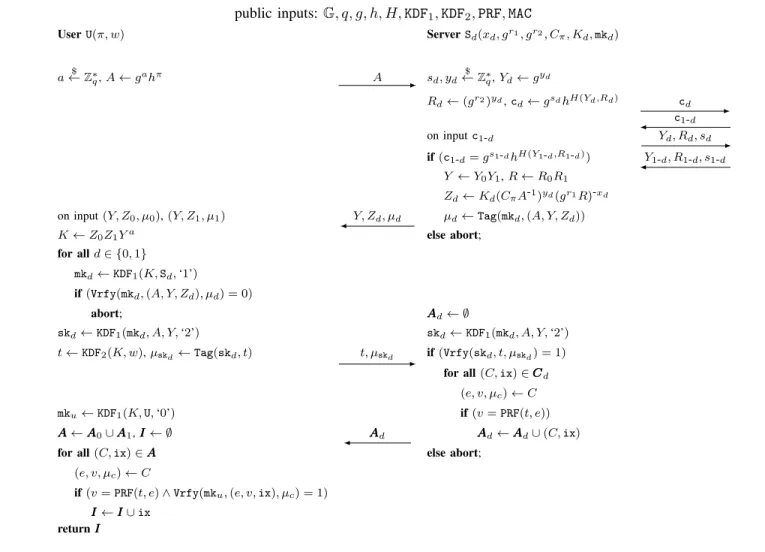
Fig. 3. TheRetrieveprotocol betweenUandSd. The server-side algorithm includes communication between serversSdandS1-d.
stress that in our protocols this communication can take place over an insecure channel.
Detailed description.In the following we provide a detailed description of all algorithms and protocols underlying our direct PAKS scheme, along with Figures 2 and 3 that illustrate the protocols OutsourceandRetrieve, respectively.
• Setup(1κ): Generated public parameters par contain {G, q, g, h,KDF1,KDF2,PRF,MAC}, where(G, q, g, h) rep-resents a multiplicative cyclic groupGwith a prime order
q and generators g, h←$ Gwhere the discrete logarithm ofhwith respect to basegis unknown.H :G×G→Z∗q
is a collision-resistant hash function. KDF1 : {0,1}∗ → KMAC andKDF2:G× W → KPRF are two key derivation
functions. PRF: KPRF× {0,1}κ → {0,1}κ is a
pseudo-random function. MAC= (KGen,Tag,Vrfy)is a message authentication code withTag:KMAC× {0,1}∗→ {0,1}κ
and Vrfy : KMAC× {0,1}∗ × {0,1}κ → {0,1} where KPRFandKMACarePRFandMACkey spaces, respectively.
We assume that passwords from D are represented as elements of Z∗q.
• Protocol Register: User U picks r1, r2, x0, x1 $ ← Z∗ q and K, K0 $ ← G; computes X ← gx0+x1, K 1 ← Xr1K(K0)-1 and C π ← Xr2hπ. Then, for d ∈ {0,1}, the user computes mkd ← KDF1(K,Sd,‘1’), sets infod ←(xd, gr1, gr2, Cπ, Kd,mkd)and sendsinfod to
server Sd, d ∈ {0,1} over server-authenticated secure
channels. Finally, Umemorizesπ.
• Protocol Outsource: For d ∈ {0,1}, the Outsource
protocol between U and Sd is illustrated in Figure 2
and detailed in the following. Note that as part of the
Outsource protocol both S0 and S1 communicate with
each other, possibly over an insecure channel. 1) UserUrandomly selects a←$ Z∗q,e
$
← {0,1}κ and
sendsA←gahπ to both servers.
2) On inputA, server Sd executes following steps:
a) Pick sd, yd $
← Z∗q, compute Yd ← gyd, Rd ← (gr2)yd.
b) Send Pedersen commitmentcd←gsdhH(Yd,Rd)
TABLE I
EFFICIENCY COMPARISON WITH PASSWORD-ONLYPASSSCHEMES.
Computation cost (unit:exp) Communication cost (unit: bits) Rounds Sharing Retrieval Sharing Retrieval Sharing Retrieval user server user server user-server user-server server-server
BJSL11 [11] 6 0 33 16 24q+ 4κ 22q+ 2κ 0 1 2
JKK14 [14] 4 1 11 4 8q+ 4κ 8q+ 4κ 0 1 1
YCHL15 [15] 1 0 7 12 6κ 10q 8q 1 1
JKKX16 [17] 3 1 3 1 8q+ 4κ 8q+ 4κ 0 2 1
In our PAKS scheme 6 0 3 8 8q+ 2κ 6q 6q+ 2κ 1 1
c) Send the opening(Yd, Rd, sd)to serverS1-dand
wait for its response(Y1-d, R1-d, s1-d). Ifc1-d6= gs1-dhH(Y1-d,R1-d) then abort.
d) Send (Y, Zd, µd) toU whereY ←Y0Y1,R ← R0R1, µd ← Tag(mkd,(A, Y, Zd)) and Zd ← Kd(CπA-1)yd(gr1R)-xd.
3) Upon receiving (Y, Z0, µ0) and (Y, Z1, µ1) from
both servers, userUexecutes following steps: a) If Vrfy(mkd,(A, Y, Zd), µd) = 0 for any d ∈
{0,1}then abort, else computeK←Z0Z1Ya.
b) Compute t ← KDF2(K, w), v ← PRF(t, e), mku ← KDF1(K,U,‘0’), µc ← Tag(mku,(e, v,ix))andC←(e, v, µc).
c) Send ((C,ix), µskd) to server Sd, d ∈ {0,1}
whereµskd ←Tag(skd,(C,ix)) using skd ← KDF1(mkd, A, Y,‘2’).
4) On input((C,ix), µskd), serverSdstores(C,ix)in
its databaseCCCd ifVrfy(skd,(C,ix), µskd) = 1 for skd←KDF1(mkd, A, Y,‘2’), elseSd aborts. • Protocol Retrieve: For d ∈ {0,1}, the Retrieve
protocol between U and Sd is illustrated in Figure 3
and detailed in the following. Note that as part of the
Outsource protocol both S0 andS1 communicate with
each other, possibly over an insecure channel.
1) UserU randomly selects a←$ Z∗q and sends A ← gahπ to both servers.
2) On inputA, serverSd executes following steps:
a) Pick sd, yd $ ← Z∗
q, compute Yd ← gyd, Rd ← (gr2)yd.
b) Send Pedersen commitmentcd←gsdhH(Yd,Rd)
to serverS1-d and wait for its responsec1-d.
c) Send opening (Yd, Rd, sd) to server S1-d and
waits for its response (Y1-d, R1-d, s1-d). If c1-d6=gs1-dhH(Y1-d,R1-d)then abort.
d) Send (Y, Zd, µd) toU whereY ←Y0Y1,R ← R0R1, µd ← Tag(mkd,(A, Y, Zd)) and Zd ← Kd(CπA-1)yd(gr1R)-xd.
3) Upon receiving (Y, Z0, µ0) and (Y, Z1, µ1) from
both servers,Uexecutes following steps:
a) If Vrfy(mkd,(A, Y, Zd), µd) = 0 for any d ∈ {0,1}then abort, else computeK←Z0Z1Ya.
b) Compute t ← KDF2(K, w) and µskd ← Tag(skd, t) using skd ← KDF1(mkd, A, Y,‘2’).
Send(t, µskd)toSd,d∈ {0,1}.
4) On input (t, µskd), server Sd executes following
steps:
a) If Vrfy(skd, t, µskd) = 0 then abort, else
com-puteskd←KDF1(mkd, A, Y,‘2’).
b) Initialize set AAAd ← ∅. For all (C,ix) ∈ CCCd,
parse (e, v, µc) ←C and add (C,ix) toAAAd if v=PRF(t, e). Finally, sendAAAd toU.
5) Upon receiving AAA0 and AAA1, user U initializes an
empty setIII ← ∅. Then, for all(C,ix)∈(AAA0∪AAA1),
parses (e, v, µc) ← C and adds ix to III if v = PRF(t, e) and Vrfy(mku,(e, v,ix), µc) = 1. This
step guarantees that only outsourced data for which the integrity check was performed successfully will be added to the output setIII.
The correctness of the protocol can be easily verified once we illustrate here that if the correct password π is used by the user in the OutsourceandRetrieveprotocols then the reconstruction throughZ0Z1Ya results in a correct keyK:
Z0Z1Ya=K0(CπA-1)y0(gr1R)-x0·
K1(CπA-1)y1(gr1R)-x1·ga(y0+y1)
=Xr1K(Xr2g-a)y0+y1(gr1R)-(x0+x1)ga(y0+y1) =Xr1KXr2(y0+y1)X-(r1)X-r2(y0+y1)=K
A. Efficiency comparison
Given that our direct PAKS construction follows the general idea of building PAKS protocols based on the techniques used for password-authenticated secret sharing, we compare perfor-mance with existing PASS protocols. Since our PAKS scheme assumes password-only setting (except for the registration) we restrict our comparison to password-only PASS schemes [11], [14], [15], [17] and compare only the costs that arise from the sharing and retrieval of the symmetric keyK— note that in our PAKS scheme sharing of K is performed as part of theRegisterprotocol whereas retrieval ofK is part of both
Outsourceand Retrieveprotocols and is accomplished in step 3 of these protocols. Since our PAKS scheme adopts a two-server architecture but the aforementioned PASS schemes were designed for a more generalt-out-of-nthreshold setting we consider their costs for the special case of t = n = 2
to ease the comparison. The results of the comparison are presented in Table I. We compare computation costs through the number of modular exponentiations for the user and each
of the servers during the sharing and retrieval phases of the symmetric key K. We also compare communication costs in the number of bits communicated in both phases, while considering user-server and server-server communications. For the lengths of elements in G and Z∗q we use |G| = q and |q| = κ bits, respectively. We also compare the number of rounds needed for the sharing and retrieval of K.
We observe that in terms of computation and communi-cation costs key sharing and reconstruction phases in our PAKS scheme compare fairly well with those of existing PASS protocols. In particular, only [17] which is the most computationally efficient PASS protocol today offers better overall computation and communication performance. We stress however that for PAKS protocols the efficiency of the retrieval phase is of greater importance than of the sharing phase. This is because in PAKS sharing of K is performed only once as part of the registration procedure, but retrieval of
Koccurs each time the user wants to outsource data or search for keywords. Furthermore, due to the simplified key manage-ment (i.e. reliance on passwords only) PAKS offers device-agnostic use of the functionality to the user and can possibly be executed on different client devices (ranging from desktops over to smartphones). In this case it becomes important to keep the costs associated with computations on the user side and the user-server communication low. Considering this we observe that in comparison to [17] our PAKS scheme achieves similar and even partly better performance for computations and communication involving the user device.
As a result of our comparison we conclude that our PAKS scheme is sufficiently practical since the additional costs arising from the encrypted keyword search functionality within our PAKS protocols are negligible (due to the nature of computations involved) in comparison to the costly key sharing and retrieval steps.
B. Extensions with multiple keywords
In the given specification of our PAKS construction users can use only one keywordwin each execution ofOutsource
andRetrieveprotocols at a time. Often, users may want to be able to outsource or search for documents associated with mul-tiple keywords. Our PAKS scheme can be extended to provide efficient support for multiple keywords. Letwww= (w1, . . . , wn)
be a set of outsourced keywords for some document ixand letwww0= (w01, . . . , wm0 )be a set of searched keywords. In the following we show how to support (i) outsourcing ofixwith
w w
wthrough a single session of theOutsourceprotocol and (ii) search for all suitable documentsixusingwww0 through a single session of the Retrieve protocol, based on three different types of search queries [8]: conjunctive queries (www = www0), disjunctive queries (|www∩www0| >0), and those for a subset of
keywords (www0 ⊆www).
Outsourcing documents with multiple keywords.In order to outsource some document ix associated with multiple keywords www = (w1, . . . , wn), user U can compute vvv = (v1, . . . , vn), ti ← KDF2(K, wi) and vi ← PRF(ti, e) for i= 1,· · ·, n, andµc ←Tag(mku,(e, vvv))as part of the same
Outsource execution and outsource C ← (e, vvv, µc) as the resulting ciphertext to both servers.
Search queries with multiple keywords.In order to search for documents using multiple keywords, i.e.w01, . . . , w0m,m≤ n, within a single execution of the Retrieve protocol, user
Ucan send a set of authenticated trapdoorsti=KDF2(K, wi)
for all searched keywords wi0, i = 1,· · ·, m to both servers. Then, for all (C,ix) = (e, vvv, µc,ix) stored in the database CCCd, serverSd can initialize an empty output setAAAd, compute vvv0 = (v01,· · · , v0m) wherevi0 =PRF(ti, e), i= 1, . . . , m, and
update the output set AAAd ← AAAd ∪(C,ix) according to the
following conditions, depending on the type of search search query, i.e.
• for conjunctive queriesw10 ∧. . .∧wm0 : ifvvv=vvv0 • for disjunctive queriesw01∨. . .∨w0m: if|vvv∩vvv0|>0 • for subset queries (w10, . . . , w0m)⊆www: ifvvv0 ⊆vvv.
C. Password change
Our PAKS scheme allows users to change their pass-words without changing the encryption keys K, avoiding re-encryption of outsourced keywords. A new passwordπ∗ can be registered with the knowledge of the currentπas follows: 1) User U sends A ← gahπ to both servers (as in
OutsourceandRetrieve). Each serverSd,d∈ {0,1}
uses its infod to respond with (Y, Zd, gr2, Cπ, µd)
whereµd←Tag(mkd,(Y, Zd, gr2, Cπ)).
2) Upon reconstructing mkd as in Outsource and Retrieve protocols and verifying µd, the user picks
random r∗ ←$ Z∗ q, computes Cπ∗ ← (Cπh-π)r ∗ hπ∗ and µ∗d ← Tag(mkd,(gr2)r ∗ , Cπ∗), and sends (gr2r∗, C π∗, µ∗ d)to both servers. 3) If Vrfy(mkd,(gr2r ∗ , Cπ∗), µ∗
d) = 1 then each Sd
re-places (gr2, C
π)in itsinfod with(gr2r
∗
, Cπ∗).
Note that current π is used to authenticate the user towards both servers. If the user no longer remembersπthen changing the password while keeping the encryption key K would require additional authentication mechanisms based on which
Uwould be able to retrieveinfodfromSd to reconstruct and
re-shareK with the newπ∗, as in the registration phase. V. SECURITY ANALYSIS OFPAKS
In the following we prove the security of our direct PAKS scheme using our definitions from Section III-B. In the proofs we adopt the standard game-hopping technique. Let succn
denote the event that the adversary wins in the experimentn.
A. IND-CKA-security of our PAKS scheme
Theorem 1: Our direct PAKS construction is IND-CKA -secure assuming the hardness of theDDHproblem and security of KDF1,KDF2,PRFandMAC.
Proof. Experiment ExpIND
0 . The simulator initializes τττ , i∗, j,Set andpar ← {
G, q, g, h, H,KDF1,KDF2,PRF,MAC}
as defined in the real security experiment ExpIND-CKA-b
PAKS,A (κ).
The oracles Chind(b,·,·,·,·),Reg(·),Out(·,·,·),Ret(·,·)and RetS(·)are implemented as follows.
• Chind(b,·,·,·,·): on input (i, w0, w1,ix∗) the oracle
aborts if((i∗≥0)∨(i≥j)∨((i, w0)∈Set)∨((i, w1)∈ Set)); otherwise, it sets i∗ ← i and invokes oracle
Out(i∗, wb,ix∗).
• Reg(·): on input d ∈ {0,1} the simulator randomly selects fresh π ← D$ and K ←$ G and initialises an empty database CCCd,j. The simulator and A complete
the Register protocol, where the simulator plays the roles of U and Sd, and A plays the role of S1-d. The
oracle sends j to A as a session identifier. Finally, it records τττ[j] ← (d, π,infod, r2, x1-d), infod ← (S1-d, xd, gr1, gr2, Cπ, Kd,mkd), increments j ← j+ 1,
and storesr2 andx1-d for later use in the proof. • Out(·,·,·): on input (i, w,ix), the simulator aborts if
(i ≥ j); otherwise, it obtains (d, π,infod, r2, x1-d) ← τττ[i]. Then, the simulator plays the roles of U and Sd
and interacts with A who plays the role of S1-d in the Outsourceprotocol.
• Ret(·,·): on input (i, w), the simulator aborts if (i ≥ j)∨((i=i∗)∧(w∈ {w0, w1})); or otherwise, it obtains (d, π,infod, r2, x1-d)←τττ[i]. Then, it plays the roles of UandSdand interacts withAwho plays the role ofS1-d
party in the Retrieve protocol. Finally, the simulator computes Set←Set∪(i, w)if(i∗=−1).
• RetS(·): on inputi, the simulator aborts if(i≥j); other-wise, it obtains parameters (d, π,infod, r2, x1-d)←τττ[i]
and executes RetrieveSd(par,U,infod).
Lemma 1: AdvIND-CKA
PAKS,A(κ) = Pr[succIND0 ]−1/2
Experiment ExpIND
1 . This experiment is similar to ExpIND0
except that the simulator aborts if some value for yd used on
behalf of honest server Sd appears in two different protocol
sessions through oracles Out(·,·,·),Ret(·,·)andRetS(·).
Lemma 2: Pr[succIND0 ] = Pr[succIND1 ]
Experiment ExpIND
2 . This experiment is similar to ExpIND1
except that the simulator aborts if some value for Y appears in two different protocol sessions executed through oracles
Out(·,·,·),Ret(·,·)andRetS(·).
1) By the perfect hiding property of Pedersen commit-ments, valueY1-dis guaranteed to be independent from Yd because the adversary acquires nothing fromcd.
2) Due to the binding property of Pedersen commitments, which is based on the hardness of the DL problem, it is hard to openc1-d to a differentY10-d6=Y1-d.
Since Y1-d is guaranteed to be independent fromYd; and Yd
is fresh, we can follow thatY is fresh based on the hardness of the DL problem.
Lemma 3: |Pr[succIND1 ]−Pr[succIND2 ]| ≤AdvADL(κ)
ExperimentExpIND
3 . This experiment is similar toExpIND2
ex-cept that in oraclesOut(·,·,·),Ret(·,·)andRetS(·), the mes-sage(Zd, µd)from the honest serverSdto the user is replaced
with(E, µ0d)whereE←$ Gandµ0d←Tag(mkd, A, Y, E). We
discuss the following two cases:
1) For the oraclesOut(·,·,·)andRet(·,·), let(g, gα, gβ, Q)
be an instance of the DDHproblem, the simulator aims
to output 1 if Q=gαβ; or 0 otherwise. The simulator
sets A←gαhπ,Y
d←gβ,Rd←(gβ)r2 and Zd←Kd(gβ)r2(x0+x1)Q-1(gr1·(gβ)r2·R1-d)-xd
If Q = gαβ, this experiment is identical to ExpIND
2 ;
otherwise, toExpIND
3 . The hardness of the DDH problem
implies the indistinguishability ofExpIND
2 fromExpIND3 .
2) For oracle RetS(·), assume π0 is the password
tried by A, the key K (in ExpIND
2 ) is equal to Z0Z1Yah(π−π
0)(y
0+y1); under the DDHassumption, the
adversary cannot distinguishh(π−π0)(y0+y1)(inExpIND
2 )
from a random number inG(inExpIND
3 ) unlessπ0 =π
which denotes a successful on-line dictionary attack. By the uniform distribution of passwords, its probability is estimated as qs·AdvDDHA (κ) +|D|qs.
Lemma 4: |Pr[succIND
2 ] − Pr[succIND3 ]| ≤ (qs + 1)AdvDDH
A (κ) + qs |D|
Experiment ExpIND
4 . This experiment is similar to ExpIND3
except that in each sessioni, values mku ←KDF1(K,U,‘0’), mkd ← KDF1(K,Sd,‘1’), mk1-d ← KDF1(K,S1-d,‘1’) are
replaced with mku ←F1(i,U,‘0’), mkd ← F1(i,Sd,‘1’) and mk1-d←F1(i,S1-d,‘1’), respectively. A tableT1is initialized
to be empty in the beginning of ExpIND
4 . The deterministic
function F1 : {0,1}∗ → KMAC is defined as follows: if ∃(i, id, k,mk) ∈ T1 then F1(i, id, k) returns mk; otherwise,
the simulator randomly picks a fresh mk ← K$ MAC, stores
(i, id, k,mk)inT1 and returnsmk where fresh means that no
record of the form (·,·,·,mk) ∈ T1 exists so far. Since A
only acquiresmk1-d, by the uniform distribution ofKand the
security ofKDF1, we obtain Lemma 5:|Pr[succIND
3 ]−Pr[succIND4 ]| ≤qr·AdvKDFA (κ)
Experiment ExpIND
5 . This experiment is similar to ExpIND4
except that in each sessioniof oraclesOut(·,·,·)andRet(·,·), value t ← KDF2(K, w) is replaced with t ← F2(i, w). T2
is initialized as an empty table in the beginning of ExpIND
5 . F2 returns t if ∃(i, w, t) ∈ T2; otherwise, F2 picks a fresh t ← K$ PRF, stores (i, w, t) in T2 and returns t where fresh
means that no record of the form(·,·, t)exists inT2. By the
uniform distribution ofK and the security ofKDF2, we have Lemma 6: |Pr[succIND4 ] − Pr[succIND5 ]| ≤ (qo + qt)AdvKDF
A (κ)
Experiment ExpIND
6 . This experiment is similar to ExpIND5
except for one of the following cases:
1) For the oracle Out(·,·,·), the adversary success-fully forges ((C,ix), µskd) which satisfies Vrfy(skd, (C,ix), µskd) = 1.
2) For the oraclesRet(·,·) or RetS(·), the adversary suc-cessfully forges (t, µskd) which satisfies Vrfy(skd, t, µskd) = 1.
By the unforgeability ofMAC, we have
Lemma 7: |Pr[succIND5 ] −Pr[succIND6 ]| ≤ (qo +qt + qs)AdvMAC
A (κ)
Experiment ExpIND
7 . This experiment is similar to ExpIND6
except that in oraclesOut(·,·,·)andRet(·,·), the valuevis set in a different way. LetOPRF(·)be the oracle from the security
experiment of the pseudorandom function PRF; and letTv be
initialized as an empty table in the beginning ofExpIND
7 . When
the simulator needs to compute v←PRF(t, e)in session i, it obtainsv using tableTv. If∃(i, t, e, rv, v)∈Tv, the simulator
uses v from Tv; otherwise, it randomly picksrv $
← {0,1}κ,
stores (i, t, e, rv,OPRF(rv))inTv and obtains v ← OPRF(rv).
Assuming the pseudorandomness ofPRF, we have
Lemma 8: Pr[succIND7 ]≤1/2 + (qo+qt)AdvPRFA (κ)
As a consequence, based on Lemmas 1 to 8 we can conclude that our proposed PAKS construction is IND-CKA -secure assuming the intractability of the DDH problem and security of KDF1,KDF2,PRFandMAC.
B. Authentication property of our PAKS scheme
Theorem 2: Our proposed PAKS construction provides authentication based on the hardness of the DDHproblem and security of KDF1,KDF2 andMAC.
Proof. Experiment ExpAuth
0 . The simulator initializes τττ , j,Set andpar← {G, q, g, h, H,KDF1,KDF2,PRF,MAC} as
defined in the real security experiment ExpAuth
PAKS,A(κ). The
oracles Reg(·),Out(·,·,·),OutS(·)andRet(·,·)are executed by the simulator as follows.
• Reg(·): on input d ∈ {0,1} the simulator randomly selects a fresh π ← D$ and K ←$ G, and initializes an empty database CCCd,j. Then, the simulator and A
execute the Register protocol, where the simulator plays the role of U,Sd andAplays the role ofS1-d. The
simulator then sendsjtoAas a session identifier. Finally, the simulator records τττ[j] ← (d, π,infod, r2, x1-d), infod ← (S1-d, xd, gr1, gr2, Cπ, Kd,mkd), increments j ← j+ 1, and stores r2 andx1-d for later use in the
proof.
• Out(·,·,·): on input(i, w,ix), the simulator aborts if(i≥ j); otherwise, it obtains (d, π,infod, r2, x1-d) ← τττ[i].
Then, it setsSet←Set∪(i, w,ix). Finally, it plays the roles of U and Sd, and interacts with A who plays the
role of S1-d party in theOutsourceprotocol.
• OutS(·): on inputi, the simulator aborts if(i≥j); other-wise, it obtains parameters (d, π,infod, r2, x1-d)←τττ[i]
and executes OutsourceSd(par,U,infod).
• Ret(·,·): on input(i, w), the simulator aborts if(i≥j); otherwise, it obtains parameters(d, π,infod, r2, x1-d)← τττ[i]. Then, it plays the roles of Uand Sd, and interacts
with A who plays the role of S1-d in the Retrieve
protocol.
Lemma 9: AdvAuth
PAKS,A(κ) = Pr[succAuth0 ]
Experiment ExpAuth
1 . This experiment is similar to ExpAuth0
except that the valueyd is ensured to be fresh in every session
executed by the simulator through the oracles Out(·,·,·),
OutS(·)andRet(·,·).
Lemma 10:Pr[succAuth
0 ] = Pr[succAuth1 ]
Experiment ExpAuth
2 . This experiment is similar to ExpAuth1
except that the simulator aborts if a value forY repeats in two different sessions of the protocol executed by the simulator through oracles Out(·,·,·),OutS(·), andRet(·,·).
1) By the perfect hiding of Pedersen commitments, values of Y1-d are guaranteed to be independent from Yd
because the adversary acquires nothing from cd.
2) Because of the binding property of Pedersen commit-ments, which is based on the hardness of the DL problem, it is hard to open c1-d to a different value Y10-d6=Y1-d.
Since Y1-d is guaranteed to be independent from Yd and Yd
is fresh, the freshness ofY is implied by the hardness of the DL problem.
Lemma 11:|Pr[succAuth1 ]−Pr[succAuth2 ]| ≤AdvDL
A(κ)
ExperimentExpAuth
3 . This experiment is similar to ExpAuth2
except that in oracles Out(·,·,·), Ret(·,·) and OutS(·), the message (Zd, µd) from the honest server Sd to the user
is replaced with (E, µ0d) where E ←$ G and µ0d ← Tag(mkd, A, Y, E). We consider the following two case:
1) For oraclesOut(·,·,·)andRet(·,·), let(g, gα, gβ, Q)be
an instance of the DDH problem, the simulator aims to output1ifQ=gαβ; or0 otherwise. The simulator sets A←gαhπ,Y
d←gβ,Rd←(gβ)r2 and
Zd←Kd(gβ)r2(x0+x1)Q-1(gr1·(gβ)r2·R1-d)-xd
IfQ=gαβ, then this experiment is identical toExpAuth
2 ;
otherwise, it is identical toExpAuth
3 . The hardness of the
DDH problem directly implies the indistinguishability of
ExpAuth
2 from ExpAuth3 .
2) For the oracle OutS(·), assume π0 is a password used by the adversary, the key K (in ExpAuth
2 ) is equal
to Z0Z1Yah(π−π
0)(y
0+y1); under the DDH assumption,
the adversary cannot distinguish h(π−π0)(y0+y1) (in ExpAuth
2 ) from a random number in G (in ExpAuth3 )
unlessπ0=πwhich denotes a successful on-line dictio-nary attack. By the uniform distribution of passwords, its probability is estimated as qs·AdvDDHA (κ) +
qs |D|. Lemma 12: |Pr[succAuth2 ] − Pr[succAuth3 ]| ≤ (qs + 1)AdvDDH
A (κ) + qs |D|
ExperimentExpAuth
4 . This experiment is similar to ExpAuth3
except that in each session i, values for mku ← KDF1(K,U,‘0’), mkd ← KDF1(K,Sd,‘1’), mk1-d ← KDF1(K,S1-d,‘1’) are replaced with mku ← F1(i,U,‘0’), mkd ← F1(i,Sd,‘1’) and mk1-d ← F1(i,S1-d,‘1’),
respec-tively. A table T1 is initialized to be empty in the beginning
of ExpAuth
4 . A deterministic function F1 : {0,1}∗ → KMAC
is defined as follows: if ∃(i, id, k,mk) ∈ T1, F1(i, id, k)
then return mk; otherwise, the simulator randomly picks a fresh mk ← K$ MAC, stores (i, id, k,mk) on T1 and returns mk ← F1(i, id, k) where fresh means that no record of the form (·,·,·,mk) ∈T1 exists so far. Since the adversary only
acquires mk1-d, by the uniform distribution of K as well as
the security of KDF1, we obtain
Lemma13:|Pr[succAuth3 ]−Pr[succAuth4 ]| ≤qr·AdvAKDF(κ)
ExperimentExpAuth
5 . This experiment is similar to ExpAuth4
except that in each session i for the oracles Out(·,·,·) and
Ret(·,·), the value t ← KDF2(K, w) is replaced with t ← F2(i, w).T2 is initialized as an empty table in the beginning
ofExpAuth
5 . FunctionF2returnstif∃(i, w, t)∈T2; otherwise,
the simulator randomly picks a fresht← K$ PRF, stores(i, w, t)
on tableT2and returnstwhere fresh means that no record of
the form(·,·, t)exists so far inT2. By the uniform distribution
of K and the security of KDF2, we obtain
Lemma 14: |Pr[succAuth4 ] − Pr[succAuth5 ]| ≤ (qo + qt)AdvKDF
A (κ)
We observe that ExpAuth
5 is simulated independent the key K. The only probability of winning ExpAuth
5 comes from
the adversary successfully forging µc for (e, v,ix)such that Vrfy(mku,(e, v,ix), µc) = 1. Assuming thatMACis
unforge-able, we obtain
Lemma 15:Pr[succAuth
5 ] =AdvAMAC(κ)
To sum, by Lemmas 9 to 15, we can conclude that our direct PAKS scheme provides authentication based on the hardness of the DDHproblem and security ofKDF1,KDF2 andMAC. C. Consistency property of our PAKS scheme
Theorem 3: Our direct PAKS construction offers consis-tency based on the hardness of theDDHproblem and security of KDF1,KDF2,PRFandMAC.
Proof. Experiment ExpCon
0 . The simulator initializes τττ , i∗, j,Setand par← {G, q, g, h, H,KDF1,KDF2,PRF,MAC}
as defined in the real security experimentExpCon
PAKS,A(κ). The
oracles Chcon(·,·,·),Reg(·), Out(·,·,·),Ret(·,·) andRetS(·)
are answered as follows.
• Chcon(·,·,·): on input (i, w0,ix∗), the simulator aborts
if ((i∗ ≥ 0)∨(i ≥ j)). Otherwise, it sets i∗ ← i and invokes oracle Out(i∗, w0,ix∗).
• Reg(·): on input d ∈ {0,1} the simulator randomly selects fresh π ← D$ and K ←$ G, and initializes an empty databaseCCCd,j. Then, the simulator andAexecute
the Register protocol, where the simulator plays the roles ofUandSd, and interacts withAthat plays the role
ofS1-d. The simulator then sendsjtoAas a session
iden-tifier. Finally, it records τττ[j] ← (d, π,infod, r2, x1-d), infod ← (S1-d, xd, gr1, gr2, Cπ, Kd,mkd), increments j ← j + 1, and stores variables r2 and x1-d for later
use in the proof.
• Out(·,·,·): on input (i, w,ix), it aborts if (i ≥ j); otherwise, it obtains(d, π,infod, r2, x1-d)←τττ[i]. Then,
it setsSet←Set∪(i, w,ix). The simulator andAthen execute the Outsource protocol, where the simulator plays the roles of U and Sd, and interacts with A that
plays the role of S1-d.
• Ret(·,·): on input(i, w), it aborts if(i≥j); or otherwise, it obtains parameters (d, π,infod, r2, x1-d)←τττ[i]. The simulator and A then execute the Retrieve protocol where the simulator plays the roles of U and Sd, and
interacts with Athat plays the role ofS1-d.
• RetS(·): on inputi, the simulator aborts if(i≥j); other-wise, it obtains parameters (d, π,infod, r2, x1-d)←τττ[i]
and executes RetrieveSd(par,U,infod).
Lemma 16:AdvCon
PAKS,A(κ) = Pr[succCon0 ]
Experiment ExpCon
1 . This experiment is similar to ExpCon0
except that the valueyd is ensured to be fresh in every session
executed by the simulator through the oracles Out(·,·,·),
Ret(·,·)andRetS(·).
Lemma 17:Pr[succCon0 ] = Pr[succCon1 ]
ExperimentExpCon
2 . This experiment is similar toExpCon1
except that the simulator aborts if a value forY repeats in two different sessions of the protocol executed by the simulator through oraclesOut(·,·,·),Ret(·,·)andRetS(·).
1) By the perfect hiding of Pedersen commitments, values of Y1-d are guaranteed to be independent from Yd
because the adversary acquires nothing from cd.
2) Because of the binding property of Pedersen commit-ments, which is based on the hardness of the DL problem, it is hard to open c1-d to a different value Y10-d6=Y1-d.
Since Y1-d is guaranteed to be independent from Yd and Yd
is fresh, this implies that the freshness of Y is based on the hardness of the DL problem.
Lemma 18:|Pr[succCon1 ]−Pr[succCon2 ]| ≤AdvADL(κ)
ExperimentExpCon
3 . This experiment is similar toExpCon2
except that in oracles Out(·,·,·), Ret(·,·) and RetS(·), the message (Zd, µd) from the honest server Sd to the user
is replaced with (E, µ0d) where E ←$ G and µ0d ← Tag(mkd, A, Y, E). We discuss the following two cases:
1) For the oraclesOut(·,·,·)andRet(·,·), let(g, gα, gβ, Q)
be an instance of the DDH problem, the simulator aims to output 1 if Q=gαβ; or 0 otherwise. The simulator sets A←gαhπ,Y
d←gβ,Rd←(gβ)r2 and Zd←Kd(gβ)r2(x0+x1)Q-1(gr1·(gβ)r2·R1-d)-xd
If Q = gαβ, this experiment is identical to ExpCon
2 ;
otherwise, identical toExpCon
3 . The hardness of the DDH
problem thus implies the indistinguishability ofExpCon
2
from ExpCon
3 .
2) For oracle RetS(·), assume π0 is the password tried by A, the key K (in ExpCon
2 ) is equal to Z0Z1Yah(π−π
0)(y
0+y1); under the DDHassumption, the
adversary cannot distinguishh(π−π0)(y0+y1)(inExpCon 2 )
from a random number inG(inExpCon3 ) unlessπ0 =π
which denotes a successful on-line dictionary attack. By the uniform distribution of passwords, its probability is estimated as qs·AdvDDHA (κ) +
qs |D|.
Lemma 19: |Pr[succCon2 ] − Pr[succCon3 ]| ≤ (qs + 1)AdvDDH
A (κ) + qs |D|
ExperimentExpCon
4 . This experiment is similar toExpCon3
ex-cept that in each sessioni, values formku←KDF1(K,U,‘0’), mkd ← KDF1(K,Sd,‘1’), mk1-d ← KDF1(K,S1-d,‘1’) are
replaced with mku ← F1(i,U,‘0’), mkd ← F1(i,Sd,‘1’)
and mk1-d ← F1(i,S1-d,‘1’), respectively. An empty table T1 is initialized in the beginning of ExpCon4 . The function F1(i, id, k) returns mk if ∃(i, id, k,mk) ∈ T1; otherwise, it
picks a freshmk← K$ MAC, stores(i, id, k,mk)inT1, and returns mk←F1(i, id, k). Since the adversary only obtainsmk1-d, by
the uniform distribution of K and the security of KDF1, we
obtain
Experiment ExpCon
5 . Let C0= (e0, v0, µc) be the ciphertext
that has been outsourced in response to the query of A
to the oracle Chcon(·,·,·) on input (i, w0,ix∗). Note that v0 =PRF(t0, e0) wheret0 ←KDF2(K, w0). This experiment
is similar toExpCon
4 except that while processingRet(i∗, w1)
on behalf of honest U and Sd the simulator aborts if t0 ← KDF2(K, w1). In this case we obtain a KDF2 collision, i.e. KDF2(K, w0) =KDF2(K, w1)for w06=w1, and hence
Lemma 21:|Pr[succCon4 ]−Pr[succ5Con]| ≤qo·AdvKDFA (κ)
Experiment ExpCon
6 . This experiment is similar to ExpCon5
except that while processingRet(i∗, w
1)on behalf of honest U and Sd the simulator aborts if v0 = PRF(t1, e0) for some t1←KDF2(K, w1). In this case we obtain aPRFcollision, i.e. PRF(t0, e0) =PRF(t1, e0)fort06=t1, and hence
Lemma 22:|Pr[succCon
5 ]−Pr[succCon6 ]| ≤qo·AdvPRFA (κ) ExpCon
6 ensures that the original ciphertext C0 = (e0, v0, µc)
that has been outsourced in response to the query(i, w0,ix∗)
will never pass the verification performed by honest U and
Sd. Hence, in order to win in ExpCon6 the adversary needs to
come up with C∗ = (e∗, v∗, µ∗c)where v∗ =PRF(t1, e∗) for t1←KDF2(K, w1)andµ∗c is a valid authentication tag on the
message(e∗, v∗,ix∗), which would constitute a MAC forgery. Assuming that MACis unforgeable, we conclude
Lemma 23:Pr[succCon6 ] =AdvMAC
A (κ)
As a result, based on Lemmas 16 to 23, our PAKS construction offers consistency based on the assumed hardness of the DL,
DDHproblems and the security of KDF1,KDF2,PRFandMAC.
VI. CONCLUSION
We introduced Password Authenticated Keyword Search (PAKS) as a new concept where search over encrypted key-words can be performed solely with the help of a human-memorizable password. In comparison to earlier formats of searchable encryption the use of passwords simplifies key management and by removing the need for storing and man-aging high-entropy keys on the user side makes the whole process device-agnostic. The use of passwords introduces however new challenges to the design of PAKS protocols; in particular, creating the need for a distributed server architec-ture to achieve security against offline dictionary attacks.
In this paper we modeled the functionality and security properties of PAKS, incl. IND-CKA-security for keyword pri-vacy, authentication for outsourcing, and consistency for the search procedure, and proposed a direct PAKS construction those security and privacy has been proven under standard assumptions. Our direct PAKS construction is an optimised version of a more general concept for building PAKS protocols based on techniques underlying password-authenticated secret sharing and symmetric searchable encryption. The proposed PAKS scheme is practical and offers high performance in relation to computations and communications on the user side.
REFERENCES
[1] M. Abdalla, M. Bellare, D. Catalano, E. Kiltz, T. Kohno, T. Lange, J. Malone-Lee, G. Neven, P. Paillier, and H. Shi, “Searchable Encryption Revisited: Consistency Properties, Relation to Anonymous IBE, and Extensions,”J. Cryptology, vol. 21, no. 3, pp. 350–391, 2008.
[2] D. Boneh, G. D. Crescenzo, R. Ostrovsky, and G. Persiano, “Public Key Encryption with Keyword Search,” inEUROCRYPT’04, 2004, pp. 506–522.
[3] R. Curtmola, J. A. Garay, S. Kamara, and R. Ostrovsky, “Searchable symmetric encryption: Improved definitions and efficient constructions,”
Journal of Computer Security, vol. 19, no. 5, pp. 895–934, 2011. [4] S. Kamara, C. Papamanthou, and T. Roeder, “Dynamic searchable
symmetric encryption,” inCCS’12, ACM, 2012, pp. 965–976. [5] L. Ballard, S. Kamara, and F. Monrose, “Achieving efficient conjunctive
keyword searches over encrypted data,” in ICICS’05, ser. LNCS, vol. 3783. Springer, 2005, pp. 414–426.
[6] C. ¨Orencik, A. Selcuk, E. Savas, and M. Kantarcioglu, “Multi-keyword search over encrypted data with scoring and search pattern obfuscation,”
Int. J. Inf. Sec., vol. 15, no. 3, pp. 251–269, 2016.
[7] D. J. Park, K. Kim, and P. J. Lee, “Public key encryption with conjunctive field keyword search,” in WISA’04, ser. LNCS, vol. 3325. Springer, 2004, pp. 73–86.
[8] D. Boneh and B. Waters, “Conjunctive, subset, and range queries on encrypted data,” inTCC’07, ser. LNCS, vol. 4392. Springer, 2007, pp. 535–554.
[9] V. Kuchta and M. Manulis, “Public Key Encryption with Distributed Keyword Search,” inINTRUST’15, ser. LNCS, vol. 9565. Springer, 2016, pp. 62–83.
[10] R. Chen, Y. Mu, G. Yang, F. Guo, and X. Wang, “Dual-server public-key encryption with keyword search for secure cloud storage,”IEEE Trans. Information Forensics and Security, vol. 11, no. 4, pp. 789–798, 2016. [11] A. Bagherzandi, S. Jarecki, N. Saxena, and Y. Lu, “Password-protected
secret sharing,” inCCS’11. ACM, 2011, pp. 433–444.
[12] J. Camenisch, A. Lysyanskaya, and G. Neven, “Practical yet univer-sally composable two-server password-authenticated secret sharing,” in
CCS’12, ACM, 2012, pp. 525–536.
[13] J. Camenisch, A. Lehmann, A. Lysyanskaya, and G. Neven, “Memento: How to reconstruct your secrets from a single password in a hostile environment,” inCRYPTO’14, ser. LNCS, vol. 8617. Springer, 2014, pp. 256–275.
[14] S. Jarecki, A. Kiayias, and H. Krawczyk, “Round-optimal password-protected secret sharing and T-PAKE in the password-only model,” in
ASIACRYPT’14, ser. LNCS, vol. 8874. Springer, 2014, pp. 233–253. [15] X. Yi, F. Hao, L. Chen, and J. K. Liu, “Practical threshold
password-authenticated secret sharing protocol,” inESORICS’15, ser. LNCS, vol. 9326. Springer, 2015, pp. 347–365.
[16] J. Camenisch, R. R. Enderlein, and G. Neven, “Two-server password-authenticated secret sharing uc-secure against transient corruptions,” in
PKC’15, ser. LNCS, vol. 9020. Springer, 2015, pp. 283–307. [17] S. Jarecki, A. Kiayias, H. Krawczyk, and J. Xu, “Highly-efficient and
composable password-protected secret sharing (or: How to protect your bitcoin wallet online),” inEuroS&P’16. IEEE, 2016, pp. 276–291. [18] F. Kiefer and M. Manulis, “Universally Composable Two-Server PAKE,”
inISC’16, ser. LNCS, vol. 9866. Springer, 2016, pp. 147–166. [19] ——, “Blind Password Registration for Two-Server Password
Authen-ticated Key Exchange and Secret Sharing Protocols,” in ISC’16, ser. LNCS, vol. 9866. Springer, 2016, pp. 95–114.
[20] M. Abdalla, P. Fouque, and D. Pointcheval, “Password-based authenti-cated key exchange in the three-party setting,” inPKC’05, ser. LNCS, vol. 3386. Springer, 2005, pp. 65–84.
[21] M. Bellare, D. Pointcheval, and P. Rogaway, “Authenticated key ex-change secure against dictionary attacks,” in EUROCRYPT’00, ser. LNCS, vol. 1807. Springer, 2000, pp. 139–155.
[22] T. P. Pedersen, “Non-interactive and information-theoretic secure veri-fiable secret sharing,” inCRYPTO’91, ser. LNCS, vol. 576. Springer, 1991, pp. 129–140.
[23] M. Luby and C. Rackoff, “How to construct pseudorandom permutations from pseudorandom functions,” SIAM J. Comput., vol. 17, no. 2, pp. 373–386, 1988.
[24] J. H˚astad, R. Impagliazzo, L. A. Levin, and M. Luby, “A pseudorandom generator from any one-way function,”SIAM J. Comput., vol. 28, no. 4, pp. 1364–1396, 1999.
[25] H. Krawczyk, “Cryptographic extraction and key derivation: The HKDF scheme,” in CRYPTO’10, ser. LNCS, vol. 6223. Springer, 2010, pp. 631–648.
[26] M. Bellare, R. Canetti, and H. Krawczyk, “Keying hash functions for message authentication,” in CRYPTO’96, ser. LNCS, vol. 1109. Springer, 1996, pp. 1–15.