Incorporating diverse data to improve genetic network alignment with IsoRank ARCHIVES by
Eric David Eisner S.B., C.S. M.I.T., 2010
Submitted to the Department of Electrical Engineering and Computer Science in Partial Fulfillment of the Requirements for the Degree of
Master of Engineering in Electrical Engineering and Computer Science at the Massachusetts Institute of Technology
May 2011
Copyright 2011 Eric David Eisner. All rights reserved.
The author hereby grants to M.I.T. permission to reproduce and to distribute publicly paper and electronic copies of this thesis document in whole and in part in any medium now known or
hereafter created.
Author
Department of Electrical Engineering and Computer Science May 20, 2011
Certified by*
Professor Bonnie Berger Thesis Supervisor
Accepted by
Kj~ Dr. Christopher J. Terman
Incorporating diverse data to improve genetic network alignment with IsoRank
by
Eric David Eisner Submitted to the
Department of Electrical Engineering and Computer Science 2011 May 20
In Partial Fulfillment of the Requirements for the Degree of Master of Engineering in Electrical Engineering and Computer Science
ABSTRACT
To more accurately predict which genes from different species have the same function
(orthologs), I extend the network-alignment algorithm IsoRank to simultaneously align multiple unrelated networks over the same set of nodes. In addition to the original protein-interaction networks, I align genetic-interaction networks, gene-expression correlations, and chromosome
localization data to improve the functional similarity of aligned genes. Alignments are evaluated with consistency measurements of protein function within ortholog clusters, and with an
information-retrieval statistic from a small set of known orthologs. Integrating these additional types of data is shown to improve IsoRank's predictions of classes of genes that have sparse coverage in the original protein-interaction networks.
Thesis Supervisor: Bonnie Berger Title: Professor
Background
Biological need
It is very useful for molecular biologists to know which proteins in one species perform the same function as specific proteins in another species. This information allows biologists to collaborate across species and improve the general knowledge of the field. Any two proteins descended from the same ancestor protein are called paralogs. Paralogs whose ancestral protein was in a different species are called orthologs. For example, the FOXP2 gene in humans and the FOXP2 gene in mice are orthologous: the mammalian common ancestor had a similar FOXP2 gene that descended to both the human and mouse variants. Orthologs that perform the same function are functional orthologs.
Since the recent availability of cheap gene sequencing technology, many well-studied organisms have had their genomes sequenced and genes identified. Before this data was available,
biologists used educated guesswork to determine which proteins from different species were orthologous. Given the recent genetic data, the computational-biology approach to the orthology problem was thus to compare the genes of two species pairwise for sequence similarity.1 Two of
the most currently used algorithms used for protein orthology are Inparanoid and HomoloGene.2 Inparanoid uses only protein sequence data, while HomoloGene also relies on conserved gene
1 Bandyopadhyay S, Sharan R, Ideker T (2006). "Systematic identification of functional orthologs based on protein network comparison." Genome Research, 16: 428-435.
2 Remm M, Storm CE, Sonnhammer EL (2001). "Automatic clustering of orthologs and in-paralogs from pairwise species comparisons." Journal ofMolecular Biology, 314 (5):
order within chromosomes.3 These types of algorithms compare each protein sequence in one species to each sequence in the other. Groups of proteins with very similar sequences are classified as an orthologous group, but any additional functional information is lacking.
Network information
One may find that a particular gene in the fruit fly has more than one ortholog in the mouse. This is a strong indication that these similar mouse genes were separated in a gene duplication event. After millions of years of mutation and selection, only one of them still needs to perform its original function, while the other may be doing something slightly different. Orthology techniques that depend entirely on gene sequence information have difficulty distinguishing the all-important functionality of the genes.
IsoRank is an algorithm that determines a global mapping of functional orthologs between all proteins of two species. IsoRank incorporates sequence alignment and local network topology to find the optimal mapping between the protein-protein interaction (PPI) networks of two species using a PageRank-style algorithm.4 An extension of IsoRank, called IsoRankN, is based on the PageRank-Nibble algorithm and creates a multiple alignment of functional orthologs across multiple species.5
IsoBase is a website in development that provides an interface for molecular biologists to
3 HomoloGene Homolog database. http://www.ncbi.nlm.nih.gov/sites/entrez?db=homologene. 4 Singh R, Xu J, Berger B (2008). "Global alignment of multiple protein interaction networks with
application to functional orthology detection." Proc. Natl. Acad. Sci. USA, 105:12763-12768.
5Liao CS, Lu K, Baym M, Singh R, Berger B (2009). "IsoRankN: Spectral methods for global
find functional orthologs of proteins.6 It is based off of the global network multiple alignment generated by IsoRankN among the five most-studied eukaryotic species: H. sapiens (human), M. musculus (mouse), D. melanogaster (fly), C. elegans (worm), and S. cerevisiae (yeast). IsoBase is not manually curated, but is dependent entirely upon the algorithmically interpreted sequence-similarity and protein interaction data.
IsoRank improved upon previous local network alignment techniques because it incorporates the entire structure of the protein-interaction network and can reason about arbitrary connectivity shapes. Many previously ambiguous functional ortholog matchings are disambiguated by IsoRank's interaction graph comparison. Unfortunately, the PPI networks that IsoRank depends on for its connectivity information are noisy and have varying levels of incompleteness
across species. The noisiness is typical of the two-hybrid experiments that are done to get the interaction data.7 The incompleteness problem is inherent in this type of data, as experimental biologists perform pairwise protein interaction studies on proteins they already have an interest in, and may have a bias towards investigating popular proteins.
Goals
This project improves IsoRank by integrating other types of data into the algorithm, so that the results are not as susceptible to errors stemming from lack of data in PPI networks. Specifically, this project investigated enhanced network alignment with gene location on chromosomes, gene
6 IsoRank PPI Network Alignment Based Ortholog Database. http://groups.csail.mit.edu/cb/
mna/IsoBase/index.php.
7 Sontag D, Singh R, Berger B (2007). "Probabilistic modeling of systematic errors in
expression correlation, Gene Ontology matchings, and genetic interaction networks, which are increasingly covered in all species, and already have excellent coverage in yeast.8
The original IsoRank algorithm defines a functional similarity score between each pair of proteins from different species. This score is based on the idea that two proteins are a good match if their sequences align and their neighbors are a good match. Therefore, the score is composed of two sub-scores: the sequence-similarity score and the network-similarity score. The sequence similarity is computed for each pair of sequences using BLAST alignment scores, and the network similarity is recursively defined from the functional similarity of a protein's neighbors. Under this formulation, solving for the functional similarity defines an alignment between two protein interaction networks. My strategy for incorporating new data sources into the IsoRank algorithm is to simply add new weighted terms to this equation, then solve for the scores in the same way, and interpret them into a mapping in the same way.
IsoRank algorithmic change
The key change that this project makes to the core IsoRank algorithm is to allow the
simultaneous alignment of multiple networks over the same nodes. The intuition is that two proteins from different species are functionally similar if their sequences are similar and if their neighbors in the PPI network are functionally similar. The original IsoRank paper computed the functional similarity score R as a vector with an entry for each pair of proteins from two species. The score for a particular pair of proteins, i andj, is recursively defined as the weighted mean
8 Tong AHY, Lesage G, Bader GD, et al (2004). "Global Mapping of the Yeast Genetic
of the R-score of its neighbors and the sequence similarity score between i andj themselves. To set up this problem, we need the pairwise sequence similarity scores (calculated with BLAST), which we will designate with the vector E. We also need the network similarity component, which is defined as the normalized average of R-scores of all of the neighbors of i andj. Thus, the network's neighbor-relation topology is represented in the matrix A and normalized by number of neighbors. This sets up the functional similarity score to be the weighted sum of the network similarity and the sequence similarity:
R
=
aAR+(1-a)E
Here we use a as the "network coefficient", the proportion of the functional similarity that derives from network similarity. Complementary, (1 -a) is the coefficient for the sequence similarity. IsoRank reformulates this recursive equation as an eigenvalue problem of a single matrix:
R =( aA+(1-a)E -1T)R
The value of R is thus the principle eigenvector of this combined matrix, and can be found simply with the power method.9
My addition to this algorithm is to allow multiple unrelated networks over the same nodes to
all contribute to the global functional alignment. This is achieved by linearly combining the neighbor-topology matrix of each network. When adding one additional network,
A
=OAj+(1-#)A2R
=
a(#lA
1+(1-3)A2)R+(1-a)E
The network component has been split into the weighted average each of the network components, where
p
is the weight for the first network. To generalize this to n networks,n n
A= Z?;A
where
pg=1
8
i=1
j=1
The benefit to using all networks and the sequence data in one global alignment is that
deficiencies in coverage of one network can be complemented by coverage in another network. Disconnected components in the first network can be connected by edges in the second and the recursive network score will reinforce functional similarity across both components.
Multiple-network alignment
The addition of extra networks to the IsoRank algorithm changes the basic premise of a network alignment to a type of multiple-network alignment. In this case, there are only two sets of nodes being aligned (the proteins) and three domains of edges. Each domain is independent of the others and is simultaneously aligned to its corresponding network of the same domain in the other species. The alignment that results will probably not be optimal for any single network domain when aligned separately, but having neighbors in any of the domains that are good matches will increase a protein's functional similarity score. For proteins that are represented
on multiple networks, the bonus from good neighbors in one network will be transferred to neighbors in another network, allowing coverage in one network to fill in for the sparsity of the others. Sparsity in PPI data is unlikely to greatly improve with further experimentation; at least
77% of all potential protein-protein interactions in yeast have been evaluated. 10
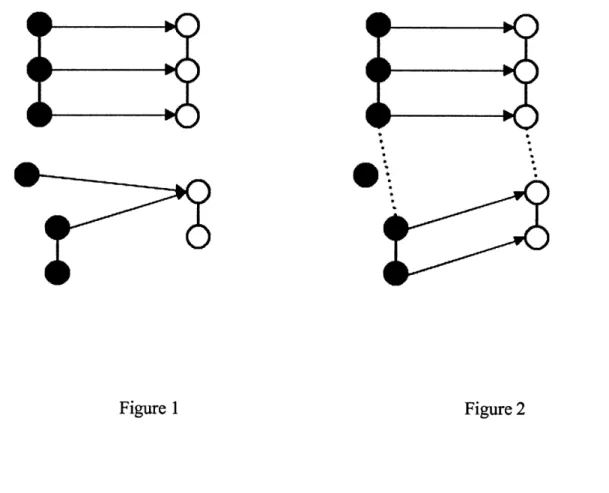
As an example of the utility of using multiple networks, consider Figure 1. On the left, the black nodes are proteins from one species linked to each other with PPI interactions. On the right, the white nodes are similar proteins linked with their own PPI data. The arrows from black to white show the alignment that IsoRank has computed, with an ambiguity in the lower set of nodes.
Figure 1 Figure 2
10Gavin AC, Aloy P, Grandi P, et al (2006). "Proteome survey reveals modularity of the yeast
But when you add an additional network, as shown in Figure 2, some of the separate components get connected by the dotted interactions of the secondary network. The high similarity score of the aligned upper cluster propagate through the secondary network to solve the ambiguity in the
lower nodes. The heightened similarity score propagates further into the original PPI network, yielding more alignments, as with the new bottom connection.
The original equation formulated by IsoRank equates the functional-similarity score (R) to the weighted sum of the network similarity score (A) and the sequence-based similarity score (E). This new multiple-alignment formulation can still be rewritten as a principle
eigenvector problem and can be solved efficiently with the power method on sparse matrices. To simultaneously align all networks, the coefficient for the network score is simply the weighted sum of the coefficients for each network. The coefficients are determined from the weighted sum of neighbors' scores as described in the IsoRank paper.
Orthology validation
The purpose of IsoRank is to compute an orthology between distantly related species that uses additional biological data to make its pairings functionally relevant. Almost all existing
orthology mappings are computed directly from sequence data from the genes or the proteins, so comparison to one of these systems is not very informative. If IsoRank is successful at finding functional orthologs that sequence-based methodologies do not, its results are expected to deviate from purely sequence-based results. How to measure the success of a computed orthology seems cyclical as there are only other computed orthologies to compare against. If every method includes the same bias, a new method without the bias will not agree with the
consensus position. IsoRank is an attempt to do things differently from the status quo, so it needs a more universal standard to compare with.
To evaluate the biological correctness of the global alignment, we need a source of genetic functional annotation that is not influenced entirely by sequence similarity. A great resource for this problem is The Gene Ontology: a project that labels genes and gene-products in a systematic and hierarchical way across species."1 These labels are called GO terms and cover three major categories: cellular component, molecular function, and biological process. The evaluation system based on these GO terms scores clusters highly when each member gene is covered with the similar labels.
For a mathematical scoring system used to invoke the GO terms, I used the technique described in the IsoBase paper.12 This method computes the normalized entropy, H, of each cluster, to produce a global mean normalized entropy. This scoring aims to gauge the internal consistency and self-similarity of each orthologous cluster within the framework of the GO term hierarchy. For each cluster S with d distinct GO terms among its members, the entropy is defined as
d
H(S) = H(p1 p,..p1 )= -j
pi
log pii=1
Where there is a p for each GO term evaluating to the proportion of members which are labeled with that term. Thus, a cluster where each member has identical labelings has every p equal to 1 and the entropy equal to 0. On the other extreme, a cluster where every member has labels that
"1The Gene Ontology Consortium (2000). "Gene ontology: tool for the unification of biology."
Nature Genetics, 25: 25-29.
12Park D, Singh R, Baym M, Liao C, Berger B (2011). "IsoBase: a database of functionally related proteins across PPI networks." Nucleic Acids Research, 39: D295-D300.
are unshared with the group will have every p equal to the inverse of the number of members in the cluster, which will add up to a very high entropy for large clusters. To account for the size of the cluster, the normalized entropy of the cluster S is defined as
H(S)
=--H(S)
log dThe final score given to a global multiple alignment of all genes of all species is the mean normalized entropy of all clusters. As seen in the IsoBase paper, IsoRank with sequence and PPI data performs better than the competing sequence-only alignment tools using this functional metric.
Genetic interaction data
The most promising new data type added to IsoRank is genetic interaction. BIOGRID,13 the same database used for the protein-protein interaction data, has an increasing coverage of genetic interaction data. However, there is a large discrepancy in coverage between species: for human and mouse there are an order of magnitude less genetic than protein interactions; for fly and worm there are half as many genetic as protein interactions, and for yeast there are twice as many genetic as protein interactions. Obviously, in order to incorporate this data into our protein functional similarity model, I need to assume a one-to-one correspondence between genes and proteins. While this is true much of the time, there are genes that can produce multiple proteins through intron splicing and post-translation protein modification. In the case of multiple proteins from a single gene, the two nodes need to be treated as separate in protein-space, but as the same thing in gene-space. The additional coverage of genes from this data will hopefully complement
13Stark C, Breitkreutz B, Reguly T, Boucher L, Breitkreutz A, Tyers M (2006). "BioGRID: a
the coverage of the PPI network.
I consider two ways to incorporate the genetic interaction network into IsoRank. The first
option is to merge the genetic and protein interactions into a single general-interaction network, and apply IsoRank exactly as before. The second option is to treat the genetic interactions as a distinct network, and align both networks simultaneously. The two-network approach is no more computationally complicated, as the second network becomes another additive term in the equation for functional similarity.
The two-network approach is superior because it has more biological relevance. In a single network alignment, the topology is indifferent to the origin of an edge, and it will blindly align an edge from a protein interaction to an edge from a genetic interaction. The resulting aligned network has the potential to score highly with improperly aligned edges. However, the two-network approach simultaneously aligns both pairs of two-networks, and an increased functional similarity from the protein network transfers to the same gene on the other network.
The large diversity of genetic interaction experiments can also be a great asset in complementing PPI data. All protein interaction experiments require both proteins under investigation to move freely in the cytoplasm to allow the factors to come together and show a response. However, there are large categories of proteins, like transmembrane proteins, that chemically cannot diffuse in the cytoplasm. Because the experiments are handicapped for these classes of proteins, PPI data for them is very spotty or nonexistent. Many types of genetic interaction experiments are indifferent to the function of the gene in question, such as experiments that assess the
viability of strains with arbitrary gene deletions. This means that whole-genome genetic
interaction studies have the ability to connect nodes in the alignment that are completely left out of the PPI network.
While IsoRank has a parameter (a) to control the relative weights of network similarity and sequence similarity, I utilize an additional parameter (p) for the relative weights of protein and genetic interaction scores. Both networks have relevance to biological function, and both are represented identically to the formulation of the functional-similarity score, but I experiment with using a parameter to control the relative weights of these two distinct networks.
Fragmentation of genetic interaction data
Unfortunately, genetic interaction is a more broadly defined term than protein-protein
interaction. With protein interaction, experiments detect direct physical interaction between two proteins. Most PPI data is from two-hybrid screening, where transcription signals are bound to each of the two tested proteins, and a reporter gene is expressed only when the two proteins
physically interact with each other. However, there are several types of experiments that yield fundamentally different information about genetic interactions. The spread of data across these experiment types across species is shown in Table 1.
For example, an initial large-scale study in yeast genetic interactions used synthetic genetic arrays to get synthetic lethality data with all known yeast gene-deletions.14 This experiment finds interactions indirectly, by crossing (mating) two strains of yeast that are each missing a gene.
14Tong AH, Lesage G, Bader GD, et al (2004). "Global mapping of the yeast genetic interaction
Each strain is viable on its own, but after the cross the resulting strain that is now missing both genes is tested for viability. Therefore, if the either one of the two genes can be deleted without issue, but both being deleted is lethal, the two genes are inferred to have a 'synthetic lethal' interaction. Obviously this type of experiment is very well suited to single celled organisms, and would be very difficult and very unethical to perform it on multicellular organisms like humans.
BioGRID 3.1.73 genetic interactions by e:
Genetic Interaction Type Yeast Worm Fly Mouse Human
Phenotypic Enhancement 5833 887 4360 22 164
Phenotypic Suppression 4313 53 5637 26 153
Negative Genetic 86066 1251 - -
-Synthetic Rescue 3725 118 - 2 27
Synthetic Lethality 13762 - - 2 2
Synthetic Growth Defect 17744 - - - 123
Dosage Rescue 4375 - 1 - 24
Table 1
Results and analysis
The GO-term entropy results show minor improvements when incorporating gene interaction networks into IsoRank. Due to the significantly fewer interactions available when the data is fragmented by experiment type, we first examine the results when all genetic interactions are combined into a single non-discriminating network. As shown in Figure 3, the
cluster-consistency measurement (normalized entropy) stays mostly constant for most values of a, except very low and very high values. When the combined genetic network is aligned
simultaneously with the PPI network, the normalized entropy is relatively unchanged for various weights of
P.
Combined genetic interaction networks
-4--- Genetic network alone ---- Genetic-PPI 0=.3
Genetic-PPI P=.5 Genetic-PPI 0=.7 0.905 >, 0.9 2 0. 895 0.89 -.N 0.885-MIN0RNNEEMKE#dENNRE IIBENNM
E
o.
88-0 Z 0.875 -&-0.87 0.3 0.4 0.5 0.6 0.7 0.8
IsoRank's network weight: a
Figure 3
As the combined genetic network offers a lot of noise and false connections between unrelated interactions, the main alternative is to choose the most universally represented types of genetic interactions from Table 1, which for our set of model organisms are phenotypic enhancement and phenotypic suppression. These well-represented types of interactions are exactly the opposite of each other, so there is no logical reason that they should be matched in the same network.
Phenotypic Enhancement and Suppression networks
-+-- PE-PS; 0=.5 -5- PPI-PE; 0=.3 PPI-PE; 0=.5 PPI-PE; 0=.71
F >% 0.98-0.96 - 0.94-N0.92-E
0.9-0 Z 0.88 0.86 0.3 0.4 0.5 0.6 0.7IsoRank's network weight: a
Figure 4
Figure 4 shows phenotypic enhancement (PE) when used in conjunction with PPI networks or its close relative phenotypic suppression (PS). The normalized entropy scores show the fully genetic network pair to yield more consistent clusters than the PPI-phenotypic enhancement pair. Both of these fragmentation strategies support the idea that combining unrelated networks leads to less consistent clusters, as measured by their GO-term self-similarity entropy.
Gold standard comparison
Despite the meager improvement in the overall GO-term similarity of clusters, using another evaluation method we can see that specific classes of proteins are better aligned using genetic
interactions. Using a gold standard set of orthologs compiled for the DIOPT ortholog evaluation tool, we can see which classes of proteins from the gold standard are better or worse represented with genetic interactions. DIOPT uses a set of 300 orthologs between human and fly from three major protein classes: transmembrane, kinase, and oxidative phosphorylation, which cover structural, signaling, and metabolic functions. This gold standard set of orthologs was compiled
by combing through biology literature for accepted functionally equivalent gene pairs. 5
As shown in Table 2, IsoRank using genetic interaction data finds many more transmembrane and kinase class proteins than the PPI data. However the metabolic proteins (oxidative
phosphorylation) showed a slight regress. Nevertheless the overall performance of IsoRank can be improved by supplementing it with genetic data. Classes of proteins for which it is fundamentally difficult to get protein interaction data do significantly better when using a more function-neutral genetic interaction.
Found by: Transmembrane Kinase OxPhos All
PPI only 15 10 11 36 Genetic only 43 25 2 70 Both 51 25 39 115 Neither 45 24 12 81 Total 154 84 64 302 Table 2
15Hu Y, Flockhart I, Vinayagam A, et al (2011). "An Integrative Approach to Ortholog
Prediction for Disease-Focused and Other Functional Studies." http://www.flyrnai.org/DRSC-OPT.html
Having a gold standard allows for a more sophisticated information-retrieval analysis of Isorank's correctness. The DIOPT paper also describes a way to apply classical sensitivity and
specificity analysis to ortholog prediction. In general, when evaluating a query that returns several potential results, the sensitivity is the ratio of returned matches to the correct results, and specificity is the ratio of returned matches out of all the returned results. In this particular case, a query is a fly gene in the gold standard set, and the expected result is the known human ortholog.
If IsoRank puts the query fly gene in a cluster containing the expected human gene, it will have
a high sensitivity for finding the correct result. If the query gene is in a large cluster with many potential human orthologs, IsoRank's results are not very specific and the specificity score will be low.
Sensitivity Specificity F-measure
PPI only 0.473 0.640 0.544
Genetic only 0.580 0.578 0.579
Union of both results 0.693 0.507 0.585
Table 3: Accuracy over DIOPT golden standard ortholog set
Without these complementary statistics, the total number of gold standard orthologs that IsoRank finds could be very misleading. Tweaking the clustering algorithm of IsoRankN to form larger clusters would make it more likely that any given pair in the golden set will be found in a predicted orthologous cluster. This would directly increase the sensitivity, as more of the golden set will be found by IsoRank's orthology prediction. However, excessively large clusters would sabotage the specificity by returning many unrelated genes. Table 3 shows that this is not the case, that with only a small decrease in specificity, there is a large increase in sensitivity. Taking the union of ortholog predictions from both PPI and genetic interaction parameters, the
sensitivity greatly increases with a similar fall in specificity. However, the F-measure, a related metric from information retrieval which is approximately the mean of both scores, increases steadily in each case, showing a progressively better ortholog metric over the golden standard set.
Gene expression correlation
The sparsity of the networks of protein and genetic interaction data is constrained by the number of experiments done on a given species. Another source of functional data which does not share this constraint is gene-expression profiling. Experiments for gene-expression take cells in different states (e.g. of the cell division cycle), from different tissue types, or with
specific diseases and use microarray technology to get a sample of all currently-expressed RNA fragments that are floating around the cytoplasm. A single microarray can have probes for thousands of genes, so gene-expression data has a very high coverage of the genetic space.
To get pairwise interaction-like data from these experiments, one calculates the correlation between each pair of genes across all of the different environment variables. In this way, two
genes that are often expressed in the same conditions will have a high correlation score, and two genes which are expressed independently will have a near-zero correlation score. Interestingly, if two genes are always expressed at different times, they may have a highly negative correlation. Either positive or negative correlation is functionally significant, as the genes are expressed (or suppressed) according to the same cues.
To map this correlation score to IsoRank, I found the correlation of all genes across a wide sample of disease and tissue-type experiments for human and mouse.16 This yields a fully dense interaction network, where all pairs of genes have a score from -1 to 1. Unfortunately IsoRank is practically incapable of operating on networks this dense. In order to represent the neighbor relations of two fully dense interaction networks of 10000 genes, IsoRank would need to operate on a matrix with 100004 entries. To alleviate this infeasible workload, I chose to only consider correlations above a cutoff as interactions. As can be seen in Figure 5, the distribution of correlations mostly follows a normal distribution around 0 with an exponential tapering off of pairs with very strong correlations. I chose the cutoffs to be 0.6 for human correlations and 0.7 for mouse correlations, which selects a similar amount of each, or roughly the most correlated 0.2% of all pairs.
16Hishiki T, Kawamoto S, Morishita S, et al (1999). "BodyMap: a human and mouse gene
Distribution of pair correlation
H. sapiens -- M. musculus
Figure 5
Since pairs with negative correlation obviously cannot be functionally equivalent to pairs with
positive correlation, I treat them as two separate networks: positively and negatively correlated gene-expression interaction networks. With this information, it is also clear that a negatively correlated interaction from the mouse should not be functionally related to a positively correlated pair from the human. We could add two more networks, mapping the mouse negative to the human positive and vice versa, and give them negative scores, so that IsoRank would prevent
6000000-
5000000-2
4000000-0. 4'-03000000-E
Z 2000000- 100000 0--1 -0.8 -0.6 -0.4 -0.2 0 0.2 0.4Correlation of gene expression
those pairs from aligning. Unfortunately, giving negative weights could put negative values in the greater interaction matrix A, which could potentially make IsoRank's results not converge. I leave that concept to different graph alignment algorithms.
However, when applied on top of the PPI data, these gene expression correlations greatly changed the results, apparently randomly. It appears that gene expression data is too noisy for being used with a cutoff in IsoRank. Even functional orthologs that are usually expressed together may not show up if it gets truncated by the cutoff. Another graph alignment algorithm that can handle much denser networks could potentially discover the functional relations hidden in the noise here.
Synteny-based similarity
Chromosome-localization data has the potential to provide both function and orthology information. Synteny is the co-localization of genes on a chromosome. Highly conserved synteny, where multiple genes occur adjacently in the same order in related species, can be an indicator of an important functional relationship in the conserved cluster. For example, the order of genes in the Hox cluster is mostly preserved throughout Animalia, and it helps to determine early body formation. Conserved synteny in closely related species is a sign that the genes are orthologous and that the local chromosome layout has not changed since speciation. Synteny has been used as the main technique to align genomes from multiple species.17
17 Kellis M, Patterson N, Birren B, Berger B, Lander ES (2004). "Methods in Comparative
Genomics: Genome Correspondence, Gene Identification and Regulatory Motif Discovery."
It seems logical to append another additive term in the definition of functional-similarity score. For synteny, a raw pairwise score similar to sequence similarity has no meaning, as genes are only syntenic to genes on the same chromosome. Adding another recursive term follows from the same motivation for the protein-interaction score. Two genes should have a high similarity
score if their sequences are similar and their chromosomal neighbors are similar. To formulate gene-ordering as a new network to be aligned, we can use a very simple structure: each
chromosome defines a linear connected component of genes with each gene connected to its two neighbors. Series of similar genes will give higher synteny-similarity scores to their neighbors and conserved orderings of the genome will be induced to align.
A major benefit of using chromosomal location data is that it is discrete and complete and not
subject to experimental noise. Data based on linkage disequilibrium experiments maps the human genome in 24 distinct lines of genes, one for each chromosome.18 The network-alignment approach to scoring synteny is much more tolerant of publication bias and noise than the protein/ gene interaction networks, which must discretize a noisy measurement and be interesting enough to be experimented on. The generalized topology matching of networks shown in the original IsoRank paper can match arbitrarily long stretches of conserved chromosomal regions across species.
For closely related species, clusters with high synteny-similarity show a very direct orthology of chromosomal descent. The related chromosomes have not had time to scramble themselves due
18Tapper W (2007). "Linkage Disequilibrium maps and location databases." Methods in
to gene duplication and movement. For the two most closely related species in IsoBase, human and mouse, most genes belong to aligned clusters that are dozens of genes long.19 Therefore
synteny-similarity for human-mouse alignment does not provide any additional functional information. All of the syntenic alignment coincides with the descent-based orthology that the sequence similarity reveals.
For more distantly related species, there is far less conservation in gene ordering along chromosomes. For eukaryotes, few regulatory mechanisms act on several consecutive genes at a time, unlike in prokaryotes, where several related genes are adjacent and simultaneously expressed by the same factor. For aligning model eukaryotes from different kingdoms, the descent-based orthology information that synteny conservation conveys is sparse and likely non-functional in nature. Including synteny networks for IsoRank's current set of species dilutes the functional information of other networks.
Conclusion and future work
The vast amount of biological experimental data across the model organisms in biology increases every year. For research spanning human disease and biological mechanisms, automated
ortholog prediction enables researchers to collaborate across species and to find models for human diseases. This project explored and evaluated the breadth of network-like data that can be applied to functional ortholog prediction. The generalization to IsoRank from this project allows
19National Center for Biotechnology Information. "Homology Maps: Human-Mouse-Rat" http://
for current and future biological networks to be added to the equation to continuously refine the alignment data. The results from integrating genetic interaction networks show some marked improvement for classes of genes that do not have good coverage in PPI data. IsoRank's current status will continue to improve when the genetic interaction network alignment catches up to the general coverage of the existing PPI network as more experiments are done and as existing experiments are adapted to the other model species.
Multiple network alignment with IsoRank allows for disparate data sets to be integrated into a single global optimization. Data from as diverse sources as evolutionary sequence alignment, physical protein interactions, regulatory genetic interactions, and inferred gene expression patterns are all combined into a single algorithm. Future work to improve automatic ortholog
detection should work to improve the evaluation side of the equation. A more complete and multi-species golden standard of orthology can give essential feedback to algorithm design and parameter tuning. With the current and future evaluation methodologies, IsoRank can continue to
integrate expanding data sources in protein and genetic interactions, as well as not-yet-invented experiments for more biological network data.