Thesis by
Richard Bruce Chapman
In Partial Fulfillment of the Requirement.s
For the Degree of Doctor of Philosophy
California Institute of Technology Pasadena, California
1970
ACKNOWLEDGMENTS
TABLE OF CONTENTS
Chapter Page
1. INTRODUC TION 1
A. Topics in Nonspherical Bubble Collapse I
B. Numerical Sirnula tion of Bubble Collapse 5
II. AN EXAMINATION OF THE PROBLEMS TO BE SOLVED
BY NUMERICAL SIMULATION 12
A. Definition of the Problems of Interest 12
B. General Characteristics of a Numerical Method Suited
to These Problems 17
III. DESCRIPTION OF THE NUMERICAL METHOD 20
IV.
V.
VI.
VII.
A. The Use of Finite Time Steps 20
B. The Finite Difference Equations 21
C. Solution of the Star Equations Using the Liebmann
Method with Overrelaxation 25
D. The Condition at Infinity Applied to the Outer Boundary 29 E. The Application of a Series of Nets to Obtain a Detailed
Solution 38
F. Calculation of Velocities on the Free Surface 45 G. Special Treatment for the Initial Time Step and the
Early Stage of Collapse 48
COLLAPSE NEAR A SOLID WALL A. Results of Numerical Simulation B. Discussion of Results
COLLAPSE OF INITIALLY NONSPHERICAL BUBBLES A. Results of Numerical Simulation
B. Discussion of Results
EVALUATION OF THE NUMERICAL METHOD A. Accuracy
B. Stability
C. Validity of Assumptions THE EFFEC T OF GRAVITY
54 54 66 71 71 77 79 79
89
9194
APPENDIXA. Garabedian's Estimate of the Relaxation Factor Applied
to Axially Symmetric Case 106
B. An Estimate of the Viscous Stresses on Nonspherical
Bubble 108
Abstract
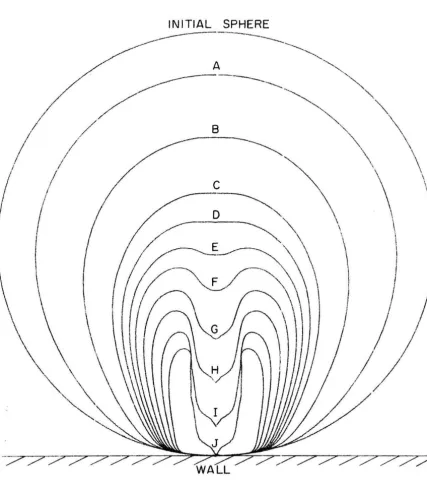
Vapor bubble collapse problems lacking spherical sym-metry are solved using a method of simulation designed especial-ly for these problems. Viscosity and compressibility in the liquid are neglected. The method of simulation uses finite time steps and features an iterative technique for applying the boundary con-ditions at infinity directly to the liquid a finite distance from the free surface. Two cases of initially spherical bubbles collapsing near a plane solid wall were simulated, a bubble initially in con-tact with the wall and a bubble initially half its radius from the wall. at the closest point. In both cases the bubble developed a jet directed towards the wall. Free surface shapes and velocities are presented at various stages in the collapses. Velocities are scaled like
j ~p
where p is the density of the liquid and~p
is the difference between the ambient liquid pressure and the vapor~p 6 ( cm ) Z 1 atm. .
pressure. For - p = 10 - - '" d .ty
f
t the Jet had a sec enSl 0 wa erspeed of about 130m/ sec in the first case and 170 m/ sec in the second when it struck the opposite side of the bubble. Collapse in a homogeneous liquid was simulated for bubbles with nonspherical initial shapes described by the
and rs = Ro[l - /0 Pz{cos8)] degree Legendre polynomial.
radi.i r s = Ro[l
+
/0 Pz{cos 8)] where P (cos 8) is the secondz
Bubble shapes in both cases were close to those predicted by linearized theory. A simple perturba-tion study oLthe effect of a small pressure gradient on a collapsing bubble shows that gravity is ordinarily negligible for bubbles
1. INTRODUCTION
A. Topic s in Nonspherical Bubble Collapse
The study of the behavior of a bubble in a liquid is greatIy simplified by the assurrlption of spherical symnlctry. Followin.g Rayleigh's[ 1) classical analysis of a problem first solved by
Be~;ant,
the inviscid collapse of a spherical cavity in a homogeneous, Incorn -pressible liquid under a constant ambient pressure, numerous Cluthor:,; have studied the behavior of spherical bubbles under a wide range of conditions. Far less is known about the nonspherical behavior (jf bubbles. Because problems lacking spherical symmetry have proven. too com,plex for direct analysis, they have been i.nvestigated primari-ly by qUiiljt~tive reasoning, experiments, and perturbations from spherically sym,metric solutions. One result of these studies has been the theory that cavitation damage is caused by the action of liquid jets forHled on bubbles near a solid surfac) 2).resulting solution suggested a reentrant jet for a high degree of deformation. This jet formation was only speculative, howev~'r, sinc~e it is not unlikely under any circurnstance for a series of
Legendre fUllctions to display singular behavior near the axis of sym -Inc try when the series is considered outside its range of validity.
The irnportance of the influence of a solid boundary on bubble collapse as a possible factor in cavitation damage was further e mpha-sized by Plesset[ 4] who argued that the stresses caused by the col-lapse and subsequent rebound of a spherical bubble containing a small amount of permanent gas falls off rapidly as the distance from the bubble is increased. These stresses are too small to damage a solid boundary unless the boundary is quite close to the bubble. Thus a
sohel wall tHust have an irnportant effect on the collapse of any bubble capable of damaging it.
Experiments by Benjamin and Ellis[ 5] confirmed that jets form on bubbles collapsing near a solid wall. Large vapor bubbles, generally about one centimeter in radius, were grown from small nuclei by the application of a negative pressure. High speed photo-graphs were taken of these bubbles as they collapsed near a plane
solid surface. The ambient pres sure was maintained at about 0.04 atm eluring collapse so that collapse velocities would be reduced to facili-tate the photography. These bubbles were nearly spherical as they started collapsing. First they became elongated in the direction
10 meters/second. Benjamin and Ellis concluded that since velocitiu,<-;
are scaled like the square root of the pressure, the jet speed under
atmospheric am,bient pressure would be increased by a factor of about
five. It should be remarked, however, that the characteristic pressure
in this case is not the ambient pressure but the difference between the
ambient pressure and the vapor pressure inside the bubble. Because
the vapor pressure of water at room temperature is not negligible
cOlnpared to 0.04 atm., the scaling factor should be greater
than five. This problem will be explored more fully in Chapter IV.
Another m.ajor topic in nonspherical bubble studies has been
the behavior of small asymmetries of a nearly spherical bubble in an
infinite, homogeneous liquid. The distortion of the shape of a nearly
spherical bubble is commonly expanded in spherical harmonics so
that the radius of the bubble is
<Xl
r
s(8,rp,t) = R(t)
+
L
n=la (t) y
n n (I -1 )
where Y
n is a spherical harmonic of degree n. For perturbation
solutions the coefficients a (t) are assumed to be much n smaller than
the mean radius R(t).
The central problelTI is the solution of a (t) for a given func-n
tion R(t) and a set of initial conditions. If the problelTI is linearized,
the various harlTIonics uncouple[ 6]. The general linearized equation
for a (t) was solved for bubbles collapsing or expanding under a n
constant ambient pressure by Plesset and Mitchell[ 7 ], who were able
One important result is that as the mean radius collapses to zero, 1
an(t) grows in magnitude like R -4: and oscillates with increasing
frequency. Thus even a small asymrnetry will become important
after the bubble has shrunk sufficiently.
Naude and Ellis[ 8] used the theory of Plesset and Mitchell to
analyze their experilnental study of the collapse of nearly hernispher-ical bubbles. Using electric sparks, they generated roughly
hemi-spberical bubbles on a plane solid surface and photographed them. as
they collapsed. Since the solid wall acts as a plane of symmetry, the
theory of Plesset and Mitchell is directly applicable.
A perfectly helnispherical bubble would, of course, remain
helnispherical as it collapsed and could be described by a spherically
symmetric theory such as Rayleigh's. The asymmetry in this case is
due to initial asymmetry in shape or velocity rather than the presence
of the soliel wall. Such bubbles can exhibit a wide range of behavior,
depending on the initial conditions, including the formation ( ) f a jet on
the axis of symlnetry. Although the solution of Plesset and Mitchell
does not require the lower harmonics to dominate as does Rattray's
solution for the collapse of an initially spherical bubble near a plane
wall, the assumption that i a
I «R means
that the linearized solution ncannot be used to describe the jet formed on a nearly hemispherical
bubble at the ti=e that it strikes the wall.
The analysis by Naude and Ellis showed that the distortion in
the shape of their bubbles was prilnarily composed of the second ha
r-lnonic with a slnall contribution from the fourth harmonic. No odd
it (t) a (t)
l 4
Nauc16 and Ellis presented the eXperilTICntal vahws of
aroJ
and il((,)l 4
over the first h;:df of the collapse (1.0 > R(t) > 0.5). These vahles agree with the perturbation solution. Since the contribution frorn the
second harrnonic was fairly large, Naude and Ellis had to add the
second order effect of a (t) on a (t) to obtain close agreement in the
Z 4
fourth harmonic. This second order effect was solved using an as -sumption analogous to Rattray's, that the lowest harmonic was
dorninant.
Because the photographic techniques used so effectively by
Benjarnin and Ellis had not yet been developed, it is not pos sible to
observe jetting directly from the photographs of Naude and Ellis.
They were able to produce some pitting in soft aluminum, however.
Similar experiments by Shutler and Mesler[
9J
also produced pitting. Shutler and Mesler concluded that jets formed but were too weak tocause the pitting which they attributed to rebound bubbles. These
results were later challenged by Benjamin and Ellis.
B. Numerical Sirnulation of Bubble Collapse
The advantages of a numerical technique for simulating
non-spherical bubble collapse arc clear . Experiments are difficult and
give only sketchy results. Perturbations frorn sph('l'icaJly r;ymmetric
solutions are not valid for large deformations. A numerical sol.ution,
however, can check results and supply detailed information.
Numer-i.cal methods can also be applied to situations which might be very
difficult to produce in the laboratory.
technique to nonspherical bubble collapse have not yet been tiuccess-ful. A report by Mitchell, Kling, Cheesewright, and Hammitt[ 10J considers the feasibility of using the MAC method for this purpose. Before this report is discussed, the MAC method will be briefly described.
The Marker-and-Cell technique is a general method for
sim.ulating incornpres sible, viscid flows with an as sortment of bound-ary conditions including free surfaces. In practice it has been applied only to two-din1ensional problel11s, either plane or axially symmetric flows. The basic calculations are Eulerian. A domain in the two-din1ensional Eulerian space is covered by a grid of rectangular cells. The tJressure and the velocity are assumed to be nearly constant over a single cell. The pressure distribution is specified by its value at the center of each cell. The horizontal velocity u and the vertical velocity v are specified at the midpoints of the vertical and hori-zontal sides of each cell, respectively, as illustrated in Fig. 1.
The pressure and the two components of velocity are related through the continuity equation and the two components of the equation of lTlotion. These three equations can be combined to give an exprcs-sion for the Laplacian of the pressure as a function of the components of the velocity and their fir st and second space derivatives. In the
plane flow case, for example,
(I -2)
./
/'
Vu eP 4 U
v
Fig. 1 Cell Us,.d bV the MAC lvl<:thoc
I
t
/
,./
{
/
1
/
VAPOR
/
J
V
V
/
V
LIQUIDJ'
V
/
V
F:ie(. Z Hcprcsent".tion 01 the P,ul>b10
, 11]
Welch, Harlow, Shannon and Dali .
The calculations progress by a series of finite time >oteps or
cycles. At the beginning of each cycle the velocity field is known so
that the right-hand side of Eq. (1-2) can be evaluated at each cell.
Poisson's equation can then be solved by some iterative technique.
Once the pressure distribution is known, it can be combined with the
known velocities in the equation of motion to find the derivatives of
both components of velocity with respect to time. These derivatives
are used to establish the velocity at each cell for the next cycle Lit
later. The final step in the cycle is to displace the nlarkers, which
represent sluall particles lUoving with the fluid. In practice there
will be several of these lUarkers in each cell. Their velocities are
found by sin1ple interpolation. These markers are used to represent
streamlines and to define the shape of the free surfaces. The manner in which a cell is treated during a cycle depends on whether it is a
full cell containing markers, an empty cell without markers, a free
surface cell containing markers but ac.jacent to an empty cell, or
sorne special case such as a cell adjacent to a solid boundary. After a certain an10unt of bookkeeping (detern1.ining which cells are full, etc.), the next cycle is ready to begin.
Mitchell, Kling, et al raised two n1ain questions in their report.
The first question, a comn1on one in flow sin1ulation, is how should
the calculations be initiated. They considered bubble collapse caused
by an instantaneous decrease of the pressure inside the bubble fron1
calculations was not justified; any discontinuity should be smoothed
out completely by the initial cycle of the MAC method. The point
remains, however, that the initiation of the calculation,; must: be ex
-cll11ined closely. It will be seen that an analysis of the early st'Lgc of
bubble collapse made in Chapter III of this thesis results in improved
accuracy and efficiency over this portion of the collapse.
The second question is how can a flow in an unbounded region
be described in a necessarily bounded domain. The collapse of a
ble is driven by the difference between the pressure inside the
bub-ble and the pressure infinitely far away. Although interest is
center-ed on the flow near the bubble, the far field cannot be ignored.
Rayleigh's solution for the collapse of a spherical bubble stated that
the difference between the pressure of the liquid and the ambient
pressure is the surn of two terms, which decrease in magnitude like
_1 _4
d and d as d, the distance from the bubble center, is increased.
For nonspherical collapse the pressure will have asymmetric terms, -2
which decrease like d and faster. One crude method of applying
the ambient pressure might be to extend the outer boundary of the
domain a number of radii away from the bubble and take the pressure
on the outer boundary to be the ambient pressure. A more refined
method was provided by Mitchell, Kling, et aI, who suggested that
Rayleigh's solution for the pressure be used at the outer boundary.
The outer boundary should be far enough away from the wall so that
the asymmetric terms will have died out. This method is based on
the linearized assumption that the spherically symmetric part of the
method presented in Chapter III of this thesis avoids this assumption
by using an iterative technique for applying the condition at infinity
directly to the outer boundary.
Another consideration in applying the .MAC rnethod to bul)bJ(,
collapse is one of stability. The theory of PIes set and Mitchell
shows that even a small error , or disturbance on the bubble surface, can become significant as the bubble collapses. Any finite difference
method will, of course, introduce small errors over the length of a
single cell. However, the MAC method is especially crude at free
surfaces and can easily give large errors that obscure the results. These errors arise because the MAC method does not modify the
finite difference equation at an irregular boundary such as a free
boundary but sin,ply imposes the condition that the pressure at the
center of a free surface cell is equal to the pressure on the free
sur-face. Modified finite difference equations at an irregular bounuary,
usually referred to as irregular stars, are essential for an accurate solution near the boundary. In their numerical study of
finite-an,plitude water waves Chan, Street, and Strelkoff[ 12] observed that
the waveforms beCalTIe unstable after a few cycles using the MAC
n,ethod. They obtained satisfactory results, however, with their
SUMMAC method, a modified MAC technique using irregular stars
at the free surface.
It is apparent that the problem of nonspherical bubble collapse
is one which is not readily solved by a general flow simulation method
principles. This is done most efficiently if the problems of greatest
II. AN EXAMINATION OF THE PROBLEMS TO BE SOLVED
BY NUMERICAL SIMULATION
A. Definition of the Problems of Interest
One problem of interest in nonspherical collapse is to
deter-mine the effect of a plane solid wall in deforming a collapsing bubble.
Typically a spherical bubble and the liquid surrounding it are visual
-ized as being at rest under a uniform ambient pressure until t '" 0
when the pressure inside the bubble is instantaneously reduced by
D.p. For a con~pressible liquid this instantaneous pressure drop will
produce a shock and an instantaneous radial velocity at the bubble
surface[ l3]
at t = 0+ (II -1 )
An alternate visualization of the problem, entirely equivalent
in the incompressible limit, is useful because it eliminates the
question of shocks and is more realistic experimentally. The bubble
is grown from a small nucleus by the application of a negative ambient
pressure. As the bubble grows the ambient pressur e is increased
continuously to the desired value where it is held constant. The
bub-ble will reach some maximum size and then collapse under the constant
ambient pressure. For spherically symmetric growth all segments of
the bubble surface will be at rest when the bubble reaches its maximum
size. In the incompressible limit the entire liquid will also be at rest.
With the absence of shocks compressibility will not become important
until speeds in the liquid are comparable with the speed of sound.
understanding that solutions are valid for small Mach nUlnbt,rs only.
The asymmetries caused by the solid wall should be separated
£I'orn those due to initial asymmetries in shape or velocity of the type
;:lllalyzed by Plesset and Mitchell. The bubble is therefore t<lkcn to be:
initially spherical and at rest,and any other extraneous asymm(;tric
effects such as gravity are also omitted.
The easiest and most widely applicable problem is one which
neglects all nonessential features. Therefore the following
assump-tions will be made.
1. The liquid is incompressible.
2 The flow is nonviscous.
3. The vapor pres sure is uniforITl throughout the bubble
interior.
4. The anlbicnt pressure and the vapor pressure arc constant
with tirne.
5. The bubble contains no permanent gas.
6. Surface tension effects are negligible.
Onlythefirstthreeassumptionsare essential to the method of
simulation developed in this thesis. The last three assumptions are
nlade to keep the essential features of the problem in the foreground.
For most cases of bubble collapse the viscous stresses are much
smaller than the inertial stresses. Thus in descriptions of bubble
collapse .. viscosity is usually neglected or kept only as n. "mall
refine-ment. Unlike the spherically symmetric case, which is always
ir-rotational, viscosity must be neglected in nonspherical collapse if
uniform pressure inside the bubble, this assumption will rernain valid
as long as speeds on the bubble surfa.ce are below the speed of sound
in the vapor.
The problem is specified by the Iollowing conditions:
p ::: an1bicnt pressure,
oJO
p ::: vapor pressure inside the bubble, v
R ::: initial radius of the bubble, o
b ::: initial distance from the plane wall to the
c enter of the bubble.
Because the flow is taken to be irrotational, the velocity
-vector v can be written in terms of a velocity potential rp
--
v(x, t) ::: Vrp(x,-
t)(II - 2 )
(II -3 )
(II -4)
(II -5)
(II -6 )
The liquid is assvmed to be incompressible so that rp must satisfy
Laplace's equation throughout the liquid,
2
-V rp(x, t) ::: 0 (II -7)
The pressure boundary conditions, (II-2) and (II-3), can be
restated in terms of
rp
and v:::I
Vrpl
with the aid of Bernoulli'sequation
ocp
vZ£.
at
+
"2
+
p ::: c(t) (II -8 )Infinitely far from the bubble the velocity is zero, and the pressure is
the ambient pressure. The velocity potential is an arbitrary ft~ncli()n
of time only. Because this function of time has no physical
...
l~IT1it'l'(x, t) = 0 I ~ I-ex)
and since v - 0 at infinity,
Then on the
8'1'
at+
c (t) - p ex)
r
free surface,
vl Pex)-Pv
2 = p
(II -9)
~P
=
p (II-IO)
On the solid wall the cOIT1ponent of velocity norIT1al to the wall IT1ust be
zero. Thus
at the solid wall, (II-II)
8
where
ihi
denotes the derivative normal to the solid surface. Thecondition that the liquid is initially at rest IY\ay be stated as
-'I' (x, t)
=
constant=
0 when t __ 0 (II-I2)The generality of this probleIT1 becoIT1es evident when it is
stated in its nondiIT1ensional forIT1. Let the nondiIT1ensionalized
quantities be teIT1porarily denoted by a star. Then the nond
iIT1ension-alized velocity and displaceIT1ent are
-
--~ v
-
xV;:~ and :x;:' Ro (Il-13 )
JAP
pso that
t,:, =
~ojApP
'1',:, = 'I',
etc.I¥
R
Laplace I S equation is unchanged in the nondimensional form as are
the homogeneous boundary conditions, (II-9) and (II-II), and the
homogeneous initial condition (II-12). The only changes are in the
initial conditions, (II-4) and (II-5), and the boundary condition (II-IO)
which have the nondimensional form:
R
o,:, co initial radius = 1
b,:, = initial distance frornwall to center of bubble
=-and
=
(II-I4)
-~
,(Il-l 5) Ro
(II-I6)
Thus the problem is completely characterized by the single
parameter
R
b The inclusion of surface tension or other effects owould have added more parameters and reduced the general
applica-bility of the solution. Now that the nondimensionalized form has been
introduced, Eqs. (Il-I4), (II-I5), and (II-I6) will be used, but the star notation will be dropped in the sequel.
Another problem of interest is the collapse of a bubble with sOlne asynlmetry in its initial shape. A numerical solution is
extreme-ly difficult for any three dimensional problem not possessing at least
axial symmetry. The shape of any axially symmetric bubble can be described by its radius,
00
r s (8, t) - R(t)
+
I
n=I
a (t)P (cos 0)
n n (II -17)
where P is the n'th Legendre polynomial. The odd coefficients
vanish for cases with both pl<me and a.xial symmetry. These cases
are convenient because the same method developed for collapse near a
plane wall may be applied directly to problems with both plane and
:1.."ial syrrllTletry with the wall forming a plane of symmetry. If it were
desired, of course, this m.ethod could be easilymodifieu to eliminate
the wall.
The same assumptions can apply for this type of problerTl as
for the collapse near a solid wall. The nondimensional forms arc also
equivalent with the characteristic length being
R o = R(O) = mean radius at t = 0
Instead of just a single parameter this problem is characterized
by an infinity of parameters:
a (0)
n
R o
and
a
(0)n
n = 2 , 4 , 6 .
B. General Characteristics of a NUITlerical Method Suited to These Problems
Now that the problcITls of interest have been defined, the
general features of a method of flow simulation especially suited to
them can be discussed. Clearly the irrotationality of these problems
is best exploited by solving them in terms of the velocity potential.
A single variable gives a great simplification to almost every aspect
of the calculation. If desired, both the velocity and the pressure can
be easily calculated from a solution in terms of the potential.
interest in these probletns is centered on the flow at and near the i"r",' SlIrrdC('. '['hv shape' "f the coJ.lajJ"ing bubble is of Lll' gJ.'Cdt('1'
s'igllifi,'anu' tilan i' rklai.led d<:sc' L'iptlon of the stl'c;lInJiIH.!S [;11:
f,'(),,,
iii"bubble, Markers like those used in the Marker-and-Cell method are of little use in representing the results. The task of defining the free surface can be perfortned by alternate methods so that marker s are not needed,
The method used in this thesis calculates the velocity only on
the bubble surface, The potential should vary most rapidly near the bubble and vary quite slowly far from the bubble, Thus it is neces-sary to have a highly accurate and detailed solution near the bubble surface, For a finite difference method this tneans that the grid should
be finest near the free surface, This can be accorrlplished either by a single nonuniforn1 grid or a series of grids with each successive grid more closely confined to the immediate neighborhood of the bubble and finer than the preceeding grid. The later method is the one used for
calculations in this thesis for reasons discussed in Chapter III. The
need for an accurate solution in the neighborhood of the free surface
also emphasizes the necessity of using irregular stars.
A basic question in the numerical simulation of axially
sym-n1ctric bubble collapse is whether to base the finite difference scheme on spherical coordinates as was suggested by Mitchell, Kling, et al
or on cylindrical coordinates. One advantage of spherical coordinates
is that a regular grid in spherical space with the origin inside the
bub-ble will have a greater concentration of points near the bubble than
the spherical system can present a problem, however, especially if
the bubble is highly deformed. Because of the singularity, the origin cannot be placed in or adjacent to the liquid. Another (litladvantag" oj"
spherical coorclinatctl is that the boundary condition at the wall cannot.
III. DESCRIPTION OF THE NUMERICAL METHOD
A. The Use of Finite Time Steps
All problems considered are axially symmetric so that the bub-ble and the liquid surrounding it can be described in any half plane bounded by the axis of symmetry. These problems are also assurrwd
to contain a plane solid wall or a plane of symmetry so that they can be further reduced to a single quadrant.
The method of flow simulation is based on a series of finite
time steps. The shape and the potential distribution of the free sur-face forming the bubble is known at the beginning of each time step.
The boundary condition at the free surface combined with the condition
at infinity and the boundary conditions at the solid wall and the axis of
syrnmetry will determine the potential throughout the liquid. The
velocities of points on the free surface can then be calculated. If the
time step At is small enough, the velocities will remain relatively
unchanged throughout the time step. Then the displacement of a point on the free surface with velocity v is approximately
-> -+
Ax = v A t (III -I )
Bernoulli's equation is used to get the rate of change of the potential of a point moving with the free surface,
acp
+ v z
~
(IIl-2)
where the nondirnensional variables have been used. F or L>t
slnall the change in the potential of a rlisplaced point on the free stlr
-i:lce is approximately
(IIl-3 )
The velocities in equations (III-I) and (IlI-3) are, of course, computed
at the beginning of the time step. After the free boundary has been
displaced and the potentials on it changed accordingly, the new bubble
shape with the new potential distribution on the free surface can be
used for another time step.
B. The Finite Difference Equations
The finite difference rnethod for solving the potential problem
is based on a cylindrical coordinate system (r, z). The r coordinate
measures the distance from the axis of symmetry, and the z
coordi-nate measures the distance from the solid wall or the plane of
sym-metry. Laplace's equation in the case of axial symmetry is
(III-4 )
Finite difference approximations to Laplace's equation can be
found in many places. Shawl 14], in particular, describes the
ap-proximation to Eq. (III-4). The domain of interest in the (1', z) plane
is covered with a square grid or net formed by a family of horizontal
z
2
3
o
4
r
Yi.'), . . ~ f\!llrnbf'rin~~ ~ystl,rn for Starn
AXIS OF SYMMETRY
vertical (r = constant) net lines parallel to tlw axis of Hytnnwtry.
Lines of both families are separated by a constant distance h called
the me sh length. The potential distribution thr oughou t the liquid is
described by the potentials of points, . called nodal points, where the
two families of net lines intersect. The free boundary is represented
in the calculation by the set of points where the free surface and the
net lines intersect (see Fig. 2).
A typical nodal point and its four neighboring nodal points,
each il distance h fron1 the central point, form a regular s';ar. If a
st:Jr is centered in the liquid but is ncar the free surface, sorne of its
outer nodal points may fall inside the bubble. Such stars are called
irregular stars because the nodal point inside the bubble must be
re-placed by a free surface point of known potential creating a leg
short-er than the meE;h length h. Stars centered inside the bubble are not
used in the calculations. The positions of points in both regular and
irregular stars with respect to the central or 0 point ar e identified
by the numbering system illustrated in Fig. 3.
The finite difference equation at a star is derived by ex
pand-ing the potential about the central point and neglecting the higher
derivatives (see Shaw, for example). The equation for most regular
stars is
cp
(
1
+
2
h
1
+
cP(I
-
~)
+
cP+
cP - 4cp =0
1 r 3 tor 4 Z a
0 , 0
(III-5)
where cpo is the potential at the i'th point of the star and r is the
1 0
distance of the central point from the axis of symmetry. Equation
point in terms of the potentials of the other points of the star.
(III-G)
Both the boundary conditions on the solid wall and the boundary condi
-tions on the free surface require special treatment for certain star s.
Stars centered near the axis of symlTIetry also need special considera
-1
tion because of the r'l'r tCrlTI in the Laplacian. 'I' can be expanded
for constant z in powers of r about the axis of symmetry,
'I' = a
+
brl+
.
(r small, z constant) (III-7 )A linear terlTI cannot be present in the expansion of (0 as a
function of r with z fixed since it would imply a line source of fluid
on the axis. For a regular star centered on the axis of symmetry
1)
4
('I' -'I' 0)lim ('I'
+ -
'I' = 4b'" _-.:...1 _ _r -> 0 rr r r I}
(III-8 )
Thus the finite difference approximation is
'I'
+
'I'+ 4'1' -
6'(1
= 02 4 1 a (III -9)
or
'1'0 (III -10)
Stars centered directly adjacent to the axis of symmetry at
r = h should also be considered. The equation for these stars is also
derived from an expansion about the axis of symmetry for constant z.
(III -1 1 ) Since the solid wall forms a plane of symrnetry, star s centered on the wall must satisfy
(III -12)
This condition is imposed simply by using the appropriate star equa-tion with <p substituted for <p •
Z 4
The boundary condition at the free surface enters the calcula-tion through the irregular stars. Equacalcula-tions for these stars contain the sizes of the irregular legs as parameters but are derived in the same way as the corresponding regular star equations. One very minor exception is a star centered at r = h with an irregular point 3
(the point closest to the axis of symmetry). The potential cannot De expanded about the axis in this case because there is no liquid at the axis. The irregular version of Eq. (III- 6) is used for this rare
case.
C. Solution of the Star Equations Using the Liebmann Method with Overrelaxation.
Each star equation can be written as a formula for the potential of the central point of the star in tenns of the central potentials of neighboring stars. The Liebmann iterative method is used with over-relaxation to find the potential distribution that solves all star equa-tions simultaneously. Each iteration of the Liebmann method covers every star in the net column by column. The central potential at each
This procedure is in contrast with another comnlOn method, the Richardson method, which does not use the new potentials until an iteration has been cornpleted. An initial estimate of the potential distribution is necessary to start the Liebmann method. Usually this is provided by the potential distribution from the preceeding time step. The first tim.c steps and time steps immediately following a change in the nets are initiated from a uniformly zero potential.
The convergence of the Liebmann method for large nets is greatly accelerated by the use of overrelaxation[ 15]. Suppose 'P s is the potential of the central point that satisfies the star equation. Then the old potential cP old is replaced by
cP new = cP old
+
a(cp s - cP old)1 :;; a
<
2 (III -13 )The constant a is called the relaxation factor . A simple estimate of the optimum relaxation factor and the rate of convergence for large nets was developed for the plane case by P. R.
Garabedia~
16]. He estirnated that after N iterations the error would be reduced by a factor of the order of magnitudeE =o(e -qNh) (III -14)
where q is defined by
(III -15)
0'
=
and k is the lowest eigenvalue of the problem
1
(III -16)
(III-I7)
The boundary conditions on U are the same as on the "rror in the
potential; U is zero on boundaries of known potential and has a 2cru
normal derivative on boundaries where the normal derivative is known.
An analysis analogous to Garabedian's is made of the axially
symmetric case in Appendix A. The results are identical if the
Laplacian in Eq. (IIl-17) is taken in its three dimensional form.
Clearly convergence is most rapid when q is maximized. Garabedian
pointed out that if C is made greater than
k/./2,
1 the real part of
- J4CZ - 2k2 will decrease sharply r educing convergence considerably,
1
but if C is less than or equal to the optimum
- j4C
2- 2k2 is purely imaginary so that
1
2 (2 -0')
q= ~
k/.[2,
1 then
(III -18)
If we assume that 0' is large enough to cover the lowest eigenvalue,
i. e.
2
0'
?:.
---"k-hr--I
+
_1_.f2
= 0' .
optlmum (III -19)
then the rate of convergence is a function of 0' only,
(III-20)
potential distributions on their surfaces. Let d measure thl' (iistancl!
from their common center. If the radii of the inner sphere and the outer sphere are d.
1 and d o respectively, the boundary condition on U is
U = 0 at d = d.
1 and d = d o (1II-21)
The eigenfunction with the smallest eigenvalue is a linear
cOlnbination of the zeroth order spherical Bessel functions,
a.nd y (k,r). FrOlTl the boundary conditions
o
where
sin k (d-d.)
1 1
U
-1 d
TI
k = d -d.
1 0 1
TI
= Jh
j (k, 1')
o
(III-22)
(1II-23)
is the smallest eigenvalue and J is the number of mesh lengths
be-tween spheres. The optimum relaxation factor is then
a . 2
optlmum =
-1
+
_iT _ _i2J
(III-24)
If the relaxation factor is this optimum value, then the error reduction
factor is
(III - 25)
The number of iterations necessary to achieve a given error reduction
is proportional to J.
Liebmann method, and overrelaxation are all well-known techniques
that have been applied to many different problems. The more
special-ized aspects of the method associated with the present problem will
now be discussed.
D. The Condition at Infinity Applied to the Outer Boundary
It was stated in Chapter I that an iterative method has been
developed for applying the condition at infinity to the outer boundary.
The outer boundary in this case refers to the boundary of the net
exclud-ing the free boundary, the axis of symmetry, and the solid wall. The
method is based on a spherical coordinate system (d, e) with its origin
at the intersection of the axis of symmetry and the solid wall. The
distance from the origin is d; the angle with the axis of symmetry is
e.
Each step begins with a net like the one in Fig. 4. The shape ofthis net is chosen to give the nodal points on the outer boundary a near
-Iy constant value of d. A slight point to point variation in d is
lln-ilnportant, however. Irregular stars are unnecessary on the outer
boundary. The average value of d on the outer boundary will be
referred to as d .
o
The potential can be expanded in a series of axially symmetric
harmonics that will be valid for values of d large enough to complete
-ly contain the bubble
00
<p (d e) = ' \ (A d Zk + B d-(Zk+ I)) P
,
L
z
k zk zk (cos e) • (III-26)k=o
Only the even Legendre polynomials are used in the expansion because
'Lpproaches zero infinitely far from the bubble may be restat.ed as
A = 0
2 n n=1,Z,3. (TTl-27)
The A coefficients will be zero only when the potential distribution on
the outer boundary is consistent with the condition at infinity.
The higher harmonics should die out most rapidly as d incr
eas-es. It is assumed that d is large enough so that the P (cos e) and
o 0
P (cos e) terms effectively describe the potential on the outer boundary.
2
The P (cos e) term is also included in the calculation~but d is
4 0
large enough in practice to keep this term negligible. The potential at
the outer boundary may then be written as
+
B2)
d 3o
P
(cOSe)+(A
d 4+
B4 )p(coso)l 4 0 d S 4
o
=
c
+
c
P (cos e)+
c
P (cos e)o l 2 4 4 (IIl-Z8)
Each time step begins with a trial potential distribution on the
outer boundary. This potential distribution is usually provided by the
results of the previous time step. The potential problem is solved
using these trial outer boundary values for the potential. The condition
that the A coefficients must vanish may be stated as a relationship
be-tween the potential and its radial derivative. Therefore, the radial
derivative is calculated at each nodal point on the outer boundary. All
nodal points on the outer boundary of nets like the one in Fig. 4 have
other nodal points directly below them and to their left. The derivative
in the vertical direction can be calculated by fitting a second order
nodal points directly b(~low it. From Eq. (III-46)jwhich is derived HI Section F of this chapter, one obtains
o<p
haz
(r,z)=
2(",(r, z) - '" (r, z-h) ) -"2 ('"
1 (r, z) - <p (r, z - 2h) ) .(III-29)The horizontal del"iv'ative is calculated by the same method and is then combined with the vertical derivative to produce the radial derivative:
B o
d l o
+(
2A d - 3 l 0BZ)
P (cos 0) d 4 l
o
+
(4A d
3_4 0 5 d B4 6 )P(COSO) 4
o
_ D
+
D P (cos e)+
D P (cos 0 )o 2 2 4 4 (III-30)
The C and D coefficients are easily evaluated fr01TI the potential on the outer boundary and its radial derivative. The A and B coefficients are determined by the C and D coefficients. In pa rti cula r ,
B = - D d2
o 0 0
B = (2C d 3 _ D d 4) / 5
2 Z 0 2 0
and B = (4C d 5 _ D d 6 ) / 9
4 4 0 4 0 (III- 31)
C
=
B /d == - D do 0 0 0 0
C =B /d 3= (2C -D d )/5
z z 0 Z Z 0
C = B /d 5= (4C - D d )/9
4 4 0 4 4 0 (III-32)
With the neglect of the higher harmonics, Eqs. (III-32) will be satisfied
only when the potentials on the outer boundary are consistent with the
condition at infinity. Equations (III-32) suggest that the B coefficients
calculated fl-om Eqs. (III-3l) may be used to form new potentials at the
outer boundary nodal points from the formula
<p (d, 8)
B o = -d
+
B
z
d 3
B
P (cos 8) + -1 P (cos 8)
Z d 5 4
(III- 33)
The iteration scheme is to solve the potential problem with the
new outer boundary potentials, then find the B coefficients from Eqs.
(III-3l) and use them inEq. (III-33) to establish outer boundary pote
n-tials for the next iteration. Let a superscript n on a coefficient
denote the value of that coefficient during the n'th iteration. Equation
(lII-33) specifies that
C n+! = B n/ d - - Dnd
0 o 0 0 0
n+1
Bn/d 3 (2Cn _Dnd )/5
C = =
Z Z 0 Z Z 0
n+ !
Bn/d 5= (4C' - rfd )/9 (III - 34)
C =
4 4 0 4 4 0
If the coefficients converge, they will converge to a solution of Eqs.
(III-32).
the simple case of a perfectly hemispherical bubble on a solid wall with an axially symmetric potential distribution on the bubble surface.
Let d. be the radius of the bubble. The potential on the bubble
sur-1
face ITlay be expanded as
()()
<p(eli , 0) ::
L
FzkFz k(cOS e)
k::o
Then the correct potential at the outer boundary is
(lI[-35)
3 5
<p (do,e)::
Fo(:~)
+ Fz(
:~)
P z (cos e) + F4(:~)
P4(cos e) +. (IlI- 36)The ratio
d.
1
d
is assumed to be sufficiently small so that higher oharmonics are negligible at the outer boundary. Let the error in the potential at the outer boundary be expanded in Legendre polynomials:
(IIl- 37)
Then from Eq. (III-36) the coefficients are given by
( d. ) B n d.
En = C n F _1
=An+~-F1-1)
0 0 o d 0 d o d
0 0 0
F z(
:~)
3
B n
F z(
:~)
3
En C n :: And Z + Z
::
- -
-Z Z Z 0 d 3
0
F
4(
:~)
5 Bn
(:~
)
5
En = C n = And 4+
- -
4
-
F (IlI-38)4 4 4 0 d
5 4
0
Since the potential is known on the free surface the solution there is
n
+
B /d. =0 Fo 1 0
(III-39)
and
Equations (III-38) can be combined with Eqs. (III-39) to obtain
d d.
Bn = F d. + En~
o 0 1 0 d -d.
o 1
(III-40)
and
From Eqs. (III - 34) the C and E coefficients for the next iteration will be
C n+l
=
F (di)+ En d.
(
E~+l
d.
1
=
En 1
0 o d 0 d -d.
,
0 d -d.0 0 1 0 1
(d.
f
d:
,(
E~+l
d3
)
C n+l -. F _1_
+
En 1=
En 1 , (III-41 )2 2 d 2 dl. -d~ 2 d3 -d~
0
0 1 0 1
and
(d. S ciS ( n+l ciS
)
C n +1 1 n 1
=
En 1
4
=
F 4d)
0 + E 4 , EdS -d~ 4 4 d S -d~
0 1 0 1
If d./d
a single iteration. It is now obvious why more terms were nol
includ-ed in the calculation to improve the validity for smaller values of d ;
o
convergence is enhanced by keeping the radius of the outer boundary
large. In practice three or four iterations were sufficient to establish
a satisfactory potential distribution on the outer boundary starting
from a uniformly zero distribution, and only a single iteration was
necessary to adjust for the small changes between consecutive time
steps.
The net used to establish the outer boundary potentials had a
radius of 40 m esh lengths or, occasionally, 50 mesh lengths. The
initial bubble shape had a radius of 5 mesh lengths in this net for thr.,
problem of an initially spherical bubble collapsing near a solid wall
and a mean radius of 10 mesh lengths for the problem of an initially
nonspherical bubble collapsing in a homogeneous liquid.
One case, for example, started with a nonspherical bubble
with a radius of
(III-42)
where
luean radius
=
1=
10 mesh lengthsThe radius of the outer boundary was four time s the mean
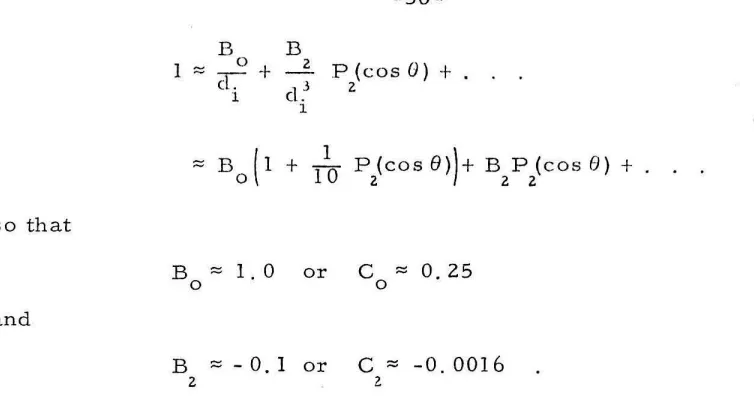
radius of the bubble. The potential was unity over the entire bubble
surface. Since the deviation from spherical (or hemispherical) was
only ten percent, a fir st order estimate of C and C can be made
o 2
B B
'"
;:r:-
0+
d] 2 P(cosO) Z+
1
1
(IIl-43 )
so that
and
B '" - O. I or C '" -0.0016
2 l
This gives a rough check on the values actually computed, which are
Iii'tecl ill Table 1. Differences are due to second order terms nc'glectcd
in Eq. (III-43) and the fact that the accuracy of the numerical solution
is lin.ited because the free surface is represented by only a finite
llurnber of points in this net, twenty-one in this case.
TABLE I
Values of the C Coefficients Computed while Establishing a Potential Distribution on the Outer Boundary
Cn C n Cn
0 2 4
Iteration
initial values 0.0 0.0 0.0
n = 1 0.28664 -0.0042862 0.0018235
0.24474 -0.00010602 -0.00057663
n 3 0.25159 -0.0014508 0.000044342
0.25038 -0.0013336 -0.000018905
n = 5 0.25060 -0.0013661 -0. 0000094077
An examination of Table I shows that the convergence of the co
-efficients does not follow Eqs. (III-41). The Cn coefficient converges
[image:40.525.74.451.60.266.2]rnore rapidly than expected; while which should converge faster
Cn is sornewhat settled. n
than C ,
o does not converge at all until o Finally Cn,
4
which should converge the fastest of all, merely cic,cJ.ines
in magnitude without approaching a limiting value. One pos sible e
x-planation is that the asymmetry of the bubble shape has coupled the
co-efficients. If d. is no longer a constant, then Eqs. (III-39) will be
1
coupled causing the coefficients of the error to couple. But this
coup-ling cannot explain, for example, why C nand C n are erratic during
z
4the first few iterations while C~ converges. The true cause is
reveal-ed by the observation that an increase in the number of iterations usreveal-ed
by the Liebrnann rnethoci reduces this type of behavior. Any change in
Cn or any other of the coefficients alters the outer boundary potentials o
and introduces an error in the potential solution near the outer boundary.
The Liebmann method reduces this error by a factor depending on the
number of iterations used. The overall effect of the reduced error
should be much smaller than the change in the potentials. But if the
changes in the outer boundary potentials are much larger than C or
z
C, the reduced error may still have a large effect on them. In this
4
case C
z
and C 11. 4
is much smaller than Co' and C is negligible.
4 Thus C n z
are highly susceptible to changes in Cn as has been observed. o
This does not pose a practical problem, however, since it is of no value
to determine C
z and C4 more accurately than Co.
The accuracy of the coefficients is enhanced by keeping the number of points used to repre sent the free surface as large as
pos-sible. Convergence demands that the outer boundary of the net be as
sirnultaneously satisfied for cases in which the bubble is close to the
solid wall. Then as the bubble collapses, the scale of the net used to
establish the outer boundary potentials can be halved from time to
time. This procedure effectively moves the outer boundary closer to
the free surface. The outer potentials are then re -established. In
practice these potentials were observed to be consistent with their
values during the preceeding time step when the new outer boundary
points were interior points. Values of the C coefficients for tirne
steps irnmedlately before and after a typical scale change are pre
-sented in Table II.
TABLE II
Values of the C Coefficients for Time Steps
Immediately Before and After a Typical Scale Change
C
2 C 4
time step preceeding scale change 0.1377 0.0002603 0.0000754
time step following scale change 0.2699 0.002600 -0.0000292
Ideally, neglecting the change between consecutive time steps, C
a
should be doubled and C increased by a factor of eight. The second
z
set of coefficients is the rnore accurate since the net used to find them
contained twenty-four free boundary points while the net used for the
fir st set contained only twelve free surface points.
E The Application of a Series of Nets to Obtain a Detailed Solution
Once the potentials on the outer boundary are established, they
l<!ngth of the net used to establish the outer boundary potentials giv(,s
only a rough solution nC'ar the free boundary. Therefor" a s<!ri.<!s of
progressively finer net;; is used to provide a l'l'lore detailed descrjption
there. A.J.1.other possibility would be to use a large sing.le net cornposed
of various regions of uniform mesh length with the mesh lengths of
these regions decreasing as the free surface is approached. This would
have one advantage in that a more detailed de'scription of the free sur-face would increase the accuracy of the outer boundary potentials. If
this single net contained a large number of points, however, the con
-vergenC'e of the Liebmann method could be quite slow. It can be seen
£1'on1 Garabedian's results that the number of Liebmann iterations
needed for a given factor of error reduction is, assuming a uniform
Hlesh, inversely proportional to the mesh length. Thus the total num
-bel' of operations required is inversely proportional to the cube of the n1.esh length. If a detailed solution of a potential problem is required, it is more economical to first obtain a solution using a coarse net and
. [ 17] h . f h
then apply the flner nets . T us a serles 0 nets is t e most
ef-ficient l'nethod for obtaining a detailed solution near the free boundary.
It is convenient if each net of the series has a mesh length half
the mesh length of the preceeding net. Then a nodal point of the finer
net falls either directly on the location of a nodal point in the precee d-ing net, midway between two such points, or equidistant from four of
NE
T
2
NET
Fig. 5 A Ty!)ical Series of Nets
The shapes of all nets except the first one of the series are arbitrary.
Usually these nets were shaped to give a minimum distance of ten to
twenty mesh lengths between the free surface and the outer boundary.
A typical series of nets is illustrated in Fig. 5.
In practice either three or four nets were used in the series.
The finer nets had a large percentage of their nodal points located in
the bubble interior. Although these "interior" points have no active
role in the calculations, they do occupy storag2. Sir-ce the number of
these points quadruples when the mesh length is halved, storage r equirc:
-ments can limit the number of nets that can be used in a series. For
an initially spherical bubble collapsing near a solid wall the final net
contained an average of 100 free surface points. Because of the plane
of symmetry, the final net contained an average of 50 free surface
points for the case of a nonspherical bubble with axial and plane
sym-metry collapsing in a homogeneous liquid. Whenever the number of
free boundary points fell below these levels, another net was added to
the series. Whenever the scale of the first net was halved, a net was
subtracted from the series.
The relaxation factor for the first net of the series was estirna
-ted from the model of a sphere of radius d with a point of known
o
potential (representing the free boundary) at its center. The optimum
relaxation factor for J = 40 is a = 1.895 from Eq. (III-24). After
N Liebmann iterations, the error will then be reduced by a factor of
E = O(exp(O. III N)). Thus 40 iterations will reduce the error by a
factor of about 85. This is enough to adjust for the small changes be
potentials between consecutive tiIne steps are always Inuch smaller than the change s at the free boundary. The potential probleIn is solved at least twice using the first net of each tiIne step, once to establish the new outer potentials and once using theIn. Thus the first net is subject to at least 80 iterations under the proper free bounda.ry condi-tions. If the outer potentials Inust be established froIn a uniforInly zero distribution, an increased nUInber of iterations such as 50 is advisable because of the large changes at the outer boundary.
The finer nets contain errors of predoIninantly SInal! wave-lengths. For these nets a relaxation factor capable of handling errors extending a distance of 20 Ineshlengths froIn a spherical boundary should be adequate. FraIn Eq. (III-24) a = 1.80 when J = 20. The initial errors in the finer nets will be sInall in Inagnitude. Also erJ:ors near the free boundary left by one net will be reduced by following nets. Therefore 15 iterations should be sufficient for the interm.edlate nets. This gives an error reduction factor of about 30 for a = 1.80. Al-though the initial errors are quite sInal!, Inore iterations are advisable for the final net of the series because the velocities at the free surface points are calculated £rOIn its solution. A choice of 25 iterations gives an error reduction factor of about 250 for a = 1.80.
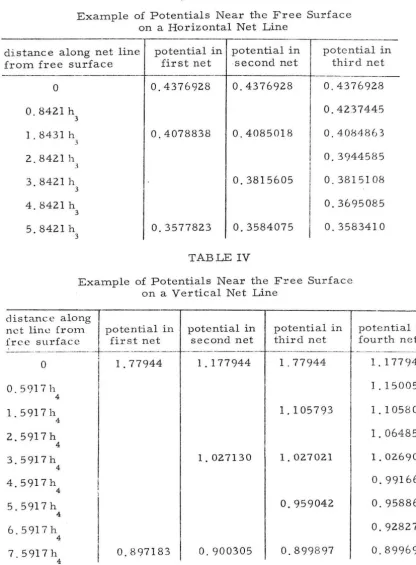
The potentials of typical points near the free surface as they appear in the various nets of the series give SOIne insight into the
The symbol h. refers to the mesh length of th,~ i't], net of the series.
1
TABLE III
Example of Potentials Near the Free Surface
on a Horizontal Net Line
distance along net line potential in potential in potential in
from free surface first net second net third net
0 0.4376928 0.4376928 0.4376928
0.8421h 0.4237445
3
1 . 8431 h 0.4078838 0.4085018 0.40~4863
3
2.8421h 0. 3<)44585
.\
3.8421 h 0.3815605 0.3815108
3
4.8421 h 0.3695085
3
5.8421 h 0.3577823 0.3584075 0.3583410
3
TABLE IV
Example of Potentials Near the Free Surface
on a Vertical Net Line
distance along
net line frorn potential in potential in potential in potential in
free surface first net second net third net fourth net
-
'
-
.
-
--
-
.. -
-
-
+
----.
-
- - -
-
+-
-
--1-- - - -_. -.--- -.-.-----o
I
1.77944 1.177944 1.77944 1.1779440.5917h 1.150050
4 1.5917h 4 2.5917h 4 3.5917h 4
4.5917h
4
5.5917h
4
6.5917h 4
7.5917h
4
1.027130
0.897183 0.900305
1.105793 1.105800 1.064858 1.027021 1.026908
0. 991664
0.959042 0.958863
0.928276
[image:47.529.66.483.122.688.2]8
V
A/
0V
/
D7
E
.~l'.t.g. ;1 Puints Used to Calculate the VeJocif:;/ ;11: FrC'(; T)oUlldal")' - ... F-'r,int 1\
l~ig. 7
[] ORIGINAL POINTS A DISPLACED POINTS
o
NEW POINTSLne a 1" III te 1":)o.ia ti on to Obt ain
These eX-3.IT1ples show that the potential at a point changes only
slightly between consecutive nets of the series; the errors in the initial
potentials of the finer nets are sIT1all, as expected. They also show
that the potential in the final net varies SITlOothly with the distance from
the free boundary and can be described accurately by a quadratic over
the distance of a few IT1esh lengths. This behavior is useful in. the
velocity calculati.ons.
F. Calculation of Velocities on the Free Surface
The velocity components in both the r a n d z directions must
be found at all free boundary points of the final net. Each free houndary
point will lie on either a vertical net line or a horizontal net line. The
v{~locity calculation will be described for a point on a vertical. net line.
The ITlethod is cOIT1pletely analogous for points on horizontal net lines.
If the ITlesh length of the final net is sufficiently sITlall, each free
bound-ary point will be part of an irregular star with a regular point opposite
the free boundary point as in Fig. 6. The only exception for free
bound-ary points on vertical net lines occurs when the bubble touches the wall
with an acute angle of contact. Then there are stars with irregular
vertical legs centered on the solid wall. Let 'fB' 'Po' and <PD be the
potentials of the free boundary point, the central point of the irregular
star, and the point opposite the free boundary point, respectively. The
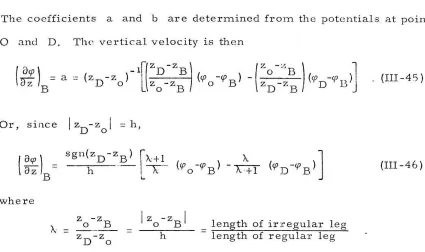
potential along the vertical net line is approxiluated near the free
boundary point by a quadratic fitted through points B, 0, and D.
'vVriting this quadratic as an expansion about the boundary point for a
(III-44)
The coefficients a and b are determined from the potentials at points
o
::lnd D. The vertical velocity is thenOr, since
where
A: =
I
z -zI
= h D o '- -- - = z -z
D
0= length of irregular leg
length of regular leg
.
(III-45)
(III-46)
When A. is smaller tl,an sorne minimum value A. M- , point D is used
In
in plac e of point 0, and the next point along the net line (point E in
Fig. 6)replacef; point D. This adds unity to A..
If the irregular star is centered on the solid wall, the potential
may be expanded about the wall along a vertical net line. Since the
potential is an even function of z,
'P = 'P o
+
bz2+
.
(for r = constant). (III-47)Thus the verticill velocity may be approximatE:d by
8rp '" 2b z '"
8z
B
(III-48 )
Once the derivative in the vertical direction has been found, the
[image:50.525.66.491.114.366.2][re',' Goundary !Joints 011 either side oJ point 13, points A awl. C, l\
.linear approxirnation is used for the potential between adjacent fr"e
surface points. Expansion of the potential about point B along the
free surface gives to first order the form
(III-49)
Equation (III -49) produce s an estimate for the horizontal velocity,
'PA-'P B -
(~~)
(zA- zj3) B(
~'P.
or
) . '" 13(III-50)
To avoid any systernatic errors, this estimate is averaged with
another estinlate of
( o<{')
made using the free surface point C onor
Bthe other side of B, Since the method for finding the horizontal
veloc-ity is essentially to subtract the known vertical component from the
velocity tangential to the free surface, the tangent to the free surface
cannot be nearly vertical if accurate results are desired, If the
nor-rnal to the free t;urface makes too small an angle with the horizontal
dlrcction, then the velocities are not calculated at that point, and the
poill!: will lJot be llsed in forming the displaced [ree bOllDda.l'y [or th(~
ncx.t tirne step, Similarly free boundary points on horizontal net. Jines
arc 110t used where the normal to the free surface is nearly vertical,
The percentage of points eliminated by this criterion is small,
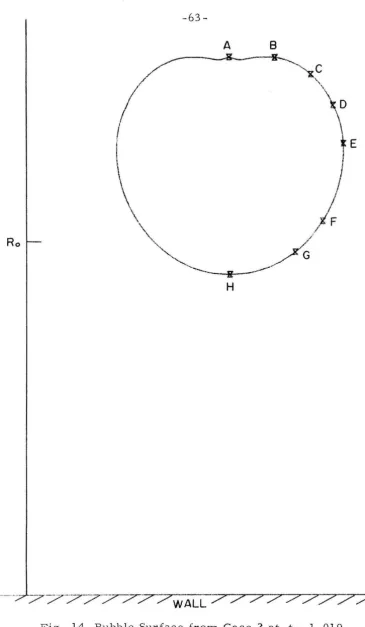
how-ever, since the free surface will cross few vertical net lines where its