371
ABARUAH at SemEval-2019 Task 5 : Bi-directional LSTM for Hate
Speech Detection
Arup Baruah
Dept. of Comp. Sc. & Engg. IIIT Guwahati, India
Ferdous Ahmed Barbhuiya
Dept. of Comp. Sc. & Engg. IIIT Guwahati, India
Kuntal Dey
IBM Research India New Delhi
Abstract
In this paper, we present the results obtained using bi-directional long short-term memory (BiLSTM) with and without attention and Lo-gistic Regression (LR) models for SemEval-2019 Task 5 titled ”HatEval: Multilingual De-tection of Hate Speech Against Immigrants and Women in Twitter”. This paper presents the results obtained for Subtask A for English language. The results of the BiLSTM and LR models are compared for two different types of preprocessing. One with no stemming per-formed and no stopwords removed. The other with stemming performed and stopwords re-moved. The BiLSTM model without attention performed the best for the first test, while the LR model with character n-grams performed the best for the second test. The BiLSTM model obtained an F1 score of 0.51 on the test set and obtained an official ranking of 8/71.
1 Introduction
Davidson et al. (2017) has defined hate speech as “language that is used to express hatred to-wards a targeted group or is intended to be deroga-tory, to humiliate, or to insult the members of the group.” Gamb¨ack and Sikdar (2017), Badjatiya et al.(2017),Waseem (2016) and Waseem et al. (2017) have used the term hate speech to indicate tweets having racist or sexist comments. Social media is becoming a convenient medium to spread hate speech. Hate speech spread through social media has fueled riots in Myanmar1, Sri Lanka2, Charlottesville (USA) 3, and many other parts of the world. Thus, it is becoming increasingly im-portant to detect and remove hate messages from
1
https://www.nytimes.com/2018/10/15/technology/ myanmar-facebook-genocide.html
2 https://qz.com/1223787/sri-lanka-shut-down-facebook-whatsapp-and-instagram-to-stop-anti-muslim-violence/
3 https://psmag.com/social-justice/how-social-media- helped-organize-and-radicalize-americas-newest-white-supremacists
the web. It is not possible to manually moder-ate the vast amount of text exchanged on the web. Developing automated systems to recognize hate speech is becoming crucially important. However, detecting hate speech in a text is more than just checking for the presence of hate words. Lexicon based approaches have not been very effective in hate speech detection (Nobata et al.,2016).
As part of the 13th workshop on semantic eval-uation (SemEval-2019), shared task 5 defines two subtasks with regard to detection of hate speech against immigrants and women in Twitter (Basile et al.,2019). This task was conducted for tweets in English and Spanish language. In Subtask A, it is required to determine if a tweet, with a given tar-get, is hateful or not. In Subtask B, it is required to determine if a given hateful tweet is aggressive or not and whether it targets an individual or a group.
2 Related Work
to detect hate speech. Pavlopoulos et al. (2017) used Convolutional Neural Network (CNN) and RNN with attention mechanism to moderate user comments.Sax(2016) compared the performance of several deep learning techniques, LR and Sup-port Vector Machine (SVM) models in detecting hate speech.
3 Data
Table1below shows the proportion of positive and negative instances of hate speech in the train, de-velopment and test data sets. As can be seen, 42% of the instances in each of the data set are hate speech. The data collected in Gao et al. (2017) had only 0.6% hateful tweets.Nobata et al.(2016) found that only 5.9% of the online comments con-tained hate speech. The data sets used for this task, however, are quite balanced.
Type Not Hate Speech Hate Speech Total
Train 5217 (58%) 3783 (42%) 9000 Dev 573 (57.3%) 427 (42.7%) 1000 Test 1718 (57.85%) 1252 (42.15%) 2970
Table 1: Data set statistics
The models used in our study were trained and validated using the train and development sets pro-vided as part of this task. No other external data sets were used for training or validating. How-ever, pre-trained GloVe4word vectors trained us-ing 2 billion tweets were used as features for the two BiLSTM models. The 200-dimensional word vectors were used in our experiments.
4 Experimental Settings
4.1 Preprocessing
The preprocessing performed on the text includes the following
-1. All URLs, mentions and non-alphabetic char-acters were removed from the tweets.
2. The tweets were then converted to lowercase.
3. Stemming was performed using NLTK’s Lancaster stemmer.
4. Stopwords were removed.
5. Tokenizer was used to convert each tweet into a sequence of integers by replacing each to-ken by its index into the vocabulary. The
4https://nlp.stanford.edu/projects/glove/
tweet with the maximum length had 58 to-kens (when stopwords were retained). This value is later used as the length of the input sequences to the Embedding layer of the BiL-STM models. So, tweets with length less than 58 were padded with zeros, so as to make all the tweets to be of the same length.
4.2 Models Used
In our study, we used a BiLSTM without attention, and a BiLSTM with attention and an LR model. The details of our models are provided below.
4.2.1 BiLSTM without attention mechanism
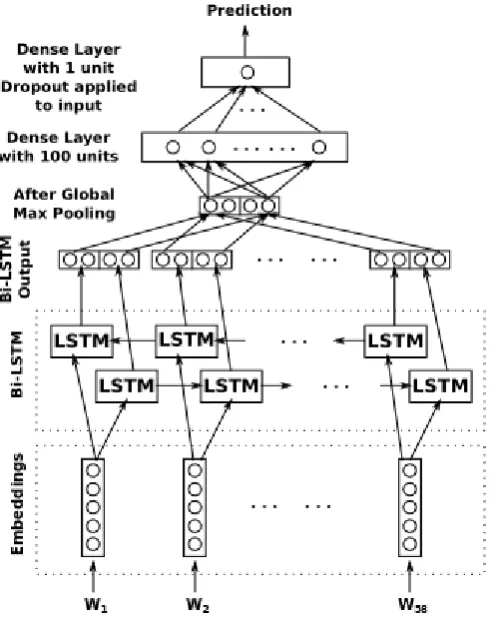
Figure 1 shows the architecture of the BiLSTM used in our study. Both the forward and back-ward Long Short-Term Memory (LSTM) layers of the bi-directional layer of this model consisted of 100 units. Pre-trained GloVe embeddings were used to train the model. An embedding layer was used to feed the word vectors to the BiLSTM layer. A dropout of 0.25 was applied to the in-put of LSTM and a dropout of 0.1 was used for the recurrent connections. The BiLSTM layer was set to return the hidden state for each timestep. Thus, the output shape of the BiLSTM layer was (None,58,200). A global max pooling layer was used on top of the BiLSTM layer. This resulted in an output of the shape (None,200). The output from the global max pooling layer was fed to a Dense layer having 100 units. The Rectified Lin-ear Unit (ReLU) activation function was used for this Dense layer. The output of the Dense layer was of the shape (None,100). The output was passed through a dropout layer with the rate set to 0.25. The output from the dropout layer was then passed through another Dense layer having a single unit. The sigmoid activation function was used for this layer. The model was trained using the Adam optimizer. The loss function used was binary cross-entropy. The model was trained with a batch size set to 32. The hyperparameter values used for the model are summarized in Table2.
4.2.2 BiLSTM with attention mechanism
Figure 1: Architecture of the BiLSTM model used
Parameter Value
Number of LSTM units 100 LSTM dropout 0.25 Recurrent dropout 0.10 Units in 1st Dense layer 100 Activation Function for ReLU
1st Dense layer
Rate for dropout layer 0.25 Units in 2nd Dense layer 1
Activation Function for sigmoid 2nd Dense layer
[image:3.595.104.260.419.529.2]Optimizer Adam Loss Function Binary cross-entropy
Table 2: Hyperparameters for the BiLSTM model
4.2.3 Logistic Regression
The third model we used was an LR model with L2 regularization. The class weight and C parameter were set to ‘balanced’ and 1.2 respectively. This model was trained with character n-grams (1 to 6), word n-grams (1 to 3), and a combination of both character and word n-grams. The hyperparameter values for the LR model were set as shown in Ta-ble3.
5 Results & Discussions
The following tests were performed by us:
1. BiLSTM model trained using GloVe word
Parameter Value
[image:3.595.371.462.419.456.2]Regularization L2 C 1.2 Class weight balanced
Table 3: Hyperparameters for the LR model
embeddings as features.
2. BiLSTM model with attention mechanism trained using GloVe word embeddings as fea-tures.
3. LR model trained using character n-grams (1 to 6) only.
4. LR model trained using word n-grams (1 to 3) only.
5. LR model trained using both character and word n-grams concatenated together.
Approach Features Acc Prec Rec F1
BiLSTM GloVe word 0.748 0.749 0.748 0.748
embeddings
BiLSTM with GloVe word 0.737 0.738 0.737 0.737 attention embeddings
Logistic Char n-grams 0.727 0.733 0.727 0.728 Regression (1 to 6)
Logistic Word n-grams 0.722 0.729 0.722 0.723 Regression (1 to 3)
[image:4.595.71.293.62.157.2]Logistic Char n-grams & 0.727 0.734 0.727 0.728 Regression Word n-grams
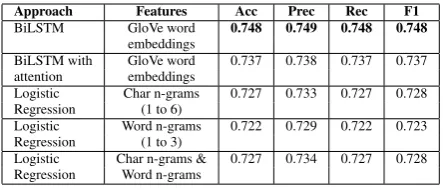
Table 4: Results of our models on Dev set of Task 5-Subtask A (No stemming + No Stopwords removed)
Approach Features Acc Prec Rec F1
BiLSTM GloVe word 0.674 0.699 0.674 0.675 embeddings
BiLSTM with GloVe word 0.698 0.698 0.698 0.689 attention embeddings
Logistic Char n-grams 0.743 0.749 0.743 0.744
Regression (1 to 6)
Logistic Word n-grams 0.727 0.731 0.727 0.728 Regression (1 to 3)
[image:4.595.72.293.206.300.2]Logistic Char n-grams & 0.739 0.746 0.739 0.740 Regression Word n-grams
Table 5: Results of our models on Dev set of Task 5-Subtask A (Stemming + Stopwords removed)
Approach Accuracy Precision Recall F1
SVC Baseline 0.49 0.60 0.55 0.45 MFC Baseline 0.58 0.29 0.50 0.37 BiLSTM 0.54 0.64 0.59 0.51
Best System 0.65 0.69 0.68 0.65
Table 6: Official results for Task 5-Subtask A
As can be seen from Table 4, the BiLSTM model without attention outperformed the other two models for all the metrics. However, the improvements achieved were not very significant compared to the other two models. It can also be seen that the choice of character or word n-grams did not make much difference to the per-formance of the LR model. Equivalent results were obtained for all the 3 tests performed using the LR model. This is surprising considering the fact that character n-grams usually performs bet-ter than word n-grams for text containing obfus-cated words. Mehdad and Tetreault (2016) men-tions that offenders often obfuscate the hate words in order to avoid detection by keyword-based fil-ters. So, character n-gram features should have improved the performance of the model. One ex-planation for this observation could be the removal of numeric and special characters from the tweets during the data preprocessing stage. Numeric and special characters are used frequently used to ob-fuscate hate words. ‘ass’ replaced by ‘a$$’, ‘slut’ replaced by ‘s1ut’ etc. are examples of such ob-fuscation. So, a test was performed without
re-moving the numeric and special characters. How-ever, no significant increase in the performance of character-based model was observed.
As can be seen from Table 5, the LR models performed better than the BiLSTM models when stemming was performed and stopwords were re-moved. The character n-gram based LR model performed the best for all the metrics considered.
The predictions obtained for the test set using the BiLSTM model without attention mechanism were submitted as the final predictions. The model that was trained with stopwords retained and stem-ming not performed was used to make the predic-tions on the test set. The official results obtained for the submission are shown in Table6. Our offi-cial ranking is 8/71 in subtask A for the English language. As can be seen from the results, the MFC baseline had the best accuracy score. By la-beling all the test instances with the most frequent label, the MFC baseline was able to obtain a bet-ter accuracy score. The MFC baseline achieved a better accuracy score at the cost of a low precision value. This resulted in a low F1 score for the base-line. Our BiLSTM model obtained a significantly higher F1 score compared to the MFC baseline. Our BiLSTM model outperformed the SVC base-line on all the metrics.
Table 7 shows the confusion matrices for the tests performed by retaining the stopwords and without performing stemming. The BiLSTM models were able to achieve better F1 score com-pared to the LR model by making better predic-tions for the benign class.
Table 8 shows the confusion matrices for the tests performed with stopwords removed and stemming performed. As can be seen, the BiL-STM models with attention and without attention show opposite tendencies. While the BiLSTM model without attention gets better in predicting the hate class, it becomes weaker in predicting the benign class. The opposite is true for the BiLSTM model with attention. The character n-gram based LR model gets better in predicting both the hate and benign classes.
6 Error Analysis
[image:4.595.88.278.347.395.2]BiLSTM BiLSTM with Attention LR (char) LR (word) LR (char+word) Predictions Predictions Predictions Predictions Predictions Not Hate Not Hate Not Hate Not Hate Not Hate Not 437 136 438 135 411 162 408 165 410 163
[image:5.595.140.459.62.106.2]Hate 116 311 128 299 111 316 113 314 110 317
Table 7: Confusion Matrix (No Stemming + No stopword removed)
BiLSTM BiLSTM with Attention LR (char) LR (word) LR (char+word) Predictions Predictions Predictions Predictions Predictions Not Hate Not Hate Not Hate Not Hate Not Hate Not 345 228 476 97 421 152 418 155 416 157
Hate 98 329 205 222 105 322 118 309 104 323
Table 8: Confusion Matrix (Stemming + Stopwords removed)
an asshole but I will love you and care about you more than any other person you have met.” Here, the speaker is attributing the word ‘bitch’ to him-self/herself. So, the tweet cannot be a hate speech. However, our system wrongly classifies the tweet as a hate speech.
There have been many instances where our sys-tem wrongly classifies a tweet as hate speech just because of the mere presence of words such as ‘bitch’, ‘#buildthewall’ etc. even when the tweet is not intended against women or immigrants. For e.g., the tweet ‘He is a snake ass bitch. He is a fugly slut...’ is a hate speech but it is not intended against women. But our system was not able to detect this and wrongly classifies it.
7 Conclusion
With hate speech in social media fomenting many riots in different parts of the world, it is becom-ing increasbecom-ingly important to prevent their spread. While manual moderation is almost impossible, the need of the time is automated systems for their removal. The BiLSTM and logistic regression models used in this study have obtained some suc-cess compared to the baselines used. But there is much left to be desired. Hate words used in the be-nign sense and hate speech not directed at women and immigrants were wrongly getting classified. Contextual information and features such as part-of-speech (POS), dependency relations may help in classifying such instances correctly.
References
Pinkesh Badjatiya, Shashank Gupta, Manish Gupta, and Vasudeva Varma. 2017. Deep Learning for Hate Speech Detection in Tweets. InProceedings of the 26th International Conference on World Wide Web Companion, pages 759–760, Perth.
Valerio Basile, Cristina Bosco, Elisabetta Fersini, Deb-ora Nozza, Viviana Patti, Francisco Rangel, Paolo Rosso, and Manuela Sanguinetti. 2019. Semeval-2019 task 5: Multilingual detection of hate speech against immigrants and women in twitter. In Pro-ceedings of the 13th International Workshop on Se-mantic Evaluation (SemEval-2019). Association for Computational Linguistics.
Thomas Davidson, Dana Warmsley, Michael Macy, and Ingmar Weber. 2017. Automated Hate Speech Detection and the Problem of Offensive Language. In Proceedings of the Eleventh International AAAI Conference on Web and Social Media (ICWSM 2017), pages 512–515, Montreal.
Nemanja Djuric, Jing Zhou, Robin Morris, Mihajlo Gr-bovic, Vladan Radosavljevic, and Narayan Bhamidi-pati. 2015. Hate Speech Detection with Comment Embeddings. InInternational World Wide Web Con-ference (WWW), 2015, pages 29–30, Florence, Italy.
Bj¨orn Gamb¨ack and Utpal Kumar Sikdar. 2017. Us-ing convolutional neural networks to classify
hate-speech. InProceedings of the First Workshop on
Abusive Language Online, pages 85–90, Vancouver, BC, Canada. Association for Computational Lin-guistics.
Lei Gao and Ruihong Huang. 2017. Detecting
on-line hate speech using context aware models. In
Proceedings of the International Conference Recent Advances in Natural Language Processing, RANLP 2017, pages 260–266, Varna, Bulgaria. INCOMA Ltd.
Lei Gao, Alexis Kuppersmith, and Ruihong Huang. 2017.Recognizing explicit and implicit hate speech using a weakly supervised two-path bootstrapping
approach. In Proceedings of the Eighth
Interna-tional Joint Conference on Natural Language Pro-cessing (Volume 1: Long Papers), pages 774–782, Taipei, Taiwan. Asian Federation of Natural Lan-guage Processing.
Shervin Malmasi and Marcos Zampieri. 2017.
Detect-ing hate speech in social media. In Proceedings
[image:5.595.138.459.143.187.2]Shervin Malmasi and Marcos Zampieri. 2018. Chal-lenges in discriminating profanity from hate speech.
Journal of Experimental & Theoretical Artificial In-telligence, 30(2):187–202.
Yashar Mehdad and Joel Tetreault. 2016. Do characters
abuse more than words? InProceedings of the 17th
Annual Meeting of the Special Interest Group on Discourse and Dialogue, pages 299–303, Los An-geles. Association for Computational Linguistics.
Chikashi Nobata, Joel Tetreault, Achint Thomas, Yashar Mehdad, and Yi Chang. 2016. Abusive Lan-guage Detection in Online User Content. In Pro-ceedings of the 25th International Conference on World Wide Web, pages 145–153, Montreal.
John Pavlopoulos, Prodromos Malakasiotis, and Ion Androutsopoulos. 2017. Deep learning for user
comment moderation. In Proceedings of the First
Workshop on Abusive Language Online, pages 25– 35, Vancouver, BC, Canada. Association for Com-putational Linguistics.
S. Sax. 2016. Flame Wars: Automatic Insult De-tection. http://cs224d.stanford.edu/ reports/Sax.pdf, (Technical Report).
Joan Serr`a, Ilias Leontiadis, Dimitris Spathis, Gianluca Stringhini, Jeremy Blackburn, and Athena Vakali. 2017. Class-based prediction errors to detect hate
speech with out-of-vocabulary words. In
Proceed-ings of the First Workshop on Abusive Language On-line, pages 36–40, Vancouver, BC, Canada. Associ-ation for ComputAssoci-ational Linguistics.
Zeerak Waseem. 2016. Are you a racist or am i seeing things? annotator influence on hate speech detection on twitter. InProceedings of the First Workshop on NLP and Computational Social Science, pages 138– 142, Austin, Texas. Association for Computational Linguistics.
Zeerak Waseem, Thomas Davidson, Dana Warmsley, and Ingmar Weber. 2017. Understanding abuse: A typology of abusive language detection subtasks. In Proceedings of the First Workshop on Abusive Language Online, pages 78–84, Vancouver, BC, Canada. Association for Computational Linguistics.