Evaluating Hierarchical Discourse Segmentation
Lucien Carroll Linguistics Dept.
UC San Diego San Diego, CA 92093
Abstract
Hierarchical discourse segmentation is a use-ful technology, but it is difficult to eval-uate. I propose an error measure based on the word error rate of Beeferman et al. (1999). I then show that this new measure not only reliably distinguishes baseline seg-mentations from lexically-informed hierarchi-cal segmentations and more informed segmen-tations from less informed segmensegmen-tations, but it also offers an improvement over previous linear error measures.
1 Introduction
Discourse segmentation is the task of identifying co-herent clusters of sentences and the points of transi-tion between those groupings. Discourse segmenta-tion can be viewed as shallow parsing of discourse structure. The segments and the relations between them are left unlabeled, focusing instead on the boundaries between the segments (i.e., the bracket-ing).
Discourse segmentation is thought to facilitate automatic summarization (Angheluta et al., 2002; Boguraev and Neff, 2000), information retrieval (Kaszkiel and Zobel, 1997), anaphora resolution (Walker, 1997) and question answering (Chai and Jin, 2004). Automatic discourse segmentation, as shallow annotation of discourse structure, also pro-vides a testing grounds for linguistic theories of dis-course (Passonneau and Litman, 1997) and provides a natural unit of measure in linguistic corpora (Biber et al., 2004).
1.1 The structure of discourse
Research in discourse structure theory (Hobbs, 1985; Grosz and Sidner, 1986; Mann and Thomp-son, 1988; Kehler, 2002; Asher and Lascarides, 2003; Webber, 2004) and discourse parsing (Marcu, 2000; Forbes et al., 2003; Polanyi et al., 2004; Baldridge et al., 2007) has variously defined dis-course structure in terms of communicative inten-tion, atteninten-tion, topic/subtopic structure, coherence relations, and cohesive devices. There is much dis-agreement about the units and elementary relations of discourse structure, but they agree that the struc-tures are hierarchical, most commonly trees (Marcu, 2000), while others have argued for directed acyclic graphs (Danlos, 2004), or general graphs (Wolf and Gibson, 2004). In contrast, most of the segmentation research to date has focused on linear segmentation, in which segments are non-overlapping and sequen-tial, and it has been argued that this sequence model is sufficient for many purposes (Hearst, 1994). I fo-cus here on tree discourse segmentation, in which larger segments are composed of sequences of sub-segments. This is potentially more informative and more faithful to linguistic theory than linear dis-course segmentation is, but it poses a more challeng-ing evaluation problem.
1.2 Hierarchical segmentation
Four studies have described hierarchical discourse segmentation algorithms, but none of them rigor-ously evaluated the segmentation in its hierarchi-cal form. Yaari (1997) used a hierarchihierarchi-cal cluster-ing algorithm for hierarchical discourse segmenta-tion, and to evaluate it, he linearized the tree (tak-ing all boundaries equally) and compared the
ing precision and recall to contemporary linear seg-mentation algorithms. Slaney and Ponceleon (2001) used scale-space segmentation (an image segmen-tation algorithm) on the discourse’s trajectory in a Latent Semantic Indexing (LSI) space (Landauer et al., 1998). They evaluated the algorithm by visual comparison with the heading-subheading structure of the text. Angheluta et al. (2002) applied a linear discourse segmentation algorithm recursively, seg-menting each major segment into a sequence of sub-segments. They used the result in a summariza-tion system, and they evaluated the summarizasummariza-tion system but not the segmentation itself. Eisenstein (2009) used a Bayesian latent topic model to find a hierarchical segmentation, and he comes the clos-est to quantitative evaluation of the whole segmen-tation. He evaluated it against three recursive seg-mentation algorithms on a corpus that had just two levels of segment depth and considers these two lev-els as separate and equally important. While each of these studies offers some insight into the validity of the hierarchical segmentation, none of these evalua-tion methods directly and quantitatively assesses the hierarchical segmentation as a whole.
Many state-of-the-art linear discourse segmenta-tion algorithms also use hierarchical frameworks, making them applicable to hierarchical discourse segmentation with only trivial modification. For ex-ample, the C99 algorithm (Choi, 2000) applies con-trast enhancement and divisive clustering to a ma-trix of lexical vector cosine similarities. The CWM algorithm (Choi et al., 2001) applies the same pro-cedure to a similarity matrix of LSI vectors. Using these algorithms for hierarchical discourse segmen-tation simply requires keeping record of the bound-ary ranking, but until now they have only been used for linear segmentation.
1.3 The Beeferman error measure
Studies of linear discourse segmentation have re-vealed that discourse boundaries are inherently fuzzy. Human annotators demonstrate frequent dis-agreement about the number of segments and ex-actly where the transitions between segments oc-cur, while still demonstrating statistically significant agreement (Passonneau and Litman, 1997). Because of this, conventional precision and recall measures penalize ‘near misses’ when they should be treated
much the same as complete matches. The crossing-bracket measure (Carbone et al., 2004) is more for-giving, but still over-penalizes near misses and fa-vors sparse bracketings. An error measure Pk
pro-posed by Beeferman et al. (1999) compensates for the variation in boundary locations. It considers a moving window of widthk equal to half the aver-age segment length in the reference segmentation, where distances are measured in words or sentences, depending on whether word boundaries or sentence boundaries are considered possible discourse seg-ment boundaries. The error is the average disagree-ment, between the reference segmentation and the evaluated segmentation, about whether the two ends of the window are in the same segment. Formally,
Pk=
1
N−k N−k
∑
i=1
δ(δ(ri,ri+k),δ(hi,hi+k))
whereNis the total number of atoms (words or sen-tences) in the document, andkis the window width. The argumentsri andhi are the indices of the
seg-ments that contain atom iin the reference and hy-pothesized segmentations, respectively, andδ is the discrete delta function, evaluating to 1 if its argu-ments are equal and to 0 otherwise. Pevzner and Hearst (2001) proposed WindowDiff, a modification ofPk that indicates the average disagreement about
how many boundaries lie within the window, replac-ing the innerδ functions with the count of segment boundaries between the two atoms. It is as sensitive to false positives as it is to false negatives, whereas
Pkis more sensitive to false negatives.
There are still a few problems with these er-ror measures. In penalizing false negatives and false positives equally, WindowDiff actually favors sparse segmentations. Whereas Pk scores the
base-line strategies of no boundaries and all possible boundaries as within a few percent of 50% error, WindowDiff scores the all-boundaries baseline at 100% error for typical reference segmentations. Fur-thermore, in running the summation from i=1 to
texts, it is quite possible that a reference segmen-tation might not include legitimate but fairly unim-portant boundaries that a hypothesized segmentation does include. These unimportant boundaries should not count against the hypothesized segmentation, but in the linear segmentation paradigm, they nec-essarily do. The ideal error measure should distin-guish more-informed algorithms from less-informed algorithms, treating equally uninformed baselines the same, and it should treat boundary placement er-rors according to the prominence of the boundaries, and not according to their positions within the text.
Building on work in evaluating linear segmenta-tion, this study considers the evaluation of tree seg-mentations. I propose an error measure, derived from Beeferman et al.’sPk(1999), for evaluating the
alignment of a tree segmentation to a reference seg-mentation. I first show that this error measure is ad-vantageous even for evaluating linear segmentations, and then I evaluate four hierarchical segmentation algorithms against a gold standard derived from en-cyclopedia articles.
2 A hierarchical measure
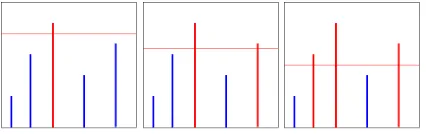
The proposed error measure is based on the intu-ition that prominent boundaries count more than less prominent boundaries. The hierarchical atom error rateEPk is the mean of Beeferman errors calculated
over all linearizations of the segmentation tree (see Fig. 1). Assume a setRof reference boundaries and a setH of hypothesized boundaries each in rank or-der (prominent boundaries precede less prominent
Figure 1: Sequential linearizations in computing hierar-chical word error rate. The heights of the vertical lines represent the prominences of boundaries, and each hori-zontal line is one linearization. In the first step, only the highest boundary is used, producing just two segments. Each following step includes one more boundary.
ones). The error is calculated as
EPk =
1
|R|
∑
i ciPk(Ri,Hi)where
Ri={bj:bj∈R∧j≤i}
The elements ofHi are chosen such that|Hi|=|Ri|
and no bn ∈ H\Hi is more prominent than any bj∈Hi. If the reference boundaries are completely
ordered, thenci=1 for all ranksi, but if some
ref-erence boundaries share ranks, onePkterm is
calcu-lated for each rank level in the reference segmenta-tion, and weighted (ci) by the number of boundaries
that were at that level. In the degenerate case of lin-ear segmentation, all segments have the same rank, andEPk reduces to the originalPk.
When hypothesized boundaries share ranks, each affected term in the summation is theoretically the average over all combinations (n boundaries at the next rankChoose rboundaries to completeHi). But
when the number of combinations is large, the com-putational complexity of the calculation can be re-duced without sacrificing much accuracy by using a representative sampling of the combinations, as this closely approximates the average.
When the set of hypothesized boundaries is smaller than the set of reference boundaries, we could simply permit Hi to be smaller than Ri for
large values of i, but that unnecessarily penalizes the hypothesized segmentation. The set of possi-ble boundaries (word or sentence boundaries) which were not marked as segment boundaries can be un-derstood to be segment boundaries of a baseline low ranking. Adding these unmarked boundaries toH, all at a single low rank, prevents incurring an unde-served penalty for false negatives.
In order to avoid undercounting boundaries near the beginning and end of the text, I consider the pos-sibility of wrapping the window around from the be-ginning to the end of the text. In calculatingPk, the
sum is understood to run fromi=1 toi=N, rather than stopping atN−k, and the atom index of the leading edge of the window (i+k) generalizes to
((i+k)modN).
3 Hierarchical replication of Choi et al.
[image:3.612.80.293.555.622.2]the standard segmentation data set that Choi (2000) compiled. Each file in that data is composed of 10 random portions of texts from the Brown Cor-pus (Francis and Kucera, 1979). The following re-sults are based on the T3−11 subset, in which text segment lengths are uniformly distributed between 3 and 11 sentences. Since each file is composed of a sequence of text portions, the reference segmenta-tion is linear, not hierarchical. Nevertheless, I evalu-ate hierarchical segmentation algorithms with the hi-erarchical measure, to show that treating linear seg-mentation as a special case of hierarchical segmen-tation solves the issue of unequal treatment of false positives and false negatives, and running the Win-dowDiff sum toN(wrapping the window around to the beginning) solves the problem of undercounting the boundaries near the text edges.
3.1 Segmentation algorithms
The C99 (Choi, 2000) and CWM (Choi et al., 2001) algorithms were evaluated. While these were de-signed and originally evaluated as linear segmenta-tion algorithms, the hierarchical clustering they use makes hierarchical segmentation a trivial matter of retaining the order of the cluster splits. I refer to the hierarchical versions of these algorithms as HC99 and HCWM. The HC99 implementation used here is built directly from the C99 code which Choi released for educational use, and the HCWM implementa-tion is based off that. The implementation uses a document-based LSI space built with Infomap-NLP1 from the British National Corpus (Aston and Burnard, 1998), whereas the original CWM used sentence-based and paragraph-based LSI spaces de-rived from the Brown Corpus. Because of these differences, the implementation of HCWM reported here differs somewhat from the implementation of CWM reported by Choi et al. (2001).
The C99 and CWM algorithms include a criterion for optional automatic determination of the number of segments, but the hierarchical error measure does not penalize a segmentation for having more seg-ments (defined by lower ranking boundaries) than the reference segmentation, so I used a constant number of segments, greater than in the reference segmentation, for the results reported here.
1Software available at http://infomap-nlp.sourceforge.net
One baseline (BIN) was constructed by a recur-sive bisection of segments, and another baseline (NONE) consisted of only the implicit boundaries at the beginning and end of the discourse, and all the possible intermediate boundaries (sentence breaks) are implicitly at one unmarked lower rank.
3.2 Results and Discussion
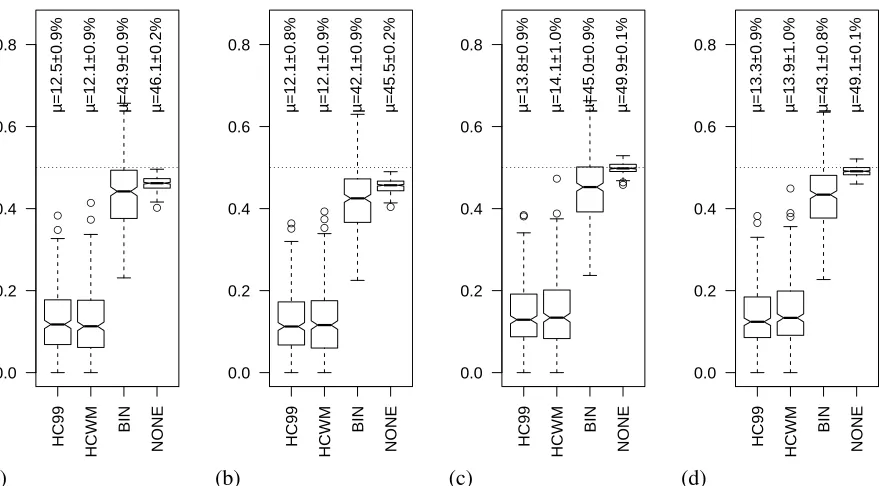
The calculated EPk error rates are displayed in
Fig. 2.2 The error for HC99 in Fig. 2a (12.5%) matches what Choi et al. (2001) reported (12%), while the error for HCWM (12.1%) is higher than that reported for the version with a paragraph-based 500-dimension LSI space (9%) but appears com-parable to their sentence-based 400-dimension LSI space. (They do not report results for the sentence-based spaces on this T3−11data set, but based on the results they report for a larger data set, it would ap-pear to be about 12% for the T3−11set.) The result for BIN (43.9%) is slightly lower than what Choi et al. (2001) reported for their equal-size segment base-line (45%). Since BIN would be an equal-segment baseline if there were only 8 segments per text, BIN should be similar to Choi et al’s equal-size baseline. And the result for NONE (46.1%) agrees with Choi et al. (2001)’s results for their NONE (46%) base-line.
Comparison of graphs (a) and (b) in Fig. 2 shows that continuing the sum to wrap the window around to the beginning of the text generally lowers the measured error, to the greatest extent for BIN and least for HCWM. The average segment length in the reference segmentation is 7 sentences, so the win-dow sizekis usually 3 or 4 sentences, comparable to the minimum segment length (3). As a result, a boundary very rarely falls within k sentences of the text ends, and fully including these sentences in the sum leads to a lower error for segmentations like BIN that don’t hypothesize boundaries near the text ends.
The EW D hierarchical error rates (calculated
ac-cording to WindowDiff) are consistently higher (Fig. 2c, d) than the correspondingEPk. WindowDiff
(a)
●
● ●
● ●
HC99
HCWM
BIN
NONE
0.0 0.2 0.4 0.6 0.8
µ=12.5±0.9% µ=12.1±0.9% µ=43.9±0.9% µ=46.1±0.2%
(b)
● ● ●●
● ●
HC99
HCWM
BIN
NONE
0.0 0.2 0.4 0.6 0.8
µ=12.1±0.8% µ=12.1±0.9% µ=42.1±0.9% µ=45.5±0.2%
(c)
●
● ●
● ●
●
HC99
HCWM
BIN
NONE
0.0 0.2 0.4 0.6 0.8
µ=13.8±0.9% µ=14.1±1.0% µ=45.0±0.9% µ=49.9±0.1%
(d)
● ● ●●
●
HC99
HCWM
BIN
NONE
0.0 0.2 0.4 0.6 0.8
[image:5.612.83.524.71.314.2]µ=13.3±0.9% µ=13.9±1.0% µ=43.1±0.8% µ=49.1±0.1%
Figure 2: Distributions ofEPk(a, b) andEW D(c, d) for each of the hypothesized and baseline segmentation algorithms. The data in graphs (a) and (c) are calculated with sums that stop atN−k(when the window reaches the end of the text), whereas (b) and (d) are calculated with sums that run toN(wrapping the window back to the beginning). The boxes indicate the quartiles, and the means with 95% confidence intervals are written above.
scores are never lower thanPkscores, because in
or-der to count as in agreement, the two segmentations must agree about the number of boundaries within the window rather than just about whether there are boundaries within the window. But these scores are not much higher than EPk either, even though the
original linear WindowDiff measure sometimes as-signs much higher scores. Under the original Win-dowDiff measure, with reference and hypothesized boundary sets of unequal size, the NONE baseline scores 43.8% (cf. Pk=43.5% for sum to N), while
an ALL baseline scores 99.2% (cf. Pk=51.1% for
sum to N). WindowDiff was designed to penalize false positives even when two boundaries are close together, a condition thatPkunderpenalizes. When a
hypothesized segmentation has more segments than the reference segmentation, the extra boundaries in-cur false positive penalties without corresponding false negative penalties, and WindowDiff assigns an error rate that is higher than the Pk error rate and
sometimes even higher than the NONE baseline. But with the hierarchical EW D error, extra
bound-aries are sampled or ignored, and so every false
pos-itive has a corresponding false negative, which limits the divergence betweenEW D andEPk and keeps the EW D error of informed segmentations below
base-line errors. As withEPk, continuing the sum to N
(Fig. 2d), has only a slight effect on the error, but the effect is most pronounced on BIN, reflecting the fact that BIN, like the reference segmentation sys-tematically does not place boundaries near the text ends.
3.3 Conclusion
We have seen here that treating linear segmentations as a special case of hierarchical segmentations, hav-ing just one rank of marked boundaries but havhav-ing implicit higher ranking boundaries at the text ends and implicit lower ranking boundaries at all ‘non-boundaries’, resolves the outstanding issues of un-equal sensitivity thatPk and WindowDiff have.
can not do much worse than 50% (at chance) just by hypothesizing fewer or more segments than the reference segmentation ‘knows’ about. The major remaining strength of WindowDiff over thePk
met-ric is thatPk still undercounts errors when there are
segments much smaller than the average size. For these reasons, I adopt a version of EW D that
continues the sum to wrap the window around the end of the text. In addition, when I refer to the lin-ear error measure in the following sections, I mean the special case ofEW D in which the information in
the reference segmentation about the ranking of the marked boundaries is ignored, but boundary ranking information in the hypothesized segmentation (both marked and unmarked boundaries) is still used to se-lect as many segment boundaries as are in the refer-ence segmentation.
4 Wikipedia Evaluation
In this section, I compare the same two algorithms and baselines with two additional hierarchical seg-mentation algorithms, using a hierarchical reference segmentation. The reference segmentation corpus is derived from encyclopedia articles, and I use the hi-erarchical error measure developed in the previous sections. I also constrast the hierarchical error rates with measurements that ignore the boundary ranking information in the hypothesized or reference seg-mentations in order to highlight the difference be-tween the performance on boundary position and the performance on boundary ranking.
4.1 Corpus and Algorithms
The evaluation corpus is derived from the 2006 Wikipedia CDrelease.3 The html pages were con-verted to flat text, removing boilerplate, naviga-tion, info-boxes, and image captions. Heading text was replaced with a boundary marker, indicating the heading depth. The subcorpus used for this evalua-tion consists of articles with a heading depth of four (i.e. having html elements h2 through h5), a total of 66 articles. The texts were reformatted with an au-tomatic sentence detector4to have one sentence per
3Available from http://schools-wikipedia.
org/2006/.
4From Ratnaparkhi’s ‘jmx’ (ftp://ftp.cis.upenn.
edu/pub/adwait/jmx/jmx.tar.gz).
line, and then tokenized.5
In addition to the HC99 and HCWM algorithms used in the previous section, I use two algorithms described by Eisenstein (2009). The HIERBAYES
algorithm (here, HBT) uses a multi-level latent topic model to perform joint inference over the locations and prominences of topic change boundaries. The GREEDY-BAYES algorithm (here, GBEM) uses a single-level latent topic model to find a linear mentation, and recursively divides each of the seg-ments.6 Both algorithms internally decide the num-ber of hypothesized boundaries, sometimes underes-timating it and sometimes overesunderes-timating.7
4.2 Results and Discussion
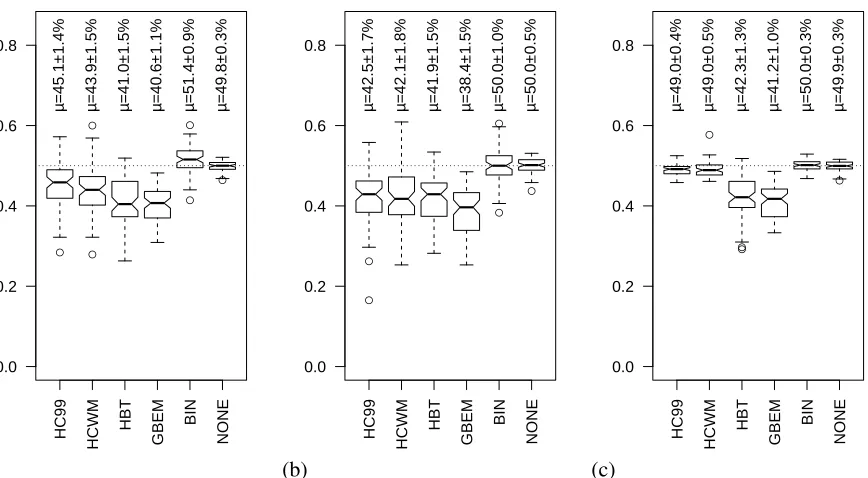
The EW D error rates for each of the hypothesized
segmentations are presented in Fig. 3. As with the Choi data, the NONE baseline has an error rate at chance (50%), while the lexical algorithms per-form better than that (highly statistically signifi-cantly (p< .0001) less than 50%, according to indi-vidual two-sided one-sample t-tests). However, they perform much worse than they did on the Choi data. In spite of the relatively high error rates, the dis-criminating power of the evaluation measure is re-vealed by comparison of the fully hierarchical er-ror rates (Fig. 3a) with the erer-ror rates that ignore the ranking information in the reference (Fig. 3b) or hypothesized (Fig. 3c) segmentations. For each of the lexical algorithms that were originally designed as linear segmentation algorithms (HC99, HCWM, and GBEM), the mean error is less in Fig. 3b against the linear standard (when reference segmen-tation boundary prominences are ignored) than in Fig. 3a under the fully hierarchical measure (two-tailed paired t-tests, each p< .0001). In contrast, HBT, designed as a hierarchical segmentation algo-rithm, obtains a lower error rate under the fully hier-archical EW D measure (though the difference does
5The evaluation code and corpus can be downloaded from
http://idiom.ucsd.edu/˜lucien/segmentation
6Both algorithms are part of the HBayesSeg pack-age, available at http://people.csail.mit.edu/ jacobe/naacl09.html
(a)
● ●
●
●
● ●
HC99
HCWM
HBT
GBEM
BIN
NONE
0.0 0.2 0.4 0.6 0.8
µ=45.1±1.4% µ=43.9±1.5% µ=41.0±1.5% µ=40.6±1.1% µ=51.4±0.9% µ=49.8±0.3%
(b)
●
●
●
● ●
HC99
HCWM
HBT
GBEM
BIN
NONE
0.0 0.2 0.4 0.6 0.8
µ=42.5±1.7% µ=42.1±1.8% µ=41.9±1.5% µ=38.4±1.5% µ=50.0±1.0% µ=50.0±0.5%
(c)
●
● ●
●
HC99
HCWM
HBT
GBEM
BIN
NONE
0.0 0.2 0.4 0.6 0.8
[image:7.612.89.523.70.309.2]µ=49.0±0.4% µ=49.0±0.5% µ=42.3±1.3% µ=41.2±1.0% µ=50.0±0.3% µ=49.9±0.3%
Figure 3: EW Derror rates for each of the segmentation algorithms. (a) Hierarchical error (b) Linear error (ignoring reference segmentation prominences) (c) Hierarchical error ignoring hypothesized segmentation prominences. Boxes show quantiles and means are written above, with 95% confidence intervals.
not reach significance: p =0.1, two-tailed paired t-test). When instead the hypothesized boundary prominences are ignored (Fig. 3c), reducing them to linear segmentations but still evaluating against the hierarchical standard, the error rates of all the lexical algorithms are raised (in two-tailed paired t-tests, eachp< .0001), but HBT and GBEM are only slightly affected, whereas HC99 and HCWM are al-most raised to chance. While HBT and GBEM hy-pothesize about the same number of boundaries as the reference segmentation (13 and 22 text-internal boundaries on average, compared to 22 text-internal boundaries in the reference corpus), the HC99 and HCWM algorithms were made to hypothesize 54 boundaries for each text. The difference between their error rates in (Fig. 3a) and (Fig. 3c) shows that the HC99 and HCWM boundaries given the highest prominences corresponded much more closely to the reference boundaries than the hypothesized bound-aries given the lowest prominences.
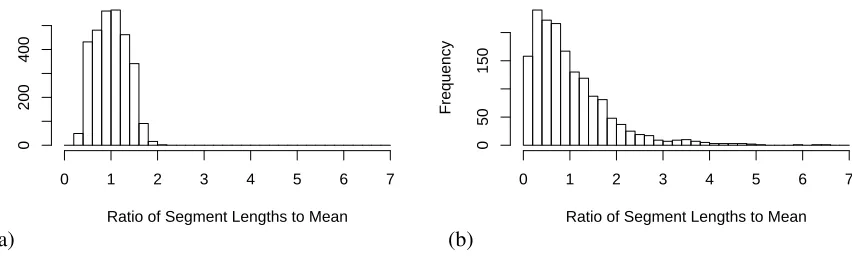
The mean scores for the BIN baseline are over 50% on the encyclopedia data. In contrast, the mean score for BIN on the Choi standard data (Fig. 2) was 45% for the linear measure and 43% for the
hierarchical measure. Why did BIN do so poorly here when it performed well above chance on the Choi data? The difference is in the distributions of segment lengths. As seen in Fig. 4, the Choi data segment lengths are well-defined by their mean, be-cause they were constructed with uniform distribu-tions of segment length. On the other hand, the dis-tribution of segment lengths in the encyclopedia data is more skewed, with many quite short segments and a few quite long segments.
The error rates for both HC99 and HCWM are much higher on the encyclopedia data than they are on the Choi data, and the error rates for HBT and GBEM are not much better. Choi’s evalua-tion corpus was specifically designed to have obvi-ous boundaries, whereas the boundaries in these dis-course samples are much less obvious. As discussed by Kauchak and Chen (2005), even algorithms that obtain low error rates on newsfeed do not perform well on more fluid discourse, and while Ji and Zha (2003) reported quite low error on an expository text sample (Pk =12%), Kauchak and Chen (2005)
re-port a best error rate ofPk=38.5% on the
Barzi-(a)
Ratio of Segment Lengths to Mean
Frequency
0 1 2 3 4 5 6 7
0
200
400
(b)
Ratio of Segment Lengths to Mean
Frequency
0 1 2 3 4 5 6 7
0
50
[image:8.612.83.509.78.206.2]150
Figure 4: Distribution of sentences per segment for (a) Choi standard data (b) Wikipedia data
lay (2006) obtainedPk error rates between 30% and
40% on the lecture data they used, comparable to human annotator pairwise Pk ranging from 24% to
42%. C99 and CWM—like the other algorithms that make use of hierarchical representations of the text, such as Ji and Zha (2003) and Fragkou et al. (2004)—depend completely on lexical information. Another strand of research, including Galley et al. (2003) and Kauchak and Chen (2005), make use of a wide variety of linguistic and orthographic cues. And the discourse parsing systems take advantage of even more linguistic cues. The ideal segmenta-tion algorithm needs to combine the advantages of each of these approaches, but the frameworks are not straightforwardly compatible. The Bayesian frame-work explored by Eisenstein and Barzilay (2008) is a potential route to a richer model, and they found their richer model beneficial for a meetings corpus but not for a textbook. The HBT and GBEM al-gorithms, which were based on that work, do not attempt to go beyond lexical cohesion, but it does provide a framework for hierarchical segmentation algorithms that take advantage of other cues.
5 Conclusions
In Section 2, I introduced a modification of the er-ror measure developed by Beeferman et al. (1999) and Pevzner and Hearst (2001). I then showed that this modification, directed at evaluating hierarchical segmentations, also produces a more robust evalu-ation of linear segmentevalu-ations as well. And applied to hierarchical segmentations, it successfully dis-tinguishes lexically-informed segmentations from
baseline segmentations, and it distinguishes hierar-chical segmentations from segmentations composed of the same boundaries but without the boundary ranking information. As a more reliable evaluation of both linear and hierarchical segmentation algo-rithms, this error measure will facilitate the devel-opment of more richly informed segmentation algo-rithms.
Acknowledgments
In this research, I have benefited from resources at both San Diego State University and UC San Diego. This work has been enriched by the questions and advice of many people, including Eniko Csomay, Rob Malouf, Lara Taylor, Rebecca Colavin, Andy Kehler, and the NAACL anonymous reviewers. I am also grateful to Freddy Choi and Jacob Eisen-stein for making their code and data available, and to Jacob for additional help running his code. All errors are my own.
References
Roxana Angheluta, Rik De Busser, and Marie-Francine Moens. 2002. The use of topic segmentation for auto-matic summarization. InDUC 2002.
Nicholas Asher and Alex Lascarides. 2003. Logics of Conversation. Cambridge University Press.
Guy Aston and Lou Burnard. 1998. The BNC Hand-book: Exploring the British National Corpus with SARA. Edinburgh University Press.
Doug Beeferman, Adam Berger, and John D. Lafferty. 1999. Statistical models for text segmentation. Ma-chine Learning, 34(1-3):177–210.
Douglas Biber, Eniko Csomay, James K. Jones, and Casey Keck. 2004. A corpus linguistic investigation of vocabulary-based discourse units in university reg-isters. Language and Computers, 20:53–72.
Branimir Boguraev and Mary S. Neff. 2000. Discourse segmentation in aid of document summarization. In 33rd HICSS.
Marco Carbone, Ya’akov Gal, Stuart Shieber, and Bar-bara Grosz. 2004. Unifying annotated discourse hi-erarchies to create a gold standard. InProceedings of 4th SIGDIAL Workshop on Discourse and Dialogue. Joyce Y. Chai and Rong Jin. 2004. Discourse
struc-ture for context question answering. In HLT-NAACL 2004 Workshop on Pragmatics of Question Answering, pages 23–30.
Freddy Choi, Peter Wiemer-Hastings, and Johanna Moore. 2001. Latent semantic analysis for text seg-mentation. InProceedings of 6th EMNLP, pages 109– 117.
Freddy Choi. 2000. Advances in domain independent linear text segmentation. In Proceedings of NAACL-00, pages 26–33.
Laurence Danlos. 2004. Discourse dependency struc-tures as constrained DAGs. InProceedings of 5th SIG-DIAL Workshop on Discourse and Dialogue, pages 127–135.
Jacob Eisenstein and Regina Barzilay. 2008. Bayesian unsupervised topic segmentation. In Proceedings of EMNLP 2008.
Jacob Eisenstein. 2009. Hierarchical text segmentation from multi-scale lexical cohesion. In Proceedings of NAACL09.
Katherine Forbes, Eleni Miltsakaki, Rashmi Prasad, Anoop Sarkar, Aravind Joshi, and Bonnie Webber. 2003. D-LTAG system: Discourse parsing with a lex-icalized tree-adjoining grammar. Journal of Logic, Language and Information, 12(3):261–279, June. P. Fragkou, V. Petridis, and Ath. Kehagias. 2004. A
dy-namic programming algorithm for linear text segmen-tation. Journal of Int Info Systems, 23:179–197. W. Nelson Francis and Henry Kucera. 1979. BROWN
Corpus Manual. Brown University, third edition. Michael Galley, Kathleen McKeown, Eric
Fossler-Lussier, and Hongyan Jing. 2003. Discourse segmen-tation of multi-party conversation. In41st ACL. Barbara J. Grosz and Candace L. Sidner. 1986.
Atten-tion, intentions, and the structure of discourse. Com-putational Linguistics, 12(3):175–204.
Marti Hearst. 1994. Multi-paragraph segmentation of expository text. In32nd ACL, pages 9 – 16, New Mex-ico State University, Las Cruces, New MexMex-ico.
Jerry R Hobbs. 1985. On the coherence and structure of discourse. InCSLI 85-37.
Xiang Ji and Hongyuan Zha. 2003. Domain-independent text segmentation using anisotropic diffusion and dy-namic programming. InSIGIR’03.
Marcin Kaszkiel and Justin Zobel. 1997. Passage re-trieval revisited. InProceedings of 20th ACM SIGIR, pages 178–185.
David Kauchak and Francine Chen. 2005. Feature-based segmentation of narrative documents. InProceedings of the ACL Workshop on Feature Engineering for Ma-chine Learning in NLP.
Andrew Kehler. 2002.Coherence, reference and the the-ory of grammar. CSLI Publications.
Thomas K. Landauer, Peter W. Foltz, and Darrell La-ham. 1998. An introduction to latent semantic analy-sis.Discourse Processes, 25:259–284.
Igor Malioutov and Regina Barzilay. 2006. Minimum cut model for spoken lecture segmentation. In Pro-ceedings of the 21st International Conference on Com-putational Linguistics and 44th Annual Meeting of the ACL, pages 25–32.
William Mann and Sandra Thompson. 1988. Rhetorical structure theory: Towards a functional theory of text organization. Text, 8(3):243–281.
Daniel Marcu. 2000. The theory and practice of dis-course parsing and summarization. MIT Press. Rebecca J. Passonneau and Diane J. Litman. 1997.
Dis-course segmentation by human and automated means. Computational Linguistics, 23(1):103–139.
Lev Pevzner and Marti Hearst. 2001. A critique and improvement of an evaluation metric for text segmen-tation.Computational Linguistics, 16(1).
Livia Polanyi, Chris Culy, Martin van den Berg, Gian Lorenzo Thione, and David Ahn. 2004. A rule based approach to discourse parsing. InProceedings of SIGDIAL.
Malcolm Slaney and Dulce Ponceleon. 2001. Hierar-chical segmentation: Finding changes in a text sig-nal. Proceedings of SIAM 2001 Text Mining Work-shop, pages 6–13.
Marilyn A. Walker. 1997. Centering, anaphora resolu-tion, and discourse structure. In Aravind K. Joshi Mar-ilyn A. Walker and Ellen F. Prince, editors,Centering in Discourse. Oxford University Press.
Bonnie Webber. 2004. D-LTAG: extending lexicalized TAG to discourse. Cognitive Science, 28:751–779. Florian Wolf and Edward Gibson. 2004. Representing
discourse coherence: A corpus-based analysis. In20th COLING.