AUEB-ABSA at SemEval-2016 Task 5: Ensembles of Classifiers and
Embeddings for Aspect Based Sentiment Analysis
Dionysios Xenos, Panagiotis Theodorakakos, John Pavlopoulos, Prodromos Malakasiotis and Ion Androutsopoulos
NLP Group, Department of Informatics Athens University of Economics and Business
Patission 76, GR-104 34 Athens, Greece
http://nlp.cs.aueb.gr
Abstract
This paper describes our submissions to the Aspect Based Sentiment Analysis task of SemEval-2016. For Aspect Category Detec-tion (Subtask1/Slot1), we used multiple en-sembles, based on Support Vector Machine classifiers. For Opinion Target Expression extraction (Subtask1/Slot2), we used a se-quence labeling approach with Conditional Random Fields. For Polarity Detection (Sub-task1/Slot3), we used an ensemble of two su-pervised classifiers, one based on hand crafted features and one based on word embeddings. Our systems were ranked in the top 6 positions in all the tasks we participated. The source code of our systems is publicly available.
1 Introduction
The amount of user-generated content on the web has grown rapidly in recent years, leading to in-creased interest in sentiment analysis and, more gen-erally, opinion mining. The task of Aspect Based Sentiment Analysis of SemEval-2014 (SE-ABSA14)
and SemEval-2015 (SE-ABSA15) was concerned
with identifying the aspects of given target entities and extracting the sentiment expressed towards each aspect (Pontiki et al., 2014; Pontiki et al., 2015). The task of Aspect Based Sentiment Analysis of SemEval-2016 (SE-ABSA16) is a continuation of
those tasks (Pontiki et al., 2016). We participated in Aspect Category Detection (ACD, Subtask1/Slot1), Opinion Target Expression (OTE, Subtask1/Slot2),
and Polarity Detection (PD, Subtask1/Slot3).
In ACD, we participated in the English language,
for both Laptops and Restaurants, submitting both
constrained and unconstrained systems. Our con-strained system used only the provided training data for the corresponding domain. Features were ex-tracted from lexicons created from the training data. One Support Vector Machine (SVM) classifier
(Vap-nik and Vap(Vap-nik, 1998) was trained for each Entity and Attribute category (calledE andArespectively).
Our unconstrained system used word embeddings as additional resources (Mikolov et al., 2013). For each category (E orA), we used an ensemble of two
sys-tems: our constrained system and one new system, which was based on word embeddings.
In OTE, we participated with both a constrained
and an unconstrained system.1 The task is to
iden-tify aspects of given target entities. We addressed the problem as a sequential labeling task (Toh and Wang, 2014), assigning one label to each word in a sentence, indicating whether the word was an aspect term or not. In this task, we used Conditional Ran-dom Fields (Lafferty et al., 2001). Similarly toACD,
our unconstrained system differed in that it also used word embeddings as features.
InPD, we participated only with an unconstrained
system, in both domains, in the English language. We used an ensemble of two classifiers. The first classifier used hand crafted features and sentiment lexicons with scores. The second classifier was based on IDF-weighted centroids of the word em-beddings of each sentence (Kosmopoulos et al., 2015).
The remainder of this paper is structured as fol-lows. In Section 2, we describe our systems in tail, including data preprocessing and feature
de-1Only the restaurants domain was available inOTE.
scriptions. In Sections 3 and 4, we present our of-ficial results and experiments, respectively. Finally, Section 5 summarizes our work and proposes future directions.
2 Systems
All our submissions used supervised learning. In Restaurants, the training data were 350 reviews (2,000 sentences), annotated with 2,499 aspects and their polarities. Each aspect consists of one Entity (E) and one Attribute of E (A), thus, forming an E#Apair. The sentiment polarity of any aspect may
be positive, negative or neutral. Included, were also annotations for linguistic expressions, called Opin-ion Target ExpressOpin-ions (OTE), indicating the origin
of eachE. For example, in “The food was well
pre-pared and the service impeccable.” there were two annotations:
• 1stOTE: “food” offsets: 4 to 8
– category: FOOD#QUALITY
– polarity: positive
• 2ndOTE: “service” offsets: 35 to 42
– category: SERVICE#GENERAL
– polarity: positive
In Laptops, the training data were 450 reviews (2,500 sentences), annotated with 2,923 {E#A,
Po-larity}labels. In this domain, no OTE annotations
were included.
As a preprocessing step, we excluded sentences with no opinion tuples and sentences labeled as “Out of Scope”.2 All the features and hyper-parameter
values used are described in a publicly available re-port, along with the source code of our systems.3
2.1 Aspect Category Detection
In Aspect Category Detection (ACD), each aspect E#A(e.g.,FOOD#PRICE) in a sentence should be
dis-covered. The possibleE and A labels were
prede-fined; thus, we considered this to be a classification task.
2Sentences including opinions that can not be described by theSE-ABSA16 annotation schema, are “Out of Scope”.
3https://github.com/nlpaueb/aueb-absa
Constrained ACD system
One Support Vector Machine (SVM) classifier was
trained for each predefinedE and A, based on
lex-icons created from the training data.4 5 The
lex-icons assigned scores to unigrams (stemmed and unstemmed) and bigrams (stemmed, unstemmed or using only POS tag bigrams). For each
uni-gram or biuni-gram, we computed its Precision, Re-call and F1 over the training data, following the
work of Karampatsis et al. (2014). We used the average, median, maximum, and minimum val-ues for each score (Precision, Recall, F1) and for
each lexicon (stemmed unigrams, unstemmed un-igrams, stemmed, unstemmed, POS tag bigrams),
thus, yielding 12 features per lexicon and 60 features overall.
One Support Vector Machine (SVM) classifier was
trained for each E and A label, yielding 11
clas-sifiers for Restaurants and 31 for Laptops. Given a new text, the confidence scores of all the classi-fiers were examined and theEs andAs of the
classi-fiers whose confidence exceeded a threshold were used to form the E#Aaspects.6 All the possible E#Acombinations are formed, provided that they
ap-peared at least once in the training data. Thus, as-suming that the classifiers of|E|entities and|A|
at-tributes exceeded the threshold, we form at most|E|
· |A|aspects.
Following the work of Hsu et al. (2010), we used a 5-fold cross validation on the training data for tun-ing and we performed a loose grid search, followed by a fine grid search. During the loose grid search, various kernels were examined (i.e., Linear, Sig-moid, Polynomial and RBF) and hyper-parameter values were searched with a big step and in a big range of values. During the fine grid search, the best kernel of the loose grid search was used and hyper-parameter values were searched with a smaller step in a much smaller range of values.
Unconstrained ACD system
Our unconstrained system was based on multi-ple ensembles, one for each E and A combination
encountered in our training data. Each ensemble
4Lexicons were created only for tokens that appeared more than 2 times in the training dataset, for eachEandAcategory.
returned the linear combination of the confidence scores of two systems.7 The first system in each
en-semble was the corresponding constrained system. The second system in each ensemble was a system based on word embeddings (Mikolov et al., 2013).
We used the Amazon product review data to produce word embeddings and Inverse Document Frequency (IDF) scores (McAuley et al., 2015).8 Word embeddings were produced, with 200 dimen-sions and the skip-gram model, using Gensim.9
Then, following the work of Kosmopoulos et al. (2015), for each sentence si in our data, we
com-puted its centroidc(si)as follows:
c(si) =
P|V|
j=1ej·T F(wj, si)·IDF(wj)
P|V|
i=1T F(wj, si)·IDF(wi)
where |V| is the size of the vocabulary, ej is the
embedding of word wj, TF(wj, si) is the Boolean
term frequency ofwj in sentencesi, andIDF(wj)
is the IDF score of wj. Preliminary experiments
in both domains, with IDF scores and term fre-quency (Boolean or not) scores, showed that the use of Boolean term frequency scores along withIDF scores was better than any other combination.
We normalized each centroid using L2 normaliza-tion and we computed the cosine similarity between the centroid of the sentence and the word embedding of the label of each possibleEorA. The final feature
vector of each unconstrainedE orA classifier (2nd
classifier in each ensemble) is produced by concate-nating all the cosine scores and the normalized cen-troid. We trained oneSVM classifier per E and A,
yielding 11 unconstrained classifiers for Restaurants and 31 for Laptops, as already noted. All the unstrained classifiers were tuned similarly to our con-strained classifiers.
In a final step, our unconstrained system returns one score per E and A, which is the linear
combi-nation of the confidence scores of the constrained and unconstrained classifiers in the corresponding
7The weights of the two confidence scores were set to 0.5, i.e. we used the average of the two scores. Other weighs were also examined, but they did not lead to better performance.
8We used the files for individual product categories from the Amazon product data corpus, which had duplicate item reviews removed (http://jmcauley.ucsd.edu/data/ amazon/).
9https://radimrehurek.com/gensim/
ensemble. Similarly to our constrained system,
E#Aaspects are then returned.
2.2 Opinion Target Expression
Opinion Target Expression is addressed as a sequen-tial labeling problem. Each word in a sentence is as-signed the label “B” to indicate the start of an aspect
term, “I” to indicate the continuation of an aspect
term, and “O” if the token is not an aspect term.
Both our constrained and unconstrained systems use Conditional Random Fields (CRF) (Lafferty et
al., 2001).10 However, our unconstrained system
extends our constrained one, by incorporating more features. The features used in each system are dis-cussed below.
Constrained OTE system
The features of our constrained system are the fol-lowing:
• Morphological (Boolean), about the current to-ken:
– Capital first letter – All letters in capitals – Only digits
– Existence of punctuation mark – Other
• Lexicon-based (one-hot)
– POS tags (both of current token and
con-text)
– Word affixes (prefixes and suffixes) of the current token
– Aspect terms
For features based on lexicons, we used the train-ing data to form lists of POS tags, word affixes of
various lengths (prefixes and suffixes of length 1, 2 and 3 characters) and aspect terms. Then, we formed a single one-hot vector (i.e., a vector of 0’s and a sin-gle 1) per list, indicating which member of the list the token being examined corresponds to. We used 5 vectors for thePOS based features (one for the
cur-rent token and 4 for the context; two on the left and two on the right), 6 vectors for features based on word affixes (prefixes and affixes of one, two and
three letters) and 1 vector for aspect terms seen in the training data. Finally, we concatenated the vec-tors and the Boolean features to yield one overall feature vector.
Unconstrained OTE system
Our unconstrained system extends our con-strained system by incorporating the following fea-tures:
• Word embedding of the current token
• Word embeddings of the context
For each word, we compute its embedding and in-corporate it to our constrained system’s feature vec-tor. Word embeddings were calculated as in Section 2.1; each word corresponds to a 200-dimensional embedding. We also incorporate features for the word’s context. We compute the embeddings of the words in a 5-context window (i.e., two words on the left and two on the right) and concatenate them to a 1000-dimensional vector.
If a word from the context had no embedding, we replaced it by the previous (for left context) or next (for right context) word that had an embed-ding. Also, in order to cope with missing words at the beginning and the end of a sentence, we intro-duced four special tokens, for the first two and the last two words of the sentence. The respective to-kens were positioned before and after each sentence of the Amazon product reviews corpus, before pro-ducing word embeddings.
2.3 Polarity Detection
The objective of Polarity Detection (PD) was to
detect the correct sentiment label for each aspect
E#Ain a sentence; possible sentiment labels were
positive, negative and neutral (i.e., mildly positive or negative). Sentences could contain multiple aspects; e.g., the sentence “Excellent food, although the in-terior could use some help.” contains two aspects; “FOOD#QUALITY” and “AMBIENCE#GENERAL”, which should be labeled positive and negative re-spectively.
We used an Ensemble of two Multi-class Logis-tic Regression (LR) classifiers, trained with
differ-ent sets of features. Each classifier yields one confi-dence sentiment (for eachE#A) per sentiment label.
Then, for each sentiment label, our ensemble com-putes a linear combination of the corresponding two scores of the classifiers and the label with the highest combined score is returned.11
We describe below the feature sets of the twoLR
classifiers,LRIandLRII.
LR I PD classifier
In LRI, we used 50 hand crafted features, which
could be categorized by nature:
• Morphological (Karampatsis et al., 2014)
– frequency based (number of exclamation and question marks, etc.)
– Boolean based (exclamation or question mark in the end of the sentence, etc.)
• POS based (number of nouns, adjectives, verbs
and adverbs) (Karampatsis et al., 2014)
• E#Abased (number of aspects and bags of
enti-ties and attributes)
• Sentiment lexicons
– AFINN12
– Hu & Liu13
– NRC14
For features based on sentiment lexicons, besides the already given word scores, we compute new scores, which are relative to our data. Following the work of Karampatsis et al. (2014), we com-puted Precision andF1scores per sentiment label,
for each word in the lexicon and for each POS bi-gram (i.e., two sequential part of speech tags).
To take into consideration negation phenomena, we used the negation lexicon compiled by Zhang et al. (2014). If a negation word precedes a word in a lexicon, we reverse the word’s score sign; i.e., positive becomes negative and vice versa. Also, we make special use of words only in upper case. If a word in upper case exists in a lexicon we multiply
11We used the average of the two scores in practice. 12http://www2.imm.dtu.dk/pubdb/views/
publication_details.php?id=6010,AFINN-111 13http://github.com/woodrad/
Twitter-Sentiment-Mining/tree/master 14http://saifmohammad.com/WebPages/
Domain Precision Recall F-measure Rank
Restaurants (U) 67.75% 75.77% 71.54% 4th/30 Restaurants (C) 64.22% 70.79% 67.35% 4th/12 Laptops (U) 45.60% 53.19% 49.10% 2nd/22 Laptops (C) 40.69% 51.94% 45.63% 4th/9
Table 1:AUEB-ABSA’s evaluation in Aspect Category Detec-tion. The first column shows the domain and the run (C for constrained and U for unconstrained). The last column shows the rank of our system.
Domain Precision Recall F-measure Rank
Restaurants (U) 71.82% 69.12% 70.44% 2nd/19 Restaurants (C) 64.35% 58.99% 61.55% 6th/8
Table 2:AUEB-ABSA’s evaluation in Opinion Target Expres-sion.
its score, in order to make it more significant.15The
resulting feature vector is normalized to [0,1] with the Euclidean norm.
LR II PD classifier
The second PD classifier uses the centroid of the
word embeddings of each sentence as features. The centroids are compiled as in Section 2.1, but with-out the IDF scores in the denominator.16 Words
without embeddings or IDF scores are ignored when computing the centroids. The same applies to words with IDF scores below a given thresh-old.17 Word embeddings are normalized with the
Euclidean norm.
[image:5.612.339.504.65.99.2]3 Results
Table 1 shows the results of our Aspect Category Detection (ACD) system. In Restaurants, our
un-constrainedACD system was ranked4th among 30
submissions. Our constrainedACD system was also
ranked 4th, but amongst 12 submissions. In
Lap-tops, our unconstrainedACD system was ranked2nd
among 22 submissions and our constrained one was ranked4th among 9 submissions.
Table 2 shows the results of our Opinion Target Expression (OTE) system. Our unconstrained OTE
system was ranked2nd out of 19 submissions, while
our constrainedOTE system was ranked6th out of 8
submissions.
15Here, we arbitrarily tripled the score
16Our experiments have shown that removing theIDFfrom the denominator improves the performance ofLRII
17The threshold was set to 0.5, which led to best results on the validation data.
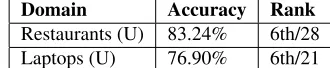
[image:5.612.81.294.65.115.2]Domain Accuracy Rank Restaurants (U) 83.24% 6th/28 Laptops (U) 76.90% 6th/21
Table 3:AUEB-ABSA’s evaluation on Polarity Detection.
Table 3 shows the evaluation of our PD system
(unconstrained only). We were ranked6th out of 28 submissions in Restaurants and 6th out of 21 sub-missions in Laptops.
4 Experiments & Discussion
As described in Section 2.1, our unconstrainedACD
system used an ensemble of two systems, one based on word embeddings and one based on features cal-culated only on the training data. Preliminary exper-iments showed that the ensemble is better than each system alone and better than a single system com-bining all the features of the two systems.
In the same task, experiments in the domain of Restaurants showed that there is no important differ-ence between having one classifier for each possible
E#A label, and having separate classifiers for each Eand eachA label. However, in Laptops, the latter
approach led to slightly better results and, hence, it was preferred.
In the task ofOTE, our constrained system is
be-low the median participant (6th out of 8
submis-sions). However, when extended with features based on word embeddings (our unconstrained system), its performance is outstanding (2nd out of 19
submis-sions).
It is also worth noting that, in preliminary experi-ments forOTE, the use of a context vector (i.e.,
con-catenated embeddings of words in a 5-context win-dow of the word in question) gave far better results than using the centroid of these word embeddings.
System Restaurants Laptops LRI(hand crafted) 80.71% (12th) 73.92% (9th) LRII(embeddings) 74.94% (22th) 73.12% (11th) Ensemble 83.24% (6th) 76.90% (6th) Table 4: Accuracy of our submittedPDensemble and its two subsystems,LRI(feature based) andLRII(based on word em-beddings). In parentheses are estimated ranks of the two sub-systems and the official rank of our ensemble.
ForPD, we performed some post-experiments on
our ensemble, which is our final PD system,
out-performs its two subsystems, both in Restaurants (2.5% - 8.3%) and Laptops (3%-3.8%). Also, post-experiments showed that the negation lexicon im-proved the Accuracy of our ensemble by 0.5% in Restaurants and 1% in Laptops.
5 Conclusions and future work
We presented our approach to sentence level Aspect Based Sentiment Analysis (SE-ABSA16), which
in-cludes the subtasks of Aspect Category Detection (ACD), Opinion Target Expression (OTE) and
Polar-ity Detection (PD). We observed and showed in
post-experiments the benefits of using word embeddings and ensembles. The source code of our systems is publicly available. Future work includes the incor-poration of neural networks in our ensembles.
Acknowledgments
This work was carried out during the BSc projects of the first two authors, which were co-supervised by the other three authors.
References
C. Hsu and C. Chang. 2010. A practical guide to support vector classification. Technical report, Department of Computer Science, National Taiwan University. R. M. Karampatsis, J. Pavlopoulos, and P. Malakasiotis.
2014. Aueb: Two stage sentiment analysis of social network messages. InProceedings of SemEval 2014, at COLING 2014, pages 114–118, Dublin, Ireland. A. Kosmopoulos, I. Androutsopoulos, and G. Paliouras.
2015. Biomedical semantic indexing using dense word vectors in bioasq.Journal of Biomedical Seman-tics, supplement on Semantics-Enabled Biomedical In-formation Retrieval, pages 5–7.
J. D. Lafferty, A. McCallum, and F. C. N. Pereira. 2001. Conditional random fields: Probabilistic models for segmenting and labeling sequence data. In Proceed-ings of the 18th ICML, pages 282–289, San Francisco, CA, USA.
J. McAuley, R. Pandey, and J.Leskovec. 2015. Inferring networks of substitutable and complementary prod-ucts. InProceedings of the 21th ACM SIGKDD, pages 785–794.
T. Mikolov, I. Sutskever, G. S. Corrado K. Chen, and J. Dean. 2013. Distributed representations of words and phrases and their compositionality. In Proceed-ings of NIPS 2013, pages 3111–3119.
M. Pontiki, D. Galanis, J. Pavlopoulos, H. Papageor-giou, I. Androutsopoulos, and S. Manandhar. 2014. Semeval-2014 task 4: Aspect based sentiment analy-sis. InProceedings of SemEval 2014, pages 27–35, Dublin, Ireland.
M. Pontiki, D. Galanis, H. Papageogiou, S. Manandhar, and I. Androutsopoulos. 2015. Semeval-2015 task 12: Aspect based sentiment analysis. InProceedings of SemEval 2015, pages 27–35, Denver, Colorado. Maria Pontiki, Dimitrios Galanis, Haris Papageorgiou,
Ion Androutsopoulos, Suresh Manandhar, Mohammad AL-Smadi, Mahmoud Al-Ayyoub, Yanyan Zhao, Bing Qin, Orph´ee De Clercq, V´eronique Hoste, Marianna Apidianaki, Xavier Tannier, Natalia Loukachevitch, Evgeny Kotelnikov, Nuria Bel, Salud Mar´ıa Jim´enez-Zafra, and G¨uls¸en Eryi˘git. 2016. Semeval-2016 task 5: Aspect based sentiment analysis. InProceedings of SemEval 2016, San Diego, California.
Z. Toh and W. Wang. 2014. Dlirec: Aspect term extrac-tion and term polarity classificaextrac-tion system. In Pro-ceedings of SemEval 2014, pages 235–240, Dublin, Ireland.
V. N. Vapnik and V. Vapnik. 1998. Statistical learning theory, volume 1. Wiley New York.