SemEval-2016 Task 5: Aspect Based Sentiment Analysis
Maria Pontiki∗1, Dimitrios Galanis1, Haris Papageorgiou1, Ion Androutsopoulos1,2, Suresh Manandhar3,Mohammad AL-Smadi4,Mahmoud Al-Ayyoub4,Yanyan Zhao5,
Bing Qin5,Orphée De Clercq6,Véronique Hoste6,Marianna Apidianaki7,
Xavier Tannier7,Natalia Loukachevitch8,Evgeny Kotelnikov9,
Nuria Bel10,Salud María Jiménez-Zafra11,Gülşen Eryiğit12
1Institute for Language and Speech Processing, Athena R.C., Athens, Greece, 2Dept. of Informatics, Athens University of Economics and Business, Greece,
3Dept. of Computer Science, University of York, UK,
4Computer Science Dept., Jordan University of Science and Technology Irbid, Jordan, 5Harbin Institute of Technology, Harbin, Heilongjiang, P.R. China,
6LT3, Ghent University, Ghent, Belgium,
7LIMSI, CNRS, Univ. Paris-Sud, Université Paris-Saclay, Orsay, France, 8Lomonosov Moscow State University, Moscow, Russian Federation,
9Vyatka State University, Kirov, Russian Federation, 10Universitat Pompeu Fabra, Barcelona, Spain, 11Dept. of Computer Science, Universidad de Jaén, Spain,
12Dept. of Computer Engineering, Istanbul Technical University, Turkey
Abstract
This paper describes the SemEval 2016 shared task on Aspect Based Sentiment Analysis (ABSA), a continuation of the respective tasks of 2014 and 2015. In its third year, the task provided 19 training and 20 testing datasets for 8 languages and 7 domains, as well as a common evaluation procedure. From these datasets, 25 were for sentence-level and 14 for text-level ABSA; the latter was introduced for the first time as a subtask in SemEval. The task attracted 245 submissions from 29 teams.
1 Introduction
Many consumers use the Web to share their experi-ences about products, services or travel destinations (Yoo and Gretzel, 2008). Online opinionated texts (e.g., reviews, tweets) are important for consumer decision making (Chevalier and Mayzlin, 2006) and constitute a source of valuable customer feedback that can help companies to measure satisfaction and improve their products or services. In this setting, Aspect Based Sentiment Analysis (ABSA) - i.e., mining opinions from text about specific entities and their aspects (Liu, 2012) - can provide valuable in-sights to both consumers and businesses. An ABSA
∗
[image:1.612.311.531.330.466.2]*Corresponding author: [email protected].
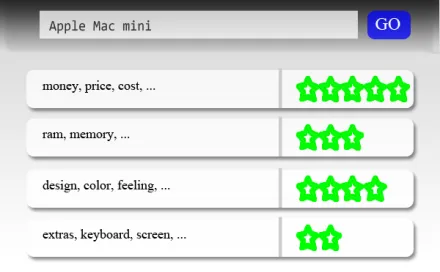
Figure 1: Table summarizing the average sentiment for each aspect of an entity.
method can analyze large amounts of unstructured texts and extract (coarse- or fine-grained) informa-tion not included in the user ratings that are available in some review sites (e.g., Fig. 1).
Sentiment Analysis (SA) touches every aspect (e.g., entity recognition, coreference resolution, negation handling) of Natural Language Processing (Liu, 2012) and as Cambria et al. (2013) mention “it requires a deep understanding of the explicit and im-plicit, regular and irregular, and syntactic and se-mantic language rules”. Within the last few years several SA-related shared tasks have been organized in the context of workshops and conferences
ing on somewhat different research problems (Seki et al., 2007; Seki et al., 2008; Seki et al., 2010; Mitchell, 2013; Nakov et al., 2013; Rosenthal et al., 2014; Pontiki et al., 2014; Rosenthal et al., 2015; Ghosh et al., 2015; Pontiki et al., 2015; Moham-mad et al., 2016; Recupero and Cambria, 2014; Rup-penhofer et al., 2014; Loukachevitch et al., 2015). Such competitions provide training datasets and the opportunity for direct comparison of different ap-proaches on common test sets.
Currently, most of the available SA-related datasets, whether released in the context of shared tasks or not (Socher et al., 2013; Ganu et al., 2009), are monolingual and usually focus on English texts. Multilingual datasets (Klinger and Cimiano, 2014; Jiménez-Zafra et al., 2015) provide additional ben-efits enabling the development and testing of cross-lingual methods (Lambert, 2015). Following this di-rection, this year the SemEval ABSA task provided datasets in a variety of languages.
ABSA was introduced as a shared task for the first time in the context of SemEval in 2014; SemEval-2014 Task 41 (SE-ABSA14) provided datasets of English reviews annotated at the sentence level with aspect terms (e.g., “mouse”, “pizza”) and their po-larity for the laptop and restaurant domains, as well as coarser aspect categories (e.g., “food”) and their polarity only for restaurants (Pontiki et al., 2014). SemEval-2015 Task 122 (SE-ABSA15) built upon SE-ABSA14 and consolidated its subtasks into a unified framework in which all the identified con-stituents of the expressed opinions (i.e., aspects, opinion target expressions and sentiment polarities) meet a set of guidelines and are linked to each other within sentence-level tuples (Pontiki et al., 2015). These tuples are important since they indicate the part of text within which a specific opinion is ex-pressed. However, a user might also be interested in the overall rating of the text towards a partic-ular aspect. Such ratings can be used to estimate the mean sentiment per aspect from multiple re-views (McAuley et al., 2012). Therefore, in addition to sentence-level annotations, SE-ABSA163 accom-modated also text-level ABSA annotations and pro-vided the respective training and testing data.
Fur-1http://alt.qcri.org/semeval2014/task4/ 2http://alt.qcri.org/semeval2015/task12/ 3http://alt.qcri.org/semeval2016/task5/
thermore, the SE-ABSA15 annotation framework was extended to new domains and applied to lan-guages other than English (Arabic, Chinese, Dutch, French, Russian, Spanish, and Turkish).
The remainder of this paper is organized as fol-lows: the task set-up is described in Section 2. Sec-tion 3 provides informaSec-tion about the datasets and the annotation process, while Section 4 presents the evaluation measures and the baselines. General in-formation about participation in the task is provided in Section 5. The evaluation scores of the participat-ing systems are presented and discussed in Section 6. The paper concludes with an overall assessment of the task.
2 Task Description
The SE-ABSA16 task consisted of the following subtasks and slots. Participants were free to choose the subtasks, slots, domains and languages they wished to participate in.
Subtask 1 (SB1): Sentence-level ABSA. Given an opinionated text about a target entity, identify all the opinion tuples with the following types (tuple slots) of information:
• Slot1: Aspect Category. Identification of the entity E and attribute A pairs towards which an opinion is expressed in a given sentence. E and A should be chosen from predefined in-ventories4of entity types (e.g., “restaurant”, “food”) and attribute labels (e.g., “price”, “quality”).
• Slot2: Opinion Target Expression (OTE). Extraction of the linguistic expression used in the given text to refer to the reviewed entity E of each E#A pair. The OTE is defined by its starting and ending offsets. When there is no explicit mention of the entity, the slot takes the value “null”. The identification of Slot2 val-ues was required only in the restaurants, hotels, museums and telecommunications domains.
• Slot3: Sentiment Polarity. Each identified E#A pair has to be assigned one of the following polarity labels: “positive”, “negative”, “neu-tral” (mildly positive or mildly negative).
4
Lang. Domain Subtask Train Test
#Texts #Sent. #Tuples #Texts #Sent. #Tuples
EN REST SB1 350 2000 2507 90 676 859
EN REST SB2 335 1950 1435 90 676 404
EN LAPT SB1 450 2500 2909 80 808 801
EN LAPT SB2 395 2375 2082 80 808 545
AR HOTE SB1 1839 4802 10509 452 1227 2604
AR HOTE SB2 1839 4802 8757 452 1227 2158
CH PHNS SB1 140 6330 1333 60 3191 529
CH CAME SB1 140 5784 1259 60 2256 481
DU REST SB1 300 1711 1860 100 575 613
DU REST SB2 300 1711 1247 100 575 381
DU PHNS SB1 200 1389 1393 70 308 396
FR REST SB1 335 1733 2530 120 696 954
FR MUSE SB3 - - - 162 686 891
RU REST SB1 302 3490 4022 103 1209 1300
RU REST SB2 302 3490 1545 103 1209 500
ES REST SB1 627 2070 2720 286 881 1072
ES REST SB2 627 2070 2121 286 881 881
TU REST SB1 300 1104 1535 39 144 159
TU REST SB2 300 1104 972 39 144 108
[image:3.612.124.484.65.328.2]TU TELC SB1 - 3000 4082 - 310 336
Table 1:Datasets provided for SE-ABSA16.
An example of opinion tuples with Slot1-3 values from the restaurants domain is shown below:“Their sake list was extensive, but we were looking for Pur-ple Haze, which wasn’t listed but made for us upon request!” → {cat: “drinks#style_options”, trg: “sake list”, fr: “6”, to: “15”, pol: “positive”}, {cat: “service#general”, trg: “null”, fr: “0”, to: “0”, pol: “positive”}. The variablecatindicates the as-pect category (Slot1), pol the polarity (Slot3), and
trg the ote(Slot2); f r, toare the starting/ending offsets ofote.
Subtask 2 (SB2): Text-level ABSA. Given a cus-tomer review about a target entity, the goal was to identify a set of {cat, pol} tuples that summa-rize the opinions expressed in the review. catcan be assigned the same values as in SB1 (E#A tu-ple), whilepolcan be set to “positive”, “negative”, “neutral”, or “conflict”. For example, for the re-view text “The So called laptop Runs to Slow and I hate it! Do not buy it! It is the worst laptop ever ”, a system should return the following opin-ion tuples: {cat: “laptop#general”, pol: “nega-tive”}, {cat: “laptop#operation_performance”, pol: “negative”} .
Subtask 3 (SB3): Out-of-domain ABSA. In SB3 participants had the opportunity to test their systems
in domains for which no training data was made available; the domains remained unknown until the start of the evaluation period. Test data for SB3 were provided only for the museums domain in French.
3 Datasets
3.1 Data Collection and Annotation
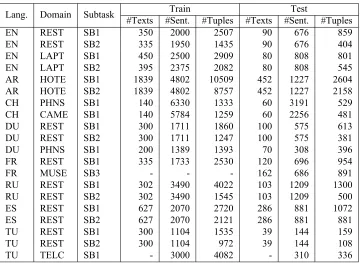
A total of 39 datasets were provided in the context of the SE-ABSA16 task; 19 for training and 20 for test-ing. The texts were from 7 domains and 8 languages; English (en), Arabic (ar), Chinese (ch), Dutch (du), French (fr), Russian (ru), Spanish (es) and Turk-ish (tu). The datasets for the domains of restaurants (rest), laptops (lapt), mobile phones (phns), digital cameras (came), hotels (hote) and museums (muse) consist of customer reviews, whilst the telecommu-nication domain (telc) data consists of tweets. A to-tal of 70790 manually annotated ABSA tuples were provided for training and testing; 47654 sentence-level annotations (SB1) in 8 languages for 7 do-mains, and 23136 text-level annotations (SB2) in 6 languages for 3 domains. Table 1 provides more in-formation on the distribution of texts, sentences and annotated tuples per dataset.
at the sentence-level (SB1) following the respective annotation schemas of SE-ABSA15 (Pontiki et al., 2015). Below are examples5of annotated sentences for the aspect category “service#general” in en (1),du(2),fr(3),ru(4),es(5), andtu(6) for the restdomain and inar(7) for thehotedomain:
1. Service was slow, but the people were friendly.
→ {trg: “Service”, pol: “negative”}, {trg: “people”, pol: “positive”}
2. Snelle bediening en vriendelijk personeel moet ook gemeld worden!! → {trg: “bediening”, pol: “positive”}, {trg: “personeel”, pol: “posi-tive”}
3. Le service est impeccable, personnel agréable.
→{trg: “service” , pol: “positive”}, {trg: “per-sonnel”, pol: “positive”}
4. Про сервис ничего негативного не скажешь-быстро подходят, все улябаются, подходят спрашивают, всё ли нравится. → {trg: “сервис”, pol: “neutral” }
5. También la rapidez en el servicio.→{trg: “ser-vicio”, pol: “positive” }
6. Servisi hızlı valesi var. →{trg: “Servisi”, pol: “positive”}
7. .. ﺔﻌﯾﺮﺳ و اﺪﺟ ةﺪﯿﺟ ﺔﻣﺪﺨﻟا →{trg: ”ﺔﻣﺪﺨﻟا“ , pol: “positive”}
Thelaptannotation schema was extended to two other domains of consumer electronics, came and phns. Examples of annotated sentences in thelapt (en),phns(duandch) andcame(ch) domains are shown below:
1. It is extremely portable and easily connects to WIFI at the library and elsewhere. → {cat: “laptop#portability”, pol: “positive”} , {cat: “laptop#connectivity”, pol: “positive”}
2. Apps starten snel op en werken vlot, internet gaat prima. → {cat: “software#operation_performance”, pol: “positive”}, {cat: “phone#connectivity”, pol: “positive”}
5
The offsets of the opinion target expressions are omitted.
3. 当然屏幕这么好→{cat: “display#quality”, pol: “positive”}
4. 更 轻 便 的 机 身 也 便 于 携 带。→ {cat: “camera# portability”, pol: “positive”}
In addition, the SE-ABSA15 framework was ex-tended to two new domains for which annotation guidelines were compiled:telcfortuandmusefor fr. Below are two examples:
1. #Internet kopuyor sürekli :( @turkcell→{cat: “internet#coverage”, trg: “Internet”, pol: “positive”}
2. 5€ pour les étudiants, ça vaut le coup. →{cat: “museum#prices”, “null”, “positive”}
The text-level (SB2) annotation task was based on the sentence-level annotations; given a customer review about a target entity (e.g., a restaurant) that included sentence-level annotations of ABSA tu-ples, the goal was to identify a set of {cat, pol} tuples that summarize the opinions expressed in it. This was not a simple summation/aggregation of the sentence-level annotations since an aspect may be discussed with different sentiment in different parts of the review. In such cases the dominant sentiment had to be identified. In case of conflicting opin-ions where the dominant sentiment was not clear, the ”conflict” label was assigned. In addition, each re-view was assigned an overall sentiment label about the target entity (e.g., “restaurant#general”, “laptop#general”), even if it was not included in the sentence-level annotations.
3.2 Annotation Process
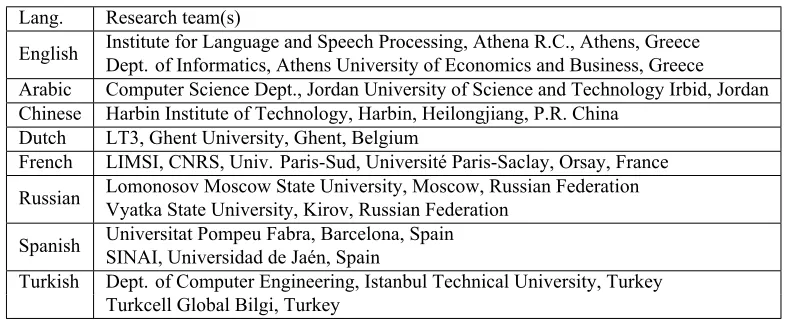
All datasets for each language were prepared by one or more research groups as shown in Table 2. The en,du,fr,ruandesdatasets were annotated using brat (Stenetorp et al., 2012), a web-based annota-tion tool, which was configured appropriately for the needs of the task. Thetudatasets were annotated us-ing a customized version ofturksent (Eryigit et al., 2013), a sentiment annotation tool for social media. For thearand thechdata in-house tools6were used.
6Thear annotation tool was developed by the technical
Lang. Research team(s)
English Institute for Language and Speech Processing, Athena R.C., Athens, Greece Dept. of Informatics, Athens University of Economics and Business, Greece Arabic Computer Science Dept., Jordan University of Science and Technology Irbid, Jordan Chinese Harbin Institute of Technology, Harbin, Heilongjiang, P.R. China
Dutch LT3, Ghent University, Ghent, Belgium
French LIMSI, CNRS, Univ. Paris-Sud, Université Paris-Saclay, Orsay, France
Russian Lomonosov Moscow State University, Moscow, Russian Federation Vyatka State University, Kirov, Russian Federation
Spanish Universitat Pompeu Fabra, Barcelona, Spain SINAI, Universidad de Jaén, Spain
[image:5.612.106.501.65.228.2]Turkish Dept. of Computer Engineering, Istanbul Technical University, Turkey Turkcell Global Bilgi, Turkey
Table 2:Research teams that contributed to the creation of the datasets for each language.
Below are some further details about the annotation process for each language.
English. The SE-ABSA15 (Pontiki et al., 2015) training and test datasets (with some minor correc-tions) were merged and provided for training (rest andlaptdomains). New data was collected and an-notated from scratch for testing. In a first phase, the resttest data was annotated by an experienced7 lin-guist (annotator A), and thelapt data by 5 under-graduate computer science students. The resulting annotations for both domains were then inspected and corrected (if needed) by a second expert linguist, one of the task organizers (annotator B). Borderline cases were resolved collaboratively by annotators A and B.
Arabic. The hote dataset was annotated in re-peated cycles. In a first phase, the data was annotated by three native Arabic speakers, all with a computer science background; then the output was validated by a senior researcher, one of the task organizers. If needed (e.g. when inconsistencies were found) they were given back to the annotators.
Chinese. The datasets presented by Zhao et al. (2015) were re-annotated by three native Chinese speakers according to the SE-ABSA16 annotation schema and were provided for training and testing (phnsandcamedomains).
Dutch. Therestand phnsdatasets (De Clercq and Hoste, 2016) were initially annotated by a trained linguist, native speaker of Dutch. Then, the output was verified by another Dutch linguist and disagreements were resolved between them.
Fi-7
Also annotator for SE-ABSA14 and 15.
nally, the task organizers inspected collaboratively all the annotated data and corrections were made when needed.
French. The train (rest) and test (rest, muse) datasets were annotated from scratch by a linguist, native speaker of French. When the annotator was not confident, a decision was made collaboratively with the organizers. In a second phase, the task or-ganizers checked all the annotations for mistakes and inconsistencies and corrected them, when necessary. For more information on the French datasets consult Apidianaki et al. (2016).
Russian. Therest datasets of the SentiRuEval-2015 task (Loukachevitch et al., SentiRuEval-2015) were auto-matically converted to the SE-ABSA16 annotation schema; then a linguist, native speaker of Russian, checked them and added missing information. Fi-nally, the datasets were inspected by a second lin-guist annotator (also native speaker of Russian) for mistakes and inconsistencies, which were resolved along with one of the task organizers.
Turkish. The telcdataset was based on the data used in (Yıldırım et al., 2015), while therestdataset was created from scratch. Both datasets were anno-tated simultaneously by two linguists. Then, one of the organizers validated/inspected the resulting an-notations and corrected them when needed.
3.3 Datasets Format and Availability
Similarly to SE-ABSA14 and SE-ABSA15, the datasets8of SE-ABSA16 were provided in an XML format and they are available under specific license terms through META-SHARE9, a repository de-voted to the sharing and dissemination of language resources (Piperidis, 2012).
4 Evaluation Measures and Baselines
The evaluation ran in two phases. In the first phase (Phase A), the participants were asked to return separately the aspect categories (Slot1), the OTEs (Slot2), and the {Slot1, Slot2} tuples for SB1. For SB2 the respective text-level categories had to be identified. In the second phase (Phase B), the gold annotations for the test sets of Phase A were pro-vided and participants had to return the respective sentiment polarity values (Slot3). Similarly to SE-ABSA15, F-1 scores were calculated for Slot1, Slot2 and {Slot1, Slot2} tuples, by comparing the anno-tations that a system returned to the gold annota-tions (using micro-averaging). For Slot1 evaluation, duplicate occurrences of categories were ignored in both SB1 and SB2. For Slot2, the calculation for each sentence considered only distinct targets and discarded “null” targets, since they do not corre-spond to explicit mentions. To evaluate sentiment polarity classification (Slot3) in Phase B, we calcu-lated the accuracy of each system, defined as the number of correctly predicted polarity labels of the (gold) aspect categories, divided by the total num-ber of the gold aspect categories. Furthermore, we implemented and provided baselines for all slots of SB1 and SB2. In particular, the SE-ABSA15 base-lines that were implemented for the English language
8
The data are available at: http://metashare.ilsp. gr:8080/repository/search/?q=semeval+2016
9META-SHARE (http://www.metashare.org/) was
implemented in the framework of the META-NET Network of Excellence (http://www.meta-net.eu/).
(Pontiki et al., 2015), were adapted for the other lan-guages by using appropriate stopword lists and to-kenization functions. The baselines are briefly dis-cussed below:
SB1-Slot1: For category (E#A) extraction, a Sup-port Vector Machine (SVM) with a linear kernel is trained. In particular, n unigram features are ex-tracted from the respective sentence of each tuple that is encountered in the training data. The cat-egory value (e.g., “service#general”) of the tu-ple is used as the correct label of the feature vec-tor. Similarly, for each test sentence s, a fea-ture vector is built and the trained SVM is used to predict the probabilities of assigning each possi-ble category tos (e.g., {“service#general”, 0.2}, {“restaurant#general”, 0.4}. Then, a thresh-old10tis used to decide which of the categories will be assigned11 to s. As features, we use the 1,000 most frequent unigrams of the training data exclud-ing stopwords.
SB1-Slot2: The baseline uses the training reviews to create for each category c (e.g., “service#general”) a list of OTEs (e.g., “service#general” → {“staff”, “waiter”}). These are extracted from the (training) opinion tuples whose category value isc. Then, given a test sentencesand an assigned categoryc, the baseline finds in s the first occurrence of each OTE of c’s list. The OTE slot is filled with the first of the target occurrences found ins. If no target occurrences are found, the slot is assigned the value “null”.
SB1-Slot3: For polarity prediction we trained a SVM classifier with a linear kernel. Again, as in Slot1,nunigram features are extracted from the re-spective sentence of each tuple of the training data. In addition, an integer-valued feature12that indicates the category of the tuple is used. The correct label for the extracted training feature vector is the corre-sponding polarity value (e.g., “positive”). Then, for each tuple {category, OTE} of a test sentences, a feature vector is built and classified using the trained SVM.
SB2-Slot1: The sentence-level tuples returned by the SB1 baseline are copied to the text level and du-plicates are removed.
10
The thresholdtwas set to 0.2 for all datasets.
11We use the –b 1 option of LibSVM to obtain probabilities. 12
Lang./ Slot1 Slot2 {Slot1,Slot2} Slot3
Dom. F-1 F-1 F-1 Acc.
EN/ NLANG./U/73.031 NLANG./U/72.34 NLANG./U/52.607 XRCE/C/88.126 REST NileT./U/72.886 AUEB-./U/70.441 XRCE/C/48.891 IIT-T./U/86.729 BUTkn./U/72.396 UWB/U/67.089 NLANG./C/45.724 NileT./U/85.448 AUEB-./U/71.537 UWB/C/66.906 TGB/C/43.081* IHS-R./U/83.935 BUTkn./C/71.494 GTI/U/66.553 bunji/U/41.113 ECNU/U/83.586 SYSU/U/70.869 Senti./C/66.545 UWB/C/41.108 AUEB-./U/83.236 XRCE/C/68.701 bunji/U/64.882 UWB/U/41.088 INSIG./U/82.072 UWB/U/68.203 NLANG./C/63.861 DMIS/U/39.796 UWB/C/81.839 INSIG./U/68.108 DMIS/C/63.495 DMIS/C/38.976 UWB/U/81.723 ESI/U/67.979 XRCE/C/61.98 basel./C/37.795 SeemGo/C/81.141 UWB/C/67.817 AUEB-./C/61.552 IHS-R./U/35.608 bunji/U/81.024 GTI/U/67.714 UWate./U/57.067 IHS-R./U/34.864 TGB/C/80.908* AUEB-./C/67.35 KnowC./U/56.816* UWate./U/34.536 ECNU/C/80.559 NLANG./C/65.563 TGB/C/55.054* SeemGo/U/30.667 UWate./U/80.326 LeeHu./C/65.455 BUAP/U/50.253 BUAP/U/18.428 INSIG./C/80.21
TGB/C/63.919* basel./C/44.071 DMIS/C/79.977
IIT-T./U/63.051 IHS-R./U/43.808 DMIS/U/79.627
DMIS/U/62.583 IIT-T./U/42.603 IHS-R./U/78.696
DMIS/C/61.754 SeemGo/U/34.332 Senti./U/78.114
IIT-T./C/61.227 LeeHu./C/78.114
bunji/U/60.145 basel./C/76.484
basel./C/59.928 bunji/C/76.251
UFAL/U/59.3 SeemGo/U/72.992
INSIG./C/58.303 AKTSKI/U/71.711
IHS-R./U/55.034 COMMI./C/70.547
IHS-R./U/53.149 SNLP/U/69.965
SeemGo/U/50.737 GTI/U/69.965
UWate./U/49.73 CENNL./C/63.912
CENNL./C/40.578 BUAP/U/60.885
[image:7.612.108.499.65.444.2]BUAP/U/37.29
Table 3:English REST results for SB1.
SB2-Slot3: For each text-level aspect categoryc
the baseline traverses the predicted sentence-level tuples of the same category returned by the respec-tive SB1 baseline and counts the polarity labels (pos-itive, negative, neutral). Finally, the polarity label with the highest frequency is assigned to the text-level categoryc. If there are no sentence-level tuples for the samec, the polarity label is determined based on all tuples regardless ofc.
The baseline systems and evaluation scripts are implemented in Java and are available for down-load from the SE-ABSA16 website13. The LibSVM package14 (Chang and Lin, 2011) is used for SVM training and prediction. The scores of the baselines
13http://alt.qcri.org/semeval2016/task5/index. php?id=data-and-tools
14http://www.csie.ntu.edu.tw/~cjlin/libsvm/
in the test datasets are presented in Section 6 along with the system scores.
5 Participation
Lang./ Slot1 Slot2 {Slot1,Slot2} Slot3
Dom. F-1 F-1 F-1 Acc.
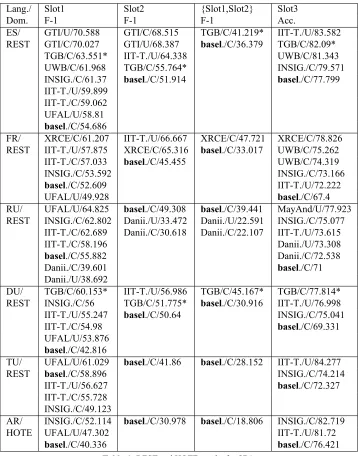
ES/ GTI/U/70.588 GTI/C/68.515 TGB/C/41.219* IIT-T./U/83.582 REST GTI/C/70.027 GTI/U/68.387 basel./C/36.379 TGB/C/82.09*
TGB/C/63.551* IIT-T./U/64.338 UWB/C/81.343
UWB/C/61.968 TGB/C/55.764* INSIG./C/79.571
INSIG./C/61.37 basel./C/51.914 basel./C/77.799 IIT-T./U/59.899
IIT-T./C/59.062 UFAL/U/58.81
basel./C/54.686
FR/ XRCE/C/61.207 IIT-T./U/66.667 XRCE/C/47.721 XRCE/C/78.826 REST IIT-T./U/57.875 XRCE/C/65.316 basel./C/33.017 UWB/C/75.262
IIT-T./C/57.033 basel./C/45.455 UWB/C/74.319
INSIG./C/53.592 INSIG./C/73.166
basel./C/52.609 IIT-T./U/72.222
UFAL/U/49.928 basel./C/67.4
RU/ UFAL/U/64.825 basel./C/49.308 basel./C/39.441 MayAnd/U/77.923 REST INSIG./C/62.802 Danii./U/33.472 Danii./U/22.591 INSIG./C/75.077
IIT-T./C/62.689 Danii./C/30.618 Danii./C/22.107 IIT-T./U/73.615
IIT-T./C/58.196 Danii./U/73.308
basel./C/55.882 Danii./C/72.538
Danii./C/39.601 basel./C/71
Danii./U/38.692
DU/ TGB/C/60.153* IIT-T./U/56.986 TGB/C/45.167* TGB/C/77.814* REST INSIG./C/56 TGB/C/51.775* basel./C/30.916 IIT-T./U/76.998 IIT-T./U/55.247 basel./C/50.64 INSIG./C/75.041
IIT-T./C/54.98 basel./C/69.331
UFAL/U/53.876
basel./C/42.816
TU/ UFAL/U/61.029 basel./C/41.86 basel./C/28.152 IIT-T./U/84.277
REST basel./C/58.896 INSIG./C/74.214
IIT-T./U/56.627 basel./C/72.327
IIT-T./C/55.728 INSIG./C/49.123
AR/ INSIG./C/52.114 basel./C/30.978 basel./C/18.806 INSIG./C/82.719
HOTE UFAL/U/47.302 IIT-T./U/81.72
[image:8.612.124.482.65.521.2]basel./C/40.336 basel./C/76.421
Table 4:REST and HOTE results for SB1.
An interesting observation is that, unlike SE-ABSA15, Slot1 (aspect category detection) attracted significantly more submissions than Slot2 (OTE ex-traction); this may indicate a shift towards concept-level approaches. Regarding participation per lan-guage, the majority of the submissions (156/245) were foren; see more information in Table 5. Most teams (20) submitted results only for one language (18 for enand 2 forru). Of the remaining teams, 3 submitted results for 2 languages, 5 teams submit-ted results for 3-7 languages, while only one team participated in all languages.
6 Evaluation Results
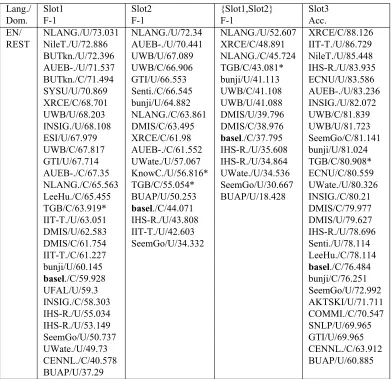
The evaluation results are presented in Tables 3 (SB1: rest-en), 4 (SB1: rest-es, fr, ru, du, tu & hote-ar), 6 (SB1: lapt, came, phns), and 7 (SB2)15. Each participating team was allowed to submit up to two runs per slot and domain in each phase; one constrained (C), where only the provided training data could be used, and one unconstrained (U), where other resources (e.g., publicly available
15
Language Teams Submissions
English 27 156
Arabic 3 4
Chinese 3 14
Dutch 4 16
French 5 13
Russian 5 15
Spanish 6 21
Turkish 3 6
[image:9.612.312.531.64.520.2]All 29 245
Table 5:Number of participating teams and submitted runs per language.
lexica) and additional data of any kind could be used for training. In the latter case, the teams had to re-port the resources used. Delayed submissions (i.e., runs submitted after the deadline and the release of the gold annotations) are marked with “*”.
As revealed by the results, in both SB1 and SB2 the majority of the systems surpassed the baseline by a small or large margin and, as expected, the un-constrained systems achieved better results than the constrained ones. In SB1, the teams with the high-est scores for Slot1 and Slot2 achieved similar F-1 scores (see Table 3) in most cases (e.g., en/rest, es/rest, du/rest, fr/rest), which shows that the two slots have a similar level of difficulty. How-ever, as expected, the {Slot1, Slot2} scores were sig-nificantly lower since the linking of the target ex-pressions to the corresponding aspects is also re-quired. The highest scores in SB1 for all slots (Slot1, Slot2, {Slot1, Slot2}, Slot3) were achieved in the en/rest; this is probably due to the high participation and to the lower complexity of therestannotation schema compared to the other domains. If we com-pare the results for SB1 and SB2, we notice that the SB2 scores for Slot1 are significantly higher (e.g., en/lapt, en/rest, es/rest) even though the respec-tive annotations are for the same (or almost the same) set of texts. This is due to the fact that it is easier to identify whether a whole text discusses an aspect c
than finding all the sentences in the text discussing
c. On the other hand, for Slot3, the SB2 scores are lower (e.g.,en/rest, es/rest, ru/rest, en/lapt) than the respective SB1 scores. This is mainly because an aspect may be discussed at different points in a text and often with different sentiment. In such cases a system has to identify the dominant sentiment, which
Lang./ Slot1 Slot3
Dom. F-1 Acc.
EN/ NLANG./U/51.937 IIT-T./U/82.772 LAPT AUEB-./U/49.105 INSIG./U/78.402
SYSU/U/49.076 ECNU/U/78.152 BUTkn./U/48.396 IHS-R./U/77.903 UWB/C/47.891 NileT./U/77.403 BUTkn./C/47.527 AUEB-./U/76.904 UWB/U/47.258 LeeHu./C/75.905 NileT./U/47.196 Senti./U/74.282 NLANG./C/46.728 INSIG./C/74.282 INSIG./U/45.863 UWB/C/73.783 AUEB-./C/45.629 UWB/U/73.783 IIT-T./U/43.913 SeemGo/C/72.16 LeeHu./C/43.754 UWate./U/71.286 IIT-T./C/42.609 bunji/C/70.287 SeemGo/U/41.499 bunji/U/70.162 INSIG./C/41.458 ECNU/C/70.037 bunji/U/39.586 basel./C/70.037 IHS-R./U/39.024 COMMI./C/67.541
basel./C/37.481 GTI/U/67.291
UFAL/U/26.984 BUAP/U/62.797 CENNL./C/26.908 CENNL./C/59.925 BUAP/U/26.787 SeemGo/U/40.824 CH/ UWB/C/36.345 SeemGo/C/80.457 CAME INSIG./C/25.581 INSIG./C/78.17
basel./C/18.434 UWB/C/77.755
SeemGo/U/17.757 basel./C/74.428 SeemGo/U/73.181 CH/ UWB/C/22.548 SeemGo/C/73.346
PHNS basel./C/17.03 INSIG./C/72.401
INSIG./C/16.286 UWB/C/72.023 SeemGo/U/10.43 basel./C/70.132
SeemGo/U/65.406 DU/ INSIG./C/45.551 INSIG./C/83.333 PHNS IIT-T./U/45.443 IIT-T./U/82.576
IIT-T./C/45.047 basel./C/80.808
basel./C/33.55
Table 6:LAPT, CAME, and PHNS results for SB1.
usually is not trivial.
7 Conclusions
[image:9.612.109.261.65.189.2]text-Lang./ Slot1 Slot3
Dom. F-1 Acc.
EN/ GTI/U/83.995 UWB/U/81.931 REST UWB/C/80.965 ECNU/U/81.436
UWB/U/80.163 UWB/C/80.941 bunji/U/79.777 ECNU/C/78.713
basel./C/78.711 basel./C/74.257
SYSU/U/68.841 bunji/U/70.545 SYSU/U/68.841 bunji/C/66.584 GTI/U/64.109 ES/ GTI/C/84.192 UWB/C/77.185 REST GTI/U/84.044 basel./C/74.548
basel./C/74.548 UWB/C/73.657
RU/ basel./C/84.792 basel./C/70.6
REST
RU/ basel./C/84.792 basel./C/70.6
REST
DU/ basel./C/70.323 basel./C/73.228
REST
TU/ basel./C/72.642 basel./C/57.407
REST
AR/ basel./C/42.757 basel./C/73.216
HOTE
EN/ UWB/C/60.45 ECNU/U/75.046 LAPT UWB/U/59.721 UWB/U/75.046
bunji/U/54.723 UWB/C/74.495
basel./C/52.685 basel./C/73.028
SYSU/U/48.889 ECNU/C/67.523 SYSU/U/48.889 bunji/C/62.202
[image:10.612.88.285.60.456.2]bunji/U/60 GTI/U/58.349
Table 7:Results for SB2.
level subtask. Future work will address the cre-ation of datasets in more languages and domains and the enrichment of the annotation schemas with other types of SA-related information like topics, events and figures of speech (e.g., irony, metaphor).
Acknowledgments
The authors are grateful to all the annotators and contributors for their valuable support to the task: Konstantina Papanikolaou, Juli Bakagianni, Omar Qwasmeh, Nesreen Alqasem, Areen Magableh, Saja Alzoubi, Bashar Talafha, Zekui Li, Binbin Li, Shengqiu Li, Aaron Gevaert, Els Lefever, Cécile Richart, Pavel Blinov, Maria Shatalova, M. Teresa Martín-Valdivia, Pilar Santolaria, Fatih Samet Çetin, Ezgi Yıldırım, Can Özbey, Leonidas Valavanis, Stavros Giorgis, Dionysios Xenos, Panos
Theodor-akakos, and Apostolos Rousas. The work described in this paper is partially funded by the projects EOX GR07/3712 and “Research Programs for Excellence 2014-2016 / CitySense-ATHENA R.I.C.”. The Ara-bic track was partially supported by the Jordan Uni-versity of Science and Technology, Research Grant Number: 20150164. The Dutch track has been partly funded by the PARIS project (IWT-SBO-Nr. 110067). The French track was partially sup-ported by the French National Research Agency un-der project ANR-12-CORD-0015/TransRead. The Russian track was partially supported by the Rus-sian Foundation for Basic Research (RFBR) accord-ing to the research projects No. 14-07-00682a, 16-07-00342a, and No. 16-37-00311mol_a. The Span-ish track has been partially supported by a grant from the Ministerio de Educación, Cultura y Deporte (MECD - scholarship FPU014/00983) and REDES project (TIN2015-65136-C2-1-R) from the Minis-terio de Economía y Competitividad. The Turk-ish track was partially supported by TUBITAK-TEYDEB (The Scientific and Technological Re-search Council of Turkey – Technology and Inno-vation Funding Programs Directorate) project (grant number: 3140671).
References
Marianna Apidianaki, Xavier Tannier, and Cécile Richart. 2016. A Dataset for Aspect-Based Sentiment Analysis in French. InProceedings of the Interna-tional Conference on Language Resources and
Eval-uation.
Erik Cambria, Björn W. Schuller, Yunqing Xia, and Catherine Havasi. 2013. New Avenues in Opinion Mining and Sentiment Analysis.IEEE Intelligent Sys-tems, 28(2):15–21.
Chih-Chung Chang and Chih-Jen Lin. 2011. LIBSVM: A library for support vector machines. ACM TIST, 2(3):27.
Judith Chevalier and Dina Mayzlin. 2006. The effect of word of mouth on sales: Online book reviews. J.
Marketing Res, pages 345–354.
Orphée De Clercq and Véronique Hoste. 2016. Rude waiter but mouthwatering pastries! An exploratory study into Dutch Aspect-Based Sentiment Analysis. In
Proceedings of the 10th International Conference on
Language Resources and Evaluation.
2013. TURKSENT: A Sentiment Annotation Tool for Social Media. In Proceedings of the 7th Linguistic Annotation Workshop and Interoperability with
Dis-course.
Gayatree Ganu, Noemie Elhadad, and Amélie Marian. 2009. Beyond the Stars: Improving Rating Predic-tions using Review Text Content. InProceedings of
WebDB.
Aniruddha Ghosh, Guofu Li, Tony Veale, Paolo Rosso, Ekaterina Shutova, John Barnden, and Antonio Reyes. 2015. SemEval-2015 Task 11: Sentiment Analysis of Figurative Language in Twitter. InProceedings of the
9th International Workshop on Semantic Evaluation,
Denver, Colorado.
Salud M. Jiménez-Zafra, Giacomo Berardi, Andrea Esuli, Diego Marcheggiani, María Teresa Martín-Valdivia, and Alejandro Moreo Fernández. 2015. A Multi-lingual Annotated Dataset for Aspect-Oriented Opin-ion Mining. InProceedings of Empirical Methods in
Natural Language Processing, pages 2533–2538.
Roman Klinger and Philipp Cimiano. 2014. The USAGE Review Corpus for Fine Grained Multi Lingual Opin-ion Analysis. In Proceedings of the Ninth Interna-tional Conference on Language Resources and
Eval-uation, Reykjavik, Iceland.
Patrik Lambert. 2015. Aspect-Level Cross-lingual Sen-timent Classification with Constrained SMT. In Pro-ceedings of the Association for Computational Linguis-tics and the International Joint Conference on
Natu-ral Language Processing, 2015, Beijing, China, pages
781–787.
Bing Liu. 2012. Sentiment Analysis and Opinion Mining. Synthesis Lectures on Human Language Technologies. Morgan & Claypool Publishers.
Natalia Loukachevitch, Pavel Blinov, Evgeny Kotel-nikov, Yulia Rubtsova, Vladimir Ivanov, and Elena Tutubalina. 2015. SentiRuEval: Testing Object-oriented Sentiment Analysis Systems in Russian. In
Proceedings of International Conference Dialog.
Julian J. McAuley, Jure Leskovec, and Dan Jurafsky. 2012. Learning Attitudes and Attributes from Multi-aspect Reviews. In 12th IEEE International Confer-ence on Data Mining, ICDM 2012, Brussels, Belgium,
December 10-13, 2012, pages 1020–1025.
Margaret Mitchell. 2013. Overview of the TAC2013 Knowledge Base Population Evaluation English Senti-ment Slot Filling. InProceedings of the 6th Text
Anal-ysis Conference, Gaithersburg, Maryland, USA.
Saif M Mohammad, Svetlana Kiritchenko, Parinaz Sob-hani, Xiaodan Zhu, and Colin Cherry. 2016. SemEval-2016 Task 6: Detecting Stance in Tweets. In Proceed-ings of the 10th International Workshop on Semantic
Evaluation, San Diego, California.
Preslav Nakov, Sara Rosenthal, Zornitsa Kozareva, Veselin Stoyanov, Alan Ritter, and Theresa Wilson. 2013. SemEval-2013 Task 2: Sentiment Analysis in Twitter. InProceedings of the 7th International
Work-shop on Semantic Evaluation, Atlanta, Georgia.
Stelios Piperidis. 2012. The META-SHARE Language Resources Sharing Infrastructure: Principles, Chal-lenges, Solutions. InProceedings of the 8th Interna-tional Conference on Language Resources and
Evalu-ation.
Maria Pontiki, Dimitrios Galanis, John Pavlopoulos, Har-ris Papageorgiou, Ion Androutsopoulos, and Suresh Manandhar. 2014. SemEval-2014 Task 4: Aspect Based Sentiment Analysis. In Proceedings of the
8th International Workshop on Semantic Evaluation,
Dublin, Ireland.
Maria Pontiki, Dimitrios Galanis, Harris Papageorgiou, Suresh Manandhar, and Ion Androutsopoulos. 2015. SemEval-2015 Task 12: Aspect Based Sentiment Analysis. In Proceedings of the 9th International
Workshop on Semantic Evaluation, Denver, Colorado.
Diego Reforgiato Recupero and Erik Cambria. 2014. Eswc’14 challenge on concept-level sentiment analy-sis. InSemantic Web Evaluation Challenge -
SemWe-bEval 2014 at ESWC 2014, Anissaras, Crete, Greece,
pages 3–20.
Sara Rosenthal, Alan Ritter, Preslav Nakov, and Veselin Stoyanov. 2014. SemEval-2014 Task 4: Sentiment Analysis in Twitter. InProceedings of the 8th
Interna-tional Workshop on Semantic Evaluation, Dublin,
Ire-land.
Sara Rosenthal, Preslav Nakov, Svetlana Kiritchenko, Saif M Mohammad, Alan Ritter, and Veselin Stoy-anov. 2015. SemEval-2015 Task 10: Sentiment Anal-ysis in Twitter. InProceedings of the 9th International
Workshop on Semantic Evaluation, Denver, Colorado.
Josef Ruppenhofer, Roman Klinger, Julia Maria Struß, Jonathan Sonntag, and Michael Wiegand. 2014. IG-GSA Shared Tasks on German Sentiment Analysis (GESTALT). In Workshop Proceedings of the 12th
Edition of the KONVENS Conference, pages 164–173.
Yohei Seki, David Kirk Evans, Lun-Wei Ku, Hsin-Hsi Chen, Noriko Kando, and Chin-Yew Lin. 2007. Overview of Opinion Analysis Pilot Task at NTCIR-6. InProceedings of the 6th NTCIR Workshop, Tokyo,
Japan.
Yohei Seki, David Kirk Evans, Lun-Wei Ku, Le Sun, Hsin-Hsi Chen, and Noriko Kando. 2008. Overview of Multilingual Opinion Analysis Task at NTCIR-7.
In Proceedings of the 7th NTCIR Workshop, Tokyo,
Japan.
Lingual Opinion Analysis. InProceedings of the 8th
NTCIR Workshop, Tokyo, Japan, pages 209–220.
Richard Socher, Alex Perelygin, Jean Wu, Jason Chuang, Christopher D. Manning, Andrew Y. Ng, and Christo-pher Potts. 2013. Recursive Deep Models for Semantic Compositionality Over a Sentiment Tree-bank. InProceedings of Empirical Methods in Natural
Language Processing, pages 1631–1642, Stroudsburg,
PA.
Pontus Stenetorp, Sampo Pyysalo, Goran Topic, Tomoko Ohta, Sophia Ananiadou, and Jun’ichi Tsujii. 2012. BRAT: A Web-based Tool for NLP-Assisted Text An-notation. InProceedings of the European Chapter of
the Association for Computational Linguistics, pages
102–107.
Ezgi Yıldırım, Fatih Samet Çetin, Gülşen Eryiğit, and Tanel Temel. 2015. The impact of nlp on turkish sentiment analysis. TÜRKİYE BİLİŞİM VAKFI BİLGİSAYAR BİLİMLERİ ve MÜHENDİSLİĞİ
DERGİSİ, 7(1 (Basılı 8).
Kyung Hyan Yoo and Ulrike Gretzel. 2008. What Moti-vates Consumers to Write Online Travel Reviews? J.
of IT & Tourism, 10(4):283–295.
Yanyan Zhao, Bing Qin, and Ting Liu. 2015. Creating a Fine-Grained Corpus for Chinese Sentiment Analysis.
IEEE Intelligent Systems, 30(1):36–43.
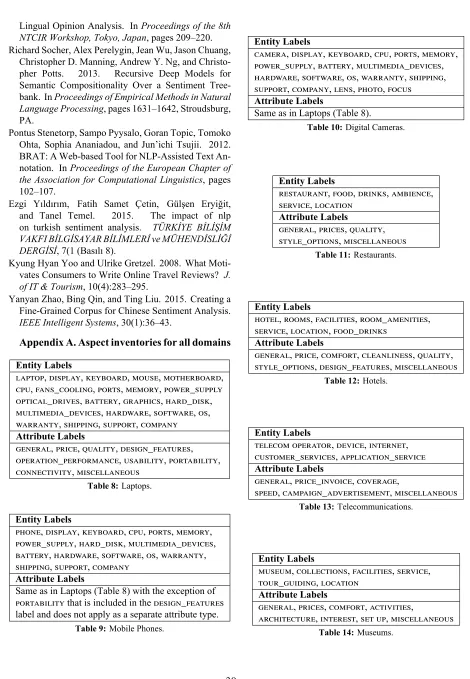
Appendix A. Aspect inventories for all domains
Entity Labels
laptop,display,keyboard,mouse,motherboard,
cpu,fans_cooling,ports,memory,power_supply optical_drives,battery,graphics,hard_disk,
multimedia_devices,hardware,software,os,
warranty,shipping,support,company Attribute Labels
general,price,quality,design_features,
operation_performance,usability,portability,
connectivity,miscellaneous Table 8:Laptops.
Entity Labels
phone,display,keyboard,cpu,ports,memory,
power_supply,hard_disk,multimedia_devices,
battery,hardware,software,os,warranty,
shipping,support,company Attribute Labels
Same as in Laptops (Table 8) with the exception of
portabilitythat is included in thedesign_features
label and does not apply as a separate attribute type.
Table 9:Mobile Phones.
Entity Labels
camera,display,keyboard,cpu,ports,memory,
power_supply,battery,multimedia_devices,
hardware,software,os,warranty,shipping,
support,company,lens,photo,focus Attribute Labels
[image:12.612.65.535.50.729.2]Same as in Laptops (Table 8).
Table 10:Digital Cameras.
Entity Labels
restaurant,food,drinks,ambience,
service,location Attribute Labels
general,prices,quality,
style_options,miscellaneous Table 11:Restaurants.
Entity Labels
hotel,rooms,facilities,room_amenities,
service,location,food_drinks Attribute Labels
general,price,comfort,cleanliness,quality,
style_options,design_features,miscellaneous Table 12:Hotels.
Entity Labels
telecom operator,device,internet,
customer_services,application_service Attribute Labels
general,price_invoice,coverage,
speed,campaign_advertisement,miscellaneous Table 13:Telecommunications.
Entity Labels
museum,collections,facilities,service,
tour_guiding,location Attribute Labels
general,prices,comfort,activities,
[image:12.612.242.529.73.580.2]