COMPLEX SOFTWARE SYSTEMS
Aled Sage
A Thesis Submitted for the Degree of PhD
at the
University of St Andrews
2003
Full metadata for this item is available in
Research@StAndrews:FullText
at:
http://research-repository.st-andrews.ac.uk/
Please use this identifier to cite or link to this item:
http://hdl.handle.net/10023/6479
Configuration of
Complex Software
Systems
Aled Sage
Thesis submitted for the Ph.D. degree
St Andrews
18
thJuly 2003
i
The ever-increasing complexity of software systems makes them hard to comprehend, predict and
tune due to emergent properties and non-deterministic behaviour. Complexity arises from the size of
software systems and the wide variety of possible operating environments: the increasing choice of
platforms and communication policies leads to ever more complex performance characteristics. In
addition, software systems exhibit different behaviour under different workloads.
Many software systems are designed to be configurable so that policies (e.g. communication,
concurrency and recovery strategies) can be chosen to meet the needs of various stakeholders. For
complex software systems it can be difficult to accurately predict the effects of a change and to know
which configuration is most appropriate.
This thesis demonstrates that it is useful to run automated experiments that measure a selection of
system configurations. Experiments can find configurations that meet the stakeholders’ needs, find
interesting behavioural characteristics, and help produce predictive models of the system’s behaviour.
The design and use of ACT (Automated Configuration Tool) for running such experiments is
described, in combination a number of search strategies for deciding on the configurations to
measure.
Design Of Experiments (DOE) is discussed, with emphasis on Taguchi Methods. These statistical
methods have been used extensively in manufacturing, but have not previously been used for
configuring software systems. The novel contribution here is an industrial case study, applying the
combination of ACT and Taguchi Methods to DC-Directory, a product from Data Connection Ltd
(DCL). The case study investigated the applicability of Taguchi Methods for configuring complex
software systems. Taguchi Methods were found to be useful for modelling and configuring
DC-Directory, making them a valuable addition to the techniques available to system administrators and
ii
I, Aled Sage, hereby certify that this thesis, which is approximately 42,000 words in length, has
been written by me, that it is the record of work carried out by me and that it has not been submitted
in any previous application for a higher degree.
date 18th July 2003 signature of candidate ……….
I was admitted as a research student in October 1999 and as a candidate for the degree of PhD in
July 2003; the higher study for which this is a record was carried out in the University of St Andrews
between 1999 and 2003.
date 18th July 2003 signature of candidate ……….
I hereby certify that the candidate has fulfilled the conditions of the Resolution and Regulations
appropriate for the degree of PhD in the University of St Andrews and that the candidate is qualified
to submit this thesis in application for that degree.
date 18th July 2003 signature of supervisor ……….
In submitting this thesis to the University of St Andrews I understand that I am giving permission
for it to be made available for use in accordance with the regulations of the University Library for the
time being in force, subject to any copyright vested in the work not being affected thereby. I also
understand that the title and abstract will be published, and that a copy of the work may be made and
supplied to any bona fide library or research worker.
iii
I would like to thank my supervisors, Graham Kirby and Ron Morrison, for their frequent
guidance and advice. Their insightful comments and unending patience were invaluable. Thanks also
to Al Dearle for useful discussions, and for helping me find employment!
Cooperation with Data Connection Ltd (DCL) was vital to this research. Thanks especially to
Richard Stamp, David Court and Edward Hibbert for their suggestions and their help in the industrial
case studies.
Harry Staines rescued me during my initial sorties into the field of statistics, and has contributed
greatly to the ideas and work in this thesis. He introduced me to Taguchi Methods and provided
expert help in applying the techniques and analysing the results.
I’d like to thank Alice for her unending encouragement and for proof reading sections of this
thesis, but I’m sure I’ll have to reciprocate in a year or two… Thanks to my parents for much valuable
support over the years, and to my flatmates and officemates for their distractions and support. Finally
thanks to the St Andrews University Mountaineering Club for providing the frequent escapes from St
iv
1 Introduction ... 1
1.1 Hypothesis... 2
1.2 Overview of approach ... 2
1.3 Contribution ... 4
1.4 Thesis structure ... 5
2 Literature review ... 7
2.1 Performance evaluation... 7
2.2 Quality of target system configurations... 8
2.3 Target system models... 12
2.4 Complex systems... 13
2.5 The need for adaptability... 14
2.5.1 Compliant systems... 14
2.5.2 Evolution of software systems... 15
2.6 Observing behaviour ... 16
2.6.1 Probes ... 16
2.6.1.1 Desirable qualities... 17
2.6.1.2 Categories of probes ... 17
2.6.2 Gauges ... 21
2.6.3 Probe and gauge run-time infrastructures... 21
2.6.4 Confidence in observations... 22
2.7 Adapting target systems ... 23
2.7.1 Dimensions of adaptation ... 23
v
2.8 Design Of Experiments (DOE) ... 27
2.8.1 Theory ... 27
2.8.2 Related work... 29
2.8.3 Controlling the target system... 30
2.9 Systems for performance tuning and evolution ... 31
2.9.1 Version granularity ... 31
2.9.2 Managing adaptation ... 32
2.9.3 Deciding on appropriate configurations ... 34
2.9.4 Performance tuning systems ... 35
2.9.5 DASADA ... 36
2.9.5.1 Software Surveyor ... 37
2.9.5.2 Kinesthetics eXtreme... 37
2.9.5.3 Rainbow... 38
2.9.5.4 Containment units ... 39
2.9.6 ArchWare ... 39
2.9.7 Reflective middleware... 40
2.10 Control theory and process modelling... 41
2.10.1 Control theory and feedback... 41
2.10.2 Process modelling... 43
2.10.2.1 FEAST ... 44
2.10.3 Catastrophe theory... 44
2.11 Software testing... 45
vi
3.1 Tool architecture... 50
3.2 Human roles ... 51
3.3 ACT set-up ... 52
3.4 Experiment description... 52
3.5 Target wrapper ... 53
3.6 Target controller... 55
3.7 Search strategy ... 56
3.8 Coordinator... 57
3.9 Recording and reporting results... 59
3.9.1 Results database... 59
3.9.2 Output files ... 60
3.10 Running an experiment ... 60
3.11 Conclusions ... 63
4 Exploring target system behaviour... 64
4.1 Meta-strategies ... 64
4.2 Use of feedback... 65
4.3 Design Of Experiments (DOE) ... 66
4.3.1 First phase experiment... 68
4.3.2 Signal to noise ratio (SNR)... 71
4.3.3 Techniques for analysing results ... 73
4.3.3.1 Main effects ... 74
4.3.3.2 Interaction effects ... 76
vii
4.3.5 Second phase experiment ... 83
4.3.6 Robust design ... 84
4.4 Conclusions ... 85
5 Case studies... 87
5.1 DC-MailServer ... 87
5.1.1 Experimental infrastructure ... 88
5.1.2 Variability in behaviour... 89
5.1.3 Varying workload... 91
5.1.4 Exploring effects of configurable aspects... 92
5.2 DC-Directory... 93
5.2.1 Experimental infrastructure ... 94
5.2.2 Normalising results... 95
5.2.3 Importance of replicating observations... 95
5.2.4 Use of Taguchi Methods... 98
5.2.4.1 First phase experiment ... 99
5.2.4.2 Second phase experiment... 101
5.2.4.3 Results of validating the model... 103
5.2.4.4 Consequences of ignoring significant effects ... 104
5.2.4.5 Relationships between factors and the response variable ... 105
5.3 Conclusions ... 108
6 Discussion ... 110
6.1 Testing the hypothesis ... 110
viii
6.4 Experimental adaptations on-the-fly ... 114
7 Future work ... 116
7.1 Further experiments... 116
7.2 Complementing other work... 117
7.3 ACT 2.0... 118
7.3.1 Event-based architecture... 120
7.3.2 Evolution strategies ... 120
7.3.3 Use of advice ... 121
7.3.4 Use of models ... 122
7.3.5 Challenges ... 123
7.4 Further versions of ACT... 124
7.5 Summary ... 124
8 Conclusions ... 126
Appendix A: Glossary ... 128
Appendix B: Issues in observation-driven configuration ... 137
Appendix C: Example of an experiment description... 141
Appendix D: Example of target wrapper functions ... 145
Appendix E: First phase experiment design ... 146
Appendix F: Second phase experiment design ... 147
1 1 Introduction
Software systems play an increasingly important role in organisations and in everyday life, the UK
software market being worth £8.5 billion in 2001 [18]. Software systems are also growing in
complexity: they are hard to comprehend, predict and tune due non-deterministic behaviour and
emergent properties (i.e. behaviour of the whole system cannot be inferred from its parts) [32].
Complexity arises from the size of software systems, the amount of data and the scale of distributed
systems. The choice of platforms, network configurations and communication policies has also
increased markedly over the years, leading to a wide variety of operating environments with ever
more complex performance characteristics. This is compounded by different versions of a software
system having different characteristics, with behaviour being dependent on the workload (i.e. usage
pattern).
Software systems attempt to meet the potentially conflicting needs of various stakeholders. Some
users demand reliability and low response times, while others may desire consistently high throughput
with minimal resource requirements. The appropriate trade-off between these needs depends on the
particular set of users.
Many software systems are designed to be configurable so that policies (e.g. communication,
concurrency and recovery strategies) can be chosen to give desired behaviour. Such systems expose a
group of configurable aspects, which are implementation details that can be controlled explicitly. The
system’s configuration refers to a group of values that specifies a setting for each configurable aspect.
Comprehending the behaviour of a software system is related to the problem of configuring it. It
can be difficult to accurately predict a configurable aspect’s effect on behaviour, and to know which
configuration is most appropriate for a given condition (i.e. environment and workload). This is
especially true for complex software systems that expose many configurable aspects: the number of
configurations increases exponentially with the number of configurable aspects, referred to as the
2 1.1 Hypothesis
This thesis proposes the following hypothesis: automating the empirical measurement of a
selection of configurations can:
• find a robust configuration (if any) that exhibits desired behaviour under a particular
condition – useful for configuring the software system when it is first deployed or when
adapting its configuration to cope with changes in the conditions of use;
• find characteristics of interest, such as conditions that cause substantial deterioration in
performance – useful for guiding system usage and for focusing development efforts;
• help construct a predictive model of the software system that can estimate behaviour for
untested configurations under given conditions.
The aim of the research described in this thesis is to develop software support, and an associated
methodology, to test the above hypothesis. The approach involves empirically measuring the
behaviour of a selection of configurations under various conditions, without assuming a priori
knowledge of the system’s implementation. This is done before the software system goes into use.
The hypothesis was tested in an industrial case study involving DC-Directory [10], an LDAP and
X.500 product from Data Connection Ltd (DCL). The case study supported the hypothesis,
demonstrating that automated measurement of a selection of configurations can achieve the goals
listed above. Discussions with system developers revealed that measurements also improved
comprehension of the system’s behaviour. The software and methodology described in this thesis
therefore makes a valuable contribution towards solving the problem of configuring software systems.
1.2 Overview of approach
The following chapters describe the design of ACT (Automated Configuration Tool) [93], and its
use to explore the behaviour of software systems. ACT provides an infrastructure to run a sequence of
trials: it tests (i.e. empirically measures the behaviour of) a configuration during each trial. The
software system’s configuration and conditions of use are adapted between trials. ACT is generic in
that it can explore the behaviour of a wide variety of software systems, and can use a variety of search
3
Figure 1.1 illustrates the semi-automated process of running experiments to measure a sequence of
configurations. The software system under test is called the target system. The experimenter (i.e. the
user of ACT) decides on the configurable aspects to vary and the values to test for each, and chooses
an appropriate search strategy. The experimenter provides information about the configurable aspects,
including the locations of functions to set each configurable aspect’s value, and the locations of
functions to run a trial and recover from target system failure. For automation, these functions must
run without human intervention. ACT dynamically loads the functions and uses them to run the trials,
and to configure both the target system and the conditions under which it operates.
Figure 1.1: System overview
A search strategy generates a sequence of target system configurations and conditions to test.
There are two categories of search strategy for ACT. The first is a feedback-based search, which uses
observations of previous configurations to decide on the next configuration to test. The second
category makes use of Design Of Experiments (DOE) [107], where the configurations to test and the
number of times to test each are decided in advance.
Taguchi Methods [101] is a standardised statistical approach for DOE, to select a small subset of
the possible configurations and conditions. It assumes that experts provide a list of (at most dozens of)
configurable aspects and suggest (up to four) values for each. Research into the use of Taguchi
Methods for configuring software systems is in collaboration with Professor Harry Staines of Abertay
University, who is expert in their use for other fields such as biology and manufacturing.
Experiments designed using Taguchi Methods are conducted in two phases. The first phase
involves testing a selection of configurations to produce a predictive model of the target system’s
4
involves testing the predicted optimal configuration and other configurations that have similar settings
for the configurable aspects. Results from the second phase are used to more accurately predict a
configuration that will consistently deliver high performance.
Taguchi Methods were used to explore the behaviour of DC-Directory. In-built observation and
adaptation mechanisms were used to measure its performance and adapt its configuration.
DC-Directory has a broad customer base, leading to a wide variety of usage patterns, operating
environments and performance requirements. It exposes hundreds of configurable aspects, including
caching policies, concurrency policies and queue management policies. Their effects on
DC-Directory’s behaviour depend on the conditions of use, and vary between system versions. DCL
currently undertakes performance analysis and tuning by hand, which relies heavily upon costly
expertise and only permits testing of a few configurations due to time constraints. The following
example illustrates the problem: given only ten configurable aspects and four possible values for each,
it would take almost sixty years to measure every configuration (given the requirement of thirty
minutes per measurement).
1.3 Contribution
Comprehending the behaviour of complex software systems is difficult: some target systems may
never be fully understood. Configuring complex software systems is therefore also difficult since it is
hard to predict which configuration will be most appropriate for a particular condition. Use of ACT
can reveal information about the behaviour of complex software systems. The approach is based on
empirically measuring a selection of target system configurations, without assuming a priori
knowledge of the system’s implementation or architecture.
ACT provides a generic infrastructure to run experiments for target systems, which contributes to
the state of the art in two ways:
• Running experiments assists human administrators to comprehend and configure target
systems.
• ACT can use various search strategies, and investigate the strengths and weaknesses of each
5
An important example is the use of ACT to investigate the suitability of Taguchi Methods for
software configuration. The novelty of this approach is in the application of Taguchi Methods to help
comprehend and configure complex software systems. Taguchi Methods have been used extensively
in manufacturing for almost five decades, but the techniques have not previously been used before for
configuring software systems. This thesis develops the techniques and applies them to an industrial
case study: the combination of Taguchi Methods and ACT, yielding the semi-automated TACT
process, is used to model and configure DC-Directory. Benefits of Taguchi Methods over other search
strategies include:
• Only a small number of configurations need be tested to infer the effects on target system
behaviour of many configurable aspects, and of selected interactions1 between them. This
gives a predictive model of the target system’s behaviour and associated confidence levels in
the results (see section 6.2 for a discussion of the assumptions of Taguchi Methods).
• The standardised approach for the design of experiments is simple and accessible to
non-statisticians.
Some target systems exhibit variability in behaviour. The importance of robustness (i.e.
consistently high performance with low variability) is emphasised in this thesis: sometimes improving
the worst cases is more useful than improving the average case. Taguchi proposes a metric for
estimating the robustness of a configuration, given replicated measurements of its performance. Use
of this metric is novel to the field of software systems.
1.4 Thesis structure
Chapter 2 presents a literature review of the broad range of work related to configuring software
systems. A glossary of the terminology used can be found in Appendix A.
Chapter 3 presents the Automated Configuration Tool in detail. Chapter 4 describes some possible
search strategies, with particular emphasis on Taguchi Methods and on the statistical analysis of
results.
1 An interaction effect differs from interaction between components of a system (e.g. message
6
Chapter 5 describes two industrial case studies. Results for DC-MailServer, a back-end mail server
from Data Connection Ltd (DCL), illustrate the importance of replicating observations to measure
robustness. The second case study illustrates the use of the TACT process to configure and model
DC-Directory. Chapter 6 uses results from the case studies to evaluate the usefulness of running
experiments, and discusses the benefits and limitations of Taguchi Methods.
Chapter 7 gives details of future work, proposing further experiments and uses of ACT. There is a
discussion of future versions of ACT to support on-the-fly evolution of target systems. Chapter 8
7 2 Literature review
Configuring target systems is important for tuning their performance, repairing faults and
modifying or adding functionality. This is true both before the target system goes into use and
on-the-fly (i.e. at run-time, while in use). The configuration process refers to the set of activities involved in
tuning or evolving a target system. Tuning is adapting a target system at a given time, to find a
configuration that behaves in a desired way. Evolution is the strategic adaptation of a target system’s
configuration over time, to progress to new and improved versions of the target system.
There are two main stages to configuring a target system: first deciding which changes are
required and when, and second making the changes. Many projects aim to do this (e.g. [4, 9, 28]),
often sharing with ACT the following common features:
• Observation mechanisms are used to measure the target system’s behaviour and conditions
of use.
• Adaptation mechanisms are used to configure the target system.
• Controllers (search strategies in ACT) are used to decide on an appropriate configuration of
the target system.
This chapter first discusses techniques for performance evaluation, introduces the notion of quality
and describes target system models. It then characterises complex software systems and justifies the
need for adaptation. The three bullet points above are then addressed to describe observation
mechanisms, adaptation mechanisms and systems for coordinating the configuration process. A
glossary of the terminology used can be found in Appendix A.
2.1 Performance evaluation
When configuring a target system, it is necessary to determine how possible configurations will
perform. Techniques for performance evaluation include analytical modelling, simulation analysis
and empirical measurement [64].
Analytical modelling involves analysis of a target system’s design and algorithms to develop a
mathematical model of a target system’s behaviour. It can be used early in the development life cycle
8
complex software systems: complexity necessitates (unrealistic) simplifying assumptions, leading to a
low level of accuracy compared to other performance evaluation techniques. Additionally, models
require calibration using empirical measurements of the running target system.
Simulation analysis involves producing an executable model (i.e. a simulation) of a target system,
which is run to predict the real target system’s behaviour. Source code analysis and profiling
information can be used to produce a simulation of a target system’s control flow, resource
requirements and communication patterns [22, 66]. The advantage of running a simulation over
running the target system is that the execution time is usually less, and that adapting the simulation is
easier than adapting the target system’s configuration. Additionally, algorithms can be simulated early
in the development life cycle before implementation of the target system is complete. However, an
executable model produced using source code analysis is unlikely to exhibit the emergent properties
and non-determinism of a complex software system.
Empirical measurement involves observing the running target system. There is a high level of
confidence in results from empirical measurement, compared to predictions from a model or
simulation, because observations are of the running target system. This approach can be used for
software systems that are too complex to analyse or simulate accurately, assuming there is the
capability to observe the running system (see section 2.6). This thesis focuses on the use of empirical
measurement.
When measuring behaviour before the target system goes into use, it is important that the
workloads be representative of the customer’s likely usage patterns. Logging a customer’s usage,
where possible, allows an identical set of inputs to be used during experiments, or a synthetic
workload to be developed based on characteristics of the logged input. An alternative is to use
domain-specific benchmarks, such as DirectoryMark [17], that describe common usage patterns.
2.2 Quality of target system configurations
A target system configuration and a condition under which it operates is called a combination.
This specifies a value for each configurable aspect of the target system and aspect of the conditions of
use that can be configured. In statistics terminology, these aspects are called factors and their values
9
The combinations form a multi-dimensional input space whose dimensions correspond to the
factors. A point in the space represents a combination, giving a level for every factor.
A multi-dimensional input space is not the only way to view the set of possible combinations.
Constraint programmers, in contrast, would describe the input space as a search tree [21]. A branch in
the tree corresponds to a choice of level for a factor, and a path from the root to a leaf node gives a
single level for every factor. Each leaf node therefore represents a combination. The following
discussion uses the metaphor of a multi-dimensional input space.
The process of configuring a software system is driven by a configuration goal, which specifies
the desired behaviour in terms of a potentially conflicting set of fitness metrics. An example
configuration goal for a database system is to maintain a latency of less than 500ms for 99% of
requests, while maximising throughput. Each time a combination is tested, the fitness metrics’ values
are recorded.
Values for each fitness metric could be qualitative or quantitative; values could have a scale type
of nominal, ordinal, interval or ratio [51]. These mean respectively that the values refer to categories,
that the values are ordered, that the values increase in regular step sizes, and that there is a fixed zero
point so that relations such as “twice the value” are meaningful.
Identifying the best configurations, in terms of the fitness metrics, is a multi-objective
optimisation problem. Some researchers search for Pareto optimal solutions, where no fitness metric
can be improved without causing at least one other fitness metric to deteriorate [36]. An alternative
approach is to combine the fitness metrics using an aggregating function to produce a single response,
the higher the better2. This makes comparing configurations simpler. It is possible if there is a
well-defined configuration goal: choice of aggregating function requires knowledge of the relative
importance of each fitness metric, their expected range of values and the desired values for each. The
following discussion assumes that a single response is calculated using such an aggregating function.
2 Maximising the response involves finding the global maximum on a response surface, and is
discussed later in the section. Maximising the response is an arbitrary choice: for some problems,
10
The quality of a combination is a measure of how well it meets the configuration goal. Taguchi
defines a high quality combination as one that imparts little loss to society from the time the target
system is shipped [101]. He suggests measuring quality in terms of robustness: consistently high
performance with low variability. This view of quality is often used in manufacturing industries, but
is just one possible definition (e.g. it ignores time to market). According to Taguchi’s definition,
quality is determined by the costs incurred whenever the target system fails to meet the configuration
goal. This implies that high-quality configurations deliver consistent performance, but some complex
software systems produce a different response each time a given combination is run. Replicating trials
is therefore important for estimating the quality of a combination – the more replications, the greater
the confidence in the estimate. The set of responses from replicated trials combine to give a single
value of the response variable for each combination.
The acceptable level of variability in a target system’s behaviour depends on the consistency
demanded by the customer. If the desired consistency is not achieved, the target system may be
classed as non-deterministic. The distribution of responses is also important.
It is arguably more useful in some situations to improve the worst cases than the average case of a
software system’s performance: bad worst cases give a negative impression of the system and can
lead to higher costs due to reduced sales and more calls to the helpdesk [99]. Taguchi’s robustness
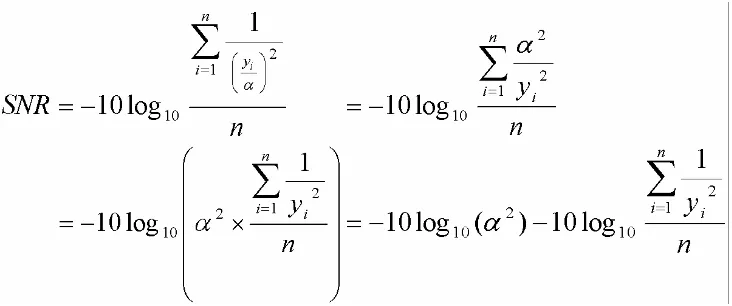
metric (called signal to noise ratio3, described in section 4.3.2) takes into account both how high
responses are and their consistency. Ranking combinations in terms of robustness can give a different
order than if the mean of the responses is used. For example, Figure 2.1 shows the results of a
hypothetical experiment: it shows the observed responses (represented by triangles) for combinations
A, B and C, and the mean response for each (denoted M). Combination C usually gives a higher
response than combination A and therefore might be considered preferable. However, one response
for A was 100, which gives A the highest mean. Combination B has two observed responses that are
very low – bad worst cases – making this configuration unfavourable. Ranking the combinations
according to robustness gives C, B, A – the reverse of the ordering produced using the mean.
3 Signal to noise ratio used here is very different to that used in communications, where it is the ratio
11
Figure 2.1: Quality of responses
A response surface can be used to show the relationship between the levels of factors and the
value of the response variable. The response surface lies over the input space, using the dimensions of
the input space and an additional “response variable dimension”. For the case of measuring quality
(i.e. robustness, according to Taguchi’s definition), each point on the surface shows how well a
combination meets the configuration goal. Figure 2.2 shows a hypothetical response surface for a
two-dimensional input space consisting of factors A and B. The surface has a phase change, where there is
a sharp change in the shape of the surface. The surface also includes: a global maximum, which
corresponds to the configuration delivering optimal quality; a local maximum, i.e. a combination
better than its neighbours but not the best in the space; and a local minimum, i.e. a combination worse
than its neighbours.
Figure 2.2: Example response surface
A search of the response surface is required to identify good configurations, interesting behaviour
and the effects of each factor. Depending on the search strategy employed, this can be a non-trivial
task due to phase changes, local maxima and interactions among factors. The problem is compounded
12
can be tested. Running experiments that assist human administrators in configuring target systems is
therefore a difficult problem.
2.3 Target system models
A model is a representation that exhibits some property of the target system. Models are useful
when configuring target systems because they make explicit the modeller’s understanding and allow
the target system to be considered at some level of abstraction. A model may form the basis for
planning and coordinating adaptation of a target system’s configuration: it may predict the target
system’s behaviour and provide a context to describe and decide upon adaptations.
Models can be categorised by:
• Properties the model represents. For example, quality of service (QoS), resource usage,
architecture, or a combination of these.
• The temporal scope of the model. For example, time the requirements were specified, time
the target system’s execution was last observed, and/or future time when predicting
behaviour.
A model may be complete (though not necessarily accurate) or incomplete. A complete model
represents a target system property over the full input space. An incomplete model provides partial
information, describing the target system property in only some situations.
A model may represent the target system in a simplified form. By ignoring some details,
complexity is reduced but at the cost of reducing the accuracy of information. Conversely, extra
information may be contained in a model (e.g. descriptions of other implementations, version history,
etc).
Techniques such as analytical modelling and empirical measurement can contribute towards
comprehension of a target system’s behaviour and help in the production of a predictive model. As
the model is refined, it converges to the most accurate model possible: running the real target system
13
Figure 2.3: Refining a model
For a model of an evolving target system to be continually useful (i.e. not become out-of-date), it
should be maintained throughout the lifetime of the target system. Bindings between the executable,
source code, documentation, requirements and models help in maintaining a target system: changes
made to the target system are mapped to changes in the model, and vice versa. When there is a
causality relationship between the model and the subject being modelled, it is called an active model.
A passive model, in contrast, is independent of the subject [104].
2.4 Complex systems
Of particular interest here are complex software systems lacking previously-known predictive
behaviour models. These are inherently difficult to configure for the following reasons [32]:
• Emergent properties are only apparent at run-time, which necessitates observation of the
running system.
• Non-deterministic behaviour makes drawing conclusions from observations difficult and
modelling problematic.
• Non-linearities and phase changes make behaviour hard to predict.
• Trends toward larger software systems, more data and more devices make the system harder
to manage.
• Choice of platforms, network configurations and communication policies has increased
markedly over the years, leading to a wide variety of operating environments with ever more
complex behaviours.
• Different versions of a software system can have different characteristics, which necessitates
configuring the system every time it is upgraded.
• Conditions of use can change, which necessitates repeated adaptation of the target system’s
14
• Many software systems are poorly documented and are maintained in an ad hoc manner,
which makes comprehending and configuring the system difficult.
2.5 The need for adaptability
2.5.1 Compliant systems
Morrison et al argue that software systems should accommodate, and thus be compliant to, the
needs of particular applications and customers [83]. This requires that the needs of the application be
known and that the software system be configured to meet those needs.
Kiczales et al [69] observe that some policy decisions are “crucial strategy issues whose resolution
will invariably bias the performance of the resulting implementation.” These policy decisions are
called mapping dilemmas (in an OS, they relate to how an abstraction is mapped onto the underlying
hardware). The choice of policy is called a mapping decision, and a mapping conflict occurs when a
policy decision is inappropriate for a given application.
The traditional view of designing systems is to use static abstract components or layers, using
encapsulation to encourage software reuse. Policy decisions that are believed to suit the requirements
of “typical” applications are hidden from the application, even though the application may have vital
information about which policies are best suited to its needs.
An open implementation approach aims to expose policy decisions, to avoid the danger of
encapsulation outlined above [68]. ACT can run experiments to measure the effects of various
policies, to infer which policies are best suited to a given application.
The Compliant Systems Architecture (CSA) project describes an architectural approach to the
construction of configurable systems: components are designed, top down, with the philosophy of
fitting the architecture to the needs of the particular application [83]. The key technique in CSA is to
separate mechanism and policy, allowing the architecture to be tailored to the policy needs of the
application. A component’s functionality is delivered by a set of mechanisms, and the policy for using
these mechanisms can be supplied by other components. Additionally, downcalls provide a way to
exploit knowledge of a component’s internal structure, to extend the interface exposed by a
15 2.5.2 Evolution of software systems
Greenwood et al discuss the characteristics of evolution in [60], defining it as a transformation; it
is an adaptive change with a time dimension. Evolution can be directed or spontaneous – it can be
externally imposed or internally driven. Evolution can be focused or diffuse – it can be the result of a
purposeful strategy decision or consist of many small logically separate changes.
Co-evolution refers to the situation where the evolving target system has a dependency on another
system [60]. Changes can cause a ripple effect: a change in one system necessitates evolution of
dependent systems to maintain consistency between them. With quasi-independent evolution, a target
system can evolve independently, but only to the extent that its neighbours can accommodate such
change.
Lehman’s first law states that an E-type software system (i.e. a target system used and embedded
in a real-world domain) must continually change or become increasingly less useful [74]. Change is
driven by the need to repair software faults, cope with new operating environments, and add or
modify functionality. It is estimated that these activities comprise 17%, 18% and 65% of software
maintenance respectively [97].
Change in expectations of a target system’s behaviour drives adaptation. Expectations change due
to changing demands of the market, an organisation’s desire to stay ahead of the competition and
changes in the structure of the organisation itself. The last is driven by feedback loops within the
organisation in which the target system operates. Development and use of a software system changes
the organisation, and causes a mismatch between the target system and its operational domain. If the
target system does not evolve to meet the changing goals of the organisation, the target system’s
functionality increasingly diverges from meeting the organisation’s needs.
Evolution can be divided into planned and unplanned change. Planned changes are catered for in
the target system’s design, but unplanned changes are unanticipated. Planned change is generally
accepted to be easier than unplanned change, but is still difficult unless one can somehow predict or
find an appropriate configuration. Use of ACT can help to find a suitable configuration by empirically
measuring a selection of configurations.
When evolving a target system, it is important to strive to reduce complexity and enhance the
16
decrease cohesion and increase coupling both amongst components and amongst non-functional
aspects of the target system; it can make the target system harder to comprehend. As Brooks says:
“All repairs tend to destroy the structure, to increase the entropy and disorder of the system. Less and
less effort is spent on fixing original design flaws; more and more is spent on fixing flaws introduced
by earlier fixes. As time passes, the system becomes less and less well-ordered” [31].
The “structure” of a system is its architecture: “the fundamental organisation of a system
embodied in its components, their relationships to each other, and to the environment, and the
principles guiding its design and evolution” [1]. Maintaining an explicit first-class representation of
the architecture at run-time, e.g. using an Architecture Description Language (ADL) [55], can help
preserve a target system’s structure. Such a description typically formally identifies the components of
the target system and the inter-component communication, defined by connectors. A connector is a
link between two or more components, across which they can interact. A connector could itself be a
component, or it could be a binding between two or more components.
2.6 Observing behaviour
The approach presented here for configuring software systems is based on empirical measurement
of the running target system. This requires observation and interpretation of the target system’s
behaviour, done by probes and gauges respectively [79]. Probes collect data, possibly at run-time
(e.g. count of operations performed), by interacting with the target system and its environment.
Gauges gather and interpret this data in a context meaningful for evaluating behaviour (e.g. in terms
of the configuration goal’s fitness metrics). Much of the work on probes and gauges described here is
part of the DASADA programme, discussed in section 2.9.5.
2.6.1 Probes
Probes observe the target system to monitor and measure its behaviour and state, and generate
events to describe this information. Probing is a form of reification: probes provide a mapping from
17 2.6.1.1 Desirable qualities
There are many qualities desirable in probes, including:
• Correctness and dependability. Observation of the target system should closely mirror the
behaviour or state of the target system. Probes should consistently observe, and not miss,
behaviour of interest.
• Little or no probe effects. Deploying and activating the probe should not cause perturbation
in the target system’s behaviour; the target system’s behaviour and state should be the same
both when the probe is and is not present. This implies safety: the probe will not cause the
target system to malfunction.
• Separation of concerns. The probe technology should be separate from the target system
implementation, to promote reusability of probes and ease of extensibility.
• Probe control and adaptation. It may be desirable to deploy, activate and/or deactivate
probes at run-time. Facilities to tailor probes for particular tasks (i.e. adapt their
configuration at run-time) may also be desirable.
• Security. Control of probes and dissemination of information should be restricted to trusted
parties.
2.6.1.2 Categories of probes
There are many techniques for observing the behaviour of a running target system. Probes can use
third party software, such as tools to monitor resource usage, profilers to collect execution time
information, and target system specific tools for extracting diagnostic information. Other probe
technologies include instrumenting a target system’s code or executable, intercepting calls to shared
libraries [26], reflection [23], and measuring a server’s behaviour at the client side by monitoring
responses to requests.
Below is a description of characteristics that categorise types of probes. This summarises and
18 Aspect of the target system
Observation (and adaptation) mechanisms can be categorised according to the aspect of the system
on which they act. Categorisation promotes reuse of probes by identifying the set of systems that each
probe can be used to observe. Mechanisms specific to bespoke components of the target system are
useful for only that target system, while mechanisms that observe or adapt the environment are
reusable for any system that operates in that environment.
Wells et al use the terms AppliProbe and EnviroProbe to describe probes that observe the
application and environment respectively [105]. Aspects of the system can be categorised further, as
listed below in order of increasing generality and reusability:
• target system components and architecture (i.e. parts of the target system and the way they
are connected) that are unique to the target system;
• the workload (i.e. facets of how the target system is used);
• shared infrastructure, such as shared libraries or middleware;
• the environment in which the target system operates.
Location in the target system architecture
Probes can be classified according to the location in the target system architecture in which the
probe is inserted. These include the categories below (the first three are described in [57]):
• Component boundary intrusive probes observe the target system from inside a component.
Any changes to the target system required for probing are contained within the component
being observed.
• Connector intrusive probes only require changes to a connector in the target system.
• Architecturally intrusive probes require changes to the target system that are visible at the
architectural level, e.g. adding a new monitoring component or changing the interface of a
component.
• Inbuilt probes are already part of the target system, requiring no target system alterations for
19
• External probes lie outside of the target system: they observe side effects of the running
target system. A special case is user-centred probes, which observe the behaviour of the
target system from the perspective of the user (e.g. response time).
Mechanism for probe insertion
Probes can be categorised according to the mechanism used for insertion. Some possible
mechanisms include:
• source code modification;
• binary or byte-code modification during or before load-time;
• connector indirection, to intercept communications between components;
• redirection during compile-time or run-time linking, for example to use an alternative
component;
• inbuilt facilities for adaptation in the target system, such as behavioural or structural
reflection [72];
• changes to the execution environment, such as modifying or replacing the virtual machine.
Time of insertion
Probes can be inserted (or removed) before the target system goes into use or on-the-fly. The
former can occur any time prior to the execution of the probed target system (e.g. composition time,
compilation time, or during run-time linking). On-the-fly insertion is performed at run-time, while the
target system is in use.
Knowledge of the internals of a target system
Probes can be categorised as black box probes or white box probes. Black box probes require no
knowledge of the internals of the target system, including its architecture and implementation. White
box probes require a (limited) understanding of the internals of the target system. Gill’s definition of
black box probes includes those that use, but have no understanding of, the target system’s source
code [57]. In this thesis, such probes are classified as white box because availability of source code
20 Probe dependencies
Probes have implementation dependencies and conceptual dependencies [57]. Implementation
dependencies of a probe technology are requirements that can be overcome by developing new tools.
Conceptual dependencies are absolute requirements of the probe technology. For example, a tool for
instrumenting Java source code has an implementation dependency of working only with Java, but
there is a conceptual dependency of requiring write access to the source code prior to (or during)
compilation.
Triggering mechanism
Probes can be categorised by the triggering mechanism (i.e. the type of activity that causes a probe
to generate an event):
• Passive probes are reactive, generating events entirely in response to activities in the target
system. For example, a passive probe could generate an event whenever a particular function
in an API is invoked. Such probes may be autonomous (i.e. generate an event every time
they are triggered) or controllable (e.g. capable of being activated and deactivated). Below
are two possible execution mechanisms for such probes:
• A probe may be executed as part of the natural flow of control of the target system.
• A probe may have its own thread of control, and observe the external behaviour of
the target system’s processes.
• Active probes are proactive, generating events in response to activities external to the target
system. Triggers include:
• a query, which is a pull mechanism that allows an external agent to trigger event
generation (e.g. a target system administrator requests the current CPU usage
statistics);
• a timing mechanism, which uses some schedule to control the probe’s activation
(e.g. measure network usage every five minutes).
• Hybrid probes combine characteristics of both passive and active probes: they can passively
observe activities in the target system, and generate events when a constraint is satisfied or
21
processing of database search operations, and generate an event every minute reporting the
throughput.
Awareness of scope
Finally, types of probes can be categorised according to their awareness of what triggered them.
That is, the ability to identify who queried the probe, in what component an observed event occurred
and what caused the event.
2.6.2 Gauges
Gauges gather and interpret observations; they can aggregate, compute, analyse and then
disseminate high-level events that describe the target system and its conditions of use [5, 56]. Gauges
differ from probes in two ways:
• Gauges can consume events produced by other probes and gauges, while probes take no such
input.
• Gauges interpret observations in the context of a model of the target system (e.g. in terms of
fitness metrics of the configuration goal), while events generated by probes need not be
directly meaningful in the context of any high-level model.
2.6.3 Probe and gauge run-time infrastructures
The purpose of a probe run-time infrastructure is to standardise the run-time deployment and
control of (potentially distributed) probes, and the delivery of events relating to probes. Such an
infrastructure has been developed as part of the DASADA programme by the probe run-time
infrastructure working group [25, 57]. Communication in the probe run-time infrastructure is through
events, which are disseminated over a probe reporting bus (e.g. using the Siena publish/subscribe
event notification service [106]). A set of event types has been defined [57], partitioned into
infrastructure events (i.e. control instructions for probes) and events that probes can generate. A
probe adapter is installed a priori on each participating host to receive and send events, and to
interact with probes on that host.
As part of the DASADA programme, the gauge infrastructure working group have developed a
22
for describing, developing and integrating gauges, which can be used as a standard that is shared
between gauge developers and gauge consumers/integrators; and (2) a common set of services that
support run-time communication between gauges and the consumers of their outputs” [5]. The gauge
reporting bus provides a publish/subscribe service for dissemination of information: gauges publish
information (in the form of events), while consumers subscribe to such information.
2.6.4 Confidence in observations
The confidence level in an observation is the probability that behaviour is as suggested by the
observation, versus the probability of a false positive result due to an alternative explanation. For
example, an observation of a component’s failure may be due to the component having failed or due
to packet loss on the network between the observer and the component. The appropriate reaction to an
observation depends on the associated confidence level and on the cost of the action. For example, it
is often not beneficial to dynamically change network routing tables when a single observation
suggests that a route is down: the risk of having to restore the routing tables outweighs the benefits
[78].
Corroborative observations from independent sources decrease the probability of a false positive
result, which is the product of the probability for each individual observation being a false positive.
Thus confidence greatly increases when there is evidence from multiple sources.
Bayesian statistics can help to determine the confidence level. Bayes’ rule states that the
probability of a hypothesis, h, being true, given evidence, e, is:
Consider the hypothesis that a component has failed, given an observation of failure. The
probability of the component having failed is proportional to the probability of making the
observation when the component has failed and to the probability of the component failing. The two
terms on the denominator are: the probability of observing failure when the component has failed,
multiplied by the probability of failure; and the probability of making the observation when the
component has not failed, multiplied by the probability of no component failure. If these terms can be
23 2.7 Adapting target systems
Adaptation mechanisms provide the capability to change a target system’s configuration or its
conditions of use.
2.7.1 Dimensions of adaptation
Many issues need to be addressed when designing adaptation mechanisms, particularly for
on-the-fly adaptation. These issues are categorised under eight dimensions [46]:
• The interface for triggering adaptations. Adaptations can either be directed or
spontaneous (i.e. externally imposed or internally driven). Mechanisms for triggering
directed adaptation can be declarative (e.g. based on specifying the required behaviour) or
procedural (e.g. exposing hooks to which new code can be bound). By definition, there is no
interface to trigger spontaneous adaptation.
• Authorisation of adaptation requests. Who can trigger adaptations, and when?
• Feasibility of adaptation. Is the suggested adaptation possible in the current situation?
• Dependency management. Interdependencies among components mean that a change in
one component can necessitate change in other components. Making changes requires a
mechanism to determine these dependencies (e.g. based on a formal description of the target
system’s architecture). Where necessary, a mechanism is required to perform a set of
adaptations as an atomic transaction that potentially spans multiple sites [102].
• State transfer. If an existing component is replaced with a new version, how is state
information transferred from the old to the new component?
• Source of new code. If introducing new code into the target system or replacing
components, where does the new code come from?
• Binding. What is the mechanism for binding new components into the target system and
activating them?
24
2.7.2 Complexity and flexibility of adaptation mechanisms
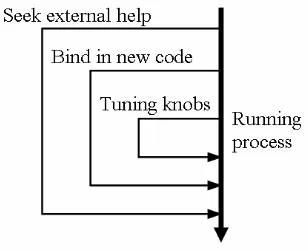
Adaptation mechanisms can be categorised according to complexity, illustrated in Figure 2.4.
Compared to simple adaptation mechanisms, complex adaptation mechanisms generally provide more
flexibility in terms of changes that can be made. However, they cause greater perturbation to the
target system and are harder to automate. The vertical arrow in Figure 2.4 represents the progress of
the target system. The loops show different adaptation mechanisms, the size of the loop indicating the
complexity. The simplest mechanism, labelled tuning knobs, uses pre-defined configurable aspects
exposed by the target system. A more complex adaptation mechanism binds new code into the target
system to change or augment behaviour, for example using structural reflection [72]. A third
mechanism seeks external help to adapt the target system, for instance requesting additional hardware
[image:34.595.249.403.336.461.2]resources or a non-trivial change to the target system’s implementation.
Figure 2.4: Mechanisms for adaptation
The adaptation mechanisms used are orthogonal to deciding how to adapt the target system’s
configuration. Each of these mechanisms can be treated in the same way, provided the set of legal
adaptations is known and there is a uniform method of invocation (e.g. sending events or calling
wrapper functions). Appendix B includes a list of issues relating to use of adaptation mechanisms.
2.7.3 Adaptation mechanisms
There are many mechanisms for adapting a target system, including those discussed below.
In-built facilities for adaptation
Many target systems have in-built configurable aspects. For example, use of the strategy pattern
25
made at run-time [46, 54]. The set of supported strategies is always predetermined if there is no
mechanism to bind in new code.
Resource allocation and process migration
A target system’s behaviour can be modified by reallocating the available resources. This includes
process migration, where the execution of a process is moved from one node to another [80]. Below
are some advantages in supporting on-the-fly resource allocation:
• Redundant resources can be exploited to balance the load across multiple nodes and to match
a task to the resource most suited to its execution (e.g. CPU intensive tasks on the fastest
node).
• Communication can be improved by co-locating processes that interact intensively and by
locating a process close to the source of its data.
• Fault resilience can be improved by replicating processes and data (i.e. redundancy) and by
migrating processes from nodes that are suspected to have experienced partial failure.
• Mobile users can utilise resources in the local proximity.
Late binding and reflection
The capability to modify a target system’s implementation, or the meaning of that implementation,
allows the target system’s functionality and behaviour to be changed. Binding new code into the
target system at run-time (i.e. late binding) allows policy decisions to be made at run-time, and the set
of supported implementations to be extended dynamically. Several techniques are discussed below.
Dynamically Linked Libraries (DLLs) are bound to a target system at load-time, rather than at
compilation time. A target system’s behaviour depends on the functions used in the shared library:
loading a new DLL can change the target system’s behaviour. This technique is comparable to the
Java mechanism of using a ClassLoader [85]. Balzer and Goldman’s mediating connectors provide a
mechanism to intercept calls to shared libraries [26]. Their mediators are wrappers that change the
behaviour of the wrapped libraries on-the-fly by changing or augmenting calls to the libraries’ APIs.
These changes are transparent to the target system.
The behaviour of programs may be changed using a combination of first-class procedures, L-value
26
assign a procedure to a variable and call the procedure using the variable’s name. Subsequent
assignment to this variable replaces the procedure and thus adapts the behaviour of the procedure
calls. Using a persistent store as a repository for the running program allows its behaviour to be
modified by changing the contents of locations containing its procedures.
Reification and reflection provide the capability for a target system to observe and adapt its own
behaviour in the course of its evaluation; they provide a means of achieving openness and flexibility.
Reification involves making explicit a representation of an aspect of the run-time system, and making
this representation accessible to the program itself. Two categories of reflection are structural
reflection and behavioural reflection.
Run-time structural reflection, also called linguistic reflection [71], is the ability of a running
program to generate new source code, compile it using a dynamically callable compiler, and link it
into the program’s own execution. Behavioural reflection allows a program to adapt its own meaning
by manipulating its evaluator. The meta-object protocol [67] provides access to the evaluator by
defining meta-objects that control aspects of a program’s behaviour, such as method invocation and
object creation. Changes to the meta-objects cause changes in related aspects of the program’s
behaviour.
Dynamic software architectures
Component-based Software Engineering (CBSE) is concerned with developing components,
building systems from these components, and evolving the system by replacing and customising
components [100]. Building systems from components is not new: Parnas introduced the ideas of
modules and abstract interfaces decades ago [89]. However, there is a drive to formalise the process
and methodology for building and evolving component-based systems.
The architecture of some target systems permits the addition, replication, removal and replacement
of components and connectors. Some Architecture Description Languages, such as π-SPACE [33],
can describe the mobility of links between processes, and can thus describe possible adaptations to the
target system’s architecture. An architecture description maintained at run-time can form the basis for
27 2.8 Design Of Experiments (DOE)
2.8.1 Theory
“To call in the statistician after the experiment is done may be no more than
asking him to perform a postmortem examination: he may be able to say what
the experiment died of.”
Sir Ronald Fisher, Indian Statistical Congress, Sankhya, ca 1938
An experiment design is a description of the set of combinations to test and the number of
replications for each. Some search strategies, such as Taguchi Methods (see section 4.3), use a
structured statistical approach for the Design Of Experiments (DOE) [107] and analysis of results.
The aim of DOE is to determine the maximum amount of information about a target system with the
minimum of effort. The approach studies simultaneously the effects of multiple factors on the
response variable (i.e. on the target system’s quality), to infer the effect of each factor and of selected
interactions, and to estimate the confidence in the results. An effect is said to be significant at the 5%
level if there is 95% confidence that the effect on the response variable is non-zero4.
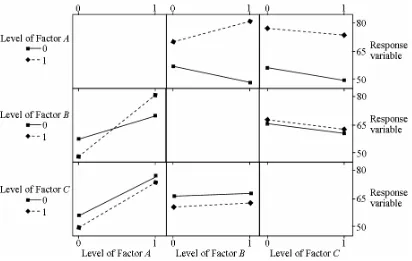
A main effect is defined as the effect on a target system’s behaviour caused by a single factor
being varied. An interaction effect between factors is defined as the degree to which the factors’
effects depend on one another’s levels. An interaction effect between two factors is called a
two-factor interaction effect. See sections 4.3.3.1 and 4.3.3.2 for a more detailed discussion of main and
interaction effects.
A full factorial design experiment tests all possible combinations, allowing the effects of every
factor and every interaction to be inferred. Such experiments are often prohibitively expensive, in
terms of time and cost, due to the large number of combinations. Approaches to reduce the size of the
experiment include:
• decreasing the number of factors to vary;
4 The 5% level is commonly used in statistics as an acceptable probability of incorrectly concluding
28
• decreasing the number of levels to test for each factor;
• using a fractional factorial design, where only some of the possible configurations are tested
(given a list of factors and a list of levels for each, without ignoring entire factors or levels in
the list).
The first approach assumes that not all factors are important in all situations – often a necessary
assumption when there are hundreds of possible factors. Deducing which are important requires either
time to determine this experimentally or expert knowledge. The second and third approaches assume
that the experimenter can infer from results the effects of factors and interactions, allowing
predictions for untested configurations.
One technique, described in [64], is to run the experiment in two phases. The first phase involves
identifying which factors have a significant effect on the response by using a full factorial design with
just two levels per factor (called a 2k design when there are k factors). The second phase involves
running an experiment for only the significant factors, to test more levels. However, the number of
combinations in a 2k design increases exponentially with the number of factors. Some fractional
factorial designs use fewer combinations and are therefore often preferable.
The assumption with fractional factorial designs is that the experimenter can interpolate the
response of untested combinations from the effects of factors and a selection of interactions. Such
designs obtain less information than full factorial designs as some effects cannot be estimated
independently: varying multiple factors simultaneously can prevent the experimenter from inferring
which change affected the target system’s behaviour. This is called aliasing, and the effects whose
influence cannot be separated are said to be aliased [64].
Some effects are assumed to be of no interest to the experimenter [107]. The hierarchical ordering
principle states that the more factors involved in an interaction effect, the less likely it is to be
significant: interactions involving three or more factors are seldom of interest. Similarly, the effect
heredity principle states that an interaction effect can only be significant if the effect of at least one of
29
combinations to test by deliberately aliasing effects that are assumed to be insignificant5. Taguchi
Methods provide an efficient way of designing experiments, based on these assumptions.
This thesis focuses on complex software systems with many possible combinations (i.e. many
factors and levels for each). Fractional factorial designs, in particular when using Taguchi Methods,
make the testing of such systems tractable (subject to the assumptions listed in section 4.3).
2.8.2 Related work
Fractional factorial designs, in the context of software systems, have been described in several
texts [38, 64]. Taguchi Methods have been used extensively by engineers for almost five decades to
produce such designs, but their use in comprehending and configuring software systems has been
limited: Sankar and Thampy suggested their use for performance tuning in [94] but the techniques
have not been applied.
Taguchi Methods provide an accessible approach for non-statisticians and have two key benefits
over previous work:
• They provide a standardised approach to DOE, which can be automated (e.g. by Minitab TM
[81]). This makes it simple to select combinations to test, such that the effects of each factor
and of selected interactions can be inferred from the results.
• The signal to noise ratio metric provides a mechanism to calculate the robustness of a
combination, given a set of responses from replicated trials.
Other projects that involve testing a sequence of combinations include:
• an automated tool, developed by Vetland and Woodside, for running full factorial
experiments [103];
• Courtois and Woodside’s use of multivariate adaptive regression splines to model a target
system’s behaviour [39], which requires a much larger set of combinations to produce a
model of a response surface than does Taguchi Methods (see section 4.3);
5 These assumptions have been shown to hold in other fields, such as manufacturing. Section 6.2