management process to drive successful
programmes and projects
Sapountzis, S, Harris, KA and Kagioglou, M
Title
The development of a benefits realisation management process to drive
successful programmes and projects
Authors
Sapountzis, S, Harris, KA and Kagioglou, M
Type
Conference or Workshop Item
URL
This version is available at: http://usir.salford.ac.uk/18400/
Published Date
2008
USIR is a digital collection of the research output of the University of Salford. Where copyright
permits, full text material held in the repository is made freely available online and can be read,
downloaded and copied for noncommercial private study or research purposes. Please check the
manuscript for any further copyright restrictions.
- 1 –
The development of a Benefits Realisation Management Process to
drive successful programmes and projects
Stelios Sapountzis1
Research Fellow,Health and Care Infrastructure Research and Innovation Centre (HaCIRIC), Research Institute for the Built and Human Environment (BuHu),
University of Salford, Salford, UK
Kathryn Harris
Research Assistant, HaCIRIC, University of Salford, Salford, UK
Mike Kagioglou
Professor of Process Management, University of Salford, Salford, UK
Abstract
Traditionally major capital investment programmes and projects are measured on their success in relation to cost, quality and time of delivery, and not in relation to the benefits or impact that they have delivered. Benefits Realisation is emerging as one of the methods to assist organisations to manage the whole life cycle of programmes and projects.
The Health and Care Infrastructure Research and Innovation Centre (HaCIRIC) based in the UK is undertaking a research project in Benefits Realisation aiming to develop a process/framework that will meet the demands above in conjunction with promoting continuous improvement and organisational learning. The methodology used is based on an action research approach; combining findings from a literature review and case studies within UK’s primary healthcare sector. This paper investigates the developments so far in Benefits Realisation Management and focuses on the requirements to manage change and benefits in a joint approach to deliver the necessary outputs on time, to quality and cost without failing to realise the benefits of the change. The aim of the paper is to demonstrate the need for benefits driven programme/project management and the importance of identifying the level of involvement, contribution and manage expectations of all stakeholders throughout the process.
Keywords
Benefits Realisation Management, Change Management, Programme and Project management, Stakeholders Requirements Management, Continuous improvement
1
- 2 –
1.
Introduction
The expectation from organisations such as the NHS that invest in long term projects in order to deliver complex health care infrastructure facilities, is to have maximum return on their investment that can only be justified by realising the benefits of such initiatives. However changes to policy during the life of a project mean that the final outcomes rarely match the initial vision. Organisations themselves will also change. Following project or programme completions much time and effort is spent trying to justify the investment and trying to realign the anticipated benefits. Fulfilling these is often costly and usually outdated. The delivery and realisation of the original planned benefits become the responsibility of the operational teams that usually have not been involved at any previous planning or decision making project stages.
In many large organisations and complex public interest sector programmes and projects failure to identify and achieve planned benefits through change initiatives appears to be common. In general the question is one of the difficulty of managing highly complex programmes, portfolios or projects rather than lack of performance of infrastructures. Lack of benefits management is often a root cause of programme failure, but equally damaging is poor benefits management, which attempts to manage benefits, without recognition of the contributors to success. The task is, therefore, complex, and demands a wide span of control (Bartlett 2006).
This paper identifies the issues in why major programme and projects are failing to fulfil expectations and identifies the need for a framework of proactive management of benefits realisation and change where the spotlight is continually focused on the benefit outcomes from the early conceptual stages and goes beyond project delivery.
2.
Research Methodology
The overarching research philosophy adopted for this research project is an actor based research philosophy used in the development of the Generic Design and Construction Process Protocol (Kagioglou et al 2000) and it consists of the preunderstanding – understanding hermeneutic spiral (Odman 1985), grounded in actor research philosophy (Berger & Luckmann 1966, Sandywell 1975).
The main channel of communication flows used currently for the refinement and development of a benefits realisation management process are workshops between HaCIRIC researchers and the industrial partners. Although crucial preunderstanding/understanding is transferred and developed through an ongoing dialogue both prior and between the workshops.
- 3 –
An action learning dimension (Susman and Evered 1978) is taken to enhance the research vision. Action research is an interactive approach and provides the platform where HaCIRIC’s research team and the industrial partners can agree on the issues, monitor the present situation, analyse data, identify improvements on the BRMP and subsequently reflect and evaluate upon impact that these improvements may have.
One of the deciding factors on taking that approach was the emergence through the research workshops of a BRMP user community consisting mainly of the project’s industrial partners. Workshop participation encourages industrial partner members to generatively learn as they discover how to make sense of the BRMP in terms of their own language and organisational settings (Kagioglou et al 2000). Research techniques used in this research include, pilot case study, case studies, questionnaire surveys, workshops and interviews, more descriptive details on these are included in a forthcoming accepted paper (Harris et al 2008).
2.1. Literature review
The concept of benefits realisation was conceived in the late 1980s and early 1990s A literature review is undertaken that investigates the latest developments in benefits realisation and management. Early signs indicated that the main body of literature on benefits realisation consists of practical guides and frameworks around IS/IT investments mainly in the private sector (Ward and Bond 1995, Leyton 1995, Thorp 1998, Bradley 2006, Bartlett 2006, Payne 2007). The literature review shows that benefits realisation and management has for many years been the Cinderella of the project management profession (Payne 2007), it is only in the recent times that is emerging as an important factor for successful programme and project delivery both in the private and public sector (OGC 2007, Reiss et al 2006, Ward and Daniel 2006, NHS 2004). It seemed appropriate that in order to identify key principles and to further develop the BRMP a literature review needs to be undertaken in areas that not immediately fall under the benefits realisation umbrella. Such areas include decision making and optioneering, performance management, impact assessment, value flow and generation, stakeholder requirements capture, change management and continuous improvement (Sapountzis et al 2007)
3.
Key issues to consider in the development of the BRMP
As a result of the initial literature review and several workshops with the industry partners there are some key issues emerging that form the basis for the development of the Benefits Realisation Management Process. These key issues are as follows.
3.1. Traditional Project management thinking
- 4 –
deliver a defined project to each clients within agreed timescales and fully fit for purpose. All these have tended to direct attention away from what happens to a project after it has been handed over to its clients (Payne 2007)
3.2. Programme Management, Change and Organisational Culture
Benefits management in programme management terms is defined as the process for the optimisation or maximisation of benefits from organisation change programmes while programme management is simply defined as the orchestration of organisational change (Reiss et al 2006). The practical management of benefits seems to be difficult for many programmes, and may be due to the lack of understanding of the contributors to benefits achievement and the techniques
available to manage benefits (Bartlett 2006). The impact of change should be
monitored throughout programmes and projects development and mechanisms should be in place ready to adverse any negative impact implications (Sapountzis et al 2007). Benefits are achieved during the life of a programme, as completing projects are decommissioned and new ones commissioned. In a project, benefits only usually accrue once the project has completed, and after the project team has been disbanded, few organisations seriously put into practice a benefits management regime. A programme however is an ideal vehicle for monitoring the achievement of benefits (Reiss 2006)
Many of the things which can go wrong in a programme in terms of benefits are to do with expectations management; this is a common source of programme risk. A key hindrance to the achievement of benefits is organizational culture. The culture of a company and its existing business base are powerful influences for or against the successful achievement of benefits. Culture is a particular challenge, especially since it is unusual for company culture to be taken into consideration when deciding the potential benefits at programme inception. Benefits are, therefore, often assumed to be achievable in spite of a particular c.ompany culture. More commonly benefits are victims of programme longevity, and their perception changes within the business. This is very much the result of inadequate expectations management. (Bartlett 2006).
3.3. Complexity and management blind spots
- 5 –
dimensions. There must also be recognition that the other three dimensions will change themselves over time.
3.4. Level of involvement, contribution and expectations management of all stakeholders throughout the process
Achieving successful change is much easier if all stakeholders are committed and the earlier this commitment is accomplished, the smother the path to a successful outcome (Bradley 2006). In order to engage and involve stakeholders you first need to identify them. At the early stages of a programme, project or a change process the stakeholder population maybe a little fluid. The process therefore of identifying them needs to be iterative. To ensure that all stakeholders become committed it is important to engage them effectively, throughout the complete change lifecycle.
The concept of managing benefits in order to ensure their delivery is usually new within a sector or organisation. The various stakeholders will need educating in how benefits are to be identified, modelled and subsequently delivered (Reiss 2006). It would be risky to assume that all stakeholders will understand the implications of benefits identification and planning. Kagioglou et al (2000) highlights that project success relies on the right people having the right information at the right time stating that the active involvement of all participants, especially in the early phase of a project, may subsequently help to foster a team environment and encourage appropriate communication and decision making.
Summarising on the key issues above and taking into account findings of a previous paper (Sapountzis et al 2007) the key principles of BRMP should be; its appropriateness for those who operate it and those that use the information produced; The way its assessment of all relevant aspects is balanced, including those that are hard to quantify; How robust it is to withstand change; the careful integration into business planning; Cost effective by producing performance information that realises benefits in proportion to the investment required to collect it; Simple to Implement.
4.
Benefits Realisation Management Process introduction and final
thoughts
It is important to understand that over the course of a benefits management lifecycle, organisations and government policy drivers especially within a healthcare setting are highly likely to change and this will impact upon agreed benefits. It is essential to have a robust process in place that will accommodate and react to change. The key for successful implementation of Benefits realisation is its integration within the organisation’s strategy and culture and taking into account external factors. Programmes and projects should be benefit driven if they are to be considered as successful. The essence of benefits realisation is “not to make good forecasts but to make them come true ...” (Ward et al. 1995)
- 6 –
appraisal approach and focus on the active planning of how benefits will be realised and measured (Glynne, 2006).
The BRMP, briefly introduced in this paper aims to accommodate the issues and concerns raised above and at its current development phase consists of five main stages. These stages are:
• Benefits Strategy
• Benefits Profile
• High Level Benefits Map
• Benefits Realisation Plan
• Evaluation and Review of Change and Benefits
The whole process is overarched by the continuous improvement principle resulting into a continuum of benefits realisation and organisational learning.
An illustration on how the BRMP is aligned within HaCIRIC with traditional development approaches is given in fig 2.
Fig 1: Benefits Realisation Management Process alignment with investment
processes (Sapountzis et al 2007)
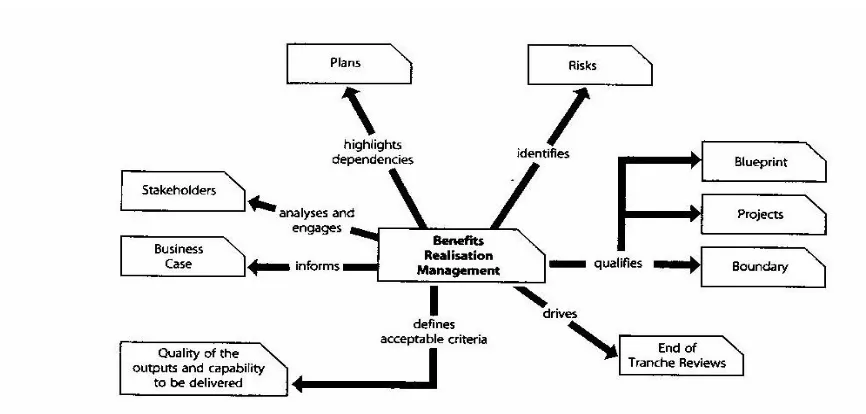
OGC (MSP 2007) agrees that best practice programme management aligns everything towards satisfying strategic objectives by realising the end benefits. The ultimate success of a programme should be judged by its ability to realise these benefits and the continuing relevance of these benefits to the strategic context. As illustrated in fig. 2 benefits realisation lies in the heart of a programme’s control. Benefits realisation is a continuous process of envisioning results, implementing, checking intermediate results and dynamically adjusting the path leading from investment to results (Thorp 1998). Benefits Realisation is not just a process that can and must be managed just like any other business process but should be the driving force behind any business justification decision.
Define business need Prepare business case Define procurem ent Invite, evaluate and Manage implementa tion Manage and operate GATE 1 Business Justification GATE 2 Procuremen t GATE 3 Investment Decision GATE 4 Readiness for Service GATE 5 Benefits Evaluation GATE 0 Strategic Assessment Te c h n ica l , han do ve r an d t Strategic context (Strategic outline case) Outline business case Full Business Case De sig n Ten der and Con trac t Post-project evaluation C onst ru c ti on OGC Gateway
CIM / DoH
Traditional PFI BRMP HaCIRIC Benefits Profile Benefits Strategy High level benefits map
Benefits Realisation Plan
Evaluation / Reviews Change &
- 7 –
[image:8.595.70.503.88.295.2]
Fig 2: Benefits realisation management as the key driver (OGC / MSP 2007)
Typically expected benefits are summarised within a business case, which is one of the key project initiating documents of any programme. Within the business case the general objectives of the programme will need to be expressed, as far as possible, in terms of specific benefit expectation or targets (Reiss et al 2006). The authors view is that a business case should not be static document but in contrast a live document throughout the life of a programme; it should evolve overtime as new understanding and insight is gained into the issues affecting the programme. Therefore the business case needs to be reviewed and adjusted in the light of changing circumstances. It is often that programmes and projects are initiated before an attempt is made to define their benefits, which is usually left until business case is first needed for a project stage approval (Payne 2007).
- 8 –
5.
References
Bartlett, J. (2006), “Managing programmes of business change” (4th Edition),
Project Manager Today, Hampshire, UK
Berger, P.L. and Luckemann, T. (1966), “The Social Construction of Reality”, Doubleday, Garden City, NY
Bradley, G. (2006), “Benefit Realisation Management – A Practical guide to achieving benefits through change”, Gower, Hampshire, UK
Farbey, B., Land, F. and Targett, D. (1999) The moving staircase – problems of appraisal and evaluation in a turbulent environment, in Information Technology
and People Journal, Vol. 12, No 3, pp. 238-252
Glynne, P. (2006) Benefits management-changing the focus of delivery, Association
for Progress Management Yearbook 2006/07, pp.45-49
Harris, K. A, Sapountzis, S., and Kagioglou, M. (2008) “The methodological development of a Benefits Realisation Management Process (BRMP) in the case of Manchester, Salford and Trafford (MaST) Local Improvement Finance Trust (LIFT)”,BuHu International Postgraduate Research Conference, June 26 -27 Prague. (Accepted)
Kagioglou, M., Cooper, R., Aouad, G. and Sexton, M. (2000) Rethinking Construction: the Generic Design and Construction Process Protocol in:
Engineering, Construction and Architectural Management Journal, Vol.7 No 2,
pp 141-153
Leyton, R. (1995) “Investment appraisal: the key for IT? In Farbey, B., Land, F.F. and Target, D., Hard Money, Soft Outcomes, Alfred Waller Ltd, in association with Unicom, Henley on Thames.
Odman, P. (1985), Hermeneutics. In: The International Encyclopaedia of Education (eds T. Husen and N.T. Postlethwaite), pp 2162-2169. Pergamon, Oxford, UK Office of Government and Commerce (OGC), (2007): STDK Home, Delivery
Lifecycle: Benefits Management, http://www.ogc.gov.uk/sdtoolkit/reference/ deliverylifecycle/benefits_mgmt.html#benmanagement1
Payne, M. (2007), “Benefits Management – Releasing project value into the business”, Project Manager Today, Hampshire, UK
Reiss, G., Anthony, M., Chapman, J., Leigh, G., Pyne, A., Rayner, P. (2006) Gower
Handbook of programme management, Gower Publishing ISBN 056608603
Sapountzis, S., Harris, K. and Kagioglou, M. (2007) “Benefits Realisation Process
for Healthcare”, 4th International Research Symposium (SCRI) March 26-27,
2007, 359 – 371.
Susman, G. I. and Evered R. D. (1978) An assessment of the scientific merits of action research. Administrative Science Quarterly Vol. 23, pp582 - 603
Thorp, J. (1998), “The Information Paradox – Realising the business benefits of information technology”, McGraw-Hill, Canada, ISBN 0071342656
Ward, J., and Daniel, E. (2006) “Benefits Management – Delivering Value from IS & IT Investments, Wiley, West Sussex UK, ISBN 10047009463