Unsupervised Topic Modeling for Short Texts Using Distributed
Representations of Words
Vivek Kumar Rangarajan Sridhar∗ AT&T Labs
1 AT&T Way, Bedminster, NJ 07920
Abstract
We present an unsupervised topic model for short texts that performs soft clustering over distributed representations of words. We model the low-dimensional seman-tic vector space represented by the dense distributed representations of words using Gaussian mixture models (GMMs) whose
components capture the notion of latent
topics. While conventional topic model-ing schemes such as probabilistic latent se-mantic analysis (pLSA) and latent Dirich-let allocation (LDA) need aggregation of short messages to avoid data sparsity in short documents, our framework works on large amounts of raw short texts (billions of words). In contrast with other topic modeling frameworks that use word co-occurrence statistics, our framework uses a vector space model that overcomes the issue of sparse word co-occurrence pat-terns. We demonstrate that our framework outperforms LDA on short texts through both subjective and objective evaluation. We also show the utility of our framework in learning topics and classifying short texts on Twitter data for English, Spanish, French, Portuguese and Russian.
1 Introduction
A popular way to infer semantics in an un-supervised manner is to model a document as
a mixture of latent topics. Several schemes
such as latent semantic analysis (Deerwester et al., 1990), probabilistic latent semantic analysis (pLSA) (Hofmann, 1999) and latent Dirichlet al-location (LDA) (Blei et al., 2003) have been used to good success in inferring the high level mean-ing of documents through a set of representative words (topics). However, the notion of a docu-ment has changed immensely over the last decade.
∗The author is currently with Apple, Inc., and can be
contacted at [email protected].
Users have embraced new communication and in-formation medium such as short messaging ser-vice (SMS), chats, Twitter, Facebook posts, Insta-gram and user comments on news pages/blogs in place of emails and conventional news websites. Document sizes have been reduced from a few
hundred words to few hundred characters1 while
the amount of data has increased exponentially. Conventional topic models such as pLSA and LDA learn latent topics in a corpus by exploit-ing document-level word co-ocurrences. Hence, these models typically suffer from data sparsity (estimating reliable word co-occurrence statistics) when applied to short documents. A popular strategy to overcome this bottleneck is to aggre-gate short texts into longer documents based on user information, title category, etc. (Weng et al., 2010; Hong and Davison, 2010). However, these schemes are heuristic and highly dependent on the data. Furthermore, such metadata may not be available for short texts such as news titles, adver-tisements or image captions.
In this work, we present an unsupervised topic model that uses soft clustering over distributed representations of words. The distributed word representations are obtained by using a log-linear model and we model the low-dimensional seman-tic vector space represented by the dense word vectors using Gaussian mixture models (GMMs).
TheKcomponents of the Gaussian mixture model
can be considered as the latent topics that are cap-tured by the model. Unlike long documents, these short messages do not have long distance syntactic or semantic dependencies and we find that the dis-tributed representations learned over limited con-text windows is sufficient in capturing the dis-tributional similarity of words within a message. In comparison with previous approaches to topic modeling, we completely ignore the distribution over documents and consider the entire corpus, thereby eliminating the need for aggregation over short messages. The framework presented here is
1Twitter currently imposes a limit of 140 characters for
each message
unsupervised, language agnostic and scalable.
2 Related Work
In thetf-idf scheme (Salton and McGill, 1986), a
collection of documents is represented as aV×D
matrix where the rows denote the terms (words)
and the columns containtf-idf values for the
cho-sen terms (words). However, the approach re-veals little about the underlying semantic struc-ture of the documents. Latent semantic analysis (LSA) (Deerwester et al., 1990) addressed the
lim-itations of thetf-idf scheme by performing
singu-lar value decomposition (SVD) on theV×D
ma-trix. The LSA features are linear combinations of
thetf-idf features in a lower dimensional subspace
and can capture linguistic notions such as poly-semy and synonymy.
Probabilistic latent semantic analysis
(pLSA) (Hofmann, 1999) improved on LSA by modeling each word as a sample from a mixture model, the components of which are multinomial random variables (topics). One of the main drawbacks of pLSA is that the topic distributions are learned for particular documents seen in training and consequently, the model is difficult to use on unseen documents. Moreover, the model size grows linearly with the size of the corpus and hence is prone to overfitting. Latent Dirichlet allocation (LDA) (Blei et al., 2003) is a generative model that overcomes some of the limitations of pLSI by using a Dirichlet prior on the topic distribution. The model can hence be used on unseen data and the parameters of the model do not grow with the size of training corpus.
LSA, pLSA and LDA have all been convention-ally used on collection of documents that are typ-ically at least a few hundred words. With the re-cent popularity of communication media such as SMS, Twitter, Facebook, Instagram, etc., many ef-forts (Weng et al., 2010; Hong and Davison, 2010) have addressed the application of topic models to short texts. (Weng et al., 2010) addressed the prob-lem of identifying influential users on Twitter us-ing a modified PageRank algorithm. They used LDA for inducing topics on user aggregated mes-sages, i.e., a document is a collection of tweets from a single user. The work in (Hong and Davi-son, 2010) also experimented with different aggre-gation strategies to apply LDA for inducing top-ics. In (Ramage et al., 2010), a supervised version
of LDA was used to model individual messages. However, such a scheme is not completely unsu-pervised and hence not desirable for large amounts of data than can span extremely large number of topics (billions of tweets, Facebook posts, image captions, etc.).
In contrast with previous approaches that have either modified LDA or the input to LDA (by ag-gregating short messages), our approach works on the entire corpus (e.g., billions of tweets or SMS messages) without any aggregation strategy and is completely unsupervised. We learn dis-tributed representations of words over sufficiently long context windows and subsequently use Gaus-sian mixture models to parameterize the vector space represented by the distributed representa-tions. Our framework is inspired by use of bot-tleneck features obtained from neural networks in hidden Markov model (HMM) based speech recognition (Grezl and Fousek, 2008). We can po-tentially use all the optimization and paralleliza-tion techniques used in HMM-based speech recog-nition to scale to large text data sets. The clos-est approach to that proposed in this work is the biterm topic model (BTM) (Yan et al., 2013) that learns topics over an entire corpus of short texts by directly modeling unordered word-pair co-occurrences (biterms) over the corpus. In our approach, the distributed representations capture longer word contexts, i.e., each word is projected into a vector that represents similarity between words within the contextual window. Hence, our approach can potentially capture context be-yond unordered word-pair co-occurrences. Fur-thermore, since we use dense vectors to repre-sent terms, our approach does not suffer from data sparsity issues typically encountered in co-occurrence statistics based topic models.
3 Distributed Word Representations
Distributed representation of words (also called word embeddings or continuous space representa-tion of words) has become a popular way for cap-turing distributional similarity (lexical, semantic or even syntactic) between words. The basic idea
is to represent each word in vocabularyV with a
real-valued vector of some fixed dimensionD, i.e.,
wi ∈ RD ∀ i = 1,· · ·, V. The idea of
wt 2
wt 1
wt+1
wt+2
wt
Lookup Table d
d*5 (concatenation)
Linear
Tanh
Linear
former south african president nelson_mandela passed away r.i.p legend
Continuous Bag-of-Words Model Deep Learning Model
south passed
away
Projection
f✓(s) f✓(sc)
Loss = max(0,1 f✓(s) +f✓(sc))
Lookup Table d
d*5 (concatenation)
Linear
Tanh
Linear
former
nelson_mandela
african president r.i.p legend
former south african president goal passed away r.i.p legend
(a) Continuous Bag-of-Words Architecture
Lookup Table D
D*9 (concatenation)
Linear
Tanh
Linear
former south african president nelson_mandela passed away r.i.p legend
f✓(s) f✓(sc)
Loss = max(0,1 f✓(s) +f✓(sc))
Lookup Table D
D*9 (concatenation)
Linear
Tanh
Linear
former south african president goal passed away r.i.p legend
[image:3.612.110.507.68.280.2](b) Deep Neural Network Architecture
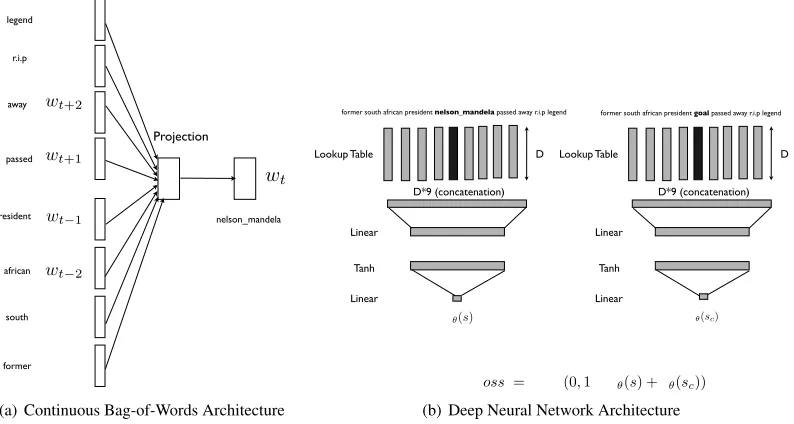
Figure 1: Illustration of obtaining distributed representations of words using two different approaches.
An entire tweet can be captured with sufficient context. For Figure 1(b),θdenotes the parameters of the
neural network whilesandscdenote the correct and corrupt windows, respectively.
in the recent past have made it possible to obtain such representations for large vocabularies.
Distributed representations can be induced for a
given vocabularyV in several ways. While they
are typically induced in the context of a deep neu-ral network framework for a given task (Bengio et al., 2003; Collobert and Weston, 2008; Bengio et al., 2009; Turian et al., 2010; Mikolov et al., 2010), recent work in (Mikolov et al., 2013) has also shown that they can also be induced by using simple log-linear models.
Figure 1 shows two different architectures for inducing distributed representations. On the left side, the architecture for the “continuous bag-of-words” model (Mikolov et al., 2013) is shown while the deep learning architecture for induc-ing distributed representations in language mod-els (Collobert and Weston, 2008) is shown on the right. Both these frameworks essentially perform a similar function in that the word representations are created based on contextual similarity. Since, the average sentence length for text media such as Twitter messages, SMS messages, Facebook posts, etc., is between 12-16 words, inducing dis-tributed representations over similar length win-dows can capture the semantic similarity between the words in a message. In the next section, we demonstrate how this property can be exploited to perform topic modeling for short messages.
4 Gaussian Mixture Topic Model
We use a log-linear model for inducing the distributed representations using the continuous-bag-of-words architecture proposed in (Mikolov
et al., 2013). The continuous-bag-of-words
model is similar to the neural network language model (Bengio et al., 2003) with the non-linear layer replaced by a sum pooling layer, i.e., the model uses a bag of surrounding words to pre-dict the center word. Since the implementation of this architecture was readily available through
the word2vec tool2, we used it for inducing the
representations. We used hierarchical sampling for reducing the vocabulary during training and used a minimum count of 5 occurrences for each word. One can also use a deep neural network ap-proach (Collobert and Weston, 2008) for inducing the representations. However, the training of these networks is extremely time consuming and we de-cided to use the simple log-linear model in this work. The framework presented here can work with distributed representations obtained with any methodology (latent semantic indexing, log-linear models, feedforward neural networks, convolu-tional neural networks, recurrent neural networks, etc.).
We use the continuous-bag-of-words
−1.5 −1 −0.5 0 0.5 1 1.5 −2
−1.5 −1 −0.5 0 0.5 1
automobile chrysler mercedes;benz
autozone engine tire
dashboard oil
diesel silencer politics
democrats republicansobama
health taxes
guns foreign ukraine
congress
mandela
nelson madiba
africa apartheid
rights
violation president
pistorius
condolence
loss
pregnancy enfamil twins expecting
stroller kids
ache hormone
[image:4.612.159.453.65.229.2]medicine pacifier
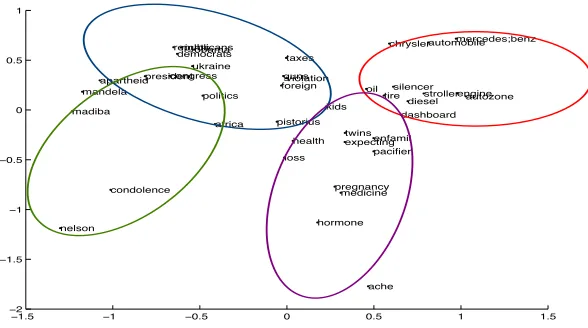
Figure 2: Illustration of fitting a Gaussian mixture model to distributed representations. The dimension of the distributed representations was reduced from 100 to 2 using principal component analysis and 4 GMM components were used.
model (Mikolov et al., 2013) to process all
windows of lengthwlen in a corpus and output
a D-dimensional vector di for each word wi
in the vocabulary V. wlen in our work is an
odd number, i.e.,wlen = 11 implies a left and
right context of 5 words. Once we obtain the
set of word embeddings wi 7→ di, ∀i ∈ V,
we use a Gaussian mixture model (GMM) to learn a parametric model for the distributed representations. Our idea is inspired from the use of bottleneck features obtained using neural networks for training HMM-based speech recog-nition systems (Grezl and Fousek, 2008). Our conjecture is that the Gaussian mixture model can learn the latent topics by clustering over the distributed representations that are already trained with a semantic similarity objective (positional and contextual similarity). The distributed
repre-sentations for the vocabularyV can be represented
as anV ×D matrix where each row represents
a word wi in the vocabulary. If we choose to
model this data with K Gaussian components,
we need to estimate µk,Σk, p(k|wi)∀k ∈ K,
wi ∈ V, namely the means, covariances and
mixture weights. We denote the parameters for
thekthcomponent byθ
k. We can use the standard
Expectation-Maximization (EM) algorithm for Gaussian mixture models to estimate the
param-eters3 (Hastie et al., 2001). The EM algorithm
was initialized withk-means clustering. We use
diagonal covariance matrix approximation in this
3The computation can be parallelized by chunking the
V×Dmatrix, computing sufficient statistics over the chunks
and finally accumulating the statistics.
work, i.e.,Σk,∀k∈Kare diagonal.
Given a new sentences0 ={w0
1,· · ·, w0N}, we
can perform decoding in the following way to
as-sign the sentence to a particular topickor a
col-lection of topics since one can obtain the posterior distribution over the topics for each sentence.
k∗= arg max
θk
p(k|w0
1,· · ·, wN0 ) (1)
= arg max
θk
p(w0
1,· · ·, w0N|k)p(k) (2)
k∗= arg max
θk
p(k)
N Y
i=1 p(w0
i|k) (3)
where p(k) and p(w0
i|k) are obtained from the
Gaussian mixture model. The notion of latent
top-ics in this model is represented by theK
compo-nents of the GMM. Figure 2 shows an example of fitting a GMM to distributed representation of words.
The key difference between our approach and previous approaches to topic modeling is that we start with a dense vector representation for each word in place of a multinomial distribution that is typically learned as part of the topic modeling framework. Second, we do not use the notion of a document since the distributed representations are learned over windows over the entire corpus.
5 Data
Language
en es fr pt ru
Corpus #voc #sents #voc #sents #voc #sents #voc #sents #voc #sents
[image:5.612.108.507.66.104.2]Twitter 8371078 178770137 5820863 74784082 1697619 14383118 1816744 22031792 2410668 16025128
Table 1: Statistics of the data used to induce distributed representation in each language. en: English,
es: Spanish,fr: French,pt: Portuguese. #voc stands for the vocabulary and #sents denotes number of
sentences.
user profile, the language code does not guarantee that all tweets are in the same language. We used a simple frequency threshold for language iden-tification based on language specific word lists
obtained from Wikitionary4. Subsequently, we
performed some basic clean-up such as replacing usernames, hashtags, web addresses and numerals
with generic symbols such as user , hashtags ,
url and number. Finally, we removed all
punc-tuations from the strings and lowercased the text. In this work, we perform our experiments on En-glish, Spanish, French, Portuguese and Russian.
We also formed a stop word list to eliminate ex-tremely common as well as rare words from our topic models. For English, the stop word list com-prised of words with frequency greater than 5 mil-lion or less than 5 in the training data. For Spanish, French, Portuguese and Russian, the stop list com-prised of words with frequency greater than 25000 or less than 5 in the respective training data.
6 Experiments
First, we randomly replaced low frequency words (less than 4 occurrences) with an UNK token to keep the vocabulary open and subsequently used the stop word list to filter the training data. Distributed representations using the continuous-bag-of-words log-linear model was used to obtain
wi 7→ di,∀i ∈ V in each language. We
exper-imented with different dimensions of distributed representations as well as mixture components. Figure 3 shows some topics learned by the model and the terms that comprise the topics for a model
learned withD=100 andK=200 on English
Twit-ter data. The Twit-terms are ranked by probability. Unsupervised topic modeling schemes are in-herently difficult to evaluate quantitatively. Per-plexity of trained models on a held-out set is typically used to objectively evaluate topic mod-els (Blei et al., 2003). However, our scheme does not model the generation process of short text doc-uments. Hence, we use a variety of subjective and
4http://en.wiktionary.org/wiki/Wiktionary:Frequency lists
objective topic coherence measures to evaluate our framework. We also present a comparison with a state-of-the-art technique for modeling short texts, namely, biterm topic model (BTM) (Yan et al., 2013).
We perform unsupervised topic modeling ex-periments on the phrasified English Twitter cor-pus using three schemes. We use LDA as a base-line and treat each tweet as an independent doc-ument without any aggregation. We also use the BTM topic model that has been proven to be a suitable fit for short texts. For LDA, we used the
open-source implementation GibbsLDA++5 and
for BTM, we used the implementation associated
with (Yan et al., 2013).6. All three schemes used
identical data. We set the parameters α = 0.05
andβ= 0.01for LDA andα= 50K andβ= 0.01
for BTM. The parameters for LDA and BTM were optimized on held-out set with line search using topic coherence metric described in Eq 4. We performed training using our framework for vary-ing window lengths (wlen), vector space dimen-sion (D) and number of clusters (K). Specifically, we trained GMMs with the following parameters,
wlen = {11,13,15,17}, D = {50,100} and
K={50,100,200}.
First, we manually inspected the topics ob-tained by our unsupervised distributed representa-tion framework. A sample of the topics is shown in Figure 3. Manual inspection of many of the topic clusters (top ranked words in each cluster)
indi-cated promising results7. As a subsequent step,
we asked three professional speech transcribers (also NLP annotators) to subjectively rate the util-ity of each topic (by displaying the top 50 words)
on a 1-3 Likert scale. A rating of1indicates
com-pletely useless topic cluster while3indicates
use-ful topic cluster.Usefulwas defined as a collection
5http://gibbslda.sourceforge.net
6http://code.google.com/p/btm/
7The topic clusters for all languages can be obtained
from https://github.com/annontopicmodel/
unsupervised_topic_modeling/. We are not able
c7 c113 c1 c3 c66 epictectus
confucius sophocles aristotle yiddish euripides machiavelli #ultimatequotes proverb #bookbuzzr rumi voltaire #proverb
#wednesdaywisdom
dexter portlandia mulan jarhead starwars misfits twilight supernatural prometheus avengers #thisistheend jumpstreet simpsons sopranos
❄️ 40°
❄
#fwinter #freezing degrees #ihatewinter blustery #winterishere brrrrr #bundleup #socold #hatewinter #toocold
#nj #ottawa #yyc #melbourne #toronto #indy #vancouver #seattle #california #colorado #austin #philadelphia #greenwich #travelpics
[image:6.612.117.500.73.234.2]conservatives politicians constitution mandate alp progressives gop government liberal lnp tories bho propaganda repubs
Figure 3: Terms with the highest probability for sample latent topics over the entire English Twitter
corpus. The topics were obtained by usingwlen= 15,D=100 andK=200.
Context K Fleiss’κ Mean rating Median rating
50 0.89 2.2±0.78 2
wlen= 11 100 0.81 2.11±0.79 2
200 0.82 2.15±0.85 2
50 0.70 2.24±0.77 2
wlen= 15 100 0.80 2.17±0.88 2.5
200 0.78 2.11±0.89 2.5
50 0.79 2.18±0.82 2
wlen= 17 100 0.68 2.3±0.89 3
200 0.54 2.18±0.87 2
LDA 100 0.80 1.97±1.01 2
BTM 100 0.78 1.84±1.15 2
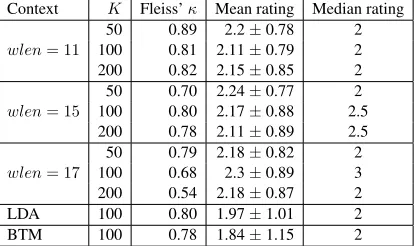
Table 2: Subjective evaluation of topic coherence across three annotators (D= 50)
of terms that indicated some meaningful semantic property (e.g., movie names, politics, headlines, superlatives, sad emoticons/words, etc.) that could be used for a categorization task. In cases of am-biguity, we asked the labelers to confer a rating of 2.
We computed the inter annotator agreement be-tween the three labelers using Fleiss’ kappa met-ric (Fleiss, 1971). The results are presented in Ta-ble 2. The inter-annotator agreement is quite high for the topic clusters induced with context
win-dowswlenof 11 and 15 words. The agreement is
lower for model trained with longer context win-dow perhaps indicating that a winwin-dow of length 11 or 15 words is sufficient for tweets. The mean
ratings are mostly higher than2and the median
rating forwlen = 15, K = {50,100}are above
2. The subjective ratings are significantly better than LDA and BTM. Hence, subjective evaluation of topics learned using our framework are of con-sistently high quality.
In order to objectively measure the quality of
topics, we also used coherence score(Mimno et
al., 2011). Given a topic z and a set of top
N words (ranked by likelihood) in z, Sz =
{wz
1,· · ·, wNz}, the coherence score is defined as:
C(z;Sz) =XN
n=2
n−1
X
l=1
logD(wzn, wzl) + 1
D(wz
l) (4)
whereD(w) is the document frequency of word
wandD(w0, w)is the co-document frequency of
wordsw andw0. The coherence score was then
averaged across all topics to obtain the mean co-herence score for each scheme, i.e., we computed
1
KPKk=1C(zk;Szk). A high coherence score
in-dicates a good topic cluster. Figure 4 shows the
average topic coherence score over topN words
across varying wlen by fixing D = 50 and
K = 50. The topic clusters are more coherent
forwlen= 11at lower values ofNbut for higher
values ofN, the model withwlen= 13performs
[image:6.612.204.411.276.399.2]clusters have a large number of terms with high likelihoods. As a result, it is more appropriate to choose a model with high topic coherence for large
values ofN.
-12000
-10000
-8000
-6000
-4000
-2000
0
20 40 60 80 100 120 140 160 180 200
Topic Coherence Score
Top N words ranked by p(w|k) Topic Coherence for top N words using our approach
[image:7.612.316.513.67.209.2]wlen=11,K=50 wlen=13,K=50 wlen=15,K=50 wlen=17,K=50
Figure 4: Topic coherence versus topN words in
each topic for different values ofwlen
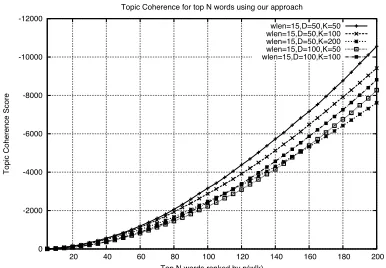
Next, we analyze the effect of dimension of the vector space model on the topic modeling frame-work. Figure 5 plots the average topic coherence
for varying D. We find that for D = 100, the
model with lowerK achieves better topic
coher-ence. In contrast, forD = 50, the model with
K = 200 is objectively better than the models
withK={50,100}. In the former case, the
num-ber of topics is smaller and hence a higher dimen-sion is separating the vectors in a better fashion while in the latter case, the increased number of topics achieves better separation even with smaller dimension vectors. One can balance the choice of
K and D based on the size of data and desired
clusters to be learned.
-12000
-10000
-8000
-6000
-4000
-2000
0
20 40 60 80 100 120 140 160 180 200
Topic Coherence Score
Top N words ranked by p(w|k) Topic Coherence for top N words using our approach
[image:7.612.101.294.128.260.2]wlen=15,D=50,K=50 wlen=15,D=50,K=100 wlen=15,D=50,K=200 wlen=15,D=100,K=50 wlen=15,D=100,K=100
Figure 5: Topic coherence versus topN words in
each topic for different values ofD
In Figure 6, we plot the topic coherence score for different cluster sizes. The plot shows that for
a givenN, the best coherence score is obtained for
-12000
-10000
-8000
-6000
-4000
-2000
0
20 40 60 80 100 120 140 160 180 200
Topic Coherence Score
Top N words ranked by p(w|k) Topic Coherence for top N words using our approach wlen=11,D=50,K=50
wlen=11,D=50,K=100 wlen=11,D=50,K=200 wlen=15,D=50,K=50 wlen=15,D=50,K=100 wlen=15,D=50,K=200 wlen=17,D=50,K=50 wlen=17,D=50,K=100 wlen=17,D=50,K=200
Figure 6: Topic coherence versus topN words in
each topic for different values ofK
wlen = 15, D = 50, K = 200. In general for a
large dataset with millions of tweets,K= 200
re-sults in better clustering since there are many
top-ics in the data. The model with wlen = 15is
interesting since the context window is about the same as the average length of a tweet. The topic
coherence scores for D = 100, K = 200were
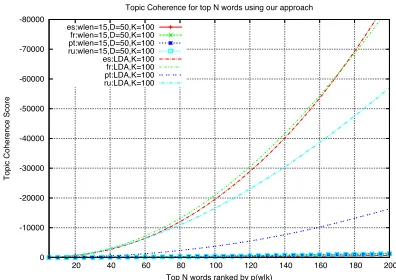
consistently lower than that of the above presented results. It may again be due to the balance needed in the separation of topics due to vector space di-mension versus the total number of GMM compo-nents. Finally, Figure 7 plots the topic coherence score for our approach, BTM and LDA. The re-sults clearly indicate that our framework performs extremely well on short texts. While previous re-sults using the BTM approach was only performed on a few million tweets, our experiments are per-formed on 178M tweets for English. The perfor-mance of LDA and BTM are very similar while our approach achieves significantly higher topic coherence scores. Finally, Figure 8 shows the topic coherence for Spanish, French, Portuguese and Russian. Our proposed scheme clearly out-performs LDA on large collections of short texts across languages.
7 Discussion
[image:7.612.102.295.500.634.2]-100000
-80000
-60000
-40000
-20000
0
20 40 60 80 100 120 140 160 180 200
Topic Coherence Score
Top N words ranked by p(w|k) Topic Coherence for top N words using our approach
[image:8.612.101.298.68.208.2]wlen=15,D=50,K=50 wlen=15,D=50,K=100 LDA,K=50 LDA,K=100 BTM,K=50 BTM,K=100
Figure 7: Topic coherence versus topN words in
each topic for our scheme, LDA and BTM for En-glish tweet data
-80000
-70000
-60000
-50000
-40000
-30000
-20000
-10000
0
20 40 60 80 100 120 140 160 180 200
Topic Coherence Score
Top N words ranked by p(w|k) Topic Coherence for top N words using our approach es:wlen=15,D=50,K=100
fr:wlen=15,D=50,K=100 pt:wlen=15,D=50,K=100 ru:wlen=15,D=50,K=100 es:LDA,K=100 fr:LDA,K=100 pt:LDA,K=100 ru:LDA,K=100
Figure 8: Topic coherence versus topN words in
each topic for our scheme and LDA across lan-guages
or location is not a good strategy since the interests of users is diverse and can change quickly. Besides such information is not available for news titles, image captions, etc. Our conjecture is that even for longer documents (emails, news pages, etc.), applying our scheme at the sentence level can be used to accrue topics over the document. The bot-tleneck is mainly due to the span of windows that one can use to learn reliable distributed represen-tations of words.
We used a log-linear model for learning dis-tributed representations of words in this work. However, our scheme can work with distributed representations obtained by neural networks or la-tent semantic indexing. The key requirement for distributed representations to work with our GMM framework is that they need to represent good par-titioning of semantic concepts in the vector space
RD, whereDis the dimensionality of the vector
space.
The GMM estimation in this work was simpli-fied due to the assumption of diagonal covariance matrices for the components. We conjecture that the performance can be further improved with full covariance matrices at the cost of computational overhead involved in the Cholesky decomposition. However, the diagonal covariance assumption im-proves training time as the GMM parameter esti-mation can be parallelized.
For short texts, the likelihood of a message con-taining more than 2 or 3 topics is quite low. The decoding scheme presented in this work can ob-tain a complete posterior distribution over all top-ics (GMM components) for each message. How-ever, we found that the a large proportion of mes-sages (over 80%) contained only one topic, i.e., the posterior distribution peaks for a particular GMM component. Our scheme can potentially be used for a variety of monitoring tasks such as de-tection of offensive posts, removal of adult con-tent, advertisement detection, targeted advertising (retail, entertainment, sports), sentiment classifi-cation, etc., since such posts are all clustered to-gether.
8 Conclusion
[image:8.612.99.297.273.413.2]References
Y. Bengio, R. Ducharme, P. Vincent, and C. Jauvin. 2003. A neural probabilistic language model. Jour-nal of Machine Learning Research, 3:1137–1155. Y. Bengio, J. Louradour, R. Collobert, and J.
We-ston. 2009. Curriculum learning. InProceedings of ICML.
David M. Blei, Andrew Y. Ng, and Michael I. Jordan. 2003. Latent dirichlet allocation. Journal of Ma-chine Learning Research, 3.
R. Collobert and J. Weston. 2008. A unified archi-tecture for natural language processing: deep neural networks with multitask learning. InProceedings of ICML.
C. De Marcken. 1996. Unsupervised Language Ac-quisitiong. Ph.D. thesis, Massachusetts Institute of Technology.
S. Deerwester, S. T. Dumais, G. W. Furnas, T. K. Lan-dauer, and R. Harshman. 1990. Indexing by latent semantic analysis. Journal of the American Society for Information Science, 41.
J. L. Elman. 1991. Distributed representations, sim-ple recurrent networks, and grammatical structure. Machine Learning, 7(2-3):195–225.
J. L. Fleiss. 1971. Measuring nominal scale agree-ment among many raters. Psychological Bulletin, 76(5):378382.
F. Grezl and P. Fousek. 2008. Optimizing bottle-neck features for LVCSR. In Proceedings of ICASSP, pages 4729–4732.
T. Hastie, R. Tibshirani, and J. Friedman. 2001. The Elements of Statistical Learning. Springer Series in Statistics. Springer New York Inc.
Thomas Hofmann. 1999. Probabilistic latent semantic indexing. InProceedings of the 22Nd Annual Inter-national ACM SIGIR Conference on Research and Development in Information Retrieval.
Liangjie Hong and Brian D. Davison. 2010. Empirical study of topic modeling in twitter. InProceedings of the First Workshop on Social Media Analytics. C. Kit and Y. Wilks. 1999. Unsupervised Learning of
Word Boundary with Description Length Gain. In Proceedings of Workshop on Computational Natural Language Learning CoNLL.
T. Mikolov, S. Kopeck´y, L. Burget, J. ˘Cernock´y, and S. Khudanpur. 2010. Recurrent neural network based language model. In Proceedings of Inter-speech.
T. Mikolov, K. Chen, G. Corrado, and J. Dean. 2013. Efficient estimation of word representations in vec-tor space. InProceedings of Workshop at ICLR.
David Mimno, Hanna M. Wallach, Edmund Talley, Miriam Leenders, and Andrew McCallum. 2011. Optimizing semantic coherence in topic models. In Proceedings of the Conference on Empirical Meth-ods in Natural Language Processing, EMNLP ’11. D. Ramage, S. Dumais, and D. Liebling. 2010.
Char-acterizing microblogs with topic models. In Inter-national AAAI Conference on Weblogs and Social Media.
J. Rissanen. 1978. Modeling by shortest data descrip-tion.Automatica, 14:465471.
D. E. Rumelhart, G. E. Hinton, and R. J. Williams. 1986. Parallel distributed processing: Explorations in the microstructure of cognition, vol. 1. chapter Learning Internal Representations by Error Propa-gation, pages 318–362.
G. Salton and M. J. McGill. 1986. Introduction to Modern Information Retrieval. McGraw-Hill, Inc., New York, NY, USA.
C. E. Shannon. 1948. A Mathematical Theory of Communication. Bell System Technical Journal, 27:379423.
S. Sista, R. Schwartz, T. R. Leek, and J. Makhoul. 2002. An algorithm for unsupervised topic discov-ery from broadcast news stories. InProceedings of HLT, pages 110–114.
J. Turian, L. Ratinov, and Y. Bengio. 2010. Word rep-resentations: a simple and general method for semi-supervised learning. InProceedings of ACL. Jianshu Weng, Ee-Peng Lim, Jing Jiang, and Qi He.
2010. Twitterrank: Finding topic-sensitive influen-tial twitterers. In Proceedings of the Third ACM International Conference on Web Search and Data Mining.