Munich Personal RePEc Archive
Environment and Growth
Horii, Ryo and Ikefuji, Masako
Tohoku University, University of Southern Denmark
February 2014
Online at
https://mpra.ub.uni-muenchen.de/53624/
Environment and Growth
∗
Ryo Horii, Tohoku University
†Masako Ikefuji, University of Southern Denmark
‡February 2014
Abstract
This paper examines the implications of the mutual causality between
environmen-tal quality and economic growth. While economic growth deteriorates the environment
through increasing amounts of pollution, the deteriorated environment in turn limits
the possibility of further economic growth. In a less developed country, this link, which
we call “limits to growth,” emerges as the “poverty-environment trap,” which explains
the persistent international inequality both in terms of income and environment. This
link also threatens the sustainability of the world’s economic growth, particularly when
the emission of greenhouse gases raises the risk of natural disasters. Stronger
environ-mental policies are required to overcome this link. While there is a trade-off between
the environment and growth in the short run, we show that an appropriate policy can
improve both in the long run.
Keywords: Environmental Kuznets Curve, Limits to Growth, Poverty-Environment
Trap, Sustainability, Natural Disasters
∗The authors are grateful to Iain Fraser and Katsuyuki Shibayama for their helpful comments and sugges-tions. We also thank Stefan Jungblut, Nobuyuki Hanaki, and the staffs at Paderborn University, GREQAM (Aix-Marseille University), and Kent University for the opportunity to write this paper. This study was financially supported by the JSPS Grant-in-Aid for Scientific Research (23730182, 23530394), DAAD, the Daiwa Anglo-Japanese Foundation, the Nomura Foundation, and the Asahi Breweries Foundation. All remaining errors are our own.
†Corresponding Author: Graduate School of Economics and Management, Tohoku University. 27-1 Kawauchi, Aoba-ku, Sendai 980-8576, Japan.
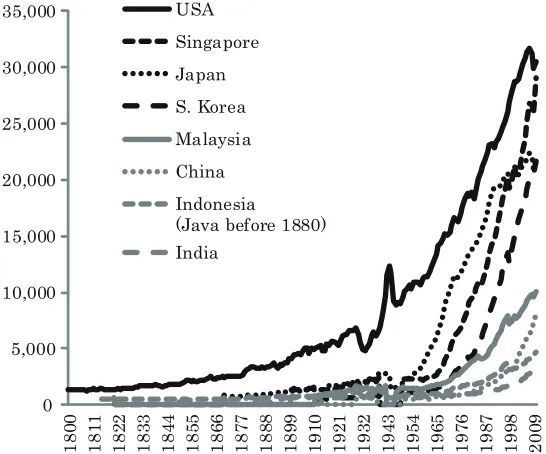
0 5,000 10,000 15,000 20,000 25,000 30,000 35,000 1 8 00 1 8 11 1 8 22 1 8 33 1 8 44 1 8 55 1 8 66 1 8 77 1 8 88 1 8 99 1 9 10 1 9 21 1 9 32 1 9 43 1 9 54 1 9 65 1 9 76 1 9 87 1 9 98 2 0 09 USA Singapore Japan S. Korea Malaysia China Indonesia (Java before 1880) India
Figure 1: Long-term evolution of per capita GDP in the U.S. and Asian countries (in 1990
international dollars).
Data source: Bolt and van Zanden (2013).1
Introduction
One of the most important and challenging questions for economists has been how to
harmonize economic growth with the natural world. Since the industrial revolution,
the growth rate of income per capita has been fairly stable in the United States. As
shown in Figure 1, the measured per capita real GDP in the U.S. has been expanding
exponentially, with its growth rate after the mid-19th century being around 2%. Figure
1 also shows that a number of Asian countries are in the process of catching up to the
U.S. income level. Although they differ in the timing when modern economic growth
took off (e.g., Japan’s modern growth started relatively earlier, while China’s rapid
growth is a much more recent phenomenon), their growth rates were typically higher
than the U.S. after the second half of the 20th century. As long as this trend
contin-ues, the per capita income of successful countries will converge to the exponentially
expanding U.S. per capita GDP level.
However, given that the world’s economic growth means the exponential expansion
of output, especially if it requires ever increasing inputs of natural resources, it is
obvious that this process cannot be continued for a very long time. This was the
theme investigated by Meadowset al. (1972) under the title of the ”Limits to Growth,”
which subsequently led to a large body of literature that examined the possibility of
1974; Smith, 1974; Stiglitz, 1974; see also a survey by Krautkraemer, 1998).
In addition to resource scarcity, the pollution that accompanies the production or
use of particular kinds of inputs poses another constraint for economic growth.
Al-though the literature on pollution and growth has largely been disjointed from that
on the resource scarcity,1the fundamental root of the problem is the same: the
finite-ness of the natural environment. Suppose that the aggregate production function has
constant returns to scale and that all inputs are reproducible or non-exhaustible. In
such a setting, long-term growth is typically achieved by a homothetic expansion of all
inputs and outputs.2 However, if the production or use of some types of inputs involves
pollution, such an expansion will result in an increasingly deteriorating environment.
Given that nature itself cannot be expanded along with other inputs, the intensity of
pollution (i.e., the ratio of pollution to environmental capacity) will increase with the
growing production. The deteriorated environment in turn makes sustained economic
growth difficult for a number of reasons, such as health problems and frequent natural
disasters caused by global warming. In the paper “Are there limits to growth?”, Stokey
(1998) considered this type of problem using an AK growth model with pollution and
showed that it is not optimal to pursue sustained growth as long as the technology
level is constant.
In this paper, we explain the implications of the interrelation between the
envi-ronment and economic growth. In particular, we focus on two issues. The first is the
feasibility of economic development in stagnant poor countries that are suffering both
from both low income and environmental degradation. Second, at the global scale we
consider the sustainability of world economic growth in the future. While these two
issues have so far been treated in two separate bodies of literature, we show that the
key to understanding both issues is the same: the mutual causality between the
envi-1
Theoretical models of economic growth that examine the relationship between pollution and growth often assumed away the finiteness of pollution-generating inputs. Besides the analytical tractability, one substantial reason for this is that when the emission of pollutants binds the possibility of economic growth, the constraint of resource scarcity becomes slack and will not affect the equilibrium or optimal outcome. Similarly, those that focus on the resource scarcity typically assume away pollution, because if the resource constraint is stricter, pollution will only have secondary effects on the possibility of economic growth. Nonetheless, some recent studies numerically examine the intricate interaction of pollution and the finiteness of resources and obtained quantitative implications of the interaction (for example, see Acemoglu et al. 2012).
2
pol
lut
ion (e
nvi
ronm
ent
al
de
gra
da
ti
on)
income (output)
・
Y=0 (limits to growth)
.
b (Environmental
Kuznets Curve)
P
[image:5.595.172.418.105.291.2]Y
a
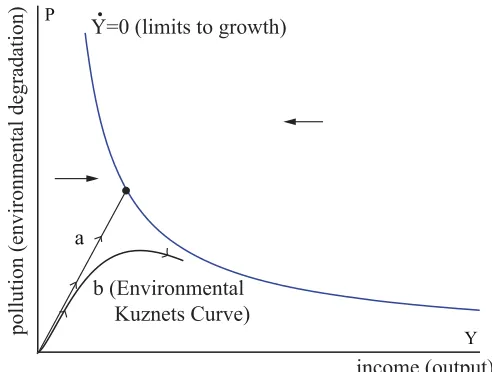
Figure 2: The relationship between income and pollution.
ronment and economic growth. After intuitively explaining how this interaction works
in the next section, we introduce two formal models that focus on the two issues in
sections 3 and 4.
2
Mutual causality between the environment and
economic growth
As we discussed in the introduction, we will inevitably face the “limits to growth”
problem if the environment continues degrading as the economy develops. The
con-sequences of “limits to growth” are illustrated in Figure 2, which depicts the mutual
relationship between pollution and the income level in one phase diagram. In the
fig-ure, the ˙Y = 0 curve reflects the causality from pollution to long-term income: for a
given intensity of pollutionPt, the output can grow up to the ˙Y = 0 curve in the long
run.3 The downward slope of this curve means that the potential for economic growth
is adversely affected by environmental degradation. For example, when air pollution
harms human health (WHO, 2006), it not only lowers the productivity of workers but
also reduces life expectancy and, hence, the return on education, which in turn lowers
the incentives for parents to provide their children with higher education. Without
sufficient educated workers, (foreign) firms with advanced technologies will be
reluc-3
tant to invest in such regions. These considerations imply that higher pollution (i.e.,
environmental degradation) will adversely affect the long-term income.
What, then, determines environmental quality? We may think of economic growth
as a determinant of pollution. At the initial stage of economic growth, the scale of
production is small, and thus, both income and pollution would be small. In the
figure, this means that the economy starts from a point near the origin. Then, as the
economy develops, the scale of production increases. As long as the economy operates
under the same technology and the same relative factor prices, the pollution P would
increase proportionally with output. In the figure, this means that the economy moves
to the upper right direction and will eventually reach the ˙Y = 0 curve, beyond which
the economy cannot grow (denoted by path a).
While this seems a pessimistic result, in reality the technology level is not constant
but improves as income grows. If improved technologies cause less pollution for a given
amount of production, economic growth could mitigate the environmental problem
through technological change.4 This consideration leads to theEnvironmental Kuznets
Curve (EKC), a hypothesis that there should be an inverted U-shaped relationship
between per capita income and various pollutants or environmental indicators. If
this hypothesis is correct, environmental degradation continues until the income per
capita reaches a certain level, but beyond it environmental quality will improve as
the economy grows. In Figure 2, the path denoted as b shows the movement of the
economy following this hypothetical EKC. If pollution begins to decrease before the
economy hits the ˙Y = 0 locus, it might be possible that the economy can grow beyond
the “limits to growth.” In fact, many studies, including seminal studies by Grossman
and Krueger (1991, 1995) and Selden and Song (1995), confirm the existence of the
EKC for local air pollutants, including sulfur dioxide (SO2), suspended particulate
4More precisely, there are both supply-side and demand-side factors behind the effect of economic growth
Poverty-Environment trap
・
Y=0 (limits to growth)
.
sustained economic growth
・
pol
lut
ion (e
nvi
ronm
ent
al
de
gra
da
ti
on)
income (output)
P
Y better steady state
c
d
[image:7.595.148.450.108.294.2]e
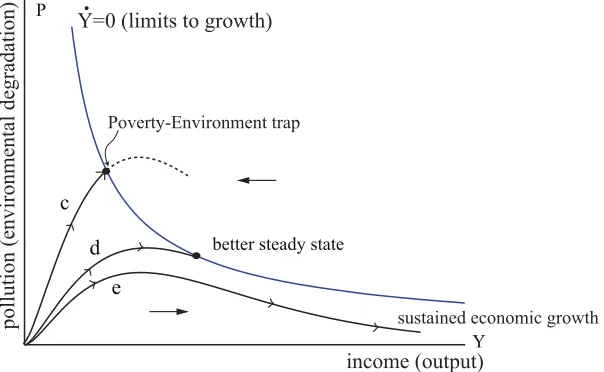
Figure 3: Poverty Environment Trap
matter (SPM), and oxides of nitrogen (NOx).
Note, however, that the existence of the EKC does not always mean that every
economy can overcome the “limits to growth.” Because of the differences in the
char-acteristics of countries, including technology, resource endowments and institutions
(particularly institutions for environmental protection), the shape and location of the
EKC vary across countries. Three paths in Figure 3 illustrate the consequences of
different EKC shapes. Pathcillustrates the case in which the economy hits the ˙Y = 0
curve before reaching the top of the EKC. At this point, the economy is trapped by
the mutual causality between environmental degradation and poverty. The
environ-mental quality is low because the economy is poor. Such an economy cannot afford
to employ better and cleaner technology because everyday consumption is their first
priority and they cannot finance the costs of required investments that would improve
their life and environment in the future. Similarly, it would be difficult for people in
such an economy to agree to set stricter environmental regulations because such
regu-lations would seem to (at least temporarily) further reduce their low incomes. At the
same time, the economy is poor because environmental degradation lowers the
pro-ductivity of workers, reduces their life expectancy, gives less incentives for parents to
provide good education for their children, and so forth. We call such a situation the
“poverty-environment trap”.
In Figure 3, pathdshows that an economy that maintains low pollution intensity
along the process of economic development can get over the top of the EKC and
Bangladesh China India
Japan Malaysia
Myanmar Nepal
Republic of Korea
Thailand
0 50 100 150 200 250
0 10000 20000 30000 40000 50000
a
n
n
u
a
l
m
ea
n
P
M
1
0
(u
g
/m
3
)
[image:8.595.124.468.92.305.2]income per capita (current US$)
Figure 4: Income and Air Pollution in Asian countries.
Vertical axis: Annual mean PM10concentrations in the capital city, where PM10 means particulate matter with a diameter of 10 µm or
less. Source: Urban outdoor air pollution database, Department of Public Health and Environment, World
Health Organization, September 2011. Per capita income is from World Development Indicators (WDI),
Worldbank.
those of economies trapped by the poverty-environment trap. Path e shows that it
is theoretically possible that an economy can grow indefinitely without facing limits
to growth. These considerations suggest that in the long run we will observe large
differences across countries in terms of the intensity of pollution and income level and
will also find a negative relationship between these two variables. Figure 4 confirms this
expectation, which shows that there is a negative relationship between air pollution
(PM10 concentrations) and the per capita income level among Asian countries. In
Section 3, we present a formal model with a microeconomic foundation that explains
the existence of multiple steady states—–the poverty-environment trap and a better
steady state—–and we discuss how the environment is related to international income
differences.
Pollution is a serious problem not only at the level of individual countries but also
at the global scale, particularly regarding the issue of global warming. In this case,
we should view the whole global economy as one entity because the emission of global
warming gases depends on the economic activities in all countries. Can we then observe
an inverted-U relationship between the average income in the world and the emission
0 0.1 0.2 0.3 0.4 0.5 0.6 1 9 60 1 9 64 1 9 68 1 9 72 1 9 76 1 9 80 1 9 84 1 9 88 1 9 92 1 9 96 2 0 00 2 0 04 2 0 08 2 0 12 all disasters weather related disasters D a m a g es b y D is a st er s / W or ld G D P (%)
Figure 5: Ratio of Economic Damage from Natural Disasters Worldwide to World GDP.
The solid line indicates the sum of damage from climatological, hydrological, and meteorological disasters.
Source: EM-DAT, the International Disaster Database, CRED, the Universit´e Catholique de Louvain.
World GDP is from WDI, Worldbank.
2004; Kijima et al., 2010), the existence of the EKC has not been supported for the
global warming gases such as carbon dioxide (CO2). If global pollution continues to
increase as the world economy grows, it will pose a threat to the sustainability of future
growth.
In fact, NASA suggests that an increase in global temperatures results in an
in-creased intensity of storms, including tropical cyclones with higher wind speeds, a
wetter Asian monsoon, and, possibly, more intense mid-latitude storms.5 Figure 5
shows that in the last 50 years total economic damages in the world have increased
more rapidly than the world’s GDP, and most of the increase was due to weather
related disasters. For example, Hurricane Katrina in August 2005 caused total
eco-nomic damages of $125 billion in the United States. More recently, typhoon Haiyan (or
Yolanda) in the Philippines in November 2013 generated $12 billion in economic
dam-ages, an enormous sum for a small country. CRED reports that floods appeared to be
most frequent during the last two decades, and the highest number of floods occurred
in Asia.6 The total damage and losses from the 2011 floods in Thailand amounted to
$40 billion, more than 1/10th of the country’s GDP. Given that the economic damages
5“The rising cost of natural hazard,” by Holli Riebeek, March 28, 2005, NASA Earth Observatory.
(i)
(ii)
world’s income
P
^
threshold level of pollution
gre
en hous
e ga
se
s
Y=0
.
Y P
current status
threshold level of pollution
f
h
g
world’s income P
^
gre
en hous
e ga
se
s
Y=0
.
Y P
current status
i
j
threshold [image:10.595.95.527.95.294.2]level of pollution
Figure 6: global pollution and sustainability of growth
from natural disasters come primarily in the form of capital destruction, a higher risk
of natural disasters inhibits the process of capital accumulation, not only by direct
destruction of the stock but also by reducing the expected return from investing in
new production facilities. If global warming continues with economic growth, and if
these weather related disasters are intensified accordingly, it is clear that at some point
further economic growth will become unsustainable.
We can again illustrate such a consequence in a phase diagram. Two panels in
Fig-ure 6 show the hypothetical evolution of the income of the worldY and the intensity
of greenhouse gases P in a phase diagram. We again have a downward sloping ˙Y = 0
curve. A higher intensity of greenhouse gases will cause a higher risk of natural
disas-ters. Given that the risk of natural disasters lowers new investments for production, it
will lead to a smaller steady-state stock of capital and, hence, a lower steady-state level
of world income. One difference from Figure 2 is that we now consider the possibility
of endogenous growth. In the literature of endogenous growth, it is considered that
physical and human capital can be accumulated without reaching a steady state, and
that the rate of accumulation is determined endogenously by underlying economic
con-ditions such as technology and preference (we will present a formal model in Section
4). In the current setting, a key factor in the economic conditions is the risk of natural
disasters, and it would be legitimate to suppose that the long-term rate of economic
growth becomes positive only when the greenhouse gas intensityP is lower than some
threshold value Pb. This means that the ˙Y = 0 locus asymptotes to theP =Pbline as
Y becomes larger.
to reduce emissions per output. In this case, P/Y is constant. As the world’s income
grows, the pollution increases proportionally, as does the risk of natural disasters. The
magnitude of the risk eventually reaches the point at which firms do not want to invest
in additional stock of capital, and this is the limit of growth for the economy in the
case of a constant P/Y ratio. To sustain economic growth, the economy needs to
stay P below the threshold value of Pb, and this requires continued reductions in the
P/Y ratio as Y increases. TheP/Y ratio could be reduced by a number of factors,
including the introduction of more advanced production technologies, the substitution
of polluting inputs for cleaner ones, and abatement activities. However, because it is
often costly for private firms to reduce pollution, it is necessary for the authorities to
encourage them to do so by appropriate policies, for example, by raising the rate of
environmental tax on the emissions of pollutants.
Pathgin figure 6 (i) shows one such possibility, where the amount of pollution is
kept barely below threshold Pb. On this path, the P/Y ratio is continually reduced,
for example, by increasing the environmental tax rate, but the amount of pollutionP
itself increases gradually toward the threshold level ofPb. In this case, economic growth
can be sustained in the meaning that the amount of output increases without bound,
but the long run rate of growth will become lower because the risk of natural disasters
gradually rises, which gives disincentives for further investments. Path h illustrates
a growth path under a stricter environmental policy, for example, where the tax rate
is raised at a quicker rate than in path g. When such a policy induces the amount
of pollution to become lower than the current level, we will eventually observe the
EKC for global pollution. In this case, the adverse effects of global warming on growth
(including the risk of natural disasters) will become milder in the long run. If the
positive effect of the lower disaster risk exceeds the negative effect of higher taxation,
such a policy will enable a higher long-term rate of economic growth than in pathg.
The preceding discussion implicitly assumed that the current level of global
pol-lution has not yet exceeded the threshold level, but this is actually far from obvious.
Figure 6 (ii) depicts the possibility that the current level of pollution is already too
high to maintain long-term growth. If this is the case, it is necessary to adopt a stricter
environmental policy that reduces not only the P/Y ratio (e.g., pathi) but also the
global level of pollution P (e.g., path j). This means that economic growth is
sus-tainable only when the amount of global pollution follows the EKC; in other words,
the EKC for global pollution is arequirementfor sustained growth. Although it might
be considered that the EKC is a result of a successful process of economic growth,
the above discussion suggests a possibility of reverse causality in that the sustained
EKC.
Note that even when a strict environmental policy is required for maintaining
eco-nomic growth, it does not necessarily mean that this is always desirable in terms of
welfare because, in the short run, consumers might need to reduce consumption
be-cause of increased production costs (and, hence, higher prices). Even in the long run, a
stricter environmental policy does not always imply a higher long-term rate of growth
because increased production costs mean lower profits, which might reduce the
in-centives to invest even under favorable natural environments. Therefore, we need to
develop an economic model to explicitly investigate the mutual causality between the
environment and growth and, by using it, examine the desirable policy. Also, in the
case of local pollution it is necessary to develop a formal model to see the precise cause
of the poverty-environmental trap, which will be indispensable in understanding the
root of the international income inequalities and helping those trapped countries. The
next two sections are devoted to these tasks.
3
The poverty-environment trap and international
inequalities
In this section, we develop a model of local pollution and economic development, and
explain the mechanism of the poverty-environment trap. The following model is based
on a simplified version of Ikefuji and Horii (2007).
3.1
A model of local pollution and technological choice
Consider an overlapping generations model where each individual lives for two periods.
Individuals in their first and second periods are called young and adult agents,
respec-tively. In youth, agents invest in human capital through education, which is necessary
if they want to adopt both more productive and cleaner technology later in their life.
In adulthood, each agent works and bears a single child (a young agent). The efficiency
of both education and production depends on their health, which in turn depends on
the amount of pollution in the environment.
Let us call an agent who is born in period t a generation-t agent. We normalize
the number of agents of each generation to one. The lifetime utility of a generation-t
agent is given by
Ut= logcyt+ (1−β) logcat+1+βlogxt+1, 0< β <1, (1)
wherecyt,cat+1, andxt+1represent the amount of consumption in youth, in adulthood,
Suppose that the health status of a generation-tagent is negatively affected by the
amount of pollution in her youth. Specifically, we assume that the ability of an agent
is given byℓt=L−Pt, whereLis a constant representing the ability of an agent under
the pristine environment, while Pt denotes the actual amount of pollution in period
t.7 Letx
tbe the amount of transfer that each young generation-t agent receives from her parents. We consider a situation of a developing country where the credit market
is imperfect, and we therefore assume that agents can neither borrow nor lend. For
simplicity, we also assume that goods are not storable, so they must be used within a
given period. A part of the transfer is used for consumption cyt. The remaining et is
used as an input to human capital investment, which is combined with her ability to
learnℓtand yieldsht+1=ϕetℓtunits of human capital for her adulthood, whereϕ >0
is a parameter. The budget constraint in her youth can be written as:
cyt+et=xt, 0≤et≤xt. (2)
In adulthood (period t+ 1), each agent produces goods by employing two types
of technologies. One is sustainable technology, which produces goods from labor and
human capital according to
yts+1=As(ht+1)θ(st+1ℓt)1 −θ
, As>0, 0< θ <1, (3)
where st+1 denotes the fraction of generation-t agents’ time devoted to sustainable
technology. This production technology does not cause pollution and, in that sense,
is clean. The other technology is called primitive technology, which uses only labor to
produce goods, according to
ytp+1=Ap(1−st+1)ℓt, Ap>0, (4)
but it emits pollution. We assume that the emission is proportional to the amount of
output from the primitive technology and that the amount of pollution in the
environ-ment evolves according to
Pt+1= (1−δ)Pt+bηytp+1, 0< δ <1,bη >0. (5)
An adult agent uses her total outputyt+1≡yts+1+y
p
t+1 for consumption and transfer for her child:
cat+1+xt+1=yt+1≡yst+1+y
p
t+1. (6)
7
3.2
Choice between dirty and clean technologies
The problem of a generation-tindividual can be described as follows: given the amount
of transfer from her parent xt and the pollution Pt, she chooses education et, the
fraction of time devoted to sustainable technologyst+1, consumptioncyt andcat+1, and
transfer to her child xt+1. Her objective is to maximize lifetime utility (1), subject
to budget constraints (2) and (6), and production technology (3) and (4). Because
condition (2) includes inequality constraints due to credit market imperfection, this
problem can be solved by the Kuhn-Tucker method. We find that the solution to the
above problem critically depends on the amount of transfer from her parent xt. Note
that under the utility function (1), xt=βyt holds because adult agents always leave
the fraction β of their income for their children as a transfer. Because it is easier
to interpret the result in terms of income level (rather than amount of transfer), we
describe the solution using yt.
If the parent generation was poor and their incomeytwas smaller than a threshold
level of y ≡(1−θ)/2σθ, whereσ≡(1/2)βϕ(As(1−θ)/Ap)1/θ, agents cannot receive
education (et= 0) and have to rely completely on the primitive technology (st+1= 0),
which worsens the quality of the environment.8 Conversely, if the income of previous
generationytwas higher thany≡(1 +θ)/2σθ, i.e., if their parents are sufficiently rich,
agents can receive sufficient education (et = θβyt/(1 +θ)) such that they rely only
on the sustainable technology (st+1 = 1), which improves the environmental quality.
Finally, if yt was betweeny and y, agents receive some education (et =β(yt−y)/2)
but have to rely partly on the primitive technology (st+1=σ(yt−y)<1). Still, it can
be seen that the dependence on the primitive technology decreases (st+1increases) as
the parents become richer. To summarize, we can writest+1 in terms ofytas:
st+1=s(yt)≡
0 ifyt≤y≡(1−θ)/2σθ,
σ(yt−y) ifyt∈(y, y),
1 ifyt≥y≡(1 +θ)/2σθ,
(7)
which is consistent with the observation that richer countries tend to use cleaner
tech-nologies in a larger fraction of their production.
The amount of productionys t+1+y
p
t+1is determined by the relative dependence on the two types of technologiesst+1 =s(yt) in (7) and the ability of agentsℓt=L−Pt
as well as human capital ht+1=ϕetℓt=ϕet(L−Pt). We thus obtain the evolution of
8
0
P
tL
P
P
y
y
yt
y
.
= 0 (limits to growth)0
P
t´ L ´+±
y
y
y
t P= 0 (pollution
in the long run)
[image:15.595.104.493.88.257.2].
Figure 7: Evolution of income (left) and pollution (right) over generations
incomeyt over the generations:
yt+1=ye(yt)(L−Pt), whereye(yt)≡
Ap ify
t≤y,
Ap(y+y t
)
/2y ifyt∈(y, y),
As[ϕθβy
t/(1 +θ)]θ ifyt≥y.
(8)
Let us examine the “limits to growth” of this economy. The ˙yt = 0 locus can be
derived by setting yt+1=yt in equation (8).9 The result is
y∗ (Pt)≡
[
As(ϕθβ/(1 +θ))θ(L−P t)
]1/(1−θ)
≥y ifPt≤P ,
Ap(2/(L−P
t)−1/(L−P))−1∈(y, y) ifPt∈(P , P),
Ap(L−P
t)≤y ifPt≥P ,
(9)
where P≡L−y/Ap andP ≡(1 +θ)P−θL.
Figure 7 (left) depicts the ˙y = 0 locus (i.e., function y =y∗
(Pt) in equation 9) in
(y, P) space. The level of income increases over generations if and only if the (y, P)
pair is to the left of this locus. Similarly to Figure 2, the ˙y = 0 locus is downward
sloping. This means that the economy can grow up to a higher level of income when
pollution is lower and, hence, the environment is better. In this economy, this occurs
for two reasons. First, when the environment is better (Pt is lower), the agents have
greater ability to work (ℓt=L−Pt), such that they can produce more output. This
is a direct effect of the environment on income. There is also an indirect effect that
9
Because the model in this section is formulated in discrete time, it is more precise to call it theyt+1=yt
[image:15.595.141.485.333.396.2]is manifested over the generations: when the environment is better, parents can leave
a larger amount of income to their children, and children themselves also have hige
ablility to learn (ℓt+1=L−Pt+1), both of which enable agents in the next generation
to adopt a better technology. In Figure 7 (left), the effect of the environment on the
technological shift appears when the amount of pollution is betweenP andP. When
Pt is within this range, a marginal changePthas a larger effect on long-term income
through inducing agents to employ the productive (and sustainable) technology in a
larger portion of total production (i.e., the long-run level of st+1 increases with Pt).
This explains why the ˙y= 0 locus is flatter in this segment than in other segments.
3.3
Dynamic interaction between income and environment
We have shown that, given the amount of pollutionPt, the evolution of income is
deter-mined by equation (8). How, then, isPtdetermined? Will it follow the environmental
Kuznets curve? From (4), (5), (7) and ℓt = L−Pt, the evolution of the amount of
pollution in equilibrium can be written as
Pt+1= (1−δ)Pt+η(1−s(yt))(L−Pt), (10)
whereη≡bηAp. Equation (10) shows that the evolution ofP
tis also determined by the (y, P) pair. By applyingPt+1=Ptfor (10), we obtain the stationary level of pollution
for each given income level yt:
P∗ (yt) =
ηL/(η+δ) ifyt≤y,
ηL/(η+δ/σ(y−yt)) ifyt∈(y, y),
0 ifyt≥y.
(11)
Let us call the curve given by (11) the ˙P = 0 locus, as depicted in Figure 7 (right).
The amount of pollution in this economy increases toward the ˙P = 0 locus whenever
the (y, P) pair is below this locus. Observe that the ˙P= 0 locus is (weakly) downward
sloping because a richer economy can afford to invest more in human capital and, hence,
can employ cleaner technologies (recall equation 7), which implies lower pollution in
the long run. Note, however, that the amount of income yt itself changes depending
onPt, and hence we need to examine the dynamic interaction betweenytandPtover
the process of economic development. This can be done by combining the ˙y= 0 locus
and the ˙P = 0 locus in one figure.
Figure 8 depicts the phase diagram of the dynamic system in (y, P) space.10 We
can observe that there are two stable steady states,TandB, and one saddle point U.
10
0
T
U
B
P
tL
´L ´+±
y
y
tk (EKC) l
m
saddle pa th
(poverty-environment trap)
(unstable)
(better steady state)
y
.
= 0
[image:17.595.141.455.91.300.2]P
.
= 0
Figure 8: The poverty-environment trap and the environmental Kuznets curve in
equilib-rium
It depends on the initial conditions which steady-state the economy converges to in the
long run. In this system, both yt andPt are state variables, and therefore, the initial
condition is given by a pair of the income of the initial adult generation y0 (i.e., the
parents of generation-0 agents) and the initial amount of pollutionP0.11 Because we
are interested in the process of economic growth, we suppose y0 to be small so that
we can examine the process from the initial stage of development. It will also make
sense to assume the initial amount of pollution P0 to be small if we consider that the
economy starts from a pre-industrial society, but the precise values of P0, as well as
the parameters of the model, will vary across economies.
Figure 8 shows three representative equilibrium paths that start from slightly
dif-ferent initial combinations of (y0, P0). Path k illustrates an equilibrium path when
the economy starts from a low P/Y ratio. On the first half of this path, pollution
gradually accumulates while the output increases. However, once the income level
suf-ficiently rises and the path moves past the ˙P = 0 locus, the accumulated amount of
pollution begins to decrease. This is because the economy now has enough income
to invest in human capital and, therefore, no longer needs to rely as much on dirty
primitive technologies. Thereafter, as the environment improves, the ability (or health
status) of the workers also improves, which enables the income level to increase further
toward the better steady stateB. This path explains that the interaction between the
11
Strictly speaking, the predetermined variables in this system arextandPt. However, becausext=βyt
income level and pollution can endogenously generate the EKC. However, this path is
not the only possibility.
Path lin Figure 8 illustrates another equilibrium path when the economic
devel-opment begins with a higher P/Y ratio. In this case, the economy hits the ˙y = 0
locus (the limits to growth) before encountering the ˙P = 0 locus. This means that the
economic growth has come to its limit due to the environmental degradation, before
the income level reaches the top of the EKC. This is not the end of the story. From
this point, environmental degradation further continues because the economy is still
below the ˙P = 0 curve. After passing the ˙y = 0 locus, the income actually decreases
due to the deteriorated ability of workers who are seriously affected by a poor
en-vironment. The economy eventually converges to steady state T, which we call the
poverty-environment trap. In this trap, workers cannot escape from poverty because
the deteriorated environment lowers their ability and productivity. At the same time,
the economy cannot escape from the deteriorated environment because workers are too
poor to obtain human capital and, hence, cannot employ cleaner technologies. This
mutual causality creates a stagnating economy that suffers both from poverty and a
de-teriorated environment. Pathmin Figure 8 shows the case where the initialP/Y ratio
is even higher. In this case, the economy converges directly to the poverty-environment
trap T, which is locally stable and can be approached from any direction in the phase
diagram.
These two long-term possibilities, the better steady state and the poverty-environment
trap, are grossly different both in terms of environmental quality and income. What,
then, separates the successful economies that get past the peak of the EKC from the
economies that stagnate in the mutual trap of poverty and environmental degradation?
Observe from Figure 8 that there exists a saddle path that converges to the saddle point
U. Because both y0 and P0 are predetermined state variables, there is virtually zero
possibility that the economy happens to be on this path. However, the location of
this saddle path is important because it separates the two long-term outcomes: the
economy converges to the poverty-environment trap if and only if the initial (y0, P0)
pair is above the saddle path. Therefore, even when all parameters are identical, a
slight difference in the initial conditions (which depends on many factors, e.g., whether
a country has been colonized or not and, if so, by what country) may explain persistent
international inequality in income and environmental quality. In addition, if the
pa-rameters of economies are not identical (e.g., because of regional characteristics), the
location of the saddle path as well as the locations of the steady states would differ
across countries. This explains another possible reason why some economies have
from low income and poor environmental conditions, as we have observed in Figure 4.
3.4
Environmental policies for trapped economies
Now let us discuss how environmental policies can or cannot save economies that are
currently trapped in the poverty-environment trap and whether such policies can
mit-igate the international inequality both in terms of income and the environment. We
have explained that, in a trapped economy, the environmental quality and thus the
productivity was low because people rely on the primitive technologies that emit
pol-lution. A direct approach to solve this problem is to limit the use of such technologies,
i.e., to force them to reduce pollution even if it is costly for individuals. Alternatively,
the authorities can tax the use of dirty technologies (or, equivalently, tax emissions)
and use the tax revenue for pollution abatement activities. In either case, the net
income from using the primitive technologyApwill fall,12 but the amount of pollution
per unit output from the primitive technology, given by parameterη, will also fall. To
examine the equilibrium outcome of such policies in a convenient way, we suppose that
both Ap andη are functions of the strictness of the environmental policy, denoted by
α∈[0,1], and that both are decreasing in α.13
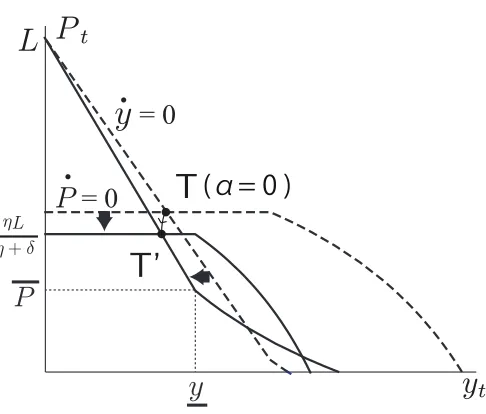
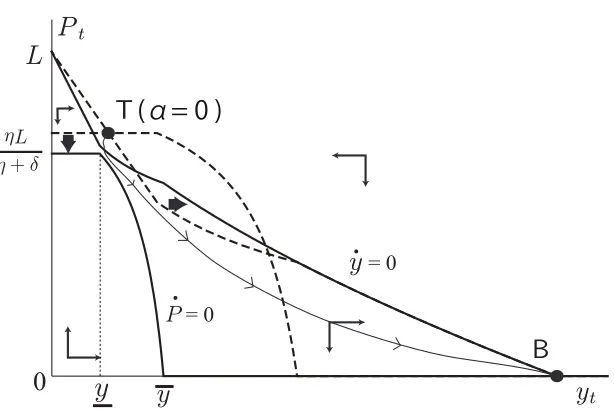
Figure 9 illustrates how such environmental policies affect the trapped economy.
Recall that in the poverty-environment trap, both the environmental quality and the
income are low so that Pt > P and yt < y hold. In this region, from (9) and (11),
we can confirm that the ˙y = 0 locus shifts leftward, while the ˙P = 0 locus shifts
downward. This implies that there are two opposing effects of environmental policies
on the income of a trapped economy. First, the leftward shift of the ˙y= 0 locus means
that, given the quality of the environment, the household income declines. This result
comes directly from our assumption that environmental policies that aim to reduce
emissions are costly for individuals. If it takes time for the environmental quality to
change, as assumed in equation (10), then the short-term effect of environmental policy
on income is necessarily negative.
In the long-run, however, the environment improves, as reflected in the downward
shift in the ˙P = 0 locus. With a better environment, the productivity of workers will
improve, increasing their incomes. The long-term net effect of environmental policy
12
Originally we assumedAp to be a technology parameter. Here, we reinterpretApas the productivity
after deducting the cost of abatement activity or after deducting the environmental tax.
13
Specifically, in Figure 9 we assume that a stricterαreduces the two parameters proportionally:Ap(α) =
(1−α)Ap0andη(α) = (1−α)η0. Equation (10) implies that for a given amount of labor input the increments
T
(α= 0 )
T'
y
= 0
.
P
= 0
.
P
tL
y
t´L ´+±
P
y
Figure 9: Effect of a small environmental tax or the enforcement of mild pollution reduction
in a trapped economy (a magnified view around steady state
T
).
The dashed loci show the phasediagram without the environmental tax. The solid loci show the case of α= 0.15 (i.e., when bothAP and
ηare 85% of their original values).
on income depends on the relative magnitude of these two effects. (In other words, it
depends on the relative significance of the reductions in AP andη, or more generally,
it depends on the elasticity of the productivity loss to the reduction of emissions). As
illustrated in Figure 9, the net effect can be negative even in the long-run. The steady
state level of income in steady stateT’ under an environmental policy of α= 0.15 is
lower than the income in steady state Twithα= 0.
The above results suggest that it is not easy to form a consensus on the
environmen-tal policy to reduce emissions in a poverty-environmenenvironmen-tally trapped economy because
it will further undermine the already low income in the short run, and it is not certain
whether it will raise income even in the long-run. However, a sufficiently strong
envi-ronmental policy can have quite different implications. As illustrated by Figure 10, the ˙
P = 0 and ˙y = 0 loci become detached from each other whenαis large enough. This
means that the poverty-environmental trap no longer exists in the new phase diagram,
and because of this structural change the economy necessarily converges to the now
unique steady state B. In this transition, the environment improves simultaneously
with the rising income, as in the latter half of the EKC.
Why does a strong environmental policy give rise to such a drastic change? One
possible reason is that a better environmental quality improves the productivity and,
[image:20.595.177.420.92.299.2]0
T
B
P
tL
´L ´+±
y
y
ty
= 0
.
P
= 0
.
y
[image:21.595.146.453.91.300.2](α= 0 )
Figure 10: Effect of a large environmental tax or the enforcement of large pollution
reduc-tion in a trapped economy.
The dashed loci show the phase diagram withα= 0. The solid loci showthe case ofα= 0.27 (i.e., when bothAP andηare 73% of their original values).
cleaner technologies. However, as we have explained above, environmental policies to
reduce emissions do not necessarily improve income as long as individuals are relying
on dirty primitive technologies (i.e., when Pt > P and yt < y), and therefore, this
first cause does not always work. The second and more definite cause of the structural
change is that because a strong environmental policy reduces the private returns from
adopting primitive technologies, workers are induced to invest in human capital and
adopt cleaner technologies even at lower income levels. This can be confirmed by the
fact that the threshold levels of income for education,y andy in equation (7), become
smaller when Ap falls.14 Obviously, such a policy temporarily reduces the income of
poor households (given that the environmental quality does not change instantly). As
time passes, however, the environment improves gradually, which increases productivity
and income. Once the income level passes a threshold level (specifically, whenytand
Pt pair falls below the saddle path in Figure 8), workers are now willing to invest in
human capital and cleaner technologies even without further policy interventions, and
the economy autonomously improves toward the better steady state.
To summarize, once an economy falls into the poverty-environment trap, it is
dif-ficult to build a consensus on environmental policies because such policies are likely
to worsen income and welfare, at least temporarily. In addition, when the policy
in-tervention is insufficient, poverty can be aggravated even in the long run. However,
14Recall thatσ
the situation can be solved permanently if a sufficiently strong environmental policy
is continued for a certain period until the economy reaches the autonomous process of
economic growth and environmental improvements. Given the short-term cost of such
a drastic intervention, assistance from developed economies (e.g., by providing funds
for the abatement cost, subsidies for education, or income assistance for households
whose earnings are adversely affected by environmental policies) will certainly be a key
in helping economies escape from the poverty-environment trap, thereby reducing the
wide international inequality both in incomes and environmental quality.15
4
Sustainability of long-term growth under global
warming
In the previous section, we examined the problems of large international differences in
income and environmental quality. We showed the possibility that the interaction
be-tween the environment and growth within each country creates a poverty-environment
trap and that this mechanism can explain the long-lasting international inequality in
terms of both environmental quality and income. Now, let us turn to the growth of the
world economy as a whole and examine how can it be harmonized with the global
envi-ronment, particularly regarding the problem of global warming. As we have discussed
in the latter half of Section 2, the growing world economy emits increasing amounts of
global warming gases, which is suspected to intensify the risk of natural disasters. The
aggregate economic damage from natural disasters, which mostly takes the form of the
destruction of capital stocks, has been increasing at a speed faster than the growth of
the world GDP (see Figure 5). If this trend continues, the risk of losing the capital
stock will sooner or later exceed a threshold at which the economy does not want to
invest further in capital stock. This is the “limits to growth” for the world economy
(see path fin Figure 6). Can any environmental policy prevent such a situation from
occurring and sustain long-term growth? Based on a simplified version of the
endoge-nous growth model by Ikefuji and Horii (2012), this section presents a formal model of
emissions, natural disasters, and the “limits to growth.”
15
4.1
A model with global pollution and capital destruction
While the previous section considered only human capital, in this section, we consider
explicitly the accumulation of physical and human capital. Note that the damage from
natural disasters occurs most strikingly in the form of capital destruction. In addition,
natural disasters entail many human casualties and therefore destroy a substantial
amount of skills and knowledge (i.e., human capital). A knowledge based economy
with a large stock of human capital can be vulnerable to natural disasters once its
telecommunication network is damaged. Therefore, it is appropriate to develop a model
where the economy accumulates both physical and human capital and where both are
subject to the risk of natural disasters. This specification also allows us to examine the
properties of long-term economic growth, rather than one-time transitional dynamics
from a poor to a rich economy.16
However, considering two types of capital simultaneously makes the analysis
sub-stantially complex. Therefore, we make several innocuous simplifications. First, rather
than explicitly considering different generations (youth and adults, as in the
previ-ous section), let us consider a representative hprevi-ousehold and assume that they divide
their human capital (or their disposable time) between production (fraction ut) and
education (1−ut). In addition, rather than considering the choice between the two
technologies, we suppose that production always uses fossil fuelsPtthat cause the
emis-sion of greenhouse gases of the same amount Pt, but that it is possible to adjust the
amount of such an input in the production process. The output of the world economy
is then given by a constant-returns-to-scale production function:
Yt=AKtα(utHt)1 −α−β
Ptβ, (12)
where Kt and Ht are the aggregate amounts of physical and human capital,
respec-tively. It is possible to interpret that the primitive technology in the previous section
corresponds to the situation where the economy uses a large amount ofPtwhile
mak-ing little use ofHt. Sustainable technology corresponds to the opposite combination.
Because this section’s objective to examine how the economy’s reliance on fossil fuels
Ptlimits the possibility of sustained growth through global warming and increased risk
of natural disasters, we do not explicitly consider the finiteness of such resources.17
16
While classical growth models requires exogenous technological change to explain long-term growth, the literature on endogenous growth (with a seminal study by Lucas 1988) has shown that long-term growth can be explained within a model if we consider both physical and human capital accumulations simultaneously.
17
We also simplify the process of education. When the representative household
uses amount (1−ut)Ht of their human capital for education, it produces additional
B(1−ut)Ht units of new human capital, where B is a constant parameter for the
efficiency of education (see equation 14 below).
In the model of the previous section, we assumed that local pollution reduces the
productivity (ability) of agents. Instead, we now assume that global pollution (i.e.,
the emission of greenhouse gases) raises the risk of capital stock destruction. Suppose
that when the world economy emits amountPtof greenhouse gases, then, on average,
a fraction ϕPt of physical capital is destroyed by natural disasters within a year.18
Natural disasters will also erode a fraction ψPt of human capital, where we assume
0 < ψ < ϕ.19 Then, the aggregate amounts of physical and human capital evolve
according to
˙
Kt = Yt−Ct−(δK+ϕPt)Kt, (13)
˙
Ht = B(1−ut)Ht−(δH+ψPt)Ht, (14)
where δK and δH are depreciation rates of physical and human capital, respectively,
excluding the effect of global warming. Because we are concerned about long-term
growth rather than short term fluctuations caused by individual events of natural
disasters, we simply assume that the whole economy consists of many regions, and, by
the law of large numbers, there is no aggregate uncertainty on the aggregate damage in
each year. In this setting, the use of fossil fuelsPtin effect accelerates the depreciation
of capital through the larger damages caused by natural disasters.
The representative household has the standard CRRA utility function:
∫ ∞
0
C1−θ −1 1−θ e
−ρt
dt. (15)
Let us consider a market economy where the authorities levy a per-unit tax ofτ >0
on the use of fossil fuelsPt(or, equivalently, the amount of greenhouse gas emissions).
Here, we abstract from the international politics and assume that the whole economy
(i.e., the world’s economy) can set a common rate of environmental tax.20 Suppose
the markets are perfectly competitive and there is a representative firm that produces
18
For simplicity, we do not explicitly consider the accumulation of greenhouse gases in the atmosphere. Ikefuji and Horii (2012) show that the basic property of the result is the same when we explicitly consider the accumulation process.
19
While human and physical capital are vulnerable to natural disasters, it is reasonable to think that physical capital suffers more directly from natural disasters and, therefore, that the damage fraction of physical capitalφPtwould be larger than that for human capitalψPt.
output Yt according to (12). Let the price of the output be normalized to one, and
assume that there are no other costs of usingPtother than the environmental taxτ.21
Then, the first order condition for the profit maximization implies
Pt=βYt/τ. (16)
Equation (16) clearly shows that the emission of greenhouse gases Pt increases
proportionally with the world’s GDP,Yt, if there is no strengthening of environmental
policyτ. At the same time, this equation shows that emissionPtcan be reduced if the
environmental tax rate τ is raised, confirming the discussion in section 2. However,
this does not come without a cost. By substituting (16) into production function (12),
we see that output can be expressed as
Yt=
( ˜
Aτ− β
1−β
)
Kαb
t(utHt)1−αb, (17)
where ˜A≡ββ/(1−β)
A1/(1−β)
and αb≡α/(1−β). Equation (17) can be interpreted as
the aggregate production function given the level of environmental tax τ. It has the
form of a standard Cobb-Douglas function with two inputs,KtandutHt, and its total
factor productivity (TFP) is given by ˜Aτ−β/(1−β)
. This expression clearly shows that,
given the current amounts of physical and human capital, the environmental tax lowers
the productivity.
4.2
“Limits to growth” under constant tax rate
We first show that if the environmental tax rate τ is kept constant, the interacting
processes of economic growth and environmental degradation eventually lead to the
“Limits to growth.”
In this economy, the only source of externality isPt, which represents the use of
fossil fuels and, hence, the accompanying emission of greenhouse gases. Other than
this aspect, the conditions for the market equilibrium with the representative household
and the representative firm coincide with the conditions for the welfare maximization
problem.22 The problem is to maximize the utility (15) subject to the production
levels and geography, it is not easy to agree on a common standard for greenhouse gas emissions, and it will be even more difficult to strengthen it over time. As we will see, such conflicts in international politics will create a threat to the sustainability of the world’s economic growth.
21
In the present setting, we assume that the tax revenue is returned to the household in a lump sum fashion. With a minor modification of the model, it is possible to interpret that τ includes other costs of using fossil fuels, such as extraction costs. In this case, only the remaining fraction ofτ will be returned to households.
function (12) and the resource constraints (13) and (14), where we take the evolution
ofPtin (16) as given. By setting up a Hamiltonian, we obtain the following first order
conditions for this problem, which should also hold in the market equilibrium:
˙
Ct
Ct = 1
θ
[(
αYt Kt
−δK−ϕPt
) −ρ
]
, (18)
˙
Ht
Ht+ ˙
ut
ut
−Y˙t
Yt = (B
−δH−ψPt)−
(
αYt Kt
−δK−ϕPt
)
. (19)
Equation (18) is the Euler equation for the intertemporal consumption. Note that
the term (αYt/Kt−δK−ϕPt) in the right-hand side (RHS) represents the (expected)
rate of return from physical capital investment, i.e., the marginal product of capital
αYt/Ktminus the depreciation rateδK minus the expected loss from natural disasters
ϕPt. Recall from (16) that if the environmental tax rateτis constant and the economic
growth continues ( ˙Yt>0), the representative firm uses an ever increasing amount of
fossil fuels Pt. The resulting increase in the risk of natural disasters lowers the rate
of return from physical capital investment (αYt/Kt−δK−ϕPt). Equation (18) shows
that economic growth can be sustained ( ˙Ct/Ct > 0) only when the rate of return
from physical capital investment is kept above the rate of time preference,ρ. For this
condition to hold along economic growth, the continual rise in the expected damage
ϕPtmust be offset by an increase in the marginal product of physical capitalαYt/Kt.
Will such an increase inαYt/Ktactually occur? Note that under production
func-tion (17) the marginal product of physical capitalαYt/Ktrises when the economy uses
more human capital utHt relative to the amount of output Yt. The rate of change in
this ratio, utHt/Yt, is represented by the left-hand side (LHS) of equation (19). The
first term in the RHS, (B−δH−ψPt), represents the rate of return from investing in
human capital. The second term is the rate of return from physical capital investment,
as explained above. Therefore, equation (19) shows that the household uses more
hu-man capital in production if the rate of return from huhu-man capital investment is higher
than that from physical capital investment.
As the amount of emissionPt increases in the RHS of (19), the rate of return for
physical capital falls more rapidly than that for human capital (recall that ϕ > ψ),
and therefore, the economy increases its reliance on human capital. This is
consis-tent with the empirical findings of Skidmore and Toya (2002), who suggested that
a higher frequency of climatic disasters leads to a substitution from physical capital
investment toward human capital. This substitution process actually increases the
world’s income
P
^
greenhouse
gas emissions
Y=0
.
Y
P
initial
status
(Limits to Growth)
low
τ
int
erm
edi
ate
τ
high
τ
A
B
C
[image:27.595.117.496.116.321.2]D
Figure 11: Evolution of the global environment and the world’s income under different
environmental tax rates.
marginal product of physical capitalαYt/Kt, which encourages growth. However, this
process cannot perpetually sustain economic growth under a constant tax rate. As
we discussed, Euler equation (18) implies that nonnegative growth in consumption
re-quires the rate of return from physical capital (αYt/Kt−δK−ϕPt) to be at least ρ.
However, as Pt= βYt/τ rises with economic growth, the rate of return from human
capital investment (B−δH−ψPt) will eventually fall toρ. This means that the RHS
of (19) becomes zero (or negative), and substitution from physical capital to human
capital stops. This means that αYt/Kt cannot rise further, and therefore, the rate
of return from physical capital investment (αYt/Kt−δK−ϕPt) must eventually fall
until it reaches the rate of time preference ρ. At this point, people are unwilling to
invest further in physical capital to increase their consumption, and economic growth
comes to an end.
By setting time derivatives to zero in equations (18) and (19), we find that this
steady state, or the “limits to growth,” is reached when the amount of emissions
increases up to
b
P =B−δH−ρ
ψ . (20)
Figure 11 illustrates the processes of economic growth in (Y, P) space for three
different environmental tax rates. These three paths start from the same level of
capital accumulation. However, as we have shown in equation (17), the initial amount
the higher tax rate reduces the effective TFP. When the tax rate is higher, the initial
level of emissionPt=βYt/τ is also lower due to both higherτ and lower initialYt.
As the economy grows, the amount of emission Pt increases proportionally with
output Yt. Observe from the figure that the slope of the path, Pt/Yt =β/τ, is less
steep when the tax rate is higher. This means that the level of income at which the
economy reaches the “limits to growth” (i.e., when Pt reaches Pb) is proportionally
related to the environmental tax rate:
b
Y = τ
βψ(B−δH−ρ). (21)
Therefore, although a higher environmental tax initially corresponds to a lower output,
it also implies there remains larger room for economic growth.
While Figure 11 illustrates the existence of the limits to growth of the world
econ-omy under a constant environmental tax rate, it also suggests that economic growth
can be maintained if the environmental tax rate is continually raised. Whenever the
world economy reaches the limit of growth, it is possible to bring the economy to a
less steep path of growth that leads to a higher long-term level of output, although
output temporarily falls (e.g., from point Ato point B, or from pointCto point Din
Figure 11). It might be even better to raise the environmental tax before the
emis-sion Pt reaches Pb because doing so will allow the possibility of keeping the rates of
return from physical and human capital investment higher, thereby encouraging faster
capital accumulation. However, it is not always better to raise the environmental tax
faster because it lowers the effective productivity of production. In the next
subsec-tion, we examine the desirable environmental tax policy both in terms of the long-term
economic growth rate and in terms of welfare.
Before leaving this subsection, let us explain the difference between Figure 6 and
Figure 11. While we discussed in Section 2 that the ˙Y = 0 locus would appear to
be downward sloping (see Figure 6), the ˙Y = 0 locus we derived so far (Figure 11)
is actually horizontal because Pb = (B−δH −ρ)/ψ does not depend on the income
levelYt. This result is due to several simplifications. In particular, we simply assumed
that δH and ψ do not change with the income level or the level of human capital.
At the initial stage of economic growth, however, when production relied more on
basic labor than advanced human capital, we may interpret thatδH andψ must have
been smaller. As the economy develops and the aggregate human capital accumulates
(i.e., the development of complex systems of skill, knowledge and information in the
world economy), the depreciation or the obsolescence of existing human capital will
accelerate (i.e., δH increases). In addition, as the system of human capital becomes
we incorporate these changes into the model, the ˙Y = 0 locus (Pb= (B−δH−ρ)/ψ)
will become downward sloping, as depicted in Figure 6.
Note, however, that if we do not expect δH and ψ to rise indefinitely, they will
converge to certain constants in the very long run. Because this section examines
the long-run consequences of the interaction between the environment and economic
growth, we consider the situation where economic development has already sufficiently
advanced so that δH and ψ can be seen as constants. In Figure 6, this corresponds
to the region where Yt is sufficiently large that the ˙Y = 0 comes close to the dashed
horizontal line atPt=Pb.
4.3
Environmental policy and sustained growth
In the previous subsection, we confirmed that economic growth can be sustained only
when the environmental tax rate is continually raised. Now let us define the rate of
tax increase gτ≡τ˙t/τtand examine how it determines the long-term rate of economic
growth g∗
≡Y˙t/Yt.23
The long-term rate of economic growth g∗
cannot be higher than the rate of tax
increase,gτ, because otherwisePt=βYt/τtwould continue to increase and eventually
face the “limits to growth,”Pb. Therefore, sustained growth (g∗
>0) requires a positive
rate of environmental tax increase. Under such a policy, there are two possible outcomes
in the state of the environment. If the long-term economic growth occurs at the
same rate as the tax increase (i.e., g∗
= gτ), then the growth rate of Pt = βYt/τt
will become zero, and therefore, the amount of emissions will converge to a constant,
which we denote by P∗
. Another possibility is that output grows slower than the tax
rate (g∗
< gτ). In such a scenario, the amount of emission Pt =βYt/τt falls at the
rate of gP = g∗−gτ < 0 and will converge toward zero. That is, the emissions are
asymptotically eliminated in the long run;P∗ = 0.
In either case, the amount of emissions and, hence, the risk of natural disasters
converge to a constant level. This by itself should be good for economic growth.
However, when the tax rateτis continually increased, is it possible to maintain output
growth, given that a higherτ reduces the effective productivity? Calculating the rates
of change on both sides of equation (17), we find that the growth rate of human capital
gH ≡H˙t/Ht should be higher than the output growth so that it offsets the effective
23
Strictly speaking, because we are interested in the long-term rate of economic growth, not the growth rate in the transition, the precise definition of g∗ should be
≡limt→∞Y˙t/Yt, and it should be called the