A Discriminative Approach for Dependency Based
Statistical Machine Translation
Sriram Venkatapathy
LTRC, IIIT-Hyderabad
[email protected] [email protected]
Rajeev Sangal
LTRC, IIIT-Hyderabad
Aravind Joshi
University of Pennsylvania
[email protected] [email protected]
Karthik Gali1 Talentica
Abstract
In this paper, we propose a dependency based statistical system that uses discrim-inative techniques to train its parameters. We conducted experiments on an English-Hindi parallel corpora. The use of syntax (dependency tree) allows us to address the large word-reorderings between English and Hindi. And, discriminative training allows us to use rich feature sets, includ-ing linclud-inguistic features that are useful in the machine translation task. We present re-sults of the experimental implementation of the system in this paper.
1 Introduction
Syntax based approaches for Machine Translation (MT) have gained popularity in recent times be-cause of their ability to handle long distance re-orderings (Wu, 1997; Yamada and Knight, 2002; Quirk et al., 2005; Chiang, 2005), especially for divergent language pairs such as English-Hindi (or English-Urdu). Languages such as Hindi are also known for their rich morphology and long distance agreement of features of syntactically re-lated units. The morphological richness can be handled by employing techniques that factor the lexical items into morphological factors. This strategy is also useful in the context of English-Hindi MT (Bharati et al., 1997; Bharati et al.,
1This work was done at LTRC, IIIT-Hyderabad, when he was a masters student, till July 2008
2002; Ananthakrishnan et al., 2008; Ramanathan et al., 2009) where there is very limited paral-lel corpora available, and breaking words into smaller units helps in reducing sparsity. In or-der to handle phenomenon such as long-distance word agreement to achieve accurate generation of target language words, the inter-dependence be-tween the factors of syntactically related words need to be modelled effectively.
Some of the limitations with the syntax based approaches such as (Yamada and Knight, 2002; Quirk et al., 2005; Chiang, 2005) are, (1) They do not offer flexibility for adding linguistically motivated features, and (2) It is not possible to use morphological factors in the syntax based ap-proaches. In a recent work (Shen et al., 2009), lin-guistic and contextual information was effectively used in the framework of a hierarchical machine translation system. In their work, four linguistic and contextual features are used for accurate se-lection of translation rules. In our approach in contrast, linguistically motivated features can be defined that directly effect the prediction of var-ious elements in the target during the translation process. This features use syntactic labels and col-location statistics in order to allow effective train-ing of the model.
trans-lation model is defined in the setting of a phrase based translation system. In their approach, the features are optimized globally. In contrast to their approach, we define a discriminative model for translation in the setting of a syntax based ma-chine translation system. This allows us to use both the power of a syntax based approach, as well as, the power of a large feature space during translation. In our approach, the weights are op-timized in order to achieve an accurate prediction of the individual target nodes, and their relative positions.
We propose an approach for syntax based sta-tistical machine translation which models the fol-lowing aspects of language divergence effectively.
• Word-order variation including long-distance reordering which is prevalent between language pairs such as English-Hindi and English-Japanese.
• Generation of word-forms in the target
lan-guage by predicting the word and its factors.
During prediction, the inter-dependence of
factorsof the target word form with the fac-tors of syntactically related words is consid-ered.
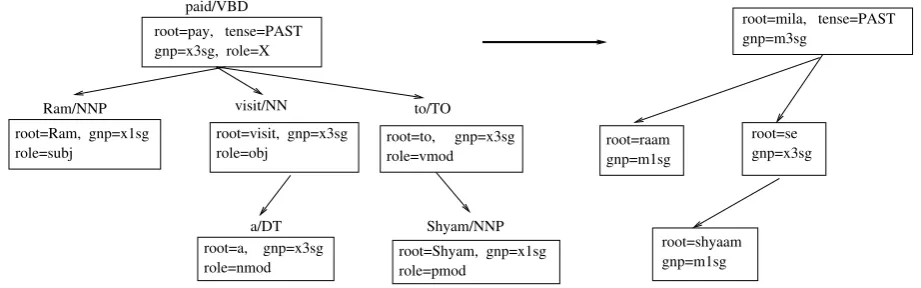
To accomplish this goal, we visualize the prob-lem of MT as transformation from a morpho-logically analyzed source syntactic structure to a
target syntactic structure1 (See Figure 1). The
transformation is factorized into a series of mini-transformations, which we address as features of the transformation. The features denote the vari-ous linguistic modifications in the source structure to obtain the target syntactic structure. Some of the examples of features are lexical translation of a particular source node, the ordering at a particu-lar source node etc. These features can be entirely local to a particular node in the syntactic structure or can span across syntactically related entities. More about the features (or mini-transformations) is explained in section 3. The transformation of a source syntactic structure is scored by taking a
weighted sum of its features 2. Let τ represent
1Note that target structure contains only the target fac-tors. An accurate and deterministic morphological generator combines these factors to produce the target word form.
2The features can be either binary-values or real-valued
the transformation of source syntactic structures,
the score of transformation is computed as repre-sented in Equation 1.
score(τ|s) =X i
wi∗fi(τ, s) (1)
In Equation 1, fi0sare the various features of
transformation andwi0sare the weights of the
fea-tures. The strength of our approach lies in the flex-ibility it offers in incorporating linguistic features that are useful in the task of machine translation.
These features are also known asprediction
fea-turesas they map from source language informa-tion to informainforma-tion in the target language that is being predicted.
During decoding a source sentence, the goal is to choose a transformation that has the high-est score. The source syntactic structure is tra-versed in a bottom-up fashion and the target syn-tactic structure is simultaneously built. We used a bottom-up traversal while decoding because it builds a contiguous sequence of nodes for the sub-trees during traversal enabling the application of a wide variety of language models.
In the training phase, the task is to learn the weights of features. We use an online large-margin training algorithm, MIRA (Crammer et al., 2005), for learning the weights. The weights are locally updated at every source node during the bottom-up traversal of the source structure. For training the translation model, automatically obtained word-aligned parallel corpus is used. We used GIZA++ (Och and Ney, 2003) along with the
growingheuristics to word-align the training cor-pus.
The basic factors of the word used in our exper-iments are root, part-of-speech, gender, number and person. In Hindi, common nouns and verbs have gender information whereas, English doesn’t contain that information. Apart from the basic factors, we also consider the role information pro-vided by labelled dependency parsers. For com-puting the dependency tree on the source side, We used stanford parser (Klein and Manning, 2003) in the experiments presented in this chapter3.
root=mila, tense=PAST gnp=m3sg
root=se gnp=x3sg root=raam
gnp=m1sg
root=shyaam gnp=m1sg root=pay, tense=PAST
gnp=x3sg, role=X paid/VBD
root=Ram, gnp=x1sg Ram/NNP
role=subj
visit/NN
root=visit, gnp=x3sg
role=obj role=vmod
root=to, gnp=x3sg to/TO
root=Shyam, gnp=x1sg role=pmod
Shyam/NNP
root=a, gnp=x3sg role=nmod
[image:3.595.68.529.72.216.2]a/DT
Figure 1: Transformation from source structure to target language
The function words such as prepositions and auxiliary verbs largely express the grammatical roles/functions of the content words in the sen-tence. In fact, in many agglutinative languages, these words are commonly attached to the con-tent word to form one word form. In this pa-per, we also conduct experiments where we begin by grouping the function words with their corre-sponding function words. These groups of words are called local-word groups. In these cases, the function words are considered as factors of the content words. Section 2 explains more about the local word groups in English and Hindi.
2 Local Word Groups
Local word groups (LWGs) (Bharati et al., 1998; Vaidya et al., 2009) consist of a content word and its associated function words. Local word group-ing reduces a sentence to a sequence of content words with the case-markers and tense-markers acting as their factors. For example, consider an English sentence ‘People of these island have adopted Hindi as a means of communication’. ‘have adopted’ is a LWG with root ‘adopt’ and tense markers being ‘have ed’. Another example for the LWG will be ‘of communication’ where ‘communication’ is the root, and ‘of’ is the case-marker. It is to be noted that Local word grouping is different from chunking, where more than one content word can be part of a chunk. We obtain lo-cal word groups in English by processing the out-put of the stanford parser. In Hindi, the function words always appear immediately after the
con-tent word4, and it requires simple pattern
matching to obtain the LWGs. The rules
ap-plied are, (1) VM (RB|VAUX)+, and (2) N.* IN.
3 Features
There are three types of transformation features explored by us, (1) Local Features, (2) Syntactic Features and, (3) Contextual Features. In this sec-tion, we describe each of these categories of fea-tures representing different aspects of transforma-tion with examples.
3.1 Local Features
The local features capture aspects of local
trans-formation of an atomic treelet in the source
structure to an atomic treelet in the target lan-guage. Atomic treelet is a semantically non-decomposible group of one or more nodes in the syntactic structure. It usually contains only one node, except for the case of multi-word expres-sions (MWEs). Figure 2 presents the examples of local transformation.
Some of the local features used by us in our ex-periments are (1)dice coefficient, (2) dice coeffi-cient of roots, (3) dice coefficoeffi-cient of null transla-tions, (4)treelet translation probability, (5) gnp-gnp pair, (5) preposition-postposition pair, (6)
tense-tense pair, (7) part-of-speech fertility etc.
Dice coefficientsandtreelet translation probabil-ities are measures that express the statistical co-occurrence of the atomic treelets.
root=Ram, gnp=x1sg Ram/NNP
role=subj
root=pay, tense=PAST gnp=x3sg, role=X
paid/VBD
visit/NN
root=visit, gnp=x3sg role=obj
root=mila, tense=PAST gnp=m3sg
[image:4.595.95.264.70.180.2]root=raam gnp=m1sg
Figure 2: Local transformations
3.2 Syntactic Features
The syntactic features are used to model the differ-ence in the word orders of the two languages. At every node of the source syntactic structure, these features define the changes in the relative order of children during the process of transformation. They heavily use source information such as part-of-speech tags and syntactic roles of the source nodes. One of the features used isreorderPostags. This feature captures the change in relative po-sitions of children with respect to their parents during the tree transformation. An example fea-ture for the transformation given in Figure 1 is shown in Figure 3.
IN NNP
VB
NNP VB
TO
Figure 3: Syntactic feature - reorder postags
The feature reorderPostagsis in the form of a
complete transfer rule. To handle cases, where the left-hand side of ‘reorderPostags’ does not match the syntactic structure of the source tree, the sim-pler feature functions are used to qualify various reorderings. Instead of using POS tags, feature functions can be defined that use syntactic roles.
Apart from the above feature functions, we can also have features that compute the score of a par-ticular order of children using syntactic language models (Gali and Venkatapathy, 2009; Guo et al., 2008). Different features can be defined that use different levels of information pertaining to the atomic treelet and its children.
3.3 Contextual Features
Contextual features model the inter-dependence of factors of nodes connected by dependency arcs. These features are used to enable access to global information for prediction of target nodes (words and its factors).
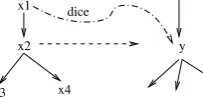
One of the featuresdiceCoeffParent, relates the parent of a source node to the corresponding target node (see figure 4.
x1
x2
x3 x4
[image:4.595.359.461.211.261.2]y dice
Figure 4: Use of Contextual (parent) information ofx2for generation ofy
The use of this feature is expected to address of the limitations of using ‘atomic treelets’ as the ba-sic units in contrast to phrase based systems which consider arbitrary sequences of words as units to encode the local contextual information. In my case, We relate the target treelet with the contex-tual information of the source treelet using feature functions rather than using larger units. Similar features are used to connect the context of a source node to the target node.
Various feature functions are defined to han-dle interaction between the factors of syntacti-cally related treelets. The gender-number-person agreement is a factor that is dependent of gender-number-person factors of the syntactically related treelets in Hindi. The rules being learnt here are simple. However, more complex interac-tions can also be handled though features such as
prep Tensewhere, the case-marker in the target is linked to the tense of parent verb.
4 Decoding
The goal is to compute the most probable target sentence given a source sentence. First, the source sentence is analyzed using a morphological ana-lyzer5, local word grouper (see section 2) and a
dependency parser. Given the source structure, the task of the decoding algorithm is to choose the transformation that has the maximum score.
[image:4.595.75.293.453.492.2]The dependency tree of the source language sentence is traversed in a bottom-up fashion for building the target language structure. At every source node during the traversal, the local trans-formation is first computed. Then, the relative or-der of its children is then computed using the syn-tactic features. This results in a target structure associated with the subtree rooted at the particular node. The target structure associated with the root node of the source structure is the result of the best transformation of the entire source structure.
Hence, the task of computing the best transfor-mation of the entire source structure is factorized into the tasks of computing the best transforma-tions of the source treelets. The equation for com-puting the score of a transformation, Equation 1, can be modified as Equation 2 given below.
score(τ|s) =X r
|r| ∗X i
wi∗fi(τr, r) (2)
where, τj is the local transformation of the
source treelet r. The best transformation τˆ of
source sentencesis,
ˆ
τ = argmaxτ score(τ|s) (3)
5 Training Algorithm
The goal of the training algorithm is to learn the feature weights from the word aligned corpus. For word-alignment, we used the IBM Model 5
imple-mented in GIZA++ along with thegrowing
heuris-tics (Koehn et al., 2003). The gold atomic treelets in the source and their transformation is obtained by mapping the source node to the target using the word-alignment information. This information is stored in the form of transformation tables that is used for the prediction of target atomic treelets, prepositions and other factors. The transformation tables are pruned in order to limit the search and eliminate redundant information. For each source element, only the top few entries are retained in the table. This limit ranges from 3 to 20.
We used an online-large margin algorithm, MIRA (McDonald and Pereira, 2006; Crammer et al., 2005), for updating the weights. During parameter optimization, it is sometimes impossi-ble to achieve the gold transformation for a node because the pruned transformation tables may not
lead to the target gold prediction for the source node. In such cases where the gold transforma-tion is unreachable, the weights are not updated at all for the source node as it might cause erro-neous weight updates. We conducted our exper-iments by considering both the cases, (1) Identi-fying source nodes with unreachable transforma-tions, and (2) Updating weights for all the source nodes (till a maximum iteration limit). The num-ber of iterations on the entire corpus can also be fixed. Typically, two iterations have been found to be sufficient to train the model.
The dependency tree is traversed in a bottom-up fashion and the weights are updated at each source node.
6 Experiments and Results
The important aspects of the translation model proposed in this paper have been implemented. Some of the components that handle word in-sertions and non-projective transformations have not yet been implemented in the decoder, and should be considered beyond the scope of this
paper. The focus of this work has been to
build a working syntax based statistical machine translation system, which can act as a plat-form for further experiments on similar lines. The system would be available for download at http://shakti.iiit.ac.in/∼sriram/vaanee.html. To evaluate this experimental system, a restricted set of experiments are conducted. The experi-ments are conducted on the English-Hindi lan-guage pair using a corpus in tourism domain con-taining 11300 sentence pairs6.
6.1 Training 6.1.1 Configuration
For training, we used DIT-TOURISM-ALIGN-TRAIN dataset which is the word-aligned dataset of 11300 sentence pairs. The word-alignment is done using GIZA++ (Och and Ney, 2003) toolkit
and then growing heuristics are applied. For
our experiments, we use twogrowingheuristics,
FINAL-AND and GROW-DIAG-FINAL as they cover most number of words in both the sides of the parallel corpora.
Number of Training Sentences 500 Iterations on Corpus 1-2 Parameter optimization algorithm MIRA
Beam Size 1-20
[image:6.595.79.281.71.172.2]Maximum update attempts at source node 1-4 Unreachable updates False Size of transformation tables 3
Table 1: Training Configuration
The training of the model can be performed un-der different configurations. The configurations that we used for the training experiments are given in Table 6.1.1.
6.2 Results
For the complete training, the number of sen-tences that should be used for the best perfor-mance of the decoder should be the complete set. In the paper, we have conducted experiments by considering 500 training sentences to observe the best training configuration.
At a source node, the weight vector is itera-tively updated till the system predicts the gold transformation. We conducted experiments by fix-ing the maximum number of update attempts. A source node, where the gold transformation is not achieved even after the maximum updates limit,
the update at this source node is termed aupdate
failure. The source nodes, where the gold trans-formation is achieved even without making any updates is known as thecorrect prediction.
At some of the source nodes, it is not possible to arrive at the gold target transformation because of limited size of the training corpus. At such nodes, we have avoided doing any weight update. As the desired transformation is unachievable, any attempt to update the weight vector would cause noisy weight updates.
We observe various parameters to check the ef-fectiveness of the training configuration. One of the parameters (which we refer to as ‘updateHits’)
computes the number of successful updates (S)
performed at the source nodes in contrast to num-ber of failed updates (F). Successful updates re-sult in the prediction of the transformation that is same as the reference transformation. A failed up-date doesn’t result in the achievement of the
cor-rect prediction even after the maximum iteration limit (see section 6.1.1) is reached. At some of the source nodes, the reference transformations are
unreachable(U). The goal is to choose the
con-figuration that has least number of average failed updates (F) because it implies that the model has been learnt effectively.
UpdateHit
K m P S F U
1. 1 4 1680 2692 84 4081
2. 5 4 1595 2786 75 4081
[image:6.595.325.498.175.264.2]3. 10 4 1608 2799 49 4081 4. 20 4 1610 2799 47 4081
Table 2: Training Statistics - Effect of Beam Size
From Table 2, we can see that the bigger beam size leads to a better training of the model. The beam size was varied between 1 and 20, and the number of update failures (F) was observed to be
least at K=20.
UpdateHit
K m P S F U
1. 20 1 1574 2724 158 4081 2. 20 2 1598 2767 91 4081 3. 20 4 1610 2799 47 4081
Table 3: Training Statistics - Effect of maximum update attempts
In Table 3, we can see that an higher limit on the maximum number of update attempts results in less number of update attempts as expected. A
much higher value ofmis not preferable because
the training updates makes noisy updates in case ofdifficultnodes i.e., the nodes where target trans-formation is reachable in theory, but is unreach-able given the set of features.
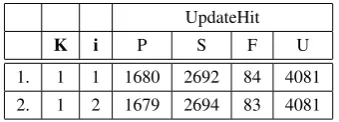
UpdateHit
K i P S F U
1. 1 1 1680 2692 84 4081 2. 1 2 1679 2694 83 4081
Table 4: Training Statistics - Effect of number of iterations
[image:6.595.322.501.370.445.2] [image:6.595.327.497.609.670.2]it-erations on the quality of the model. In table 4, we can observe that the number of iterations on the data has no effect on the quality of the model. This implies, that the model is adequately learnt after one pass through the data. This is possible because of the multiple number of update attempts allowed at every node. Hence, the weights are up-dated at a node till the model prediction is consis-tent with the gold transformation.
Based on the above observations, we consider the configuration 4 in Table 2 for the decoding ex-periments.
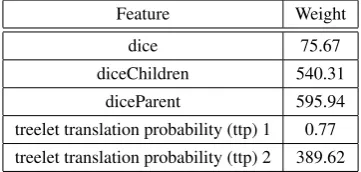
Now, we present some of the top features weights leant by the best configuration. The weights convey that important properties of trans-formation are being learnt well. Table 5 presents the weights of the features ‘diceRoot’, ‘dice-RootChildren’ and ‘diceRootParent’.
Feature Weight
dice 75.67
diceChildren 540.31
diceParent 595.94
[image:7.595.342.479.177.238.2]treelet translation probability (ttp) 1 0.77 treelet translation probability (ttp) 2 389.62
Table 5: Weights of dice coefficient based features
We see that the dice coefficient based local and contextual features have a positive impact on the selection of correct transformations. A feature that uses a syntactic language model to compute the perplexity per word has a negative weight of -1.115.
Table 6 presents the top-5 entries of contex-tual features that describe the translation of source argument ’nsubj’ using contextual information (‘tense’ of its parent).
Feature Weight
roleTenseVib:nsubj+NULL NULL 44.194196513246 roleTenseVib:nsubj+has VBN ne 14.4541356715382 roleTenseVib:nsubj+VBD ne 10.9241093097953 roleTenseVib:nsubj+VBP meM 6.14149937079584 roleTenseVib:nsubj+VBP NULL 4.76795730621754
Table 6: Top weights of a contextual feature : preposition+Tense-postposition
Table 7 presents the top-10 ordering relative po-sition feature where the head word is a verb. In this feature, the relative position (left or right) of the head and the child is captured. For example, a feature ‘relPos:amod-NN’, if active, conveys that an argument with the role ‘amod’ is at the left of a head word with POS tag ‘NN’.
Feature Weight
relPos:amod-NN 6.70
relPos:NN-appos 1.62
relPos:lrb-NN 1.62
Table 7: Top weights ofrelPosfeature
6.3 Decoding
We computed the translation accuracies using two metrics, (1) BLEU score (Papineni et al., 2002), and (2) Lexical Accuracy (or F-Score) on a test set of 30 sentences. We compared the accuracy of the experimental system (Vaanee) presented in this paper, with Moses (state-of-the-art translation system) and Shakti (rule-based translation system
7) under similar conditions (with using a
develop-ment set to tune the models). The rule-based sys-tem considered is a general domain syssys-tem tuned to the tourism domain. The best BLEU score for Moses on the test set is0.118, and the best
lexi-cal accuracy is0.512. The best BLEU score for
Shakti is 0.054, and the best lexical accuracy is 0.369.
In comparison, the best BLEU score of Vaanee is0.067, while the best lexical accuracy is0.445. As observed, the decoding results of the experi-mental system mentioned here are not yet compa-rable to the state-of-art. The main reasons for the low translation accuracies are,
1. Poor Quality of the dataset
The dataset currently available for English-Hindi language pair is noisy. This is an extremely large limiting factor for a model which uses rich linguistic information within the statistical framework.
2. Low Parser accuracy
[image:7.595.90.271.329.415.2]The parser accuracy on the English-Hindi dataset is low, the reasons being, (1) Noise, (2) Length of sentences, and (3) Wide scope of the tourism domain.
3. Word insertions not implemented yet
4. Non-projectivity not yet handled
5. BLEU is not an appropriate metric
BLEU is not an appropriate metric (Anan-thakrishnan et al., ) for measuring the trans-lation accuracy into Indian languages.
6. Model is context free as far as targets words are concerned. Selection depends on chil-dren but not parents and siblings
This point concerns the decoding algorithm. The current algorithm is greedy while chos-ing the best translation at every source node. It first explores the K-best local transforma-tions at a source node. It then makes a greedy selection of the predicted subtree based on it’s overall score after considering the predic-tions at the child nodes, and the relative posi-tion of the local transformaposi-tion with respect the predictions at the child nodes.
The problem in this approach is that, an er-ror once made at a lower level of the tree is propogated to the top, causing more mis-takes. A computationally reasonable solution to this problem is to maintain a K-best list of predicted subtrees corresponding to every source node. This allows rectification of a mistake made at any stage.
The system, however, performs better than the rule based system. As observed earlier, the right type of information is being learnt by the model, and the approach looks promising. The limitations expressed here shall be addressed in the future.
7 Conclusion
In this work, we presented a syntax based de-pendency model to effectively handle problems in translation from English to Indian languages such as, (1) Large word order variation, and (2) Ac-curate generation of word-forms in the target lan-guage by predicted the word and its factors. The
model that we have proposed, has the flexibility of adding rich linguistic features.
An experimental version of the system has been implemented, which is available for download at http://shakti.iiit.ac.in/∼sriram/vaanee.html. This
can facilitate as a platform for future research in syntax based statistical machine translation from English to Indian languages. We also plan to per-form experiments using this system between Eu-ropean languages in future.
The performance of the implemented transla-tion system, is not yet comparable to the state-of-art results primarily for two reasons, (1) Poor quality of available data, because of which our model which uses rich linguistic information doesn’t perform as expected, and (2) Components for word insertion and non-projectivity handling are yet to be implemented in this version of the system.
References
Ananthakrishnan, R, B Pushpak, M Sasikumar, and Ritesh Shah. Some issues in automatic evaluation of english-hindi mt: more blues for bleu. ICON-2007.
Ananthakrishnan, R., Jayprasad Hegde, Pushpak Bhat-tacharyya, and M. Sasikumar. 2008. Simple syntac-tic and morphological processing can help english-hindi statistical machine translation. InProceedings of IJCNLP-2008. IJCNLP.
Bharati, Akshar, Vineet Chaitanya, Amba P Kulkarni, and Rajeev Sangal. 1997. Anusaaraka: Machine translation in stages.A Quarterly in Artificial Intel-ligence, NCST, Bombay (renamed as CDAC, Mum-bai).
Bharati, Akshar, Medhavi Bhatia, Vineet Chaitanya, and Rajeev Sangal. 1998. Paninian grammar framework applied to english. South Asian Lan-guage Review, (3).
Bharati, Akshar, Rajeev Sangal, Dipti M Sharma, and Amba P Kulkarni. 2002. Machine translation activ-ities in india: A survey. InProceedings of workshop on survey on Research and Development of Machine Translation in Asian Countries.
Crammer, K., R. McDonald, and F. Pereira. 2005. Scalable large-margin online learning for structured classification. Technical report, University of Penn-sylvania.
Gali, Karthik and Sriram Venkatapathy. 2009. Sen-tence realisation from bag of words with depen-dency constraints. InProceedings of Human Lan-guage Technologies: The 2009 Annual Conference of the North American Chapter of the Association for Computational Linguistics, Companion Volume: Student Research Workshop and Doctoral Consor-tium, pages 19–24, Boulder, Colorado, June. Asso-ciation for Computational Linguistics.
Guo, Yuqing, Josef van Genabith, and Haifeng Wang. 2008. Dependency-based n-gram models for gen-eral purpose sentence realisation. In Proceedings of the 22nd International Conference on Compu-tational Linguistics (Coling 2008), pages 297–304, Manchester, UK, August. Coling 2008 Organizing Committee.
Ittycheriah, Abraham and Salim Roukos. 2007. Di-rect translation model 2. InHuman Language Tech-nologies 2007: The Conference of the North Amer-ican Chapter of the Association for Computational Linguistics; Proceedings of the Main Conference, pages 57–64, Rochester, New York, April. Associa-tion for ComputaAssocia-tional Linguistics.
Klein, Dan and Christopher D. Manning. 2003. Ac-curate unlexicalized parsing. InProceedings of the 41st Annual Meeting of the Association for Com-putational Linguistics, pages 423–430, Sapporo, Japan, July. Association for Computational Linguis-tics.
Koehn, Philipp and Hieu Hoang. 2007. Factored translation models. InProceedings of the 2007 Joint Conference on Empirical Methods in Natural guage Processing and Computational Natural Lan-guage Learning (EMNLP-CoNLL), pages 868–876. Koehn, P., F. J. Och, and D. Marcu. 2003. Statistical phrase-based translation. InProceedings of the Hu-man Language Technology Conference 2003 (HLT-NAACL 2003), Edmonton, Canada, May.
Liang, P., A. Bouchard-Cote, D. Klein, and B. Taskar. 2006. An end-to-end discriminative approach to machine translation. In International Conference on Computational Linguistics and Association for Computational Linguistics (COLING/ACL). McDonald, R. and F. Pereira. 2006. Online learning
of approximate dependency parsing algorithms. In
EACL.
Och, F.J. and H. Ney. 2003. A systematic comparison of various statistical alignment models. Computa-tional Linguistics, 29(1):19–51.
Papineni, Kishore, Salim Roukos, Todd Ward, and W.J. Zhu. 2002. Bleu: A method for automatic eval-uation of machine translation. In Proceedings of 40thAnnual Meeting of the Association of Compu-tational Linguistics, pages 313–318, Philadelphia, PA, July.
Quirk, Chris, Arul Menezes, and Colin Cherry. 2005. Dependency treelet translation: Syntactically in-formed phrasal SMT. In Proceedings of the 43rd Annual Meeting of the Association for Computa-tional Linguistics (ACL’05), pages 271–279, Ann Arbor, Michigan, June. Association for Computa-tional Linguistics.
Ramanathan, Ananthakrishnan, Hansraj Choudhary, Avishek Ghosh, and Pushpak Bhattacharyya. 2009. Case markers and morphology: Addressing the crux of the fluency problem in english-hindi smt. In Pro-ceedings of ACL-IJCNLP 2009. ACL-IJCNLP.
Shen, Libin, Jinxi Xu, Bing Zhang, Spyros Matsoukas, and Ralph Weischedel. 2009. Effective use of lin-guistic and contextual information for statistical ma-chine translation. InProceedings of the 2009 Con-ference on Empirical Methods in Natural Language Processing, pages 72–80, Singapore, August. Asso-ciation for Computational Linguistics.
Vaidya, Ashwini, Samar Husain, Prashanth Reddy, and Dipti M Sharma. 2009. A karaka based annotation scheme for english. InProceedings of CICLing , 2009.
Wu, Dekai. 1997. Stochastic Inversion Transduction Grammars and Bilingual Parsing of Parallel Cor-pora. Computational Linguistics, 23(3):377–404.