Identifying Events using Similarity and Context
Dominic R. Jones and Cynthia A. Thompson
School of Computing
University of Utah
Salt Lake City, UT 84103
[email protected]
,
[email protected]
Abstract
As part of our work on automatically build-ing knowledge structures from text, we apply machine learning to determine which clauses from multiple narratives describing similar sit-uations should be grouped together as descrip-tions of the same type of occurrence. Our approach to the problem uses textual similar-ity and context from other clauses. Besides training data, our system uses only a partial parser as outside knowledge. We present re-sults evaluating the cohesiveness of the aggre-gated clauses and a brief overview of how this work fits into our overall system.
1
Introduction
Early work in natural language processing included am-bitious research on the representation and use of informa-tion about commonly experienced situainforma-tions (Schank and Riesbeck, 1981). The concept of a script was introduced in this research, to explain how people understand these situations and make inferences about them. A script is a stereotypical sequence of events that occur as part of a larger situation and can be used to infer missing de-tails from a partial description of the larger occurrence, in essence providing a means for extracting information that is not actually present in a text.
Research on scripts includes demonstrations of hand built scripts (Cullingford, 1978) and sketchy scripts (De-Jong, 1982) and the adjustment of hand-built scripts using a genetic algorithm (Mauldin, 1989). Work on learning schemata under constrained circumstances (Mooney and DeJong, 1985) pursues similar goals.
Our research has indicated that scripts may not explic-itly occur in common types of text, such as newspaper stories or incident reports. Other research also appears to
support this conclusion (Clark and Porter, 1995). There-fore, we are investigating event correlations as a more appropriate and extractable knowledge structure. In gen-eral, it appears that long event sequences do not reliably recur in our data. We instead look for reliable correlations between a small number of events.
Our goal is to automatically extract correlated events from text, using only a partial parser as outside infor-mation. To support this goal, we need to group clauses from distinct texts into coherent events, handling several sources of variety in descriptions of the same type of oc-currence. Synonymy and abbreviations are two common contributors. A more important phenomenon is the ex-istence of semantic categories keyed to the events them-selves. A number of different objects may participate in an event, and yet have dissimilarities that place them in different conventional semantic categories. For example, a tree and a parked vehicle may both be collided with in different aircraft crashes, yet it is difficult to conceive of a reasonably specific semantic category that contains both. Each is a physical object, yet there are a large number of other physical objects that would not reasonably partici-pate in a crash in the same way (books, hamburgers, and moons are a few examples).
As a result of these phenomena, conventional semantic lexicons, whether hand built or automatically generated, differ from our work in two regards. First, they group words, not clauses. Second, they use pre-defined seman-tic categories instead of contextual relevance.
Our answer to this problem is a technique that uses textual similarity and context from neighboring events to decide when to group clauses. The only outside resource we use is a partial parser. Our technique takes parsed text and partially built event sequences and uses them to group clauses that represent the same event.
formation technique using human judges’ ratings of the cohesiveness of the resulting events. Finally, we discuss areas of related work before concluding the paper.
2
An Event Correlation Learning System
To understand the event formation process, some back-ground on our larger system is useful. That sys-tem, SPANIEL (Sequence Processing and ANalysis for Inference Enhancement and Learning), attempts to learn ordered correlations between events from a corpus of parsed narratives.1 We assume that the narratives all de-scribe related, but not necessarily identical, situations. An event is a particular atomic occurrence described by a single clause. SPANIELuses a statistical model to identify correlations. Our overall goal is to capture significant cor-relations between events. We provide an overview here, and will discuss the details in a future paper.
Briefly, SPANIEL uses a modified Markov model to capture correlations. The model attempts to capture a se-quence identifying the significant events in a text. Our modification to Markov chaining captures the fact that events can be conditioned on a prior event that occurs several clauses distant, instead of on direct sequential de-pendence between events.
After the training data is parsed, SPANIEL creates a
graph from individual clauses. This graph is meant to capture the semantically important information from each clause in the training texts. The nodes in the graph are created from the actual clauses, with the arcs in the graph indicating which clauses occur together in a text, and in what order. Events are built from the nodes in the graph, with the arcs providing the starting point for correlations between events.
We convert the parsed text to graph nodes using a frame representation. Each frame contains four slots. Three primary slots represent the agent, the action, and the theme of the clause. The agent and action slot fillers are straightforward: the agent slot takes a noun phrase that was tagged as the clause’s subject by the parser, and the action slot takes the clause’s verb phrase. The theme slot is more flexible, and can be filled by a noun phrase, prepositional phrase, or adjective phrase that follows the verb. Noun phrases tagged as the direct object have pri-ority, but the first prepositional or adjective phrase can serve as the filler in the absence of a direct object.2 A fourth slot is only filled if the system identifies a depen-dent clause through the presence of a clause marker or the absence of a theme (e.g. “She reported she was hav-ing control problems.”). Words are not stemmed, except
1
Following previous authors, we use narrative instead of
story to refer to a text, indicating that we do not expect to find a
full plot structure. 2
Passive verbs result in rearrangement of the fillers.
in two special cases described later.
The three primary slots are filled by a head and a mod-ifier. The head is the head word of the appropriate phrase. Prepositional phrases also concatenate the preposition to the head. Verb phrases include all verbs from the phrase, along with particles. The modifier is a concatenation of all adjectives, adverbs, and other nouns. Two examples of sentences and the resulting frames are given in Figure 1.
We define three functions over the graph. These func-tions allow us to both detect correlafunc-tions between events, and identify when nodes might represent the same event. First, the cooccurrence of two nodes,C(Ni, Nj), is the
number of narratives in whichNioccurs beforeNj, and
thus quantifies each arc. Ni andNj do not have to be
neighbors: any number of other clauses could have sepa-rated them. Cooccurrence is directional: C(Ni, Nj)is
not the same as C(Nj, Ni). Next, two nodes Ni and
Njmatch, denotedM(Ni, Nj), if their frames are
iden-tical.3 Finally, two nodesN
iandNjare similar, denoted
S(Ni, Nj), if they demonstrate a certain degree of textual
similarity. This function plays an important role in event creation, and we define it in detail in the next section.
Given this graph, SPANIELuses a beam search to de-tect correlations of multiple events by incrementally ex-panding a sequence of events that occur frequently to-gether. As of this writing, most resulting correlations in-clude only a pair of events, with rare sequences of three events. Our goal is to find such correlations with min-imal domain-specific knowledge. Thus, SPANIEL must create events from individual nodes as it expands event sequences. We describe this event formation process, the heart of this paper, in the next section.
3
Event Construction and Revision
The goal of event formation is to identify nodes that can play the same role within a domain. Event formation starts with a single node, identified as a potential part of a correlation, and attempts to expand this simple event by adding additional nodes. This process is unsupervised, so we restrict the search by defining two criteria that nodes must meet to be included in the same event. First, the Similarity criterion states that each node in an event must be textually similar to at least one other node in the event. Therefore, a node must be similar to at least one node that is already part of an event in order to be added to the event. Second, the InSeq criterion states that each node in the event must occur, in the appropriate order, with at least one node in each of the event’s immediate neighbors in the sequence.
Similarity is determined by a functionS(Ni, Nj)that
indicates whether two nodes share sufficient textual
fea-3
The pilot reported that he was running out of fuel.
DC: null
AGENT: AIRCRAFT ACTION: CRASHED THEME: INTO_GROUND
DC:
AGENT: PILOT ACTION: REPORTED THEME: null
DC: null AGENT: HE
ACTION: WAS_RUNNING_OUT THEME: OF_FUEL
[image:3.612.329.522.239.351.2]The aircraft crashed into the ground.
Figure 1: Example Frames
ACTION: IMPACTED THEME: TREES DC: null
AGENT: AIRPLANE ACTION: IMPACTED THEME: HILL DC: null AGENT: AIRPLANE
Figure 2: Textually Similar Nodes
tures. Two nodes satisfy this function if two of their three primary slots share heads, with some exceptions described below. Empty fillers are not considered simi-lar. In addition, the nodes must have similar dependent clauses (identified by recursively applying the same cri-teria). Null fillers for this slot are considered similar. An example of two textually similar nodes is given in Fig-ure 2.
Two exceptions to this general definition handle nom-inalizations and “to be.” First, if two nodes’ actions do not match, but the stemmed head of one node’s action matches the stemmed head of the other node’s theme, the nodes are considered similar. Second, if the stemmed form of a node’s action is “to be”, the action is ignored in determining similarity. Therefore, the node’s agent and theme must match the other node for the nodes to be sim-ilar.
The second criteria for adding nodes to events, In-Seq, ensures that all nodes in an event occur in simi-lar contexts. Within a correlation, we call events im-mediately prior to or following a given event its neigh-bors. Neighbors provide contextual information indicat-ing which nodes occur in similar places in narratives. The InSeq constraint states that for a node to be added to an event, it must cooccur at least once with each of that event’s neighbors in the proper order. To test for this cooccurrence, we extend the definition of cooccurrence to apply to mixed node and event arguments. ThusC(N, E) orC(E, N)is the number of times nodeNcooccurred in the training data with any node from eventE. The order in which the arguments are given is the order in which
C(N3,E3) = 1 C(N1,N3) = 1
S(N2,N3) = true
C(N2,N4) = 1 C(N1,N4) = 2
N1 N4
N3 N2 C(N1,N2) = 1
E1 E3
E2
C(N3,N4) = 1
C(E1,N2) = 1 C(E1,N3) = 1
C(N2,E3) = 1
Figure 3: Example of Acceptable Node Pair
they must appear to count.
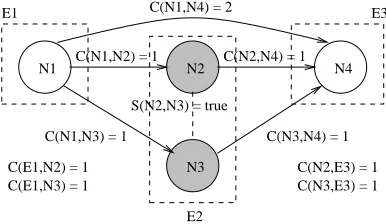
An example of two nodes (N2 andN3) that meet our two criteria is given in Figure 3. The two nodes are both textually similar (S(N2, N3) =true) and have the same context (C(E1, N2),C(E1, N3),C(N2, E3), and
C(N3, E3)are all greater than zero), so they can be com-bined into one eventE2.
Event formation is divided into two algorithms. The first, AUGMENT, adds nodes to an event based on the context provided by one neighbor. The second, REVISE, removes nodes that do not meet the InSeq criterion when an event acquires a second neighbor through further cor-relation expansion.
3.1 The AUGMENTAlgorithm
The job of the AUGMENT algorithm is to form a new event and add it to the front or back of a correlation. Therefore the new event initially has one neighboring event. Each new event is initialized from a single node, and AUGMENTadds all nodes that meet both the Similar-ity and InSeq criteria to this node.
Input:seed, a seed node,B, a neighbor event Output: the augmented event,E
Function AUGMENT(seed,B)
E={seed}
∀Ns.t.∃M ∈E, S(N, M)
ifC(N, B)>0then
ifC(N, B)>(C(N, E) +C(E, N))then
E=E∪N
returnE
Figure 4: AUGMENTAlgorithm Pseudocode
nodes are likely to actually represent different events.4To avoid adding to an event a node that actually represents a different type of occurrence, we bias the cooccurrence function to penalize events that contain multiple nodes from the same narrative.
SPANIEL employs the AUGMENT algorithm, illus-trated in Figure 4, each time it evaluates the addition of a new event to a sequence. The new event is seeded with an initial node, and AUGMENTthen checks each node that is similar to the event. If the node occurs at least once with the neighboring event and does not occur more frequently with the event being augmented, the algorithm adds the node to the event. We show the pseudocode for augmen-tation at the beginning of a sequence; augmenaugmen-tation at the conclusion of a sequence is analogous, withC(N, B) replaced byC(B, N)in all cases.
Two special cases bootstrap event formation when a correlation of two events is first created. First, AUGMENT
allows the InSeq criterion to be fulfilled by cooccurrence with a node similar to the existing neighbor, since that neighbor initially consists of a single node. Second, since that neighbor also previously had no context to constrain it, AUGMENTis also called on the neighbor.
3.2 The REVISEAlgorithm
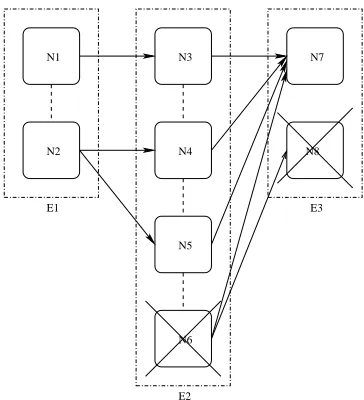
As previously mentioned, AUGMENTonly has one neigh-bor against which to enforce the InSeq criterion. Fulfill-ment of the criterion using one neighbor does not ensure that the node will be acceptable given a second neighbor. Therefore, if a second neighbor to this event is added to the sequence, the REVISEalgorithm removes nodes that fail to remain acceptable. Figure 5 illustrates the situa-tion with a sequence containing three events, the new one having just been added at the front of the sequence. Each node in the new event meets the InSeq criterion, but now a node in its neighbor does not. REVISEremoves such nodes from events. Any removals from the first event re-vised may also warrant removals from the next neighbor in the sequence and so on. Therefore, SPANIEL applies REVISEto each existing node in the sequence in order,
4
This does not mean that identical events cannot occur in a sequence.
N6 N5 N4
N3 N7
N1
N2
E1
E2
N8
[image:4.612.335.517.68.268.2]E3
Figure 5: Example of an InSeq Violation
Input: An event sequence,S=< E1, E2, . . . , En> Output: An event sequence respecting InSeq Function REVISE(S)
modified = true
i= 2
while (modified &&i≤n) modified = false
∀X ∈Ei
ifC(Ei
−1, X) = 0then
Ei=Ei\X modified = true if|Ei|= 0then
return failure
i++
returnS=< E1, . . . , En>
Figure 6: REVISEAlgorithm Pseudocode
starting with the event neighboring the new event. REVISE(see Figure 6 for the pseudocode) checks that all nodes in an event are still valid members, given the context provided by a new neighbor. If the algorithm re-moves any nodes from the event, it proceeds to check the next event in order. The pseudocode presents this order-ing from left to right, as when an event is added to the front end of the correlation. The reverse traversal is anal-ogous, with the loop proceeding fromn−1down to 1 instead of from 2 up ton, wherenis the length of the se-quence. Note that the first (respectively last) event does not need to be checked, as AUGMENTensures the InSeq criterion for this event with its single neighbor.
REVISEcan have one additional effect. If revision re-sults in any event having no nodes, the proposed event addition fails. In other words, the new event is inconsis-tent with the rest of the correlation.
that contains all nodes that are similar to the original node and that cooccur with the neighboring event in the se-quence. Since AUGMENTworks on an event that has only one neighbor, REVISE checks these constraints when a second neighbor is added next to an event. Together, the algorithms enforce the two criteria we use to define events.
4
Evaluation
Automatic evaluation of individual events would be dif-ficult, since they primarily have meaning in the context of a specific correlation. Therefore, we primarily employ manual evaluation. In addition, we describe a series of ablation tests that illustrate why events and our two event formation criteria are needed.
To conduct the evaluation, we applied SPANIEL to a corpus of narratives from the National Transportation Safety Board’s online database of summaries of aviation accidents. This database, as of our experiments, contains more than 43,000 texts. We sampled five sets of approx-imately 4,300 texts each, and subdivided these sets with eighty percent of the sample used for training and twenty percent used for testing.
4.1 Event Cohesion
To evaluate event generation, we presented human judges with events acquired by our system and asked them to score each event by assessing the nodes’ concurrence in describing an identifiable type of occurrence. The judges were asked to apply the following procedure:
1. Read all nodes in the event, and determine what oc-currence the nodes describe.
2. Read all the nodes again, with the dominant concept of the occurrence in mind. For each node, assign a score of one if the node matches the concept or zero otherwise.
3. For each event, total the scores of the nodes. This gives a score for the event.
The first step is asks the judge to choose the dominant concept of each event based on their interpretation of the nodes. The second and third steps assign a score to each event based on the nodes it contains. We then divide this score by the number of nodes in the event to give a per-centage of nodes that match the dominant concept of the occurrence represented by the event. We call these the conforming nodes.
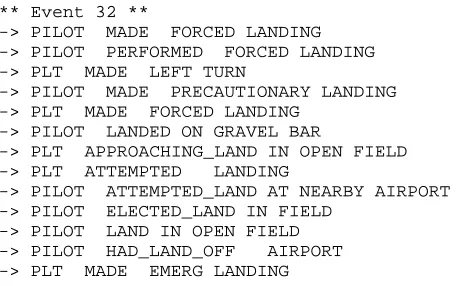
We used two human judges, both of whom have back-grounds in computer science and aviation. Each judge was given the same set of results from the learning sys-tem, with each two event correlation separated into in-dividual events. An example of an event, printed as the
** Event 32 **
-> PILOT MADE FORCED LANDING
-> PILOT PERFORMED FORCED LANDING
-> PLT MADE LEFT TURN
-> PILOT MADE PRECAUTIONARY LANDING
-> PLT MADE FORCED LANDING
-> PILOT LANDED ON GRAVEL BAR
-> PLT APPROACHING_LAND IN OPEN FIELD
-> PLT ATTEMPTED LANDING
-> PILOT ATTEMPTED_LAND AT NEARBY AIRPORT
-> PILOT ELECTED_LAND IN FIELD
-> PILOT LAND IN OPEN FIELD
-> PILOT HAD_LAND_OFF AIRPORT
[image:5.612.314.542.69.212.2]-> PLT MADE EMERG LANDING
Figure 7: Example Learned Event
System Judge 1 Judge 2 Baseline 0.623 0.696 Learned 0.925 0.930
Table 1: Evaluation Results
judges received it, is given in Figure 7. We generated correlations from the five different data sets, and blindly chose one set to give the judges. Figure 10 gives the dis-tribution of the number of nodes in each event.
To provide a baseline, ten percent of the events pre-sented to the judges were generated by probabilisti-cally choosing a set of random nodes from the graph, with more frequent nodes chosen with higher probabil-ity. Each random event contains between two and ten nodes. The judges were not informed of this procedure, and thus we can obtain a measure of their scoring applied to a randomly generated event.
In Table 1, we give the mean fraction of conforming nodes for our event generation algorithm and the random baseline.5
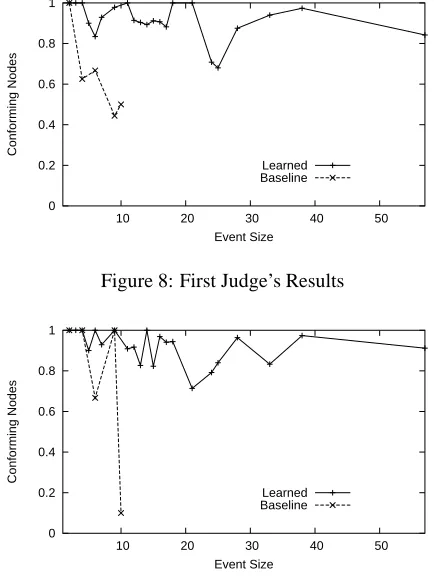
We present more detailed results in two graphs, one for the results from each judge, in Figure 8 and Figure 9. We plot both the baseline and the learned results, giving the fraction of nodes that were judged conforming versus the size of the event in nodes. Where more than one event had the same number of nodes, we plot the mean conforming node fraction for the events. These graphs give an indi-cation of the cohesiveness of the events as the size of the events increases. The cohesiveness of the learned events does not appear to drop dramatically as the size of the events increases, whereas the the baseline’s performance does appear to decrease.
5
0 0.2 0.4 0.6 0.8 1
10 20 30 40 50
Conforming Nodes
Event Size Learned Baseline
Figure 8: First Judge’s Results
0 0.2 0.4 0.6 0.8 1
10 20 30 40 50
Conforming Nodes
[image:6.612.303.543.77.215.2]Event Size Learned Baseline
Figure 9: Second Judge’s Results
4.2 Ablation Testing
We also evaluated the utility of events by eliminating SPANIEL’s ability to acquire events. The ablated ver-sion of SPANIEL can only learn correlations of nodes, not events. We used the same five sets of training texts as input to the ablated system. The full system learned between 22 and 28 correlations meeting a probability threshold corresponding to approximately 12 occurrences in the training set, while the ablated system learned be-tween zero and two correlations with the same probabil-ity.
We also ablated SPANIELby removing each of the two criteria, Similarity and InSeq, individually. Removing ei-ther criteria rendered the system computationally infea-sible to run. Neither version could expand even a sin-gle sequence in a reasonable amount of time. This phe-nomenon appears to be the result of two similar causes. If the InSeq criterion is disabled, the system encounters a chain reaction caused by similar nodes. Each time a node is added to an event, more nodes become similar to the event, causing uncontrolled expansion. If the Similarity criterion is disabled, any node that occurs in the proper order with the neighboring event can be added to the event. Since cooccurrence ignores intervening clauses, a potentially huge number of nodes can cooccur with an event, again causing uncontrolled expansion. These
re-0 1 2 3 4 5
10 20 30 40 50
# of Events
Event Size
[image:6.612.74.291.78.366.2]Learned Random
Figure 10: Event Sizes
sults support our hypothesis that, since event formation is an unsupervised process, it must be somewhat conserva-tive to avoid allowing excessive noise into events.
5
Related Work
Two lines of research are relevant to this work. First, our research is based on research into scripts. Second, re-cent work in semantic lexicon learning is similar to our work, although it focuses on learning related words, not related clauses. In addition, extraction patterns and case frames bear some resemblance to our events. Riloff and Schmelzenbach’s work (1998) is an example of this line of research. However, events use contextual information about other events, unlike extraction patterns and case frames.
The idea of a script originated with Schank and Abel-son (1977) through research on human knowledge struc-tures, and was demonstrated in the SAM system (Culling-ford, 1978). Later work includes manual creation of a va-riety of knowledge structures including scripts to under-stand stories (Lehnert et al., 1983), application of man-ually generated scripts to the processing of newswire stories (DeJong, 1982), and a combination of apply-ing manually generated scripts to information retrieval and applying genetic algorithms to adjusting existing scripts (Mauldin, 1989).
Rooth et al. (1999) used clustering to create clusters sim-ilar to Levin verb classes (Levin, 1993). Pereira, Tishby and Lee (1993) clustered words according to context.
6
Conclusion
Both of our criteria play essential roles in the event gen-eration process. Using similarity alone would combine all clauses that, while similar on the surface, actually are referring to different types of occurrences. Using context alone would combine all clauses encountered in the same position relative to some other clause. Either approach al-lows excessive noise to contaminate the resulting events. Our event generation technique is an essential part of SPANIEL, our event correlation learning system.
With-out a means for combining nodes, the system would be unable to generalize between different authors’ descrip-tions of occurrences, unless they used exactly the same terminology. While standardized lexicons have been in-vestigated (Kamprath et al., 1998), their use has not be-come common. Therefore, competent event generation is required for success in detecting event correlations.
In addition to their role in event correlations, events could be used as information extraction tools. Using mul-tiple fillers from different nodes for two primary slots makes the event potentially useful as a pattern for extract-ing fillers for the third slot from specific documents.
Our results show that this technique for generating events produces encouragingly coherent events and out-performs randomly grouping nodes. Our technique for exploiting the training texts during event generation is relatively simple. Possible future work includes testing other algorithms for combining nodes, such as standard clustering techniques. In summary, we have defined an interesting problem and provided useful insight into its solution, which furthers our research into learning event correlations.
7
Acknowledgements
We would like to thank Robert Cornell and Donald Jones for evaluating our system.
References
Peter Clark and Bruce Porter. 1995. Constructing scripts from components: Working note 6. Unpublished manuscript, University of Texas at Austin.
Richard Cullingford. 1978. Script Application: Com-puter Understanding of Newspaper Stories. Ph.D. the-sis, Yale University, New Haven, Connecticut.
Gerald DeJong. 1982. An overview of the FRUMP sys-tem. In Wendy Lehnert and Martin Ringle, editors, Strategies for Natural Language Processing. Lawrence Erlbaum Associates, Hillsdale, New Jersey.
Christiane Fellbaum, editor. 1998. WordNet, An Elec-tronic Lexical Database. MIT Press.
Christine Kamprath, Eric Adolphson, Teruko Mitamura, and Eric Nyberg. 1998. Controlled language for mul-tilingual document production: Experience with cater-pillar technical english. In Proceedings of the Second International Workshop on Controlled Language Ap-plications (CLAW ’98).
Wendy Lehnert, Michael Dyer, Peter Johnson, C J Yang, and Steve Harley. 1983. BORIS — an experiment in in-depth understanding of narratives. Artificial Intelli-gence, 20:15–62.
Beth Levin. 1993. English Verb Classes and Alterna-tions: A Preliminary Investigation. The University of Chicago Press, Chicago, IL.
Dekang Lin. 1998. Automatic retrieval and clustering of similar words. In Proceedings of COLINGACL ’98, Montreal, Canada, August.
Michael L. Mauldin. 1989. Information Retrieval by Text Skimming. Ph.D. thesis, Carnegie Mellon University, Pittsburgh, PA.
Raymond Mooney and Gerald DeJong. 1985. Learning schemata for natural language processing. In Proceed-ings of IJCAI-85.
Fernando Pereira, Naftali Tishby, and Lillian Lee. 1993. Distributional clustering of english words. In Proceed-ings of ACL-93.
William Phillips and Ellen Riloff. 2002. Exploiting strong syntactic heuristics and co-training to learn se-mantic lexicons. In Proceedings of EMNLP-2002.
Ellen Riloff and Mark Schmelzenbach. 1998. An em-pirical approach to conceptual case frame acquisition. In Proceedings of the Sixth Workshop on Very Large Corpora.
Mats Rooth, Stefan Riezler, Detlaf Prescher, Glenn Car-roll, and Franz Beil. 1999. Inducing a semantically an-notated lexicon via em-based clustering. In Proceed-ings of ACL-99.
Roger Schank and Robert Abelson. 1977. Scripts, Plans, Goals and Understanding: An Inquiry into Human Knowledge Structures. Lawrence Erlbaum Associates, Hillsdale, New Jersey.
Roger Schank and Christopher Riesbeck, editors. 1981. Inside Computer Understanding: Five Programs Plus Miniatures. Lawrence Erlbaum Associates, Hillsdale, New Jersey.