IMPROVED HYBRID DECISION BASED SWITCHING MEDIAN FILTER USING SOFT COMPUTING
*,1
Sarmandip Kaur
1
M.Tech Scholar, ACET Manawala Amritsar
2
Assistant Professor, ACET, Manawala, Asr
ARTICLE INFO ABSTRACT
De-noising an image is major area of research in the field of image processing. Many techniques has been proposed so far for removing the noise from image in more optimistic manner. However no method is best for high density of noise and for preserving the edges. This paper has proposed a new technique that preserves edges and also removes the noise fr
decision tree structure to replace the noisy pixel in given window. The proposed technique is to be effective as it will replace the noisy pixel with its best suitable alternative which is evaluated using negative sel
technique outperforms over the available techniques.
Copyright © 2015 Sarmandip KaurandNavneet Bawa.
unrestricted use, distribution, and reproduction in any medium, provided the original work is properly cited.
INTRODUCTION
Digital images which are associated to digital signals acquired through modern sensors, cameras may be contaminated by a variety of noise sources. Noise can occur during image capture, transmission, etc. Noise removal is an important task in image processing. In general the results of the noise removal have a strong influence on the quality of the image processing technique. Several techniques for noise removal are given. The major goal of noise reduction is to remove the noise without losing much detail contained in an image.
Noise
Noise is undesired information that contaminates the image. Information about the type of noise present in the original image plays a significant role in Image processing process. Images are corrupted with noise modeled with either a Gaussian, uniform, or salt or pepper distribution. Noise is present in an image either in an additive or multiplicative form.
*Corresponding author: Sarmandip Kaur M.Tech Scholar, ACET Manawala Amritsar
ISSN: 0975-833X
Article History:
Received 14th May, 2015
Received in revised form 06th June, 2015
Accepted 06th July, 2015
Published online 21st August,2015
Citation: Sarmandip KaurandNavneet Bawa
International Journal of Current Research, 7, (8),
Key words:
Noise, De-Noising, Filter, Negative Selection Algorithm.
RESEARCH ARTICLE
IMPROVED HYBRID DECISION BASED SWITCHING MEDIAN FILTER USING SOFT COMPUTING
Sarmandip Kaur
and
2Navneet Bawa
M.Tech Scholar, ACET Manawala Amritsar
Assistant Professor, ACET, Manawala, Asr
ABSTRACT
noising an image is major area of research in the field of image processing. Many techniques has been proposed so far for removing the noise from image in more optimistic manner. However no method is best for high density of noise and for preserving the edges. This paper has proposed a new technique that preserves edges and also removes the noise from image. This new technique will use decision tree structure to replace the noisy pixel in given window. The proposed technique is to be effective as it will replace the noisy pixel with its best suitable alternative which is evaluated using negative selection based algorithm. The comparative analysis has clearly shown that the proposed technique outperforms over the available techniques.
Navneet Bawa. This is an open access article distributed under the Creative Commons Att use, distribution, and reproduction in any medium, provided the original work is properly cited.
Digital images which are associated to digital signals acquired cameras may be contaminated by a variety of noise sources. Noise can occur during image capture, transmission, etc. Noise removal is an important task in image processing. In general the results of the noise removal have a f the image processing technique. Several techniques for noise removal are given. The major goal of noise reduction is to remove the noise without
is undesired information that contaminates the image. Information about the type of noise present in the original image plays a significant role in Image processing process. Images are corrupted with noise modeled with either a Gaussian, uniform, or salt or pepper distribution. Noise is ither in an additive or multiplicative form.
An additive noise follows the rule
( , ) = ( , ) + ( , )
while the multiplicative noise satisfies
( , ) = ( , ) × ( , )
where f(x,y) is the original image,
introduced into the image to produce the corrupted image
w(x,y), and (x,y) represents the pixel location.
Digital images are corrupted by noise. Noise is the
that reduces the quality of the image. Noise hides the essential details of images. Impulse noise is one of the noise types that normally related to digital imag
random pixels which has a very high contrast compared to surroundings. There are two types of impulse noise, they are salt and pepper noise and random valued noise. Salt pepper noise can corrupt the images where the corrupt
takes either maximum or minimum gray level. Impulse noise is a set of random pixels which has a very high contrast compared to surroundings. To improve the image qualities, we have to remove noises from the images with no loss of image information.
Available online at http://www.journalcra.com
International Journal of Current Research
Vol. 7, Issue, 08, pp.19018-19024, August, 2015
INTERNATIONAL
Navneet Bawa, 2015. “Improved hybrid decision based switching median , 7, (8), 19018-19024.
z
IMPROVED HYBRID DECISION BASED SWITCHING MEDIAN FILTER USING SOFT COMPUTING
noising an image is major area of research in the field of image processing. Many techniques has been proposed so far for removing the noise from image in more optimistic manner. However no method is best for high density of noise and for preserving the edges. This paper has proposed a new om image. This new technique will use decision tree structure to replace the noisy pixel in given window. The proposed technique is to be effective as it will replace the noisy pixel with its best suitable alternative which is evaluated using ection based algorithm. The comparative analysis has clearly shown that the proposed
mmons Attribution License, which permits
An additive noise follows the rule
…. (1)
the multiplicative noise satisfies
…..(2)
) is the original image, n(x,y) denotes the noise introduced into the image to produce the corrupted image
resents the pixel location.
Digital images are corrupted by noise. Noise is the major factor that reduces the quality of the image. Noise hides the essential Impulse noise is one of the noise types that rmally related to digital image. Impulse noise is a set of random pixels which has a very high contrast compared to surroundings. There are two types of impulse noise, they are salt and pepper noise and random valued noise. Salt-and-pepper noise can corrupt the images where the corrupted pixel takes either maximum or minimum gray level. Impulse noise is a set of random pixels which has a very high contrast compared To improve the image qualities, we have to remove noises from the images with no loss of image
INTERNATIONAL JOURNAL OF CURRENT RESEARCH
Input Image Fig 1(a)
Noisy Image Fig 1(b)
Types of noises
There are various types of noises like impulse noise, Gamma noise, Rayleigh noise, Speckle noise, Uniform noise, Brownian Noise etc. Some of them are discussed below:-
Impulse Noise: -Impulse noise is sometimes called
pepper noise or spike noise. An image containing salt-and-pepper noise will have dark pixels in bright regions and bright pixels in dark regions. This type of noise can be caused by analog-to-digital converter errors, bit errors in transmission, etc. It can be mostly eliminated by using dark frame subtraction and interpolating around dark/bright pixels. Salt and pepper noise is a form of noise typically seen on images. It represents itself as randomly occurring white and black pixels
Brownian Noise:-Brownian noise comes under the category of
fractal or 1/f noises. The mathematical model for 1/f noise is fractional Brownian motion. Fractal Brownian motion is a non-stationary stochastic process that follows a normal distribution. Brownian noise is a special case of 1/f noise. It is obtained by integrating white noise.
Photon Noise: - When the physical signal that we observe is
based upon light, then the quantum nature of light plays a significant role. A single photon at λ = 500 nm carries an
energy of E = hν = hc/λ = 3.97 × 10⁻¹⁹ Joules. Modern CCD
cameras are sensitive enough to be able to count individual photons. The noise problem arises from the fundamentally statistical nature of photon production.
Uniform noise: - The uniform noise cause by quantizing the
pixels of image to a number of distinct levels is known as quantization noise. It has approximate uniform distribution. The level of the gray values of the noise is uniformly distributed across a particular range in the uniform noise. Uniform noise can be utilized to produce any different type of noise distribution. It is generally used to degrade images for the evaluation of image restoration algorithms. This noise provides the neutral or unbiased noise.
Periodic Noise:-If the image signal is subjected to a periodic
rather than a random disturbance, we obtain an image corrupted by periodic noise. The effect is of bars over the image.
IMAGE DE-NOISING
A fundamental problem is to effectively remove noise from an image while keeping its fundamental structure constituting of edges, corners, etc. retaining as much as possible the important signal features. This method is called Image De-noising. The nature of noise removal depends on the type of the noise corrupting the images. The most common type of noise model is salt and pepper impulse noise, random valued impulse noise, Gaussian Noise, Additive noise and multiplicative noise. In salt and pepper impulse noise, the pixels are corrupted by maximum and minimum value. Many dots can be spotted in a Photograph taken with a digital camera under low lighting conditions. Appearance of dots is due to the real signals getting corrupted by noise (unwanted signals). On loss of reception, random black and white snow-like patterns can be seen on television screens, examples of noise picked up by the television. Image de-noising is needed because a noisy image is not pleasant to view.
FILTERS
Switching Median Filter
Switching median filter is one of the popular median filtering techniques or also known as decision based median filter. Switching median filter checks each input pixel whether it has been corrupted by impulse noise or not. Then it changes only the intensity of noisy pixel, while left the other pixels unchanged. Normally, switching median filter works in two stages. The first stage is for noise detection, while the second stage is for noise reduction.
Weighted Median Filter
line preservation, area preservation and compound details preservation. Median filters, however, often blur images when window becomes larger. Weighted median filters, when properly designed, can preserve finer image details than the standard median filter under the same noise attenuation. Weights may be adjusted to yield “best” filter. An N-length WM filter can be described by N parameters and implemented using a sorting operation with the same order of computations as the same size median filter. On the other hand, WM filters offer much greater flexibility in design specifications than the median filter. The weights control the filtering behavior.
Fuzzy Filter
Fuzzy techniques have already been applied in several domains of image processing (e.g., filtering, interpolation, and morphology), and have many practical applications (e.g., in industrial and medical image processing). Several fuzzy filters for noise reduction have been developed, e.g., the well-known FIRE-filter from, the weighted fuzzy mean filter from, and the iterative fuzzy control based filter from. Fuzzy filters eliminate impulse noise satisfactorily. Even though image enhancement techniques such as mean and median filters have been used in various applications for impulse noise removal but they were unable to preserve the edge sharpness and could not achieve good contrast. Fuzzy Filter is based on noise detection, fuzzy parameter identification, fuzzy mean estimation and intensity estimation, fuzzy decision making. Fuzzy filter is obtained in two steps; in first step fuzzy decision rule is applied to detect the impulse noise on input image (noisy image). In second step, noisy pixels are removed using decision based filters.
Negative selection algorithm
The negative selection algorithm (NSA) is one of models in artificial immune systems. It is based on the discriminatory mechanism of the natural system. The aim of the negative selection algorithm is to classify a bit or string representations of real-world data, termed antigen, as normal or anomalous. In nature, Antigen is anything which is not part of the body itself. The algorithm processes in two steps: learning and testing. The basic idea of the negative selection algorithm is to generate a number of detectors in the complementary space. Then, apply these detectors to classify new, unseen, data as self or non self.
LITRATURE SURVEY
Chandrakar et al. (2013) explained Finite Impulse Response (FIR) filter based on various windows and Infinite Impulse Response (IIR) filters for noise removal of ECG signal. From the results of papers it was seen that Kaiser Window based FIR filter was better to remove artifacts from ECG signals. ECG signals are very low frequency signals of about 0.5Hz-100Hz.Digital filters were very efficient for noise removal of such low frequency signals.
Mahesh et al. (2010) presented a new fuzzy filter for the noise reduction of image degraded with additive noise. The filter had two stages. The first stage computed a fuzzy derivative for eight different directions. The second stage used these fuzzy derivatives to perform fuzzy smoothing by weighting the contributions of neighboring pixel values. These two stages were based on fuzzy rules. Fuzzy filter could be applied iteratively and effectively reduce heavy noise. Fuzzy rules were fired to consider every direction around the processed pixel.
Chen et al. (2012) proposed a new multiplicative noise removal algorithm based on the proposed fourth-order PDE model. To remove the multiplicative noise, the convolution was changed into a product by applying the Fourier transform. Fourier transform and logarithm strategy were utilized on the noisy image to convert the convolution noise into additive noise, so that the noise can be removed by using the traditional additive noise removal algorithm in frequency domain. For noise removal, a new fourth-order PDE model was developed, which avoided the blocky effects produced by second order PDE model and attained better edge-preserve ability.
Castillo et al. (2013) introduced a novel one-step wavelet-based method performing both BW and noise containment with a sensible reduction of hardware resources. This paper presented a fixed-point model for de-noising ECG signals. The proposed method allowed reducing the computational complexity, while its fixed-point modeling showed the expected performance of possible future portable hardware implementations.
Alajlan (2010) proposed a new recursion algorithm for removing impulse noise in digital images The author showed that we could take any impulse noise removal approach, where the noise detection and estimation processes was separable, and enhanced its detail preservation capability. The classical recursive implementation which performed sequential row-by row scanning but the proposed algorithm maximized the contribution of noise-free neighbors in detecting and correcting the noisy pixels.
Simrat et al. (2014) proposed filtering techniques for the removal of speckle noise from the digital images. The author introduced a Speckle noise reduction model for Ultrasound Sound images as well as Synthetic Aperture Radar (SAR) imagery. These models preserved the appearances of structured regions. The performance of the algorithm had been tested using visual performance measured.
Leavline et al. (2013) analyzed the standard median filter and its variants for removal of impulse noise. This paper presented an experimental analysis of median based impulse noise
removal for gray scale images. The experimental results showed that tri-state median filter and switching median filter exhibit visually pleasing results. The other methods such as standard median filter, adaptive median filter, weighted median filter lack in preserving edges while retaining some noise components.
Agrawal et al. (2013) explored the various novel methods for the removal of noise (Gaussian or Impulse noise) from the digital images. The purpose of using all these filters give well line, edge, detail and texture preservation and also effectively removing noise from the given input image. Some filters could use fuzzy reasoning to deal with the uncertainty present in the local information. These filters provided better performance as compared to other filters based on the criteria of Mean Absolute Error and Mean Square Error.
Liu et al. (2013) proposed a method for reducing noise from
audio or speech signals using LMS adaptive filtering algorithm. The most commonly used method was optimal linear filtering method, which achieved clean audio estimated by passing the noise observation through an optimal linear filter or transformation. Simulation results demonstrated that the proposed method was quite effective in noise reduction, especially in the case of stationary white Gaussian noise.
Lei et al. (2010) proposed a Hybrid filter combination of
wiener filter, median filter and novel adaptive Neuro fuzzy inference system (ANFIS). The noise was estimated through the proposed operator. ANFIS construct a fuzzy inference system whose membership value was tuned by a parameter using either by back propagation algorithm. It required training parameter. This approach was suitable for impulse noise having a density of 15%.
Lee et al. (2005) explained Genetic-based Fuzzy Image Filter
(GFIF) was to remove additive identical impulse noise from highly corrupted images. The GFIF filter consisted of a fuzzy number construction process, a fuzzy filtering process, a genetic learning process, and an image knowledge base. First, the fuzzy number construction process receives sample images as input or the noise-free image and then constructs an image knowledge base for the fuzzy filtering process. Second, the fuzzy filtering process contained a parallel fuzzy inference mechanism, a fuzzy mean process, and a fuzzy decision process to perform the task of noise removal. Finally, the genetic algorithms applied to adjust the parameters of the image knowledge base. GFIF results in a higher quality of global restoration. In this paper, the author used trapezoidal function to adjust the parameter of fuzzy variable of fuzzy sets. In future, GFIF was used to process color images as well.
Plapous et al. (2006 proposed a two step- decision-directed (TSDD) algorithm to improve the estimate of the a priori SNR for a decision-directed approach. Experimental results showed that the performance of the decision-directed approach could be significantly improved by their novel method.
Fabijańska et al. (2011) presented a novel, fast and accurate method. This method was tuned for recovered images from high ratio of noise although it had good results with low ratio
noises as well. The author proposed a novel method for candidate selection based on counting the maxima and minima pixels. The speed of their method came from the fact that they used different fixed window sizes based on the noise ratio. The results were the most competitive ones compared to ours.
Easwara et al. presented fast decision based weighted fuzzy mean filter for highly noise density images. In this method corrupted pixels were replaced by weighted fuzzy mean estimation and certainty degrees of each pixel were used as weight.
Riji et al. (2012) proposed a new noise reduction method based on directional weighted median based fuzzy impulse noise detection and reduction method (DWMFIDRM) which had been specially developed for de-noising all categories of impulse noise. The main contribution of the novel impulse noise reduction technique lies in the unification of three different methods; the impulse noise detection phase utilizing the concept of fuzzy gradient values, edge-preserving noise reduction phase based on the directional weighted median of the neighboring pixels and a final filtering step in order to deal with noisy pixels of non-zero degree.
PROPOSED METHODOLOGY
The proposed methodology comprises of the combination of decision based switching median filter and Negative Selection algorithm based on soft computing technique. The proposed method will reduce salt and pepper noise in a corrupted image at high noise densities with greater edge preservation.
RESULTS AND DISCUSSION
Experimental Set-Up
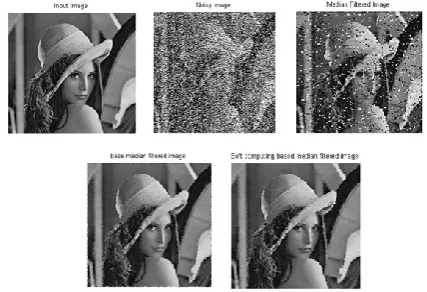
In order to implement the proposed algorithm, design and implementation has done in MATLAB using image processing toolbox. Results of our proposed algorithm are as showed below:-
Fig 2. (a) Input Image (b) Noisy Image (c) Median Filtered Image (d) Base Paper Image (e) Proposed filtered image
Performance Evaluation
[image:4.595.326.540.528.674.2]Mean Squared Error (MSE) and Root Mean Square Error. The images are corrupted by salt and pepper noise with noise density of 70 % has been used. We compare the proposed filter with the noisy image, standard median filter; Decision based median filter and Soft computing algorithm. Both qualitative and quantitative measures will be checked using different tables and graphs for each image by using different evaluation parameters as described above.
Point Signal to Noise Ratio Evaluations (PSNR)
The goal of proposed method is to increase PSNR as much as possible. Table 1 and Graph 1 clearly shows that PSNR is maximum using proposed filter.
[image:5.595.119.489.510.752.2]
PSNR
Table 1. Peak to Signal Ratio
Image no.
Noisy mage (70%)
Median filter
Base Paper
Edge Preserving Healing
1. 6.8969 9.8726 23.2594 25.3433
2. 6.7977 9.6718 20.8311 21.6570
3. 6.6810 9.6164 20.2775 22.0349
4. 6.7665 9.7593 24.8880 29.2659
5. 6.1998 9.2761 25.0345 28.7356
6. 6.7611 9.8281 24.4572 26.5774
19022 International Journal of Current Research, Vol. 7, Issue, 08, pp.19018-19024, August, 2015
Graph 1. Peak to Signal Ratio Evaluation
Mean Squared Error Evaluations (MSE)
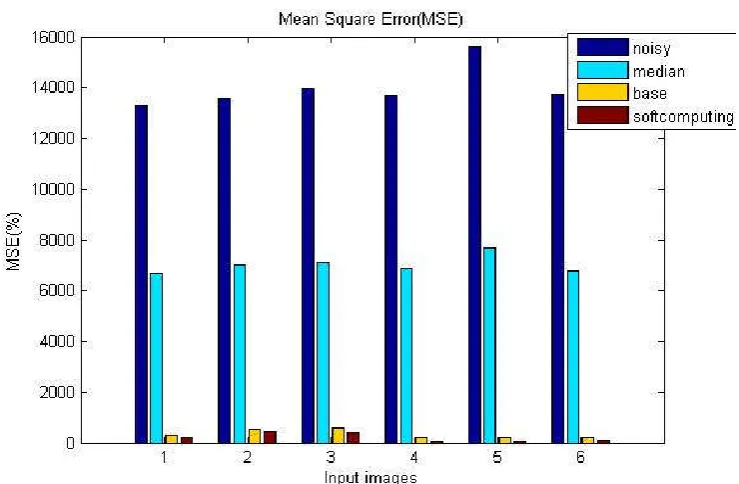
Less is the value of MSE more is the quality of image. Table 2 and Graph 2 clearly indicate that MSE is less using the proposed algorithm. Thus proposed filter provides best results.
Root Mean Squared Error Evaluations (RMSE)
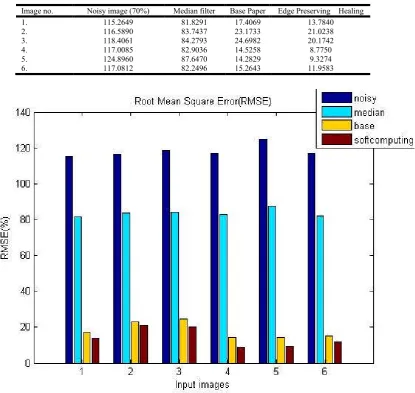
Less is the value of RMSE more is the quality of image. Table 3 and Graph 3 clearly indicate that RMSE is less using the proposed algorithm. Thus proposed filter provides best results.
Conclusion
A novel soft computing based technique is proposed which has used decision tree kind of structure to replace the noisy pixel in given window.
[image:6.595.120.476.150.220.2]The proposed technique seems to be effective as it replaces the noisy pixel with its best suitable alternative. Proposed method is divided into two parts: (1) Algorithm will evaluate the center pixel’s value i.e. whether or not it is equal to 0 or 255 if yes then will go to find the alternative noise free value for the same else window will switched further.
Table 2. Mean Square Error
Image no. Noisy image (70%) Median filter Base Paper Edge Preserving Healing
1. 13286 6696 307 192
2. 13593 7013 537 444
3. 13963 7103 610 407
4. 13691 6873 211 77
5. 15599 7682 204 87
6. 13708 6765 233 143
Table 3. Root Mean Square Error
Image no. Noisy image (70%) Median filter Base Paper Edge Preserving Healing
1. 115.2649 81.8291 17.4069 13.7840
2. 116.5890 83.7437 23.1733 21.0238
3. 118.4061 84.2793 24.6982 20.1742
4. 117.0085 82.9036 14.5258 8.7750
5. 124.8960 87.6470 14.2829 9.3274
6. 117.0812 82.2496 15.2643 11.9583
[image:6.595.103.519.336.729.2](2) This part will find the neighborhood pixels of the center value and see whether all are having 0 or 255 as its value or not. If no then median will be evaluated and replaced with center value and window will switched further else we will use decision tree to evaluate the value by taking the global median and recently evaluated median to replace the same. Global median will be replaced when no median is found recently. The comparative analysis has clearly shown that the proposed technique outperforms over the available techniques. This work has not considered any other kind of noise so in near future we will use different kind of noise to evaluate the effectiveness of the proposed technique.
REFERENCES
Agrawal. P, V. Jayendra Singh “A Survey of Linear and Non-Linear Filters for Noise Reduction”, International Journal of Advance Research in Computer Science and
Management Studies, Volume 1, ISSN- 2321-7782, 2013
Alajlan, Naif. "A Novel Recursive Algorithm for Detail-Preserving Impulse Noise Removal." Journal of King Saud
University-Computer and Information Sciences, 22 (2010):
37-44.
Castillo, Encarnación, et al "One-step wavelet-based
processing for wandering and noise removing in ECG signals." IWBBIO. 2013.
Chandrakar, Bhumika, O. P. Yadav, and V. K. Chandra. "A Survey of noise removal Techniques for ECG [2]. Signals." International Journal of Advanced Research in
Computer and Communication Engineering, 2.3 (2013):
1354-1357
Chang-Shing Lee, Shu-Mei Guo, and Chin-Yuan Hsu, “Genetic-Based Fuzzy Image Filter and Its Application to Image Processing” IEEE Transactions on Systems, Man, and Cybernetics—part b: cybernetics, vol. 35, no. 4, August 2005.
Chen, Bo, et al "A multiplicative noise removal approach based on partial differential equation model." Mathematical
Problems in Engineering 2012 (2012).
Easwara M, Satish Babu J, “Fast Decision Based Weighted Fuzzy Mean Filtering for Extremely Corrupted images”,
International Journal of Technology Enhancements and
Emerging Engineering Research, Vol. 1, ISSN-2347-4289,
2013.
Fabijańska, A. and Sankowski, D. ‘‘Noise adaptive switching median-based filter for impulse noise removal from extremely corrupted images’’, Image Processing, IET, 5(5), pp. 472–480 (2011).
Kaur, S. and Bawa, N.” Improved Negative Selection based Decision based Median Filter for Noise Removal”,
International Journal of Application or Innovation in
Engineering & Management, ” Vol 4(2015), 2319-4847
Leavline, E. Jebamalar, and D. Asir Antony Gnana Singh. "Salt and Pepper Noise Detection and Removal in Gray Scale Images, an Experimental Analysis." International Journal of Signal Processing, Image Processing and Pattern
Recognition, 6.5 (2013): 343-352
Mahesh, T. R., S. Prabhanjan, and M. Vinayababu. "Noise Reduction by using Fuzzy Image filtering." Journal of
Theoretical & Applied Information Technology, 15 (2010)
Parteek, G.K., V. Puspneeel, B. Ankur ,” Survey Paper on Various Median Filtering Techniques for Noise Removal from Digital Images”
Plapous C, Marro C, Scalart P. Improved singal-to-noise ratio estimation for speech enhancement. IEEE Trans Audio Speech Lang Process 2006; 14: 2098–108.
Riji, R., Keerthi AS Pillai, Madhu S. Nair, and M. Wilscy. "Fuzzy based directional weighted median filter for impulse noise detection and reduction."Fuzzy Information and
Engineering, 4, no. 4 (2012): 351-369.
Simrat, Sagar A, “Novel Approach to Reduce Speckle Noise
from Images using Adaptive Thresholding”
International Journal of Advanced Research in Computer
Science and Software Engineering, vol.4 September 2014,
Yang, Liu, Xiao Mingli, and Tie Yong. "A Noise Reduction Method Based on LMS Adaptive Filter of Audio Signals." 3rd International Conference on Multimedia
Technology (ICMT-13). Atlantis Press, 2013.
Zhang Lei, Song Hongxun,” A Hybrid Filter based on an adaptive neuro-fuzzy inference system for efficient removal of impulse noise from corrupted digital images” IEEE 2nd Conference on Environmental Science and Information Application Technology, 2010.