Approximate Solution of the Singular-Perturbation
Problem on Chebyshev-Gauss Grid
Mustafa Gülsu, Yalçın Öztürk
Department of Mathematics, Faculty of Science, Mugla University, Mugla, Turkey E-mail:[email protected]
Received April 27, 2011; revised May 24,2011; accepted June 5, 2011
Abstract
Matrix methods, now-a-days, are playing an important role in solving the real life problems governed by ODEs and/or by PDEs. Many differential models of sciences and engineers for which the existing method-ologies do not give reliable results, these methods are solving them competitively. In this work, a matrix methods is presented for approximate solution of the second-order singularly-perturbed delay differential equations. The main characteristic of this technique is that it reduces these problems to those of solving a system of algebraic equations, thus greatly simplifying the problem. The error analysis and convergence for the proposed method is introduced. Finally some experiments and their numerical solutions are given.
Keywords: Singular Perturbation Problems, Two-Point Boundary Value Problems, The Shifted Chebyshev Polynomials, Approximation Method, Matrix Method
1. Introduction
The boundary-value problems for singularly perturbed delay-differential equations arise in various practical problems in biomechanics and physics such as in varia- tional problem in control theory. These problems mainly depend on a small positive parameter and a delay pa- rameter in such a way that the solution varies rapidly in some parts of the domain and varies slowly in some other parts of the domain. Moreover, this class of prob- lems possess boundary layers, i.e. regions of rapid change in the solution near one of the boundary points. There is a wide class of asymptotic expansion methods available for solving the above type problems. But there can be difficulties in applying these asymptotic expan- sion methods, such as finding the appropriate asymptotic expansions in the inner and outer regions, which are not routine exercises but require skill, insight and experi- mentation. The numerical treatment of singularly per- turbed problems present some major computational dif- ficulties and in recent years a large number of special- purpose methods have been proposed to provide accurate numerical solutions [1-5] by Kadalbajoo. This type of problem has been intensively studied analytically and it is known that its solution generally has a multiscale character; i.e. it features regions called “boundary lay- ers” where the solution varies rapidly. And these equa-
tions as well as numerical methods have been studied by several authors [6-10]. The outer solution corresponds to the reduced problem, i.e., that obtained by setting the small perturbation parameter to zero. In recent years, the Chebyshev method has been used to find the approxi- mate solutions of differential, difference, integral and integro-differential-difference equations [11,12]. The main characteristic of this technique is that it reduces these problems to those of solving a system of algebraic equa- tions, thus greatly simplifying the problem.
Consider the of singularly-perturbed delay differential equations form
( ) ( ) ( ) ( ) ( ) = ( )
y x p x y x q x y x g x
(1) where 0 < < 1x , with the boundary conditions y(0) =0,
1 (1) =
y and is a small positive parameter 0 <1, is also a small shifting parameter 0 < 1, ,
, ,
( )
p x
( )
q x r x( ) s x( ) and f x( ) are sufficiently smooth functions. Our goal is to find an approximate solution expressed polynomial of degree N in the form
*
=0
( ) = N ( )
N r r
r
y x
a T x (2) where r unknown coefficients, is the shifted Chebyshev polynomials of the first kind and is cho-sen any positive integer such that . To obtained a solution (2) of the problem (1), we can use the zeroes ofa *( )
r
T x
the shifted Chebyshev polynomials of the first kind defined by
* 1( )
N
T x
1
3 π
1 2
= 1 cos , = 1,, 1
2
i
n i
x i N
N (3)
2. Basic Idea
Polynomials are the only functions that a computer can evaluate exactly, so we make approximate functions
a b, by polynomials. The uniform norm (or Chebyshev norm, maximum norm) is defined by ,
= maxx a b ( ) .
f f x
Definition 2.1. For a given continuous function
, fC a b N, a best approximation polynomial of degree is a polynomial *
N N
p f such that
* = min :
N N
f p f f p p
It is a good idea to approximate function by polyno-mials, because the classical Weierstrass Theorem is a fundamental result in the approximation of continuous functions by polynomials [13-15].
Theorem 2.2. Let fC a b
, . Then for any > 0, there exists a polynomial p for which f p .Proof: See Ref.[13-16].
Theorem 2.3. For any f C a b
,
and thebest approximation polynomial
0
N
* N
p f exists and is unique.
Proof: See Ref. [13-16].
Definition 2.4. Given an integer then a grid set of points are 0 i N in
1
N
N1
X =
xi
a b, 0 ( )xi isuch
that 0 1 . Then points are
called the nodes of the grid.
< < <xN
a x x b N
Theorem 2.5. Given a function fC a b
,N
and a grid of
N1
nodes, X ( )xi 0i , there exists aunique polynomial of degree N, N
XI f such that
= , 0N i
iX
I f x f x i N
X N
I f is called the interpolant (or the interpolating polynomial) of f through the grid X.
Proof: See Ref. [13-16]. The interpolant X
N
I f can be express in the La-grange form as
=0 = N X X N i i iI f
f x xwhere X
i x
is the i-th Lagrance cardinal polynomial associated with the grid X:
0,
( ) N j , 0 .
X i
j i j i j
x x
x i N
x x
The Lagrange cardinal polynomials are such that
, 0 , .X
i xj ij i j N
The best approximation polynomial *
Np f is also an interpolant of f at
N1
nodes the error is given by formula:
1
*
XN N N
f I f X f p f
where N
X is the Lebesgue constant relative to thegrid X,
,
0
: max N X
N x a b i
i
X x
The Lebesgue constant contains all the information on the effects of the choice of X on X
.N
f I f
Theorem 2.6. For any choice of the grid X, there exist a constant C> 0 such that
2ln
1
π
N X N C
) Proof: See Ref. [13-16].
Definition 2.7. The nodal polynomial associated with the grid is the unique polynomial of degree (N1 and leading coefficient 1 whose zeroes are the N1 nodes of X:
1 0
( ) N
X
N i
i
w x x x
Theorem 2.8. If fCN1
a b, , then for any grid X 1N
of nodes, and for any x
a b, , the in rpola- tion error atte x is
( 1)1 !
1( ) NX X
N N
f
f x I f x w x
N
(4)
where = ( )x
a b, and nodal polyno-mial associated with the grid 1( )
X N
w x X. Proof: See Ref. [13-16].
2.1. The Shifted Chebyshev Polynomial of the First Kind
Definition 2.9. The Chebyshev polynomial of the first kind T xn( ) is a polynomial in x of degree , defined by the relation [17]
n
( ) cos when cos .
n
T x n x
If the range of the variable x is the interval[ 1,1] , the range the corresponding variable can be taken
. Since the range is quite often more con-venient to use than the range , we map the inde-pendent variable
[0,π] [0,1]
[ 1 ,1]
x in[0,1] to the variables in[ 1,1]
2.2. Chebyshev-Gauss Grid
1
2 1 or 1
2
s x x s
Definition 2.10. The grid i 0i N such that the i
X x
x ’s are the N1 zeroes of the Chebyshev polynomial of degree N1 is called the Chebshev-Gauss (CG) grid.
and this lead to a shifted Chebyshev polynomial of the first kind *( ) of degree in
n
T x n x on given
by [17]
[0,1]
*( ) = ( ) = 2 1 .
n n n
T x T s T x Theorem 2.11. The polynomials of degree N1 and
leading coefficient 1, the unique polynomial which has the smallest uniform norm on [ 1,1] is the (n1)-th Chebyshev polynomial divided by 2N.
Thus we have the polynomials
* * * 2
0( ) = 1, 1( ) = 2 1, 2( ) = 8 8 1,
T x T x x T x x x
Proof: See Ref. [13-16]. It is of course possible to defined , like ,
directly by a trigonometric relation. Indeed, we obtained
*( )
n
T x T xn( )
3. Fundamental Matrix Relations
*( ) cos 2 when cos .2
n
T x n x x
This relation might alternatively be rewritten, with replace by 2, in the form
*( ) cos when cos2 1 1 cos
2 2
n
T x x
Let us consider the Equation (1) and find the matrix forms of each term of the equation. We first consider the solution y xN( ) and its derivative y( )Nm( )x defined by
a truncated Chebyshev series. Then we can put series in the matrix form
* (1) *(1) (2)
*(2)
( ) ( ) , ( ) ( ) , ( ) ( )
N N N N N
N
y x T x A y x T x A y x T x A
(6)
Note that the shifted Chebyshev polynomial is neither even nor odd and indeed all powers of x from
( )
n
T x
0
1 =x to xn appear in . The leading coefficient
of
*( )
n
T x
n
x in for to be . These poly-nomials have the following properties:
*
n
T ( )x n> 0 22n1 where
* * * *
0 1
( ) = ( ) ( ) ( )
N N
T x T x T x T x 1) * has exactly
1( )
n
T x n1 real zeroes on the in-terval [0,1]. The m-th zero xn m, of is located
at
* 1( )
n
T x
*(1) *(1) *(1) *(1)
( )N ( ) = 0 ( ) 1 ( ) N ( )
T x T x T x T x
*(2) *(2) *(2) *(2)
( )N ( ) = 0 ( ) 1 ( ) N ( )
T x T x T x T x
,
3 π
1 1 cos 2
2 n m n m x n
0 1
= N T
A a a a
By using (5), we obtained the corresponding matrix relation as follows:
1* *
( ) ( ) and so ( ) ( )
T T
N N
X x DT x T x X x DT (7)
2) It is well known that the relation between the pow-ers xn and the shifted Chebyshev polynomials
is
*( )
n
T x
where
( ) = 1 N
X x x x
* 2 1 =0 2 1 = 2 n n n k n k n ( ).
x T x
k
(5)and
0
2 1
4 3 3
2 2 1 2 1 2 1
0
2 0 0 0
0
2 2
2 0 2 0
1 2
= 4 4 4
2 2 2 0
2 3 4
2 2 2
2 2 2 2
1 2
N N N N
D
N N N
N N N
2
Moreover it is clearly seen that the relation between the matrix X x( ) and its derivative X( )k ( )x ,
1 (2)
(1)( ) = ( ) , ( ) = ( ) 2
X x X x B X x X x B (8) where
0 1 0 0
0 0 2 0
= .
0 0 0
0 0 0 0
B
N
The derivative of the matrix *( ) defined in (7), by
N
T x
using the relation (8), can expressed as
1*( )k ( ) ( )k T ( ) k( T) ,1 0,1, 2 N
T x X x D X x B D k (9) where *(0)( ) = *( ),
N N
T x T x X(0)( ) = ( )x X x , . By
substituting (9) into (6), we obtain
0=
B B
1( )k ( ) = ( ) k T , = 0,1, 2
N
y x X x B D A k (10) where (0)( ) = ( )
N N
y x y x . Moreover, we know that;
=
X x X x B (11) where
0 1 2
0 1
0 2
0
0 1 2
( ) ( ) ( ) ( )
0 1 2
1 2
0 ( ) ( ) ( )
0 1 1
= 2
0 0 ( ) ( )
0 2
0 0 0 ( )
0
N
N
N
N N N N
B N
N
N
1
Using relation (8) and (11), we can write
(1)( ) = ( ) 1
X x X x B B (12) In a similarly way as (10) , we obtain
1(1) *(1) T .
N
y x T x A X x BB D A (13)
Matrix Representation of the Conditions
Using the relation (10), the matrix form of the conditions given by (2) can be written as
10 0
1
1 1
0 0
1 1
T
T
y X D A
y X D A
(14) where
0 = 1 0
0
X
1 = 1 1
1 .
X
4. Method of Solution
We are ready to construct the fundamental matrix equa-tion corresponding to Equaequa-tion (1). For this propose, firstly substituting the matrix relation (10) and (13) into (1) we obtained
1 1
2
1
T T
T
X x B D p x X x BB D
q x X x D A g x
(15)
For computing the Chebyshev coefficient matrix A numerically, the zeroes of the shifted Chebyshev poly-nomials of the first kind defined by (3) are putting above relation (15) and organized. We obtained,
2 T 1 T 1
T 1
i i i i i i
X x B D p x X x BB D q x X x D A g x
So, the fundamental matrix equation is gained
2 T 1 T 1 T 1
EXB D PXBB D QX D A G
here
0 0 0 1 1 2 2
( ) 0 0 0 ( ) 0 0 0
0 ( ) 0 0 0 ( ) 0 0
= 0 0 ( ) 0 = 0 0 ( ) 0
0 0 0 ( N) 0 0 0 ( N)
p x q x
p x q x
p x q x
p x q x
P Q 2 0
0 0 0
2
1
1 1 1
2
2
2 2 2
2
( ) 0 0 0
1
( ) 0 0
1
( ) 0 0 0
1
( ) 0 0 0
1 N N N N N
N N N
g x
x x x
g x
x x x
X x x x G g x E
g x
x x x
The fundamental matrix equation (16) for Equation(1) corresponds to a system of (N1) algebraic equation for the (N1) unknown coefficients a a0, , ,1 aN.
Briefly we ite Equation(15) as
can wr
= or ;
WA G W G (17) so that, for
1
T
Briefly, the matrix form for conditions (2) are
, = 0,1, ,
p q N
1
1
2 =
pq
T T
EXB D PXBB D QX D
=
W w
or ;
, 0,1i i i i
C A C i (18) where
1
0 1
= ( ) T
i i i
C X i D c c ciN
To obtain the solution of Equation (1) under the con-ditions (2), by replacing the rows matrices (18) by the last m rows of the matrix (17), we have the required aug-mented matrix
00 10 0 0
10 11 1 1
* *
2
2 0 2 1 2
00 01 0 0
10 11 1 1
; ; ; = ; ; ; N N N
N N N N
N N
w g x
w w w g x
W G
w w w g x
c c c
c c c
w w or corresponding matrix equation
(19) If
* = *
W A G
* *; * 1rank W rank W G N w
, then we can rite
* 1 *= .
A W G (20) Thus the coefficients are uniquely de-termined by Equation (2
4.1. Convergence and Error Analysis
, = 0, ,
i
a i N 0).
Since * 1 = 1
N
T , we conc grid nodes
lude that if we choose the
xi 0 i N to be zero the (N1) zeroes ofhebys
the shifted C hev polynomial TN*1, we have
1 2 1
1 =
X
N N
w 2
and this is the smallest possible value. In particular, for any f CN1
0,1 we have [14]
( 1)2 1
2 1 !
N
N N
y y y
N 1
If yN1
the interpolation
is uniformly bounded, the convergence of towards y x( )
besgue
N
y when is
then e ely fast Also the Le co at ith th
nstant associ-N
xtrem .
ed w e Chebyshev-Gauss grid is small
2ln
1 as
.π
N X N N
This is much better than uniform grids and close to the optimal value.
4.
We can easily check the accuracy of the obtained solu-tained the shifted Cheby-shev polynomial of the first kind expansion is an
ap-2. Checking of Solution
tions as follows: Since the ob
proximate solution of Equation (1), when the function
( )
N
y x and its derivatives are substituted in Equation (1), the resulting equation must be satisfied approximately, that is for xi
0,1
,
i
E N
y x x
p x yi i q x y xi i g xi 0
5. Illustrative Example
of the method, we consi- der the examples given below and solve them using the pre- of the solution and the efficiency
sent method and all of them were performed on the com- puter using a program written in Maple 9 software in the solving process. We have plotted the graphs of the solu-tion of the problem for different with different values of
to show the effect of delay on the boundary layer so-lution.
The maximum errors denoted y b EN, at all the grid ints are evaluated using the formula
po
, max0
N i N i i
E y x
Example 5.1. Let us consider the sec
N
y x
ond-order singu- la
under the conditions
lution for the considered examples is not available but l result Figur
rly-perturbed delay differential equation [3]
0.25 = 0
y y y x
(0) = 1
y , y(1) = 0. The exact
so-we compare numerica s in es 1(a) and (b) given by Kadalbajoo ([3], Example 2). In Figure 1(a), we show the numerical result using present method and for the method using by Kadalbajoo is shown in Figure 1(b). The graphs of the solution of the considered exam-ples for different values of delay are plotted in Figures 1(a)-(d) to examine the questions on the effect of delay on the boundary layer behavior of the solution.
(a) (b)
(c) (d)
Figure 1. (a) Numerical results of Example 5.1 for various
= 0.01,N= 20
; (b) Numerical results of Example 5.1 for various in [3]
= 0.01
; (c) Numerical results of Example 5.1 for various
= 0.01,N= 20
; (d) Numerical results of Example 5.1 for various in [3]
= 0.01
. [image:6.595.61.536.257.674.2]
ns e second er
singu-under the conditions . Its exact solu-Example 5.2. Let us co ider th -ord
larly-perturbed delay differential equation [3]
0y y y x
(0) = 1
y , y(1) = 1
tion is given by
=
1 2
11
21 1
2m m x m m x
m m
e e e e
y x
e e
where
1
1 1 4
= 2
m
1
1 1 4
= .
2
m
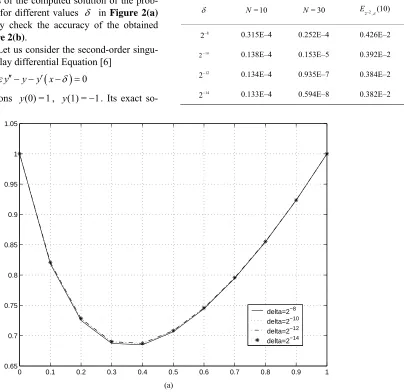
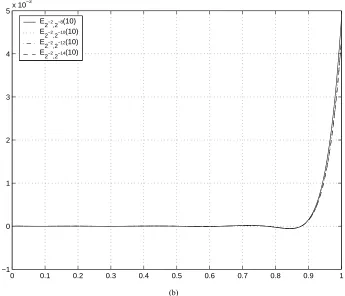
We solved this problem using the method presented here and compared the result with the exact solution of the problems in Table 1. Also for N= 10, we have plotted the graphs of the computed solutio f the prob-lem for = 22, for different values in n o
Figure 2(a) and we ca sily check the accuracy of the obtained solutions in Figure 2(b).
Example 5.3. Let us consider the second-order singu-la
n ea
rly-perturbed delay differential Equation [6]
0y y y x
under the conditions . Its exact so-
lution is given by
(0) = 1
y , y(1) = 1
1 m2
mm x11
m2m1 1
m x2e e e e
y x
e e
where
1
1 1 4
2
m
1
1 1 4
. 2
m
[image:7.595.129.533.327.719.2]We calculated numerical results for = 0.5 and di
Table 1.
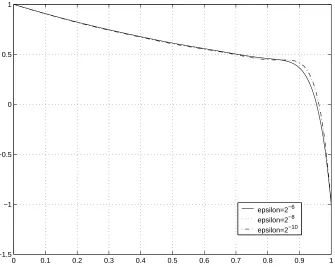
splay results for some various N. Moreover, we com-pare the results with Non-standard finite difference methods (NSFDMs) in Table 2 and we display results for N= 10, in Figure 3.
2 ,2
N
E values of Example 5.1.
N= 10 = 30N E22,(10)
8
2 0.315E–4 0.252E–4 0.426E–2
10
2 0.138E–4 0.153E–5 0.392E–2
12
2 0.134E–4 0.935E–7 0.384E–2
14
2 0.133E–4 0.594E–8 0.382E–2
0 0.1 0.2 0.3 0.4 0.5 0.6 0.7 0.8 0.9 1 0.65
0.7 0.75 0.8 0.85 0.9 0.95 1 1.05
delta=2−8 delta=2−10 delta=2−12 delta=2−14
0 0.1 0.2 0.3 0.4 0.5 0.6 0.7 0.8 0.9 1 −1
0 1 2 3 4 5x 10
−3
E
2−2,2−8(10)
E
2−2,2−10(10)
E
2−2,2−12(10)
E
2−2,2−14(10)
(b)
[image:8.595.124.469.80.376.2]Figure 2. (a) Numerical results of Example 5.2 for various (N = 10); (b) ForE22,(10), numerical results of Example 5.2 for various .
Table 2. For = 0.5, EN,values of Example 5.3.
N= 10 N= 20 N= 30 N= 40 NFSDs (N = 32) NFSDs (N = 64)
6
2 0.213E–0 0.222E–1 0.258E–1 0.201E–1 0.340E–1 0.170E–1
7
2 0.311E–0 0.538E–1 0.347E–1 0.265E–1 0.340E–1 0.170E–1
8
2 0.613E–0 0.224E–0 0.336E–1 0.218E–1 0.340E–1 0.170E–1
9
2 0.941E–0 0.340E–0 0.202E–0 0.598E–1 0.340E–1 0.170E–1
10
2 1.136E–0 0.656E–0 0.306E–0 0.232E–0 0.340E–1 0.170E–1
studies of the singularly-perturbed
overall accuracy. Illustrative examples are included to
tions by putting them back into the original equation with
6. Conclusions
In recent years, the
delay differential equations have attracted the attention of many sciences and engineers. The Chebyshev expan-sion methods are used to solve the singularly-perturbed delay differential equations numerically. A considerable advantage of the method is that the Chebyshev polyno-mial coefficients of the solution are found very easily by using computer programs in Maple 9. Shorter computa-tion time and lower operacomputa-tion count results in reduccomputa-tion of cumulative truncation errors and improvement of
demonstrate the validity and applicability of the tech-nique. To get the best approximating solution of the equation, we take more forms from the Chebyshev ex-pansion of functions, that is, the truncation limit N must be chosen large enough. Suggested approximations make this method very attractive and contributed to the good agreement between approximate and exact values in the numerical example.
[image:8.595.90.509.442.563.2]
0 0.1 0.2 0.3 0.4 0.5 0.6 0.7 0.8 0.9 1 −1.5
−1 −0.5 0 0.5 1
[image:9.595.131.466.82.353.2]epsilon=2−6 epsilon=2−8 epsilon=2−10
Figure 3. Numerical results of Example 5.3 for various .
the aid of Maple, it provides an extra measure of confi-dence in the results.
Kumar, “Fitted Mesh B-Spline ethod for Singularly Perturbed Differential-ations with Small Delay,” Applied
Mathe-7. References
[1] M. K. Kadalbajoo and D. Collocation M
Difference Equ
matics and Computation, Vol. 204, No. 1, 2008, pp. 90- 98. doi:10.1016/j.amc.2008.05.140
[2] M. K. Kadalbajoo and K. K. Sharma, “A Numerical Me- thod Based on Finite Difference for Boundary Value Pro- blems for Singularly Perturbed Delay Differential Equa- tions,” Applied Mathematics and Computation, Vol. 197, No. 2, 2008, pp. 692-707. doi:10.1016/j.amc.2007.08.089 [3] M. K. Kadalbajoo and V. P. Ramesh, “Numerical Meth-
ods on Shishkin Mesh for Singularly Perturbed Delay Differential Equations with a Grid Adaptation Strategy,”
Applied Mathematics and Computation, Vol. 188, No. 2, 2007, pp. 1816-1831. doi:10.1016/j.amc.2006.11.046 [4] M. K. Kadalbajoo and V. P. Ramesh, “Hybrid Method for
Numerical Solution of Singularly Perturbed Delay Dif- ferential Equationsy,” Applied Mathematics and Compu- tation, Vol. 187, No. 2, 2007, pp. 797-814.
doi:10.1016/j.amc.2006.08.159
[5] M. K. Kadalbajoo and K. K. Sharma, “Numerical Analy- sis of Singularly Perturbed Delay Differential Equations with Layer Behavior,” Applied Mathematic
putation, Vol. 157, No. 1, 2004,
s and Com-
pp. 11-28. doi:10.1016/j.amc.2003.06.012
[6] K. C. Patidar and K. K. Sharma, “ε-Uniformly Conver-
Vol. 175, No. 1, 2006, pp. 864-890.
gent Non-Standard Finite Difference Methods for Singu- ff ntial Difference Equations with
li Mathematics and Computation, larly Perturbed Di ere
Small Delay,” App ed
doi:10.1016/j.amc.2005.08.006
[7] M. H. Adhikari, E. A. Coutsias and J. K. M odic Solutions of a Singularly P
clver, “Peri-erturbed Delay Differen-tial Equation,” Physica D, Vol. 237, No. 24, 2008, pp. 3307-3321. doi:10.1016/j.physd.2008.07.019
[8] I. G. Amirsliyeva, F. Erdogan and G. M. Amiraliyev, “A Uniform Numerical Method for Dealing with a Singularly Perturbed Delay Initial Value Problem,” Applied Mathe- matics Letters, Vol. 23, No. 10, 2010, pp. 1221-1225. doi:10.1016/j.aml.2010.06.002
[9] S. N. Chow and J. M. Paret, “Singularly Perturbed Delay- Differential Equations, Cuopled Nonlinear Oscillators,” North-Holland Publishing Company, Amsterdam, 1983. [10] R. E. O’Malley Jr., “Introduction to Singular Perturbation,”
Academic Press, New York, 1979.
[11] M. Glsu, Y. Öztürk and M. Sezer, “A Newcollocatio Method for Solutionof the Mix
n ed Linear Integro-Differ- ential-Difference Equations,” Applied Mathematics and Computation, Vol. 216, No. 7, 2010, pp. 2183-2198. doi:10.1016/j.amc.2010.03.054
[12] M. Sezer and M. Gulsu, “Polynomial Solution of the Most General Linear Fredholm Integro-Differential-Dif- ference Equation by Means of Taylor Matrix Method,”
International Journal of Complex Variables, Vol. 50, No. 5, 2005, pp. 367-382.
proximation,” Dover Pub- and Fourier Spectral Methods,”
yno- mials,” Chapman and Hall/CRC, New York, 2003. [14] P. J. Davis, “Interpolation and Ap
lications, New York, 1963.
[15] K. Atkinson and W. Han, “Theoretical Numerical Analy-sis,” 3rd Edition, Springer, 2009.
[16] J. P. Body, “Chebyshev
University of Michigan, New York, 2000.
![Figure 1. (a) Numerical results of Example 5.1 for various = 0.01,N= 20; (b) Numerical results of Example 5.1 for various in [3] = 0.01; (c) Numerical results of Example 5.1 for various = 0.01,N= 20; (d) Numerical results of Example 5.1 for](https://thumb-us.123doks.com/thumbv2/123dok_us/9243562.411901/6.595.61.536.257.674/numerical-example-numerical-example-numerical-example-numerical-example.webp)