Effect of Butanol and Di-Ethyl Ether Additives on the Performance and
Emission of VCR Engine Fueled with Diesel-Ethanol Blend
Sreepathi Naidu Kalluru
1, Dr. B. Omprakash
2, Dr. R. Ganapathi
31
PG Research Scholar,
Advanced Internal Combustion Engines, Dept, of Mechanical Engineering, Jawaharlal Nehru
Technological University Anantapur College of Engineering (Autonomous), Anantapuramu, Andhra Pradesh, India
2
Assistant Professor, Jawaharlal Nehru Technological University Anantapur College of Engineering (Autonomous),
Anantapuramu, Andhra Pradesh, India
3
Dept, of Mechanical Engineering, Anurag Engg College (Autonomous), Kodad, Telangana, India
---***---Abstract -
The global industrialization and transportation are revolutionized in the usage of fossil fuels. This utility increases the carbon footprint and affects the environment pollution levels. Due to stringent emission limits and fuel economy standards, which updated periodically leads to research in automobile engine technology to achieve more thermally efficient and less emission engines. From all possibilities Variable compression Ratio engines are recognized as methods for improving the fuel economy of CI engines. In this experimental investigation, the performance, emission characteristics of diesel engine using methanol as blend and di-ethyl-ether and butanol as additive.Present thesis focus on maximum utility of alcohols as blends with diesel as main fuel at various compression ratios 15, 16, 17 and 18 in conventional VCR engine. The blend mixture properties are studied, and fuel phase separation of diesel and methanol is minimized by using 2.5% butanol as a co-solvent. To achieve the higher thermal efficiency and good performance characteristics proper blend mixtures are preferred for suitable compression ratio at constant speed of 1500rpm and various load 3, 6, 9 and 12 kg.
The fuel preparation is achieved systematically based on previous publication about concentrations of blends and additives in diesel fuel. Primarily D100 is used for finding suitable compression ratio. Later methanol is added at E05, E10, E15 and E20 (5%, 10% 15% & 20% by volume in diesel) tested at same best compression ratio. The performance characteristics are improved by adding oxygenated additives butanol and Di-Ethyl-Ether (DEE) of 2.5% of each by volume. The Performance parameters such as brake thermal efficiency, specific fuel consumption, brake power was determined. Exhaust emissions like CO2, CO, NOx and smoke have been evaluated.
Key Words: Carbon Footprint, Variable compression
ratio (VCR), ethanol, n-butanol, di-ethyl-ether, oxygenated additives, performance and emissions.
1. INTRODUCTION
William E. Rees and Mathis Wackernagel developed Carbon Footprint concept and it defines the total amount of greenhouse gases produced directly and indirectly to support human activities, usually expressed in equivalent tons of carbon dioxide (CO2). Fossil fuels contain high-power producing
2. Materials and Methods
Sample Biofuels are produced with any of the following chemical reactions. 1. Anaerobic Reaction 2. Transesterification and 3.Fermentation. In anaerobic reaction Biogas is produced primarily consists of methane (CH4) and carbon dioxide (CO2) and may have small amounts of hydrogen sulphide (H2S), moisture and siloxanes. Its major input resources are biomass agriculture waste etc. Transesterification processes the exchanging of the alkyl group attached to the oxygen atom of the ester with the alkyl group of an alcohol in the presence of catalyst NaOH, KOH. Transesterification reaction is indicated by the separation of the ester and glycerol layers after the reaction time. Almost all biodiesel is produced using base catalyzed transesterification as it is the most economical process requiring only low temperatures and pressures and producing a 98% conversion yield. The Production of biodiesel process is shown in Figure 2.1
C
12H
22O
11+ H
2O + invertase → 2 C
6H
12O
6C
6H
12O
6→ 2 C
2H
5OH + 2 CO
2Fig- 1 Production of Ethanol process
To meet the energy demand blends are added to the main fuel line which needs to have significant properties as main fuel. Whereas additives are intended to increase the combustion rates and to meet emissions standards which are updated periodically in our country as Bharat Stage emissions standards. Current thesis mainly focuses on the Compression Ignition engines powered by alcohol blends. The blend fuel mixture properties depend upon the number of carbon atoms in the chain. The effect of carbon atoms shown in the figure 3.1
Fig- 2 Effect of Carbon atoms in chain
In this thesis Ethanol as blend along with n-butanol and di-ethyl-ether (DEE) as additives with diesel in various proportions i.e. D100, E05 and E15Bu2.5DEE2.5 (E05 is taken as 5% ethanol and 95% Diesel, E15Bu2.5DEE2.5 is taken as 15% ethanol, 2.5% n-butanol and 2.5% DEE) (2). In the experimenting process pure diesel is used at various compression ratio (CR) ranging from 15, 16, 17 and 18 and at best CR ethanol is blended at 0 to 20% by volume (3). The additives are added for best blend 2.5% of each butanol and
di-ethyl-ether. The performance and emissions graphs are depicted with respect to the brake power.
3. Engine Setup and Procedure
Fig- 3 Complete Experimental engine setup For experimental setup, Kirloskar single cylinder compression ignition 4-stroke water cooled engine which can operate on multiple fuels and at different compression ratio ranging 14:1-23.1 is used as test rig. For loads on the engine, the eddy current dynamometer is used which is connected to the flywheel. The required compression ratios 15, 16, 17 and 18 are adjusted by rotating the knob attached to the engine keeping the injection pressure constant throughout test at 210 bar. The fuel taken for doing these experiments is diesel with ethanol, butanol blends and DEE as additive which are with different sample. By keeping the engine speed constant i.e., 1500 rpm, experiments are conducted at various loads 3, 6, 9, and 12 by using eddy current dynamometer. The HC, CO, CO2, HC and NOX emissions are evaluated using the fire gas analyzer AVL-DIGAS 444. AVL smoke meter measures the opacity of the smoke.
3.1 Test procedure
1. Diesel (D100) tested at compression ratios 15, 16, 17 & 18. 2. Ethanol is added 05% with diesel (D95E5) tested for best compression ratio of D100.
Engine fuel research test rig Kirloskar VCR multi-
No. of Cylinders Single Cylinder No. of Strokes 4 Strokes
Cylinder Bore 87.5mm
Stroke Length 110mm
Connecting Rod
Length 234mm
Orifice Diameter 20mm
Dynamometer Arm
Length 185mm
Rated Power 3.5kW at 1500rpm Compression Ratio 14:1-23.1 (Variable)
3. Ethanol is added 10% with diesel (D90E10) tested for best compression ratio of D100.
4. Ethanol is added 15% with diesel (D85E15) tested for best compression ratio of D100.
5. Ethanol is added 20% with diesel (D85E15) tested for best compression ratio of D100.
6. Di-Ethyl-Ether (DEE) and Butanol (Bu) are added by 2.5% each to best Ethanol blend.
The current research focuses on the compatibility of oxygenated blends in the existing diesel fuel engines at altered compression ratio. The fuel properties of oxygenated blends are used to predict the combustion behavior in combustion chamber and its emissions. Ethanol contains low calorific value and cetane number so butanol is used to increase kinematic viscosity and calorific value whereas diethyl ether is used to increase cetane number. The blend proportions are limited by the phase separation with time in fuel tanks, reduced kinematic viscosity which is prone of fuel supply system leakage. By considering the limitations blend of ethanol range of 0 to 20% (E05, E10, E15 and E20) and as additives butanol and di-ethyl-ether each of 2.5% are added with diesel.
4. Results and Discussions
In this section the performance and emission of various blends with different compression ratio and loads. The engine performance is an indication of the degree of success of energy conversion and emissions indicators of quality of combustion.
4.1 Performance Analysis of D100:
In this section performance and emission characteristics plotted on the ordinate and brake power on abscissa (A) Brake thermal efficiency (BTE):-
Fig- 4 B.P (kW) vs BTE (kW)
The effect of compression ratio on BTE with respect to brake power and D100 as fuel are shown in the Fig-4. At lower loads, irrespective of compression ratio BTE is minimum. But at high compression ratio and load, the fuel rich mixture under the high combustion temperature and pressure. This drastic conditions enhances the combustion reaction. BTE at CR 17 for D100 increases to 14.4% at part loads to 20.67% at full load. But due to knocking effect at CR18 BTE attains 9.88% at part load and 15.24% at full load condition. So CR 17 is considered as best compression ratio for rest test setup.
4.1.2 Brake specific fuel consumption.
Fig- 5 B.P (kW) vs BSFC (kg/kWh)
The effect of compression ratio on BSFC with D100 are shown in the Fig-5. Brake specific fuel consumption is a performance indicator which is inversely proportional to the brake thermal efficiency. It quantifies the amount of fuel flow (ṁf) kg/hr required to produce 1kW power at crankshaft.
Initially BSFC is more to overcome the inertial and frictional forces. Due to dynamic effects with small amount fuel engine produces more brake power. The increase in compression ratio attains maximum temperature and pressure and decreases fuel consumption rate. At part load conditions BSFC decrease to 10.53% and for full load decrease to 15.71% at CR17 compared to CR15.
Emission Analysis
The main constituents of the emissions are oxides and unburnt particulates. The Carbon Monoxide (CO), carbon dioxide (CO2) and Oxides of Nitrogen (NOX) are oxides and under unburnt particulate are Hydrocarbons (HC) and particulate matter (PM). The four types of emissions- three oxides and HC are measured and graphs are plotted against Brake Power on abscissa, the results are analyze and compare the results with different compression ratios. (C) Brake Power Vs Carbon monoxide Emissions
Fig.-6 B.P (kW) vs CO (%Vol)
decreased by 26.52% and at full load decreased by 15.53% with respect to the CR15.
(D) Brake Power Vs HC emissions
Fig. 7 B.P (kW) vs HC (ppm)
Fig-7 shows the variation of HC with load for different compression ratios with respect to the brake power in kW. The presence of HC in emissions is also treated as energy loss from the fuel. The unburnt HC are produced due to quenching effects of walls, poor mixing and poor atomization. By the increase of load and compression ratio temperature and pressure increases, which accelerates evaporation of outer surface of droplets to atomize level. From the graph it is observed that for CR 18 HC emissions are low due to high temperature and pressure, and compared to CR15. For CR17 at part load CO emissions are decreased by 22.91% and at full load decreased by 36.11% with respect to the CR15. (E) Brake Power Vs CO2 emissions
Fig.-8 B.P (kW) vs CO2 (%Vol)
Fig-8 shows the variation in carbon dioxide emission with respect to the brake power in kW. The CO2 emissions are indicators of effective combustion of fuel. The combustion process of diesel engine is partially diffusive and partially premixed due to low volatility nature of fuel. The atmosphere above the piston at Top dead center (TDC) is very complex to identify and it depends upon fuel properties like volatility and viscosity, engine design variables like compression ratio, fuel injection timing, and intake boosting the pressure, temperature and engine load. So the higher compression ratio and loads enhances the heat release and ensures complete combustion .It is observed that CO2 emissions are increased at CR17 at part loads by 57.14% and at full loads by 39.13% compared to CR15.
(F) Brake Power Vs NOX emissions
Fig- 9 B.P (kW) vs NOX (ppm)
Fig-9 shows the variation in oxides of nitrogen in the exhaust gas of the internal combustion engine at different loads and compression ratio. The rate of NOx formation is function of flame front temperature, the dwell time of nitrogen at that temperature, and the availability of oxygen in the combustion process. In combustion theory, NOx formation is three types, they are NOx formation due to nitrogen in the fuel, thermal NOx formation (Zeldovich mechanism) and prompt NOx formation (Fenimore mechanism) (4). The NOx emissions involves in secondary chemical reaction called photochemical reaction under sunlight. This reaction creates photochemical smog which dissolves the cornea of eyes. It is because ozone is created at the ground surface. From the test results it is observed that NOx emissions are increased at CR17 at part loads by 97.32% and at full loads by 78.7% compared to CR15 when considered in ppm.
4.2 Performance Analysis on various blends at compression ratio (17):
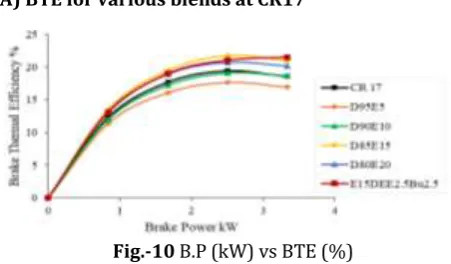
The blend used at compression ratio 17 are ethanol (E05, E10, E15 and E20) as a blend fuel butanol (Bu2.5) and di-ethyl ether (DEE2.5). The additives are added to the best blend of ethanol and Diesel. For the comparison reason D100 CR17 performance and emissions are plotted on the graphs along with the other blends results. In this section performance and emission characteristics on ordinate are graphed against brake power on abscissa
[image:4.595.313.555.90.229.2](A) BTE for various blends at CR17
Fig.-10 B.P (kW) vs BTE (%)
[image:4.595.46.277.133.261.2] [image:4.595.47.278.421.568.2] [image:4.595.317.543.577.709.2]ethanol creates cooling effect and reduces exhaust temperature (5). The ethanol blend D85E15 shows increase of BTE 9.85% at part loads and 13.1% at full loads. The additives butanol is used to minimise the phase separation and maximise the Kinematic viscosity and di-ethyl-ether is used to increase the cetane number of blend which reduces the ignition delay. Due to addition of 2.5 v/v% each additives to D80E15 BTE at increases to 6.29% at part loads to 15.85% at full load compared to CR17 (6).
(B) Brake specific fuel consumption.
Fig-11 B.P (kW) vs BSFC (kg/kWh)
The effect of compression ratio on BSFC with D100 are shown in the Fig-11. The increase in ethanol blend in the diesel decreases BSFC due to the complete combustion due to the presence of oxygen content in fuel. At part load conditions BSFC decrease by 7.27% and for full load decrease to 9.95% compared to CR17. The additives DEE and Bu affects increase the cetane number and viscosity of fuel which helps minimum ignition delay. At part load conditions BSFC decrease by 5.3% and for full load decrease to 13.3% compared to CR17. So with performance results E15 shows best performance at CR17 and improved by adding additives of 2.5% each of butanol and di-ethyl-ether at full load conditions.
EMISSION ANALYSIS
(C) Brake Power Vs Carbon monoxide Emissions
Fig-12 B.P (kW) vs CO (%Vol)
The change of carbon monoxide with respect to the brake power in kW is shown in Fig-12. The latent heat of vaporization of ethanol is high which lowers the flame temperature. This effects at higher blend and lower load, weakens the oxidation reaction at partial load. So CO-emission increases relatively with all ethanol blends compared to diesel at CR17. The results show that for E15 CO emissions are increased by 1.21 times at part load 0.632 at full loads but by adding butanol and DEE increased by 1.45
times at part load and decreased by 0.10 times at full load condition compared to D100 at CR17.
(D) Brake Power Vs HC emissions
Fig-13 B.P (kW) vs HC (ppm)
Fig-13 shows the variation of HC with load for different blends with respect to the brake power in kW. It can be observed from the graph that the HC emissions increased under lower engine load with increase in ethanol blend. The lower cetane value and high latent heat of vaporization of the ethanol blend increases the ignition delay. This ignition delay results in excessive suppression of ignitability of fuel, triggering an increase in HC emissions up to the part load conditions. The results show that for E15 HC emissions are increased by 64.86% at part load 17.39% at full loads compared to CR17. But by adding butanol and DEE to the E15 HC emissions are reduced by 10.66% at part load and 3.75% at full load condition.
(E) Brake Power Vs CO2 emissions
Fig-14 B.P (kW) vs CO2 (%Vol)
(F) Brake Power Vs NOX emissions
Fig-15 B.P (kW) vs NOX (ppm)
The change of NOx with respect to the different blends and additives with increased loads shown in Fig-15. The NOx are indicators of flame temperature and availability of oxygen. At lower loads NOX emissions due to lower flame temperature but at higher loads temperature reaches above 16000C and rich availability oxygen enhances NOx formation.
From graph NOx are reduced by 22.17% at part loads and 23.11% at full loads. The additives achieves reduction by 39.37% at part loads and 13.82% at full loads relative to CR17 D100.
Conclusion
The conclusion of D100 performance and emissions analysis at various compression ratios, the best results are shown for compression ratio 17. So considering this compression ratio as optimum and keeping it constant CR for various blends and performance and emission test are conducted for methanol blends. The results show that D85E15 is more efficient. The additives of DEE2.5Bu2.5 is added to D85E15 which improves the 15.85% of BTE compared to CR17.
REFERENCES
[1] World Oil Outlook 2017 Organization of the Petroleum
Exporting Countries
[2] Swamy RL, Chandrashekar TK, Banapurmath NR and
Khandal SV, “Impact of Diesel-butanol Blends on Performance and Emission of Diesel Engine” Oil & Gas Research 2015M.
[3] Prabakaran, B, Vijayabalan and Palanimuthu and
Balachandar M, “Experimental Investigation of Ethanol-Diesel-Butanol Blends in a Compression Ignition Engine by Modifying the Operating Parameters” SAE International, 2018.
[4] M. Young V. Gnanamoorthi and G. Devaradjane, “Effect of
compression ratio on the performance, combustion and emission of DI diesel engine fueled with ethanol e Diesel blend” Journal of the Energy Institute 88 (2015) 19-26
[5] Banapurmath NR, Khandal SV, Ranganatha Swamy L and
Chandrashekar TK, “Alcohol (Ethanol and Diethyl Ethyl Ether)-Diesel Blended Fuels for Diesel Engine Applications-A Feasible Solution” Banapurmath et al., Adv Automob Eng 2015, 4:1
[6] Dr. K. R. Patil, “Effect of Oxygenated DEE Additive to