© 2019, IRJET | Impact Factor value: 7.211 | ISO 9001:2008 Certified Journal | Page 5012
ANDROID ENABLED SMART IRRIGATION SYSTEM USING THE INTERNET
Peace Muyambo
11
PhD student at the University of Zimbabwe, Faculty of Science, Department of Computer Science, Zimbabwe
---***---
Abstract - Irrigation automation is a technique, which has been of interest to many especially in the academia merging it with microcontrollers and wireless technology such as GSM, Bluetooth, Wi-Fi and ZigBee. This approach devised the ways of interaction between humans and the environment. Convenience and comfort to farmers was provided for they will control irrigation pumps and valves with just a click on their mobile devices. More so, they will monitor the soil moisture levels and status or irrigation valves from anywhere around the world and anytime. Android phones has hit the market and many people embraced it due to its ease of use and affordable prices. In this thesis, an authenticated based remote irrigation automation system controlled via the internet is developed which allows only authorized users to control irrigation tools and components. Almost every android mobile phone has a Wi-Fi facility in it that will be of importance in providing connectivity to farmers so that they control the irrigation system at home or anywhere around the world. Wi-Fi protocol 802.11 offers a low energy consumption facility vital for conserving battery life and secure protocol to ensure confidentiality. This project focuses on design and implementation of a mobile android application with biometric and/or password security for controlling irrigation pumps and valves via the internet. An interactive application allows the use of cell phone to send commands to the Arduino microcontroller, which responds by turning on/off the irrigation valves, and send back the soil moisture level recorded by sensors to the mobile application. A user can program the system to trigger events under explicit conditions thereby controlling water supply to the plants. The Wi-Fi signal strength depends on transmission power, the bandwidth and the rate of absorption of the medium. However, the strength is not weakened by increase in distance between communicating devices
Key Words: Internet of Thing (IoT), Irrigation, Microcontroller, Sensor
1. INTRODUCTION
Agriculture is a primary sector of Zimbabwean Economy and other developing countries making it essential to automate it to improve efficiency in this sector. Lot of labor is required on a typical farm. Automation can make farming easier and faster through moderating the amount of manual labor. Automation involves the use of machinery, information technologies and other control systems in optimizing productivity in the production and provision of goods and services. Thus it helps to answer to Zimbabwe‘s pursuit for being self-sustainable and food security. Zimbabwean agriculture mechanization and computerization is progressing at a fast pace yet it is one of the areas that is difficult to admire and achieve- it requires continuous innovation and identifying technological trends and innovations that stabs the application of computerization and mechanization in the country and foreign countries. Zimbabwe being one of the Sub-Saharan countries’ fastest growing economies banking on agriculture and farming, has not taken to technology at a relatively quick pace.
Internet of Things and agricultural irrigation: Most of Zimbabwean agriculture is supported by natural rains. Almost 50% of the population depends on agriculture therefore the need to improve agriculture productivity through automation. Internet of Things Irrigation Controlling and Automation system is the answer to the need for automation and computerization of irrigation agriculture. IoT irrigation monitoring and control system is a collection of hardware and software to support the computerization and automation of agriculture, irrigation agriculture and exactitude (precision) agriculture. Cisco said that IoT will create, from 2013 to 2022, a 14.4$ Trillions of value at stake for companies and industry.
© 2019, IRJET | Impact Factor value: 7.211 | ISO 9001:2008 Certified Journal | Page 5013
Due to the need to supplement rain and the need to support agriculture and farming all year round people introduced various forms of agriculture some of which is irrigation agriculture. Before the existence of modern and internet technologies irrigation was being carried out using canals and this can be dated back to the Egypt and Kush era where they dug canals in the fields as a form of irrigation. In addition, irrigation on small scale was being carried out using containers and scotch carts but due to the need to increase the size of irrigated land these methods become obsolete. More so, the recent changes in climate especially in southern Africa due to various weather phenomenon like El Nino increase the need for irrigation on a large scale and the only answer to that was mechanization. The need for mechanization leads to invention of various technologies to ease irrigation such us the use of water pressure controlled sprinklers, expensive center pivot irrigation systems and other manually controlled irrigation machinery which requires the user to control (turn on and off) manually. However, these irrigation mechanization and automation methods improve irrigation agriculture but most of them are expensive to set up and maintain, requires the user to be at the location to be able to control them and some require experts to run them. As the field of irrigation agriculture was racing invention and innovations, internet technology took the stage and tends to find its position in every aspect of our daily lives. It makes it possible to connect every object, tool or gadget together and be able to monitor and control devices from anywhere and anytime through communication between these devices through the internet. This ability to make all devices connected and communicate with one another is termed Internet of Things and irrigation agriculture is taking advantage of this new technology. The answers to total automation of irrigation agriculture lies within Internet of Things though it is taking time for farmers to accept these automation technologies.
1.1 Problem Statement
Internet of Things, mobile phones, websites and web technology has recently creeped into our lives, turned out to be inseparable part of our everyday lives, and cannot be overlooked but instead take advantage of these technologies and use them in irrigation automation. Due to the increase in irrigated land because of climatic changes, farmers tend to work on large portions of land to grow crops. It is difficult for one person to keep track of the entire farmland all the time. Sometimes it may happen that a given patch of land receives more water leading to water logging or might receive little or no water resulting in dry soil. In any of these cases, crops can get damaged leading to losses hence the need to keep updates of moisture levels of each patch and supply water per each patch’s need. In addition, most of current irrigation mechanization technologies still requires a lot of manual input and need user to be at the location to start them up or open and close water sources and require human labor and technical expertise, which is costly, and tend to make mistakes such as forgetting to close a water supply to the reservoir. Farmers needs to be in control of their irrigation and get updates about their farmland from anywhere anytime yet current irrigation technology is not giving them that. There is need to automate the irrigation systems to reduce human labor needed and improve efficiency or irrigation systems. More so, existing irrigation systems are expensive to setup and maintain. Nevertheless, by one click on their smart phones and some cost equipment, they can get total control of their irrigation systems as well as get updates of moisture levels of various farmland patches.
1.2 Aim
To design and implement prototype of irrigation controlling and monitoring systems using Internet of Things that can be remotely monitored and controlled through a mobile application via the internet and can automatically start irrigation using soil moisture level values read by sensors.
1.3 Research Objectives
Automatically turn on/off irrigation water pump by checking soil moisture levels using sensors
Enable authenticated user to control the irrigation system by switching the water pump using an android application connected via the internet
Read soil moisture levels using a sensor and send to an android application for display to the authorized and authenticated users
1.4 Research Hypothesis
Null Hypothesis (H0):
© 2019, IRJET | Impact Factor value: 7.211 | ISO 9001:2008 Certified Journal | Page 5014
Alternative Hypothesis (H1):
Irrigation cannot be monitored and controlled from a remote location through internet using IoT and a secure mobile application and cannot start/stop automatically depending on soil moisture level read by sensors.
2. LITERATURE REVIEW
Many systems concerning remote and automated irrigation monitoring and controlling systems and irrigation mechanization systems has been designed and developed for large-scale farmland as well as for commercial and non-commercial platforms
Automation and remote controlling with Internet of Things has found its use in irrigation automation, security systems and in home automation. A lot of research work on automated and remote irrigation monitoring and controlling has been carried out across the globe using various platforms some of them afore-mentioned. The most crucial aspect of distant controlling and computerization is to allow users to carry out tasks and control gadgets and equipment from anywhere and anytime as well as lessen human effort and intervention through linking devices and sensors.
Artificial Network Controller Irrigation System
Umair & Usman, proposed and implemented a simple approach to Irrigation control problem of using Artificial Network Controller (ANN). This system is compared with On/Off controller and it fails miserably due to its limitations. However, ANN based system has resulted in possible implementation of better, more efficient control, and these controllers do not require prior knowledge of system and have innate ability to adjust to changing conditions unlike conventional methods. It is noteworthy that ANN based systems can save many resources (energy, water and labour) and can deliver heightened results to all types of agriculture. [1]
Evapotranspiration and fuzzy inference method irrigation system
Mousa, Croock, & Abdullah, proposed a system based on computing evapotranspiration (ET) and the required quantity using fuzzy inference methodology and it aims to schedule irrigation according to the specific requirements of a crop and variations in various climatological factors. This avoids over or under-watering which considerably affect crops and yields. More so, the algorithm lessens the power switching conserving energy. Results show that the model of fuzzy is speedy and precise tool for calculating evapotranspiration and required water and in this system a wide-ranging algorithm was introduced to compute irrigation time making it suitable for all categories of irrigation with diverse sizes. However, more advanced algorithms require high computing power to run efficiently which is in turn expensive to implement and maintain. [2]
Programmable Device for Remote Control and Monitoring of Irrigation
Baker proposed a Programmable Device for Remote Control and Monitoring of Irrigation system, which have three levels that are: the microcontroller for information processing using atmega32 that has a control program for real time measurement and control, GSM unit to provide wireless communication with cell phones for monitoring of field parameters and control requirement with aid of sensors. Radio Frequency transmitter is used to collect and transmit data from field to the controller, which includes Radio Frequency receiver. This system work with parameters fed by the user through the system keypad according to plant requirements (temperature, humidity). The use of a system by typing in parameters and values requires extra care. If the user make a typing error and enter wrong values, a catastrophic damage to plants can occur and a better way to send information to the irrigation apparatus have to be used that doesn’t require the user to memorize values and type in them manually. The author did not mention exactly how the mobile phone will be used i.e. the signals and control messages will be sent through SMS or a native application. Also, radio frequencies are prone to interference. [3]
GSM based ZigBee Controlled Solenoid Valve for drip irrigation
© 2019, IRJET | Impact Factor value: 7.211 | ISO 9001:2008 Certified Journal | Page 5015
Solar Power Based Smart Irrigation System
Amol, Bhaskar, Svpm, & Malegaon, proposed a Solar Power Based Smart Irrigation System by Using PIC (Peripheral Interface Controller) Controller which uses solar panel to provide power supply to the motor and main system control. This system curb the waste of time of today’s chamber ON/OFF system that is done manually by automatically checking status of soil sensor for controlling the chamber using solenoid valve which operates on 12 volt DC supply. Valves are opened or closed based on the output of the sensor. The author propose that one can control the main motor via mobile through messages using GSM model. These SMS need to be compiled into meaningful programmable hardware device operations. However, the system requires the user to remember AT commands needed to control devices because there is no graphical user interface. In addition to that, the use of solar power has limitations such as during the summer cloudy conditions and nights the system may not have enough power supply hence not functional at those times. The proposed system will have mobile application with GUI widgets for user interactions hence no need for the user to remember any technical commands. More so, the proposed system will be using electricity power that is not affected by the weather conditions hence functional all the time given the electricity supply is present. [5]
Main Features of the Proposed System
Fig- 1 shows block diagram of Smart Irrigation System
3.0 METHODOLOGY
© 2019, IRJET | Impact Factor value: 7.211 | ISO 9001:2008 Certified Journal | Page 5016
noted the type of equipment currently being used, the size of manual labor (workers) being used in operating the current irrigation systems and sizes of the farmland under irrigation.
Advantages of observation
An improved understanding of how current irrigation systems work
Real time and real world environment data has a high level of validity given the technique is conducted in the right way.
Cheaper to prepare and administer
Disadvantages of Observation
Requires skills and training for accurate results
Subjects may act differently if they realize that they are being watched and observed leading to distorted results.
Some schemes are restrict access to their premises especially where their machinery is located; they only allow their staff and authorized personnel only to those areas
Design methods
Remote irrigation monitoring and controlling system via Internet is implemented using:
Arduino Microcontroller
Wi-Fi(internet) enabled Android smart phone
Esp8266 Wi-Fi Module
Soil Moisture Sensors
Solenoid Valves/DC water Pump
Relays
Hardware Description
Control Components
Microcontroller is the brains of the project that transfers suitable commands to turn. On/off appropriate devices as well as reading sensor data.
Wi-Fi Module provides a wireless communication channel between devices.
Relays are electromagnetic switches, which turn on/off the irrigation valves.
Soil Moisture Sensors read data from the soil and pass it microcontroller for processing.
Smart mobile devices uses android version 7.0.
© 2019, IRJET | Impact Factor value: 7.211 | ISO 9001:2008 Certified Journal | Page 5017
Fig- 2 Systems Architecture
This project aimed at designing an Internet based Remote Irrigation monitoring and controlling using Arduino Uno. It will allow the end user to use his or her android smart phone to view data on levels of soil moisture of various farmland sections read by sensors and controlling irrigation valves in the irrigation field using an android application. Arduino is the mastermind of the project. Mobile application has the capability of turning ON/OFF the solenoid valves to start/stop watering of the land. Commands are send from android phone to the microcontroller through the Wi-Fi module causing the microcontroller to respond to send commands by comparing them to predefined ones. After identifying the signal, the microcontroller activates the corresponding relay by passing 5V through. 0V signal to the respective relay from the microcontroller will turn off the solenoid valve
2.1 Software Description
This system consist of two major fragments of software, the first one is the Arduino software (programmed in C Programming Language, running at the backend ) and the second one is for the android application(the frontend designed in Java Android Programming Language). The Android application is responsible for displaying sensor data values to the client and directing user demand commands to the microcontroller through internet. The microcontroller executes those commands and responds to user request by passing suitable commands to solenoid valves or sensors and pass data between components of the system and android application
Android Application Development
© 2019, IRJET | Impact Factor value: 7.211 | ISO 9001:2008 Certified Journal | Page 5018
Android six and above come with feature for saving power to extend battery life of a mobile device called Doze. Doze lessens battery usage by deferring background activities when the device is not interacted with for long periods. [6]
3.0 RESULTS ANALYSIS
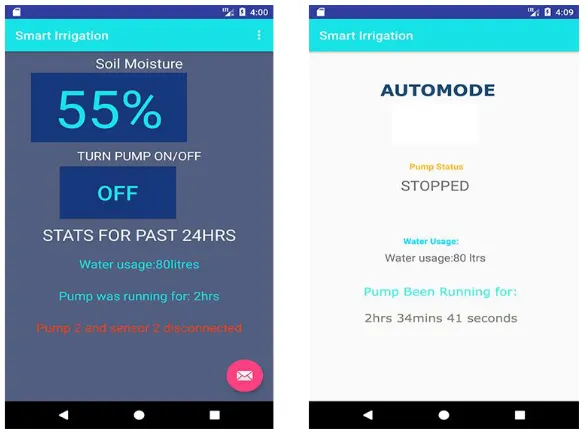
Fig- 3 screen shots of results
The researcher carried out some test as seen in the screenshots above to see if the system requirements were fulfilled. Section 3.4 defines the system requirements namely:
A user shall be able to scan and store their fingerprints for use in the authentication process
Authorized or authenticated users will be allowed by the system to control the irrigation valves.
The system should display sensor data values for soil moisture of the farmland as well the valve or pumps status (i.e. ON or OFF).
The system must have the facility to start or stop irrigation based on the moisture levels automatically.
[image:7.612.161.455.149.370.2]The above mentioned were successfully implemented with the exception of the Field Y section which made use of dummy data instead of actual moisture levels and valve status.
Table -1 comparison of planned vs final
Feature Planned Product Final prototype
Arduino as control unit X X
Valves controlled by an android app and soil moisture levels and valve status displayed on the mobile app via the internet
X X
© 2019, IRJET | Impact Factor value: 7.211 | ISO 9001:2008 Certified Journal | Page 5019
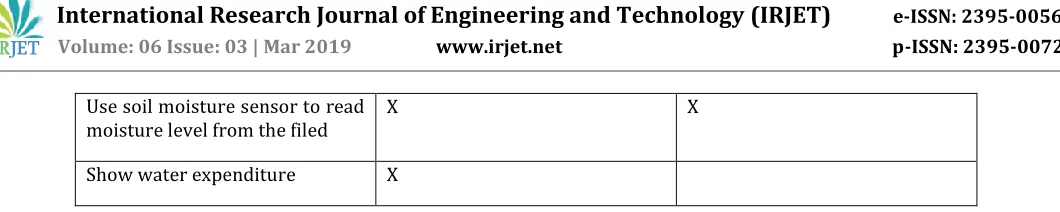
Use soil moisture sensor to read
moisture level from the filed X X
Show water expenditure X
Among planned features, not all were used due to financial constraints although the main objectives were successfully met.
[image:8.612.43.573.48.154.2]Measurements for different locations and network access
Table -2 Testing different location and network access
Location Same Network Different Networks Control
On site Connected Connected Automatic/Manual
Remote Location N/A Connected Automatic /Manual
Different type of measurements were taken on location and off location (remote location) as well as connecting our system to the same network and different network to test the system accessibility from various locations. Different kind of operation modes that is automatic or manual where the system was being controlled by a mobile phone were recorded.
3.1 Results discussion
In agriculture automation systems, crops and environment safety, security and privacy are major issues, which needs to be addressed with concern. There is unpredictable and dynamic developments in the future that may compromise environment safety. Additionally, the use of internet which is the largest network and highly unsecure as a communication medium pose a risk of packets modification and eavesdropping by intruders. User privacy maybe compromised also as some systems may work with information about utility charges such as water consumption. Automatic supply of water to plants without user interaction may fail and lead to the drowning of crops or starve the crops from water supply. Also security breaches on end users’ mobile phones which will be used in automated irrigation may lead to undesirable controls send by hackers or unauthorized users and water supplies to pants leading to drowning of crops or damaging the environment through water logging and water deficiency to the land damaging the land. In this system, the researcher planned to use fingerprint authentication as it covers major pillars of security such as authentication, privacy, authorization (access control), non-repudiation and data integrity. However, in the final prototype password authentication method was used. The password method has many flaws that need to be addressed as well but it is an inexpensive method.
The Wi-Fi Internet signal speed depends on the transmission power and speed (bandwidth), number of nodes connected on one Wi-Fi access point, sensitivity of the Wi-Fi module and the rate of absorption of the medium. The signal is however not weakened by increase in distance or interference but require internet access on both communicating sides of the system. For fast and efficient operation of the system, users need to make sure their Wi-Fi is reliable, faster Wi-Fi speeds lead to faster communication, and transmission hence increased efficiency.
© 2019, IRJET | Impact Factor value: 7.211 | ISO 9001:2008 Certified Journal | Page 5020
4.0 AIM AND OBJECTIVES REALISATION
The major aim of the research was to design and develop a secured android mobile application, which remotely control and monitor irrigation system remotely via the internet and monitor soil moisture levels of a field using sensors via the internet. More so, gather information about the security issues and how they were addressed. The objectives were successfully achieved. The system managed to allow authorized personnel to control irrigation components remotely over the internet hence we accept H0, which states that irrigation can be monitored and controlled from a remote location through internet using IoT and a mobile android application.
4.1 Challenges Faced
During the course of the project, the researcher faced challenges during the testing phases. The fingerprint authentication system caused some problems during the link establishment. Some android seven devices with fingerprint sensor fail to establish link successfully. Majority of people with android devices still use android version 5 and 6 which means that the researcher had few mobile devices to test the system. The author had to opt for alternative authentication method, which is password to authenticate authorized users. Another problem was encountered during the sending of commands between phone and hardware. The phone will just send the command without confirming to see if the link had been established until the issue was resolved. In addition, internet speeds were an issue, as at times the user had to wait while the application is loading data send from microcontroller through Wi-Fi.
5.0 CONCLUSION
The author managed to meet set objectives but there are some improvements that needs to be considered and address the challenges faced in this thesis. The mobile application must be updated for security reasons to ensure integrity and confidentiality of data in transit. The mobile application must be upgraded to allow the user to set the minimum and maximum moisture levels needs of their farmland to be used when the irrigation is running automatically. The system should be improved to be intelligent and learn from analysis of user interaction with the system and behaviour to train itself to carryout tasks automatically based on user preferences, activities and behaviour when using the system (incorporating machine learning).
REFERENCES
[1] Umair, S. M. and Usman, R. (2010) ‘Automation of Irrigation System Using ANN based Controller’, (2), pp. 1–7.
[2] Mousa, A. K., Croock, M. S. and Abdullah, M. N. (2014) ‘Fuzzy Based Decision Support Model for Irrigation System Management’, International Journal of Computer Applications, 104(9), pp. 14–2mol, P. et al. (2017) ‘SOLAR POWER BASED SMART IRRIGATION’, 2(3), pp. 122–125.
[3] Baker, T. (2014) ‘Design and implementation of a programmable remote controlled and monitored irrigation system’, 4(12), pp. 25–29.
[4] Guerbaoui, M. and Afou, Y. E. L. (2013) ‘Pc-Based Automated Drip Irrigation System’, 5(1), pp. 221–225.
[5] Amol, Bhaskar, Svpm, & Malegaon P. et al. (2017) ‘Solar Power Based Smart Irrigation’, 2(3), pp. 122–125.