How to train your multi bottom-up tree transducer
Andreas Maletti
Universit¨at Stuttgart, Institute for Natural Language Processing Azenbergstraße 12, 70174 Stuttgart, Germany
Abstract
The local multi bottom-up tree transducer is introduced and related to the (non-contiguous) synchronous tree sequence substitution gram-mar. It is then shown how to obtain a weighted local multi bottom-up tree transducer from a bilingual and biparsed corpus. Finally, the problem of non-preservation of regular-ity is addressed. Three properties that ensure preservation are introduced, and it is discussed how to adjust the rule extraction process such that they are automatically fulfilled.
1 Introduction
A (formal) translation model is at the core of ev-ery machine translation system. Predominantly, sta-tistical processes are used to instantiate the for-mal model and derive a specific translation device. Brown et al. (1990) discuss automatically trainable translation models in their seminal paper. However, the IBM models of Brown et al. (1993) are string-based in the sense that they base the translation de-cision on the words and their surrounding context. Contrary, in the field of syntax-based machine trans-lation, the translation models have full access to the syntax of the sentences and can base their decision on it. A good exposition to both fields is presented in (Knight, 2007).
In this paper, we deal exclusively with syntax-based translation models such as synchronous tree substitution grammars (STSG), multi bottom-up tree transducers (MBOT), and synchronous tree-sequence substitution grammars (STSSG). Chiang (2006) gives a good introduction to STSG, which originate from the syntax-directed translation schemes of Aho
and Ullman (1972). Roughly speaking, an STSG has rules in which two linked nonterminals are re-placed (at the same time) by two corresponding trees containing terminal and nonterminal symbols. In addition, the nonterminals in the two replacement trees are linked, which creates new linked nontermi-nals to which further rules can be applied. Hence-forth, we refer to these two trees as input and output tree. MBOT have been introduced in (Arnold and Dauchet, 1982; Lilin, 1981) and are slightly more expressive than STSG. Roughly speaking, they al-low one replacement input tree and several output trees in a single rule. This change and the pres-ence of states yields many algorithmically advanta-geous properties such as closure under composition, efficient binarization, and efficient input and output restriction [see (Maletti, 2010)]. Finally, STSSG, which have been derived from rational tree rela-tions (Raoult, 1997), have been discussed by Zhang et al. (2008a), Zhang et al. (2008b), and Sun et al. (2009). They are even more expressive than the lo-cal variant of the multi bottom-up tree transducer (LMBOT) that we introduce here and can have sev-eral input and output trees in a single rule.
In this contribution, we restrict MBOT to a form that is particularly relevant in machine translation. We drop the general state behavior ofMBOTand re-place it by the common locality tests that are also present in STSG, STSSG, and STAG (Shieber and Schabes, 1990; Shieber, 2007). The obtained device is the localMBOT(LMBOT).
Maletti (2010) argued the algorithmical advan-tages of MBOT over STSG and proposed MBOT as an implementation alternative for STSG. In partic-ular, the training procedure would train STSG; i.e., it would not utilize the additional expressive power
of MBOT. However, Zhang et al. (2008b) and Sun et al. (2009) demonstrate that the additional expres-sivity gained from non-contiguous rules greatly im-proves the translation quality. In this contribution we address this separation and investigate a training procedure for LMBOT that allows non-contiguous fragments while preserving the algorithmic advan-tages ofMBOT. To this end, we introduce a rule ex-traction and weight training method forLMBOTthat is based on the corresponding procedures forSTSG and STSSG. However, general LMBOT can be too expressive in the sense that they allow translations that do not preserve regularity. Preservation of reg-ularity is an important property for efficient repre-sentations and efficient algorithms [see (May et al., 2010)]. Consequently, we present 3 properties that ensure that anLMBOTpreserves regularity. In addi-tion, we shortly discuss how these properties could be enforced in the rule extraction procedure.
2 Notation
The set of nonnegative integers isN. We write[k] for the set{i | 1 ≤ i ≤ k}. We treat functions as special relations. For every relationR⊆A×B and
S ⊆A, we write
R(S) ={b∈B | ∃a∈S: (a, b)∈R}
R−1={(b, a)|(a, b)∈R} ,
whereR−1 is called theinverseofR.
Given an alphabet Σ, the set of all words (or se-quences) overΣisΣ∗, of which the empty word isε. The concatenation of two wordsu andw is simply denoted by the juxtaposition uw. The length of a word w = σ1· · ·σk with σi ∈ Σ for all i ∈ [k] is |w| = k. Given 1 ≤ i ≤ j ≤ k, the (i, j) -spanw[i, j]ofwisσiσi+1· · ·σj.
The set TΣ of all Σ-trees is the smallest set T
such that σ(t) ∈ T for all σ ∈ Σ and t ∈ T∗. We generally use bold-face characters (like t) for sequences, and we refer to their elements using sub-scripts (like ti). Consequently, a tree t consists of a labeled root node σ followed by a sequence t of its children. To improve readability we sometimes write a sequencet1· · ·tkast1, . . . , tk.
Thepositionspos(t) ⊆N∗ of a treet=σ(t)are
inductively defined bypos(t) ={ε}∪pos(t), where
pos(t) = [
1≤i≤|t|
{ip|p∈pos(ti)} .
Note that this yields an undesirable difference be-tweenpos(t)andpos(t), but it will always be clear from the context whether we refer to a single tree or a sequence. Note that positions are ordered via the (standard) lexicographic ordering. Lett ∈ TΣ and p ∈pos(t). The label oftat positionpist(p), and the subtree rooted at positionpist|p. Formally, they are defined by
t(p) =
(
σ ifp=ε
t(p) otherwise t(ip) =ti(p)
t|p=
(
t ifp=ε
t|p otherwise t|ip=ti|p
for allt =σ(t)and1≤ i≤ |t|. As demonstrated, these notions are also used for sequences. A posi-tionp∈pos(t)is aleaf (int) ifp1∈/ pos(t). Given a subsetNT⊆Σ, we let
↓NT(t) ={p∈pos(t)|t(p)∈NT, pleaf int} .
Later NT will be the set of nonterminals, so that the elements of↓NT(t)will be theleaf nonterminals oft. We extend the notion to sequencestby
↓NT(t) = [
1≤i≤|t|
{ip|p∈ ↓NT(ti)} .
We also need a substitution that replaces sub-trees. Let p1, . . . , pn ∈ pos(t) be pairwise in-comparable positions and t1, . . . , tn ∈ TΣ. Then t[pi ← ti | 1 ≤ i ≤ n]denotes the tree that is ob-tained fromtby replacing (in parallel) the subtrees atpibyti for everyi∈[k].
Finally, let us recall regular tree languages. A fi-nite tree automatonM is a tuple (Q,Σ, δ, F) such that Q is a finite set, δ ⊆ Q∗ × Σ× Q is a fi-nite relation, andF ⊆ Q. We extend δ to a map-pingδ:TΣ →2Qby
δ(σ(t)) ={q |(q, σ, q)∈δ,∀i∈[|t|] : qi ∈δ(ti)} for everyσ ∈Σandt∈TΣ∗. The finite tree automa-tonM recognizes the tree language
L(M) ={t∈TΣ |δ(t)∩F 6=∅} .
A tree languageL ⊆TΣ isregular if there exists a
VP
VBD
signed
PP → PV twlY
,
NP-OBJ
NP
DET-NN
AltwqyE PP
1
S
NP-SBJ VP →
VP
PV NP-OBJ NP-SBJ
1
[image:3.612.108.512.66.148.2]2 1
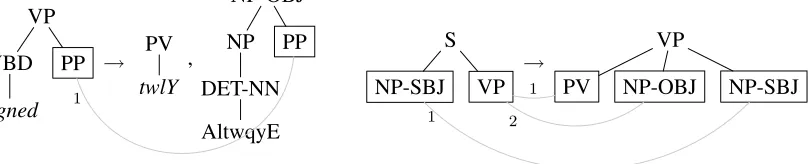
Figure 1: SampleLMBOTrules.
3 The model
In this section, we recall particular multi bottom-up tree transducers, which have been introduced by Arnold and Dauchet (1982) and Lilin (1981). A detailed (and English) presentation of the general model can be found in Engelfriet et al. (2009) and Maletti (2010). Using the nomenclature of Engel-friet et al. (2009), we recall a variant oflinear and nondeleting extended multi bottom-up tree transduc-ers(MBOT) here. Occasionally, we will refer to gen-eralMBOT, which differ from the local variant dis-cussed here because they have explicit states.
Throughout the article, we assume setsΣand∆ of input and output symbols, respectively. More-over, letNT⊆Σ∪∆be the set of designated non-terminal symbols. Finally, we avoid weights in the formal development to keep it simple. It is straight-forward to add weights to our model.
Essentially, the model works on pairs ht,ui consisting of an input tree t ∈ TΣ and a
se-quence u ∈ T∆∗ of output trees. Each such pair is called apre-translation and the rank rk(ht,ui) the pre-translationht,uiis|u|. In other words, the rank of a pre-translation equals the number of output trees stored in it. Given a pre-translationht,ui ∈TΣ×T∆k
andi ∈ [k], we callui theith translation of t. An alignment for the pre-translation ht,ui is an injec-tive mappingψ: ↓NT(u) → ↓NT(t)×Nsuch that (p, j) ∈ ψ(↓NT(u))for every (p, i) ∈ ψ(↓NT(u)) andj∈[i]. In other words, an alignment should re-quest each translation of a particular subtree at most once and if it requests the ith translation, then it should also request all previous translations.
Definition 1 A local multi bottom-up tree trans-ducer(LMBOT) is a finite setRof rulessuch that ev-ery rule, writtenl →ψ r, contains a pre-translation hl,riand an alignmentψfor it.
The component l is the left-hand side, r is the right-hand side, and ψ is the alignment of a rulel→ψ r∈R. The rules of anLMBOTare similar to the rules of anSTSG (synchronous tree substitu-tion grammar) of Eisner (2003) and Shieber (2004), but right-hand sides of LMBOT contain a sequence of trees instead of just a single tree as in anSTSG. In addition, the alignments in an STSG rule are bijec-tive between leaf nonterminals, whereas our model permits multiple alignments to a single leaf nonter-minal in the left-hand side. A model that is even more powerful than LMBOT is the non-contiguous version of STSSG (synchronous tree-sequence sub-stitution grammar) of Zhang et al. (2008a), Zhang et al. (2008b), and Sun et al. (2009), which al-lows sequences of trees on both sides of rules [see also (Raoult, 1997)]. Figure 1 displays sample rules of anLMBOTusing a graphical representation of the trees and the alignment.
Next, we define the semantics of an LMBOT R. To avoid difficulties1, we explicitly exclude rules like l →ψ r where l ∈ NT or r ∈ NT∗; i.e., rules where the left- or right-hand side are only leaf nonterminals. We first define the traditional bottom-up semantics. Letρ = l →ψ r ∈ R be a rule and p ∈ ↓NT(l). The p-rankrk(ρ, p) of ρ is rk(ρ, p) =|{i∈N|(p, i)∈ψ(↓NT(r))}|.
Definition 2 The setτ(R)of pre-translations of an LMBOT R is inductively defined to be the smallest set such that: If ρ = l →ψ r ∈ R is a rule, htp,upi ∈ τ(R)is a pre-translation ofR for every
p∈ ↓NT(l), and
• rk(ρ, p) = rk(htp,upi),
• l(p) =tp(ε), and
1
PP
IN
for
NP
NNP
Serbia
D
PP
PREP
En
NP
NN-PROP
SrbyA
E
VP
VBD
signed
PP
IN
for
NP
NNP
Serbia
D PV
twlY
,
NP-OBJ
NP
DET-NN
AltwqyE
PP
PREP
En
NP
NN-PROP
SrbyA
E
S
. . . VP
VBD
signed
PP
IN
for
NP
NNP
Serbia
D
VP
PV
twlY
NP-OBJ
NP
DET-NN
AltwqyE
PP
PREP
En
NP
NN-PROP
SrbyA
. . .
[image:4.612.81.525.56.280.2]E
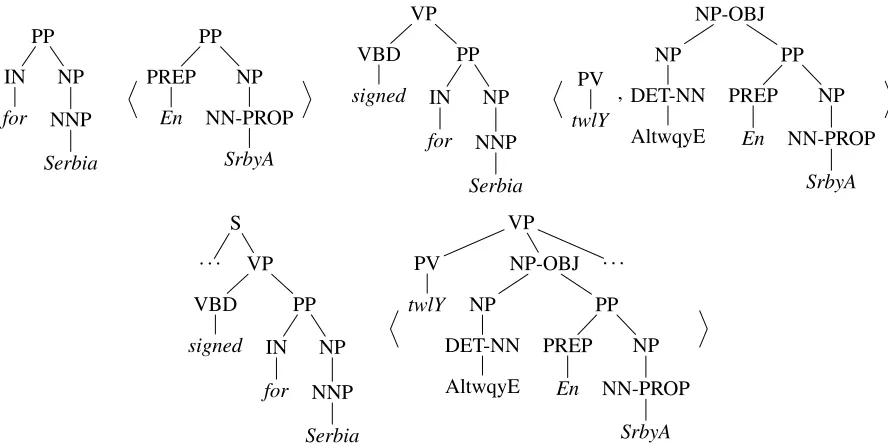
Figure 2: Top left: (a) Initial pre-translation; Top right: (b) Pre-translation obtained from the left rule of Fig. 1 and (a); Bottom: (c) Pre-translation obtained from the right rule of Fig. 1 and (b).
• r(p0) =up00(i)withψ(p0) = (p00, i)
for everyp0∈ ↓NT(r), thenht,ui ∈τ(R)where
• t=l[p←tp|p∈ ↓NT(l)]and
• u=r[p0←(up00)i|p0∈ψ−1(p00, i)].
In plain words, each nonterminal leaf p in the left-hand side of a rule ρ can be replaced by the input tree t of a pre-translation ht,ui whose root is labeled by the same nonterminal. In addition, the rankrk(ρ, p)of the replaced nonterminal should match the rankrk(ht,ui)of the pre-translation and the nonterminals in the right-hand side that are aligned to p should be replaced by the translation that the alignment requests, provided that the non-terminal matches with the root symbol of the re-quested translation. The main benefit of the bottom-up semantics is that it works exclusively on pre-translations. The process is illustrated in Figure 2.
Using the classical bottom-up semantics, we sim-ply obtain the following theorem by Maletti (2010) because the MBOT constructed there is in fact an LMBOT.
Theorem 3 For every STSG, an equivalentLMBOT can be constructed in linear time, which in turn yields a particularMBOTin linear time.
Finally, we want to relate LMBOT to the STSSG of Sun et al. (2009). To this end, we also introduce the top-down semantics for LMBOT. As expected, both semantics coincide. The top-down semantics is introduced using rule compositions, which will play an important rule later on.
Definition 4 The setRkofk-fold composed rules is inductively defined as follows:
• R1 =Rand
• `→ϕ s ∈ Rk+1 for allρ = l →ψ r ∈Rand
ρp =lp →ψp rp∈R
ksuch that
– rk(ρ, p) = rk(hlp,rpi),
– l(p) =lp(ε), and
– r(p0) =rp00(i)withψ(p0) = (p00, i)
for everyp∈ ↓NT(l)andp0∈ ↓NT(r)where
– `=l[p←lp |p∈ ↓NT(l)],
– s=r[p0 ←(rp00)i|p0∈ψ−1(p00, i)], and
– ϕ(p0p) = p00ψp00(ip) for all positions
p0 ∈ψ−1(p00, i)andip∈ ↓NT(rp00).
The rule closureR≤∞ofRisR≤∞=S
i≥1Ri. The top-down pre-translation ofRis
X
X →
X
a X
, X
a X
1
2
X
X →
X
b X
, X
b X
1
2
X
X
X →
X
a X
b X
, X
a X
b X
1
[image:5.612.76.297.54.185.2]2
Figure 3: Composed rule.
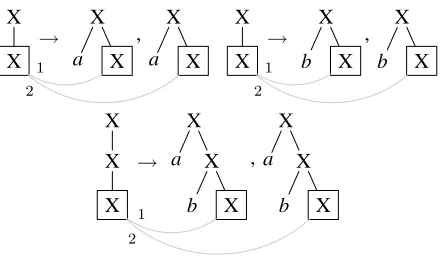
The composition of the rules, which is illus-trated in Figure 3, in the second item of Defini-tion 4 could also be represented as ρ(ρ1, . . . , ρk) where ρ1, . . . , ρk is an enumeration of the rules {ρp | p ∈ ↓NT(l)} used in the item. The
follow-ing theorem is easy to prove.
Theorem 5 The bottom-up and top-down semantics coincide; i.e.,τ(R) =τt(R).
Chiang (2005) and Graehl et al. (2008) argue that STSG have sufficient expressive power for syntax-based machine translation, but Zhang et al. (2008a) show that the additional expressive power of tree-sequences helps the translation process. This is mostly due to the fact that smaller (and less specific) rules can be extracted from bi-parsed word-aligned training data. A detailed overview that focusses on STSGis presented by Knight (2007).
Theorem 6 For everyLMBOT, an equivalentSTSSG can be constructed in linear time.
4 Rule extraction and training
In this section, we will show how to automatically obtain an LMBOT from a bi-parsed, word-aligned parallel corpus. Essentially, the process has two steps: rule extraction andtraining. In the rule ex-traction step, an (unweighted) LMBOT is extracted from the corpus. The rule weights are then set in the training procedure.
The two main inspirations for our rule extraction are the corresponding procedures forSTSG (Galley et al., 2004; Graehl et al., 2008) and forSTSSG(Sun et al., 2009). STSG are always contiguous in both the left- and right-hand side, which means that they (completely) cover a single span of input or output
words. On the contrary, STSSG rules can be non-contiguous on both sides, but the extraction proce-dure of Sun et al. (2009) only extracts rules that are contiguous on the left- or right-hand side. We can adjust its 1st phase that extracts rules with (poten-tially) non-contiguous right-hand sides. The adjust-ment is necessary becauseLMBOTrules cannot have (contiguous) tree sequences in their left-hand sides. Overall, the rule extraction process is sketched in Algorithm 1.
Algorithm 1Rule extraction forLMBOT
Require: word-aligned tree pair(t, u)
Return: LMBOTrulesRsuch that(t, u)∈τ(R)
while there exists a maximal non-leaf node
p ∈ pos(t) and minimal p1, . . . , pk ∈ pos(u) such that t|p and (u|p1, . . . , u|pk) have a con-sistent alignment (i.e., no alignments from withint|p to a leaf outside(u|p1, . . . , u|pk)and vice versa)
do
2: add ruleρ=t|p →ψ (up1, . . . , upk)toR with the nonterminal alignmentsψ
// excise rule ρ from (t, u)
4: t←t[p←t(p)]
u←u[pi ←u(pi)|i∈ {1, . . . , k}] 6: establish alignments according to position
end while
The requirement that we can only have one in-put tree inLMBOTrules indeed might cause the ex-traction of bigger and less useful rules (when com-pared to the correspondingSTSSGrules) as demon-strated in (Sun et al., 2009). However, the stricter rule shape preserves the good algorithmic proper-ties ofLMBOT. The more powerfulSTSSGrules can cause nonclosure under composition (Raoult, 1997; Radmacher, 2008) and parsing to be less efficient.
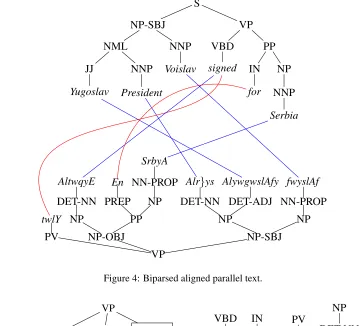
Figure 4 shows an example of biparsed aligned parallel text. According to the method of Galley et al. (2004) we can extract the (minimal) STSG rule displayed in Figure 5. Using the more liberal format ofLMBOTrules, we can decompose theSTSGrule of Figure 5 further into the rules displayed in Figure 1. The method of Sun et al. (2009) would also extract the rule displayed in Figure 6.
Let us reconsider Figures 1 and 2. Let ρ1 be
S
NP-SBJ
NML
JJ
Yugoslav
NNP
President NNP
Voislav
VP
VBD
signed
PP
IN
for NP
NNP
Serbia
VP PV
twlY
NP-OBJ NP
DET-NN AltwqyE
PP PREP
En
NP NN-PROP
SrbyA
NP-SBJ NP
DET-NN Alr}ys
DET-ADJ AlywgwslAfy
NP NN-PROP
[image:6.612.123.482.60.386.2]fwyslAf
Figure 4: Biparsed aligned parallel text.
S
NP-SBJ VP
VBD
signed
PP →
VP
PV
twlY
NP-OBJ
NP
DET-NN
AltwqyE PP
NP-SBJ
1
1
Figure 5: MinimalSTSGrule.
left and right rule of Figure 1, respectively. We can represent the lower pre-translation of Figure 2 byρ3(· · · , ρ2(ρ1)), whereρ2(ρ1)represents the
up-per right pre-translation of Figure 2. If we name all rules of R, then we can represent each pre-translation ofτ(R) symbolically by a tree contain-ing rule names. Such trees containcontain-ing rule names are often calledderivation trees. Overall, we obtain the following result, for which details can be found in (Arnold and Dauchet, 1982).
Theorem 7 The setD(R)is a regular tree language for everyLMBOTR, and the set of derivations is also regular for everyMBOT.
VBD
signed , IN
for
→ PV
twlY ,
NP
DET-NN
AltwqyE
, PREP En
Figure 6: SampleSTSSGrule.
Moreover, using the input and output product con-structions of Maletti (2010) we obtain that even the setDt,u(R)of derivations for a specific input treet and output treeu is regular. SinceDt,u(R) is reg-ular, we can compute the inside and outside weight of each (weighted) rule ofR following the method of Graehl et al. (2008). Similarly, we can adjust the training procedure of Graehl et al. (2008), which yields that we can automatically obtain a weighted LMBOTfrom a bi-parsed parallel corpus. Details on the run-time can be found in (Graehl et al., 2008).
5 Preservation of regularity
L⊆TΣ, we let
Tc(L) ={ui |(u1, . . . , uk)∈ T(L), i∈[k]} ,
which collects all translations of input trees in L. We say thatT preserves regularityifTc(L)is
regu-lar for every reguregu-lar tree languageL ⊆ TΣ.
Corre-spondingly, anLMBOTR preserves regularity if its setτ(R)of pre-translations preserves regularity.
As mentioned, an LMBOT does not necessarily preserve regularity. The rules of an LMBOT have only alignments between the left-hand side (input tree) and the right-hand side (output tree), which are also calledinter-treealignments. However, several alignments to a single nonterminal in the left-hand side can transitively relate two different nontermi-nals in the output side and thus simulate an intra-treealignment. For example, the right rule of Fig-ure 1 relates a ‘PV’ and an ‘NP-OBJ’ node to a sin-gle ‘VP’ node in the left-hand side. This could lead to an intra-tree alignment (synchronization) between the ‘PV’ and ‘NP-OBJ’ nodes in the right-hand side. Figure 7 displays the rules R of an LMBOT that does not preserve regularity. This can easily be seen on the leaf (word) languages because the LMBOT can translate the word x to any element ofL = {wcwc | w ∈ {a, b}∗}. Clearly, this word language Lis not context-free. Since the leaf lan-guage of every regular tree lanlan-guage is context-free and regular tree languages are closed under inter-section (needed to single out the translations that have the symbol Y at the root), this also proves that
τ(R)c(TΣ)is not regular. SinceTΣ is regular, this
proves that theLMBOTdoes not preserve regularity. Preservation of regularity is an important property for a number of translation model manipulations. For example, the bucket-brigade and the on-the-fly method for the efficient inference described in (May et al., 2010) essentially build on it. Moreover, a reg-ular tree grammar (i.e., a representation of a regreg-ular tree language) is an efficient representation. More complex representations such as context-free tree grammars [see, e.g., (Fujiyoshi, 2004)] have worse algorithmic properties (e.g., more complex parsing and problematic intersection).
In this section, we investigate three syntactic re-strictions on the setR of rules that guarantees that the obtained LMBOTpreserves regularity. Then we
shortly discuss how to adjust the rule extraction al-gorithm, so that the extracted rules automatically have these property. First, we quickly recall the no-tion of composed rules from Definino-tion 4 because it will play an essential role in all three properties. Figure 3 shows a composition of two rules from Fig-ure 7. Mind thatR2might not contain all rules ofR, but it contains all those without leaf nonterminals.
Definition 8 An LMBOT R is finitely collapsing if there isn∈Nsuch thatψ: ↓NT(r)→ ↓NT(l)×{1} for every rulel→ψ r∈Rn.
The following statement follows from a more gen-eral result of Raoult (1997), which we will introduce with our second property.
Theorem 9 Every finitely collapsing LMBOT pre-serves regularity.
Often the simple condition ‘finitely collapsing’ is fulfilled after rule extraction. In addition, it is au-tomatically fulfilled in anLMBOTthat was obtained from an STSG using Theorem 3. It can also be en-sured in the rule extraction process by introducing collapsing pointsfor output symbols that can appear recursively in the corpus. For example, we could en-force that all extracted rules for clause-level output symbols (assuming that there is no recursion not in-volving a clause-level output symbols) should have only 1 output tree in the right-hand side.
However, ‘finitely collapsing’ is a rather strict property. Finitely collapsing LMBOT have only slightly more expressive power than STSG. In fact, they could be called STSG with input desynchro-nization. This is due to the fact that the alignment in composed rules establishes an injective relation between leaf nonterminals (as in an STSG), but it need not be bijective. Consequently, there can be leaf nonterminals in the left-hand side that have no aligned leaf nonterminal in the right-hand side. In this sense, those leaf nonterminals are desynchro-nized. This feature is illustrated in Figure 8 and such an LMBOT can compute the transformation {(t, a) |t∈TΣ}, which cannot be computed by an STSG(assuming thatTΣis suitably rich). ThusSTSG
X
x
→ X
c , X
c
X
X
→ X
a X
, X
a X
1
2
X
X
→ X
b X
, X
b X
1
2
Y
X
→ Y
X X
[image:8.612.75.525.51.278.2]1 2
Figure 7: Output subtree synchronization (intra-tree).
X
X X
→ a X
a
→ DE
Figure 8: Finitely collapsingLMBOT.
Theorem 10 For every STSG, we can construct an equivalent finitely collapsingLMBOTin linear time. Moreover, finitely collapsing LMBOT are strictly more expressive thanSTSG.
Next, we investigate a weaker property by Raoult (1997) that still ensures preservation of regularity.
Definition 11 AnLMBOTRhasfinite synchroniza-tion if there is n ∈ N such that for every rule
l →ψ r ∈ Rn andp ∈ ↓NT(l) there exists i ∈ N withψ−1({p} ×N)⊆ {iw|w∈N∗}.
In plain terms, multiple alignments to a single leaf nonterminal at p in the left-hand side are allowed, but all leaf nonterminals of the right-hand side that are aligned top must be in the same tree. Clearly, anLMBOTwith finite synchronization is finitely col-lapsing. Raoult (1997) investigated this restriction in the context ofrational tree relations, which are a generalization of ourLMBOT. Raoult (1997) shows that finite synchronization can be decided. The next theorem follows from the results of Raoult (1997).
Theorem 12 EveryLMBOTwith finite synchroniza-tion preserves regularity.
MBOT can compute arbitrary compositions of
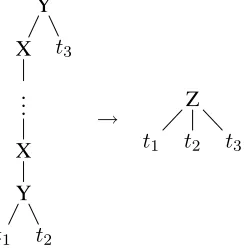
STSG (Maletti, 2010). However, this no longer re-mains true for MBOT (or LMBOT) with finite syn-chronization.2 In Figure 9 we illustrate a transla-tion that can be computed by a compositransla-tion of two STSG, but that cannot be computed by an MBOT (orLMBOT) with finite synchronization. Intuitively, when processing the chain of ‘X’s of the transforma-tion depicted in Figure 9, the first and second
suc-2This assumes a straightforward generalization of the ‘finite synchronization’ property forMBOT.
Y
X
.. .
X
Y
t1 t2 t3
→ Z
t1 t2 t3
Figure 9: Transformation that cannot be computed by an MBOTwith finite synchronization.
cessor of the ‘Z’-node at the root on the output side must be aligned to the ‘X’-chain. This is necessary because those two mentioned subtrees must repro-ducet1 and t2 from the end of the ‘X’-chain. We
omit the formal proof here, but obtain the following statement.
Theorem 13 For every STSG, we can construct an equivalentLMBOTwith finite synchronization in lin-ear time.LMBOTandMBOTwith finite synchroniza-tion are strictly more expressive thanSTSGand com-pute classes that are not closed under composition.
Again, it is straightforward to adjust the rule ex-traction algorithm by the introduction of synchro-nization points(for example, for clause level output symbols). We can simply require that rules extracted for those selected output symbols fulfill the condi-tion mencondi-tioned in Definicondi-tion 11.
Finally, we introduce an even weaker version.
Definition 14 An LMBOTR iscopy-freeif there is
n ∈ Nsuch that for every rulel →ψ r ∈ Rnand
p ∈ ↓NT(l) we have (i) ψ−1({p} ×N) ⊆ N, or (ii)ψ−1({p} ×N)⊆ {iw |w∈N∗}for ani∈
[image:8.612.367.489.156.280.2]X
X
.. .
X
X →
X
a X
a . ..
X
a X
, X
a X
a . ..
X
a X
1
[image:9.612.100.270.53.192.2]2
Figure 10: Composed rule that is not copy-free.
in the right-hand side forest) or group all those leaf nonterminals in a single tree in the forest. Clearly, theLMBOTof Figure 7 is not copy-free because the second rule composes with itself (see Figure 10) to a rule that does not fulfill the copy-free condition.
Theorem 15 Every copy-free LMBOT preserves regularity.
Proof sketch: Let n be the integer of Defini-tion 14. We replace theLMBOTwith rulesRby the equivalentLMBOTM with rulesRn. Then all rules have the form required in Definition 14. Moreover, let L ⊆ TΣ be a regular tree language. Then we
can construct the input product ofτ(M)withL. In this way, we obtain anMBOT M0, whose rules still fulfill the requirements (adapted forMBOT) of Defi-nition 14 because the input product does not change the structure of the rules (it only modifies the state behavior). Consequently, we only need to show that the range of the MBOT M0 is regular. This can be achieved using a decomposition into a relabeling, which clearly preserves regularity, and a determinis-tic finite-copying top-down tree transducer (Engel-friet et al., 1980; Engel(Engel-friet, 1982). 2 Figure 11 shows some relevant rules of a copy-free LMBOT that computes the transformation of Figure 9. Clearly, copy-freeLMBOTare more gen-eral than LMBOTwith finite synchronization, so we again can obtain copy-free LMBOT from STSG. In addition, we can adjust the rule extraction process using synchronization points as for LMBOTwith fi-nite synchronization using the restrictions of Defini-tion 14.
Theorem 16 For every STSG, we can construct an equivalent copy-free LMBOT in linear time.
Y
X S
→
Z
S S S
1 2
X
X
→ D S , S E
1 2
X
Y
S S
→ D S , S E
1 2
Figure 11: Copy-free LMBOT for the transformation of Figure 9.
Copy-freeLMBOTare strictly more expressive than LMBOTwith finite synchronization.
6 Conclusion
We have introduced a simple restriction of multi bottom-up tree transducers. It abstracts from the general state behavior of the general model and only uses the locality tests that are also present in STSG, STSSG, and STAG. Next, we introduced a rule extraction procedure and a corresponding rule weight training procedure for ourLMBOT. However, LMBOTallow translations that do not preserve reg-ularity, which is an important property for efficient algorithms. We presented 3 properties that ensure that regularity is preserved. In addition, we shortly discussed how these properties could be enforced in the presented rule extraction procedure.
Acknowledgements
The author gratefully acknowledges the support by KEVIN KNIGHT, who provided the inspiration and the data. JONATHAN MAYhelped in many fruitful discussions.
[image:9.612.361.490.55.289.2]References
Alfred V. Aho and Jeffrey D. Ullman. 1972. The Theory of Parsing, Translation, and Compiling. Prentice Hall. Andr´e Arnold and Max Dauchet. 1982. Morphismes et bimorphismes d’arbres. Theoret. Comput. Sci., 20(1):33–93.
Peter F. Brown, John Cocke, Stephen A. Della Pietra, Vincent J. Della Pietra, Fredrick Jelinek, John D. Laf-ferty, Robert L. Mercer, and Paul S. Roossin. 1990. A statistical approach to machine translation. Computa-tional Linguistics, 16(2):79–85.
Peter F. Brown, Stephen A. Della Pietra, Vincent J. Della Pietra, and Robert L. Mercer. 1993. Mathematics of statistical machine translation: Parameter estimation.
Computational Linguistics, 19(2):263–311.
David Chiang. 2005. A hierarchical phrase-based model for statistical machine translation. InProc. ACL, pages 263–270. Association for Computational Linguistics. David Chiang. 2006. An introduction to synchronous
grammars. In Proc. ACL. Association for Computa-tional Linguistics. Part of a tutorial given with Kevin Knight.
Jason Eisner. 2003. Simpler and more general mini-mization for weighted finite-state automata. InProc. NAACL, pages 64–71. Association for Computational Linguistics.
Joost Engelfriet, Grzegorz Rozenberg, and Giora Slutzki. 1980. Tree transducers, L systems, and two-way ma-chines. J. Comput. System Sci., 20(2):150–202. Joost Engelfriet, Eric Lilin, and Andreas Maletti. 2009.
Composition and decomposition of extended multi bottom-up tree transducers. Acta Inform., 46(8):561– 590.
Joost Engelfriet. 1982. The copying power of one-state tree transducers. J. Comput. System Sci., 25(3):418– 435.
Akio Fujiyoshi. 2004. Restrictions on monadic context-free tree grammars. In Proc. CoLing, pages 78–84. Association for Computational Linguistics.
Michel Galley, Mark Hopkins, Kevin Knight, and Daniel Marcu. 2004. What’s in a translation rule? InProc. HLT-NAACL, pages 273–280. Association for Compu-tational Linguistics.
Jonathan Graehl, Kevin Knight, and Jonathan May. 2008. Training tree transducers. Computational Linguistics, 34(3):391–427.
Kevin Knight. 2007. Capturing practical natu-ral language transformations. Machine Translation, 21(2):121–133.
Eric Lilin. 1981. Propri´et´es de clˆoture d’une ex-tension de transducteurs d’arbres d´eterministes. In
Proc. CAAP, volume 112 of LNCS, pages 280–289. Springer.
Andreas Maletti. 2010. Why synchronous tree substi-tution grammars? InProc. NAACL, pages 876–884. Association for Computational Linguistics.
Jonathan May, Kevin Knight, and Heiko Vogler. 2010. Efficient inference through cascades of weighted tree transducers. InProc. ACL, pages 1058–1066. Associ-ation for ComputAssoci-ational Linguistics.
Frank G. Radmacher. 2008. An automata theoretic ap-proach to rational tree relations. InProc. SOFSEM, volume 4910 of LNCS, pages 424–435. Springer. Jean-Claude Raoult. 1997. Rational tree relations. Bull.
Belg. Math. Soc. Simon Stevin, 4(1):149–176.
Stuart M. Shieber and Yves Schabes. 1990. Synchronous tree-adjoining grammars. InProc. CoLing, volume 3, pages 253–258. Association for Computational Lin-guistics.
Stuart M. Shieber. 2004. Synchronous grammars as tree transducers. InProc. TAG+7, pages 88–95, Vancou-ver, BC, Canada. Simon Fraser University.
Stuart M. Shieber. 2007. Probabilistic synchronous tree-adjoining grammars for machine translation: The ar-gument from bilingual dictionaries. In Proc. SSST, pages 88–95. Association for Computational Linguis-tics.
Jun Sun, Min Zhang, and Chew Lim Tan. 2009. A non-contiguous tree sequence alignment-based model for statistical machine translation. In Proc. ACL, pages 914–922. Association for Computational Linguistics. Min Zhang, Hongfei Jiang, Aiti Aw, Haizhou Li,
Chew Lim Tan, and Sheng Li. 2008a. A tree se-quence alignment-based tree-to-tree translation model. InProc. ACL, pages 559–567. Association for Compu-tational Linguistics.