EXAMINING THE REGULATION OF NEGATIVE AFFECT WITHIN A MULTI-DIMENSONAL FRAMEWORK IN SIX MONTH OLD INFANTS
Kelly A. Sutton
A dissertation submitted to the faculty of the University of North Carolina at Chapel Hill in partial fulfillment of the requirements for the degree of Doctor of Philosophy in the Department of Psychology.
Chapel Hill 2006
Approved by:
Advisor: Martha J. Cox Advisor: Jean-Louis Gariépy Reader: Vonnie McLoyd Reader: Dan Bauer
ABSTRACT
KELLY A. SUTTON: Examining the regulation of negative affect within a multi-dimensional framework of negative affect in six month old infants (Under the direction of Martha J. Cox, Ph.D. and Jean-Louis Gariépy, Ph.D.) The measures of multiple dimensions of expressed negative affect and putative behavioral strategies of regulation in the current study afforded the opportunity to examine early regulation of negative affect within a multi-dimensional framework of emotion. The purpose of the current study was to first describe the dynamic, multi-dimensional nature of expressed negative affect and the use of behavioral strategies of regulation. The study then investigated the relationships between the various dimensions of negative affect and
behavioral strategies of regulation, as well as the influence of temperament and the care-giving context on early emotion regulation
Participants of the study included 129 six-month-old infants from the Durham Child and Health Study. As part of this study, infants’ expressions of negative affect and their use of behavioral strategies of regulation were observed during the still-face procedure. Measures of temperament were obtained via mother report on the Infant Behavior Questionnaire, while measures of maternal sensitivity were obtained during observations of a free play session. Maternal ethnicity and level of education were obtained through questionnaires.
ACKNOWLEDGEMENTS
Without the support of my advisors Martha Cox and Jean-Louis Gariepy this
dissertation would not have been possible. I would like to extend my gratitude for all they have done for me. I must also thank my mom, Rita Hollifield, for her willingness to read all the many version of my manuscript to find all those little grammatical errors and for her unwavering support. Thanks to my dad, Lee Sutton, for always believing in me. Finally, without the never-ending support and love from my husband, Rick Smith, I might have given up. Thank you, Rick.
TABLE OF CONTENTS
Page
LIST OF TABLES ………...……...………… ix
LIST OF FIGURES………..………...……. x
Chapter 1. INTRODUCTION ……….…………..…..……….1
Emotion Regulation and Negative Affect ………..……….4
The multiple dimensions of negative affect …………...… ...…….………..5
Stylistic responses of expressed negative affect during the still-face procedure………. . . ... 8
Measuring infant negative affect ….…..………….………10
Early Behavioral Strategies of Emotion Regulation …..………...…11
Toddler studies of behavioral strategies of emotion regulation …..……..…………..14
Possible categories of regulatory behaviors based on putative functions at six-months………... .……….16
The Context of Early Regulation of Negative Affect..………19
Temperament ………..….…...………..………..20
Maternal sensitivity ……….………22
Maternal ethnicity ……….………..23
Socio-economic status ………26
Overview of Current Study ………..………...27
2. METHODS………...…..32
Participants ………..32
Sample ……….32
Procedures ………...33
Overview ……….33
Still-face procedure ……….33
Freeplay procedure ………..35
Constructs and Measures ………35
Behavioral strategies of emotion regulation ………..……….35
Infant negative affect ………..37
Intensity ………..37
Duration of negative affect ……….38
Speed of onset ……….38
Lability of negative affect ………...39
Infant Behavior Questionnaire ………39
Maternal sensitivity ……….40
Socio-economical status ………..42
3. RESULTS ……….….44
Regression Diagnositics ………... ………..45
Overall Descriptive Summary of Six-Month Old Infants’ Expressed Negative Affect ……….…………46
Cluster Analysis to Examine the Stylistic Responding of Negative Affectivity…….49
Examining the Predicitve Relationships between Temperament and the Care-giving Context to the Ordinal Categories of the Dimensions of
Expressed Negative Affect ……….………….…...56
Model 1: Peak intensity ………..57
Model 2: Duration ………..58
Model 3: Speed of Onset ………60
Model 4: Lability ………62
Description of Observed Behavioral Strategies ………..63
Predicting the Use of Behavioral Strategies as a Function of Temperament and the Care-giving Context………... ………....64
Predicting Cluster Membership as a Function of the Use of Behavioral Strategies ……….65
Predicting Negative Affect Dimensions as a Function of the Use of Behavioral Strategies ………..68
Model 1: Peak intensity ………..68
Model 2: Duration ………..70
Model 3: Speed of onset ……….72
Model 4: Lability ………74
4. DISCUSSION ..………..76
Future Directions ………87
APPENDIX I …....………..90
LIST OF TABLES Table
1. Brief definitions of infant putative emotion regulation behaviors………..36
2. Levels of negative affect……….38
3. Dimensions of negative affect………....39
4. Descriptive statistics for the four dimensions………...46
5. A brief description of the ordinal categories of expressed negative affect…………...47
6. Correlations among observed variables………..48
7. Descriptive statistics for model parameters………52
8. Log Likelihood tests for Logistic Regression Predicting Cluster Membership as a Function of Temperament and the Caregiving Context………...56
9. Model Goodness of Fit Statistics for individual dimensions as predicted temperament and the caregiving context………57
10. Parameter estimates for ordinal logistic regression predicting duration by temperament and the caregiving context………...59
11. Parameter estimates for ordinal logistic regression predicting speed of onset by temperament and the caregiving context……….61
12. Parameter Estimates for Logistic Regression Predicting Cluster as a Function of Behavioral Strategies……….66
13. Model Goodness of Fit Statistics for predicting the use of behavioral strategies as a function of the individual dimensions of negative affect………..68
14. Parameter estimates for ordinal logistic regression predicting intensity function of the individual dimensions of negative affect………70
15. Parameter estimates for ordinal logistic regression predicting duration as a function of the individual dimensions of negative affect………...71
LIST OF FIGURES Figure
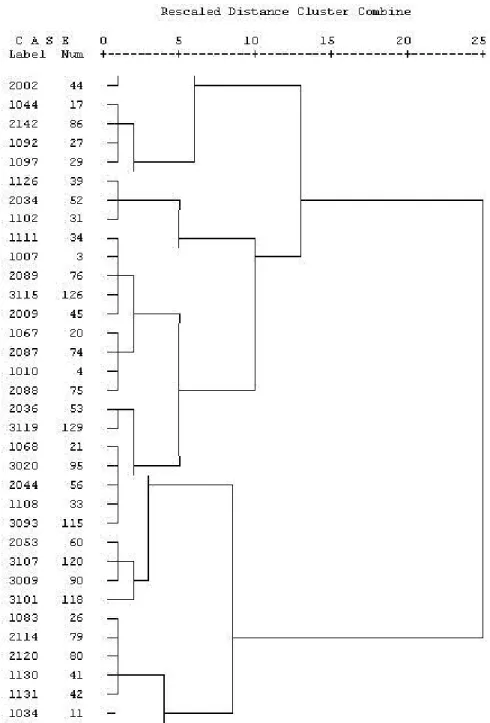
1. An excerpt of the dendrogram displaying the linkages of the
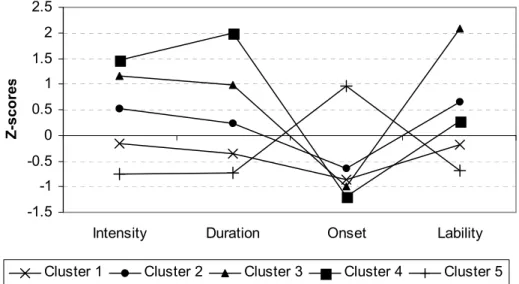
final cluster stages using the rescaled distances……….…50 2. Profiles of the five clusters: z-scores as a function of the
CHAPTER I INTRODUCTION
Developmental psychologists have long been interested in aspects of emotion regulation such as children’s ability to control their excitement (Redl & Wiseman, 1951), delay
gratification (Mischel & Baker, 1975), tolerate frustration, and control their impulses (Kopp, 1982). However, only in the past two decades has the concept of emotion regulation moved to the forefront of psychological research. Emotion regulation is the process by which emotional experiences are attuned to the ebb and flow of life’s ongoing demands (Cole, Michel, & Teti, 1994). Emotion regulation is not control, but an adjustment of emotional experiences to assist in achieving situational goals. Regulation of emotional states “helps to subdue (or accentuate) the intensity of an experienced emotion, retard (or accelerate) its speed of onset and recovery, limit (or enhance) its persistence over time, reduce (or increase) emotional range or lability, and affect other qualitative features of emotional responding” (Thompson, 1994).
self-McClaskey, & Brown, 1986), and increased vulnerability to psychopathology (Rutter, 1991; Cicchetti, et al.). Unregulated child negative affect, in particular, has been found to be associated with negative outcomes during the preschool period (NICHD Early Child Care Research Network, 2004).
Given that the study of emotion regulation is relatively new, the amount of research and knowledge already gained is quite remarkable. However, three notable weaknesses exist in our understanding of negative affect and emotion regulation. First, scant research exists that focuses on emotion regulation during the first year of life. In order to better understand the developmental trajectory of emotion regulation, we must first determine how early in
document this influence (Sroufe, 1996; Cicchetti, et al., 1991; Kopp, 1989; Thompson, 1994; Calkins, Smith, Gill, & Johnson, 1998).
Accordingly, the study outlined here was designed to examine emotion regulation behaviors at 6 months of age in the context of a situation that was constructed to elicit negative affect in infants. This examination is accomplished by 1) characterizing negative affectivity in 6-month old infants within a multi-dimensional framework of emotions as observed in the still-face procedure, 2) characterizing infants’ behavioral capacities to
regulate negative affect during the still-face procedure and their relationship with expressions of negative affect at six months of age, and 3) characterizing how some factors internal (temperament) and factors external (care-giving context) to the child may influence infant negativity affectivity and behavioral strategy use as observed in the still-face procedure at 6 months of age.
Emotion Regulation and Negative Affect
Over the years, developmentalists have investigated the role emotion plays in many developmental phenomena. Indeed, it has been established that emotions play an important role in development allowing children to accomplish a variety of developmental goals that include individual well-being and the maintenance of supportive social relationships
(Tronick, 1989; Shipman & Zeman, 2001; Thompson, 1994). These investigations, however, have predominantly focused on the role of positive emotions. Kopp (1989) suggested that infant negativity has not received due attention because of a prevailing interest in normative development.
be adaptive and serves two basic functions (Campos, Mumme, Kermoian, & Campos, 1994). First, expressions of negative affect may serve to communicate needs and instill change in the behavior of others to meet the infant’s needs. Second, the experience of negative affect motivates infants to learn adaptive means to regulate their affective state and enhance their own well-being (Kopp, 1989). The task of young infants is to learn to regulate negative affect in order to adapt to the many contextual demands to which they are exposed. In early
infancy, this is best achieved through the maintenance or re-establishment of internal arousal within manageable levels such that optimal functioning is possible (Kopp, 1992).
Although there is a distinction between expressed emotion and the internal experience of emotion, the current study is focusing on expressed emotion. In infancy, expressions of negative affect and their experience are believed to be highly related and to closely reflect the infant’s current feeling state (Izard & Malatesta, 1987).
The multiple dimensions of negative affect. Researchers have identified both temporal and intensive differences in the expression of negative affect (Derryberry & Rothbart, 1988; Thompson, 1994). More specifically, individual emotional displays have been found to vary in intensity, duration, speed of onset, and lability (Thompson, Flood, & Lundquist, 1995). For example, speed of onset implies that some bouts of crying begin immediately, while others may take longer to begin. Similarly, a measure of intensity may reveal that crying may be uncontrollable, mild, or consist of intermittent fussing. Attention to these dimensions should reveal considerable variability in the young infants’ expressions of negative affect that may have implications for regulation strategies. Importantly, a theoretical connection
individual emotional experiences are the same dimensions that regulatory processes seek to modulate in order to attune emotional experiences to environmental demands. This
relationship between the expression of negative affect and its regulation may have interesting implications for infants as they learn to effectively adjust their emotions. For example, infants may have characteristic styles of affective responding that influence the use of or need for behavioral strategies during challenging situations. Few empirical studies exist to examine the nature of infant negative affect and its regulation within a multi-dimensional framework of infant emotional expression. The current study was designed to examine the nature of infant emotional expressions of negative affect within a multi-dimensional
framework that takes into account intensity, duration, speed of onset, and emotional lability. Of the four dimensions identified by Thompson (e.g. intensity, duration, speed of onset, and lability; 1994), the dimension of intensity has been of most interest to researchers. Indeed, it has been conjectured that intensity levels of negative affect must be relatively low for infants to successfully initiate and utilize a strategy to manage their own discomfort. With growing levels of arousal or discomfort, infants can easily become unable to enlist strategies on their own (Kopp, 1989; Saarni & Crowley, 1990; Grolnick, Bridges, & Connell, 1996). With little practice in implementation and the relatively simplistic nature of strategies, the intensity of experienced emotion may have a profound influence on the infant’s ability to mobilize behavioral means of regulation. Research with toddlers supports this relationship between the intensity of negative affect during challenging situations and behavioral strategies of emotion regulation.
levels of negative affect, they were more likely to actively interact with objects in order to create a distraction. However, when expressing more intense levels of negative affect,
toddlers tended to use less active and less effective modes of self-regulation, such as focusing on the delay object and physical self-soothing (Grolnick, et al.). While examining the same phenomenon in 12-month-old infants, Diener, Mangelsdorf, McHale, and Frosch (2002) found that higher intensity levels of negative affect were associated with more self-soothing and less use of more complex strategies such as distraction and leave-taking. Thus, infants as young as 12 months have an impressive repertoire of behavioral strategies for emotion regulation, but high levels of negative affect appear to impede the use of the more complex strategies.
It is reasonable to assume that similar results would be found in 6-month-old infants. In fact, the intensity of negative affect may be even more likely to overwhelm the regulatory efforts of the 6-month old. The available behavioral strategies at 6 months are just emerging and infants, having less practice than toddlers, may be less effective at implementing
regulatory strategies. Accordingly, a meaningful relation between the intensity of expressed negative affect and the behavioral strategies used to regulate them was expected for 6-month-old infants. Specifically, as the intensity of negative affect increases, young infant should engage in less active forms of behaviors (e.g. object play) and resort to more passive
processes. Further research to investigate this relationship in 6-month-old infants is thus warranted.
In addition to examining strategies of emotion regulation with regard to the intensity of negative affect it appears necessary to examine other key dimensions of negative affect as well, including the dimensions of duration, speed of onset, and lability. While researchers have identified these dimensions as important with regard to emotion regulation (Thompson, 1994), there is a lack of empirical investigation of the relationships between these dimensions of negative affect and behavioral strategies of emotional regulation. Considering negative affect within a multi-dimensional framework should provide additional empirical evidence about the infant’s ability to mobilize behavioral strategies for regulating negative affect.
Stylistic responses of expressed negative affect during the still-face procedure. Although the experience of negative affect is universal, infants differ in their styles of
express highly intense negative affect for long durations may be more likely to revert to more passive strategies than infants who express highly intense negative affect for only short durations. Identifying clusters of infants who have similar stylistic responses of expressed negative affect in these 6-months of age would provide a first step in advancing our understanding of the importance of styles of responding in the development of regulation capacities. It is strongly believed that a description of the various styles of response to challenging situations is a critical first step to study emotion regulation (Thompson, 1994; Kopp, 1989). Buss and Goldsmith (1998), for example, theorized that regulation behaviors might work for some individuals but not for others. These differences in the choice or the efficacy of behavioral strategies may be related to differing stylistic responses to challenging situations.
regulatory strategies appears to be related in some way to emotional experience. On the basis of this research, it was expected (1) that clusters of infants with similar stylistic responses to the still face procedure could be identified among 6-month-olds, and (2) that the identified clusters would be differentially related to the use of behavioral strategies.
In order to assess stylistic responses, cluster analysis was utilized to identify groups or clusters of infants who vary in their patterning of emotional responses to the still-face
procedure. Cluster analysis is a multivariate statistical technique that allows individuals to be sorted into groups or clusters based on similarities. The multiple dimensions of negative affect will be used to establish the groups. Once these affective stylistic responses have been established, their relationship with the use of behavioral strategies can then be explored.
Measuring infant negative affect. Infants typically experience negative affect in many everyday situations, including being restrained in a car seat or a high chair and having to wait for food or access to toys. Researchers have developed procedures designed to elicit negative affect. The still-face procedure was used in the current study. The still-face procedure has been extensively used to examine communicative abilities, affect synchrony, and more recently, regulation of affective states (Tronick, 1989). This procedure was designed for use with infants aged 2 to 9 months and exposes the infant to age-appropriate stimuli that typically elicit a fear response in the infant (Wienberg & Tronick, 1996). The still face procedure is composed of three phases: (1) a 2-minute period of normal interaction between the mother and the child; (2) a 2-minute period during which the mother is unresponsive to the infant while maintaining a still or “poker” face; and (3) a 2-minute reunion period during which mother and child resume normal interactions. Research utilizing the still-face
and increase their motor activity during the still-face period (phase 2 as described above; Weinberg & Tronick).
During the Still-Face Procedure, infants reliably express negative affect through vocal, facial, and bodily reactions (Grolnick, et al., 1996; Tronick & Cohn, 1989; Buss &
Goldsmith, 1998). Thus, it is expected that the majority of infants will display negative affect during this challenging situation. In the current study negative affect was assessed by
recording the infant’s vocal, facial, and body tension on four-point scales using a 5-second interval coding for the duration of the challenge tasks. The four levels of negative affect coded were as follows: no negative affect, low, moderate, and high negative affect.
In addition to the intensity of negative affect, other dimensions were also measured in order to more fully capture the dynamic aspects of this emotion, including its duration, speed of onset, and lability. Duration was measured by calculating the number of intervals that contained expressions of negative affect. Speed of onset was measured by calculating the latency to expressions of negative affect. Lability was measured by totaling the absolute value of changes in expression of negative affect. These assessments were made with the goal of more fully exploring the relationships between the dynamics of negative emotions and observed behavioral strategies of regulation in 6-month old infants.
Early Behavioral Strategies of Emotion Regulation
As such, the relationships between behaviors and expressions of negative affect, as well as the function of regulation served by the behaviors, may evolve over time. By identifying the early strategies and their relationships with expressions of negative affect, the current study will serve to advance our understanding of the foundation of early regulation capabilities and early qualitative relationships. This is a first step in understanding the trajectory of emerging emotion regulation capacities.
In early infancy, the caregiver plays an important role in developing emotion regulation capabilities. In fact, early efforts to regulate emotions are heavily dependent upon the
caregiver. It is only over time that the burden of regulation is gradually taken over by the child (Cicchetti, et al., 1991; Grolnick, Durowski, McMenamy, Rivkin, & Bridges, 1998). However, very early in life infants possess some capacity to regulate their own emotions. For example, it has been shown that non-nutritive sucking serves as a regulatory strategy from the first few days of life. Over time, the infant’s capacity to regulate negative affect evolves with the maturation of other body systems. The infant’s motor, communicative, cognitive, and emotional systems are rapidly maturing and becoming increasingly sophisticated. Not surprisingly, the development of emotion regulation and the maturation of other systems are intertwined. Many strategies utilized for emotion regulation are dependent upon specific maturational levels. For instance, children cannot shift their focus of attention until their motor system has become sufficiently organized to support voluntary control of the head. The child's developing capacities apparently set the stage for self-regulation of emotions. The current study was designed to focus solely on the child’s capabilities.
voluntary control over head rotation (Gesell, 1938), thus giving the infant access to potential regulatory strategies such as looking to mom and gaze aversion. Similarly, the acquisition of voluntary control of the hands and feet allow infants to use motor activity to reach for their mother, other objects, or to simply gaze at their extremities as a means of distraction (Kopp, 1989). At the same time, infants are learning to signal their emotional needs in more
competent ways and are becoming more intentional in regulating their emotional states, even if this is still primarily achieved through explicit signals (Sroufe, 1996). As early as 5 months of age, increases in communication skills enable the infant to utilize strategies such as
signaling and eliciting the caregiver’s attention. Infants are becoming increasingly capable of eliciting specific actions from the caregiver in order to achieve a desired response (Sroufe, 2000). Moreover, between 3 and 6 months of age, attention becomes more selective; a change that now permits infants to disengage their gaze from aversive stimuli and to
anticipate the location of upcoming events (Johnson, Posner, & Rothbart, 1991). As shown by Derryberry and Rothbart (1988), the voluntary control of attention is a critical hallmark in the acquisition of emotion regulation skills and certainly plays an important role in the effortful regulation of negative affect. These developmental advances in intentionality, cognitive, and communicative abilities set the stage for the child to take a more active role in the regulatory process (Cohn & Tronick, 1987). As such, this time period around 6 months of age is ripe with opportunities to examine the interplay between expressions of negative affect and early regulative activity.
they also act as filters that may serve either to bias interpretations of others’ reactions, or to elicit responses from social partners that are consistent with one's goals (Thompson, 1999). When children routinely experience recovery from negative affect and learn that behavior can stay organized even when facing difficult challenges, the stage is set for acquiring confidence in their own ability to regulate emotions and control their social surroundings (Sroufe, 2000). As these experiences become integrated into an organized network of behavioral strategies, children generalize these response patterns to maintain personal well being, manage their self-presentation to the social world, and achieve a variety of other goals (Thompson & Calkins, 1996).
Toddler studies of behavioral strategies of emotion regulation. Researchers have made great strides toward identifying the regulation strategies used by toddlers (Grolnick, et. al., 1996; Diener, et al., 2002; Calkins, Gill, Johnson, & Smith, 1999; Buss & Goldsmith, 1998). Behaviors such as self-soothing, signaling, gaze aversion, soliciting the caregiver, venting, and object play have been consistently observed during times of expressed negative affect in young children (Stansbury & Sigman, 2000; Diener & Mangelsdorf, 1999; Feldman,
foundation of behaviors that appear early in life. It remains unclear, however, how early these behaviors are seen or how early they begin to serve true regulatory functions.
Studies have demonstrated that toddlers use a variety of context-related behavioral strategies. For example, Diener and Manglesdorf (1999) found, using a cross-sectional design with 18 and 24 month olds, that during mother-constrained periods, children were more likely to engage in help-seeking. In addition, during the mother-involved periods, children initiated more social referencing, engagement, and leave-taking. Likewise, behavioral strategy varied based on experienced emotion. During anger-inducing situations, children were more likely to seek help from their mother, to engage her, and to use social referencing, problem solving, avoidance, distraction, leave-taking, and tension release than during fear situations. These studies demonstrate that the use of regulatory strategies is susceptible to environmental influences (mother’s presence) and internal influences (type of emotion experienced). Use of regulatory strategies may be further constrained by the experience of the multiple temporal and intensive dimensions of negative affect.
1995; Stansbury & Sigman, 2000), few studies have actually demonstrated if and how these strategies are used and whether they actually serve a regulatory function for the 6-month-old infant. Kopp (1989) theorizes that elemental forms of infant emotion regulation arise
between 3 and 9 months of age; thus, this is an important gap in the literature.
Possible categories of regulatory behaviors based on putative functions at 6 months. Infant behaviors like self-soothing, gaze aversion, gazing at the mother, distraction with other objects (object play), withdrawal, venting, signaling, and gazing at self have been identified within the current literature as important behavioral strategies for emotion regulation
(Stansbury & Sigman, 2000; Diener & Mangelsdorf, 1999; Feldman, et al., 1999; Bridges, et al., 1997). For analytic purposes these may be grouped into five basic categories of
regulation strategies: (a) signaling, (b) self-soothing, (c) other-directed, (d) attentional strategies, and (e) venting.
Signaling and other-directed behaviors represent the most passive forms of behavioral strategies. In this category, simple vocalizations of varying intensity like pouting, fussing, and crying serve to alert the caregiver of a need for regulation. Mild negative vocalizations, such as pouting and intermittent fussing, may signal mild levels of negative affect, while fussing and sustained crying would signal moderate to heightened levels, respectively. These variations help the caregiver interpret the needs of the infant. Although these forms of
signaling may serve important regulatory functions for infants, they were not considered in the current study. These signaling behaviors are confounded with the measures of negative affect, which would prevent meaningful interpretation from statistical analysis. However, other forms of other-directed behaviors, which are more behaviorally oriented, can be
may use this strategy to convey the expectation of a response on the caregivers’ part or to signal that the caregivers’ assistance is needed. Proximity seeking, another other-directed behavior, has long been identified as an important set of behavioral responses to a variety of potential stressful situations (Bowlby, 1969/1982). With proximity seeking, infants actively seek to decrease the distance between themselves and their caregiver. This may be
accomplished by reaching for, touching, or leaning toward the caregiver. When faced with high levels of negative affect, signaling and other-directed behavior may be one of the strategies 6-month-old infants most frequently use.
Self-soothing encompasses behaviors such as mouthing, sucking, and stereotypic movements. Mouthing involves placing objects in or around the mouth. Sucking may be directed at a body part, such as a finger or thumb, or may simply involve the motion of sucking. Finally, stereotypies are repetitive body movements such as rocking or hand flapping. These behaviors appear very early in life, some from the first few days of life. Thus, infants have considerable experience with these behaviors and, as a result, may use these behaviors frequently.
The ability to focus attention and, thereby, use distraction has been described as a hallmark of emotion regulation (Derryberry & Rothbart, 1988). Behaviors involving the modulation of attention are among the most active strategies available to the 6-month-old. Distraction may take several forms, such as gazing at self, gazing at the environment, or playing with an object. As a group, these behaviors are believed to serve a regulatory function by focusing attention away from the source of negative affect. Gazing at the
attentional skills are relatively new to infants and, as such, infants are likely not very adept at using them.
The final category of behavioral strategies, venting, is rooted in anger and frustration. Venting is often expressed by kicking, flailing, thrusting, pushing, or hitting. Venting behaviors are often identified as a means to let out negative feelings.
The current study was designed to assess the behavioral capacities of 6-month old infants as observed during the still-face procedure. As such, the occurrence of behavioral strategies from each of these five categories was coded using 5-second interval recording. On a descriptive level, the rate of behavioral strategies observed, which category of strategy occurred most frequently, and whether infants tended to utilize a single strategy or multiple strategies. In addition to describing the observed behavioral strategies, the present study also assessed the relationship between the multiple dimensions of negative affect and the
Another expectation of the current study was that the dimensions of intensity and duration might be the most salient for attentional strategies. First, attentional strategies are relatively new and are some of the more complex strategies available to infants. For this reason, high intensities of negative emotion would likely overwhelm the infant’s capacity to engage in these strategies. However, given that attentional strategies are more active it is likely that these strategies would be more effective in regulating the infant’s negative affect. If this were the case, one would expect the duration of negative affect to be shorter.
By identifying the relationships that exist between the multiple dimensions of negative affect and the use of behavioral strategies of regulation, results from the current study advance our understanding of different functional avenues for regulation of negative affect. Researchers have reliably demonstrated that certain behaviors accompany expressions of negative affect, but have not examined whether or not they may serve a specific regulatory function. Preliminary findings on this issue have been contradictory. One reason for these contradictory findings may be that behavioral strategies may be differentially related to the multiple intensive and temporal dimensions of negative affect. Therefore, the current study sought to determine how behavioral strategies are related to emotional expressions of negative affect across multiple dimensions. Through the examination of negative affect across specific dimensions, we may find more consistent relationships.
The Context of Early Regulation of Negative Affect
signals, providing appropriate stimuli, modulating arousal levels, and reciprocating infant reactions (Cole, Martin, & Dennis, 2004). Also within the context of these social interactions, the infant, over time, learns to internalize regulatory functions. Hence, one can reasonably argue that early emotion regulation occurs within a dyadic system where caregivers play a vital role in managing infants’ emotional and behavioral reactions (Kopp, 1989; Sroufe, 1996; 2000; Thompson, 1994; Calkins, et al., 1998).
Given that early emotion regulation occurs within the context of the caregiver-infant relationship, one must also examine key infant and caregiver factors that may contribute to those early relationships. On the part of the infant, temperamental characteristics play an important role in expressed differences in emotions (Calkins & Fox, 2002; Dunn & Brown, 1991). On the side of the caregiver, maternal sensitivity (Lyons-Ruth & Zeenah, 1993), ethnicity (Anderson, 1991), and SES (Halpern, 1993) have all been identified as important for the care-giving context and the quality of the infant-mother relationship.
Temperament. Expressed differences in emotions and behaviors are, in part, based on individual configurations of physiological structures expressed as differences in reactivity known as temperament (Calkins & Fox, 2002; Dunn & Brown, 1991). Temperament is a psychobiological construct that has been shown to be relatively stable over time (Kagan, 1994, Goldsmith, et al., 1987). In addition, there is general agreement that temperament contributes to differences in emotional arousal, behavioral styles, and cognitive skills (Vondra, Shaw, Swearingen, Cohen, & Owens, 2001; Dunn & Brown, 1991; Kagan, 1994). For instance, infants are unique with regard to daily responses to being fed, changed, played with, and bathed. Temperament represents those characteristics that make an infant’s
temperament is strongly tied to emotional arousal and emotional responding, it is likely that infants who have higher mother reports of fear and distress to limitations will display more negative affectivity during the still-face procedure than infants with higher mother ratings in stoothability and falling reactivity/recovery. Furthermore, if temperament were found to be related to the identified clusters of negative affect styles, it would provide further evidence that these identified clusters represent true characteristic response styles of the infants.
The influence of temperament on the regulation of negative affect does not end with its influence on styles of expressed affect. Temperamental characteristics may also have an important influence on the use of behavioral strategies. On the one hand, infants must experience and communicate negative affect to learn that certain behaviors can be used to self-regulate. On the other hand, extreme levels of distress may actually inhibit the infant’s recruitment and effective utilization of behavioral strategies (Kopp, 1989; Stifter &
passive and less active strategies of regulation. Infants who are rated higher on soothability and falling reactivity/recovery dimensions of the IBQ will use more active strategies and less passive strategies.
Maternal Sensitivity. Infant-caregiver dyads develop characteristic regulatory patterns based on countless daily interactions (Izard & Malatesta, 1987; Sroufe, 2000; Cicchetti, et al., 1991; Kopp, 1989). Caregivers must assist the infant in establishing and maintaining
physiological organization through monitoring changes in alertness and signs of distress (Sroufe; Cole, et al., 2004), while still providing optimal stimulation and assistance (Field, 1994). In addition to monitoring infants’ states, caregivers must monitor their own states and then resonate with certain qualities of infants’ internal state, not necessarily overt behaviors (Schore, 2000). The caregiver must achieve a balance that allows the child to independently deal with circumstances that are within her capacities, anticipating challenges beyond the child’s ability, and then assisting when the child begins to be overwhelmed (Sroufe). When the dyadic system is working, infants and caregivers are attuned to each other and the infant is able to remain organized (Tronick, 1989). When the dyadic system is not working, infants withdraw and interactions with caregivers are characterized by more frequent negative affect and less mutual sharing (Tronick).
Maternal sensitivity represents the mother’s capacity to provide warm, responsive, and consistent caregiving. Caregivers with high sensitivity, who are emotionally available, enable their infants to experience positive and negative emotions in a secure, controlled manner (Lyons-Ruth & Zeenah, 1993). On the other hand, caregivers who are emotionally
levels, which allows the child to remain organized for longer periods of time, thereby, increasing the likelihood of the child developing more effective regulation styles. By allowing the infant to remain organized and experience success in the face of challenge, sensitive mothers may provide increased opportunity for infants to implement and practice behavioral strategies. Thus, infants with more sensitive mothers may utilize a greater variety of strategies, as well as more active and complex strategies, such as attentional strategies.
Maternal sensitivity influences the infant’s expectations regarding the responsiveness of the caregiver that, in turn, may influence the infant’s responding to a task such as the still-face procedure. It has been suggested that once infants have formed stable internal working models of their parent-infant relationship, sometime after 7 months of age (Ainsworth, Blehar, Waters, & Wall, 1978; Bowlby, 1969/1982), their expectations about how the parent will respond to their emotional needs will be established (Braungart-Rieker, Garwood, Powers, & Wang, 2001). These stable expectations, whether positive or negative, may influence the extent to which infants regulate their own emotions. For infants with sensitive mothers, the still-face may be more discrepant with their expectations and daily experiences. These infants have come to rely on a sensitive, responsive caregiver for dyadic regulation of negative affect. For these reasons, we would expect these infants to have a more intense affective response to the unresponsiveness of their mothers, and thus, will use more passive strategies.
affect and behavioral strategies of regulation. The current study was designed to recruit African Americans for 50% of the sample. Recruitment was based on the mother’s ethnicity and the study does include bi-racial families. To clarify that the focus in this study is on the mother’s ethnicity, the term maternal ethnicity will be used.
In general, researchers have suggested that broad sociocultural contexts, including environmental factors and chronic stressors such as racism and discrimination contribute to commonalities in ethnic group experiences, beliefs, and values (Anderson, 1991; Anderson, 1989; Anderson & McNeilly, 1991). It has been speculated that for these reasons
emotionality and parental socialization of emotion may differ between cultures because of these different environmental demands, social structure, resources, and cultural norms (Essau & Trommsdorff, 1996). In a study designed to evaluate an African American sample of 4 and 5 year-old children within the context of emotion regulation, Smith and Walden (2001) found that parental socialization of emotion was related to differences in behavioral strategies during emotionally arousing situations in the classroom. The study, however, was composed of an all African American sample and, as such, comparisons between groups could not be assessed.
Researchers have shown that African Americans have been found to be more emotionally expressive than European Americans (Boykin, 1986; Dixon, 1976). This difference in expressed emotion is attributed to the finding that African cultural heritage places a higher value on emotional expression (Boykin; Dixon; White & Parham, 1990). In fact, ethnic differences have been consistently found in physiological responding to
On the other hand, research on emotional expressions has been less consistent. Observed differences in emotional expressions may relate to differences in emotion socialization. In a research study evaluating different social context, Vrana and Rollock (2002) found that emotional expressiveness depends not only on one’s own ethnic group values, but also on (at least) the situational context, gender roles, and the ethnic
characteristics of others in the encounter. Importantly, differences may also occur in
laboratory contexts, including the experimental manipulations, perception of, and comfort in the experimental setting; and personal context, such as psychological and behavioral factors (Anderson, 1991; Anderson, 1989; Anderson & McNeilly, 1991). One explanation for these differences based on environmental factors may be that these two ethnic groups have
different display rules for facial expressions (Ekman, 1973) that take into account the affective valence and/or other aspects of the encounter.
Although some discrepancy exists within the current literature, it is likely that infants with African American mothers will express higher levels of negative affectivity during the still-face procedure. This expectation is based on the fact that early emotion regulation processes occur within the context of dyadic relationships (Kopp, 1989). Within these early relationships infants are highly susceptible to socialization processes and begin to internalize the beliefs and values of their dyadic partner (Schore, 2000). Given that African American culture places higher importance on emotional expressiveness (Boykin), it is likely that infants with African American mothers will be more expressive.
1993). For example, a number of studies have reported higher percentages of insecure attachment in low-SES, high-risk samples (Spieker & Booth, 1988) or an increased likelihood of insecurity associated with economic disadvantage (NICHD Early Child Care Research Network, 1997). Furthermore, theory and prior research link SES to caregiver factors that influence the mother-infant care-giving context. More specifically, economic hardship has been linked to lower psychological well-being in parents, which may lead to more punitive, inconsistent, or unresponsive parenting, which partially mediates low-SES effects on child development (McLoyd & Wilson, 1994). In general, these conditions of economic hardship have been recognized as stressors on caregiving and child development (Duncan, Brooks-Gunn, & Klebanov, 1994; Halpern, 1993; McLoyd & Wilson, 1994). Given the large body of research that has shown that lower SES has negative affects on the care-giving context, it is reasonable to expect that lower SES may influence infant negative affectivity and behavioral regulation.
Research examining the role of SES in emotion regulation is sparse. However, SES indicators have been linked to differences in the use of behavioral strategies of older children. More specifically, in 4 and 5 year-old children, Smith and Walden (2001) found that mothers with higher levels of education tended to have children who used more cognitive distraction strategies and more instrumental action. Furthermore, infants of unemployed mothers used more aggressive strategies and more support seeking strategies. These findings would suggest that indicators of higher SES (higher education and
limited by the fact that the results relied on data from hypothetical stories that the children responded to verbally. No observational data were taken (Smith & Walden). Additional research utilizing direct observation would be beneficial in further exploring these findings.
The current study utilizes a measure of maternal level of education as the indicator of SES. Due to the nature of the sample, income was felt to be an insufficient indicator. Income was confounded by the fact that many of the mothers in the current study were students, which would limit their earning potential.
Overview of Current Study
Goals and Hypotheses of the Current Study
Goal 1: To characterize negative affectivity in 6-month old infants within a multi-dimensional framework of emotions as observed in the still-face procedure.
1) How do infants express negative affect during the still-face procedure as measured by intensity, duration, speed of onset, and lability?
a. While the majority of infants will display negative affect during still-face procedure, there will be variability across infants in their expressions of intensity, duration, speed of onset, and lability.
2) To what extent are these dimension of negative affect correlated with each other? a. It is expected that the four dimensions of negative affect will be
correlated.
3) Are there identifiable clusters of infants with patterns of stylistic responding in regard to the intensity, duration, speed of onset and lability of expressed negative affect as observed during the still-face procedure at 6 months of age?
a. Stylistic clusters will be identified based on the combinations of intensity, duration, speed of onset, and lability.
Goal 2: To characterize how some factors internal (temperament) and external (care-giving context) to the child may influence infant negativity affectivity as observed in the still-face procedure at 6 months of age.
1) To what extent do 6 month mother-reported temperamental characteristics predict different patterns of negative affect in the 6-month still-face procedure?
b. It is expected that infants scoring higher on the soothability and falling reactivity dimensions will express less negative affectivity.
c. It is expected that different temperamental characteristics will be predictive of the different individual dimensions of expressed negative affect.
i. The IBQ dimension of fear will be predictive of intensity and speed of onset.
ii. The IBQ dimension of distress to limitations will be predictive of intensity and duration.
iii. The IBQ dimension of soothability will be predictive of duration and lability
iv. The IBQ dimension of falling reactivity/recovery will be predictive of duration.
2) To what extent does the care-giving context as measured by 6-month maternal sensitivity, maternal ethnicity, and SES predict different styles of negative affectivity as observed during the still-face procedure?
a. It is expected that infants who have more sensitive mothers will display more negative affectivity during the still-face procedure.
c. It is expected that infants from lower SES families will express more negative affectivity.
Goal 3: To characterize infants’ behavioral capacities to regulate negative affect during the still-face procedure at 6 months of age.
4) What behavioral strategies are observed in infants during the still-face procedure at 6 months of age?
a. It is expected that behavioral strategies in the categories of
other-directed/signaling, self-soothing, attentional, and venting will be observed in 6-month old infant during the still-face procedure.
b. It is expected that other-directed and self-soothing behaviors will occur more frequently than attentional or venting strategies.
c. It is expected that 6-month old infants will use multiple strategies during the still-face procedure.
5) To what extent does mother-reported temperament predict the use of different types of behavioral strategies during the still-face procedure?
a. It is expected that infants with higher scores on the IBQ dimensions of fear and distress to limitations will use more passive strategies.
6) To what extent do aspects of the care-giving context as measured by maternal ethnicity, maternal sensitivity (observed in another context), and SES predict the use of different types of behavioral strategies during the still-face procedure?
7) To what extent do different stylistic responses of expressed negative affect (i.e., clusters) predict the use of behavioral strategies during the still-face procedure?
a. It is expected that the identified stylistic clusters (i.e., based on configurations of expressed negative affect) will be related the use of different types of behavioral strategies during the still-face procedure at 6 months of age.
8) How are the individual dimensions of expressed negative affect related to the use of behavioral strategies during the still-face procedure?
a. It is expected that attentional strategies (e.g., object play and gaze at environment) will be used less with higher levels of negative affectivity. b. It is expected that self-soothing behaviors (e.g., self-soothing and gaze at
self) will be used more with higher levels of negative affectivity. c. It is expected that other-directed strategies (e.g., reaching and gaze at
mom) will be used more with higher levels of negative affectivity.
CHAPTER 2 METHODS Participants
The current study is part of a larger longitudinal project investigating social, cognitive, and emotional development across the first three years of life. The infants and their families were recruited during the first months of the infants’ life from birth records and community contacts. Recruitment procedures specified an approximately equal number of European- and African-Americans at both low-income (i.e., below 2 times the poverty line) and
high-income (i.e., above 2 times the poverty line) levels from a predominantly urban area. Recruitment was based on the mother’s ethnicity. The larger project includes a total of six assessment points at 3, 6, 12, 18, 24, and 30 months of age, with a combination of home visits and laboratory visits. Measures consisted of a combination of questionnaires, interviews, and laboratory tasks. The participants in the current study were 154 of the 176 families originally recruited by the Durham Child Health and Development (DCHD) Study. For the current study, a subset of the data from the 6-month visit was used.
Sample
The final sample consisted of 129 infants who completed the still-face procedure with valid administrations. The final sample was comprised of approximately equal numbers of male (N=64) and female infants (N=65). Forty-seven percent of the subjects were European-Americans and 53% were African-American. With regard to income, 53% of families had an income times above the national poverty level and 47% had income levels falling below 2-times the poverty level. Fifty-three percent of the sample had a four-year degree or more, 6% had some college, 31% had a high school education, and 10% had less than a high school degree.
Procedures
Overview. The current study utilizes observational data from the still-face procedure from the 6-month laboratory visit and the freeplay session from the 6-month home visit. Following informed consent, the mother and infant participated in a variety of behavioral assessments including the still-face and arm-restraint procedures, a free play session, a book reading session, and three memory tasks. In addition to the behavioral assessments, mothers participated in interviews, video rating activities and several physiological measures were collected. The laboratory visit and the home visit lasted for approximately 2 hours each.
turned back toward her infant, looking at her while maintaining for 2 minutes a still face during which she refrained from smiling, talking, or touching and remained emotionally unresponsive. This period was followed by another 15 seconds period during which she was again facing away from her infant. The infants were videotaped during the challenge tasks that are explained below. Video images from two cameras were transmitted through a split-screen generator in order to produce simultaneous frontal views of the mother’s face and the infant’s entire body.
Prior to beginning the still-face procedure, the mother was told that she was free to immediately terminate any and all procedures if she was uncomfortable with the assessment protocol. If the infant became too upset (e.g., continuous hard crying for at least 20 seconds) to continue any one of these tasks, the episodes were terminated and the caregiver was asked to comfort the infant. If the child recuperated within a few minutes, the procedure was re-attempted with the permission of the mother. Otherwise, the experimenter moved to the next task. Given that the focus of the current study is on the capacities of the infant, it was felt that the still-face procedure was best suited for this analysis. During this episode the mother was unavailable and the infant had to rely on her own capabilities to regulate negative affect. During the normal interaction periods, the mother was available to assist the infant in regulation efforts.
also excluded from the analysis. These exclusionary criteria resulted in the elimination of 25 participants, leaving a total of 129 infant-mother dyads.
Free Play Procedure. At 6-months of child age, the free play procedure occurred in the context of a 2-hour home visit. At each visit a standardized interview was completed along with several joint and individual tasks for the child and mother. For the free play session, mothers were asked to interact with their children as they normally would during a typical day. A standard set of toys was provided for the mother and infant to use, and the pair was asked to sit on a blanket that was laid out across the floor. This session was videotaped for later coding, with researchers monitoring the camera discreetly to minimize interference with the ongoing interaction.
Constructs and Measures
Behavioral strategies of emotion regulation. Putative emotion regulation behaviors were
coded from videotapes using 5-second time intervals. Behavioral strategies and negative
affect were coded separately and independently. The coders were trained to reliability
reaching 85% agreement. A digital time display was used to track the intervals. Tapes were
run at normal speed, although they were frequently stopped or rewound to accurately assess
the infant’s behavior. In the event that the infant’s behavior could not be observed, the
interval was labeled as uncodable. This code was used if the mother’s body was between the
infant and the camera preventing the coder from observing the infant’s behavior.
Seven emotion regulation behavioral strategies were coded for the purposes of the
current study: (a) gaze at mother, (b) gaze at environment, (c) gaze at self, (d) self-soothing,
(e) object play, (f) reaching, and (g) venting. Table 1 contains a brief definition of each of
the strategy entered for that interval. For instance, if self-soothing and object play occurred in
succession in the same interval, only self-soothing was the strategy coded for that interval.
This type of co-occurrence was the most common type. In the majority of intervals, only one
behavioral strategy occurred, so it was felt that this approach did not introduce unacceptable
error in the data.
Table 1
Brief Definitions of Infant Putative Emotion Regulation Behaviors
Behavior Description
Signaling/other-directed
Gaze to mother Infant looks at mom, either directly in the face or the body.
Reaching Infant shows a deliberate attempt to touch the caregiver by holding arms
towards caregiver or successfully touching caregiver. The action must be
performed by the child. Caregiver initiated contact does not count.
Self-soothing
Self-soothing Behaviors that are self-stimulating, including thumbsucking, rubbing or
patting the body, mouthing objects, and stereotypies.
Gaze at self Infant is looking at some part of her own body, such as her fingers or feet.
Attentional/distraction
Gaze at environment Child is looking around the room or at self, but is not looking at mom.
Object play/distraction Behaviors that target objects, such as banging on the car seat, pulling off a
sock and playing with it, playing with toys and books.
Venting
Venting Behaviors used to express anger and frustration including kicking, thrusting,
flailing, pushing, or hitting.
5-second intervals using a digital time display. The coders were trained to reliability reaching 85% agreement. To avoid observer drift, reliability was assessed on approximately 15% of
the sample. Interrater reliability was found to remain at 0.85 across coders. A digital time display was used to track the intervals. Tapes were run at normal speed, although they were
frequently stopped or rewound to accurately assess the infant’s behavior.
Table 2
Levels of Negative Affect
Intensity Level Description
No Negative Affect The infant displayed no behavioral or vocal signs of negative affect.
Low Negative Affect The infant displayed brief negative vocalizations, brief fussiness, or brief
frowns or grimaces
Moderate Negative Affect The infant displayed behaviors such as, protesting, pouting, fussiness, brief
cries, or contorted facial displays
High Negative Affect The infant displayed prolonged crying, intense protesting, increased motor
activity, accompanied by tense body postures, and contorted facial
expressions
Duration of negative affect. Duration of expressed negative affect reflected the total length of time that infants displayed negative affect at any level. Duration of expressed negative affect was calculated by summing the number of intervals where any level of negative affect was observed (i.e., 1 or higher). For logistic regression purposes, infants were divided into four ordinal categories of duration: (a) no duration, (b) low duration, (c)
moderate duration, and (d) high duration.
Lability of negative affect. Lability of emotion was assessed by calculating the absolute value of interval-to-interval changes in the intensity of negative affect. For example, a change from 3 to 1 between consecutive blocks yielded a value of 2 for this interval. Calculated over the full duration of the still-face procedure for each infant, lability scores reflected the sum of these changes across successive 5-second intervals. For logistic regression purposes, infants were divided into four ordinal categories of lability: (a) no lability, (b) low lability, (c) moderate lability, and (d) high lability.
Table 3
Dimensions of Negative Affect
Dimension Description
Intensity The qualitative level of negative affect expressed by the infant.
Duration The total length of time that the infant displayed negative affect.
Speed of Onset The number of intervals from the onset of an assessment phase to the first
signs of infant negative affect.
Lability A measure of the observed variability in expressions of negative affect
represented by the absolute value of changes in expressed negative affect.
Infant Behavior Questionnaire (IBQ). The Infant Behavior Questionnaire (IBQ; Rothbart, 1981) is a 99-item parent-report instrument that assesses the frequency with which certain infant behaviors occurred during the last 2 weeks. The IBQ consists of seven
The dimension of distress to limitations consists of 16 items that assess the infant’s level of fussing, crying, or showing distress while: (a) waiting for food, (b) refusing a food, (c) being in a confining place or position, (d) being dressed or undressed, or (e) being prevented access to an object toward which the infant is directing her attention. The
dimension of fear consists of 16 items that assesses the infant’s startle response or distress to sudden changes in stimulation, novel physical objects or social stimuli. The soothability dimension consists of 18 items that assess the infant’s reduction of fussing, crying, or distress when soothing techniques are used by the caregiver. Finally, the falling reactivity/recovery dimension consists of 13 items that assess the rate of recovery from peak distress,
excitement, or general arousal, as well as ease of falling asleep.
The IBQ has demonstrated satisfactory reliability and validity (Goldsmith & Rothbart, 1991). Mothers indicate on a seven-point scale ranging from 1 (never) to 7 (always) how frequently their infants responded to specific events in a particular fashion during the
previous week (e.g., ‘‘when introduced to a stranger, clung to the parent or approached the
stranger at once’’). Subscales have good internal reliability (.75---.81) and interrater reliability
(.54---.66) for 6-month-old infants (Rothbart, 1981), good concurrent validity with home
observations of infant temperament at 6 months (mean r = .40; Rothbart & Goldsmith, 1985)
and with the negative emotionality and approach-sociability subscales of the Revised Infant
Temperament Questionnaire and the Infant Characteristics Questionnaire (rs = .61---.73;
Goldsmith, Rieser-Danner, & Briggs, 1991).
duration following the still face procedure (Rosenblum, McDonough, & Muzik, 2002). The three scales included sensitivity/responsiveness, intrusiveness, and positive regard, each scored on a 5-point scale and further described below. An overall composite for maternal sensitivity was created by summing the scale scores for sensitivity, positive regard, and a reverse coding of intrusiveness.
The sensitivity/responsiveness scale was adapted from Ainsworth et al. (1978) and rated how the parent responded to the infant’s gestures, facial expressions, and signals as she responded to cries, frets, or other expressions of negative affect. The defining characteristic of a sensitive interaction is that it is infant-centered. The sensitive parent is synchronized with the infant, showing an awareness of the infant’s needs, moods, interests, and
capabilities. If the infant directs gestures of facial displays to the parent (e.g., looking at, reaching toward, waving, clapping hands, handing objects), or makes demands or requests (e.g., stretching arms to be picked up, reaching for toys the parent in holding), the sensitive parent responds appropriately. Mothers received a score of 1 on sensitivity when this
description was not at all characteristic of their behavior, and up to 5 if sensitivity was highly characteristic of their interactions. Intraclass correlations across coders reached .82 based on double coding 20% of the parent-infant interactions from all three contexts of observations.
infant averts her gaze, turns away, or expresses negativity in response to the parent’s actions. Extreme cases such as this can be conceptualized as overcontrol to a point of stripping away the infant’s autonomy. Some examples include failure to modulate behavior in response to the child’s protest by, for example: (a) continuously overstimulating,(b) taking away objects the infant is clearly engaged with, (c) not allowing her to make choices, and (d) manipulating the infant’s body in an intrusive manner. Mothers receive a score of 1 on intrusiveness if this description is not at all characteristic of their behavior, and up to 5 if such behaviors are highly characteristic of their interactions. Intraclass correlations across coders reached .80 based on double coding 20% of the parent-infant interactions from all three contexts of observations.
The positive regard scale rated maternal expressions of positive feelings towards the infant. Positive regard is observed when the parent is seen speaking in a warm tone of voice, hugging or engaging in other expressions of physical affection, positive affect, enthusiasm, praise, and showing her general enjoyment of the infant. Mothers were given a rating of 1 if the corresponding description was not at all characteristic of their behavior, and up to 5 when it was highly characteristic of their interactions. Intraclass correlations across coders reached .81 for positive regard, based on double coding 20% of the parent-infant.
CHAPTER 3 RESULTS
The results are organized according to the three basic goals outlined above: (a) Goal 1, characterizing negative affectivity within a multi-dimensional framework of emotions as observed in the still-face procedure; (b) Goal 2, characterizing how some factors internal (temperament) and external (care-giving context) to the child may influence infant negativity affectivity; and (c) Goal 3, characterizing infants’ behavioral capacities to regulate negative affect during the still-face procedure at 6 months of age.
adequately address the third goal of the project, to characterize infants’ behavioral capacities to regulate negative affect during the still-face procedure at six months of age, descriptive statistics and a series of logistic regressions are presented. First, descriptive statistics are presented to characterize behavioral strategies as observed during the still-face procedure. Second, logistic regression results are presented to explore the relationship between temperament and the care-giving context with behavioral strategies. Finally, a series of logistic regression analyses are presented to examine the relationships between stylistic clusters and behavioral strategy use and between the individual dimensions of expressed negative affect and behavioral strategy use.
examination of the residuals and model fit. All models had adequate fit and plots of residuals did not reveal any outliers.
Overall Descriptive Summary of 6-Month Old Infants’ Expressed Negative Affect The first goal of this study was to characterize negative affectivity in 6-month old infants within a multi-dimensional framework of emotions as observed in the still-face procedure. As expected, the majority of infants expressed some level of negative affect during the still-face procedure. Specifically, 64.3% (N=83) of infants expressed at least some level of negative affect. Furthermore, the majority of infants completed the still-face
procedure with only 15.5% (N=20) of infants requiring termination of the session due to high negative affect. The average length of the still-face procedure was 21.9 intervals (SD=4.66).
Table 4
Descriptive statistics for the four dimensions of expressed negative affect.
Mean
Standard
Deviation Range
Intensity 1.12 1.08 0-3
Duration 5.10 6.14 0-23
Speed of Onset 12.33 9.99 0-24
Lability 4.19 4.80 0-19
In order to address the question of how infants express negative affect during the still-face procedure as measured by intensity, duration, speed of onset, and lability, descriptive statistics are presented for each dimension in Table 4. As hypothesized, there was
lowest levels of each dimension of negative affect. Furthermore, examination of the ordinal categories of each dimension demonstrate that a good proportion of infants fall into each of the four categories (see Table 5). Although the majority of infants do express negative affect with considerable variability, the overall level of negative affect observed is low. The average infants expressed a low level of negative affect for an average of 20 seconds (see Table 4).
Table 5
A brief description of the ordinal categories for each dimension.
Intensitya Duration Speed of Onset Lability
Category N (%) M N (%) M (SD) N (%) M (SD) N (%) M (SD) 1 46 (35.7%) 0 46 (35.7%) 0 (0) 39 (30.2%) 0.74 (1.07) 48 (37.2%) 0 (0) 2 42 (32.6%) 1 35 (27.1%) 11.2% (0.06) 25 (19.4%) 6.52 (2.04) 23 (17.8%) 2.13 (0.63) 3 20 (15.5%) 2 29 (22.5%) 45.8% (0.16) 19 (14.7%) 17.58 (3.22) 39 (30.3%) 6.08 (1.75) 4 21 (16.3%) 3 19 (14.7%) 92.1% (0.09) 46 (35.7%) 23.15 (3.09) 19 (14.7%) 13.37 (2.85)
Note: For each dimension, the categories are arranged in ascending order.
a. The ordinal categories for intensity were based on the peak intensity of expressed as coded on the 0-3 scale.