Influence of Substance Use Disorders on 2-Year HIV Care
Retention in the United States
Bryan Hartzler1 •Julia C. Dombrowski2•Jason R. Williams1•Heidi M. Crane2• Joseph J. Eron3,4•Elvin H. Geng5•Christopher Mathews6•Kenneth H. Mayer7,8• Richard D. Moore9,10,11•Michael J. Mugavero12•Sonia Napravnik3•
Benigno Rodriguez13•Dennis M. Donovan1,14
Published online: 13 June 2017
Abstract Substance use disorders (SUDs) are thought to predict care discontinuity, though magnitude and sub-stance-specific variance of effects are unclear. This report of analytic work undertaken with a multi-regional Ameri-can cohort of 9153 care enrollees addresses these gaps. Care retention was computed from 24-month post-linkage clinic visit documentation, with SUD cases identified from patient-report screening instruments. Two generalized estimating equations tested binary and hierarchial SUD predictors of retention, and potential effect modification by patient age-group, sex, and care site. Findings demonstrate: (1) detrimental SUD effect, equivalent to a nine percent-age-point decrease in retention, with independent effects of age-group and care site; (2) substance-specific effect of marijuana UD associated with lower retention; and (3) age-modification of each effect on care discontinuity, with SUDs serving as a risk factor among 18–29 year-olds and
protective factor among 60?year-olds. Collective findings document patient attributes as influences that place par-ticular subgroups at-risk to discontinue care.
Resumen Los trastornos de uso de sustancias (TUS) se cree que predicen la discontinuidad del cuidado, aunque la magnitud y la varianza de los efectos de sustancias especı´ficos no son claros. Este informe de trabajo analı´tico realizado con una multi-regional americano cohorte de 9153 inscritos de cuidado aborda estos brechas. La reten-cio´n en la atenreten-cio´n se calculo´ utilizando la documentareten-cio´n de la visita clı´nica registrada 24 meses despue´s de la conexio´n a la atencio´n, con casos de TUS identificados a partir de las medidas de deteccio´n realizadas por los pacientes. Dos ecuaciones de estimacion generalizadas probaron predictores binarios y jeraquicos del efecto de trastornos de uso de sustancias en la retencion, y la
& Bryan Hartzler
1 Alcohol & Drug Abuse Institute, University of Washington,
1107 NE 45th Street Suite 120, Box 354805, Seattle, WA 98105-4631, USA
2 Division of Allergy and Infectious Disease, University of
Washington, Seattle, WA, USA
3 Department of Medicine, University of North Carolina,
Chapel Hill, NC, USA
4 Department of Epidemiology, University of North Carolina,
Chapel Hill, NC, USA
5 School of Medicine, University of California, San Francisco,
CA, USA
6 Department of Medicine, University of California,
San Diego, CA, USA
7 School of Medicine, Harvard University, Boston, MA, USA
8 School of Public Health, Harvard University, Boston, MA,
USA
9 Department of Medicine, Johns Hopkins University,
Baltimore, MD, USA
10 Department of Epidemiology, Johns Hopkins University,
Baltimore, MD, USA
11 Center for Global Health, Johns Hopkins University,
Baltimore, MD, USA
12 Department of Medicine, University of Alabama,
Birmingham, AL, USA
13 Department of Medicine, Case Western Reserve University,
Cleveland, OH, USA
14 Psychiatry and Behavioral Sciences, University of
modificacio´n del efecto potencial por edad del paciente, sexo y ubicacio´n del cuidado. El ana´lisis demuestra: (1) TUS tuvieron un efecto perjudicial equivalente a una dis-minucio´n del 9 por ciento en la retencio´n, con efectos independientes de la edad y ubicacio´n del cuidado; (2) El TUS de marihuana tuvo un efecto de la sustancia especı´fico asociado con menor retencio´n; y (3) La edad tuvo un efecto modificador en la discontinuidad del cuidado; TUS fueron un factor de riesgo para los jo´venes de 18 a 29 an˜os y un factor de proteccio´n para los mayores de 60 an˜os. Los resultados colectivos documentan los atributos del paciente que influyen en el riesgo de interrupcio´n de la atencio´n para subgrupos particulares.
Keywords HIV care settingsSubstance use disorders
Care retentionUnited States
Introduction
Substance use disorders (SUDs), defined by recurrent use of alcohol, tobacco, or illicit drugs causing clinically and functionally significant impairment [1], pose challenges along the HIV Care Continuum [2]. In diagnosis and care linkage phases, SUDs diminish the effectiveness of uni-versaltest-and-treatapproaches and hamper care continuity [3–5]. Whereas Gardner and colleagues’ [6] seminal HIV Care Continuum data suggested 19% of HIV?Americans linked to care are not subsequently retained, a recent Center for Disease Control (CDC) estimate [7] places the figure at 71% and highlights this as a prime target for quality improvement. Multisite studies document inverse associa-tion of HIV?Americans’ substance use and retention [8,9]. Beyond its doubling of mortality rates for HIV?Americans [9], unsuccessful care retention—reflected by lack of recurrent care visits at which virologic monitoring occurs— unduly burdens health system resources via ‘‘churn’’ pro-cesses where patients cycle in and out services [10]. If global health goals for antiretroviral medication access and viral suppression are to be attained in the U.S. [11,12], impedi-ments that SUDs appear to pose to HIV?Americans’ care retention merit attention.
Care retention is variously conceptualized by the HIV community, mostly as post-linkage indices marked by patterns of care visit attendance in one or more 12-month periods. Mugavero and colleagues [13] note among rele-vant indices: visit constancy, reflecting semi-annual inter-vals during which a visit is attended; gaps in care, or 6-month intervals in which no visits occur; and visit adherence, computed as percentage of visits attended [e.g., attended visits/(attended visits?‘no-shows’)]. A widely-recognized retention index is that formulated by the Health Resources and Services Administration HIV/AIDS Bureau
(HRSA/HAB), since adopted by the Institute of Medicine as a core clinical indicator [14]. This HRSA/HAB index defines care retention as two attended visits, separated by at least 90 days, in a 12-month period. While other retention indices have been linked to clinical care milestones like initiation of antiretroviral medications or viral suppression, this HRSA/HAB retention index most robustly and reliably predicts these milestone achievements in initial years of HIV care [13, 15]. To what extent the presence of SUDs among HIV?Americans may influence their retention, and if patient attributes—age, sex, or location of care received—that are robust predictors of the presence of SUDs in this population [16] may modify hypothesized SUD effects on retention, remain unanswered questions. Likewise, to what extent retention may vary among sub-stance-specific SUD patient groups, and potential influence of these other patient attributes on variance in their HIV care retention, remains unsettled.
In the current work, the aforementioned patient attri-butes were examined as influences of HRSA/HAB-defined 2-year retention among a multisite Center for AIDS Research Network of Integrated Clinical Systems [CNICS; [17] ] cohort of HIV?Americans linked to care. The pri-mary patient attribute was SUDs, conceptualized in models as a: (1) bivariate predictor (any SUD, no SUD), or (2) categorical predictor, defined hierarchically to form sub-stance-specific SUD subgroups that vary in antiretroviral medication initiation [18]. In each model, patient age, sex, and care site were explored as potential modifiers of the proposed SUD effects on retention. Enhanced understand-ing of patient attributes servunderstand-ing as risk factors for care discontinuance may inform health service dissemination to address unmet needs among HIV?Americans.
Methods
Data Sources
documentation for the 2-year period that followed patients’ initial visit date. For descriptive purposes, additional indi-ces outlined by Mugavero and colleagues [13] were simi-larly calculated from this 24-month visit documentation. These were: 1) visit-constancy, or number of 4-month intervals wherein a scheduled visit was attended (range of 0–6), 2) care gaps, or number of 6-month periods without an attended visit (range of 0–4), 3) number of attended visits (range of 0–67), 4) number of ‘no-shows’, or visits scheduled but not kept by the patient (range of 0–36), and 5) visit adherence, or rate at which scheduled visits were attended [attended visits/(attended visits?‘no-shows’), range .01–1.00].
Participants
The sample (N=9153) were HIV?adults linked to care at seven sites, who voluntarily completed a patient-report assessment between 01/01/2007 and 12/31/2014 and for whom available visit data encompassed the 1st 2 years of care. Sites were located at Harvard University, Johns Hopkins University, University of Alabama-Birmingham, University of California-San Diego, University of Cali-fornia-San Francisco, University of North Carolina-Chapel Hill, and the University of Washington. Demography was reported upon enrollment, and the patient-report assess-ment was completed prior to a routine clinic visit. Per CNICS policy, otherwise willing patients deemed medi-cally unstable, appearing intoxicated, evidencing signifi-cant cognitive impairment, or unable to speak English or Spanish did not complete patient-report assessments.
Analytic Strategy
Generalized estimating equations (GEEs) tested two pop-ulation-average models [24] that each described variance in HRSA/HAB-defined 2-year retention attributable to a hypothesized predictor (SUD) while accounting for non-independent observations at CNICS sites. To examine a binary logistic outcome, the 1st model included a binary predictor (any SUD, no SUD) with dummy-coded care site (#1–7), categorical age-group (18–29, 30–39, 40–49, 50–59, 60?year-olds), and binary sex (male, female) indices as potential effect modifiers and robust covariance structure due to the aggregate sample size. The 2nd model retained the noted specifications, but reconceptualized SUD as a six-level hierarchial index—informed by Teg-ger’s [18] identification of opioid UD, methamphetamine UD, and alcohol UD as specific SUDs that impede initia-tion of antiretroviral medicainitia-tions and by mixed evidence regarding marijuana use in HIV care [25–29]. Thus, the hierarchial SUD index was defined as: (1) opiod UD with or without other SUDs, (2) methamphetamine UD with or principal investigator by the CNICS Data Management
Core. Current work is restricted to data on patient demography, substance-focused patient-reporting on the Alcohol Use Disorders Identification Test-Version C [AUDIT-C[21]]andtheAlcohol,Smoking,andSubstance InvolvementTest [ASSIST [22]], andcare visit informa-tionforthe 2-yearperiod followingeachpatient’searliest recordedvisitdate.
PatientAttributes
Focal attributes explored as potentialeffect modifiersfor expected SUD influences on care retention were those previouslyfound tobe robust predictorsof careretention [15,23]andSUDprevalence[16]inCNICScohorts.These attributeswerepatients’:(1)caresite(affiliateduniversities laternoted), (2) age-group (18–29, 30–39, 40–49, 50–59, 60?year-olds), and(3) sex (female,male). Other demo-graphic characteristics that furthered initial sample description were race (non-hispanic white, non-hispanic black, hispanic, other), gender (cis, trans) and male patients’historyofsexwithmalepartners (yes,no).
SUDIdentification
Governed by a ‘past 12months’ reporting interval, the AUDIT-C is well-established as a screening instrument with strong sensitivity and specificity for diagnoses of alcoholuse disorder [21],hereafter referred to as alcohol UD.Inthe currentwork, AUDIT-Csummaryscores were comparedagainstthisdiagnosticthresholdtoidentifycases of alcohol UD. Regarding other substances, CNICS assessmentabbreviates ASSIST measurement to cocaine, marijuana, methamphetamine, and non-prescription opi-oids.Governedbya‘past3months’reportingintervaland resulting in substance-specific ‘involvement scores,’ the ASSISTisalsowell-establishedasascreeninginstrument for SUD diagnoses [22] with its involvement scores demonstratingstrong diagnosticsensitivityandspecificity for cocaine use disorder, marijuana use disorder, methamphetamine use disorder, and opioid use disorder (hereafter referred to as cocaine UD, marijuana UD, methamphetamineUD,andopioidUD).Substance-specific ASSISTinvolvementscores were compared against these diagnostic thresholds to identify cases of cocaine UD, marijuana UD, methamphetamine UD, and opioid UD. CasesforwhichneitherAUDIT-C norASSISTdiagnostic thresholdswerereachedcomprised anoSUDgroup.
2-YearCareRetention
without other SUDs, (3) alcohol UD with or without other SUDs, 94) cocaine UD with or without other SUDs, (5) marijuana UD only, and (6) no SUD. For the SUD effect identified in each model, supplemental post hoc examina-tion focused on corresponding annual patterns of retenexamina-tion during the 2-year care period (i.e., initial year, subsequent year). For further descriptive purposes, other aforemen-tioned care retention indices outlined by Mugavero and colleagues [13] were computed and presented from avail-able 24-month clinic visit documentation for each of the six groups defined in the hierarchial SUD index.
Results
In the aggregate sample of 9153 CNICS patients, age ranged from 19 to 84 years [mean (M)=44.1, standard deviation (S.D.)=10.4)]. Distribution of race was 51% non-Hispanic White, 33% non-Hispanic Black, 12% His-panic, and 4% ‘Other.’ The sample was 84% male, among whom 79% had a history of sex with male partners. Transgender status was affirmed for less than 1% of the sample. Table1 lists 2-year HRSA-HAB-defined care retention by patient demography, and at de-identified CNICS care sites (per IRB stipulations at one or more sites).
Influence of SUD on 2-Year HRSA/HAB-Defined Care Retention
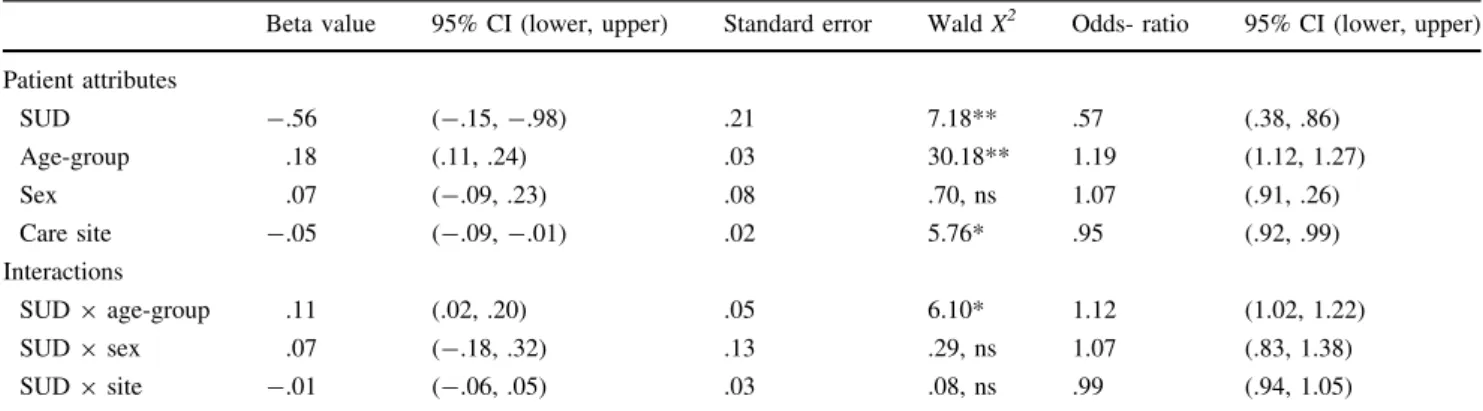
Table2 lists full reporting of model statistics, as GEE identified SUD, age-group, and care site as predictors of retention. Retention was lower in SUD (67%) than non-SUD patients (76%). As earlier noted in Table1, retention in 18–29 year-olds was quite low and progressively higher in older age-groups, and between-site variance in retention was extensive. As for SUD effect modifiers, only the SUD 9 age-group interaction was significant (see Table2). Retention was lower in SUD than non-SUD patients among 18–29 year-olds (56 vs. 67%), 30–39 year-olds (64 vs. 71%), 40–49 year-olds (70 vs. 73%), and 50-59 year-olds (73 vs. 79%), whereas this pattern reversed in 60? year-olds (86 vs. 78%). Post-hoc temporal exploration of retention rates underlying the SUD effect revealed a modest initial-year gap (SUD=89%, non-SUD =92%) that subsequently doubled among remaining patients (SUD=76%, non-SUD=83%).
Influence of Substance-Specific SUDs on 2-Year HRSA/HAB-Defined Care Retention
Table3 lists full reporting of model statistics, as in addi-tion to age-group and care site GEE identified marijuana
UD as a substance-specific predictor of retention. Retention varied minimally among the five substance-specific SUD groups (67–70%), and was lower in all than in the no SUD group (76%). As for marijuana UD effect modifiers, only its interaction with age-group was significant (see Table3). Relative to overall retention of 67% marijuana UD patients, the rate was lowest in 18–29 year-olds (52%) and progressively higher in the older age-groups (30–39 year-olds, 63%; 40–49 year-year-olds, 69%, 50–59 year-year-olds, 71%; 60?year-olds, 85%). Post-hoc temporal exploration of retention rates for the marijuana UD effect revealed in the initial year retention was slightly lower in the marijuana UD group (87%) than other substance-specific SUD groups (88–90%) and no SUD group (92%). Among remaining patients in the subsequent year, retention was again slightly lower in the marijuana UD group (69%) than other sub-stance-specific SUD groups (70–72%) and the no SUD group (76%).
Additional 2-Year Care Retention Indices by Substance-Specific SUDs
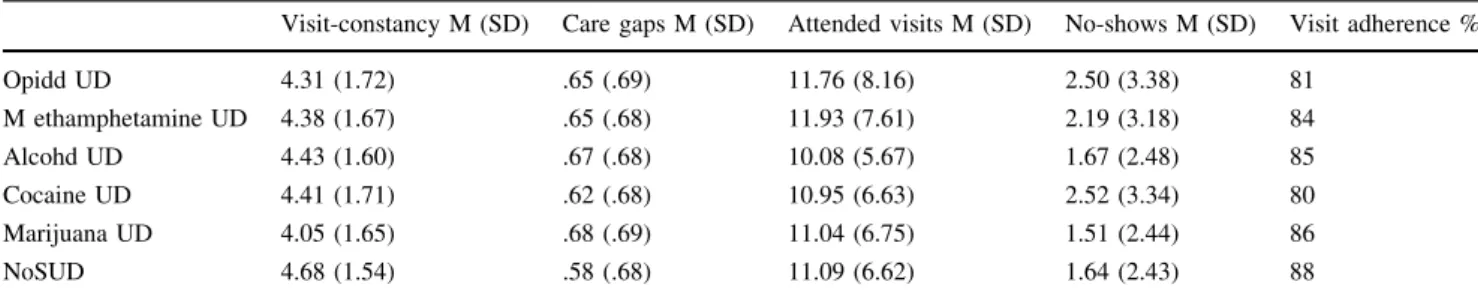
Table4 lists descriptive statistics, by substance-specific SUD group, for other retention indices noted by Mugavero and colleagues [13]. For visit-constancy, the cohort’s mean number of 4-month intervals with an attended visit was 4.56 (SD=1.60), with more such intervals for no SUD patients (4.68) than each substance-specific SUD subgroup (range 4.05–4.43). For care gaps, the cohort’s mean of 6-month intervals without an attended visit was .61 (SD=.68), with fewer gaps for no SUD patients (.58) than all substance-specific SUD subgroups (range: .62–.68). Respective mean frequencies for attended visits and ‘no-shows’ were 11.06 (SD=6.72) and 1.76 (SD =2.64), eventuating in mean visit adherence rate of 86% for the cohort. Consistent with the pattern of these two other retention indices, the visit adherence rate was higher among no SUD patients (88%) than all other substance-specific SUD subgroups (range of 80–86%).
Discussion
lower rate reported in the aforementioned CDC report [7]. This suggests, perhaps unsurprisingly, that a high quality of care is provided at CNICS-affiliate sites that other HIV care settings in the community struggle to replicate. Given elevated care retention rates in these well-resourced CNICS clinical environments, it may be unsurprising that a hypothesized risk factor like SUD was associated with no more than a nine percentage-point decrease in HRSA/ HAB-defined retention and that patient gender—previously linked to differential HIV care retention [8]—failed to emerge as a predictor in any of the analyses of this CNICS cohort. Nevertheless, current findings are broadly
Table 1 Rates of 2-year care retention by patient demography and site
Subsample size (%) 2-year care retention rate (%)a
Aggregate sampleb 9153 (100%) 71
Patient demography
Age-group
18–29 years 944 (10%) 60
30–39 years 1943 (21%) 67
40–49 years 3493 (38%) 72
50–59 years 2210 (24%) 77
60?years 563 (6%) 80
Sex
Male 7655 (84%) 71
Female 1498 (16%) 71
Race/ethnicity
Non-hispanic white 4635 (51%) 72
Nonhispanic black 2973 (32%) 70
Hispanic 1142 (13%) 73
Other 403 (4%) 71
Gender
Cis 9072 (99%) 71
Trans 81 (x\1%) 67
Males with history of sex with male partnersc(n=7655)
Yes 6048 (79%) 72
No 1607 (21%) 70
CNICS-affiliate sitesd
Site #1 740 (8%) 84
Site #2 810 (9%) 76
Site #3 1999 (22%) 69
Site #4 2625 (29%) 67
Site #5 1131 (12%) 75
Site #6 617 (7%) 74
Site #7 1231 (13%) 68
a 2-Year Care Retention computed according to HRSA HAB formulation of two attended visits, separated
by at least 90 days, within a calendar year
b Sample consists of HIV?persons linked to care, thereafter completing a patient-report assessment while
enrolled in services 01/01/2007–12/31/2014
c MSM history per chart notation at CNICS care sites
d CNICS-affiliate sites are de-identified, per stipulation of one or more of their local IRB agreements
SUDeffect onretention by patient age-group,with SUD serving as a risk factor for care discontinuance among young adults (aged 18–29) and as a protective factor for retention among older patients (aged 60?); and (4) a substance-specificeffectof marijuanaUD associatedwith lower retention, similarly modified by patient age-group suchthatyoung adult marijuanaUD patients evidenceda particularly low retention rate. Collective findings docu-ment thesepatient attributes as influencesthat place par-ticularpatientsubgroups at-riskforcarediscontinuity.
consistent with multisite reports of substance misuse as a frequent precursor of care discontinuity [8,9]. Notably, the lone demographic modifier of this SUD effect was patient age-group, such that the presence of an SUD placed young adult patients at-risk to discontinue care yet was associated with higher care retention rates among 60?year-old patients. Taken together, current findings underscore the importance of identifying SUDs among HIV care patients and monitoring of patient substance use, particularly among young adults, as critical tasks for the workforce that provides services in HIV care settings.
Modest variability in retention rates among the hierar-chically-defined substance-specific SUD groupings was somewhat surprising, given Tegger and colleagues’ [18] reporting of the differential prediction of a related HIV care outcome (i.e., antiretroviral medication initiation) by opi-ate, amphetamine, alcohol, and cocaine groups. Notably, marijuana UD—the lone substance-specific SUD to emerge as a predictor of care discontinuity in the current CNICS cohort—was omitted in this prior work of Tegger et al. [18]. These discrepant sets of findings underscore an importance of comprehensive, substance-specific SUD measurement when examining influences on HIV care processes. Further, the collective findings point to a varied topography of HIV care adherence wherein substance-specific SUDS may uniquely influence indices of care adherence that encompass attendance of clinic visits, access and adherence to antiretroviral medications, and other relevant clinical targets. While a comparatively large marijuana UD subsample in this CNICS cohort [16] may contribute to findings reported herein, it nevertheless
suggests HIV care patients whose use of marijuana results in clinically and functionally significant impairments are specifically at elevated risk for care discontinuity in the initial years following treatment linkage.
In the current findings, age-related influences were salient. This is evident both in direct influences of patient age-group on care retention, and in the modification of SUD effects on care retention by patient age-group. Young adulthood, defined in the current work as 18–29 years of age, was reliably linked in current analyses to the poorest rates of care continuity and magnified the detrimental influence of SUDs on this clinical care index. Notably, young adulthood and substance misuse have been previ-ously identified among a constellation of risk factors for poor HIV care retention [9,30–32]. Clearly, there is need to more effectively engage substance-using young adults in care, as their elevated transmission risks may be exacer-bated when disengaged from the health system. A sur-prising age-related finding—that SUDs were associated with greater continuity of care among 60?year-olds— also has public health implications. As public access to effective antiretroviral therapy has increased, the HIV care population has matured. Accordingly, it is increasingly important for the HIV workforce to monitor among its elder patients medical marijuana authorizations and other potentially problematic prescriptions (i.e., opioids) to identify and intervene around possible substance misuse. Influence of care site was far less robust as an independent predictor of retention and did not modify SUD effects, but this findings does suggest some variance in care continuity even among these seven CNICS sites.
Table 2 Binary SUD prediction of HRSA/HAB-defined 2-year care retention
Beta value 95% CI (lower, upper) Standard error WaldX2 Odds- ratio 95% CI (lower, upper)
Patient attributes
SUD -.56 (-.15,-.98) .21 7.18** .57 (.38, .86)
Age-group .18 (.11, .24) .03 30.18** 1.19 (1.12, 1.27)
Sex .07 (-.09, .23) .08 .70, ns 1.07 (.91, .26)
Care site -.05 (-.09,-.01) .02 5.76* .95 (.92, .99)
Interactions
SUD9age-group .11 (.02, .20) .05 6.10* 1.12 (1.02, 1.22)
SUD9sex .07 (-.18, .32) .13 .29, ns 1.07 (.83, 1.38)
SUD9site -.01 (-.06, .05) .03 .08, ns .99 (.94, 1.05)
Analyses based on an aggregate patient sample (N=9153), drawn from seven CNICS care sites
2-Year Care Retention computed according to HRSA HAB formulation of two attended visits, separated by at least 90 days, within a calendar year
SUD identification based on substance-specific diagnostic thresholds from both the AUDIT-C (for alcohol UD) and the ASSIST (for cocaine UD, marijuana UD, methamphetamine UD, and opioid UD)
Odds-ratios reflect the likelihood of 2-year care retention
distinguish them from other patients. Unfortunately, the CNICS data access agreement limits the local investigative team to analysis of only this cohort, and thus broader comparisons of its demography, background, or treatment participation vs. that of other CNICS enrollees were not possible. Another study caveat concerns SUD measure-ment, as the CNICS patient-reported outcome battery includes an abbreviated version of the ASSIST that omits some licit (i.e., tobacco) and illicit (i.e., sedatives/tran-quilizers, solvents/inhalants, hallucinogens, club drugs) substance categories that are otherwise included in current national and international diagnostic systems. Further, we recognize potential influence of unassessed 3rd-variables— such as mental illness, trauma/victimization, employment,
Table 3 Substance-specific SUD prediction of HRSA/HAB-defined 2-year care retention
Beta value 95% CI (lower, upper) Standard error Wald X2 Odds ratio 95% CI (lower, upper)
Patient attributes
Opioid UD -.76 (-1.84, .33) .55 1.86, ns .47 (.16, 1.39)
Methamphetamine UD -.21 (-.99, .57) .40 .29, ns .81 (.37, 1.76)
Alcohol UD -.39 (-1.00, .22) .31 1.59, ns .68 (.37, 1.24)
Cocaine UD -.35 (-1.35, .65) .51 .47, ns .71 (.26, 1.91)
Marijuana UD -.95 (-1.59,-.31) .33 8.42** .39 (.20, .74)
Age-group .18 (.11, .24) .03 30.18** 1.19 (1.12, 1.27)
Sex .07 (-.09, .23) .03 .70, ns 1.07 (.91, 1.26)
Care site -.05 (-.09,-.01) .02 5.76* .95 (.92, .99)
Interactions
Opioid UD9age-group .07 (-.16, .30) .12 .34, ns 1.07 (.85, 1.35)
Methamphetamine UD9age-Group .07 (-.08, .21) .07 .77, ns 1.07 (.92, 1.23)
Alcohol UD9age-group .08 (-.07, .19) .07 .88, ns 1.06 (.94, 1.21)
Cocaine UD9age-group .06 (-.21, .27) .12 .07, ns 1.03 (.82, 1.31)
Marijuana UD9age-group .04 (.10, .35) .07 11.64** 1.25 (1.10, 1.42)
Opioid UD9sex -.25 (-.86, .35) .30 .66, ns .78 (.43, 1.42)
Methamphetamine UD9sex -.07 (-.64, .50) .29 .06, ns .93 (.53, 1.65)
Alcohol UD9sex .13 (-.24, .50) .19 .51, ns 1.14 (.79, 1.65)
Cocaine UD9sex -.06 (-.59, .46) .27 .06, ns .94 (.55, 1.59)
Marijuana UD9sex .16 (-.30, .61) .23 .46, ns 1.17 (.74, 1.84)
Opioid UD9care site .09 (-.04, .22) .07 1.81, ns 1.10 (.96, 1.25)
Methamphetamine UD9care Site -.03 (-.12, .05) .04 .54, ns .97 (.89, 1.05)
Alcohol UD9care site -.03 (-.10, .05) .04 .54, ns .97 (.90, 1.05)
COCAINE UD9care site -.01 (-.13, .11) .06 .03, ns .99 (.88, 1.12)
Marijuana UD9care site .01 (-.07, .08) .04 .03, ns 1.01 (.93, 1.09)
Analyses based on an aggregate patient sample (N=9153), drawn from seven CNICS care sites
2-Year Care Retention computed according to HRSA HAB formulation of two attended visits, separated by at least 90 days, within a calendar year
SUD identification based on substance-specific diagnostic thresholds from both the AUDIT-C (for alcohol UD) and the ASSIST (for cocaine UD, marijuana UD, methamphetamine UD, and opioid UD)
Odds-ratios reflect the likelihood of 2-year care retention
* p\.05, , ** p\.01
income, or education—that have been shown in prior research to influence the course and outcome of HIV infection [33–35].
Conclusions
Caveats notwithstanding, findings advance understanding of the scope of the American SUD-HIV syndemic as relates to post-linkage care continuity. Even at model HIV care facilities where high rate of 2-year care retention was observed, SUD was a risk factor for discontinuity in the initial years following care linkage. Among substance-specific SUDs, relative risk is greatest among patients with marijuana UD, with broader SUD and specific marijuana UD effects both age-modified with risk concentrated among young adults. Effective clinical efforts to counteract such risks may occur by increasing capacity for addiction-focused services in HIV care settings. In addition to established pharmacotherapies for particular substances of abuse (i.e., acamprosate, disulfirambuprenorphine, metha-done, extended release naltrexone), a shortlist of behavior therapies (i.e., cognitive-behavioral therapy, contingency management, motivation interviewing) are documented in multiple randomized controlled trials to increase HIV care adherence among SUD patients [36–41]. Each is firmly established in the addictions field, with broad application recommended for its use across adult patient groups and substances of abuse [42]. Expanded therapy application in HIV settings to promote greater care continuity among SUD patients appears entirely appropriate. Case manage-ment is an additional form of health service intervention, one for which ubiquity and demonstrated efficacy to improve SUD patient retention in addiction care and link-age to other services [43] may facilitate compliance with
HIV treatment tasks (i.e., consistent clinic attendance, antiretroviral medication adherence, use of strategies to reduce transmission risk) that promote care continuity. Current study findings suggest that, even in well-resourced HIV care settings, there remains room to improve care continuity—particularly among young adults with an SUD. This may occur via implementation of empirically-sup-ported behavior therapies, case management, or a blending of the two.
Acknowledgements The funding source for this analytic work was National Institute on Drug Abuse R03DA039719 (Informing Dis-semination of Behavior Therapies to Enhance HIV Care Among
Substance Abusers,Hartzler PI). The authors thank the CNICS sites
for contributing data to this endeavor. CNICS is funded by R24 AI067039 with sites at University of Alabama at Birmingham, University of Washington, University of California San Diego, University of California San Francisco, Case Western Reserve University, John Hopkins University, Fenway Health/Harvard, and University of North Carolina Chapel Hill.
Disclaimer The content of this report is solely the responsibility of the authors and does not necessarily represent the official views of the National Institute of Health.
Compliance with Ethical Standards
Conflict of interest Julia C. Dombrowski has conducted STD clin-ical research unrelated to this work supported by grants to the University of Washington from Genentech, ELITech, Melinta Ther-apeutics, Curatek Pharmaceuticals, Quidel, and Hologic. Among the authorship group, no other conflicts of interest were declared.
Ethical Approval All procedures involving human participants were in accordance with institutional review boards at the CNICS-affiliate universities, and with the 1964 Helsinki Declaration and its later amendments or comparable ethical standards.
Informed Consent Informed consent was obtained from all indi-viduals during their initial enrollment in CNICS.
Table 4 Additional 2-year care retention indices by substance-specific SU D subgroups
Visit-constancy M (SD) Care gaps M (SD) Attended visits M (SD) No-shows M (SD) Visit adherence %
Opidd UD 4.31 (1.72) .65 (.69) 11.76 (8.16) 2.50 (3.38) 81
M ethamphetamine UD 4.38 (1.67) .65 (.68) 11.93 (7.61) 2.19 (3.18) 84
Alcohd UD 4.43 (1.60) .67 (.68) 10.08 (5.67) 1.67 (2.48) 85
Cocaine UD 4.41 (1.71) .62 (.68) 10.95 (6.63) 2.52 (3.34) 80
Marijuana UD 4.05 (1.65) .68 (.69) 11.04 (6.75) 1.51 (2.44) 86
NoSUD 4.68 (1.54) .58 (.68) 11.09 (6.62) 1.64 (2.43) 88
Descriptive statistics based on an aggregate patient cohort (N=9153), drawn from seven CNICS care sites
SUD identification based on substance-specific diagnostic thresholds from both the AUDIT-C and ASSIST, with six subgroups defined as: (1) opioid UD with or without other SUD, (2) methamphetamine UD with or without other SUD, (3) alcohol UD with or without other SUD, 94) cocaine UD with or without other SUD, (5) marijuana UD only, and (6) no SUD
References
1. APA. Diagnostic and Statistical Manual of Mental Disorders. 5th ed. Arlington, VA: American Psychiatric Publishing; 2013. 2. Hall HI, Holtgrave DR, Tang T, Rhodes P. HIV transmission in
the United States: considerations of viral load, risk behavior, and health disparities. AIDS Behav. 2013;17:1632–6.
3. Dieffenbach WW, Fauci AS. Universal voluntary testing and treatment for prevention of HIV transmission. JAMA. 2009;301:2380–2.
4. Granich RM, Gilks CF, Dye C, De Cock KM, Williams BG. Universal voluntary HIV testing with immediate antiretroviral therapy as a strategy for elimination of HIV transmission: a mathematical model. Lancet. 2009;373:48–57.
5. Giordano TP, Visnegarwala F, White ACJ, Troisi CL, Fran-kowski RF, Hartman CM, et al. Patients referred to an urban HIV clinic frequently fail to establish care: factors predicting failure. AIDS Care. 2005;17(6):773–83.
6. Gardner EM, McLees MP, Steiner JF, del Rio C, Burman WJ. The spectrum of engagement in HIV care and its relevance to test-and-treat strategies for prevention of HIV infection. Clin Infect Dis. 2011;52(6):793–800.
7. Centers for Disease Control and Prevention. Monitoring selected national HIV prevention and care objectives by using HIV surveillance data—United States and 6 dependent areas, 2014 2016.http://www.cdc.gov/hiv/library/reports/surveillance. 8. Hall HI, Gray KM, Tang T, Li J, Shouse L, Mermin J. Retention
in care of adults and adolescents living with HIV in 13 U.S. areas. J Acquir Immune Def Syndr. 2012;60:77–82.
9. Mugavero MJ, Lin HY, Willig JH, Westfall AO, Ulett KB, Routman JS, et al. Missed visits and mortality among patients establishing initial outpatient HIV treatment. Clin Infect Dis. 2009;48:248–56.
10. Rebeiro P, Althoff KN, Buchacz K, Gill J, Horberg M, Krentz H, et al. Retention among North American HIV-infected persons in clinical care, 2000-20008. J Acquir Immune Def Syndr. 2013;62(3):356–62.
11. UNAIDS. 90-90-90: An ambitious treatment target to help end the AIDS epidemic. Geneva, Switzerland: Joint United Nations Programme on HIV/AIDS, 2014 October. Report No.: Contract No.: UNAIDS/JC2684.
12. Office of National AIDS Policy. The National HIV/AIDS Strat-egy: Updated to 2020 2015.https://www.aids.gov/federal-resour ces/national-hiv-iad-strategy/nhas-update.pdf.
13. Mugavero MJ, Westfall AO, Zinski A, Davila J, Drainoni ML, Gardner LI, et al. Measuring retention in HIV care: the elusive gold standard. JAIDS. 2012;61(5):574–80.
14. IOM. Monitoring HIV care in the United States: indicators and data systems. Washington, D.C.; 2012.
15. Dombrowski JC, Kitahata MM, Von Rompaey SE, Crane HM, Mugavero MJ, Eron JJ Jr, et al. High levels of antiretroviral use and viral suppression among persons in HIV care in the United States, 2010. JAIDS. 2013;63(3):299–306.
16. Hartzler B, Dombrowski JC, Crane HM, Eron JJ Jr, Geng EH, Mathews WC, et al. Prevalence and predictors of substance use disorders among HIV care enrollees in the United States. AIDS Behav. 2017;21(4):1138–48.
17. CNICS. CFAR Network of Integrated Clinical Systems: University of Alabama-Birmingham; 2017.www.uab.edu/cnics. Accessed 3 May 2017.
18. Tegger MK, Crane HM, Tapia KA, Uldall KK, Holte SE, Kita-hata MM. The effect of mental illness, substance use, and treat-ment for depression on the initiation of highly active antiretroviral therapy among HIV-infected individuals. AIDS Patient Care STDs. 2008;22(3):233–43.
19. Kitahata MM, Rodriquez B, Haubrick R, Boswell S, Mathews WC, Lederman MM, et al. Cohort profile: the centers for AIDS research network of integrated clinical systems. Int J Epidemiol. 2008;37:948–55.
20. Hughes MD. Initial treatment of HIV infection: randomized trials with clinical endpoints are still needed. J Infect Dis. 2006;194:542–4.
21. Dawson DA, Smith SM, Saha TD, Rubinsky AD, Grant BF. Comparative performance of the AUDIT-C in screening for DSM-IV and DSM-5 alcohol use disorders. Drug Alcohol Depend. 2012;126:384–8.
22. Humeniuk R, Ali R, Babor TF, Farrell M, Formigoni ML, Jitti-wuikarn J, et al. Validation of the alcohol, smoking, and sub-stance involvement screening test (ASSIST). Addiction. 2008;103(6):1039–47.
23. Mugavero MJ, Amico KR, Westfall AO, Crane HM, Zinski A, Willig JH, et al. Early retention in HIV care and viral load sup-pression: implications for a test and treat approach to HIV pre-vention. J Acquir Immune Def Syndr. 2012;59(1):86–93. 24. Hubbard AE, Ahern J, Fleischer NL, Van der Laan M, Lippman
SA, Jewell N, et al. To GEE or not to GEE: comparing population average and mixed models for estimating the associations between neighborhood risk factors and health. Epidemiology. 2010;21:467–74.
25. de Jong BC, Prentiss D, McFarland W, Machekano R, Israelski DM. Marijuana use and its association with adherence to antiretroviral therapy among HIV-infected persons with moderate to severe nausea. JAIDS. 2005;38(1):43–6.
26. Fogarty A, Rowstorne P, Prestage G, Crawford J, Grierson J, Kippax S. Marijuana as therapy for people living with HIV/ AIDS: social and health aspects. AIDS Care. 2007;19:295–307. 27. Lutge EE, Gray A, Siegfried N. The medical use of cannabis for
reducing morbidity and mortality in patients with HIV/AIDS Cochrane Database Systematic Review. 2013;4(CD00517):5. 28. Bonn-Miller MO, Oser ML, Bucossi MM, Trafton JA. Cannabis
use and HIV antiretroviral therapy adherence and HIV-related symptoms. J Behav Med. 2014;37:1–10.
29. Abrams DI, Jay CA, Shade SB, Vizoso H, Reda H, Press S, et al. Cannabis in painful HIV-associated sensory neuropathy: a ran-domized placebo-controlled trial. Neurology. 2007;68:515–21. 30. Mugavero MJ, Lin HY, Allison JJ, Willig JH, Chang PW, Marler
M, et al. Failure to establish HIV care: characterizing the ‘no show’ phenomenon. Clin Infect Dis. 2007;45(1):127–30. 31. Catz SL, McClure JB, Jones GN, Brantley PJ. Predictors of
outpatient medical appointment attendance among persons with HIV. AIDS Care. 1999;11:361–73.
32. Israelski D, Gore-Felton C, Power R, Wood MJ, Koopman C. Sociodemographic characteristics associated with medical appointment adherence among HIV-seropositive patients seeking treatment in a county outpatient facility. Prev Med. 2001;33:470–5.
33. Oldenburg CE, Perez-Brumer AG, Reisner SL. Poverty matters: contextualizing the syndemic condition of psychological factors and newly diagnosed HIV infection in the United States. AIDS. 2014;28(18):2763–9.
34. Pence BW, Miller WC, Gaynes BN, Eron JJ Jr. Psychiatric illness and virologic response in patients initiating highly active antiretroviral therapy. J Acquir Immune Def Syndr. 2007;44(2):159–66.
35. Kalichman SC, Sikkema KJ, DiFonzo K, Luke W, Austin J. Emotional adjustment in survivors of sexual assault living with HIV-AIDS. J Trauma Stress. 2002;15(4):286–96.
among HIV-positive men and women: results of a pilot project. AIDS Patient Care STDs. 2005;19(1):31–9.
37. Safren SA, O’Cleirigh CM, Bullis JR, Otto MW, Stein MD, Pollack MH. Cognitive behavioral therapy for adherence and depression (CBT-AD) in HIV-infected injection drug users: a randomized controlled trial. J Consult Clin Psychol. 2012;80(3):404–15.
38. Petry NM, Weinstock J, Alessi SM, Lewis MW, Dieckhaus K. Group-based randomized trial of contingencies for health and abstinence in HIV patients. J Consult Clin Psychol. 2010;78(1):89–97.
39. Rosen MI, Dieckhaus K, McMahon TJ, Valdes B, Petry N, Cramer JA, et al. Improved adherence with contingency man-agement. AIDS Patient Care STDs. 2007;21(1):30–40.
40. Diiorio C, McCarty F, Resnicow K, McDonnell-Holstad M, Soet J, Yeager K, et al. Using motivational interviewing to promote adherence to antiretroviral medications: a randomized controlled study. AIDS Care. 2008;20(3):273–83.
41. Golin CE, Earp J, Tien HC, Stewart P, Porter C, Howie L. A 2-arm, randomized, controlled trial of a motivational interview-ing-based intervention to improve adherence to antiretroviral therapy (ART) among patients failing or initiating ART. J Acquir Immune Defic Syndr. 2006;42(1):42–51.
42. NIDA. Principles of drug addiction treatment: a research-based guide (3rd ed.). Services USDoHaH, editor2012.