Pay & Benefits Audit
FINAL REPORT
Prepared By:
Samson & Associates
August 2006
PEAG 2 AUGUST 2006
Her Majesty the Queen in Right of Canada, represented by the Chief Executive Officer of Parks Canada, 2007 Cagalogue No. : R62-392/2007E-PDF
TABLE OF CONTENTS
EXECUTIVE SUMMARY ...4
I INTRODUCTION ...9
II AUDIT OBJECTIVES & SCOPE ...11
2.1 AUDIT OBJECTIVES...11
2.2 SCOPE OF THE AUDIT...12
2.3 AUDIT CRITERIA...12
III APPROACH AND METHODOLOGY ...13
IV OBSERVATIONS AND RECOMMENDATIONS ...15
4.1 ORGANIZATIONAL STRUCTURE FOR THE ADMINISTRATION OF COMPENSATION AND BENEFITS...15
4.2 ADEQUACY OF SYSTEMS AND CONTROLS FOR THE ADMINISTRATION OF COMPENSATION AND BENEFITS.19 4.3 ADEQUACY OF SYSTEMS AND CONTROLS FOR THE MANAGEMENT OF LEAVE...27
Appendix A Audit Criteria
Appendix B Organization Chart Appendix C Process Mapping
EXECUTIVE SUMMARY
A salary management risk-based preliminary survey was conducted by Samson & Associates, in September 2004, to provide Parks Canada with an identification of potential areas of risk in the administration of compensation and benefits. Salary expenditures ($233.9M) represented approximately 39% of total Agency expenditures ($599.5M) for fiscal year 2004-05. The preliminary assessment of the salary management process was carried out in the National Office and two service centres (Quebec and Ontario).
Results of the preliminary survey identified seven areas of Ahigh@ risk:
• organizational structure;
• taken-on-strength (TOS) actions;
• executive pay;
• struck-off strength (SOS) actions;
• Section 33, Financial Administration Act (FAA);
• pay entitlements (allowances); and
• leave without pay (LWOP)
Subsequent to the results of the preliminary survey, Human Resources senior management indicated some concerns with the management of leave and requested that a review of such be included in any further audit work. More than 156,000 leave transactions were processed for the period April 1, 2004 to November 30, 2005.
The Pay and Benefits Audit was included in Park’s Canada’s Internal Audit Plan for 2005-06. Samson and Associates was contracted to carry out the audit from November 2005 to March 31, 2006.
The objectives established for this audit were as follows:
• To assess the adequacy of the organizational structure for the administration of compensation and benefits
• To determine the adequacy of Parks Canada=s systems and controls for the administration of compensation and benefits and to identify means for improving the efficiency and effectiveness of these systems and accuracy of the data (including taken-on-strength, Executive pay, struck-off-strength, allowances and leave without pay)
• To determine the adequacy of Parks Canada=s systems and controls for the management of leave, and identify means for improving the efficiency and effectiveness of these systems and accuracy of the data (including annual, sick, compensatory leave, family, volunteer, personal).
A total of 587,672 pay transactions were processed during the period April 1, 2004 to March 31, 2005 by approximately 50 compensation staff in the National Office (NO) and four service centres resulting in $233.8M in salary costs for the Agency. For the first nine months of fiscal year 2005-06 (as of November 30, 2005) a total of 452,633 pay transactions were processed resulting in $216.8M in salary costs. In addition, 156,000 leave transactions were also processed for the same time frame. A breakdown of these expenditures, by service centre, is presented in Section 1 - Table 1A, 1B and 2.
The audit was conducted in accordance with the standards set out in the TB Policy on Internal Audit. These standards require that the audit is planned and performed in a manner that allows the audit team to determine assurance of the audit findings. The audit team's conclusions are based on the assessment of findings against the objectives and criteria as defined in Section 2.0 and reflect the audit work conducted between December 2005 and March 2006.
In the audit team's opinion, sufficient audit work has been performed and the necessary evidence has been gathered to support the conclusions contained in this audit report. Debriefings were conducted by audit team members at which time audit findings were discussed. Some service centres have already taken action to address specific areas requiring improvement.
Employee pay entitlements and benefits deductions are governed by various Acts and regulations, the Parks Canada Agency Collective Agreement and Terms and Conditions of Employment Regulations. Compensation staff are challenged with applying the interpretations of these sometimes complex legislative requirements and guidelines. Compensation Advisors undergo an extensive combination of formal and on-the-job training with more complex files assigned to senior Compensation Advisors. The Compensation Advisors and Managers draw on an extensive library of compensation and benefits guidelines, directives, policies, procedures and manuals.
The Agency has an obligation to ensure that employees are receiving the correct rate of pay, in accordance with the Agency’s collective agreement or terms and conditions of employment, that their pay is effected in a timely manner and that they are afforded an acceptable level of service with respect to their compensation and benefits related concerns.
Overall, with respect to regular pay, management can be provided with a good level of assurance that employees are being paid at the correct rate of pay in accordance with the Parks Canada collective agreement. We noted that while few errors of significance are occurring with regular pay transactions such as taken-on-strength (TOS), struck-off-strength (SOS) and pay increments, the controls over non-regular (supplementary) pay transactions such as acting pay/appointments and payment of allowances such as the bilingual bonus need improvement. We found that errors are occurring and going undetected and pay actions are not supported by adequate documentation.
A summary of our audit findings are categorized according to the Internal Audit Strategy & Plans’Audit Reporting Rating System and are presented below.
ORANG E
Significant Improvements Needed
Controls in place are weak. Several major issues were noted that could jeopardize the accomplishment of program/operational objectives. Immediate management actions need to be taken to address the control deficiencies noted.
1. Controls over the payment of the bilingual bonus need improvement. Payment of the bilingual bonus to Agency employees totalled $732,000 in fiscal year 2004-05. We found in all service centres that employee files lacked sufficient evidence to support that the employee was entitled to the bilingual bonus. We did note however, that for more recent appointments, entitlement to the bilingual bonus was stipulated in the employee’s letter of offer. For those employees who have remained in their substantive positions for a long period of time, evidence on the files was for the most part lacking. Of particular concern was the lack of evidence to support that an employee in an acting position was entitled to the bilingual bonus since in many instances, entitlement to the bilingual bonus was absent from acting pay forms and acting appointment letters. We are recommending that
compensation staff ensure they receive the necessary documentation, on a timely basis, to support the commencement and cessation of the bilingual bonus. (Section 4.2.4)
2. The Leave Reporting System (LRS) contains no system edits or checks to reconcile the total hours taken against the total time taken since there are too many variables that affect the relation of time periods i.e. compressed hours, part-time hours etc. For example, if an employee had taken vacation leave from April 1 to 2, the requisite leave credits should normally be reduced by 15 hours. If the employee inadvertently recorded 150 hours instead of 15 the leave transaction would not have been validated by the system and the employees leave would therefore be reduced by 150 hours. There is no monitoring mechanism in place to detect this type of error. We are recommending that: a leave monitoring system is implemented to identify and address data inaccuracies. (Section 4.3.2)
3. The Agency has not implemented a leave monitoring system to identify and address inaccuracies or system weaknesses. Although we found mechanisms in place to monitor excess vacation leave beyond leave entitlements in accordance with the Parks Canada collective agreement, we found numerous anomalies with respect to sick leave, family related leave, other paid leave etc. In particular, we found that more than 6,500 hours of leave were recorded against “other paid leave” (code 699) which are beyond the leave entitlements of the collective agreement. The absence of an effective leave monitoring system has allowed leave usage beyond entitlements as per the collective agreement to go undetected. Given these weaknesses consideration should be given to conducting a more in-depth review of leave and overtime. We are recommending that a leave monitoring system is implemented to identify and address data inaccuracies, system weaknesses, potential abuse and trends and that use of other paid leave is assessed and it’s use restricted to exception situations. (Section 4.3.3)
YELLOW Moderate Improvements Needed
Some controls are in place and functioning. However, major issues were noted and need to be addressed. These issues could impact on the achievement or not of program/operational objectives.
4. Accountability for the compensation and benefits function has not been clearly defined with three separate directorates having responsibility for the delivery of compensation and benefits. Compensation and benefits services are delivered through a fragmented organizational structure which has led to significant weaknesses in controls over the compensation and benefits function. In addition, we found existing guidelines are dated and do not clearly define and communicate the responsibilities of all individuals involved in the process for effecting pay actions, including the manager, supervisor, staffing officers/HR advisors and Compensation and Benefits advisors. This is resulting in errors going undetected and missed or untimely pay actions. We noted many instances where managers either lacked a sufficient knowledge of their responsibilities for ensuring the timely compensation of their employees or lacked an adequate knowledge of the Parks Canada collective agreement regarding entitlements such as leave. We are recommending that: the current organizational structure and accountability for the delivery of compensation and benefits services is reviewed and assessed so that the optimum level of compensation services is provided to all employees and; that existing service standards be updated and expanded to clearly define and communicate the responsibilities of the manager, supervisor, staffing officers/HR advisors and Compensation and Benefits advisors in the process for effecting pay actions, that these guidelines be communicated to managers and be supported by senior management. (Section 4.1.1)
5. While we found no significant issues with respect to taken-on-strength (TOS) and struck-off-strength (SOS) actions, we found controls over the adequacy of documentation needed improvement. In many files reviewed, letters of offer were missing and/or the content and quality of the letters lacked key information such as entitlement to bilingual bonus, etc. We also noted that the majority of files for SOS’d employees did not contain employee clearance reports indicating financial certification that no money is owed the Agency. We did note improvements in the letters in the 2005 files with all service centres now using standard benefits letters available from the HR Library or Service Canada Virtual Pay website and that most service centres were using checklists although these varied in content. We are recommending that: employee files contain the adequate documentation which provide compensation staff with the authority to pay; that a common set of checklists are developed for TOS and SOS actions and; that employee clearance reports are received by compensation staff for all SOS actions. (Section 4.2.1)
6. While we noted no significant anomalies during our review of Executive pay files, a key control in the pay verification process, namely adequate separation of duties, is not in place. The Executive Pay Compensation Advisor processes all PCX pay transactions as
well as performing the pay verification process on the same transactions. Despite this situation we did find adequate evidence of pay verification, which was supported by pay documentation on each of the files reviewed. We are recommending that an independent pay verification process is in place for Executive pay transactions. (Section 4.2.2)
BLUE Minor
Improvements Needed
Many of the controls are functioning as intended. However, some minor changes are necessary to make the control environment more effective and efficient.
7. Although there is evidence that pay transactions are being verified in accordance with Section 34 FAA, we found that financial officers do not always have supporting pay documentation readily available to them at the time of authorization. There is the risk that financial officers cannot provide the necessary level of assurance, as required by the FAA, that pay actions are valid and accurate. Guidelines for the authorization of pay transactions have not been established which has resulted in an inconsistent approach to FAA Section 34 authorization and the associated sampling process. We are recommending that: procedures for the authorization of pay transactions are developed and communicated; that a consistent approach to pay verification is implemented across the Agency and; that guidelines for service centre financial officers, which outline the pay transaction authorization process, associated sampling process, and documentation requirements are developed. (Section 4.2.3)
8. In fiscal year 2004-05 more than 28,000 LWOP transactions were processed totalling a recovery of three million dollars. While no significant issues were identified, given the significance of the cost to the Agency, Compensation Managers should have an active role in monitoring these high risk cases. We are recommending that Compensation Managers have an active role in monitoring LWOP cases. (Section 4.2.5)
9. The Agency has made a positive step forward in the management of leave and has undertaken a phased in approach over the past year to move from a manual leave recording process to an automated process with the Leave Request System (LRS). The LRS will significantly reduce, and eventually eliminate, the cumbersome and time consuming manual processing of leave requests and permit existing resources involved in the manual process to be used elsewhere. However, we found that most employees and managers have not been provided with formal training on the use of the LRS and that step-by-step procedures have not been developed. While there appears to be a positive uptake to using the LRS we found during the audit that all service centres are still processing manually prepared leave requests. We noted that although senior management is encouraging the use of the LRS, it has yet to be made a mandatory requirement. We are recommending that: use of the Leave Request System (LRS) becomes a mandatory requirement for the processing of leave requests and; that step-by-step procedures to access and use LRS are developed. (Section 4.3.1)
I
INTRODUCTION
A salary management risk-based preliminary survey was conducted by Samson & Associates, in September 2004, to provide Parks Canada with an identification of potential areas of risk in the administration of compensation and benefits. Salary expenditures ($233.8M) represented approximately 39% of total Agency expenditures ($599.5M) for fiscal year 2004-05. The preliminary assessment of the salary management process was carried out in the National Office (NO) and two service centres (Quebec and Ontario).
The assessment took into consideration all types of pay actions that result in direct or indirect salary costs including:
• General salary management (planning, budget, expenditures, forecasting, and information systems);
• Pay (PWGSC On-Line Pay Interface, Pay cards);
• Allowances (isolated post, bilinguism, etc);
• Leave management and control;
• Extra-Duty pay (overtime and compensatory leave).
The risk assessment included: identifying risks, controls in place, deficiencies, as well as documenting and mapping the existing processes and sub-processes.
Results of the audit team=s review of documentation and interviews identified seven areas of
Ahigh@ risk:
• organizational structure;
• taken-on-strength (TOS) actions;
• executive pay;
• struck-off strength (SOS) actions;
• Section 33, Financial Administration Act (FAA);
• pay entitlements (allowances); and
• leave without pay (LWOP).
Subsequent to the results of the preliminary survey, Human Resources senior management indicated some concerns with the management of leave and requested that a review of such be included in any further audit work.
The Pay and Benefits Audit was included in Park’s Canada’s Internal Audit Plan for 2005-06. Samson and Associates was contracted to carry out the audit from November 2005 to March 31, 2006.
A database of 1 million pay transactions actioned between April 1, 2004 and November 30, 2005 was obtained for review and analysis. These pay actions represents a cost of $450.6M to the Agency. The following tables present a summary of the volume of pay transactions by service centre for the period April 1, 2004 to March 31, 2005, and April 1, 2005 to November 30, 2005,
Table 1A
Summary of Volume of Pay Transactions and Associated Salary Costs By Service Centres April 1, 2004 to March 31, 2005 SERVICE CENTRES PAY TRANSACTIONS INCLUDED IN SAMPLING CRITERIA PERCENTAGE OF PAY TRANSACTIONS AMOUNT Atlantic 31,994 22.5% $5,384,661 Quebec 16,853 11.9% $4,742,457 Ontario 17,962 12.6% $5,401,042
National Office (NO) 14,618 10.3% $4,594,130
Western (Winnipeg) 24,564 17.3% $4,712,427
Western (Calgary) 36,145 25.4% $7,928,958
SUB-TOTAL 142,136 100% $32,763,675
Regular pay, overtime and miscellaneous pay transactions excluded from sampling criteria
445,587 $201,087,129
TOTAL PAY TRANSACTIONS 587,672 $233,850,804 Table 1B
Summary of Volume of Pay Transactions and Associated Salary Costs By Service Centres April 1, 2005 to November 30, 2005 SERVICE CENTRES PAY TRANSACTIONS INCLUDED IN SAMPLING CRITERIA PERCENTAGE OF PAY TRANSACTIONS AMOUNT Atlantic 10,383 18.2% $2,382,444 Quebec 10,140 17.8% $3,575,843 Ontario 7,179 12.5% $2,680,640
National Office (NO) 8,487 14.8% $3,924,648
Western (Winnipeg) 8,034 14.0% $3,131,169
Western (Calgary) 12,974 22.7% $4,960,347
SUB-TOTAL 57,197 100% $20,656,091
Regular pay, overtime and miscellaneous pay transactions excluded from sampling criteria 395,436 $196,150,059 TOTAL PAY TRANSACTIONS 452,633 $216,806,150 GRAND TOTAL APRIL 1, 2004 TO NOVEMBER 30, 2005 1,040,305 $450,656,954
Table 2
Summary of Leave Transactions By Service Centres April 1, 2004 to November 30, 2005
SERVICE CENTRES APRIL 1, 2004 TO MARCH 31, 2005 APRIL 1, 2005 TO NOVEMBER 30, 2005 TOTAL LEAVE TRANSACTIONS PERCENTAGE BY SERVICE CENTRES Atlantic 19,871 15,323 35,194 22.5% Quebec 14,985 10,189 25,174 16.1% Ontario 14,838 8,571 23,409 15.0%
National Office (NO) 6,279 3,299 9,578 6.1%
Western (Winnipeg) 8,266 3,955 12,221 7.8%
Western (Calgary) 31,397 19,310 50,707 32.5%
TOTAL LEAVE TRANSACTIONS
95,596 60,647 156,283 100%
Data Sources: Pay transaction data was obtained from the PWGSC On-line pay system. Leave data was obtained from the Parks Canada Agency PeopleSoft
II
AUDIT OBJECTIVES & SCOPE
2.1 Audit
Objectives
The objectives of the audit are:
• To assess the adequacy of the organizational structure for the administration of compensation and benefits
• To determine the adequacy of Parks Canada=s systems and controls for the administration of compensation and benefits and to identify means for improving the efficiency and effectiveness of these systems and accuracy of the data (including taken-on-strength, Executive pay, struck-off-strength, allowances and leave without pay)
• To determine the adequacy of Parks Canada=s systems and controls for the management of leave, and identify means for improving the efficiency and effectiveness of these systems and accuracy of the data (including annual, sick, compensatory leave, family, volunteer, and personal).
2.2
Scope of the Audit
The audit covered pay and leave transactions actioned during April 1, 2004 to November 30, 2005 and was national in scope. Site visits were conducted at the National Office (Executive Pay only), and in the following service centres:
$ Atlantic Service Centre (Halifax)
$ Western Service Centre (Winnipeg & Calgary)
Site visits to the National Office (NO) and the Ontario and Quebec Service Centres were conducted during the preliminary survey. Detailed testing of pay and leave transactions for these organizations were excluded from the scope of this audit.
A sample of non-regular (supplementary) pay and leave transactions for the period April 1, 2004 to November 30, 2005 were selected for review. Overtime transactions were not included in the scope of this audit. Transactions selected were based on sampling criteria as outlined in Section 3.0.
2.3 Audit
Criteria
Audit criteria were derived from the Parks Canada’s collective agreement, Terms and Conditions of Employment for Executives, Terms and Conditions of Employment for Students and Terms and Conditions of Employment Policy. Criteria were also based on Treasury Board, PWGSC and Agency policies and directives. These include:
$ Financial Administration Act (FAA)
$ PWGSC – Personnel Pay Input Manual (PPIM)
$ Parks Canada Policies
o Bilingual Bonus Directive
o Staffing Policy
$ Treasury Board Policy
o Comptrollership Policy on Pay Administration o Compensation and Pay Administration
o Pay Authorities B Policies and Publications o Salary Administration
o Commuting Assistance Directive
III APPROACH
AND
METHODOLOGY
Pay transaction data was obtained from the PWGSC on-line pay system. Data was also obtained from PeopleSoft, the Agency’s human resources management information system for information on the number of employees taken-on-strength (TOS), struck-off-strength (SOS), employees occupying bilingual positions, etc. Leave usage data was obtained from the Agency’s Leave Reporting System (LRS). A data analysis software package, Audit Command Language (ACL) was used in the analysis of approximately 600,000 pay transactions and 156,000 leave transactions. Considering the total population and a 95% confidence level, it was determined that approximately 35 pay transactions and 12 leave transactions per service centre would provide a representative sample for detailed testing.
Detailed testing and employee file reviews were carried out on a random risk-based sample of approximately 19 pay transactions at the National Office (NO) (Executive Pay) and 35 pay transactions for each of the Western (Winnipeg & Calgary) and Atlantic (Halifax) Service Centres. An additional random selection of 12 leave usage transactions for each of the above-mentioned service centres and 6 leave usage transactions for the National Office (Executive Pay) were also reviewed.
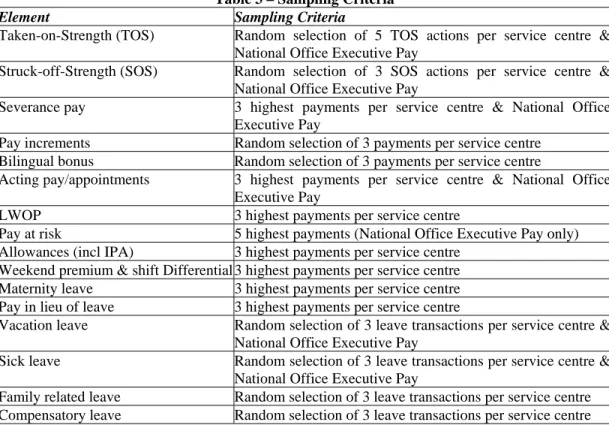
Transactions were selected based on sampling criteria as outlined below. The sampling criteria were developed from the audit team’s previous knowledge and experience in conducting compensation and benefits audits. Regular pay transactions and overtime transactions were excluded from the audit.
Table 3 – Sampling Criteria
Element Sampling Criteria
Taken-on-Strength (TOS) Random selection of 5 TOS actions per service centre & National Office Executive Pay
Struck-off-Strength (SOS) Random selection of 3 SOS actions per service centre & National Office Executive Pay
Severance pay 3 highest payments per service centre & National Office Executive Pay
Pay increments Random selection of 3 payments per service centre Bilingual bonus Random selection of 3 payments per service centre
Acting pay/appointments 3 highest payments per service centre & National Office Executive Pay
LWOP 3 highest payments per service centre
Pay at risk 5 highest payments (National Office Executive Pay only) Allowances (incl IPA) 3 highest payments per service centre
Weekend premium & shift Differential 3 highest payments per service centre Maternity leave 3 highest payments per service centre Pay in lieu of leave 3 highest payments per service centre
Vacation leave Random selection of 3 leave transactions per service centre & National Office Executive Pay
Sick leave Random selection of 3 leave transactions per service centre & National Office Executive Pay
Family related leave Random selection of 3 leave transactions per service centre Compensatory leave Random selection of 3 leave transactions per service centre
Detailed process flowcharts were also developed for the compensation and benefits processes. The processes were validated during the conduct of on-site audit work in each service centre. The resulting process flowcharts are attached in Appendix C.
IV OBSERVATIONS
AND
RECOMMENDATIONS
4.1
Organizational Structure for the Administration of Compensation and
Benefits
4.1.1 An appropriate organizational structure is in place to ensure compliance to policies, efficient and effective service delivery and financial integrity. YELLOW Moderate
Improvements Needed
Some controls are in place and functioning. However, major issues were noted and need to be addressed. These issues could impact on the achievement or not of program/operational objectives.
We expected to find in place, a well-defined organizational structure that would support the effective delivery of compensation and benefits services throughout the Agency. Such a structure should include elements such as: clearly defined accountability; resource and work allocation; proper direction; and roles and responsibilities.
Accountability
We found that overall accountability for the compensation and benefits function has not been clearly defined. While the Chief Human Resources Officer has functional responsibility for compensation and benefits, these services are delivered through four directorates. The Director, Human Resources Eastern Canada and Director, Human Resources Western and Northern Canada have responsibility for the provision of human resources services, including compensation and benefits services, in the East and West service centres. These two Director positions report to the respective Director General positions for Eastern Canada and Western and Northern Canada. The Director, Executive Group Services has responsibility for compensation and benefits services for the Executive Group and the Director, Labour Relations and Occupational Safety and Health (OSH) has responsibility at the National Office (NO).
Resource and Work Allocation
Compensation and benefits services are decentralized and delivered in the National Office and four service centres, including Western (Winnipeg & Calgary), Ontario (Cornwall), Quebec and Atlantic (Halifax). Compensation Managers at the National Office, and in each service centre, oversee the provision of compensation and benefits services, provided by approximately 50 Compensation Advisors (CA’s), to more than 7,000 employees at the Agency’s peak employment period. The CA’s are geographically dispersed throughout the regional service centres and sites. Compensation services are also augmented by Field Unit Human Resources staff.
We found that the provision of compensation and benefits services is delivered through a fragmented delivery structure as follows:
• Both the Winnipeg and Calgary Compensation and Benefits Managers, report directly to the Director, Human Resources Western and Northern Canada located in Calgary.
• The Compensation Manager for the Human Resources National Office (HRNO) reports to the Director, Labour Relations, Compensation & Occupational Safety and Health.
• Compensation Managers for the Ontario, Quebec and Atlantic Service Centres report to the Manager, Compensation & Labour Relations, located in Halifax.
• Nine Compensation Advisors report to Compensation Managers but are located in
geographical locations other than where the Compsensation Managers are.
• Executive pay services are centralized at the HRNO and are provided by the Executive Pay Compensation Advisor.
• Field Unit Human Resources Staff, who provide support to the compensation and benefits function, including processing of leave transactions, report to Service Centre Directors or Field Unit Superintendents. Compensation Managers have no control/jurisdiction over these employees with respect to compensation activities.
A chart depicting the organizational structure is attached in Appendix B. Direction
Functional direction, and the provision of policy interpretation and guidance are provided to the Compensation Managers by the National Office Compensation & Benefits Unit. This unit reports to the Director, Labour Relations, Compensation & Occupational Safety & Health in the National Office. The audit team found that the functional direction provided by this unit was well received in the service centres. We were informed that regular conference calls are held with the Compensation Managers and Executive Pay Compensation Advisor. The unit also contributes to the HR Library which provides compensation staff with easy and up-to-date access to Treasury Board, PWGSC and Agency policies and procedures.
However, we found that the operational reporting relationship of the Compensation Managers does not provide for a strong linkage to the National Office (NO) position providing functional direction. Compensation Managers are often obligated to follow the established hierarchy of their reporting relationships to seek compensation and benefits advice from individuals who may or may not possess a sufficiently advanced level of expertise in compensation and benefits. There is a risk that the Compensation Managers may be placed in situations of perceived conflicting direction or that they may find themselves in situations where they cannot maintain impartiality.
We also found that the physical location of the Louisbourg, NS Compensation Advisor leaves this individual disconnected from a critical network of compensation resources. There is a risk that this satellite compensation unit lacks the direction and support needed to ensure that the optimum level of compensation service can be provided to its clientele.
Roles and Responsibilities
We expected to find guidelines which clearly define and communicate the responsibilities of the manager, supervisor, staffing officers/HR advisors and compensation and benefits advisors in the processing of all staffing actions which result in a pay action. There is a risk that the absence of such guidelines may result in errors or missed or untimely pay actions.
Employee pay entitlements and benefits deductions are governed by the Parks Canada collective agreement, Agency policies and directives and various Acts and regulations such as, but not limited to the Public Service Superannuation Act, Financial Administration Act, Terms and Conditions of Employment Regulations and Treasury Board policies and guidelines governing salary administration.
Although a Compensation & Benefits Service Delivery document was developed in 1999 which outlined broad service standards and an overview of managers roles & responsibilities this document has not been kept current. Further, we found that the document does not adequately elaborate the roles and responsibilities of all the individuals involved in the pay process (including managers, staffing and compensation), the documentation requirements and timing of submitting such. In accordance with the TB Management Accountability Framework, managers have a “people” responsibility. Part of this responsibility is to ensure that their employees are paid on a timely basis. In order to achieve this compensation staff need to be duly informed of staff changes that have an impact on pay. We found that in many cases managers are either not fully aware of these responsibilities, or choose not to respect them. Of particular concern are the absences of, or delays in submitting required documentation for taken-on-strength (TOS) actions, particularly in an environment where TOS actions increase substantially during the hiring of seasonal employees. The Agency has been remiss in ensuring that managers have the necessary tools needed to ensure that compensation and benefits requirements are met in a timely manner.
Compensation and benefits staff need to ensure that they have the requisite supporting documentation which provides them with the “authority to pay”. The Agency employs a group of very dedicated compensation staff that are extremely conscientious of the impact on the employee from not receiving adequate supporting documentation. However, we found in all too many instances that actions will be taken to pay or continue to pay an employee without the requisite authority to pay.
The Compensation & Benefits National Office Team and HR Directors Eastern and Western &Northern have a key role to play in developing guidelines, procedures and directives to ensure the optimum delivery of compensation and benefits services. These internal procedures need to be communicated to managers and supported by senior management.
Conclusion
Overall, results of the audit have revealed that such a fragmented structure has led to significant weaknesses in controls over the compensation and benefits function. We noted many instances
where managers either lacked a sufficient knowledge of their responsibilities for ensuring the timely compensation of their employees or lacked an adequate knowledge of the Parks Canada collective agreement regarding entitlements such as leave. We have elaborated on the instances of control weaknesses in the Section 4.2.
We found that accountability for the compensation and benefits function has not been clearly defined and that the current organizational structure does not adequately support the effective delivery of compensation and benefits services in all service centres. In addition, we found existing guidelines are dated and do not clearly define and communicate the responsibilities of all individuals involved in the process for effecting pay actions, including the manager, supervisor, staffing officers/HR advisors and compensation and benefits advisors. This is resulting in errors going undetected and missed or untimely pay actions.
Recommendations
The Chief Human Resources Officer should:
1. Ensure that the current organizational structure and accountability for the delivery of compensation and benefits services is reviewed and assessed so that the optimum level of compensation services is provided to all employees.
Management response:
Partially agree.The current reporting structure of Compensation and Benefits is not significantly different from other parts of the Public Service. In most non-centralized departments, compensation operations do not report to Compensation and Benefits at National Office. In terms of background to the current structure at Parks Canada, in March 2001, a retreat of the Executive Board’s CEO and DG’s approved HR strategies for the short and longer term and how best to structure HRNO. Executive Board decided that the HR model should be aligned to the overall accountability and organization structure of Parks Canada, whereby the National Office would have key responsibility for policy, standards and monitoring and for HR functional direction and the Directors General East and West/North would have primary responsibility for coordination of program delivery and operations. This change took effect April 1, 2001. However, in keeping with the ongoing changes in central agency service delivery models, Parks Canada is conducting a national review of the organizational structure within Compensation, including the current accountability structure.
2. Ensure that existing guidelines be updated and expanded to clearly define and communicate the responsibilities of the manager, supervisor, staffing officers/HR advisors and compensation and benefits advisors in the process for effecting pay actions and that these guidelines be communicated to managers and be supported by senior management.
Management response:
Agree. The Compensation and Benefits service standards, which were developed, approved by Senior Management, and issued to Managers, HR Managers, Finance and Compensation staff in December 1999 will be updated. These include the responsibilities of the Manager, HR Manager, Compensation and Benefits, and Finance in the processing and documentation required to effect pay actions. The standard will also include PeopleSoft protocols, in anticipation of the
implementation of the pay interface. These standards will then be communicated to Managers, HR Managers, Compensation and Finance staff. We are targeting April 2008.
4.2
Adequacy of Systems and Controls for the Administration of
Compensation and Benefits
4.2.1 Taken-on-strength (TOS) and Struck-off-strength (SOS) procedures and practices comply with Acts and regulations and Parks Canada policies and directives
YELLOW Moderate Improvements Needed
Some controls are in place and functioning. However, major issues were noted and need to be addressed. These issues could impact on the achievement or not of program/operational objectives.
We expected to find established processes in place for taken-on-strength (TOS) and struck-off-strength (SOS) pay transactions.
Compensation staff processed more than 3,800 taken-on-strength (TOS) and 3,700 struck-off-strength (SOS) actions during the period April 1, 2004 to November 30, 2005. While we found no significant issues, we found controls over the adequacy of documentation were weak. In 30% of the 20 TOS actions reviewed, staffing letters of offer were missing and/or the content and quality of the letters lacked key information such as entitlement to bilingual bonus. This was more prevalent with TOS/SOS actions in early 2004. We did note improvements in the staffing letters of offer in the 2005 files.
Results of the audit also revealed that most service centres were using checklists to ensure that all steps to action an employee taken-on-strength or struck-off-strength had been followed and the required documents were obtained and processed. We found most service centres had adopted the use of checklists for TOS/SOS actions however these checklists varied from service centres to service centres. Although we found no Agency guidelines or directives outlining the requirement for completion of the checklists, we found the use of the checklists to be a good practice.
We also noted that the majority of the files for SOS’d employees did not contain employee clearance reports indicating financial certification that no money is owed the Agency. As required by the TB Comptrollership Policy on Pay Administration, individuals delegated Section 33 of the FAA should be the last to sign off before final payment is released. We were informed that in some service centres the employee clearance reports were retained at the sites.
Conclusion
Overall, while we found no significant issues with respect to taken-on-strength (TOS) and struck-off-strength (SOS) actions, we found controls over the adequacy of documentation needed
and quality of the letters lacked key information such as entitlement to bilingual bonus. This was more prevalent with TOS/SOS actions in early 2004. We did note improvements in the staffing letters of offer in the 2005 files.
Recommendations
The Chief Human Resources Officer should:
3. Ensure that employee files contain the adequate documentation which provide compensation staff with the authority to pay
Management response:
Agree. As stated in the audit report, the 2005 staffing letters of offer showed a marked improvement over the letters examined from early 2004. The standard letters of offer are reviewed and updated from time to time and were updated most recently in April 2006 to include the Code of Ethics requirement and are available on the HR Library to all HR staff. At that time, a communication was sent to the HR Managers to advise them of the updated letters, as well as to introduce two new documents. These new documents are “What letter to use” (depending on type of employment) and “Information applicable to your employment” (which is completed and attached to letters of offer). This latter document includes the required information regarding the bilingual bonus. We will investigate the possibility of capturing the attachment information in the letter of offer to ensure that Compensation staff receive all documentation required.
5. Ensure that a common set of checklists are developed for TOS and SOS actions Management response:
Agree.Checklists for TOS and SOS actions are now available on the Publiservice Virtual Pay website, which is available to all Compensation staff. A Compensation Directive will be issued to ensure Parks Canada Compensation staff use these checklists.
6. Ensure that employee clearance reports are received by compensation staff for all SOS actions
Management response:
Agree. The procedures for employee clearance reports will be reviewed by National Office and discussed with the Compensation Managers. These procedures, along with a generic clearance form, will be provided to Compensation and Finance staff as well as HR Managers. We are targeting September 2007.
4.2.2 Executive pay services are provided consistently and efficiently across the Agency YELLOW Moderate
Improvements Needed
Some controls are in place and functioning. However, major issues were noted and need to be addressed. These issues could impact on the achievement or not of program/operational objectives.
We expected to find adequate controls in place to provide assurance that PCX pay transactions are accurate, processed in a timely manner and supported by adequate documentation.
As mentioned previously, Executive pay services are centralized at the Human Resources National Office and are provided by the Executive Pay Compensation Advisor. This individual processes all PCX pay transactions as well as performing the pay verification process on the same transactions. While we noted no significant anomalies during our review of 25 PCX files, a key control in the pay verification process, namely adequate separation of duties, does not exist. However we did find adequate evidence of pay verification, which was supported by pay documentation on each of the files reviewed. Evidence of pay verification is annotated on copies of pay input screens from the on-line pay system and/or source documents, including the amount of payment and the date of the payroll register.
We noted that the Executive pay Compensation Advisor provides compensation and benefits services to approximately 75 Executive staff. Although this is significantly lower than the average number of accounts handled by other Agency compensation advisors (between 120-150), we were informed that this individual is not dedicated solely to CA activities and has other responsibilities such as research, analysis and special projects.
Conclusion
Overall, although the audit team did not note any errors of significance in the pay verification process for Executive pay transactions, a key control in the pay verification process, namely adequate separation of duties, is not in place.
Recommendation
The Chief Human Resources Officer should:
6. Ensure that an independent pay verification process is in place for Executive pay transactions.
Management response:
Agree. In light of the sensitivity and confidentiality of the information, there is currently no “buddy” system in place for verification. There are not a lot of PCX transactions, as this is a fairly stable group. There is a special allocation for the PCX group, which is monitored by the HRNO Finance and Administration Officer as well as the Chief Financial Officer. As a result, errors are guarded against and would be detected. However, on a quarterly basis, we propose to do some sampling of transactions after the fact to determine the rate of error.
4.2.3 Adequate controls have been established and implemented for pay transactions, and the pay processes are efficient and effective and part of the Agency=s financial management framework.
BLUE Minor
Improvements Needed
Many of the controls are functioning as intended. However, some minor changes are necessary to make the control environment more effective and efficient.
We expected to find that adequate controls have been established and implemented for pay transactions, and the pay processes are efficient and effective and part of the Agency’s financial management framework.
Pay Verification (section 34)
Compensation Advisors (CA’s) enter all pay transactions in PWGSC=s On-Line Pay System. The CA=s follow the specific instructions and procedures of the Personnel Pay Input Manual (PPIM) for preparing, verifying, authorizing and batching input to the On-Line Pay System.
Although the PWGSC On-Line Pay System contains key edits to check the accuracy and validity of regular pay transactions, we noted the system contains no specific edits to ensure that salary levels are accurate for non-regular (supplementary) pay transactions, such as, acting pay, LWOP actions, etc. This means that the Agency must rely on internal compensating controls to ensure the accuracy of pay transactions. Further, the system also contains no system verification to prevent a Compensation Advisor (CA) from inputting and verifying the same pay transaction. We expected to find that the Agency had developed compensating controls intended to further ensure the accuracy of pay transactions and to minimize the occurrence of errors. As such, with the exception of Executive pay transactions, all pay transactions are subject to review and verification by an alternate Compensation Advisor (Buddy System) prior to finalization. As mentioned previously, Executive pay transactions are both processed and verified by the Executive pay Compensation Advisor.
During our testing we expected to find evidence that all pay transactions had been verified by an alternate Compensation Advisor and that supporting documentation was available to support the action. We found that with the exception of the Executive pay unit, each service centre records evidence of pay verification on separate log sheets. The particulars of a pay transaction are recorded on the log sheet and the pay verifier initials the accuracy and validity of the pay transaction in concert with the documentation to support the transaction. These logs are not retained on the employee files. The use of the verification logs means that no evidence exists on the employee file to indicate verification of the accuracy and validity of the pay transaction.
Payment Authorization (Section 33)
According to TBS policy on Account Verification and the Financial Administration Act (FAA): "Financial Officers with payment authority pursuant to FAA Section 33, must provide assurance of the adequacy of the Section 34 account verification and be in a position to state that the process is in place and is being properly and conscientiously followed". We expected to find that the Agency had adequate controls and processes in place to meet these legislative and policy requirements.
We found that there is no consistent approach across the Agency with respect to financial authorization of pay transactions. On a daily basis Financial Officers in the National Office (NO) and each service centre access the On-Line Pay system and approve pay transactions either in bulk or transaction by transaction. Results of the audit revealed that in some service centres source documents are submitted with the pay transaction log prepared by the Compensation Advisors however, due to different physical locations of finance officers and compensation staff, in some service centres source documents are not forwarded.
Since all Agency pay offices are not in the same geographic location as finance offices, Financial Officers (FO)’s do not always have supporting documentation readily available to them at the time of verification. The Agency has not established specific policies and procedures for Financial Officers to follow for the verification of pay transactions. We feel that the majority of financial officers therefore cannot provide the necessary level of assurance, as required by the FAA, that paytransactions are valid and accurate.
The policy on Account Verification further states that the Agency must establish and document internal policies outlining the extent of verification required, based on risk considerations, to certify that transactions are accurate. Although the Agency has implemented a random sampling process this process varies from service centre to service centre. We were informed that there are no clear guidelines outlining the sampling requirements.
We also found at the Western service centre (Calgary) site that financial authority for FAA Section 33 has been delegated to the Compensation Manager since the Western service centre’s financial officer is physically located in Winnipeg. While the Treasury Board Comptrollership Policy on Pay Administration allows for delegation of financial authorities to human resources personnel there is a risk that assurance of Section 33 payment authorization may not be adequate. Conclusion
Although there is evidence that pay transactions are being authorized in accordance with Section 33 FAA, we found that financial officers do not always have supporting pay documentation readily available to them at the time of authorization. There is the risk that financial officers cannot provide the necessary level of assurance, as required by the FAA, that pay actions are valid and accurate. Guidelines for the authorization of pay transactions have not been established which has resulted in an inconsistent approach to FAA Section 33 authorization.
Recommendations
The Chief Human Resources Officer should in conjunction with the Executive Director, Finance: 7. Ensure that procedures for the authorization of pay transactions are developed and
communicated and that a consistent approach to pay verification is implemented across the Agency.
8. Ensure that guidelines for service centres financial officers, which outline the pay transaction authorization process, associated sampling process, and documentation requirements are developed.
Management response:
Partially disagree (7&8). The financial authorities related to FAA section 33 have been in place for many years in the Public Service, including Parks Canada, which was previously affiliated with different departments prior to becoming an Agency on April 1, 1999. We will meet with the Chief Financial Officer to discuss the issues related to FAA section 33. The pay verification procedures in place in the Compensation units will also be reviewed.
4.2.4 Allowances are paid as per the dispositions of the collective agreement
BLUE Minor
Improvements Needed
Many of the controls are functioning as intended. However, some minor changes are necessary to make the control environment more effective and efficient.
We expected to find adequate controls in place to ensure that employees entitlement to allowances and benefits such as the bilingual bonus, isolated post, terminable allowance, etc. were supported by adequate documentation and paid on a timely basis. We also expected to find that the cessation of these allowances and benefits were actioned according to the expiry of such. We found no significant issues related to allowances in the files reviewed with the exception of bilingual bonus on which we focused our audit work.
Controls over the payment of bilingual bonus ORANG
E
Significant Improvements Needed
Controls in place are weak. Several major issues were noted that could jeopardize the accomplishment of program/operational objectives. Immediate management actions need to be taken to address the control deficiencies noted.
Payment of the bilingual bonus to Agency employees totalled $732,000 in fiscal year 2004-05. Results of the audit revealed that in all service centres, employee files lacked sufficient evidence to support that the employee was entitled to the bilingual bonus. We found that for more recent appointments, entitlement to the bilingual bonus was stipulated in the employee’s letter of offer. However, for those employees who have remained in their substantive positions for a long period of time, evidence on the files was for the most part lacking. Further, of particular concern was the lack of evidence to support that an employee in an acting position was entitled to the bilingual bonus. In many instances, entitlement to the bilingual bonus was absent from acting pay forms and acting appointment letters.
In accordance with the Agency’s Bilingual Bonus Policy, the CEO is responsible for ensuring that payment of the bilingual bonus is initiated and stopped in accordance with established policies and procedures. The policy clearly stipulates that in any instance where the bonus ceases to be paid, the incumbent must receive written notice that payments will stop two months after date of notice. Therefore, the Agency must take the appropriate steps regarding negative results on an SLE or raised or re-identified linguistic profiles, whichever applies, to properly stop payment of the bonus. The policy does not address the issue when an employees’ substantive position is bilingual but has been acting for extended periods of time in a non-bilingual position. Conclusion
Controls over the payment of the bilingual bonus need improvement. Payment of the bilingual bonus to Agency employees totalled $732,000 in fiscal year 2004-05. We found in all service centres that employee files lacked sufficient evidence to support that the employee was entitled to the bilingual bonus. We did note however, that for more recent appointments, entitlement to the bilingual bonus was stipulated in the employee’s letter of offer. For those employees who have remained in their substantive positions for a long period of time, evidence on the files was for the most part lacking. Further, of particular concern was the lack of evidence to support that an employee in an acting position was entitled to the bilingual bonus. In many instances, entitlement to the bilingual bonus was absent from acting pay forms and acting appointment letters.
Recommendation
The Chief Human Resources Officer should:
9. Ensure that compensation staff receive the necessary documentation, on a timely basis, to support the commencement and cessation of the bilingual bonus.
Management response:
Agree.Compensation staff require this information in a timely manner. Appropriate measures will be taken to ensure that the HR Managers put the information regarding the employee’s entitlement to the bilingual bonus on the staffing file in cases of acting situations and that this information is also provided to Compensation staff to authorize the payment or cessation of the bilingual bonus, where applicable. A review of the concurrence of the information between the position and the incumbent is currently underway and, where applicable, any changes related to the payment or cessation of the bilingual bonus will be provided to Compensation.
Compensation will work with the Official Languages group to address the issue.
4.2.5 Leave without pay are authorized in accordance with the Parks Canada collective agreement or appropriate Terms and Conditions of Employment.
BLUE Minor
Improvements Needed
Many of the controls are functioning as intended. However, some minor changes are necessary to make the control environment more effective and efficient.
We expected to find that leave without pay (LWOP) pay actions are authorized in accordance with the Parks Canada collective agreement or appropriate terms and conditions of employment. The Parks Canada collective agreement includes provision for employees to apply for a variety of leave without pay situations including maternity and parental leave, the care of immediate family, family-related responsibilities, personal needs, etc.
In fiscal year 2004-05 more than 28,000 LWOP transactions were processed totalling a recovery of three million dollars. While no significant issues were identified, given the significance of the cost to the Agency, Compensation Managers should have an active role in monitoring these high risk cases. We noted that all service centres are making good use of automated calculation tools for LWOP situations such as maternity and paternity leave, which provides for an adequate control over payments.
Conclusion
While no significant issues were identified, given the significance of the cost to the Agency, Compensation Managers should have an active role in monitoring these high risk cases.
Recommendation
The Chief Human Resources Officer should:
10. Ensure that Compensation Managers have an active role in monitoring LWOP cases. Management response:
Agree. Monitoring of LWOP will take place. Compensation and Managers/Supervisors have a role to play. While a significant number of LWOP transactions were processed in fiscal year 2004-05 amounting to 3 million dollars, much of that was related to the strike that occurred in that year and lasted 64 days. To further strengthen our controls in this area, National Office will investigate the possibility of managing requests for LWOP through the LRS. Following from a review of the LWOP accounts on a national basis, Parks Canada through the CHRO will commence with a comprehensive return to work program. This program will have the goal of reducing the amount of LWOP necessary to ensure that employees are returning to their positions after illness or injury. The revised return to work program will commence in early 2007-2008.
4.3
Adequacy of Systems and Controls for the Management of Leave
4.3.1 Management of leave within Parks Canada is in accordance with the Parks Canada collective agreement and Agency policies and procedures, and the process for leave requests and their approvals is clear, consistent, understood by staff, properly documented and based on sound decision-making.
BLUE Minor
Improvements Needed
Many of the controls are functioning as intended. However, some minor changes are necessary to make the control environment more effective and efficient.
We expected to find that the management of leave is in accordance with the Parks Canada collective agreement and Agency policies and procedures including an established process for leave requests and their approvals.
The Parks Canada collective agreement and applicable Terms and Conditions of Employment outline entitlements for the various types of leave including vacation, sick, family related, etc. The Leave Reporting System (LRS) is used to record and track leave entitlements and usage for Agency employees. More than 156,000 leave requests were processed for the period April 1, 2004 to November 30, 2005. The Agency has made a positive step forward and has undertaken a phased in approach over the past year to move from a manual leave recording process to an automated process with the LRS. This system allows employees to directly input their leave request in the LRS. The employee=s manager is notified by email that an employee has submitted a leave request for approval. The manager is then required to access the LRS to either approve or deny the leave request, which automatically updates the employee=s leave balances in the LRS. The LRS will significantly reduce the cumbersome and time consuming manual processing of leave requests and permit existing resources involved in the manual process to be used elsewhere.
We found that no formal training has been provided to managers and employees. Although there are Frequently Asked Questions (FAQ’s) to guide users in the use of the LRS, step-by-step procedures have not been developed to guide new or infrequent users.
While there appears to be a positive uptake to using the LRS we noted during the audit that all service centres are still processing manually prepared leave requests. We noted that although senior management is encouraging the use of the LRS, it has yet to be made a mandatory requirement.
Conclusion
Overall, we found that until all Agency staff are using the LRS, there will continue to be an additional demand on compensation resources to process manual leave requests. Further, the lack of formal training and step-by-step procedures may have a negative impact on encouraging the use of the LRS.
Recommendations:
The Chief Human Resources Officer should:
11. Ensure that use of the Leave Request System (LRS) becomes a mandatory requirement for the processing of leave requests.
Management response:
Agree.To date, the LRS system has been rolled out to 98 % of the staff. Steps will be taken to make the Leave Request System (LRS) mandatory where possible immediately in order to ensure full usage of the system. Work will continue on resolving the issue of employees who do not have access to a computer and in the interim will continue to promote the use of the Third Party function in the Leave Request System (LRS). Plans are being developed to include functionality for Extra Duty and Overtime, complete with the ability to do scheduling forecasts, and expand the capabilities for reporting purposes, within the Leave Request System (LRS). The functionallity for Extra Duty and Overtime is targeted for late 2007-08.
12. Ensure that step-by-step procedures for accessing and using the LRS are developed. Management response:
Agree.A Procedure / Training manual will be developed for the Leave Request System (LRS) to assist new employees and those employees who are infrequent users of the Leave Request System (LRS). Target date is April 2007.
4.3.2 Mechanisms in place, to record and account for leave, including entry into the Leave Reporting System (LRS), as well as ensure that all leave is recorded in a timely and efficient manner.
ORANG E
Significant Improvements Needed
Controls in place are weak. Several major issues were noted that could jeopardize the accomplishment of program/operational objectives. Immediate management actions need to be taken to address the control deficiencies noted.
We expected to find adequate mechanisms in place to record and account for leave, including entry into the Leave Reporting System (LRS).
The system has a built in control that will not permit employees to request leave above their available balance for leave such as annual and sick leave. However, there is no such control in place for family related, personal or volunteer leave.
LRS contains no system edits or checks to reconcile the total hours taken against the period of time taken since there are too many variables that affect the relation of time periods i.e. compressed hours, part-time hours etc. For example, if an employee had taken vacation leave from April 1 to 2, the requisite leave credits should normally be reduced by 15 hours. If the employee inadvertently recorded 150 hours instead of 15 the leave transaction would not have been validated by the system and the employees leave would therefore be reduced by 150 hours. There is no monitoring mechanism in place to detect this type of error.
Conclusion
Given the system control weaknesses of the Leave Reporting System, employees and managers will need to ensure that leave is recorded accurately and that a monitoring regime is in place to identify and address data inaccuracies.
Recommendation:
The Chief Human Resources Officer should: 13. Reference 4.3.3.
4.3.3 Leave monitoring system has been established to identify and address data inaccuracies, system weaknesses, potential abuse, trends and is used for planning purposes (i.e. scheduling, budgeting)
ORANG E
Significant Improvements Needed
Controls in place are weak. Several major issues were noted that could jeopardize the accomplishment of program/operational objectives. Immediate management actions need to be taken to address the control deficiencies noted.
We expected to find a leave monitoring system in place to identify and address data inaccuracies, system weaknesses, potential abuse and trends.
We found that the Agency has not implemented a leave monitoring system to identify and address inaccuracies or system weaknesses.
Results of our audit identified a number of areas where implementation of an effective monitoring system would have identified the following weaknesses.
Sick Leave
In accordance with the Parks Canada collective agreement employees earn sick leave credits for each calendar month for which the employee receives at least ten days pay. Employees are granted sick leave with pay when he/she is unable to perform the duties of their position. . All data has been reviewed and the number of employees with a negative sick leave balance at the end of the audited year is 117, of which 27 exceeded their entitlements by more than 100 hours We also noted in one service centre that a manager had authorized sick leave totalling 2,400 hours from 2004-05 to 2005-06 without the employee submitting a medical certificate. The sick leave was approved based on a “Leave Agreement” between the employee and manager. The employee subsequently retired in 2005.
Family Related Leave (FRL)
In accordance with the Parks Canada collective agreement leave with pay may be granted, not to exceed five days, for various circumstances pertaining to family member medical and dental appointments and for immediate and temporary care of family members. This is commonly referred to in the Agency as “FRL”. There is no provision for carry-over of unused FRL days into the following fiscal year.
We noted that 32 employees of the 355 files reviewed (9%) exceeded their 5 day entitlement in 2004-05 with 21 employees exceeding their entitlement in 2005-06 (as of November 30/05). There is no LRS system control in place to restrict the usage/recording of Family Related Leave (FRL) to 5 days. Further, there is no monitoring of the use of FRL at the National Office or in the service centres. A random sample of five employee files per service centres was selected where the employee had used a total of five FRL days. Results of our testing revealed that in some instances where the employee had requested FRL beyond the 5 days, LWOP action had been taken.
Other Paid Leave
We found during the detailed testing that leave is being recorded against LRS code 699 which is reserved for recording other paid leave. Approximately 600 employees recorded a total of 6,567 hours (875 days) against other paid leave during the period April 1, 2004 to November 30, 2005. We noted three instances where leave usage against this code exceeded 100 hours (13 days). There is a risk that this code is being used due to employee’s lack of knowledge regarding coding of leave. There is the potential that this may be used to circumvent leave entitlements that have been exhausted. Further, the extensive use of this code may jeopardize the accuracy of information reported to senior management for decision making regarding leave.
Excess Vacation Leave
In accordance with the Park’s Canada collective agreement employees are expected to take all their vacation leave during the vacation year in which it is earned. Where an employee has accumulated vacation leave credits in excess of 262.50 hours (or 280 hours in accordance with the Hours of Work Code) leave shall be automatically paid in cash at his or her daily rate of pay based on their daily rate of pay on the last day of the vacation year. We found that the National Office, Compensation and Benefits communicates annually with managers regarding the collective agreement leave requirements and monitors occurrences of excess vacation leave. Approximately 5,300 leave payment transactions were actioned in 2004-05 totalling more than $800,000.