4321
SEGMENTATION METHODS
FOR A GROUP-HOUSED PIG MONITORING SYSTEM
1 MISO JU, 2 YEONWOO CHUNG, 3HANSOL BAEK, 4YONGWHA CHUNG, 5DAIHEE PARK, 6BYUNGKWAN PARK*
1,3-6Department of Computer Convergence Software, Korea University, Republic of Korea
2Department of Applied Statistics, Korea University, Republic of Korea
E-mail: 1[email protected], 2[email protected], 3[email protected], 4[email protected], 5[email protected], 6[email protected],
*Corresponding Author
ABSTRACT
The analysis of individual pig behavior in group-housed pigs is important for pig management. In this study, we propose two low-level segmentation methods for group-housed pigs to facilitate the video-based high-level analysis of pig behavior. In a 24-hour pig room monitoring environment where no pig is allowed to enter/leave the room during the monitored period, the previous video frame has sufficient information for separating touching-pigs in the current video frame. In this paper, we propose two methods to separate touching-pigs using the information of the previous video frame and a hybrid method for combining the segmentation results of each method. According to experimental results with the Korean pig farm data, the proposed segmentation methods based on the labeled outline/region information can provide more accurate results than widely used methods.
Keywords: Group-Housed Pigs, Pig Management, Video-based Pig Monitoring, Image Processing, Segmentation
1. INTRODUCTION
The early detection of management problems is important when caring for group-housed pigs [1],[2],[3]. Caring for individual pigs is necessary to minimize the possible damage caused by infectious disease. However, it is almost impossible for individual pigs to be cared for effectively by the small number of farm workers employed on large-scale pig farms. For instance, the Korean farm where the video data was obtained had 2,000 piglets per farm worker.
In order to significantly reduce working time for farm workers and facilitate the early detection of health or management problems, researches on the automatic monitoring of group-housed pigs have been reported recently. For example, pig activity monitoring using attached sensors such as accelerometers [4] has been reported. However, these attached sensor-based solutions may not be acceptable for a large-scale pig farm because of the managing cost/time of the sensor. Thus, video camera-based solutions, which do not need such managing overhead once installed,
4322 than 10 pigs and the mean times between tracking failures were less than a few minutes. For the ultimate goal of long-time tracking of individual pigs [15] in a crowded pig room (including more than 20 pigs), separating touching-pigs is required.
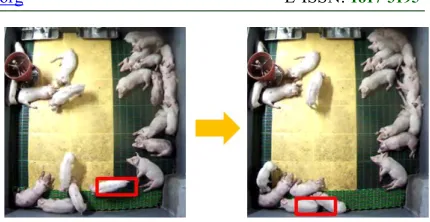
In this paper, we consider a 24-hour closed pig room monitoring application where no pig is allowed to enter/leave the room during the monitored period and solve the segmentation problem of touching-pigs occurred in the crowded pig room. In general, the accurate segmentation of individual objects is important to understand an input scene in many applications including [16]. For example, with the current techniques [17],[18],[19] implemented in OpenCV [20], each isolated moving pig can be segmented and tracked correctly. If they are close together, however, the current techniques regard those pigs as a pig group and can no longer maintain the individual identity of those pigs (See Figure 1). For analyzing each moving pig automatically in order to detect possible health and social problems of each pig as early as possible, we need to separate touching-pigs.
(a) Tracking Results With The Mean-Shift Algorithm [17] Implemented In OpenCV
(b) Tracking Results With The CAM-Shift Algorithm [18] Implemented In OpenCV
[image:2.612.311.526.80.191.2](c) Tracking Results With The Kalman Filter Algorithm [19] Implemented In OpenCV
Figure 1: Tracking Failures Caused By Touching-pigs.
Since we consider a 24-hour closed room monitoring situation and each isolated pig can be identified with current techniques, we can assume that each pig in the previous frame is identified individually. Therefore, we exploit this previous frame information, in addition to the current frame information, for separating touching-pigs in the current frame. At the beginning, there could be touching-pigs whose separation is impossible with the proposed method. By carefully verifying the video obtained from a pig room, however, we found that pigs can move in close proximity; however, they move away from each other in time. That is, each pig of the touching-pigs at the beginning will be separated eventually and can be identified individually with current techniques. Once they are identified individually, using the proposed methods we can maintain each identity even with another touching-pig case later. In particular, we can provide more accurate segmentation results by combining the segmentation results of two low-level outline/region-based segmentation methods.
The remainder of this paper is organized as follows. Section 2 describes the proposed methods for separating touching-pigs; Section 3 explains our experimental results; and Section 4 presents a summary of this research.
2. SEGMENTATION OF TOUCHING PIGS
4323 bigger than that of a single pig, a separation step to the moving region caused by the touching-pigs is applied.
2.1 Outline-based Segmentation
In this method, we interpret the separation problem in a crowded pig room as a “time-series alignment” problem of the touching-pigs in the current frame using the labeled outline of the individual pigs in the previous frame. Figure 2 illustrates the main idea of the outline-based segmentation method using the relationship between the previous and current frames.
(a) Previous Frame’s Segmentation Result
(b) Current Frame’s Touching Region Figure 2: Illustration Of Projecting The Previous Frame’s Segmentation Result Into The Current Frame’s Touching Region With The Outline-based Method (3-pig Sequence). (a) Three Pigs Identified Individually In The Previous Frame. (b) Outline Alignment Of The Current Frame.
For each input frame, we extract a center-point of touching-pigs to transform the outline of the touching-pigs into time-series data. Then, we create time-series data for the touching-pigs by calculating the distance from the extracted center-point to the outline center-points of the touching-pigs. Note that, to extract the center-point of the previous frame of a touching sequence where the touching-pigs in the current frame were separated, we first apply the opening operation [20] to the separated pigs in order to connect them.
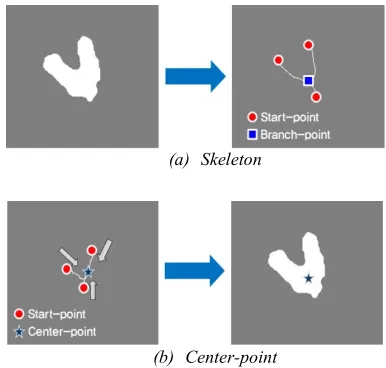
For extracting a center-point, we first get the skeleton of the touching-pigs by using the Medial Axis Transform (MAT) algorithm [22]. This skeleton image may have several start-points and branch-points. From each start-point, we perform skeleton-based contour-tracing simultaneously. The contour-tracing will be stopped at one point along the skeleton, and this point is defined as a “center-point” of the touching-pigs. Note that, at a branch-point, the contour-tracing will be stopped except the last one (i.e., for a 3-points branch-point as shown in Figure 3, the first and second arrived contour-tracings will be stopped, whereas the third arrived contour-tracing will continue the tracing operation).
(a) Skeleton
[image:3.612.106.286.264.499.2](b) Center-point
Figure 3: Illustration Of Extracting A Center-point (2-pig Sequence). (a) Finding The Skeleton Using MAT. (b) Finding A Center-point Of The Skeleton.
Then, we can make time-series data for the touching-pigs by calculating the distance from the center-point to outline points of the touching-pigs. Especially, the time-series data of the previous frame already have the labelled outline of individual pigs.
[image:3.612.320.513.284.468.2]4324 the time-series outline data, we apply the Dynamic Time Warping (DTW) algorithm [23].
As the result of the alignment, the “labeled” outline of the current frame can be obtained. Figure 4 (b) illustrates the result of the time-series alignment of the proposed method. The outline-based segmentation method is summarized in Figure 5 and the details of the method can be found in [24]. Note that this kind of labeling may not guarantee perfect “pixel-level” separation accuracy. Since this labeled outline of the touching-pigs can separate the touching-touching-pigs, however, the proposed method can maintain “identity-level” separation accuracy.
(a) Previous Frame’s Segmentation Result
(b) Current Frame’s Touching Region Figure 4: Illustration Of Projecting The Previous Frame Into The Current Frame (2-pig Sequence). (a) Two Pigs Identified Individually In The Previous Frame. (b) Outline Alignment Of The Current Frame.
Outline_based_segmentation
Input: unlabeled touching-pigs in the current frame, labeled individual pigs in the previous frame Output: individually labeled touching-pigs in the current frame
// Connect the separated pigs in the previous frame Morphological_Open(individual pigs)
// Extract a center-point MAT(touching-pigs)
MAT(connected individual pigs)
current_centerpoint = contour-tracing(touching-pigs) previous_centerpoint = contour-tracing(connected individual pigs)
// Make a time-series data current_unlabeled_timeseries =
calculate_distance(current_center_point, outline points of the touching-pigs)
previous_labeled_timeseries =
calculate_distance(previous_center_point, outline points of the connected individual pigs)
// Align between the time-series data current_labeled_timeseries = DTW(previous_labeled_timeseries, current_unlabeled_timeseries)
// Separate the touching-pigs in the current frame label_touching_pigs(touching-pigs,
current_labeled_timeseries)
Figure 5: Outline-based Segmentation Algorithm.
2.2 Region-based Segmentation
In this method, we interpret the separation problem in a crowded pig room as a “region partitioning” problem of the touching-pigs in the current frame using the labeled regions of the individual pigs in the previous frame.
For the first frame containing the touching-pigs, the previous frame’s “labeled” segmentation result is projected onto the current frame’s “unlabeled” touching-pigs region. As shown in Figure 6 (a), for example, the previous frame contains three colors for each pig. Based on this color information, we can partition the touching-pigs region in the current frame. For example, some overlapped pixels colored with “green” in the previous frame may have to be colored with “red” in the current frame. In order to address these tricky overlapped pixels, we first apply the erosion operator until these overlapped pixels can be excluded. For explanation, we denote this eroded region of each pig as a skeleton of each pig in the touching-pigs region.
From the skeleton of each pig, we apply the dilation operator until the dilation reaches to the skeleton of another pig in the touching-pigs region. After the dilation, the touching-pig region in the current frame can be partitioned into three types of regions as illustrated in Figure 6 (b):
not-determined region with conflict, not-determined
4325 the three types of regions, we need to determine a label of each not-determined region further.
First, not-determined regions without
conflict are labeled using a region-growing
technique. After applying the region-growing with the seed labels determined by the boundary pixels of the determined region, the label of each pixel in
the not-determined regions without conflict can be
determined. Then, not-determined regions with
conflict are labeled by comparing the area of each
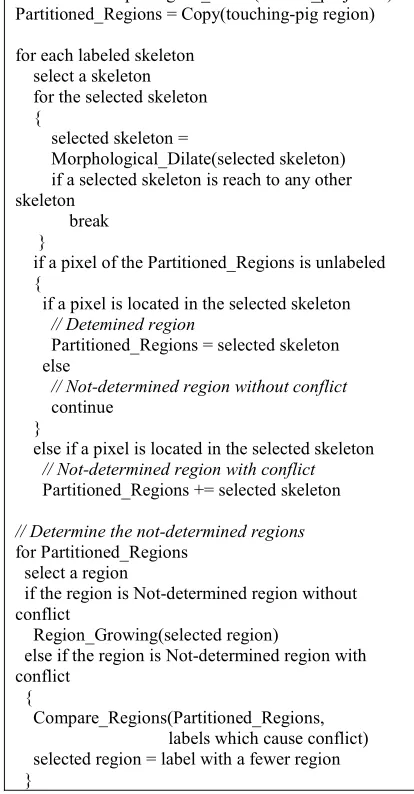
color between the previous and current frames. Figure 6 (b) illustrates the result of the region partitioning of the proposed method, and the region-based segmentation method is summarized in Figure 7. Note that this kind of labeling may not guarantee perfect “pixel-level” separation accuracy. Since some of the tricky overlapped pixels explained in the first step are solved, however, the proposed method can maintain “identity-level” separation accuracy.
(a) Previous Frame’s Segmentation Result
(b) Current Frame’s Touching Region
Figure 6: Illustration Of Projecting The Previous Frame’s Segmentation Result Into The Current Frame’s Touching Region With The Region-based Method (3-pig Sequence. (a) Three Pigs Identified Individually In The Previous Frame. (b) Region Partitioning Of The Current Frame.
Region_based_segmentation
Input: unlabeled touching-pigs in the current frame, labeled individual pigs in the previous frame Output: individually labeled touching-pigs in the current frame
// Project the labeled previous frame into the unlabeled current frame
projected_current = Project(unlabeled touching-pigs, labeled individual pigs)
// Partition the touching-pig region into three types of regions
for every pixel of the projected_current if a pixel of the projected_current is labeled
labeled_projected = the labeled pixel
skeleton = Morphological_Erode(labeled_projected) Partitioned_Regions = Copy(touching-pig region) for each labeled skeleton
select a skeleton for the selected skeleton {
selected skeleton =
Morphological_Dilate(selected skeleton) if a selected skeleton is reach to any other skeleton
break }
if a pixel of the Partitioned_Regions is unlabeled {
if a pixel is located in the selected skeleton // Detemined region
Partitioned_Regions = selected skeleton else
// Not-determined region without conflict continue
}
else if a pixel is located in the selected skeleton // Not-determined region with conflict Partitioned_Regions += selected skeleton // Determine the not-determined regions for Partitioned_Regions
select a region
if the region is Not-determined region without conflict
Region_Growing(selected region)
else if the region is Not-determined region with conflict
{
[image:5.612.311.518.196.593.2]Compare_Regions(Partitioned_Regions, labels which cause conflict) selected region = label with a fewer region }
Figure 7: Region-based Segmentation Algorithm.
2.3 Hybrid Segmentation
4326 consider the specific location as a background (i.e., neither of any pig). As we can see in the experimental results, both the outline-based and region-based methods are accurate and the locations whose segmentation results of the two methods disagree are near the actual boundary between the touching-pigs. Therefore, by considering any disagreement location as a background, we can separate the touching-pigs more clearly.
3. RESULTS AND DISCUSSION
For the experiments, the resolution size was set to 640 × 480 pixels. Also, the frame rate was set to 8 frames per second (fps). There were 22 weaning pigs in a pig room that measured 4 × 3 m, and a camera was located 4 m above the floor. From the video sequences, we set the ROI to regions of touching-pigs that could not be separated, and labeled each pig in the previous frame. As we used the previous frame’s segmentation result, we could obtain the current frame’s segmentation result.
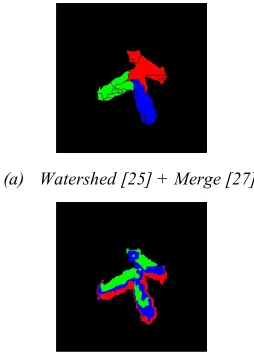
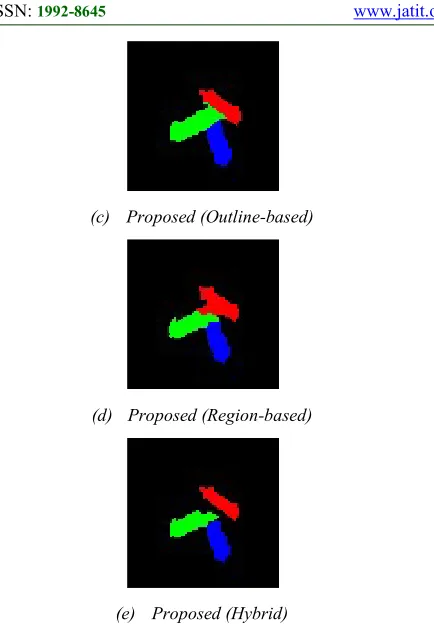
As indicated in Figure 8 and 9, we confirmed that the touching-pigs were separated individually using the proposed outline-based and region-based methods. By combining these segmentation results, the hybrid method could separate the touching-pigs more clearly. For comparison, we also applied typical segmentation methods based on Watershed [25] and K-Means [26]. For maintaining the identity of each pig between consecutive frames, the widely used segmentation methods require an additional step such as region-merging [27] to build the relationship between consecutive frames. On the contrary, the proposed method uses both previous and current frame information and thus can maintain the identity of each pig between consecutive frames without any additional step.
(a) Watershed [25] + Merge [27]
(b) K-Means (K = 2) [26]
(c) Proposed (Outline-based)
(d) Proposed (Region-based)
(e) Proposed (Hybrid)
Figure 8: Separation Results Using Common Methods And The Proposed Methods (2-pig Sequence).
(a) Watershed [25] + Merge [27]
[image:6.612.355.482.523.705.2]4327
(c) Proposed (Outline-based)
(d) Proposed (Region-based)
(e) Proposed (Hybrid)
Figure 9: Separation Results Using Common Methods And The Proposed Methods (3-pig Sequence).
In the accuracy evaluation, we compared the “pixel-level” segmentation results obtained by the proposed methods with the ground-truth segmentation. Note that the purpose of this study was not the foreground (i.e., pig) detection, rather, the separation of the touching-pigs. Therefore, we only focused on the area of the touching-pigs. Because it was necessary to separate multiple touching-pigs, we defined Segmentation Accuracy (SA) as follows. T and F denote the true area (i.e., an area whose pig ID was correctly identified) and the false area (i.e., an area whose pig ID was incorrectly identified), respectively. We then defined SA = T/(T+F) and summarized the SAs in Table 1.
Table 1: Comparison Of Segmentation Accuracy.
Method Accuracy (%) Segmentation
Watershed [25] + Merge [27] 69.14 K-Means [26] 45.86 Proposed
Method
Outline-based 83.14 Region-based 88.00 Hybrid 93.14
Compared with the Watershed and K-Means methods, we confirmed that segmentation accuracy was improved qualitatively using the proposed methods. In particular, the hybrid method could separate the touching-pigs with an average SA = 93.14%.
4. CONCLUSION
Automated monitoring of “individual” pigs in a crowded pig room is an important issue in order to detect health or management problems earlier. Although some progress for a group-housed pig monitoring system has been reported recently, researches on identifying the movements of each individual pig accurately have not yet been reported.
In this study, we proposed two methods for segmenting the touching-pigs by exploiting the characteristic of closed room monitoring applications (i.e., using the information of the previous video frame). The first method interpreted the separation problem in a crowded pig room as a “time-series alignment” problem of the touching-pigs in the current frame using the labeled outline of the individual pigs in the previous frame. In the second method, we interpreted the separation problem in a crowded pig room as a “region partitioning” problem of the touching-pigs in the current frame using the labeled regions of the individual pigs in the previous frame. Furthermore, we determined that more accurate segmentation results could be obtained by combining the segmentation results of each method. In the experimental results, the hybrid method could separate touching-pigs with an average segmentation accuracy of 93.14% in the video sequences.
Although segmentation methods have been proposed to separate the touching-pigs, several issues need to be considered for the ultimate goal of long-time monitoring of individual pigs in real-time. As future works, we will design a robust tracking method based on the segmentation methods, and parallelize the whole operations to satisfy the real-time requirement.
ACKNOWLEDGEMENTS:
[image:7.612.96.313.73.385.2]4328 Leading Human Resource Training Program of Regional Neo Industry through the NRF funded by the MSIP (2016H1D5A1910730).
REFRENCES:
[1] A. Velarde and R. Geers, “On Farm Monitoring of Pig Welfare”, Wageningen Academic Pub.
(Netherlands), 2007.
[2] T. Banhazi, H. Lehr, J. Black, H. Crabtree, P. Schofield, M. Tscharke, and D. Berckmans, “Precision Livestock Farming: An International Review of Scientific and Commercial Aspects”,
International Journal of Agriculture and
Biology, Vol. 5, 2012, pp. 1-9.
[3] S. Matthews, A. Miller, J. Clapp, T. Plotz, and I. Kyriazakis, “Early Detection of Health and Welfare Compromises through Automated Detection of Behavioural Changes in Pigs”, The
Veterinary Journal, Vol. 217, 2016, pp. 43-51.
[4] H. Escalante, S. Rodriguez, J. Cordero, A. Kristensen, and C. Cornou, “Sow-Activity Classification from Acceleration Patterns: A Machine Learning Approach”, Computers and
Electronics in Agriculture, Vol. 93, 2013, pp.
17-26.
[5] B. Shao and H. Xin, “A Real-Time Computer Vision Assessment and Control of Thermal Comfort for Group-Housed Pigs”, Computers
and Electronics in Agriculture, Vol. 62, 2008,
pp. 15-21.
[6] Y. Chung, H. Kim, H. Lee, D. Park, T. Jeon, and H. Chang, “A Cost-Effective Pigsty Monitoring System based on a Video Sensor”, KSII Tr.
Internet and Information Systems, Vol. 8, 2014,
pp. 1481-1498.
[7] G. Tu, H. Karstoft, L. Pedersen, and E. Jorgensen, “Illumination and Reflectance Estimation with Its Application in Foreground Detection”, Sensors, Vol. 15, 2015, pp. 21407-21426.
[8] M. Oczak, K. Maschat, D. Berckmans, E. Vranken, and J. Baumgartner, “Automatic Estimation of Number of Piglets in a Pen during Farrowing, using Image Analysis”,
Biosystems Engineering, Vol. 151, 2016, pp.
81-89.
[9] F. Lao, T. Brown-Brandl, J. Stinn, K. Liu, G. Teng, and H. Xin, “Automatic Recognition of Lactating Sow Behaviors through Depth Image Processing”, Computers and Electronics in
Agriculture, Vol. 125, 2016, pp. 56-62.
[10] J. Navarro-Jover, M. Alcaniz-Raya, V. Gomez, S. Balasch, J. Moreno, V. Grau-Colomer, and A. Torres, “An Automated Colour-based Computer Vision Algorithm for Tracking the Position of Piglets”, Spanish J. of Agricultural
Research, Vol. 7, 2009, pp. 535-549.
[11] W. Zhu, X. Pu, X. Li, and X. Zhu, “Automated Detection of Sick Pigs based on Machine Vision”, IEEE Proc. of ICIS, Vol. 2, 2009, pp. 790-794.
[12] M. Kashiha, C. Bahr, S. Ott, C. Moons, T. Niewold, F. Odberg, and D. Berckmans, “Automatic Identification of Marked Pigs in a Pen using Image Pattern Recognition”,
Computers and Electronics in Agriculture,
Vol. 93, 2013, pp. 111-120.
[13] N. McFarlane and C. Schofield, “Segmentation and Tracking of Piglets in Images”, Machine
Vision and Applications, Vol. 8, 1995, pp.
187-193.
[14] P. Ahrendt, T. Gregersen, and H. Karstoft, “Development of a Real-Time Computer Vision System for Tracking Loose-Housed Pigs”, Computers and Electronics in
Agriculture, Vol. 76, 2011, pp. 169-174.
[15] A. Dell, J. Bender, K. Branson, I. Couzin, G. Polavieja, L. Noldus, A. Perez-Escudero, P. Perona, A. Straw, M. Wikelski, and U. Brose, “Automated Image-based Tracking and its Application in Ecology”, Trend in Ecology &
Evolution, Vol. 29, 2014, pp. 417-428.
[16] E. Zanaty and S. Ghoniemy, “Medical Image Segmentation Techniques: An Overview”,
Intl’ J. of Informatics & Medical Data
Processing, Vol. 1, 2016, pp. 16-37.
[17] D. Comaniciu and P. Meer, “Mean Shift: A Robust Approach Toward Feature Space Analysis”, Pattern Analysis and Machine
Intelligence, Vol. 24, 2002, pp. 603-619.
[18] J. Allen, R. Xu, and J. Jin, “Object Tracking Using CamShift Algorithm and Multiple Quantized Feature Spaces”, Proc. of the Pan-Sydney Area Workshop on Visual
Information Processing, 2004, pp. 3-7.
[19] A. Harvey, “Forecasting, Structural Time Series Models and the Kalman Filter”,
Cambridge University Press, 1990.
[20] Open Source Computer Vision: ‘OpenCV’. Available at http://opencv.org, accessed on 31/07/2017 09:50:19 GMT.
[21] Z. Zivkovic, “Improved Adaptive Gaussian Mixture Model for Background Subtraction”,
4329 [22] N. Amenta, S. Choi, and R. Kolluri, “The
Power Crust, Unions of Balls, and the Medial Axis Transform”, Computational Geometry, Vol. 19, 2001, pp. 127-153.
[23] H. Kim, J. Sa, Y. Chung, D. Park, and S. Yoon, “Fault Diagnosis of Railway Point Machines using Dynamic Time Warping”,
Electronics Letters, Vol. 52, 2016, pp.
818-819.
[24] Y. Chung, H. Baek, M. Ju, Y. Chung, D. Park, and B. Park, “Segmentation of Group-Housed Pigs for a Pig Monitoring System”, Proc. of
ICCCA, 2016.
[25] J. Zheng and R. Hryciw, “Segmentation of Contacting Soil Particles in Images by Modified Watershed Analysis”, Computers &
Geotechnics, Vol. 73, 2015, pp. 142-152.
[26] A. Jain, “Data Clustering: 50 Years beyond K-Means”, Pattern Recognition Letters, Vol. 31, 2010, pp. 651-666.
[27] J. Ning, L. Zhang, D. Zhang, and C. Wu, “Interactive Image Segmentation by Maximal Similarity based Region Merging”, Pattern