Full Length Research Article
PRE MULTI-CRITERIA DECISION MAKING FOR RISK MANAGEMENT PLAN USING DEA-TOPSIS:
CASE STUDY OF USA
*1
Amit Yadav,
1Maira Anis and
1,2Mohsin Ali
1,2
PhD Scholar, School of Management and Economics, University of Electronic Science and Technology of China
2Employee of International Islamic University, Islamabad, Pakistan
ARTICLE INFO ABSTRACT
An exploit applies to incorporates assessment of risk, risk recognition, developed various strategies to manage risk and extenuate it by using executive techniques. Environmental vulnerability due to hazardous waste from industrial facilities is one of the major anxieties for the developed country like USA. Where federal law entails industrial facilities to file a Risk Management Plan (RMP) with Environmental Protection Agency (EPA) in USA to protect lives, property and prevent pollution. Dealing with RMP is not an easy task by dministration because all parties have their own interpretations which is difficult to put it together at a once. Researchers always come up with new proposal even it is hard to adopt and that can be benefited to all parties. MCDM is one of the best methods when it has to solve decision making problems. In this paper adopts DEA-TOPSIS (data envelopment analysis-technique for order performance by similarity to ideal solution) hybrid approach proposed by CDM for findings of accident incident cause by industrial effluent. It will be easier for the Risk Management Planner to make decision by using linguistic terms. Analysis result will help EPA to make Risk Management Plan by comparing all regions of USA with the best managed region.
Copyright © 2016, Amit Yadav et al. This is an open access article distributed under the Creative Commons Attribution License, which permits unrestricted use,
distribution, and reproduction in any medium, provided the original work is properly cited.
INTRODUCTION
Risk management is a combination of good management and decision making at all levels of an organization. It is not a new method, which have various standards and guidance documents are useable (ON 2008, IEC 2008, DGQ 2007, FAA 2007, Rio Tinto 2007, HB 2004, ACT 2004, AZ/NZS 2004). Risk acquaint in human daily lives, from private to public sector organizations but depends on the context such as environmental risk, hazardous waste, insurance, stakeholder, technical cause etc. In short risk can be defined as an uncertainty of the outcomes. There arefew researchers who explained, having risk as adverse outcomes. Risk is also explained as the uncertainty that covers future events and outcomes, which express as odds and impact of a case with the capacity to influence the achievement of an organization’s objectives. In some organizations risk management result in biased or unwanted consequences. There are two different safety management principles, the worse possible events at an installation should not have consequences outside certain boundaries claimed by effect based safety management and
*Corresponding author:Amit Yadav
PhD Scholar, School of Management and Economics, University of Electronic Science and Technology of China
secondly, to assure this will design safety systems. Risk management asserts that the remainder risk should be analyzed both according to the nature of hazard as well as probabilistic and hence gives information for further risk mitigation. Every organization manage risk ceaselessly whether they realize it or not but sometimes systematically or more strictly or sometimes less. Where more strictly risk management done in an organization whose main mandate is to protect the environment, public health and safety. In this paper, research tries to show the condition of industrial effluent risk in environment of various regions of USA so that risk management body can strictly act on it. This analysis result will also help the risk management to plan for future by mitigating environment hazard, healthy life and safety for the people. Risk management is also describing as assessment of risk, decision making process, complete process, including risk identification and decisions around risk issues. Risk management is a decision making process to select the best alternative and according to that rank all the alternatives then set the goals. Finally the target is to protect, create and enhance shareholder value by bringing off doubtfulness’s influencing the accomplishments of the firm’s objectives (Barton et al. 2002). It involves many conflicting factors, alternatives and decision making involve a lot of intangibles
ISSN: 2230-9926
International Journal of Development Research
Vol. 06, Issue, 04, pp. 7598-7604, April,2016
DEVELOPMENT RESEARCH
Article History:
Received 19th January, 2016 Received in revised form 21st February, 2016
Accepted 17th March, 2016
Published online 27th April, 2016
Key Words:
aspects. Even though, with various problems risk managers have to make strong decision which helps to mitigate risk. Financial decision makers have increased complexity with multiple conflicting reasons; this makes them to choose MCDM approach for decision making (Zopounidis and Doumpos 2002). USA federal law commands to all industrial facilities that use large about of highly hazardous substance such as flammable substances, toxic, chemical effluent etc. which directly or indirectly effects environment, endanger employees and surrounding communities to file a Risk Management Plan (RMP) with the Environmental Protection Agency (EPA). Researcher thought that in recent developed world this is the major problems which need to take seriously for precaution and make safe to all. It is believed that the outcomes of this research will help the decision makers to minimize risk.
Literature Review
Likelihood of an emergency to occur is the risk and its management is known as risk management. To develop risk assessment models, MCDM tools are widely used. An orderly steps based on fuzzy TOPSIS methods for selecting top risk judgment model by taking in account several criteria was proposed by Karimi et al (2011). Emergency management is grouped into five phases with respect to time, function to all types of emergencies and disasters such as planning, preparedness, mitigation, recovery and response (Russ 2000). The recent engaging environment is demanding a more amalgamated risk management access (Bolvin 2007, Treasury Board of Canada 2001). Organizations of various parts of worlds are profitedfrom a best approach to dealing with all their risks. Risk management needed progress judgment of potential risk for an organization at all level and then combining the conclusion at corporate level to alleviate priority setting and improved decision making. Unprocessed release contaminants into rives from industrial effluent, storm water emancipations, domestic sewers, agriculture surfeit and other sources can have short term as well as long term effect on the water quality (Singh 2007, Varghese et al. 2011, Rai et al. 2012, Giri and Singh 2014). Accident is one of the factors which are increasing in various sectors, which shows the importance of safe operational management. Recently, effective safety management is seen as determinant factor of safe operational management (Hess et al. 2006). MCDM only proposed risk at first level and do not integrate techniques for dealing with doubtfulness (Hobbs et al. 1997, Martins et al. 1996).
Risk management studies primarily deals with burden of risk management in an organization value (Hoyt et al. 2011, Gordon et al. 2009, Beasley et al. 2008). MCDM helps in decision making and management bodies in complex decisions from conditions that arise from economic, environmental and social factors (Malczewski 2006, Figueira et al. 2005, Jankowski 1995, Hwang and Yoon 1981, Saaty 1980, Keeney and Raiffa 1976). With the help of multiple alternatives, MCDA helps to find solutions to decision problems. Similarly, energy planning carried out taking in consideration of historical data collected in the previous energy plans of the country under examination (Cormio 2003). For this research also data had been taken from EPA, which collect the data of
Risk management plan of various industrial sectors of USA. Several MCDM methods based on weighted values of alternatives, priority setting, fuzzy principles, ranking and their combinations are applied for decision making. It is ascertained that AHP is the most popular MCDM methods followed by outranking techniques. The three MCDA fundamental problems are available for evaluating a set of alternatives such as choice, sorting and ranking (Roy 1996). Sorting of problems can be done based on the result and rank them by applying a logic group assignment procedure. Chen et al. 2008 (a, b) and Ng and W.L. 2007 proposed the sorting problem to accommodate multiple criteria.
To solve ranking problem or MCDM problems TOPSIS (technique for order preference by similarity to ideal solution) method was proposed (Tsou and C.S. 2007, Chu 2007, Wang 2007, Yurdakul 2005, Hwang and Yoon 1981). TOPSIS is such a method that gives clear conclusion and easily understandable mathematical meaning, which considered/s best to worse point of view. Various researchers have developed different methodology to refine original TOPSIS to get more accurate result (Shih and H.S. 2008, Shih et al. 2007, Abo-Sinna 2005, Chen and C.T. 2000, Lai 1994). TOPSIS is group decision making depends on logical thinking and which is appropriate for quantitative data based on simultaneous rating of the nearest distance from the best alternatives to the worse alternatives. DEA (Data Envelopment Analysis) was developed by Charnes (1978) which is widely used for productivity as well as efficiency analysis and first DEA was named as CCR (Charnes, Cooper and Rhodes). The benefit of using DEA is its capability to perform combining and weighting steps simultaneously for which it don’t need expert opinion as well as analyst judgment. As non-parametric method for calculating output bailiwick DEA method perform a set of decision making units where there are various output and inputs which makes difficult to compare. Researchers tried to combine DEA with MCDM and ascertained the utilization of cross-efficiency while evaluating variables in MCDM.
MATERIALS AND METHODS
DEA-TOPSIS is a hybrid methodology where DEA tackles the problem by measuring the performance of a set of homogeneous Decision Making Unite (DMUs) (Charnes et al. 1978), and TOPSIS is distance based approach (Shih et al. 2007). Let “n” uses “m” inputs (xij, i =1,2,3,…,m) to give “s”
outputs (yij, r = 1,2,3,…,s). The efficiency of a specific DMU
k assesses by the standard DEA model. Which maximize the ratio of its weighted sum of outputs to its weighted sum of inputs with the condition that this ration shouldn’t exceed one for all DMUs.
Above eq. 1 is developed by Charnes et al. (1978), where vi
and ur denote the weight allotted to the input “i” and output
“r” respectively, epsilon () is a non-Archimedean nfinitesimal value, k denotes the performance score of DMU. Linear
fractional programming model shown in eq. 1 can be changed over to a linear programing model mention in eq. 2. For MCDM methods assigning appropriate weights to criteria is a major problem. Expert opinion and analysis judgment can have substantial impact on assigned criteria weight and affects quality of final score (Hatefi and Torabi 2010), where DEA doesn’t require such experts opinion. Eq. 2 shows that DEA model with “m” inputs and “s” outputs for all the DMUs, it helps to maximize the outputs while keeping the inputs at their current levels. In the above equation the efficiency ) is between 0 and 1. A DEA-WEI model is applicable where inputs are not directly considered, which is also known as model without explicit inputs (Liu et al. 2011). TOPSIS methodology was developed by Hwang and Yoon (1981), which is based on the distance measure by similarity to the apotheosis solution. It’s general procedure consist making of performance matrix, define apotheosis and anti-apotheosis, normalize performance, assign
weight to criteria, calculate
distance of a
ito the two apotheosis point which is a,
obtaining amalgamated distance a
+and a
-(Shih
et al
.
[image:3.595.334.523.63.228.2]2007). The performance matrix needs to be normalizing
by eq. 3 to apply the TOPSIS; here it is used vector
normalization.
Figure 1. Representation of distance between apotheosis and anti-apotheosis point in TOPSIS (Yilmaz and Harmancioglu 2010)
Where, P, Q, R, S, T= Choice of criteria R1, R2
Using Euclidean distance with equal weights then, R = Closest to the apotheosis, S = Furthest
Performance matrix is the major element for the decision
making process, where column correspondent to criteria
(C
1, C2,…., C
n) and rows correspondent to criteria (r
1r
2,….,r
m) with the entries (G) represents all alternatives
across all criteria. Using eq. 4 and eq. 5 each, alternative
(a
i) the weighted distance
D (a
i)
+and D
(a
i)
-is calculated
to know the ideal and anti-ideal points for performance
matrix.
Where, vj and vj represent the apotheosis and
anti-apotheosis values obtained from performance matrix respectively. After this calculation, D(ai) is calculated (eq. 6) which is the overall performance and their values varies from 0 to 1. An alternative with the highest values shows the best option or performance.
DEA-TOPSIS method and its detailed steps is mention by Chen and Kevin et al. (2009) and Ali et al. (2015). Optimization model based on DEA is used to get analysis for above mentioned problems and this is designed to tackle some chore such as integrated optimization model and individual optimization models.
Data Analysis
identified to determine substantial risk and those risks prevent firms from accomplishing objective. Industrial effluents are also one of the major risks to the environmental pollution, incidents, death to human, hospitalization, injuries, people evacuation and property damage. This is one of the major problems of the USA to the causes of risk as it has been mentioned by Environmental Protection Agency (EPA). To mitigate and plan risk, of industrial effluents this research is conducted. According to EPA risk had been identified and data had been taken from RTKNet (Right To Know Network) on 10 August, 2015 of last five years.
[image:4.595.115.493.223.387.2]As we know that for risk management decision making identification of best alternatives or ranking the alternatives for a particular risk management goal is important and same steps had been followed. To accomplish this research DEA-TOPSIS methodology is followed as it is one of the best methods for decision making and ranking of alternatives. This paper used data of incidents, death to human, hospitalization, injuries, people evacuation, property damage and policy influence of each states. This all data of states had been sum up and brought to each region of USA. To make more comprehensive evaluation, we have added policy influence data on the data collected from EPA.
Table 1. Basic structure of the problem
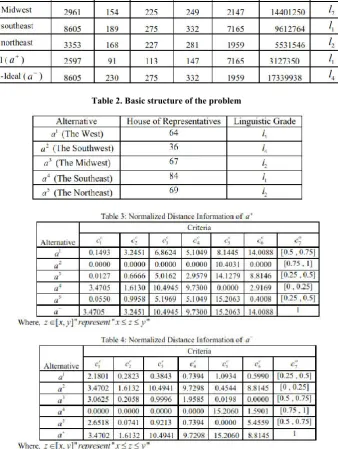
[image:4.595.136.475.303.753.2]The basic structures of MCDM establish 5 region of USA appoint the alternatives set A, labelled a1 a5. In Table 1 mentioned criteria set C, where c c1 - cc6 are measured on a
quantitative basis and co7 is subjective basis. Table 1 shows the
values of alternatives and these values are the sum of all states (values for each region) collected from
RTKNet. The
number of policy influence have mentioned as linguistic
order set (
l=l
1, l
2, l
3, l
4) number in Table 2. To obtain
linguistic grades following transformation methods are
followed (Table 2)
To ascertain that the result contemplate his or her intrinsic preferences, the decision maker’s provides rough information about alternatives weights. The intrinsic preference expressions in this paper have explained as below
To fortify the expression more important, it is assumed that the weight gap between the above differences is greater than or equal to 0.1. Therefore the above preference relationship can be interpreted into the following constrain and fed into P(ai)+ and P(ai)-.
In table 5 below mentioned the analysis of DEA based methods, where (D (ai)+ and D (ai)-)= Individual Optimization model and (D (ai)) Integrated optimization model. Integrated optimization model (D (ai)) gives the final ranking of risk management plan of all regions of USA.
Table 5.Final Distance Performance and Ranking
RESULTS AND CONCLUSION
On above table 5, final Euclidian distance and ranking shows that overall performance of risk management in each region. The ranking result generated using integrated optimization model conceived both distance from ideal (a+) and anti-ideal (a-) values. From data we collected, shows that number of incidents, death, hospitalized, injuries and property damage is less in the southwest region (a2). Results showed that house of representative is less (36) in comparison to other regions and this region ranked 1st in our analysis result. This result means that southwest region is safe place and risk is minimized well than that of other regions. Even in other states house of representative is more and expense is high but risk managed is poor than that of southwest region. In tables 5, we can see that Southeast (a4) is ranked 2nd, the Northeast (a5) is ranked 3rd, the Midwest is ranked 4th and last 5th rank is the west. The Southeast region has the maximum number of house of representative (84) but it is ranked 2nd, from this we can observe that risk is not managed well in this region. Ideal and anti-idea both methods gave the same ranking of regions which we got results in final ranking (D (ai)). From our result and ranking of each regions of USA, we conceive that Risk management and EPA or other related authority will follow the alike process which is followed by the 1st ranked region (the Southwest region) then risk can be mitigate, well managed and sustainable. To manage risk there should well understand between managerial bodies, so that they can know other regions management system and can follow well managed region risk mitigation process.
Results of this study shows that the prioritization of the all the five regions of USA ranked according to data result from top (best) to the bottom (worse). This analysis result can help EPA in decision making for Risk Management to minimize risk and create safe environment for human which is not well managed in comparison to the 1st ranked. DEA- TOPSIS which is also known as hybrid approach is used for analysis to take advantage of unique features of this method for multiple criteria decision making process. As this research data is of USA had been taken from EPA, this result will be so helpful for the risk management for USA. It is also believed that this result will help government of USA as well as EPA to make decision regarding finance to manage risk and take major precaution for risk.
REFERENCE
Abo-Sinna, M.A. and Amer, A.H. 2005. Extensions of TOPSIS for multi-objective large-scale nonlinear programming problems. Applied Mathematics and Computation, 162 (1): 243-256.
ACT Insurance Authority 2004. Risk Management Toolkit. February 2004.
Ali, M., Yadav, A., Anis. M. and Sharma. P. 2015. “Multiple Criteria Decision Analysis Using DEA-TOPSIS Method for Hazardous Waste Management: A Case Study of the USA”. International Journal of Managing Information Technology (IJMIT), Vol. 7, No. 3, pp. 1-17,
Barton, T., Shenkir, W. and Walker, P. 2002. Making enterprise risk management payoff: How leading companies implement risk management. Financial Times Prentice Hall.
Beasley, M., Pagach, D. and Warr, R. 2008. Information conveyed in hiring announcements of senior executives overseeing enterprise-wide risk management processes.
Journal of Accounting, Auditing and Finance, 23 (3), 311-332.
Charnes, A., Cooper, W., and Rhodes, E. 1978. “Measuring the Efficiency of Decision Making Units,” European Journal of Operational Research, vol. 2, pp. 429-444. Chen, Y., Kilgour, D.M. and Hipel, K.W. 2008a. Multiple
criteria sorting method with strategic flexibility. Journal of Industrial and Management Optimization, 4: 407-423. Chen, Y., Li, K.W., Kilgour, D.M. and Hipel, K.W. 2008b. A
case-based distance model for multiple criteria ABC analysis. Computers and Operations Research, 35: 776-796.
Chen, C.T. 2000. Extensions of the TOPSIS for group decision-making under environment. Fuzzy Sets and Systems, 114: 1-9.
Chen. Y, Kevin W. Li, Haiyan XU, Sifeng LIU 2009. A DEA-TOPSIS method for multiple criteria decision analysis in emergency management. J Syst Sci Syst Eng, paper: 1861-9576.
Chen, Y., Su, X. and Hipel, K.W. 2009. An index aggregation approach to comparing the overall performance of emerging and developed countries. Socio-Economic Planning Sciences, 43: 25-39
Chu, Mei-Tai, Shyu, Joseph, Tzeng, Gwo-Hshiung, and Khosla, Rajiv 2007. Comparison among three analytical methods for knowledge communities’ group decision analysis. Expert Systems with Applications, 33, 1011– 1024.
Deutsche Gesellschaft für Qualität e.V. (DGQ) 2007. Risk Management. DGQ 12 – 41, Beuth-Verlag, Berlin, April 2007 (in German).
Federal Aviation Administration (FAA) 2007. Safety Risk Management Guidance for System Organization. SRMGSA-Final Version 1.4a, February 2007.
Figueira, J., Greco, S. and Ehrgott, M. 2005. Multiple Criteria Decision Analysis: State of the Art Surveys. Springer, New York.
Giri S, Singh AK 2014. Risk assessment, statistical source identification and seasonal fluctuation of dissolved metals in the Subarnarekha River, India. Journal of Hazardous Materials, 265:305-314.
Gordon, L., Loeb, M., and Tseng, C. 2009. Enterprise risk management and firm performance: A contingency perspective. Journal of Accounting and Public Policy, 28 (4), 301-327.
Hatefi M. and Torabi A. 2010. “A Common Weight MCDA-DEA Approach to Construct Composite Indicators,” Ecological Economics, vol. 70, no. 1, pp. 114-120.
HB 436 2004. Handbook Risk Management Guidelines. Standards Australia International Ltd., Sydney 2004. Hess, S.M., Gaertner, J. P. He. Application of risk
management as a cornerstone in ensuring nuclear plant safety. Proc. of the 8th International Conference on Probabilistic Safety Assessment and Management, May, 14 – 18, 2006, New Orleans, paper PSAM-0477.
Hobbs, B.F., G.T.F. Horn, 1997. “Building public confidence in energy planning: a multimethod MCDM approach to demand-side planning ar BC gas”. Energy policy, Vol. 25, No. 3, pp. 357-357.
Hoyt, R. E., and Liebenberg, A. P. 2011. The value of enterprise risk management. Journal of Risk and Insurance, 78 (4), 795-822.
Hwang, C. L., Yoon, K.P. 1981. Multiple attribute decision making methods and applications: a state-of-the-art survey New York. Springer, Berlin.
International Electrotechnical Commission (IEC) 2008. Draft IEC 31010 Ed. 1.0, Risk Management Risk Assessment Techniques. May 2008.
Jankowski, P. 1995. Integrating geographical information systems and multicriteria methods: A case study. Int J Geoinfo Syst 9(3):251–273.
Karimi Azari R., Mousavi N., and Mousavi F., and Hosseini B., “Risk Assessment Model Selection in Construction Industry,” Expert Systems with Applications, vol. 38, no. 8, pp. 9105-9111, 2011.
Keeney, R.L. and Raiffa, H. 1976. Decisions with Multiple Objectives: Preferences and Value Tradeoffs. Wiley, New York.
Lai, Y.J., Liu, T.Y. and Hwang, C.L. 1994. TOPSIS for MODM. European Journal of Operational Research, 76: 486-500.
Liu B., Zhang Q., Meng W., and Xu F., “A Study of DEA Models without Explicit Inputs,” Omega, vol. 39, no. 5, pp. 472-480, 2011.
Malczewski, 2006. GIS-based multicriteria decision analysis: A survey of the literature. Int J Geogr Inform Sci
20(7):703–726.
Martins, A.G., D. Coelho, C.H. Antunes, H. Climaco, 1996. “A multiple objective linear programming approach to power generation planning with demand-side management”. International Transactions in Operational Research, Vol. 3, No ¾, pp. 305-317.
Ng, W.L. 2007. A simple classifier for multiple criteria ABC analysis. European Journal of Operational Research, 177: 344-353.
Oesterreichisches Normungsinstitut (ON) 2008. ONR 49000 Risikomanagement für Organisationen und Systeme. (in German).
Rai, A.K., Biswajit, P., Nawal, K. 2012. A study of the sewage disposal on water quality of Harmu River in Ranchi city Jharkhand, India. International Journal of plan, animal and environmental science, 2 (1): 102-106.
Ramanathan, R. 2006. Data envelopment analysis for weight derivation and aggregation in the analytic hierarchy process. Computers and Operations Research, 33: 1289-1307.
Rio Tinto 2007. Risk Policy and Standard. August 2007. Roy, B. 1996. Multicriteria Methodology for Decision Aiding.
Kluwer, Dordrecht.
Russ Johnson, 2000, GIS Technology for Disasters and Emergency Management. An ESRI white paper, May 2000.
Saaty, T.L. 1980. Analytic Hierarchy Process. McGraw Hill, New York.
Shih, H.S., Shyur, H.J. and Lee, E.S. 2007. An extension of TOPSIS for group decision making. Mathematical and Computer Modelling, 45: 801-813.
Shih, H.S. 2008. Incremental analysis for MCDM with an application to group TOPSIS. European Journal of Operational Research, 186:720-734.
Singh, L.B. 2007. River Pollution. 1st Edn., APH Publishing, New Delhi, ISBN-10: 8131300854, pp. 192.
Tsou, C.S. 2007. Multi-objective inventory planning using MOPSO and TOPSIS. Expert Systems with Applications. doi:10.1016/j.eswa.2007. 06.009.
Verghese, G.K., Shah, I.K., Mudliar, S.L., Babu, J.A. 2011. Integrated source water protection plan for an urban water body –A case study of Tapi river, India. International Journal of Environmental Sciences, 1(7): 1559-1573. Wang, Tien-Chin, and Chang, Tsung-Han, 2007. Application
of TOPSIS in evaluating initial training aircraft under a fuzzy environment. Expert Systems with Applications, 33(4), 870–880.
Wang, Y.M. and Chin, K.S. 2009. A new data envelopment analysis method for priority determination and group decision making in the analytic hierarchy process.
European Journal of Operational Research, 195: 239-250 Yilmaz B. and Harmancioglu N. B. 2010. Multi-criteria
decision making for water resource management: a case study of the Gediz River Basin, Turkey. Water SA, 36(5), 563-576.
Yurdakul, M., and IC, Y. T. 2005. Development of a performance measurement model for manufacturing companies using the AHP and TOPSIS approaches.
International Journal of Production Research, 43(21), 4609–4641.
Zopounidis, C., and Doumpos, M. 2002. Multi-criteria decision aid in financial decision making: Methodologies and literature review. Journal of Multi-Criteria Decision Analysis, 11 (4-5), 167-186.