Georgia State University
ScholarWorks @ Georgia State University
Psychology Honors Theses Department of Psychology
Winter 12-15-2010
Acculturative Stress and Gang Involvement among
Latinos: U.S.-born versus Immigrant Youth
Alice N. Barrett
Georgia State University
Follow this and additional works at:https://scholarworks.gsu.edu/psych_hontheses
This Thesis is brought to you for free and open access by the Department of Psychology at ScholarWorks @ Georgia State University. It has been accepted for inclusion in Psychology Honors Theses by an authorized administrator of ScholarWorks @ Georgia State University. For more information, please [email protected].
Recommended Citation
Barrett, Alice N., "Acculturative Stress and Gang Involvement among Latinos: U.S.-born versus Immigrant Youth." Thesis, Georgia State University, 2010.
ACCULTURATIVE STRESS AND GANG INVOLVEMENT AMONG LATINOS: U.S.-BORN VERSUS IMMIGRANT YOUTH
by
ALICE N. BARRETT
Under the Direction of Gabriel P. Kuperminc
ABSTRACT
Quantitative and qualitative data from the 2002 Latino Adolescent Transition Study were
used to explore differences in acculturative stress and gang involvement between foreign-born
and U.S.-born Latino middle school students. Regression analyses showed significant
interactions between discrimination stress and immigration status as well as adaptation stress and
immigration status. U.S.-born youths were significantly more likely to be gang-involved if they
experienced discrimination stress. They were also less likely to be gang-involved if they
experienced high adaptation stress. A minority of primarily foreign-born youths identified
economic inequality and prejudicial attitudes as factors that differentiated them from Americans.
Those reporting economic inequality were more likely to be gang-involved than those who did
not. These findings suggest that the origins of gang involvement could differ between the two
immigrant generations. Whereas U.S.-born Latinos may be more negatively affected by
discrimination, foreign-born Latinos may be more sensitive to their comparatively low economic
status.
ACCULTURATIVE STRESS AND GANG INVOLVEMENT AMONG LATINOS:
U.S.-BORN VERSUS IMMIGRANT YOUTH
by
ALICE N. BARRETT
Honors Thesis Submitted in Partial Fulfillment of the Requirements for the Degree of
Bachelor of Arts with Research Honors
College of Arts and Sciences
Georgia State University
Copyright by
Alice Noel Barrett
2010
U.S.-BORN VERSUS IMMIGRANT YOUTH
by
ALICE N. BARRETT
Advisor: Gabriel P. Kuperminc
Co-Advisor: Kelly M. Lewis
Departmental Liaison: Marsha G. Clarkson
Electronic Version Approved:
The Honors Program
Georgia State University
ACKNOWLEDGEMENTS
In the completion of this honors thesis, several individuals and organizations have played an
instrumental role. First of all, I would like to thank my family for having exposed me to diverse
cultural contexts from an early age onward and for always having supported me in my academic
endeavors. I would also like to thank the Bridging the Gap Project, Culture Connect, and
Refugee Family Services. Through the volunteer and work opportunities these organizations
provided me with, I was able to develop an awareness of the reality that my research topics
address. In addition, I would like to thank my thesis advisors Dr. Kuperminc and Dr. Lewis for
challenging me and enabling me to pursue mixed methods research by sharing their knowledge
and skills. My thanks furthermore go to Dr. Weaver, who allowed me to build a foundation in
research methodology through the two years I spent working as his lab assistant. Last but
certainly not least, I would like to thank my research assistant María Regina Franco for all of the
TABLE OF CONTENTS
ACKNOWLEDGEMENTS iv
LIST OF TABLES vii
LIST OF FIGURES viii
1. Introduction 1
1.1 Understanding Gang Involvement: Quantitative and Qualitative Approaches
1
1.2 Acculturative Stress 3
1.3 The Acculturation Process and Segmented Assimilation
6
1.4 Segmented Assimilation, Acculturative Stress, and Problem Behaviors
7
2. Method 9
2.1 Participants 9
2.2 Procedure 9
2.3 Measures 10
2.3.1 Quantitative measures 10
2.3.2 Qualitative measures 11
2.4 Plan of Analysis 13
2.4.1 Quantitative analysis 13
2.4.2 Qualitative coding procedure 13
2.4.3 Qualitative analysis 14
3. Results 15
3.1 Quantitative Results 15
3.1.2 T-tests 16
3.1.3 Regression Analyses 16
3.2 Qualitative Results 20
3.2.1 Economic Inequality 20
3.2.2 Perceived Discrimination and Prejudice 20
4. Discussion 21
4.1 Interpretation of Qualitative Results 22
4.2 Limitations and Suggestions for Future Research 24
4.3 Policy Implications 25
Works Cited 26
Appendix A 29
LIST OF TABLES
Table 3.1 Correlations Among Types of Acculturative Stress and Gang Involvement
15
Table 3.2 Significant Differences in Gang Activity and Acculturative Stress between Immigrant and U.S. born Youth
17
Table 3.3 Regressions of Immigration Status and Acculturative Stress on Gang Activity
LIST OF FIGURES
Figure 3.1 Interaction of Immigrant Status by Discrimination Stress on Gang Involvement
19
Figure 3.2 Interaction of Immigrant Status by Adaptation Stress on Gang Involvement
1.Introduction
Over the past eight years, the number of youth gangs in the United States has increased
by 28%. Of their 774,000 members, approximately 36% are under the age of eighteen, and
approximately 50% are Latino (U.S. Department of Justice, 2006, 2008; Howell & Egley, 2005).
With such a disproportionately large representation in a growing number of delinquent groups,
Latinos at risk for gang involvement merit research attention. While Latino gang activity is
highest in Southern California, Texas, and metropolitan Washington D. C., it is spreading in
growing metropolises such as Atlanta. The Central American gang MS-13, for example, is one of
the most rapidly growing street gangs in the United States (Torpy & Rankin, 2010). In March
2010, twenty-six alleged members from the Atlanta area were indicted for violence and seven
murders within the past four years. According to a review of police reports, the gang’s presence
has spread beyond Atlanta proper to several outlying suburbs. Among the many factors
predicting gang involvement, research suggests that the acculturation experience and
acculturative stress play a determining role for Latino youth. Moreover, the relationships
between these factors appear to differ for foreign-born and U.S.-born Latinos. The present study
employs both qualitative and quantitative methods to provide a deeper understanding of the
connections between acculturative stress and gang involvement. Moderated regression models
are used to examine how acculturation stress due to discrimination and cultural adaptation relate
to gang involvement for U.S.-born and immigrant youth. Qualitative analyses explore underlying
acculturation stressors within a segmented assimilation framework.
1.1 Understanding Gang Involvement: Quantitative and Qualitative Approaches
Psychological studies on gang involvement employ a diverse array of methodological
literature review of longitudinal quantitative studies, Howell and Egley (2005) found that low
community social capital and family problems in early childhood predicted later problem
behavior and involvement with delinquent peers, which increased the likelihood of later gang
involvement. Early adolescence is a crucial time at which the most risk factors seem to interact
and predict later gang membership by mid-adolescence. These factors include drug presence and
low perceived security in one’s community, individual life stressors, friends and family who are
gang members, delinquent/violent behavior and high interaction with or commitment to
delinquent peers, low parental attachment and monitoring, and poor academic performance
(Curry & Spergel, 1992; Bjerregaard and Smith, 1993). Howell and Egley (2005) note that these
factors exist at multiple ecological levels: The individual, the familial, the micro-systemic (or
immediate community), meso-systemic (where the community and one’s family interact), and
the macro-systemic level (including the societal, political, and economic contexts). Gang
membership susceptibility increases with the quantity of risk factors as well as the amount of
levels at which these factors exist.
While such quantitative findings have been indispensible to youth gang interventions,
qualitative studies can allow for a deeper understanding of how gang members view themselves
and their self-explained motivations to join a gang. In a study of families of convicted Mexican
and U.S.-born Mexican gang members in Phoenix, Arizona, criminologists Zatz and Portillos
(2000) found that gang members paradoxically viewed themselves as protectors of their
communities, even though they were often harming people in these neighborhoods. Some of
them had parents who were also gang members, and, in spite of being more lenient toward their
children’s gang membership, these parents expressed concern about the high levels of violence
attitudes were more common among foreign-born parents and those who did not hold strong
traditional Mexican values. While many of the foreign-born mothers felt helpless in the face of
gang activity or remained in denial that their children were involved, several U.S. – born women
were active community advocates for stronger local law enforcement and other programs.
If Latino gang members feel they are protecting their communities, it is worth exploring
reasons why they sense the need for such protection. Along with their generally low
socio-economic status, obstacles associated with being an ethnic minority and an immigrant population
cannot be ignored. Acculturative stress, for example, is a risk factor that may negatively
influence emotional development, lower self-esteem and academic performance, and predict
problem behavior among Latino youth (Kuperminc, Wilkins, Roche, & Alvarez-Jimenez, 2009;
Gil, Vega, & Dimas, 1994; Vega, Zimmerman, Khoury, Gil, & Warheit, 1995). Since several of
these outcomes are closely related to gang involvement, it is important to explore the construct of
acculturative stress, including different types of stress as well as underlying stressors as they are
qualitatively defined by Latinos and how these relate to gang involvement.
1.2 Acculturative Stress
Out of the many definitions of acculturative stress, Arbona and colleagues (2010)
comprehensively summarize it as “the level of psychological strain experienced by immigrants
and their descendants in response to the immigration-related challenges (stressors) that they
encounter as they adapt to life in a new country.” Several measures exist to quantify
acculturative stress, among them the Social, Attitudinal, Familial, and Environmental (SAFE)
Scale by Mena, Padilla, and Maldonado (1987) employed in the present study. This scale
Inextricably connected to their unique immigration experience, acculturative stress
among Latinos has several distinct characteristics. Among six of such Latino-specific stressors,
Smart and Smart (1995) identify racial discrimination as well as reliance on agricultural labor,
which is becoming increasingly scarce. Saldaña and Padilla (1995) also found in a study
comparing whites and Latinos that stress due to ethnic minority status affected Latino college
students significantly, constituting 8.25% of their physical and psychological distress symptoms.
Latinos of low SES experienced higher levels of distress.
Since racial discrimination appears to be an important stressor for Latinos, several
researchers have examined it as a factor within their acculturative stress scale. Gil, Vega, and
Dimas (1994), for example, examine the acculturative stress categories of language issues,
discrimination, tension due to mismatching cultural values, and acculturative dissonance
(differences in the rate of child and parent acculturation). They measured acculturative stress
among middle school boys in metropolitan Miami and found that, although foreign-born
immigrants experienced more acculturative stress, this stress had a greater negative impact on
self-esteem for U.S.-born youth. U.S.-born boys reported more discrimination, while language
conflict was more prominent among first-generation youth. The detrimental effects of
acculturative stress were strongest for U.S.-born youth who were not highly acculturated to U.S.
society.
Using this same sample, Vega and colleagues (1995) examined an even more distinct
group of acculturative stressors and their relationship to youth problem behavior assessed via
both youth self-report and teacher reports. The acculturative stressors Vega and colleagues
measured included language conflicts, acculturation conflicts, perceived discrimination, and
language conflict was the only significant predictor of increased problem behavior at higher
stress levels. U.S. born youth, on the other hand, showed significant increases in problem
behavior with stress levels in three domains: Language conflict, perceived discrimination, and
perception of a closed society. These findings suggest, as do the findings of the previous study,
that stress due to discrimination should be examined separately from other acculturation
struggles, such as language. Interestingly, the latter two stressors were only significant for
teacher reports. This difference may indicate that youth are more likely to act problematically
outside the home and under the influence of peers, rather than under the supervision of the home,
and are hence more evident to teachers.
Both of these studies indicate that acculturative stress works differently for U.S.-born and
immigrant Latino youth, with U.S.-born youth seemingly more affected by discrimination. Most
importantly, the deconstruction of Latino acculturative stress shows that perceptions of societal
phenomena, such as racism and inequality, are key stressors that may lead to negative
developmental outcomes, especially for U.S.-born youth. Few researchers, however, have looked
beyond the acculturative stress scale to understand these phenomena at a systemic level and the
way in which they contribute to Latino youth’s qualitative self-identification in relation to
Americans. Segmented assimilation theory provides a societal framework that identifies the role
of racism and inequality in the acculturation experience. This understanding, in turn, provides
important themes to look for in the ways Latinos differentiate themselves from Americans,
allowing for a richer understanding of acculturative stress formation and its relationship to gang
1.3 The Acculturation Process and Segmented Assimilation
Acculturation can be defined as “the process of cultural and psychological changes that
follow intercultural contact, including alterations in a group’s customs, their economic and
political life,” (Berry, 2003) as well as “psychological changes such as alterations in individuals’
attitudes toward the acculturation process, their cultural identities, and their social behaviors in
relation to the groups in contact” (Phinney, 2003). Evidently, this is a multidimensional process
in which an immigrant’s host culture and his culture of origin interact at both societal and
individual levels. Both of these levels and the ways in which they inform one another are critical
for advancing understanding of the breadth of acculturation dynamics and how these differ for
foreign-born immigrants as compared to U.S.-born children.
In segmented assimilation theory, Portes and Rumbaut (2001) primarily consider the
societal factors that influence immigration and acculturation. They assert that the current waves
of Asian and Latino immigrants cannot be expected to behave the same as previous European
immigrant groups, as they arrive in a different societal context. For example, immigrants or
U.S.-born Latinos who grow up in an inner-city neighborhood, marked by poverty and
countercultures, will more likely to undergo “downward assimilation,” into an underclass of U.S.
society where negative outcomes such as gang involvement are pronounced, than Latinos who
grow up in wealthy suburbs. Portes and Rumbaut also argue that the bifurcation of the U.S. labor
market due to a decline of medium-pay industry jobs has resulted in a large demand for
low-paying service jobs. The sole alternatives tend to be white-collar jobs that require high levels of
education. The increasing inequality provoked by this divide also predicts downward
assimilation for those Latino youth who feel they must resort to the lower end jobs. Finally, the
ability to advance in this society. U.S.-born Latinos may merit the benefit of learning English
and the ways of this society early on, but they often still confront the challenges of racial
discrimination, inequality, and persistent exposure to countercultures. Portes and Rumbaut’s
analysis of these three acculturation challenges provide a clearer picture of societal acculturation
stressors confronting Latino youth. With indications from their work and the previously
discussed literature that these stressors are related to problem behavior, what is missing is a more
in-depth analysis of how these societal stressors are understood by Latinos and through what
processes they may lead to problem behaviors. Moreover, a specific look at gang involvement
warrants attention, considering the significant threat gangs pose to American society. Few
researchers have explored the process between segmented assimilation challenges, (i.e. racism,
inequality, counterculture exposure) acculturative stress, and delinquency among immigrant and
U.S.-born Latinos. Moreover, none have done so using a mixed methods approach that examines
segmented assimilation challenges as themes in the qualitative comparisons Latinos make
between themselves, other Latinos, and Americans.
1.4 Segmented Assimilation, Acculturative Stress, and Problem Behaviors
Some quantitative studies have linked societal phenomena to immigrant acculturative stress
and Latino delinquency with support of Agnew’s (1992, 2001, 2006) general strain theory
(GST). Agnew relates the strains of rejection, neglect, or abuse by parents or peers, generally
negative experiences in high school, criminal victimization, and discrimination encounters, to
anger and subsequent delinquency (2001). Perez and colleagues examined this theory among
Latino youth, specifying perceived discrimination, immigrant generation, intergenerational
conflict, and English proficiency as strains specific to this ethnic group. Interestingly, they found
whereas perceived discrimination and intergenerational conflict were related to anger in areas of
low Latino concentration. Anger acted as a partial mediator to delinquency for most of these
variables. Discrimination was directly related to delinquency for both groups but was fully
mediated by anger for those in low Latino concentration areas. Although Agnew (2001, 2006)
explains that in order to increase the likelihood of delinquency, strains must be perceived as
unfair and outside of one’s social control, neither he nor Perez and colleagues examine strains
other than discrimination that exist at a societal level, such as economic inequality and
counterculture exposure. A literature review by Vega and Gil (1999) on substance abuse,
however, develops a framework in which acculturation proceeds as segmented assimilation,
which in turn informs acculturative stress that predicts substance abuse. The authors point out
that, while family plays a crucial role in Latino youth development, delinquency prevention
programs must also consider and incorporate relevant community factors. They emphasize the
need for research to test this more comprehensive model through both quantitative and
qualitative methodologies.
The present study employs a mixed methods approach to explore a portion of Vega and Gil’s
proposed model, examining potential sources of acculturative stress and subsequent gang
involvement in qualitative data. These potential sources are hypothesized to reflect a downward
assimilation process. Using 2002 data from the Latino Adolescent Transitions Study, conducted
at a low-income middle school in metropolitan Atlanta, we test associations between
discrimination stress, cultural adaptation stress, and gang involvement, as well as a possible
moderating effect of U.S. nativity. Moreover, we look for themes of racial discrimination,
economic inequality, and counterculture exposure in short-answer vignettes regarding how the
quantitatively test whether the youths expressing them are more likely to experience
discrimination stress and gang involvement. We propose that U.S.-born Latinos are more likely
become involved in gangs due to perceived discrimination, inequality, and exposure to
countercultures than immigrant youth.
2. Method
2.1 Participants
Data were drawn from the first wave of the Latino Adolescent Transitions Study (n =
199), which sampled youths aged 12 -15 from a diverse middle school in metropolitan Atlanta.
The school served a low-income community — more than 90% of its students qualified for
federally subsidized lunch. Its racial/ethnic composition was 54% Latino, 24% African
American, 14% Asian, 8% White, and <1% Native American. Of the study’s participants, 52%
were in 7th grade, the other 48% in 8th grade. The sample was 57% female and 43% male. All
students were either born in the U.S. (21%) or had moved to the U.S. around age 5 (17%), in
elementary school (35%), or in middle school (27%). Out of the entire sample, 73% were of
Mexican heritage, and the remaining youths were primarily from Central America, South
America, and the Caribbean. Sixteen percent came from single parent households.
2.2 Procedure
In order to explore these adolescents’ cultural adaptation at home and in school as well as
their general psychological well-being and risk profile, the study employed questionnaires using
quantitative psychometric scales. In addition to such measures assessing acculturative stress,
gang involvement, and U.S. nativity, the surveys included four short answer vignettes about the
adolescents’ identity, including, (a) “What makes you different from Americans?” and (b) “What
Latinos, i.e. (c) “What makes you different from Latinos?” and (d) “What do you have in
common with Latinos?” The adolescents completed the surveys in their classrooms. All
questionnaires included Spanish translations, which were established via an initial translation,
back-translation, and a repeated comparisons procedure (decentering) to assure cultural
sensitivity (Kuperminc et al., 2009). A copy of the relevant scales and open-ended questions, as
presented to the participants, can be found in Appendix A.
2.3 Measures
The present study focused on the quantitative measures of acculturation stress, gang
involvement, gang delinquency, and U.S. nativity. Once relationships between these variables
were established, themes relevant to quantitative results were identified in the short-answer
qualitative data and converted to codes for acculturation stressors surrounding race and ethnicity,
economic disadvantage, and counterculture exposure.
2.3.1 Quantitative measures.
Acculturative stress. The adult version of Mena and colleagues’ (1987) Social,
Familial, Attitudinal, and Environmental SAFE scale for acculturative stress was employed to
measure acculturative stress, since the child version has only been validated for youth under the
age of 12. This 24-item scale assesses a balance of social, attitudinal, familial, and environmental
stressors, as well as discrimination-related strains, on a four-point Likert scale ranging from “not
at all true“ (1) to “very true” (4). Higher scores indicate higher levels of stress. The scale has
been normed on young adult Latinos, with an overall internal consistency of alpha = .84.
Roche and Kuperminc (2005) identified two subscales comprised of 18 items from the
SAFE scale using factor analysis. The first scale measures stress due to cultural adaptation and
U.S.” The second subscale assesses discrimination stress with 13 items such as “I feel bad when
others make jokes about or put down Latino customs.” This scale has alpha = .79.
Gang activity. An abbreviated version of the Pillen and Hoewig-Roberson (1992)
Gang Membership Inventory developed by Walker-Barnes and Mason (2001), served to measure
the youths’ gang activity. A four-point Likert scale ranging from “never” (0) to “five times or
more within the past week” (3) was used to measure the frequency of respondents’ gang-related
behavior. Higher scores indicate more gang activity.
This scale includes two subscales, with three items assessing gang involvement (alpha = .74).
Walker-Barnes and Mason (2001) defined involvement as non-delinquent and non-violent
activities associated with gangs, in this case including wearing gang colors on purpose, showing
gang hand signs on purpose, and hanging out with a gang. Gang delinquency, on the other hand,
included the illegal and violent activities of getting in a fight for a gang, selling drugs for a gang,
and spray-painting gang symbols. These three items have an internal consistency of alpha = .83.
Immigration status. Based on previous research differentiating between the first
and second generation as well as prior studies comparing the four different “age of arrival”
groups (Roche & Kuperminc, 2005, Kuperminc et al., 2009), these groups were simplified into
U.S.-born and immigrant youth. The latter group included all who had moved to the United
States from abroad in their lifetime, regardless of age. Throughout the present paper, this
variable will be referred to as “immigration status.”
2.3.2 Qualitative measures.
The four short-answer vignettes included in the quantitative survey were employed to
gain a deeper understanding of potential sources of discrimination stress. It should be noted that
discrimination stress, but for a general understanding of the adolescents’ ethnic identity.
Moreover, many of the responses consisted of one-word answers, limiting the extent to which
they can be interpreted as indicative of life stressors.
Despite these limitations, review of the data indicated the presence of three meta-themes
aligned with Portes and Rumbaut’s (2001) major challenges identified as facing the second
generation (the importance of race, the bifurcated labor market, and concentration of
lower-income immigrant youth in marginalized inner-city neighborhoods where countercultures
prevail). The themes identified in the qualitative data may be interpreted as the psychological
perception and manifestation of these societal phenomena. They include an awareness of racial
and ethnic differences, perception of economic disadvantage, and exposure to countercultures. In
addition to the descriptions below, the codebook used for qualitative analyses is included in
Appendix B.
Prejudice and discrimination. This meta-theme included reports of
discrimination or prejudice. If the youth mentioned “mean looks at Latinos,” or “talking bad
about Latinos,” such experiences were coded as discrimination. Statements such as “they are
stuck up,” or “they hate Latinos,” on the other hand, were coded as prejudice since they refer to
general attitudes rather than actions.
Economic disadvantage. A further prevalent theme in the short-answer vignettes
was a sense of economic shortcomings. Responses ranged from one-word answers, such as
“money,” “jobs,” and “hardships,” to statements like “they are rich,” and “some don’t have food
to eat.” Many of these answers were responding to questions about what makes the participants
different from Americans or Latinos, in which case they were coded as economic inequality.
Latinos, economically related responses to “What makes you different from Latinos?” were only
coded as inequality if they had a clear connotation of disadvantage.
If participants gave economically related responses to commonality questions such as
“What do you have in common with Latinos?” these were coded as poverty only if they had clear
indications of disadvantage. For example, “money,” in response to this question was not coded,
but “hardships” was.
Exposure to countercultures. This theme involving countercultures was evident
among a minority of participants; however, it was deemed worthy of examination due to its
relevance to the research questions. Responses revealing this theme included “we both have
problems with gangs,” “they are cholos,” and “I like low-riders.” These were often not
indications of the youths’ direct involvement in such countercultures (which would strongly
overlap with the outcome variable) but simply the acknowledgement of their presence. The code
for this theme included any mention of gangs, the word “cholo,” and “low-riders.”
2.4 Plan of Analysis
2.4.1 Quantitative analysis. Preliminary quantitative analyses of the associations
between different types of acculturation stress and gang activity were assessed using two-tailed
Pearson’s r correlations. Next, t-tests were used to determine differences in types of gang activity
and acculturative stress by immigration status. Finally, three hierarchical regressions were run to
determine whether discrimination stress interacts with immigration status to predict overall gang
activity, gang involvement, and/or gang delinquency. Covariates of the regression included
gender, age, and socioeconomic status.
2.4.2 Qualitative coding procedure. For qualitative analyses, both the author and a
Once the codes had been established, a randomly selected subset of twenty-five participants’
responses was initially coded to establish a general understanding of how the codes would be
applied. Next, both coders proceeded with approximately one half of the sample, after which
new questions arose and the codes underwent a round of specifications. Following these changes,
the coders checked their inter-coder reliability using another randomly selected subset of
twenty-five participants, this time selected by a third research assistant who was unfamiliar with the data
and erased all respondent ID’s to avoid coder bias with any previously coded items. Inter-coder
reliability was 86% for discrimination and prejudice and 100% for counterculture exposure.
Economic disadvantage, however, had an inter-coder reliability of 50%.
In response to the low agreement on economic disadvantage, the code was further
specified to distinguish between poverty and inequality as well as neutral and negative responses.
Following these specifications, the coders proceeded with a second test of inter-coder reliability
for economic disadvantage, this time using a random subset of fifteen participants selected under
the same conditions. The resulting inter-coder reliability for economic disadvantage was 100%.
Both coders subsequently revised their previously coded data and completed coding of the
remaining items in line with the new coding scheme. Inter-coder reliability for the entire sample
was 83% for prejudice and discrimination 74% for economic disadvantage, and 100% for
counterculture exposure. Disagreements were decided upon by consensus between the coders.
2.4.3 Qualitative analysis. Frequencies of all codes were identified across the sample,
and noticeably higher frequencies of all codes in responses to the question “What makes you
different from Americans?” indicated that it was the most salient out of the four vignettes.
Moreover, the counterculture exposure dimension was dropped due to its low frequency,
prejudice and discrimination codes were similarly collapsed due to the low frequency of
discrimination. An exploration of the responses in each of these dimensions revealed several
salient themes. In order to identify whether these constructs may be sources of discrimination
stress or relate directly to gang involvement among the second generation, both discrimination
stress and gang involvement were converted into categorical variables using a median split and
chi-square analyses were employed.
3. Results
3.1 Quantitative Results
3.1.1 Correlations. Although there was no significant relationship between overall gang
activity and acculturative stress, there were significant negative associations of adaptation stress
with overall gang activity (r = -.15, p < .05) and gang involvement (r = -.16, p < .05). A positive
relationship between discrimination stress and gang involvement was marginally significant (r =
[image:25.612.66.559.507.665.2].12, p < .10). All correlations can be seen in Table 3.1.
Table 3.1
Correlations Among Types of Acculturative Stress and Gang Involvement
1. 2. 3. 4. 5. 6.
1. Acculturative stress 1.0
2. Adaptation stress 0.72** 1.00
3. Discrimination stress 0.88** 0.44** 1.00
4. Gang activity overall 0.02 -0.15* 0.08 1.00
5. Gang involvement 0.04 -0.16* 0.12† 0.91** 1.00
6. Gang delinquency -0.01 -0.09 -0.02 0.80** 0.49** 1.00 Mean
Standard Deviation
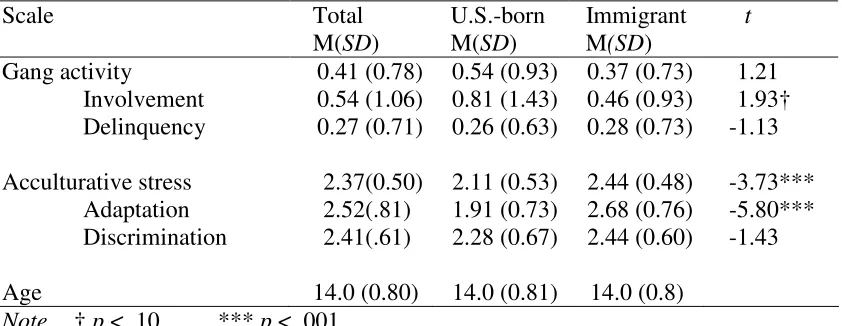
3.1.2 T-tests. As presented in detail in Table 3.2, overall gang involvement and gang
delinquency did not significantly differ for U.S.-born youth as opposed to immigrant youth.
Gang involvement was marginally more prominent among U.S.-born adolescents (t = 1.93, p <
.10). There was significantly more overall acculturative stress (t = -3.73, p < .001) and adaptation
stress (t = -5.80, p < .001) among immigrant youth than among those who were U.S.-born.
3.1.3 Regression Analyses. For overall gang activity, only older age (β = 0.04, p < .01)
and low adaptation stress (β = -0.50, p < .05) were significant predictors. Gang delinquency was
also significantly related to older age (β = 0.19, p < .01) as well as Mexican origin (β = 0.30, p <
.01). The most interesting findings were within the regression for gang involvement, where a
significant interaction was observed between immigration status and discrimination stress (β =
-0.41, p < .01), as displayed in image 1. In addition, there was a significant interaction between
immigrant status and adaptation stress (β = 0.43, p < .05), as displayed in image 2. U.S. – born
youth experiencing high levels of discrimination stress were more susceptible to gang
involvement. For immigrant youth, discrimination stress was not a strong predictor of gang
involvement. Interestingly, adaptation stress had a reverse effect: Higher levels of stress were
related to lower gang involvement for U.S.-born youth than for immigrant youth. Table 3.3
Table 3.2
Significant Differences in Gang Activity and Acculturative Stress between Immigrant and U.S. born Youth
Scale Total
M(SD)
U.S.-born M(SD)
Immigrant M(SD)
t
Gang activity 0.41 (0.78) 0.54 (0.93) 0.37 (0.73) 1.21 Involvement 0.54 (1.06) 0.81 (1.43) 0.46 (0.93) 1.93† Delinquency 0.27 (0.71) 0.26 (0.63) 0.28 (0.73) -1.13
Acculturative stress 2.37(0.50) 2.11 (0.53) 2.44 (0.48) -3.73*** Adaptation 2.52(.81) 1.91 (0.73) 2.68 (0.76) -5.80*** Discrimination 2.41(.61) 2.28 (0.67) 2.44 (0.60) -1.43
Age 14.0 (0.80) 14.0 (0.81) 14.0 (0.8)
Table 3
Regressions of Immigration Status and Acculturative Stress on Gang Activity
Overall Gang Activity Gang Involvement Gang Delinquency
B SE ß ∆R² B SE ß ∆R² B SE ß ∆R²
1. 0.26 0.22 0.20
Sex -0.08 0.11 -0.15 -0.07 0.16 -0.01 -0.18† 0.10 -0.39
Age 0.18 0.07 0.04** 0.18† 0.10 2.13 0.17 0.06 0.19**
Mexican origin 0.23 0.12 0.22† 0.06 0.17 0.04 0.27 0.11 0.30**
2. 0.03 0.05 0.01
Immigration status -0.16 0.15 -0.16 -0.28 0.21 -0.21 -0.02 0.14 -0.03
Adaptation stress -0.17 0.08 -0.50* -0.25 0.12 -0.55* -0.08 0.08 -0.26
Discrimination stress 0.16 0.11 0.46 0.35 0.14 0.72* 0.00 -0.10 -0.01
3. 0.01 0.03 0.01
Immigration status x Adaptation stress
0.38† 0.21 0.30 0.63 0.28 0.43* 0.10 0.20 0.09
Immigration status x Discrimination stress
-0.03 0.24 -0.02 -0.82 0.32 -0.41** 0.18 0.22 0.13
Image 3.1
Interaction of Immigrant Status by Discrimination Stress on Gang Involvement
Image 3.2
3.2 Qualitative Results
3.2.1 Economic disadvantage. Out of the entire sample, 13% reported economic
disadvantage when asked what made them different from Americans. Sixteen of them were male,
and ten were female. This difference was marginally significant (Chi-Square (1, N = 198) =
4.23, p = .06). Only three out of these twenty-six individuals, however, were U.S.-born. Twenty
of them were of Mexican origin. Respondents focused largely on monetary holdings, indicated
by multiple incidences of the one-word answer “money” and statements such as “Americans
have more money” and “not being that rich.” Jobs were also an important focus, implied by
responses such as “they get better jobs.” Finally, statements including “they have more
possibilities than us,” and “we are not born with a social security,” seemed to emphasize the
unequal nature of the American dream. Adolescents generally emphasized Americans’ advantage
rather than their own disadvantage. A median split and Chi Square test for discrimination stress
and gang involvement revealed that youth reporting economic disadvantage were significantly
more likely to be gang involved than those not reporting disadvantage (Chi-Square(1, N = 198)
= 6.87, p = .01). Those reporting discrimination stress of 2.5 or higher on a scale from 1 to 4
were not significantly likely to report economic inequality (Chi-Square (1, N = 198) = 0.18, p =
.83).
3.2.2 Perceived discrimination and prejudice. Only 6% of the adolescents reported
discrimination or prejudice as a difference between themselves and Americans. These responses
were generally evenly distributed between the genders (seven female, five male), but were again
more common among immigrants (ten out of twelve respondents) and those of Mexican origin
(eleven respondents). These statements were primarily focused on prejudicial attitudes
Americans into one category, as they used disclaimers such as “some”, and “a little”, as in the
response “I don’t think I’m all that (some are nice).” Again, there was a strong focus on the
other rather than the self: Adolescents spoke of Americans’ prejudicial stances rather than the
Latino experience thereof. A Chi Square test revealed no significant relationship between reports
of prejudicial attitudes/discrimination and discrimination stress (Chi-Square(1, N = 198) = 0.00
p = 1.00), or gang involvement (Chi-Square(1, N = 198) = 0.18 p = .83).
4. Discussion
While confirming several of the hypotheses and pre-existing findings, this study’s results
also brought up questions warranting further investigation. The significant interaction between
discrimination stress and immigration status relates to previous findings by Gil and colleagues
(1994) and Vega and colleagues (1995) that U.S.-born Latinos experience more negative
repercussions of acculturative stress, particularly stress related to discrimination. In these studies,
such stress predicted both lower self-esteem and increased problem behaviors among U.S.-born
youths. Similarly, U.S.-born youths in the present study’s sample were more likely than
immigrants to be involved in gangs if they experienced discrimination stress.
This interaction also supports the assertion of Portes and Rumbaut’s (2001) segmented
assimilation theory that differential treatment based on race is an important challenge that can
influence the likelihood of downward assimilation, a process in which gang involvement is more
likely than in a positive integration experience. However, the present study’s results do not
necessarily support the idea of a worse-off second generation, since gang involvement was not
significantly higher among U.S.-born youth than among immigrants. Rather, the process leading
The significant interaction between adaptation stress and gang involvement adds further
complexity to the present findings. Although Gil and colleagues’ (1994) work suggests that
adaptation stress may be more common among immigrant Latinos, Vega and colleagues’
findings show that language conflict, a key component of adaptation stress, may predict problem
behavior among U.S.-born and immigrant youths. The present study’s negative relationship
between adaptation stress and gang involvement for both of these groups, and its significantly
stronger nature for U.S.-born adolescents, are hence puzzling. Moreover, Roche and Kuperminc
(2005) identified that adaptation stress was related to lower GPA’s for U.S.-born youth in the
same Latino Adolescent Transition Study sample. Considering that poor academic performance
tends to heighten the likelihood of gang involvement (Howell & Egley, 2005; Curry & Spergel,
1992; Bjerregaard and Smith, 1993), the interaction seems even more counterintuitive. One
possibility is that the effects of this form of acculturative stress were internalized rather than
externalized. Prior studies indicate that characteristics of adaptation stress, such as LEP status or
language struggles, problematic family dynamics, and challenging intergroup relations are
related to symptoms such as anxiety, symptoms of depression, loneliness, low self-esteem, and
sadness (Dawson & Williams, 2008; Pappamihiel, 2001; Alva & De los Reyes, 1999).
Considering previous research evidence that U.S.-born Latinos have more negative academic and
problem behavior outcomes than immigrant Latinos but experience less adaptation stress,
research examining whether such stress is internalized more frequently than it is externalized
may be warranted.
4.1 Interpretation of Qualitative Results
Qualitative findings surrounding economic inequality lent only partial support to the
availability largely reflect the bifurcated labor market problems addressed by Portes and
Rumbaut (2001) as well as Smart and Smart (1995). Moreover, the theme of an American dream
that is not for everyone alludes to the “perception of a closed society” stressor, which was related
to problem behaviors in the study by Vega and colleagues (1995). Similarly, the present study
revealed a relationship between perceived economic inequality and gang involvement. However,
perceived economic inequality was not related to discrimination stress.
These findings indicate that economic hardship may act as a macro-systemic influence
that limits positive alternatives to gang involvement rather than being internalized as a stressor, a
hypothesis supported by the literature (Howell & Egley, 2005; Portes & Rumbaut, 2001; Zatz &
Portillos, 2000; Bursik & Grasmick, 1993). One counterintuitive finding is that the youths
reporting economic inequality were primarily immigrants. This difference may in part be due to
the proportionately low number of U.S.-born youth in the present sample. Considering the
interaction between discrimination stress and immigrant status, however, this finding also
indicates that economic disadvantage and racial/ethnic discrimination work differently as
predictors of gang involvement. Unlike the indication that discrimination affects U.S.-born youth
more harshly, these results suggest that economic hardship puts immigrants as well as U.S.-born
youth at risk for negative social outcomes.
Finally, reports of prejudicial attitudes and discrimination were surprisingly unrelated to
reports of discrimination stress. Although this finding may initially call into question the validity
of measures employed in the present study, a closer look makes the absent relationship
somewhat interpretable. The large majority of youths reporting prejudice and discrimination
were immigrants, and these twelve individuals were a small minority of the sample. The
bothered or stressed by incidences of discrimination, not whether they were experiencing it.
Considering previous research on the stronger negative repercussions of discrimination for
U.S.-born individuals (Vega et al., 1995; Viruell-Fuentes, 2007; Roche & Kuperminc, 2005), it may
be that the small group of immigrants reporting prejudice and discrimination by Americans are
aware of these issues but not as stressed by them as second-generation youths. Moreover, the
respondents primarily reported perceived prejudicial attitudes of Americans, which are related to
but a distinct construct from the perceived incidences of discrimination evaluated as stressors in
the SAFE scale.
4.2 Limitations and Suggestions for Future Research
Several limitations to the present study’s findings should be noted. It relied on
cross-sectional data, and the separation of the SAFE scale was only recently conducted and validated
in one study (Roche & Kuperminc, 2005), limiting the evidence for the construct validity of the
discrimination and adaptation stress measures. Furthermore, the qualitative data consisted
primarily of one-word-answers. More in depth-qualitative interviews with gang-involved youths
or with those experiencing discrimination stress would likely have been more revealing of
factors underlying these two constructs. This lack of methodological precision alludes to the
larger issue of using previously collected data for new research questions.
Due to prior collection of the data, the wording of the short-answer vignette that emerged
as the most important (What makes you different from Americans?) was also problematic. This
question does not necessarily clarify a comparison group for U.S.-born Latinos, all of whom
have the right to American citizenship. Such wording may be a partial explanation for the themes
of economic disadvantage and prejudice/discrimination arising primarily among immigrants.
considering the multiethnic make-up of their school. Finally, the Latino adolescents in this
sample were primarily of Mexican descent and restricted to Metropolitan Atlanta, limiting the
interpretability of significant findings.
Further research might deepen the present analysis of discrimination stress and gang
involvement by focusing only on U.S.-born Latinos but examining a variety of contexts,
including cities where gangs are established as well as ones where their presence is only
emerging. Future studies could also compare the role of economic inequality in gang
involvement between immigrant and U.S.-born Latinos using groups that are closer in size and a
more in-depth qualitative methodology.
4.3 Policy Implications
The present findings hold several implications for schools and social policy. At middle
schools, diversity initiatives as well as clearly articulated policies against discriminatory
treatment may help prevent gang-involvement among second-generation youth. Moreover,
policy-makers overseeing gang prevention and intervention initiatives should support a holistic
approach that includes economic support and well-equipped schools for disadvantaged students
as well as culturally sensitive programs that acknowledge the specific issues facing U.S.-born
Works Cited
Agnew, R. (1992). Foundation for a general strain theory of crime and delinquency. Criminology 30(1), 47-87.
Agnew, R. (2001). Building on the foundation of general strain theory: Specifying the types of strain most likely to lead to crime and delinquency. Journal of Research in Crime and Delinquency, 38(4), 319-361.
Agnew, R. (2006). General strain theory: Current status and directions for further research. In Cullen, F. T., Wright, J. P., Blevins, K. R. (Eds), Taking stock: Advances in
criminological theory, vol. 15 (pp. 101-118). New Brunswick, NJ: Transaction Publishers.
Alva, S. A., & De los Reyes, R. (1999). Psychosocial stress, internalized symptoms, and the academic achievement of Hispanic adolescents. Journal of Adolescent Research, 14(3), 343-358.
Arbona, C., Olvera, N., Rodriguez, N., Hagan, J., Linares, A., & Wiesner, M. (2010).
Acculturative stress among documented and undocumented Latino immigrants in the United States. Hispanic Journal of Behavioral Sciences, 32(3), 362-384.
Berry, J.W. (2003). Conceptual approaches to acculturation. In K. Chun, P. Balls- Organista, & G. Marin (Eds.), Acculturation: Advances in theory, measurement and applied research (pp. 17–37). Washington, DC: APA Press.
Bjerregaard, B., & Smith, C. (1993). Gender Differences in Gang Participation, Delinquency, and Substance Use. Journal of Quantitative Criminology, 9(4), 329-355.
Bursik, R. J., & Grasmick, H. G. (1993). Economic deprivation and neighborhood crime rates, 1960-1980. Law & Society Review, 27(2), 263-283.
Curry, G.D., & Spergel, I.A. (1992). Gang involvement and delinquency among Hispanic and African-American adolescent males. Journal of Research in Crime and Delinquency, 29(3), 273-291.
Dawson, B. A., & Williams, S. A. (2008). The impact of language status as an acculturative stressor on internalizing and externalizing behaviors among Latino/a children: A longitudinal analysis from school entry through third grade. Journal of Youth and Adolescence, 37(4), 399-411.
Gil, A. G., Vega, W. A., & Dimas, J. M. (1994). Acculturative stress and personal adjustment among Hispanic adolescent boys. Journal of Community Psychology, 22(1), 43-54.
Kuperminc, G. P., Wilkins, N. J., Roche, C., & Alvarez-Jimenez, A. (2009). Risk, resilience, and positive development among Latino youth. In Villarruel, F. A., Azmita, M., Cabrera, N., Carlo, G., & Chahin, J. (Ed), Handbook of U.S. Latino psychology (pp. 213-233).
Thousand Oaks, CA: Sage Publications.
Mena, F. J., Padilla, A. M., & Maldonado, M. (1987). Acculturative stress and specific coping strategies among immigrant and later generation students. Hispanic Journal of
Behavioral Sciences, 9(2), 207-225.
Pappamihiel, N.E. (2001). Moving From the ESL Classroom into the Mainstream: An Investigation of English Language Anxiety in Mexican Girls. Bilingual Research Journal, 25(1/2), 31-38.
Phinney, J. (2003). Ethnic identity and acculturation. In K. Chun, P. Organista, & G. Marin (Eds.), Acculturation: Advances in theory, measurement, and applied research (pp. 63–81). Washington, DC: American Psychological Association.
Pillen, M. B., & Hoewig-Roberson, R. C. (1992). Determining youth gang membership: Development of a self-report instrument (ERIC Document Reproductive Service No. E 352 412). Bloomington, IL: Chestnut Health Systems. In Walker-Barnes, C. J., & Mason, C. A. (2001). Ethnic differences in the effect of parenting on gang involvement and gang delinquency: A longitudinal, hierarchical linear modeling perspective. Child
Development, 72(6), 1814-1831.
U.S. Department of Justice, Office of Juvenile Justice and Delinquency Prevention. OJJDP fact sheet: Highlights of the 2008 national youth gang survey. Retrieved from:
http://www.nationalgangcenter.gov/About/Surveys-and-Analyses. Released in March, 2010.
Portes, A., & Rumbaut, R.G. (2001). Legacies: The story of the immigrant second generation. Berkeley, CA: University of California Press.
Roche, C. & Kuperminc, G.P. (2005) Making the grade: Academic achievement among Latino adolescents. Manuscript submitted for publication.
Saldaña, D. H., & Padilla, A. M. (1995). Acculturative stress: Minority status and distress
Hispanic psychology: Critical issues in theory and research. (pp. 43-54). Thousand Oaks, CA US: Sage Publications, Inc.
Smart, J. F., & Smart, D. W. (1995). Acculturative stress of Hispanics: Loss and challenge.
Journal of Counseling & Development, 73(4), 390-396.
Torpy, B., & Rankin B. (2010, April 4, 2010). It’s a dead end in MS-13. The Atlanta Journal Constitution, from http://www.ajc.com/news/its-a-dead-end-433983.html.
Vega, W. A., Khoury, E. L., Zimmerman, R. S., & Gil, A. G. (1995). Cultural conflicts and problem behaviors of Latino adolescents in home and school environments. Journal of Community Psychology, 23(2), 167-179.
Viruell-Fuentes, E. A. (2007). Beyond acculturation: Immigration, discrimination, and health research among Mexicans in the United States. Social Science & Medicine, 65(7), 1524-1535.
Walker-Barnes, C. J., & Mason, C. A. (2001). Ethnic differences in the effect of parenting on gang involvement and gang delinquency: A longitudinal, hierarchical linear modeling perspective. Child Development, 72(6), 1814-1831.
APPENDIX A
Quantitative Measures
Acculturative Stress Scale (ASQ) (Mena et al., 1987)
ASQ
Not At All True Slightly True Somewhat True Very True
1. I feel bad when others make jokes about or put down Latinos.
Me siento mal cuando otros se burlan ó dicen cosas malas de los Latinos.
1 2 3 4
2. I have more problems to overcome than most people do.
Yo tengo más problemas que solucionar que otras personas.
1 2 3 4
3. It bothers me that my family does not understand my new American values.
Me molesta que mi familia no entienda mis nuevos valores norte- americanos.
1 2 3 4
4. People in my family who I am close to have plans for when I grow up that I don't like.
Algunos familiares cercanos hacen planes para cuando yo sea grande que a mí no me agradan.
1 2 3 4
5. It is hard to tell my friends how I really feel. Es difícil decirle a mis amigos como me siento realmente.
1 2 3 4
Nada Cierto
Ligeramente Cierto
Algo Cierto Muy Cierto
6. It bothers me to think that so many people use drugs.
Me molesta pensar qué tanta gente usa drogas.
1 2 3 4
7. It bothers me that some of my family does not live near me.
Me molesta que algunos miembros de mi familia no vivan cerca de mi.
1 2 3 4
8. I sometimes feel that being Latino(a) makes it hard to get a good job.
Algunas veces siento que por ser Latino(a) se me hace más difícil obtener un buen trabajo.
1 2 3 4
9. I don't have any close friends. No tengo ningún(a) amigo(a) cercano(a).
1 2 3 4
10. Many people have stereotypes about Latinos and treat me as if those things are true.
Muchas personas tienen ciertas ideas acerca de los latinos (estereo-tipos) y a mí me tratan
como si esas cosas fueran verdad.
ASQ
Not At All True Slightly True Somewhat True Very True
11. I don't feel at home in the United States. No me siento como en mi casa aquí en los Estados Unidos.
1 2 3 4
12. People think I am shy when I really just have trouble speaking English.
Algunas personas piensan que soy tímid(a) cuando la verdad es que tengo problemas al hablar ingles.
1 2 3 4
13. I often feel that people try to stop me from improving myself.
Con frecuencia siento que hay personas que tratan de evitar que yo me supere.
1 2 3 4
14. It bothers me when people pressure me to be like everyone else.
Me molesta cuándo la gente me presiona a que sea como todas las demás personas.
1 2 3 4
15. I often feel ignored by people who are supposed to help me.
Muchas veces siento que me ignoran las personas que supuestamente están para ayudarme.
1 2 3 4
Nada Cierto
Ligeramente Cierto
Algo Cierto Muy Cierto
16. Because I am Latino(a) I do not get enough credit for the work I do.
No me dan sufuciente credito por el trabajo que hago, porque soy latino(a).
1 2 3 4
17. It bothers me that I have an accent. Me molesta tener un acento.
1 2 3 4
18. It's hard to be away from the country that my family is from.
Es duro estar lejos del país de donde vino mi familia.
1 2 3 4
19. I often think about my cultural background. Pienso frecuentemente acerca de mi cultura.
1 2 3 4
20. Because I'm Latino(a), I feel that
others(neighbors, students) don't include me in their activities.
Siento que por ser latino(a), hay personas (vecinos, estudiantes) que no me incluyen en sus actividades.
1 2 3 4
21. Being with my family in a public place makes me feel really different.
Cuando estoy con mi familia en un lugar público, me siento realmente diferente a los demás.
1 2 3 4
22 People look down on my Latino customs. Algunas personas no respetan mis costumbres latinas.
1 2 3 4
Me cuesta trabajo entender a otros cuando hablan ingles.
24 I feel at home here in Georgia.
Me siento como en mi casa aquí en Georgia.
1 2 3 4
Nada Cierto
Ligeramente Cierto
Algo Cierto Muy Cierto
Gang Activity Scale (Walker-Barnes & Mason, 2001, from Pillen & Hoewig-Roberson, 1992)
AB
Nunca 1 o 2 Veces 3 o 4 Veces 5 o Más Veces 4. I wore gang colors on purpose.
Usé los colores de la ganga a propósito.
0 1-2 3-4 5+
7. I spray painted gang symbols. Pinté con spray símbolos de ganga.
0 1-2 3-4 5+
Never 1 or 2 Times
3 or 4 Times
5 Times or More
11. I showed gang hand signs on purpose.
Hice señales de ganga con las manos a propósito.
0 1-2 3-4 5+
14. I sold drugs for a gang.
Vendí drogas para una ganga.
0 1-2 3-4 5+
17. I took part in a fight as part of a gang.
Participé en una pelea como parte de una ganga
0 1-2 3-4 5+
22. I hung out with a gang.
Anduve con una ganga (pandilla, banda).
Qualitative Measures
AQ
1. What three things do you have in common with Americans? ¿Qué tres cosas tienes en común con los(as) Americanos(as)? A. ______________________________________________________________________________ B. ______________________________________________________________________________ C. ______________________________________________________________________________
2. What three things make you different from Americans? ¿Qué tres cosas te hacen diferente de los(as) Americanos(as)? A. ______________________________________________________________________________ B. ______________________________________________________________________________ C. ______________________________________________________________________________
3. What three things do you have in common with Latinos? ¿Qué tres cosas tienes en común con los(as) Latinos(as)? A. ______________________________________________________________________________ B. ______________________________________________________________________________ C. ______________________________________________________________________________
APPENDIX B
Sequoya Qualitative Data Codebook
Research Questions:
1) What are potential sources of Discrimination-linked Acculturative Stress?
2) Are second-generation Latinos who experience high levels of Discrimination-linked Acculturative Stress more likely to experience downward assimilation stressors than their first-generation counterparts?
Codes to be assigned to “chunks” of three responses to each the following questions:
1. What three things do you have in common with Americans?
2. What three things make you different from Americans?
3. What three things do you have in common with Latinos?
4. What three things make you different from Latinos?
Final Codes to be entered and added using EZText Software
For each chunk, assign all codes for which (a) relevant term(s) appear.
Assign each code only once per chunk, whether the relevant term appears once or multiple times.
Acculturative (Discrimination) Stressors (linked to segmented assimilation)
(1) Economic Disadvantage
(1-1) Perceived economic inequality: In response to questions 2 OR 4 (differences), mention of:
-what we/I do not have (little of)
-what they have (more of)
- what we/I cannot do
- economic benefits/disadvantages: (money, papers, travel rights, jobs)** and hardships
Ex: “they are rich”
**Neutral one-word answers in parentheses ONLY to be coded if in response to question 2.
(1-2) Perceived poverty: In response to questions 1 OR 3 (commonalities), mention of :
-what we/I do not have( little of)
-what we/I cannot do
- other economic disadvantages: hardship, poverty, lack of basic necessities
**This code DOES NOT apply to one-word answers “money,” “jobs,” or “papers,” as these do not clearly convey disadvantage. One-word answers that ARE ACCEPTABLE include “hardships,” “poor,” or other words that clearly indicate disadvantage.
Ex: “some don’t have food to eat”
(2) Notice of racial/ethnic differences
(2-1) Physical features – specific mention of the terms "color", "skin color", "eye color", "hair", "light," "dark," or any other physical trait
Ex: “my skin color,” “hair,” “dark”
(2-1a) Mention of race – explicit use of the term “race”
Ex: “my race”
(2-2) Racial labels – explicit use of the terms “mestizo,” “white,” “mulatto,” or “black”
Ex: “mestizo,” “they are white”
Ex: “te ven feo”
(2-3a) Perceived prejudicial attitudes – mention of how a group holds attitudes of superiority that are not actions, i.e. : racist, “think they are better,” “snobby,” “hate,” “mean”
Ex: “some are racist”
(2-3N) Negated perceived discrimination- reference to the ”perceived discrimination” concepts/terms preceded by a negation
Ex : « We do not say mean things about Americans, » « they do not discriminate against Latinos »
(2-3aN) Negated prejudicial attitudes - reference to the “perceived prejudicial attitudes” concepts/terms preceded by a negation
EX : « they are not racist »
(2-4) Ethnic labels
(2-4a) Latino Collective Ethnic labels – explicit use of the terms
« Hispanic, » or « Latino » to describe oneself or a group. This does NOT include description of a custom/activity, mention of « Latin America » as an entity/birthplace or any nationality (i.e. Mexican).
Ex : « I am Hispanic »
(2-4b)Latino Nationality labels – explicit reference to a nationality, such as « Mexican ,» or « Guatemalan» to describe oneself or a group. This does NOT include description of a custom/activity, mention of a country as an entity/birthplace or any of the collective labels above.
Ex : « I am Mexican »
(2-4c) American Ethnic labels – explicit use of the terms « American » or « gringo/a » to describe oneself or a group. This does NOT include
description of a custom/activity mention of the United Sates as an entity/birthplace
Ex : « I am American, » « They are American »
*For « speaking » and « talking ,» do NOT code for mention of amount of speech (i.e. « I talk a lot ,» but DO code for mention of ways of speaking (i.e. « the way I talk »).
Ex : « I speak Spanish,»
(2-5a) Accent- mention of the word « accent »
Ex: « my accent »
(3) Counterculture awareness: Specific mention of gangs, drugs, organized crime, reference to “cholos” or “low-riders”