Volume 2012, Article ID 702458,12pages doi:10.1155/2012/702458
Research Article
The Solution of a Coupled Nonlinear System
Arising in a Three-Dimensional Rotating Flow
Using Spline Method
Jigisha U. Pandya
Department of Mathematics, Sarvajanik College of Engineering & Technology, Surat 395001, India
Correspondence should be addressed to Jigisha U. Pandya,[email protected]
Received 30 March 2012; Revised 28 May 2012; Accepted 26 June 2012
Academic Editor: Theodore E. Simos
Copyrightq2012 Jigisha U. Pandya. This is an open access article distributed under the Creative Commons Attribution License, which permits unrestricted use, distribution, and reproduction in any medium, provided the original work is properly cited.
The behavior of the non-linear-coupled systems arising in axially symmetric hydromagnetics flow between two horizontal plates in a rotating system is analyzed, where the lower is a stretching sheet and upper is a porous solid plate. The equations of conservation of mass and momentum are transformed to a system of coupled nonlinear ordinary differential equations. These equations for the velocity field are solved numerically by using quintic spline collocation method. To solve the nonlinear equation, quasilinearization technique has been used. The numerical results are presented through graphs, in which the effects of viscosity, through flow, magnetic flux, and rotational velocity on velocity field are discussed.
1. Introduction
In fluid mechanics, the problems associated with the flow that occurs due to the rotation of a single disk or that between two rotating disks have been found of interest of many researchers. Flows between finite disks were studied by Dijkstra and van Heijst1, Adams and Szeri2and Szeri et al.3. Berker4showed that when the two disks are rotating with the same angular speed, there exists a one parameter family of solutions all but one of which is not rotationally symmetric. This result has been extended by Parter and Rajagopal 5, to disks rotating with differing angular speeds; they prove that the rotationally symmetric solutions are never isolated when considered within the full scope of the Navier-Stokes equations. The numerical study of the asymmetric flow has been carried out by Lai et al. 6,7.
sheet at a different uniform temperature. Banerjee 9studied the effect of rotation on the hydromagnetic flow between two parallel plates where the upper plate is porous and solid, and the lower plate is a stretching sheet.
In this paper, we analyze the behavior of the solution of the nonlinear coupled systems arising in axially symmetric hydromagnetic flow between two horizontal plates in a rotating system, where the lower plate is a stretching sheet. The governing coupled ordinary differential equations are solved by quintic spline collocation method.
InSection 2, the mathematical model of the problem given by Vajravelu and Kumar 10is presented. The quintic spline collocation method is explained inSection 3. The results are displayed in graphical manner in Section 4, and the discussion of results is drawn in
Section 5.
2. Formulation of the Problem
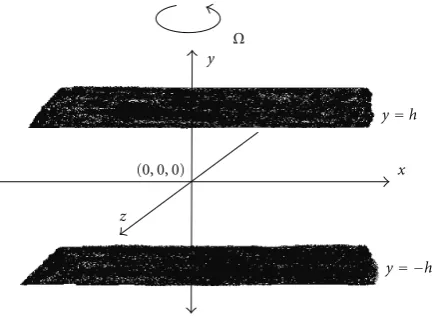
We consider the steady flow of an electrically conducting fluid between two horizontal parallel plates when the fluid and the plates rotate in unison about an axis normal to the plates with an angular velocityΩ. A Cartesian coordinate system is considered in such a way that thex-axis is along the plate, they-axis is perpendicular to it, and thez-axis is normal to thexy-plane as shown inFigure 1.
The origin is located at the centre of the channel, and the plates are located aty−h
andh. The lower plate is is stretched by introducing two equal and opposite forces so that the position of the point0,−h,0remains unchanged. A uniform magnetic flux with density
Bois acting alongy-axis about which the system is rotating. The upper plate is subjected to
a constant wall injection with a velocityVo. The equations of motion in a rotating frame of
reference are
u∂u
∂x υ
∂u
∂y 2Ωω−
1
ρ ∂p∗
∂x ν
∂2u
∂x2
∂2u
∂y2
−σBo2
ρ u, 2.1
u∂υ
∂y −
1
ρ ∂p∗
∂y ν
∂2υ ∂x2
∂2υ ∂y2
, 2.2
u∂ω
∂x υ
∂ω
∂y −2Ωuν
∂2ω
∂x2
∂2ω
∂y2
−σBo2
ρ ω, 2.3
∂u ∂x
∂υ
∂y 0, 2.4
whereu, υ, andω denote the fluid velocity components along thex, y, andzdirections,ν
is the kinematics coefficient of viscosity,ρis the fluid density, andp∗ is the modified fluid pressure. The velocity is independent ofzand that all derivatives towardsztherefore do not appear in the equations of motion. This leads to the absence of∂p∗/∂zin2.3which implies that there is a net cross-flow along thez-axis.
The boundary conditions are
uEx, υ0, ω0 aty−h,
u0, υ−υ0, ω0 atyh.
y
z
x Ω
(0, 0, 0)
y=h
[image:3.600.193.410.97.262.2]y= −h
Figure 1: Flow configuration.
We introduce nondimensional variables
η y
h, uExf
η, υ−Ehfη, ωExgη, 2.6
where a prime denotes differentiation with respect toη. Substituting2.6in2.1to2.4, we have
−1 ρ
∂p∗
∂x E
2x
f2−ff−f
R M2
R f
2K2
R g
, 2.7
− 1 ρh
∂p∗
∂η E
2h
ff 1
Rf
, 2.8
g−Rfg−fg 2K2f−M2g 0, 2.9
where
R Eh
2
ν , viscosity parameter,
M2 σB
2
0h2
ρν , magnetic parameter,
K2 Ωh
2
ν , the rotation parameter.
2.10
Equation2.7with the help of2.8can be written as
f−Rf2−ff−2K2g−M2fA, 2.11
Differentiation of2.11with respect toηgives
f−Rff−ff−2K2g−M2f0. 2.12
Thus we solve the following nonlinear system numerically for several sets of values of the parameters:
f−Rff−ff−2K2g−M2f0,
g−Rfg−fg 2k2f−M2g 0, 2.13
subject to the boundary conditions
f0, f1, g0 atη−1,
fλ, f0, g0 atη1, 2.14
whereλυ0/Eha parameter depending on the y component of velocity at the upper plate.
3. Quintic Spline Collocation Method
The fifth degree spline is used to find numerical solutions to the boundary value problems discussed in2.13together with2.14. A detailed description of spline functions generated by subdivision is given by de Boor11.
Consider equally spaced knots of a partitionπ:a xo < x1 < x2 < · · · < xn bon
a, b. LetS5πbe the space of continuously differentiable, piecewise, Quintic polynomials
onπ. That is,S5πis the space of Quintic polynomials onπ. The Quintic spline is given by
Bickley12and by G. Micula and S. Micula13
sxa0 b0x−x0
1
2 c0x−x0
2 1
6d0x−x0
3 1
24e0x−x0
4 1
120
n−1
k0
Fkx−xk5, 3.1
where the power functionx−xk is defined as
x−xk
x−xk, ifx > xk,
0, ifx≤xk,
3.2
Consider a fourth-order linear boundary value problem of the form
subject to the boundary conditions
α0y0 β0yn γ0yn δ0ynη0,
α1y0 β1yn γ1yn δ1ynη1,
α2y0 β2yn γ2yn δ2ynη2,
α3y0 β3 yn γ3yn δ3ynη3,
3.4
whereyx, px, qx, rx, tx, andmxare continuous functions defined in the interval
x∈a, b; η0, η1, η2, η3are finite real constants.
Let3.1be an approximate solution of3.3, wherea0,b0,c0,d0,e0,F0,F1, . . . , Fn−1are
real coefficients to be determined.
Letx0, x1, . . . , xnben 1 grid points in the intervala, b, so that
xia ih, i0,1, . . . n; x0a, xnb, h
b−a
n . 3.5
It is required that the approximate solution 3.1 satisfies the differential equation at the pointx xi. Putting3.1with its successive derivatives in3.3, we obtain the collocation
equations as follows:
n−1
k0
Fk
xi−xk
1
2pxixi−xk
2 1
6qxixi−xk
3 1
24rxixi−xk
4
1
120txixi−xk
5
e0
1 pxixi−x0
1
2qxixi−x0
2 1
6rxixi−x0
3 1
24txixi−x0
4
d0
pxi qxixi−x0 1
2rxixi−x0
2 1
6txixi−x0
3
c0
qxi rxixi−x0
1
2txixi−x0
2
b0{rxi txixi−x0} a0{txi}
mxi, i0,1,2, . . . , n.
3.6
From boundary conditions,
n−1
k0
Fk
δ0
2 b−xk
2 γ0
6b−xk
3 e
0
δ0b−a
γ0
2b−a
2
d0
δ0 γ0b−a
c0
γ0
b0
β0
n−1 k0 Fk δ1
2 b−xk
2 γ1
6b−xk
3 β1
120b−xk
5
e0
δ1b−a
γ1
2b−a
2 β1
24b−a
4
d0
δ1 γ1b−a
β1
6b−a
3 c0 γ1 β1
2b−a
2
b0
β1b−a α1
a0
β1
η1,
n−1
k0
Fk
δ2
2 b−xk
2 γ2
6b−xk
3 β2
120b−xk
5
e0
δ2b−a
γ2
2b−a
2 β2
24b−a
4
d0
δ2 γ2b−a
β2
6b−a
3 c0 γ2 β2
2b−a
2 γ
2b−a α2
b0
β2b−a
a0
β2
η2,
n−1
k0
Fk
δ3
2 b−xk
2 γ3
6b−xk
3 β3
120b−xk
5
e0
δ3b−a
γ3
2b−a
2 β3
24b−a
4
d0
δ3 γ3b−a
β3
6b−a
3 α 3 c0 γ3 β3
2b−a
2
b0
β3b−a
a0
β3
η3.
3.7
Using the power functionx−xk in the above equations, a system ofn 5 linear equations
inn 5 unknownsa0,b0,c0,d0,e0,F0,F1, . . . , Fn−1is thus obtained. This system can be written
in matrix-vector form as follows:
AX B, 3.8
where X Fn−1, Fn−2, . . . , F2, F1, F0, e0, d0, c0, b0, a0T,B η3, η2, η1, η0, mxn,
mxn−1, . . . , mx1,mx0T.
The coefficient matrixAis an upper triangular Hessenberg matrix with a single lower subdiagonal, principal and upper diagonal having nonzero elements. Because of this nature of matrixA, the determination of the required quantities becomes simple and consumes less time. The values of these constants ultimately yield the quintic splinesxin3.1.
with fitting a curve satisfying the end conditions and this curve is designated asyi. We obtain
the successive iterations yi’s with the help of an algorithm described as above till desired
accuracy.
4. Quintic Spline Solution
We solve following nonlinear system numerically for several sets of values of the parameters:
f−Rff−ff−2K2g−M2f0, 4.1
g−Rfg−fg 2K2f−M2g 0. 4.2
subject to the boundary conditions
f0, f1, g0 atη−1,
fλ, f0, g0 atη1. 4.3
The spline collocation method is used to solve the differentiation system4.1to4.3. Equation4.2is a linear equation of order two, whereas4.1is a nonlinear equation of order four. For solving nonlinear equation by spline collocation method, we require a linear form of differentiation equation. The quasilinearization technique transforms4.1into linearized form as
fiiv 1 Rfi
fi 1−Rfi M2
fi 1−Rfifi 1 Rfifi 1 2K2gi R
fifi −fifi
, 4.4
with boundary conditions
fi 1−1 0, fi 1−1 1,
fi 11 λ, fi 11 0.
4.5
The linear equation4.2can be written as
g Rfg−Rf M2g−2K2f 4.6
with boundary conditions
g−1 0, g1 0. 4.7
The quintic spline given by
sηi
a0 b0
ηi−η0
1
2c0
ηi−η0
2 1
6d0
ηi−η0
3 1
24e0
ηi−η0
4 1
120
n−1
k0
Fk
ηi−ηk
5
4.8
is an approximate solution of the problem given by4.4and4.5. Substitutingsηin both of above equations, we obtain the collocation as
N−1
k0
Fk
ηi−ηk
Rfi
2
ηi−ηk
2 −
Rfi M2
6
ηi−ηk
3
−Rfi
2
ηi−ηk
4 Rf
120
ηi−ηk
5
e0
1 Rfi
ηi−η0
−
Rfi M2
2
ηi−η0
2−Rfi
6
ηi−η0
3 Rfi
24
ηi−η0
4
d0
Rfi−
Rfi M2ηi−η0
−Rfi
2
ηi−η0
2 Rfi
6
ηi−η0
3
c0
−Rfi M2−Rfiηi−η0
Rfi
2
ηi−η0
2
b0
Rfiηi−η0
−Rfi a0
Rfi 2K2gi Rfifi fifi
, i01N.
4.9
First two boundary conditions in4.5immediately give
a00, b01, 4.10
and other two boundary conditions are
1 120
N−1
k0
Fk
ηN−ηk
5 1
24e0
ηN−η0
4 1
6d0
ηN−η0
3
1 2c0
ηN−η0 2
b0
ηN−η0
a0 λ,
1 24
N−1
k0
Fk
ηN−ηk
5 1
6e0
ηN−η0
3 1
2d0
ηN−η0 2
c0
ηN−η0
b00.
0 1 2 3 4
I II III
IV V
I II III IV V
1 1 1 3 3
1 1 3 3 3
0 3 3 3 25
−1.5
−1
−0.5
0 0.5 1 1.5
f =v/−Eh
η
=
y/
h
λ
M2
[image:9.600.185.416.98.389.2]K2
Figure 2: Velocity profile forR0.1, N10.
First of all, initial assumptions regardingfi, fi, fi, fiare necessary. Let a curveaη3 bη2 cη d
be fitted through the pointsη −1 andη 1 satisfying the boundary conditions4.5. This requirement yieldsa 1−λ/4, b −1/4, c 3λ −1/4 andd 1 2λ/4 so that
fη 1−λ/4η3−1/4η2 3λ−1/4η 1 2λ/4.
Further, using the cubic spline
sηi
a0 b0
ηi−η0
1
2c0
ηi−η0
2 1
6
n−1
k0
dk
ηi−η0
3
. 4.12
In4.6and4.7, the following set of equations is obtained:
N−1
k0
dk
ηi−ηk
0.1fi
2
ηi−ηk
2−
0.1fi 1 6
ηi−ηk
3
c0
1 0.1fi
ηi−η0
−
0.1fi 1 2
ni−η0
2
b0
0.1fi−
0.1fi 1ηi−η0 a0
−0.1fi 1
−2K2fi, i01N,
a00
0 1 2 3
I II III
IV V
I II III IV V
1 1 1 3 3
1 1 3 3 3
0 3 3 3 25
f=u/Ex
−1.5
−1
−0.5
0 0.5 1 1.5
η
=
y/
h
λ
M2
[image:10.600.185.416.94.377.2]K2
Figure 3: Velocity profile forfR0.1, N10.
and the last equation is
1 6
N−1
k0
dk
ηN−ηk
3 1
2c0
ηN−η0
2
b0
ηN−η0
a00. 4.14
A straight linegη aη bcan be fitted to the boundary conditions forg. A line
gη 0 satisfied the boundary conditions4.7. Therefore, initial values ofg andgare also zero.
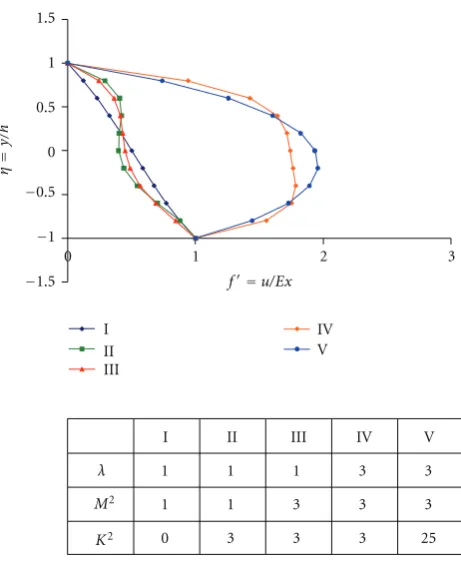
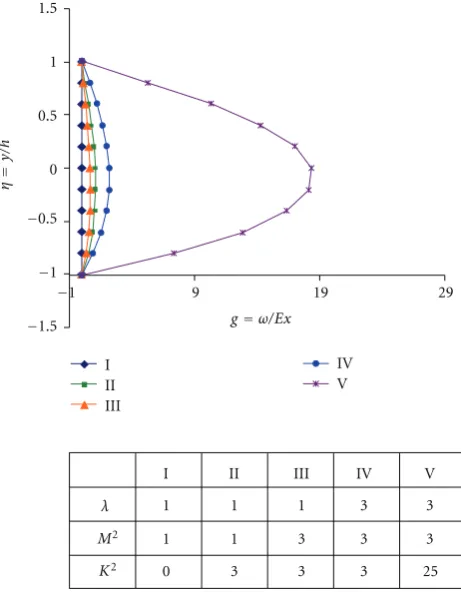
ForN 10,R 0.1 and several sets of values of the parametersλ, M2 andK2, the
velocity componentsf, f, and g are obtained in graphical form. The behavior of velocity components are shown in Figures2,3, and4. The results obtained by the spline collocation method are compared with the graphical solutions obtained by Vajravelu and Kumar10, which are tested by comparing the analytical solutions for small value of R with the exact solutionsf andg. The numerical results thus obtained by the spline method to find
f, f, andg are in close agreement with the available data. In Figures2,3, and4,η equals a dimensionless injection parameter, M2 is a magnetic parameter, and K2 is a rotational
parameter.
−1 9 19 29
I II III
IV V
I II III IV V
1 1 1 3 3
1 1 3 3 3
0 3 3 3 25
−1.5 −1 −0.5 0 0.5 1 1.5
η
=
y/
h
g=ω/Ex
λ
M2
[image:11.600.184.415.99.398.2]K2
Figure 4: Velocity profile forgR0.1,N10.
5. Discussion of the Results
The behavior of the nondimensional velocity componentfforR 0.1 is shown inFigure 2. From Figure 2, it is evident that the Lorenz force decreases the velocity componentf see curves II and III, but the value off increases with an increase in the value of the parameter
λas seen in curves III and IV. Further, inFigure 2, curves IV and V show thatf decreases steadily for smallK2, whereas for large value of K2, f increases near the lower plate and
decreases near the upper plate.
Figure 3 describes the behavior of fη, which is proportional to velocity along parallel plates, for several sets of values of the parameters onlyλ, M2andK2 the rotation
parameterare varied whileRis kept constant at 0.1. FromFigure 3, curves III and IV, it is evident that the velocity componentfincreases with the parameterλυ0/Eh,ycomponent
of velocity at the upper plate, and the increase is maximized near the stretching plate. However, the effect of the Lorenz forcemagnetic parameterM2offis to increase it near
the upper plate and to decrease it near the lowerstretchingplate that is displayed from the curves II and III ofFigure 3. Further, the effect of smallK2is to increasefat the upper plate and to decrease it near the lower plate is evident from curves I and II. But the effect of large
K2 is to increasefnear the plates and to decrease it at the centre of the channel. Also, the rotation of the channel brings humps near the plates, indicating the occurrence of a boundary layer near the plates. Furthermore, for largeK2the coriolis force and the magnetic field that
The transverse velocityg increases as the parameterλ increases, which is shown in curves III and IV ofFigure 4. But this is quite opposite to the phenomenon with the magnetic parameterM2. However, the rotation parameterK2increasesgand the maximum ofgoccurs
near the stretching sheet for largeK2.
From above figures, it is observed that for largeK2convergence in the results is not guaranteed. This fact is also observed by Vajravelu and Kumar10.
We conclude from the above numerical experience that the spline collocation method can be successfully applied to solve the fourth-order nonlinear coupled equation, which governs the hydromagnetic fluid flow. This widens the field of applicability to the higher-order coupled differential equations. This encourages the applications to other types of problems.
Another useful conclusion is that the selection of the domain is not restricted to positive interval only. That is we can successfully apply the above method for the negative intervals as the domain of the problem.
References
1 D. Dijkstra and G. J. F. van Heijst, “Flow between two finite rotating disks enclosed by a cylinder,”
Journal of Fluid Mechanics, vol. 128, pp. 123–154, 1983.
2 M. L. Adams and A. Z. Szeri, “Incompressible flow between finite disks,” Journal of Applied Mechanics,
Transactions ASME, vol. 49, no. 1, pp. 1–9, 1982.
3 A. Z. Szeri, S. J. Schneider, F. Labbe, and H. N. Kaufman, “Flow between rotating disks—part 1. Basic flow,” The Journal of Fluid Mechanics, vol. 134, p. 103, 1983.
4 R. Berker, “A new solution of the Navier-Stokes equation for the motion of a fluid contained between two parallel plates rotating about the same axis,” Archives of Mechanics, vol. 31, no. 2, pp. 265–280, 1979.
5 S. V. Parter and K. R. Rajagopal, “Swirling flow between rotating plates,” Archive for Rational Mechanics
and Analysis, vol. 86, no. 4, pp. 305–315, 1984.
6 C. Y. Lai, K. R. Rajagopal, and A. Z. Szeri, “Asymmetric flow between parallel rotating disks,” The
Journal of Fluid Mechanics, vol. 146, p. 203, 1984.
7 C. Y. Lai, K. R. Rajagopal, and A. Z. Szeri, “Asymmetric flow above a rotating disk,” Journal of Fluid
Mechanics, vol. 157, pp. 471–492, 1985.
8 A. Chakrabarti and A. S. Gupta, “Hydromagnetic flow and heat transfer over a stretching sheet,”
Quarterly of Applied Mathematics, vol. 37, no. 1, pp. 73–78, 1979.
9 B. Banerjee, “Magnetohydrodynamic flow between two horizontal plates in a rotating system, the lower plate being a stretched sheet,” Journal of Applied Mechanics, Transactions ASME, vol. 50, p. 470, 1983.
10 K. Vajravelu and B. V. R. Kumar, “Analytical and numerical solutions of a coupled non-linear system arising in a three-dimensional rotating flow,” International Journal of Non-Linear Mechanics, vol. 39, pp. 13–24, 2004.
11 C. de Boor, A Practical Guide to Splines, vol. 27, Springer, New York, NY, USA, 1978.
12 W. G. Bickley, “Piecewise cubic interpolation and two-point boundary problems,” The Computer
Journal, vol. 11, pp. 206–208, 1968.
13 G. Micula and S. Micula, Handbook of splines, Kluwer Academic Publishers, Dordrecht, The Netherlands, 1998.
Submit your manuscripts at
http://www.hindawi.com
Hindawi Publishing Corporation
http://www.hindawi.com Volume 2014
Mathematics
Journal ofHindawi Publishing Corporation
http://www.hindawi.com Volume 2014
Hindawi Publishing Corporation http://www.hindawi.com
Differential Equations
International Journal of
Volume 2014
Applied MathematicsJournal of
Hindawi Publishing Corporation
http://www.hindawi.com Volume 2014
Hindawi Publishing Corporation
http://www.hindawi.com Volume 2014
Hindawi Publishing Corporation
http://www.hindawi.com Volume 2014
Mathematical PhysicsAdvances in
Complex Analysis
Journal ofHindawi Publishing Corporation
http://www.hindawi.com Volume 2014
Optimization
Journal of Hindawi Publishing Corporationhttp://www.hindawi.com Volume 2014
Combinatorics
Hindawi Publishing Corporation
http://www.hindawi.com Volume 2014
International Journal of
Hindawi Publishing Corporation
http://www.hindawi.com Volume 2014
Journal of
Hindawi Publishing Corporation
http://www.hindawi.com Volume 2014
Function Spaces
Abstract and Applied Analysis Hindawi Publishing Corporation
http://www.hindawi.com Volume 2014
International Journal of Mathematics and Mathematical Sciences
Hindawi Publishing Corporation http://www.hindawi.com Volume 2014
The Scientific
World Journal
Hindawi Publishing Corporation
http://www.hindawi.com Volume 2014
Hindawi Publishing Corporation
http://www.hindawi.com Volume 2014
Discrete Dynamics in Nature and Society
Hindawi Publishing Corporation
http://www.hindawi.com Volume 2014
Hindawi Publishing Corporation
http://www.hindawi.com Volume 2014
Discrete Mathematics
Journal ofHindawi Publishing Corporation
http://www.hindawi.com Volume 2014
Hindawi Publishing Corporation
http://www.hindawi.com Volume 2014