© 2016, IRJET ISO 9001:2008 Certified Journal Page 625
SOLUTION FOR ECONOMIC LOAD DISPATCH PROBLEM WITH GENERATOR CONSTRAINTS USING QPSO
P.Vignesh1, U.Shyamala2, D.Rajkumar3, B.Gnanasekaran4
1P.G Scholar,M.Kumarasamy College of Engineering,Karur,India
2,3,4Assistant Proffesor,M.Kumarasamy College of Engineering,Karur,India
---***---Abstract— The power system around the world has more interconnections. The focus has shifted towards enhanced performance, increased customer focus, low cost, reliable and clean power . In reality power stations neither are at equal distances from load nor have similar fuel cost functions. Hence for providing cheaper power, load has to be distributed among various power stations in a way which results in lowest cost for generation. For this problem here the QPSO is implemented to satisfy the system constraints and minimizing the cost. The economic load dispatch problem is solved for three unit system using Q PSO with neglecting the losses.. The optimization technique is constantly evolving to provide better and faster results.
KEYWORDS—Optimal power flow(OPF), Economic load
dispatch(ELD), particle swarm optimization(PSO), Quantum behaved particle swarm optimization(QPSO).
Introduction
Nowadays in the power system, the power generation to the demand is the major problem. The purpose of this paper is dealing with the thermal power plant. At present the tamilnadu has the present demand as 91,642 million units in 2014-2015 as per TNEB record. The power demand has increased to 14% compared to the previous year. In future the government has planned to produce the power by using the wind energy, hydro-electric energy and thermal energy.
Fig.1 Installed capacity of TNEB in tamilnadu
Tthermal energy consumes more fuel cost. So the paper deals with the thermal power plant.
Economic load Dispatch
Economic load dispatch is the problem depends upon the fuel cost. The thermal unit generator fuel cost is high when compared with other generator cost. So it is necessary to include the thermal power plant in the economic load
dispatch. The main objective is to serve load at minimum cost. The various cost comparison of the different power plants are being listed below.
TABLE 1
COMPARISION OF THE FUEL COST BETWEEN VARIOUS POWER PLANTS
COST THERMAL UNIT
HYDRO UNIT
NUCLEAR UNIT
Fixed cost 20% 75% 70%
Fuel cost 70% 0 20%
Other cost 10% 25% 10%
ECONOMIC LOAD DISPATCH PROBLEM
A)objective functions
The objective of the Economic load dispatch problem is to reduce the fuel cost including operating constraints.The fuel cost function can be represented as,
is the cost function of the generator
is the reactive output power of the ith generator
unit
The non-linear function of the economic load dispatch problem was ,
Here are the cost co-effecients of the generator.
B)Constraints
© 2016, IRJET ISO 9001:2008 Certified Journal Page 626 It is expressed as ,
The system generator has the load and the demand losses. So the generator cost is minimized .so the equation should be satisfies the demand.
System demand
C)Generator limits
(i=1,……,N) (4)
Here as per the equation no (4) the load must be satisfied with the demand. So only the paper proceeds with the economic load dispatch problem to reduce the fuel cost.
PARTICLE SWARM OPTIMIZATION
[image:2.595.50.288.592.710.2]Particle swarm optimization method is a population based stochastic optimization technique. In this optimization process it provides a population base search by getting the best solution from the problem by taking the particles and moving them into the search space. Dr Eberhart and Dr kennedy in 1995 originated this technique in a simple social system.The system starts with a random populations and the optimization takes place when updating the particles. The particles searches the space by following the optimum particles. And the PSO has the position vector(x)and a velocity vector(v).The population is called as swarm and in the swarm each member is called as a particle
Fig .2 PSO technique using birds and fishes Swarm: A set of particles
Particle: A Potential solution or a member of a swarm
i)position
ii)velocity
Each Particle maintains its previous best position
iii)individual best position
iv)swarm global position
v)Original velocity updating equation
inertia
© 2016, IRJET ISO 9001:2008 Certified Journal Page 627
[image:3.595.324.487.121.378.2]Flow chart of ELD using PSO
Fig. 3 Flow chart of PSO
The flow chart presents the solution to the economic dispatch problem using PSO to search the optimal solution of the each generating unit. The population was described as the swarm and the particles was described as the position .
ECONOMIC LOAD DISPATCH USING QPSO
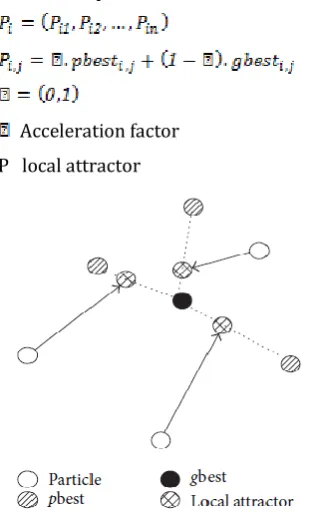
This optimization technique also similar to the particle swarm optimization. Quantum is nothing but the requirement of the particles with the position vectors. Here the particles moved based on the searching the updated mbest value.
Each particle converges to its local attractor. It means the best of its own particle.
(9)
Acceleration factor P local attractor
Fig4:Search behavior of QPSO
In QPSO each particle has only position vector and does not have any velocity vector. So its convergence speed of the searching process has been high when comparing to the PSO.
During evaluvation the particles update their position according to their best fitness values.
Using monte carlo method the particles moving according to this equation
It is the contraction expansion co-efficient which can be turned to control the speed of the algorithm.
L and u are the random variables distributed uniformly with the range of (0,1).
Mbest is the mean best position of the position which is calculated by
N is the number of particles P is the local attractor t is the total time taken
© 2016, IRJET ISO 9001:2008 Certified Journal Page 628
Psedo code for QPSO
Begin
While FES<=MAX.FES Go
Update the position(9) Calculate the fitness value FES++
End for
Update the pbest,gbest and mbest using (10) End while
End
Flow chart for ELD using QPSO
1) Fig.5 Flow Chart of QPSO
This optimization technique provides the low fuel cost for the Thermal generator comparing the results with PSO.
ALGROTHIM OF QPSO
1)Initialize population : Random( ) 2) Go
3)calculate mbest using equation (10) 4)for i=1 to population size M
5)if then
6)
7)for d=1 to dimension D 8)
9)
10)L=
11)u=rand(0,1) 12)if rand (0,1)>0.5 13)
14)else 15)
16)until termination criteria is met
Based on this algorithm only the particles going to search the mbest. So the fitness factors are obtained by searching the new particles by the previous best one. According to this formulation the iteration was repeated to the when the fitness value was not obtained.
PROBLEM FORMULATION FOR THREE GENERATOR UNITS
2) In PSO and QPSO techniques we applied here for the three generator units.In all the case the transmission losses are neglected. All the simulations are done in the MATLAB R2010a environment
The Three generators considered are having different characteristics their fuel cost function characteristics are given by the following equations
The operating limits of minimum and maximum power also different. The unit operating ranges for the power generation for ith units are given below
100 MW P1 600 MW
100 MW P2 400 MW
© 2016, IRJET ISO 9001:2008 Certified Journal Page 629 The generator demand is set to the four variations. From
the above table the results of Economic Load Dispatch problem was obtained using PSO
TABLE.2
OUTPUT FOR THREE GENERATOR UNITS (QPSO)
S.No DEMAND (MW)
P1
(MW) (MW) P2 (MW) P3 COST$/Hr FUEL
1 450 205.30 185.34 61.34 4653.42 2 700 322.72 277.88 99.39 6840.62 3 800 369.687 315.69 114.6 7737.77 4 850 393.169 334.60 122.32
8193.35
The Optimum solution was obtained from the Quantum Behaved Particle Swarm (QPSO) search algorithm. When comparing with the PSO technique. So finally the results obtained for the three thermal unit generators.The fuel cost was reduced up to 3$/Hr when comparing to PSO.
Cost curve for the Economic Load Dispatch using QPSO
Fig.6 Cost curve for the ELD using QPSO
For the X-axis there the no of iterations totally taken. Here the iterations totally taken are 500.In Y axis the fuel cost of the thermal generator.
Advantages of QPSO
1)The speed of the algorithm can be controlled by the parameter
2)Fast convergence
Conclusion
Thus the paper provides the feasible solution for the economic load dispatch problem. In future work the algorithm was implemented to increase the performance of the thermal generator units into six to fifteen units.so this optimization technique can be implemented to the real time application like the mettur thermal power station and other thermal power stations in tamilnadu. Hence this paper satisfies the demand with the lowest fuel cost of the generator.
REFERENCES
[1] Lin Lu, Qi Luo, Jun-yong Liu, Chuan Long, “An Improved Particle Swarm Optimization Algorithm”, IEEE International Conference On Granular Computing, pp. 486-490, 2008.
[2] A. Immanuel Selvakumar, Member, IEEE, and K. Thanushkodi, “A New Particle Swarm Optimization Solution to Non convex Economic Dispatch Problems”, IEEE TRANSACTIONS ON POWER SYSTEMS, VOL. 22, NO. 1, pp. 42-51, FEBRUARY 2007.
[3] T. O. Ting, Student Member, IEEE, M. V. C. Rao, and C. K. Loo, Member, IEEE,“A Novel Approach for Unit Commitment Problem via an Effective Hybrid Particle Swarm Optimization”, IEEE TRANSACTIONS ON POWER SYSTEMS, VOL. 21, NO. 1,pp. 411-418, FEBRUARY 2006.
[4] Zwe-Lee Gaing, “Particle Swarm Optimization to solving the Economic Dispatch Considering the Generator Constraints”, IEEE Trans. On Power Systems,Vol.18, No.3, pp. 1187-1195, August 2003.
[5] P. Venkatesh, R. Gnanadass, and Narayana Prasad Padhy, “Comparison and application of evolutionary Programming techniques to combined economic Emission dispatch with line flow constraints”, IEEE Trans, on Power Syst., Vol. 18, No. 2, pp. 688-697, May 2003.
[6] Hirotaka Yoshida, Kenichi Kawata, Yoshikazu Fukuyama, Member, IEEE, Shinichi Takayama, and Yosuke Nakanishi,Member, IEEE,“A Particle Swarm Optimization for Reactive Power and Voltage Control Considering Voltage Security Assessment”, IEEE TRANSACTIONS ON POWER SYSTEMS, VOL. 15, NO. 4, pp. 1232-1239, NOVEMBER 2000.
[7] Angeline, P. J. “Using selection to improve particle swarm optimization”, Proceedings of IEEE Congress on Evolutionary Computation 1998Anchorage,Alaska, USA, 1998b.
[8] H. T. Yang, P. C. Yang, and C. L. Huang, “Evolutionary programming based economic dispatch for units with
non-FUEL COST
© 2016, IRJET ISO 9001:2008 Certified Journal Page 630 smooth fuel cost functions”, IEEE Trans. on Power Systems,
Vol. 11, No. 1, pp. 112-118, Feb. 1996.
[9] J. Kennedy and R. C. Eberhart, “Particle swarm optimization,” Proceedings of IEEE International Conference on Neural Networks (ICNN‟95),Vol. IV, pp. 1942-1948, Perth, Australia, 1995.
[10]B H Chowdhury and S Rahman, “A Review of Recent Advances in Economic Dispatch”, IEEETransactions on Power System, Vol 5, no 4, pp.1248-1259, 1990.
[11]D W Ross and S Kim, “Dynamic Economic Dispatch of Generation”, IEEE Transactions on Power Apparatus and Systems, pp. 2060,November/December1980.
[12]HAPP, H.H, “Optimal power dispatch”, IEEE Trans., PAS-93, pp. 820-830, 1974.
[13]T.E. Bechert and H.G. Kwatny, “On the Optimal Dynamic Dispatch of Real Power”, IEEE Transactions on Power Apparatus and Systems, pp.889,May/June 1972.
[14]I.J. Nagrath, D.P. Kothari, “Modern Power System Analysis”, 2nd Edition, Tata McGraw-Hill Co, 1989.