Georgia State University
ScholarWorks @ Georgia State University
Public Health Theses School of Public Health
5-1-2007
Physical Teen Dating Violence and Risk Behaviors
among Black and Latino Teens
Belsie R. Gonzalez
Follow this and additional works at:https://scholarworks.gsu.edu/iph_theses Part of thePublic Health Commons
This Thesis is brought to you for free and open access by the School of Public Health at ScholarWorks @ Georgia State University. It has been accepted for inclusion in Public Health Theses by an authorized administrator of ScholarWorks @ Georgia State University. For more information, please contact
Recommended Citation
Gonzalez, Belsie R., "Physical Teen Dating Violence and Risk Behaviors among Black and Latino Teens." Thesis, Georgia State University, 2007.
ABSTRACT
BELSIE R. GONZALEZ
Physical Teen Dating Violence and Risk Behaviors among Black and Latino Teens (Under the direction of Russ Toal, Associate Professor)
Victims of teen dating violence (TDV) in the United States engage in risk
behaviors that increase their vulnerability to ill health. Although teen dating violence
affects millions of adolescents of diverse ethnic backgrounds, there is a higher prevalence
of TDV among Blacks and Latinos. In order to develop effective interventions for diverse
populations, it is critical to understand the risk behaviors associated with different victims
of TDV. The purpose of this thesis is to determine whether there is a difference between
the risk behaviors (alcohol abuse, illegal drug use and perilous sexual intercourse)
engaged in by Black, Latino and White adolescent victims of TDV. The national 2005
Youth Risk Behavior Survey (YRBS) was the source of data. This thesis hypothesizes
that there are different risk behaviors related to each ethnic group, and aims to provide
information to support the development of culturally competent TDV interventions.
PHYSICAL TEEN DATING VIOLENCE AND RISK BEHAVIORS AMONG BLACK AND LATINO TEENS
by
BELSIE R.GONZALEZ
B.S. UNIVERSIDAD DE PUERTO RICO
A Thesis Submitted to the Graduate Faculty of Georgia State University in Partial Fulfillment
of the
Requirements for the Degree
MASTER OF PUBLIC HEALTH
PHYSICAL TEEN DATING VIOLENCE AND RISK BEHAVIORS AMONG BLACK AND LATINO TEENS
By
BELSIE R. GONZALEZ
Approved:
Russ Toal, MPH
Committee Chair
LaQuinda M. Gentry, MBA, PhD
Committee Member
Karen E. Gieseker, PhD, MS
Committee Member
April 27, 2007
ACKNOWLEDGMENTS
In first place, I must express my gratitude to God for allowing me to accomplish
this goal.
Many thanks go to my advisor, Russ Toal, M.P.H., who read my numerous
revisions and helped me clarify and organize my thoughts. Thanks are also due to my
committee members, Quinn M. Gentry, M.B.A., Ph.D.; and Karen E. Gieseker, Ph.D.,
M.S., for their valuable guidance.
I extend my heartfelt acknowledgement to Barry Boyle, Nick Degner and Pam J.
Cox who endured this process with me. Their unwavering love, encouragement, and
guidance were invaluable during this process.
A special acknowledgment goes to Teri Barber at the Centers for Disease Control
and Prevention Division of Violence Prevention (CDC), for allowing me to work as an
intern with the Choose Respect national initiative. This experience inspired this thesis.
I am also in debt to Don M. Segal, Research Coordinator, Georgia State
University College of Education; Steven Kinchen, CDC Division of Adolescent and
School Health; and Jeffrey Hall, PhD, MSPH, CDC Division of Violence Prevention who
in various occasions provided technical direction in the middle of the chaos.
Finally, I express my sincere gratitude to my family and friends who have
AUTHOR’S STATEMENT PAGE
In presenting this thesis as a partial fulfillment of the requirements for a Master of Public Health from Georgia State University, I agree that the Library of the University shall make it available for inspection and circulation in accordance with its regulations governing materials of this type. I agree that permission to quote from , to copy from, or to publish this thesis may be granted by the author or, in her absence, by the professor under whose direction it was written, or in his absence, by the Associate Dean, College of Health and Human Sciences. Such quoting, copying, or publishing must be solely for scholarly purposes and will not involve potential financial gain. It is understood that any copying from or publication of this dissertation which involves potential financial gain will not be allowed without written permission of the author.
Belsie R. González
NOTICE TO BORROWERS PAGE
All theses deposited in the Georgia State University Library must be used in accordance with the stipulations prescribed by the author in the preceding statement.
The author of this thesis is:
Student’s Name: Belsie R. González
Street Address: 2100 Hedge Row
City, State, and Zip Code: Lawrenceville, GA 20043
The Chair of the committee for this thesis is:
Professor’s Name: Russ Toal, MPH
Department: Institute of Public Health
College: College of Health and Human Sciences
Georgia State University P.O. Box 4018
Atlanta, Georgia 30302-4018
Users of this thesis who not regularly enrolled as students at Georgia State University are required to attest acceptance of the preceding stipulation by signing below. Libraries borrowing this thesis for the use of their patrons are required to see that each user records here the information requested.
NAME OF USER
ADDRESS DATE TYPE OF USE
VITA
Belsie González 2100 Hedge Row Lawrenceville, GA 30043
EDUCATION
BS-Business Administration - Marketing, 1988. Universidad de Puerto Rico, Mayagüez, Puerto Rico.
PROFESSIONAL EXPERIENCE
Patient Representative and Interpreter, Gwinnett Health System, Duluth, Georgia
11/2004- Present
Resources Development Intern, National Center for Injury Prevention and Control, Center for Disease Control and Prevention (CDC),Atlanta, Georgia
05/2006-10/2006
Graduate Research Assistant, Georgia State University in collaboration with Emory University, Atlanta, Georgia
05/2004-12/2005
Multicultural Services Director, Cherokee Family Violence Center, Canton, Georgia
2/2003-12/2005
Resource Development Program Manager, National Latino Alliance for the Elimination of Domestic Violence - Atlanta, Georgia
1/2002-12/2002
Manager of Outreach and Community Services - Outreach Coordinator - Bilingual Counselor, Houston Area Women’s Center Houston, Texas
10/1995-12/2001
CONFERENCE PRESENTATIONS
• “Listening to their voices: what Latina immigrant survivors need,” National Coalition against
Domestic Violence's 12th National Conference on Domestic Violence: Organizing for Collective Power, July 9-12, 2006 - Presenter
• “From the Horse’s Mouth: Latinos and Mayas Speak Out,” National Leadership Summit on
Eliminating Racial and Ethnic Disparities in Health, The Office of Minority Health,
• January 9-11, 2006 – Presenter
• “Using the Maya Heritage Community project with Ethnic Groups in your Community,”
Southern Organization for Human Service Education 29th Annual Conference: Human
Services: Survival Strategies for the 21st Century, April 7-10 – Co-presenter
• “Se Habla Español: Including Spanish-Speakers in Your Volunteer Force,” Texas Council on
Family Violence’s Conference 19th Annual Statewide Family Violence Conference:
Partnering for Peace, September 24-27, 2000 – Co-presenter
• “Working with Immigrant Women,” Texas Council on Family Violence 16th Annual
Statewide Family Violence Conference: Building a New World, October 5-8, 1997 – Co-presenter
PUBLICATIONS
Mary Odem and Belsie González, “Health and Welfare of Maya Immigrant Families,” in
Proceedings of the Maya Pastoral National Conference, ed. Alan Lebaron (Kennesaw State University Press, 2006).
Belsie González, “Including Latinas and Latinos,” Domestic Violence Awareness: Tips, Tactics &
TABLE OF CONTENTS
Page
ACKNOWLEDGEMENTS ……… iii
LIST OF TABLES ……….. v
CHAPTER INTRODUCTION ……… 1
1. LITERATURE REVIEW.………...………… 4
2. METHODS AND PROCEDURES…………..……… 25
Subjects………. 26
Survey Procedures……… 27
Statistical Analysis……… 27
3. RESULTS………. 33
4. DISCUSSION AND CONCLUSION……….. 54
REFERENCES……….. 63
APPENDICES A METHODOLOGY OF THE YOUTH RISK BEHAVIOR SURVEILLANCE SYSTEM ………. 68
LIST OF TABLES
Table Page
1 TDV+ and TDV- Chi Square and P-value ………. 34
2 Odds Ratio and 95% Confidence Interval by prevalence of TDV… 37
3 Odds Ratio and 95% Confidence Interval by Race and Ethnicity – Blacks
and Whites ……… 41
4 Odds Ratio and 95% Confidence Interval by Race and Ethnicity –Latinos
and Whites………. 43
5 Odds Ratio and 95% Confidence Interval by Race and Ethnicity – Blacks
and Latinos ……… 45
6 Logistic Regression Analysis for Blacks and Latinos - Risk Behaviors as
Predictors of Teen Dating Violence: Youth Risk Behaviors Survey ………..……….. 47
7 Logistic Regression Analysis for Blacks - Risk Behaviors as Predictors of
Teen Dating Violence: Youth Risk Behaviors Survey
……… 48
8 Logistic Regression Analysis for Latinos - Risk Behaviors as Predictors
of Teen Dating Violence: Youth Risk Behaviors Survey
………..……. 49
9 Logistic Regression Analysis for Whites - Risk Behaviors as Predictors of
Teen Dating Violence: Youth Risk Behaviors Survey..……...…… 51
10 Logistic Regression Analysis – Teen Dating Violence as Predictor of Risk
CHAPTER I
INTRODUCTION
Intimate partner violence (IPV) is a serious health threat affecting millions in the
United States, including adolescents. Nearly one and a half (1.5) million high school
students nationwide are victims of teen dating violence (TDV) (CDC 2006), a type of
IPV. Most of those reporting TDV victimization are Blacks and Latinos (Grunbaum et al.
2004). Healthy People 2010, a Department of Health and Human Services initiative that
sets health objectives for the nation (DHHS year not provided), identifies teen dating
abuse as a public health issue that demands national attention (DHHS 2000b).
Intimate partner violence has been associatedwith negative direct (injuries) and
indirect (risk behaviors) consequences on health. Current (year 2000 or later) TDV
studies often focus more on the behaviors associated with teen dating violence than on its
direct health consequences; however, studies with adult victims of IPV give a clear
perspective of the serious health consequences of physical violence between couples.
Thousands of men and women in the U.S. find themselves in need of medical attention
due to injuries sustained during rapes and physical assaults perpetrated by intimate
partners (Tjaden and Thoennes 2000). Additionally, many more suffer mental health
problems such as depression and mental health disabilities (Carbone-López, Kruttschnitt,
and Macmillan 2006).
TDV. For the overall population, research findings have linked TDV to excessive alcohol
consumption, illegal drug use, unhealthy weight control, and careless sexual conduct
(Ackard and Neumark-Sztainer 2002; Silverman et al. 2001). However, despite the higher
prevalence of TDV among Black and Latino adolescents, no research has studied how
risk behaviors vary among White, Black and Latino victims or perpetrators of TDV.
This thesis investigates the interrelationship between teen dating violence, alcohol
consumption, other drug use, and sexual behavior and compares the nature of these
relationships among Black, Latino and White adolescents. The risk behaviors chosen
were selected based on previous research documenting the higher prevalence among
adolescents who have been abused by their boyfriend or girlfriend. American Indian,
Alaska Native, Asian and Native Hawaiian or other Pacific Islander populations are not
included in the analysis, as they were not represented in a statistically significant manner
among the 2005 Youth Risk Behavior Survey participants.
The thesis hypothesis is: There is a significant difference between the risk
behavior reported by Black, Latino and White victims of teen dating violence. The null
hypothesis tested in this study is: There is no significant difference between the risk
behavior reported by Black, Latino and White victims of teen dating violence. Data from
the Youth Risk Behavior Surveillance 2005 is analyzed to identify what are the risk
behavioral characteristics of the Black, Latino and White high school students in United
States who answered “yes” to the Youth Risk Behavior Survey (YRBS) question:
“During the past 12 months, did your boyfriend or girlfriend ever hit, slap, or physically
hurt you on purpose?” The statistical computer software Statistical Package for the Social
between teen dating violence, ethnicity and the various risk behaviors. The independent
variables are physical teen dating violence and ethnicity. The dependent variables are risk
behaviors, defined as alcohol consumption, illegal drug use, and multiple sexual partners,
as well as, alcohol consumption or drug use before last sexual intercourse, and having
sexual intercourse without a condom.
In order to develop scientifically sound public health programs to prevent TDV
and its negative physical and emotional health impact, the public health approach
demands that there be an accurate scientific definition of the problem to be addressed and
an epidemiological understanding of potential risk and protective factors (DHHS 2001).
This being said, the successful design, development, and implementation of TDV
prevention programs among Black and Latino groups of adolescents must take into
consideration the specific risk behaviors related to TDV among Black and Latino victims
and perpetrators of TDV.
To provide a more in-depth context for this study, a literature review discussing
findings and gaps of previous TDV research follows, along with a detailed description of
the data analysis, and a discussion of the findings and their implications in the
CHAPTER II
LITERATURE REVIEW
Intimate partner violence (IPV) has a significant health impact on millions of men
and women in theUnited States, including adolescents. Approximately one in 11 high
school students in the United States report being a victim of teen dating violence (TDV)
(CDC 2006). When comparing with diverse ethnic groups, most of those reporting
physical dating violence are Black and Latino adolescents (Grunbaum et al. 2004). TDV
has been identified as a possible precursor of intimate partner violence in adulthood,
(Rich et al. 2005; Smith Hall, White, and Holland 2003). It has also been linked to health
risk behaviors such as: cigarette use, physical fighting, attempted suicide, binge drinking,
illegal substance use, unhealthy weight control, multiple sexual partners, and unprotected
sexual intercourse (Ackard and Neumark-Sztainer 2002; Foshee et al. 2001; Howard and
Wang 2003a, 2003b; Roberts and Klein 2003; Roberts, Klein, and Fisher 2003; Wingood
et al. 2001). Many studies have investigated the relations between these risk behaviors
and intimate partner violence among adults and adolescents (Thompson and Kingree
2006; Lipsky et al. 2005; Caetano et al. 2005; Howard and Wang 2003a, 2003b; Ackard
and Neumark-Sztainer 2002; Foshee et al. 2001; Wingood et al. 2001). However, to the
best of the author’s knowledge, no other study has explored the potential differences
existing in the type of risk behaviors engaged in by Black, Latino and White victims of
TDV. In order to develop scientifically sound public health programs to prevent TDV and
the accurate scientific definition of the problem to be addressed and the epidemiological
analyses of potential risk and protective factors (Satcher 2001). Hence, the successful
design, development, and implementation of TDV programs for Black and Latino highly
populated communities or schools must take into consideration the specific risk behaviors
related to TDV among Black and Latino victims and perpetrators of TDV.
The purpose of this study is to investigate the relations between teen dating
violence and alcohol consumption, illegal drug use, and careless sexual behavior, and
compare how these relations manifest themselves among Black, Latino and White
adolescent victims of TDV. The thesis question is “Is there a significant difference
between the risk behaviors carried out by Black, Latino and White adolescent victims of
teen dating violence?” This literature review synthesizes findings regarding the
magnitude of TDV, the consequences of the most prevalent risk behaviors among
adolescents and their relation to TDV. In addition, the review highlights the absence of
TDV surveillance and of research specifically assessing the relation between TDV and
risk behaviors among Black and Latino victims of TDV. This literature review is
organized in four sections: the first section provides the definition of intimate partner
violence, explains how this definition applies to teen dating violence, and describes the
types of abuse involved in intimate partner violence. The second section describes the
magnitude of IPV among adults and adolescents. The third section provides an overview
of the most common risk behaviors associated with IPV and TDV. Finally, the fifth
section summarizes the concepts presented in this chapter and sets the basis for this
study’s research question: Is there a significant difference between the risk behaviors
Definition of Intimate Partner Violence (IPV)
Intimate partner violence is defined by the Centers for Disease Control and
Prevention (CDC) as, “victim/perpetrator relationships among current or former intimate
partners.” Intimate partners refers to current or former marital or non-marital partners
regardless of whether or not they have cohabitated or been sexually intimate. (Saltzman
et al. 1999) A dating relationship fits in the category of current or former non-marital
partners. Intimate partner violence is not age specific and can take place among same sex
couples. When IPV is perpetrated among adolescent couples who are not married or
living together, the term frequently used is teen dating violence (TDV) or teen dating
abuse (TDA).
The CDC categorizes the many forms of IPV victimization in three broad
categories: psychological, sexual, and physical abuse. Psychological abuse includes
humiliating the victim, making her or him feel diminished, isolating her or him from
family or friends, prohibiting access to financial resources and threatening to harm the
intimate partner or someone he or she cares about, including the perpetrator him/herself.
Sexual abuse among couples refers to forcing any type of sexual activity at a time when
the other person is not willing to participate or unable to consent either because the
person is mentally or physically disabled, or is under the influence of an alcohol or
another drug. Some perpetrators of IPV utilize threats and physical force, even weapons
to make the other person have sexual intercourse. Physical abuse involves the intentional
use of physical force with the potential of causing harm. Physical abuse ranges from hair
pulling, pushing, shoving, and punching to burning, shooting or stabbing. (Saltzman et al.
In this paper, the term “intimate partner violence” is used to refer to the cases
involving individuals aged 19 or older. “Teen dating violence” is used to refer to physical
abuse perpetrated by intimate partners between the ages of 12 and 18 years.
Magnitude of Intimate Partner Violence and Teen Dating Violence
Prevalence
The magnitude of IPV is nationally measured using the number of fatal and
nonfatal incidents, and impact on physical and psychological health. However, there is no
comprehensive IPV or TDV national surveillance in place to track the prevalence and
impact in a systematic way. There are three commonly cited national sources of statistics
on IPV prevalence and impact, the Federal Bureau of Investigation (FBI) (FBI 2006).
Uniform Crime Report (UCR), the U.S. Department of Justice Bureau of Justice Statistics
National Crime Victimization Survey (NCVS), and the National Violence against
Women Survey (NVAWS) co-sponsored by the U.S. Department of Justice National
Institute of Justice and the US Department of Health and Human Services Centers for
Disease Control and Prevention. The three differ on their data collection methodology,
and none of them examines the total breadth of IPV. Further, these data sources do not
collect specific data on TDV. Most studies on TDV utilize data from the Youth Risk
Behavior Survey (YRBS) or from the National Longitudinal Study of Adolescent Health
(Add Health). The YRBS was developed by the CDC (CDC 2004) and the Add Health
was developed by the University of North Carolina Population Center with funds from
various partners including, the National Institute of Child Health and Human
The YRBS goal is to determine the prevalence of health risk behaviors among
adolescents in grades nine to twelve attending high schools across the United States. The
survey assesses and monitors the trends and co-occurrence of various health indicators
classified in six categories: (1) tobacco use; (2) alcohol and other drugs use; (3) sexual
behaviors that may result in HIV infection, other sexually transmitted diseases, and
unintended pregnancies; (4) unhealthy dietary behaviors; (5) physical inactivity; (6)
behaviors that may result in violence and unintentional injuries. The YRBS has been
administered in high schools across the nation every two years since 1991 and it provides
comparable national, state and local data. (CDC 2004) To assess TDV the YRBS asks
participants, “During the past 12 months, did your boyfriend or girlfriend ever hit, slap,
or physically hurt you on purpose?” This question only assesses if the respondent has
been a victim of physical dating violence.
The Add Health is a school-based, longitudinal study launched in 1994. The study
has an ecological approach to youth health threats as it assesses social (family, peers,
school) and behavioral (tobacco, alcohol and illegal drugs consumption) factors. The Add
Health consists of an in-school questionnaire administered to a nationally representative
sample of students in grades seven through twelve, followed by in-home interviews
approximately one, two, and six years later (1995, 1996 and 2000 respectively). The
study also includes other sources of data such as interviews with parents, and
questionnaires administered to siblings, school mates and school administrators (UNCPC
2003). Add Health assesses psychological abuse through a series of questions including
inquiries about having been called names by a boyfriend or girlfriend, having been
months preceding the interviews. Students are also questioned about physical abuse such
as being pushed or shoved or having something thrown at them that might cause injury.
(UNCPC 2003a) Both surveys provide data on diverse ethnic and racial populations;
however, the Add Health inquires about same sex relationships while the YRBS does not.
Neither the Add Health nor the YRBS address TDV perpetration.
The UCR compiles national data brought to the attention of law enforcement
officers through victim testimony or observation. The data includes details on crime
location, characteristics of the offender and the victim, and victim-offender relationship
(Fox and Zawitz 2006). The NCVS gathers information from a nationally representative
sample of households on crimes committed against persons aged 12 years and older. The
NCVS data includes information about victim and offender demographic characteristics
and relationship to each other, and the nature of the crime, such as use of weapons, time
and place of incidents, and nature of injuries, if any. The NCVS includes data on crimes
that have been reported to law enforcement as well as those that have not been reported.
For the 1993-2004 NCVS, data were collected by interviewing individuals in their
residences.(Catalano 2006) The Intimate Partner Violence Report from the NCVS
(IPV-NCVS) provides information on the number of homicides, rapes, robberies and assaults
perpetrated by a current or former spouse, boyfriend, and girlfriend or same-sex intimate
partners. In addition, it includes details on the circumstances surrounding the IPV
incidents, such as, (level of alcohol or drugs and presence of weapons) the IPV incidents,
the location, the injuries resulted and the treatment sought. All this information from the
UCR and the IPV-NCVS is especially helpful since it provides information about the
information on the number of incidents, the prevalence of nonfatal and fatal IPV
incidents, and the trends over time. However, they do not provide specific data on teen
dating violence. Neither UCR nor IPV-NCVS provide data on both type of
victim-perpetrator relationship and age. Furthermore, even for IPV, the surveys do not collect
data on psychological abuse which often results in emotional illnesses and affects the
victim quality of life and productivity (Bonomi et al. 2006; Carbone-López, Kruttschnitt,
and Macmillan 2006). The findings from the NVAWS include statistics on males and
females who have been victimized through rape, physical assault and stalking perpetrated
by current and former dates, spouses and cohabitating partners. It also includes statistics
on injuries and medical services utilized by victims of IPV. The NVAWS provides
statistics on participants’ IPV that occurred over the 12 months prior to the survey, as
well as during their lifetimes. The data were collected through telephone interviews with
8,000 men and 8,000 women randomly selected from a national household database.
(Tjaden and Thoennes 2000) However, the NVAWS was administered only once from
November 1995 to May 1996, to adults, thus it is becoming outdated and lacks
information on TDV.
The vast variety of data collection criteria and the inconsistencies of study periods
compromise precise estimates on the prevalence of TDV. Accurate accounts of
prevalence, incidence and impact of any health threat are critical to the effective design
and implementation of any program or campaign. The dispersion of financial and human
resources depends on accurate surveillance. The NCVS Intimate Partner Violence in the
United States report (2006) indicated that in 2004, there were 627,400 victims of nonfatal
Approximately one-third of the total nonfatal intimate partner crimes were serious violent
criminal acts namely, rapes, sexual assaults, robberies and aggravated assaults. (Catalano
2006) Based on the findings from the NVAWS, Tjanden and Thoennes (2000) reported
much higher number of incidents. They found that approximately 1.5 million women and
834,732 men in the United States are victims of intimate partner rape or physical assault
every year.
In relation to TDV incidents, in 2003, 15,214 high school students nationwide
participated on the YRBS of those 14,956 answered the question, “During the past 12
months, did your boyfriend or girlfriend ever hit, slap, or physically hurt you on
purpose?” Approximately nine percent (1,354) reported having been hit, slapped or
physically hurt on purpose by their boyfriend or girlfriend within the past year. When
comparing diverse groups of adolescents, greater prevalence was reported by Blacks
(13.9% ) and Latinos (9.3%) than Whites (7.0%) (CDC 2006). From 1999 to 2003, the
prevalence of TDV fluctuated between 8.8% and 9.5% among U.S. high school students;
8.8% to 9.8% of the victims of TDV were females, and 8.3% to 9.1% were male. (CDC
2006a) Conversely, the Add Health revealed that of7,493 participants a third (2,299)
reported having suffered some type of dating abuse from their dating partner; twelve
percent (828) revealed that they had been physically abused. The only racial related
finding reported revealed that the rate of victimization was about twice as high for Black
males than for White males. (Tucker Halpern et al. 2001) Discrepancies on prevalence
might be due to the fact that the YRBS only includes grades nine to twelve while the Add
Health includes grades seven to twelve. In addition, the YRBS only uses a 12-month
With regard to the impact of TDV on physical health, there is a noticeable
absence of research documenting the direct physical impact of TDV. IPV related injuries
on the other hand, have undoubtedly been found to be a serious problem. The IPV injury
estimates give a perspective of the potential TDV threat against adolescents’ physical
health.
IPV injury estimates, like prevalence estimates, vary from source to source.
However, there are two constants found in studies’ results with heterosexual couples:
women are the primary victims of IPV and they are more likely to be injured than men
who are abused. The 1993 to 2004 NCVS report revealed an average of 871,510 annual
nonfatal intimate partner victims, 746,580 were females and 124,930 were males. Of the
female victims, 50.5 percent (376,910) were physically injured. The injuries documented
ranged from serious injuries such as broken bones, internal injuries, knife wounds and
gunshot wounds to minor injuries such as scratches and bruises. IPV female victims have
also reported having been knocked unconscious. Additionally, approximately three
percent of female victims were sexually assaulted without suffering more injuries. Of the
male victims of nonfatal IPV, 45,360 (36.3 %) were injured, 4.7 percent were seriously
injured, 30.9 sustained only minor injuries and 0.1 percent suffered not specified injuries.
Male victims of rape or sexual assault without other injuries were estimated to be 460
(0.4%). (Catalano 2006) The NVAWS also records injuries sustained by IPV victims.
Findings from the NVAWS revealed similar percentages of injuries among females, but
significantly different among males. Of the 1,451 female victims of physical assault by
an intimate partner, 41.5 percent were injured. Most of the injuries (76.1%) reported were
knife wounds, broken bones, dislocated joints, head and spinal cord injuries, sore
muscles, sprains, internal injuries, broken bones or teeth and burns. (Tjaden and
Thoennes 2000) Tjanden and Thoennes (2000) found that there were 542 male victims of
physical assault by an intimate partner and of those 19.9 percent sustained injuries.
TDV has an impact on the psychological health of young people. Various studies
have found adolescent victims of TDV to have higher rates of depression, low
self-esteem, prevalent sense of hopelessness, lack of life satisfaction, lower levels of health
related quality of life, suicidal ideations and suicidal attempts than those who have not
endured TDV (Howard and Wang 2003a, 2003b; Roberts, Klein, and Fisher 2003;
Roberts, Auinger, and Klein 2005). These findings are supported by IPV studies that have
also found strong correlation between higher rates of depression and lower levels of
social and mental functionality among adult female victims of IPV (Bonomi et al. 2006;
Carbone-López, Kruttschnitt, and Macmillan 2006). Coker et al. (2000a) examined the
impact of psychological abuse on women and found that psychological abuse had as
many adverse health outcomes as had physical abuse. Coker and colleagues concluded
that incapacitating disabilities, arthritis, chronic pain, migraines, stomach ulcers, spastic
colon and frequent indigestion, diarrhea and constipation are related to psychological
abuse. The literature on IPV prevalence and impact focuses mainly on women. A study
investigating the impact of psychological abuse on a sample of adult men and women
found that, although male victims of IPV were less likely to suffer serious depression
than women, they were more likely to suffer serious depression than men who have not
The psychological health impact of TDV has been assessed mainly through
crossectional studies. The nature of the crossectional design prevents the establishment of
a causal relation between TDV and the previously stated psychological symptoms.
Nonetheless, the recurrent results substantiate a possible strong correlation between TDV
and poor psychological health. Lehrer and colleagues (2006), in a prospective study,
investigated the association between depressive symptomatology and TDV among
adolescent girls exhibiting depressive characteristics. The study showed that elevated
levels of depressive symptoms at baseline were associated with a higher vulnerability for
IPV during later adolescence and early adulthood. Further, Roberts, Klein and Fisher
(2003) conducted a longitudinal study with data from the Add Health and found an
association between date abuse and increased depression in male adolescents and
females, and suicidal behavior among female adolescents.
The magnitude of violence between intimate adolescent partners has also been
found to be related to poor academic performance. The 2003 California Student Survey
results revealed that victims of TDV were 1.6 to 1.8 times as likely as the total sample
(10,351 students in grades 7, 9, and 11) to report receiving mostly grades D and F
(WestEd year not provided-a, year not provided-b). These study results are supported by
the findings of a national longitudinal study that revealed that in the case of female
adolescents and young women, poor academic performance was a significant predictor of
physical and emotional abuse. This suggests that females with lower grades may have
increased vulnerability to physical victimization (Tucker Halpern et al. 2001).
All the discussed consequences of violence between intimate partners come with
financially affects its victims or the economy. However, considering that TDV has been
found to be a precursor of IPV, the estimates of the IPV financial burden on its victims
and the economy once again provide a perspective of the possible long-term
consequences of TDV. The costs of intimate partner rape, physical assault, and stalking
have been estimated to exceed $5.8 billion each year. The primary sources of IPV related
expenditures are direct medical and mental health services, estimated at $4.1 billion of
the total cost. The total costs of IPV also includes estimates of the cost of lost of
productivity from paid work and household chores, and of lifetime earnings lost by
victims of IPV homicide ($0.9 billion each). (CDC 2003) No need for REF earlier on the
paragraph
The ultimate consequence of violence between intimate partners is death. The
Federal Bureau of Investigation Supplemental Homicide Reports 1976 - 2004 (2006)
revealed that there were 577,574 homicides in U.S. between 1976 and 2004. Of those
homicides, 11.1% (64,337) were perpetrated by an intimate partner. The report states that
in recent years one third of all female murder victims, and 3% of all male murder victims,
were killed by an intimate partner. Correspondingly, for every age group, females were
more likely to be murdered by an intimate partner than males. From 1976-2004, female
adolescents between the ages of 12 and 17 years, accounted for five percent of all
murders by intimates, while males in the same age range represented less than half of a
percent (.5%) of those killed by an intimate. The greatest risk for intimate partner
homicide was found among Black females aged 20 to 29 years, White females and Black
Risk Behaviors Factors
Healthy People 2010, a Department of Health and Human Services initiative that sets
health objectives for the nation (DHHS year not provided), has linked TDV to the leading
physical and mental health indicators: weight, tobacco use, illegal substance abuse,
sexual behavior, injury and violence (DHHS 2000a). Boys, as well as girls, who are
victims of physical dating violence, tend to drink alcohol, take unhealthy weight-control
measures, use tobacco products and illegal drugs, have multiple sexual partners and
engage in street violence. The most prevalent risk behaviors are alcohol, illegal drug use
and risky sexual practices (Foshee et al. 2001; Silverman et al. 2001; Howard and Wang
2003a, 2003b).
Alcohol
Intimate partner violence can exist without alcohol consumption, however, in
cases where alcohol consumption is present, the incidents of violence are more frequent
and severe, especially in heterosexual couples where the male partner is the one who has
been drinking (Testa, Quigley, and Leonard 2003). The odds of any physical
male-to-female partner violence increased more than eight times on days when drinking had taken
place, compared to the days when the male partner had not been drinking. The odds of
severe physical aggression increased to 11 times on the days the male partners had been
drinking heavily as compared to days when male partners had not been drinking.
(Fals-Stewart 2003) Female victims of intimate partner violence are more likely to suffer
injuries if their partner is under the influence of alcohol at the time of the assault than
those whose abuser had not been drinking (Thompson and Kingree 2006). Alcohol
female partners. In a study with newlyweds 30 years old or younger in violent
relationships, female partners were more likely to become physically aggressive during
male drinking episodes compared to when their male partners were sober (Testa, Quigley,
and Leonard 2003).
Alcohol consumption also affects young people, even those under the drinking
age allowed by law in the United States. Approximately 17 percent of persons between
the ages of 12 and 17 years are currently alcohol drinkers (at least one alcohol drink in
the past 30 days), 9.9 percent are binge drinkers, and 2.4 are heavy drinkers (five or more
drinks on the same occasion on at least five different days in the past 30 days) (SAMHSA
2006). However, it seems that the level of alcohol consumption varies among different
ethnic groups. In a nationally representative survey of persons aged 12 to 17 years, the
rate of current alcohol use among Blacks was 19.0 percent, 25.9 percent among Latinos
and 32.3 percent among Whites (SAMHSA 2006).
With regard to the relation between TDV and alcohol consumption, researchers
have found that there is a strong correlation between being a victim of TDV and alcohol
consumption. Male and female high school students who reported higher rates of alcohol
consumption, and the drinking five or more drinks within a couple of hours, were also
more likely to be hit, slapped or physically hurt on purpose by a boyfriend or girlfriend
(CDC 2006; Foshee et al. 2001; Howard, Qiu, and Boekeloo 2003; Howard and Wang
2003a, 2003b). In a longitudinal study among adolescents, Foshee et al (2001) also found
that alcohol consumption is a predictor of female perpetration of physical dating
violence, but not male perpetration. The findings from both crossectional and
increasing vulnerability to being abused, as well as to perpetrating the abuse (at least
among females).
Illicit Drug Use
Illicit drug use has been empirically linked to individuals who behave violently
and those who have been victimized; however, the exact relation between illegal drug use
and intimate partner violence has not been established. Researchers have tried to
determine if drugs are a precursor of perpetration of violent behavior, or if being a victim
of violence or having a violent personality is what prompts the use of illicit drugs. A
review of the literature on the effects of drugs on IPV found that often in the case of
drugs such as: marijuana, cocaine, heroin, amphetamines, ecstasy and steroids; level of
use, personal traits and environmental variables might act as mediators or moderators
between drug use and violence (Hoaken and Stewart 2003). For instance, in the case of
marijuana, first time use and withdrawal from its main chemical ingredient,
delta-9-tetrahydrocannabinol, has been associated with violent behavior. Moderate or excessive
use, however, actually results in suppressing or eliminating aggressiveness (Hoaken and
Stewart 2003). Approximately 2.1 million persons aged 12 years or older initiated the use
of marijuana in 2005 (SAMHSA 2006). In relation to cocaine and amphetamines, there is
evidence that the use of these drugs leads to heightened aggressive behavior (Hoaken and
Stewart 2003). Cocaine has been found to be more directly related to violent behavior
regardless of the presence of antisocial personality disorders (Moeller et al. 2002).
Correspondingly, the findings on ecstasy reveal a significant correlation between
aggressive behavior and ecstasy use. In the case of steroids, findings are contradictory.
aggressively, making the relation to violence inconclusive. (Hoaken and Stewart 2003)
Inhalants, which are volatile substances with chemical vapors that can be inhaled and
induce psychoactive or mind altering effects, are commonly used by adolescents. The fact
that these substances are found in common household products makes them especially
risky (NIDA 2005). Adolescents have frequent and free access to inhalants just by
opening a kitchen or garage cabinet at home. In 2005, 877,000 persons aged 12 years or
older used inhalants for the first time within the 12 months prior to the 2005 National
Survey on Drug Use and Health (SAMHSA 2006). Of those 877,000, 72.3 percent were
under 18 years of age when they first used inhalants. There are different types of
chemical inhalants all with diverse and dangerous effects that go from initial excitation to
unconsciousness, damage to the heart, lungs, liver, kidneys, and death. Agitation and
belligerence are among the effects of the chemicals found in solvents, aerosol sprays and
gases. (NIDA 2005)
Weiner et al. (2005) assessed the relation between illegal drug use and violence in
a five year prospective study among high school students in Southern California. The
study inquired about the use of weapons to injure; weapons used to threaten; injuries
occurred without a weapon, and if property was damaged or stolen on purpose. The study
findings revealed a reciprocal relation between illegal drug use and being victimized,
indicating that victims of violence might become more vulnerable to victimization by
using drugs, and conversely, those who are victimized prior to using drugs become more
vulnerable to drug use as a result of being victimized. The authors of the study concluded
that illegal drug use was a highly significant predictor of violence perpetration among
Kennedy (2005) concluded that neither a crossectional nor a prospective study could
account for all the additional variables that affect the relation between illegal drugs or
alcohol usage and intimate partner violence, i.e., socio-economic environment, education,
street violence, personal violent traits and other drug interaction.
Researchers seem to be in consensus on the high prevalence of the coexistence of
violence between intimate partner and illicit drugs use. Studies have shown that adult, as
well as adolescent victims and perpetrators of intimate partner violence, have a higher
prevalence of alcohol and illegal drugs use (Lipsky et al. 2005; El-Bassel et al. 2003).
The question is, if that relation applies equally to victims of TDV from diverse ethnic
groups. Studies with the general population have shown disparities among Black, Latino
and White adolescents. Latino high school students reported higher levels of current use
of marijuana (42.6%) use than Black (40.7%) or White (40.0%) students. Latinos were
also found to use cocaine at higher rate (6.1%) than Whites (3.2%) and Blacks (1.5%).
However, Latinos had the same rates of lifetime use of inhalants and hallucinogenic
drugs as Whites (13%); Blacks only registered a 6.8% of inhalants lifetime use. The only
drug where Latinos registered a lesser frequency of use (2.4%) than Black (3.9%) and
White (4.2%) students was in lifetime steroid use. (Eaton et al. 2006) The National
Institute of Drug Abuse (2006) reported that compared to Latino and White high school
students, Blacks had lower rates of annual illicit drug use among students in grade 12.
Nationwide results from the 2005 YRBS also showed disparities in illegal drugs used by
Black, Latino and White high school students. Black high school students reported a
lesser current and lifetime use of cocaine (1.5% and 2% respectively), lifetime use of
ecstasy (4%) than Latinos and Whites. Latinos on the other hand, reported the highest
rates of current and lifetime use of marijuana (23% and 43% respectively) and cocaine
(12% and 6% respectively), lifetime use of injected illegal drugs (3%), heroin (4%),
methamphetamines (9%) and ecstasy 10%). White high school students reported higher
rates of lifetime use of inhalants and illegal steroids (13.4% and 4.2% respectively).
(CDC 2006b) There is no empirical evidence showing that these disparities apply to the
Black, Latino and White adolescent victims of TDV.
Sexual Behavior
In the United States, approximately 750,000 young women aged 15 to 19 years
become pregnant each year (Guttmatcher 2006). In the year 2000, there were
approximately 9.1 million new cases of sexually transmitted diseases (48% of all new
cases) among persons aged 15 to 24 years. The three most common STDs among this
group were human papilloma virus, trichomoniasis and Chlamydia (Weinstock, Berman,
and Cates Jr. 2004). The highest rate of gonorrhea was found among females aged 15 to
19 years (624.7 per 100,000) (CDC 2006e).
Sexual intercourse with various partners and not wearing a condom increase a
TDV victims’ vulnerability to sexually transmitted diseases and pregnancies. Twenty six
percent of female victims of physical dating violence were found to have two or more
sexual partners while 18 percent reported not using condoms (Howard and Wang 2003b).
The prevalence of having more than two sexual partners among male victims of TDV is
21 percent and of not using a condom, 17 percent (Howard and Wang 2003a). In a study
with Black single females (N=522) between the ages of 14 and 18 years, Wingood et al.
condoms consistently, 2.8 times more likely to have non-monogamous male partners, and
2.8 times more likely to have had a sexually transmitted disease. Additionally, they were
2.1 times more likely to have ever been pregnant. These findings were supported by a
nationally representative study among sexually active girls that found TDV victims to be
twice as likely as their non-abused peers to have multiple sexual partners (Silverman et
al. 2001). According to the same study, recent condom use was significantly lower
among the girls that had suffered TDV.
The prevalence of being currently (during the last 3months) sexually active
among high school students was reportedly higher among Blacks (47.4%) and Latinos
(35.0%) than Whites (32.0%). Regarding the overall prevalence of having multiple sexual
partner (> 4 persons during a lifetime), Blacks (28.2%) and Latinos (15.9%) were found
to have higher rates than White (11.4%) students. Finally, Blacks reported higher rates of
condom use during the last sexual intercourse (68.9%), followed by White students
(62.6%) and Latinos (57.7%). Latinos reported higher rates of being sexually active and
having multiple sexual partners than Whites however, they reported the lowest rate of
condom use. (Eaton et al. 2006)
In summary, more than a million adolescents in the United States are being hurt
by their intimate partners. The empirical evidence confirms that physical abuse has the
potential to cause significant harm to adolescents’ health. The magnitude of TDV
however, goes beyond its immediate impact. TDV has been identified as a precursor of
intimate partner violence during adulthood (Rich et al. 2005; Smith Hall, White, and
Holland 2003), turning TDV into a possible long-term health threat with long lasting, and
issues, decreasing quality of life and lack of productivity (Bonomi et al. 2006; Coker et
al. 2000a). The CDC estimates that there are approximately 1.5 million adolescents who
are victims of TDV (CDC 2006). These statistics translate into more than a million young
individuals with the potential of being physically injured, psychologically traumatized
and suffering stress related illnesses. The literature confirms that TDV is a public health
threat in need of being addressed as a public health issue.
The Surgeon General Youth Violence Report (2001) calls for the use of the public
health approach to eliminate the prevalence of youth violence. The report emphasizes that
the prevention focus of the public health approach, as with other health threats, would be
more effective in eliminating TDV than the traditional crime approach that emphasizes
punishment over prevention. The public health approach encompasses four steps: first, it
is necessary to define the problem based on surveillance that establishes the nature of the
problem and the trends in its incidence and prevalence; second, risk and protective factors
associated with the problem have to be epidemiologically identified; third, effective and
generalizable interventions should be designed, developed, and evaluated. Once these
steps are accomplished, dissemination of successful models becomes the fourth step for a
coordinated effort to educate and reach out to the public. (Satcher 2001) Hence, in order
to develop effective public health initiatives to prevent TDV, there needs to be a formal
TDV surveillance system, and emphasis has to be placed on understanding the risk
behaviors and protector factors associated with teen dating violence. In this study, the
focus is on risk behaviors of two particular groups, Black and Latino adolescents.
In relation to the surveillance aspect of the public health approach, the literature
trends. The Add Health and the YRBS are good sources of TDV data, however, the fact
that neither one collects data on perpetration makes them incomplete. In order to develop
effective TDV initiatives from the public health point of view, it is critical to have
information about the entire nature of TDV not just about its consequences, just like
understanding the consequences of any outbreak or epidemic is not enough--even to
develop interventions that would control it--let alone eliminate it.
The literature confirms a strong correlation between TDV and various risk
behaviors associated with the leading causes of morbidity and mortality among
adolescents. The most common of these life-threatening behaviors associated with TDV
are alcohol consumption, illegal drugs use and careless sexual behavior. As the
aforementioned studies demonstrate, there are disparities in alcohol consumption, illegal
drugs use and careless sexual behavior in the general population. Black adolescents are
less likely to consume alcohol than Latinos and Whites and less likely to use most
common illegal drugs. White adolescents lead in consumption of alcohol and steroids,
while Latino adolescents report higher rates of most common illegal drugs. In relation to
sexual behavior, Black and Latinos reported higher rates of sexual activity and of having
multiple partners; however Blacks had the highest rates of using condoms and Latinos the
lowest. These dissimilarities of risk behaviors and the prevalence of TDV among Blacks
and Latinos, support the thesis question, is there a significant difference between the risk
behaviors engaged in by Black, Latino and White adolescent victims of TDV? This study
analyzes data from the YRBS 2005 in order to answer that question. The following
section describes the methodology and procedures utilized to conduct the statistical
CHAPTER III
METHODS AND PROCEDURES
To test the thesis hypothesis, data from the 2005 Youth Risk Behavior Survey
(YRBS) was analyzed. The YRBS is a component of the Youth Risk Behavior
Surveillance Survey (YRBSS) developed by the Centers for Disease Control and
Prevention. The objectives of the YRBS are to determine the prevalence of health risk
behaviors, assess whether the prevalence of these behaviors increases, decreases or
remains the same over time, examine the co-occurrence of risk behaviors among young
people, provide comparable national, state and local data, and monitor progress toward
achieving the Healthy People 2010 objectives. The Healthy People 2010 objectives are
based on ten leading health indicators (physical activity, overweight and obesity, tobacco
use, substance abuse, responsible sexual behavior, mental health, injury and violence,
environmental quality, immunization and access to health care). In the YRBS, the health
indicators are classified into six categories that encompass the leading causes of
morbidity and mortality among adolescents. These categories are: (1) tobacco use; (2)
alcohol and other drugs use; (3) sexual behaviors that may result in HIV infection, other
sexually transmitted diseases, or unintended pregnancies; (4) unhealthy dietary behaviors;
(5) physical inactivity and (6) behaviors that may result in violence and unintentional
This study involved the national school-based data collected in 2005 YRBS. The
2005 YRBS was selected because it contains the most recent national data on adolescent
health risk behaviors as well as information on teen dating violence victimization.
Subjects
The YRBS uses a three-stage cluster sample designed to ensure national
representation of students in grades nine to twelve. The 2005 YRBS sampling frame
consisted of all public and private schools with students in at least one of the grades from
nine to twelve from each of the 50 states, and the District of Columbia. Coordinators of
the YRBS obtained the sampling from the Quality Education Data (QED), Inc. database.
The QED is a marketing corporation that collects data on contact and demographic
information for early childhood centers, K-12 schools, and higher education institutions
(QED year not provided). Their database includes information from public and private
schools, along with the most recent data from the Common Core of Data from the
National Center for Education Statistics (CDC 2004).
Separate analysis of data on Black and Latino students was made possible by
applying three strategies of oversampling students self-identified as Black and Latino.
First, a larger sampling rate was used to select primary sample units from high schools
with high-Black and high-Hispanic populations. Second, a modified measure of size was
used that increased the probability of selecting schools with a disproportionately high
minority enrollment. Finally, two classes per grade (rather than one) were selected in
schools with a high minority enrollment. In addition, to adjust for school and student
nonresponse and oversampling of Black and Hispanic students, the CDC applied a weight
were scaled to ensure that the students equaled the total sample size and the weighted
proportions of students in each grade matched the national population. (CDC 2006b)
For the national 2005 YRBS, 13,953 questionnaires were completed in 159
schools across the country. Of the total, 36 were excluded for failing the quality control
assessment. There were 13,917 usable questionnaires. The school response rate was 78
percent and the student response rate was 86 percent with an overall response of 67
percent. (CDC 2006b)
Survey Procedures
Local procedures to obtain parental consent were followed prior to administering
the survey. Local procedures for obtaining parental consent varied, with some schools
preferring “active consent” procedures that required parents to sign a form authorizing
their children to participate in the survey, while other schools preferred a “passive
consent,” which required a parent to sign the consent form only if they did not want their
child to participate in the survey.
The YRBS is administered by trained data collectors who travel to each
participating school. The administrator followed a uniform protocol that included a
standardized script as the introduction to the survey. Participants were allowed to respond
anonymously and voluntarily to protect their privacy. They completed the
self-administered 87 questions survey in their classrooms during a 45 minutes class period by
recording their responses directly in a computer-scannable booklet or on an answer sheet.
The CDC’s Institutional Review Board granted clearance for the national YRBS. (CDC
2006b)
The literature review revealed a dearth of research assessing risk behaviors among
Black and Latino victims of TDV, even though they have been empirically identified as
the groups with higher prevalence of TDV. This literature deficiency, and the
documented higher prevalence of some illegal drugs use among Latino and Black
adolescents, is the basis for assessing the study hypothesis, there is a significant
difference between the risk behaviors reported by Black, Latino and White victims of
teen dating violence. The Georgia State Institutional Review Board granted clearance for
this thesis study.
SPSS® (14) was used to conduct statistical analyses of the 2005 YRBS data set
for this study. Initially descriptive statistics were used to establish prevalence of TDV.
Subsequently, Chi square (X2)tests, and p-value of <0.05 were used to examine the
relationship between the independent variables (ethnicity/race and physical dating
violence) and the dependent variables (alcohol consumption, illegal drugs use and
careless sexual behaviors). Chi-square tests if there is statistical difference between two
variables. The larger the chi-square, the less likely it is that the difference is due to
chance. A five or less percent P value means that the probability that the result obtained
could have happened by chance is five percent or less; the smaller the number, the greater
the likelihood that the results were not merely due to chance. (Vogt 2005)
Ethnicity and race were assessed in the survey by asking the participants, “How
do you describe yourself? (Select one or more responses.)” The participants were allowed
to choose one or more of the following categories: “American Indian or Alaska Native,”
“Asian,” “Black or African American,” “Native Hawaiian or other Pacific Islander,” or
African-American” only. Participants were classified as “Latino” if they selected “Latino
or Hispanic” only orin combination with some other response, and as “White” if they
selected “White” only. The other classifications did not amount to statistically significant
percentages of the sample, and were not included in this study’s analysis. For clarity
purposes, only the terms Black, Latino and White are used herein.
Physical dating violence was assessed in the survey by asking the participants:
“During the past 12 months, did your boyfriend or girlfriend ever hit, slap or physically
hurt you on purpose?” The response categories for this question were coded as “yes” or
“no.”
The dependent variables were classified into three categories: alcohol use, illegal
drugs use, and careless sexual behavior. To assess alcohol use, responses to two questions
were analyzed: (1)”During the past 30 days, on how many days did you drink alcohol?”
The response categories were recoded and dichotomized to indicate “zero to two days” or
“three to 30 days,” and (2) “During the past 30 days, on how many days did you have 5
or more drinks of alcohol in a row, that is, within a couple of hours?” The responses were
recoded to reflect, “zero to two days” or “three to 30 days.”
Illegal drug use assessment consisted of seven questions: (1) “During the past 30
days, how many times did you use marijuana?”; (2) “During the past 30 days, how many
times did you use any form of cocaine, including powder, crack, or freebase?”; (3)
“During your life, how many times have you sniffed glue, breathed the contents of
aerosol spray cans, or inhaled any paints or sprays to get high?”; (4) “During your life\
how many times have you used heroin (also called smack, junk, or China White)?”; (5)
crystal, crank, or ice)?”; (6) “During your life, how many times have you used ecstasy?”;
and (7) “During your life, how many times have you taken steroid pills or shots without a
doctor’s prescription?” All illegal drug use responses with the exception of injected
illegal drugs were recoded as “zero to two days” or “three or more days.” Responses to
the questions about injected illegal drugs use were recoded to reflect “zero to one time”
or “two or more times” due to the format of the question in the survey (CDC 2005).
To assess careless sexual behavior three questions were considered: (1) “During
the past 3 months, with how many people did you have sexual intercourse?” Responses to
this question were recoded as “have never had sexual intercourse” or “one or more
persons;” (2) “Did you drink alcohol or use drugs before you had sexual intercourse the
last time?” The responses codes were “yes” or “no;” and (3) “The last time you had
sexual intercourse, did you or your partner use a condom?” The response categories were
“yes” or “no.”
Odds ratio (OR) analysis and 95% confidence intervals (CI) results from
participants that responded “yes” to having been hit, slapped or hurt by their boyfriend or
girlfriend were compared to determine differences and similarities among the risk
behaviors engaged in by Black, Latino and White adolescent victims of TDV. Odds ratio
is a comparative quantity of the odds of an event occurring in one group compared to the
odds of the event occurring in the other group. An odds ratio of one means that there is
no relationship between the two variables, an odds ratio of less than one indicates a
negative relationship and an odds ratio of greater than one indicates a direct or positive
relationship. (Vogt 2005) A confidence interval is a range of values calculated from the
A 95% implies that one can be 95% confident that the true value of a statistical measure
for the whole population lies with the parameter values. (Everitt 2006)
Logistic regression analyses were conducted to determine if TDV predicts risk
behaviors or if conversely, risk behaviors predict TDV. A logistic regression coefficient
represents the effect of one independent variable over a dependent variable (Vogt 2005).
Logistic regressions allow to assess how well a set of predictor variables can forecast a
dependent variable (Pallant 2005).
The initial logistic regression analysis was conducted to predict the odds that an
adolescent engaged in a particular risk behavior would be a victim of TDV. Hence, for
this analysis, the predictors (independent variables) were all the risk behaviors and some
demographic characteristics (age, gender, and race or ethnicity). The dependent variable
was TDV. In order to assess differences on predictors of TDV among the different
groups, logistic regression analyses were conducted simultaneously for Blacks and
Latinos, and separately for Blacks, Latinos, and Whites. Each of the predictors was
entered simultaneously in the logistic regression analysis. All variables were recoded to
reflect “0” as “no” (when the response alternatives are “yes” and “no”) or absence of risk
behaviors and “1” to reflect “yes” or presence of risk behavior. With regard to the
demographic characteristics, “0” was assigned to the characteristics that showed lower
odds in the odds ratio analyses and “1” represented those characteristics with higher odds
ratios. Age was coded as “0 = 12 to 15 years old” and “1 = 16 years old or older”; and
gender was coded as “0 = male” and “1 = female.” Race was coded for Blacks as “0 =
“Whites and Latinos” and “Blacks = 1.” For Whites, “Blacks and Latinos = 0” and
Latinos.” Based on the responses provided on the survey, each risk behavior was coded to
reflect “0 = 0 to 2 days or times” and “1 = 3 or more days or times.” In the case of
injected illegal drugs, “0 = 0 to one time” and “1 = 2 or more times.” The variable
number of sexual partners during the last three months was coded to reflect “0 = Never
have had sexual intercourse and no sexual intercourse in the last 3 months” and “1 = 1 or
more sexual partners during the past three months.” Using alcohol or illegal drugs before
the last sexual intercourse was coded as “0 = No” and “1 = Yes.” Condom use during the
last sexual intercourse was coded as “0 = No” and “1 = Yes.” The survey provides an
additional response option for the two later questions; participants who responded that
they had never had sexual intercourse or have not had sexual intercourse during the three
months prior to the survey were excluded from the analysis.
Subsequent logistic analysis was conducted to determine if being a victim of TDV
predicted engaging in risk behaviors. For this study, the dependent variables were each of
the risk behaviors and the independent or predictor variables were TDV and the
demographic characteristics (age, gender, and race or ethnicity). The independent
variables were entered simultaneously. Variables were coded the exact same way as they
were described above. The following section will discuss the findings from the statistical
CHAPTER IV
RESULTS
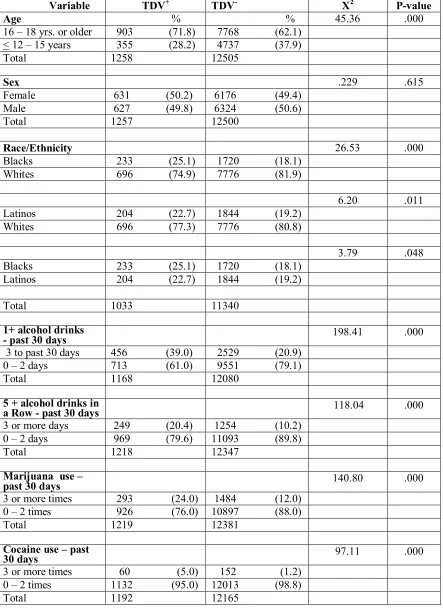
Of 13,917 students who participated in the 2005 YRBS, 99.2 percent (13,808)
answered the question inquiring about TDV, “During the past 12 months, did your
boyfriend or girlfriend ever hit, slap, or physically hurt you on purpose?,” 9.1 percent
(1,263) answered ‘yes’ and 90.1 percent (12,545) answered ‘no’. Of the “yes”
respondents, 28.2 percent (355) were between 12 and 15 years of age and 71.8 percent
(903) were between the ages of 16 and 18 years; 50.2 percent (631) were females and
49.8 percent (627) were males.
With respect to race, 20.6 percent (233) self-identified themselves as Blacks, 18.0
percent (204) as Latinos and 61.4 percent (696) as Whites. In terms of prevalence within
the different races and ethnicities, 11.9 percent of Blacks, 10 percent of Latinos and 8.2
percent of Whites reported having been hit, slapped or physically hurt on purpose by a
boyfriend or girlfriend.
Table 1 presents the associations between TDV and age, gender, race or ethnicity
and risk behaviors (drinking alcohol, using illegal drugs and careless sexual behavior).
With the exception of gender, all the variables were significantly associated with TDV as
estimated by chi square and P-value.