ISSN:1992-8645 www.jatit.org E-ISSN:1817-3195
A NOVEL APPROACH FOR SIMULTANEOUS GENDER AND
HINDI VOWEL RECOGNITION USING A MULTIPLE-INPUT
MULTIPLE-OUTPUT CO-ACTIVE NEURO-FUZZY
INFERENCE SYSTEM
SACHIN LAKRA1, T. V. PRASAD2, G. RAMAKRISHNA3 1Research Scholar, Computer Science & Engineering,
K L University, Vaddeswaram, Guntur, Andhra Pradesh, India. [email protected]
2
Dean, Research & Planning, Chirala Engineering College, Chirala, Andhra Pradesh, India. [email protected]
3Professor, Computer Science & Engineering,
K L University, Vaddeswaram, Guntur, Andhra Pradesh, India [email protected]
ABSTRACT
Human beings can simultaneously recognize vowels in speech as well as gender of a speaker inspite of high variability. However, machines have not been able to simultaneously overcome both gender variability and vowel variability existing in speech due to gender. This paper uses a Multiple-Input Multiple-Output Co-Active Neuro-Fuzzy Inference System to recognize both these patterns in speech simultaneously. The features used as input for the recognition is the pitch and the set of first three formant frequencies extracted from speech samples recorded from 70 Indian speakers, 33 male and 37 female. The individual recognition of either gender or vowel has been achieved at a rate of 68% and 95%, respectively, whereas the simultaneous recognition of both patterns has been attained upto 66% for the training set. Thus, this combined approach is a consolidated single-step novel approach which can replace the two-step method in automatic speech recognition systems where gender recognition is being used as the first step as part of hierarchical decision tree based vowel recognition. This can prove significant in enhancing the performance of an automated speech recognition system by eliminating an additional step.
Keywords: Formant Frequency, Co-Active Neuro-Fuzzy Inference System, Gender Recognition, Vowel
Recognition.
1. INTRODUCTION
Vowel Recognition (VR) and Gender Recognition (GR) are two classical problems in the area of Automated Speech Recognition (ASR). Human beings have not only the capability to identify either of them individually, but to identify both of them simultaneously as well. Thus, humans have the ability to recognize which vowel was spoken by a speaker of which gender. However, machines have not been applied to implement such a combined approach till date.
Both types of recognition have been individually accomplished by a number of diverse methods based on soft computing as well as non-soft computing approaches. VR has been achieved by various methods including those based on recognizing features extracted from speech using
fuzzy inference systems [1], [2], neural networks [3], [4], and Adaptive Neuro-Fuzzy Inference Systems (ANFIS) [5], [6]. Extracted features include formant frequencies, Linear Predictive Coding Coefficients (LPCCs) and Mel-Frequency Cepstral Coefficients (MFCCs). Similarly, GR has been attained by a non-soft computing method [7], [8], [9] as well as by a soft computing method [10]. Each of the above methods has led to GR and VR with a very high recognition rate, but each handles only one of the two problems at a time. Several studies [11], [12] present the analysis of the problem of simultaneous recognition of both types of variability, however, VR and GR have not been achieved simultaneously by any approach.
ISSN:1992-8645 www.jatit.org E-ISSN:1817-3195 by 70 Indian speakers, 33 male and 37 female. Each
speaker uttered 2 Hindi words each containing one of the Hindi vowels, EE and AA. The formant frequencies for these two vowels were extracted from each word of each speaker and classified into 4 fuzzy sets, corresponding to combinations of each of the two genders with each of the 2 Hindi vowels. Training patterns were presented to a Multiple-Input Multiple-Output (MIMO) Co-Active Neuro-Fuzzy Inference System (CANFIS). Each training pattern was constructed of 4 inputs, namely, the three formant frequencies F1, F2 and F3, and pitch, and two encoded outputs corresponding to gender (male or female), and one of the two selected vowels. Individual recognition of vowels was very high but moderately high for the gender and the simultaneous recognition of both gender and Hindi vowels was successfully achieved at a recognition rate of 66% for the training set and 30% for the test set.
2. METHOD
2.1 Formant frequencies of a vowel
Each vowel in a language has a set of formant frequencies at which it is uttered by a speaker. There are three formant frequencies, namely, F1, F2 and F3 for each vowel, which are speaker and gender dependent.
In this paper, two vowels of the Hindi language, namely, EE and AA, were selected for solving the problem of simultaneous VR and GR. 70 speakers of Indian nationality were selected for the study, whose native language was Hindi. A description of the training set and the test set is given in Table 1.
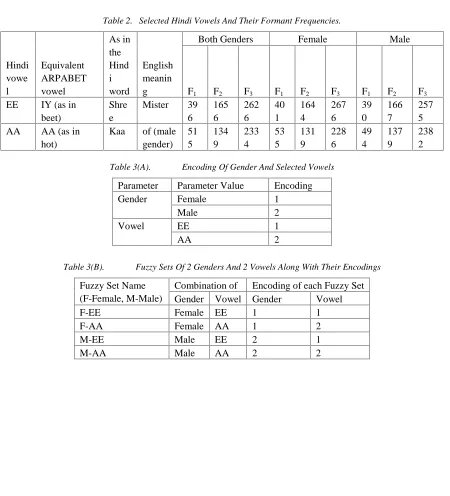
Each speaker spoke the Hindi words shown in Table 2 corresponding to each vowel, which were recorded at a sampling rate of 44,100 samples/second. The selected vowels were subsequently extracted from each word manually.
Table 2 shows typical formant frequencies for the two vowels, which were extracted experimentally using MATLab from voice samples of the 50 speakers of the training set. These formant frequencies were identified for each vowel by extracting an auto-regressive model from the voice sample of each vowel, followed by calculating the transfer function of the vocal tract and then evaluating the transfer function to obtain the frequency response for each vowel recorded from each speaker.
2.2 Formant Frequencies Of A Speaker Of A Particular Gender
A human speaker who speaks a particular language has a set of three formant frequencies for each sound that he utters. Further, the formant frequencies are gender-dependent. A human listener can easily identify a vowel along with identifying the gender of a speaker simultaneously, due to this dependence. These different formant frequencies are shown in Table 2 for the selected female and male speakers, respectively.
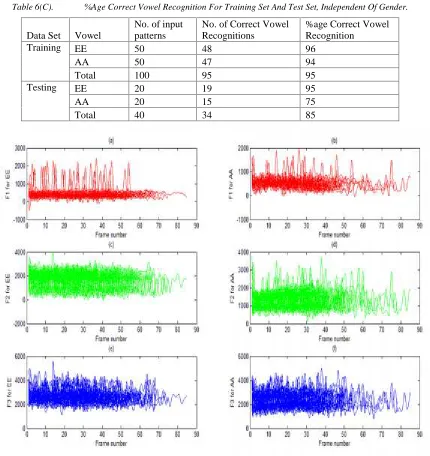
2.3 Formant Frequencies As Fuzzy Sets Speakers of different genders utter the same vowel with different formant frequencies. However, for a particular vowel a particular formant frequency, e.g., F1, falls within a particular frequency interval, even though the vowel may be uttered by different speakers. This is observable from Fig. 1, which depicts the formant frequency plots of the voice samples of each selected vowel uttered by the speakers in the training set. For 50 speakers there are 50 plots in Fig. 1(a). Each curve plots the value of a formant frequency for each sample in a voice signal of a vowel. Fig. 1 shows the curves for each of the three vowels for F1, F2 and F3 for both the vowels. Upon plotting these curves, it was observed that each formant frequency for any speaker can be classified into a fuzzy set. Thus, 3 fuzzy sets, namely, F1, F2 and F3 were formed for each of the formant frequencies for each vowel. Similarly, pitch can also be considered to fall into a pair of fuzzy sets, one for female speakers and one for male speakers [10].
Further, Fig. 2 presents the plots of the 3 formant frequencies for each selected vowel for the female and male speakers, respectively. From the curves, it was evident that gender can also be recognized from the formant frequencies along with the pitch of a speaker by further classifying the frequencies of each vowel according to gender. The plots in Fig. 2 are simplified projected collective spectrograms. Fig. 2 thus leads to the conclusion that each vowel-gender combination has a lower and upper bound which help to define the universe of discourse for each fuzzy set for each such combination.
2.4 Simultaneous Gender And Hindi Vowel Recognition
ISSN:1992-8645 www.jatit.org E-ISSN:1817-3195 frequencies of male and female speakers for the
same vowel differ from each other. Thus the formant frequencies of a group of male speakers uttering the same vowel form a fuzzy set which is different from the fuzzy set of female speakers uttering that same vowel.
2.5 Training Set
Each training pattern used to train the CANFIS had the following generic form:
< Input 1-F1, Input 2-F2, Input 3-F3, Input 4-Pitch || Output1-Gender, Output 2-Vowel>
Depending on the duration of the utterance of a vowel, the number of frames was different for
each speaker’s speech samples. Training patterns
consisted of one set of values in the above format for each frame of each speech sample.
The gender and the corresponding vowels were encoded as depicted in Table 3(a). Table 3(b) shows the 4 combinations of fuzzy sets formed by the genders and vowels, along with their encoding.
2.6 The Architecture of the CANFIS Table 4 presents the layer-by-layer description of the CANFIS used, and the architecture of the CANFIS is depicted in Fig. 3.
The method used is presented in Algorithm 1.
Algorithm 1: Simultaneous Vowel and Gender Recognition
Training Phase:
1. Input a set of vowel speech samples, VKJ,
where, K=1,…,k,…,P and J=1,…,j,…,Q, for P vowels and Q human speakers. Each human speaker can be either male or female. Each gender is assigned an identification number, that is, 1 for female and 2 for male. Each group of P vowel speech samples is assigned an identification number i I, where, I=1,…,i,…,P, and the textual vowel Di.
2. For each vowel speech sample Vkj,
a. Segment the vowel into a set of frames FC,
where,C=1,…,c,…,R, each of size N. b. For each frame Fc, extract a set FFcof the
first 3 formant frequencies.
c. For each Fc, extract the pitch value Hc.
d. Append Hc to FFc at the column position
4.
e. Append either the value 1 or 2 according to the gender of the speaker at the column position 5 in the set FFc. Append i,
assigned to the vowel Vkj, at the column
position 6. The values of i and the gender are the desired outputs for Vkj.
f. Append FFc to a set of training patterns
Tkj.
3. Append each Tkjto the set of training patterns
for all vowels TKJ.
4. Train a CANFIS considering the range for each formant frequency and pitch for each vowel as a fuzzy set.
Testing Phase:
1. Input a test vowel speech sample L, LVKJ
recorded from a speaker SJ.
2. Segment L into a set of frames FC, where, C=1,…,c,…,R,each of size N.
3. For each frame Fc, extract a set FFcof the first
3 formant frequencies.
4. For each Fc, extract the pitch value Hc.
5. Append Hcto FFcat the column position 4.
6. Append each FFcto a set of test patterns EC.
7. Input each FFc to the trained CANFIS and
obtain the test outputs Ocg and Ocv of the
evaluation.
8. Calculate the mean values µgand µvof Ocgand
Ocv, respectively, c C, and round each
value to the nearest integer.
9. If the rounded µgis equal to the gender for the
vowel L, retrieve “Female” for 1 and “Male”
for 2. If the rounded µv is equal to i for the
vowel L, retrieve the textual word Di.
10. Simultaneous vowel and gender recognition is complete.
3. RESULTS
The training stage of the CANFIS involves presenting training patterns each with four inputs, F1, F2, F3 and pitch, and 2 corresponding desired outputs, that is, a combination of encoded gender and vowel values. For each of the formant frequency inputs, values are taken starting at the lower bound up to the upper bound.
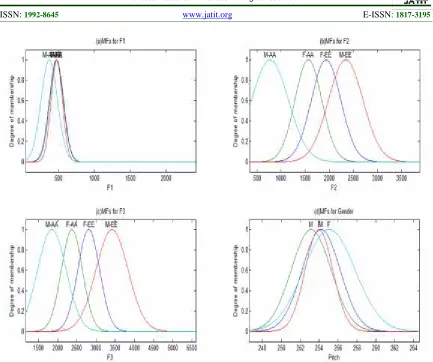
The membership functions for the training patterns are shown in Fig. 4. The names of the fuzzy sets are those specified in Table 3(b) above.
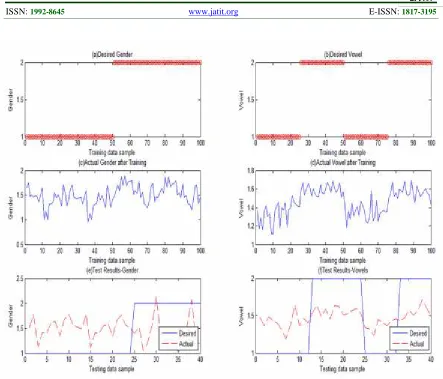
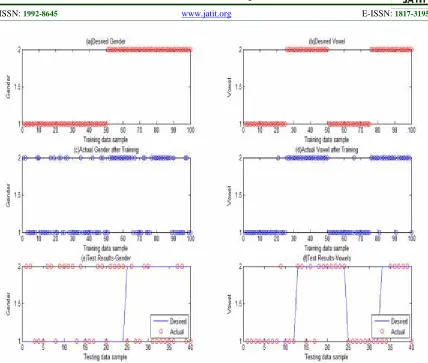
ISSN:1992-8645 www.jatit.org E-ISSN:1817-3195 Fig. 6 shows the same graphs with rounded mean
values. (a) and (b) in each figure show the desired outputs as given in the training set, (c) and (d) in each figure show the learned outputs obtained as a result of training, and (e) and (f) show the results of testing.
The MSE value obtained as a result of training the CANFIS, is shown in Table 5.
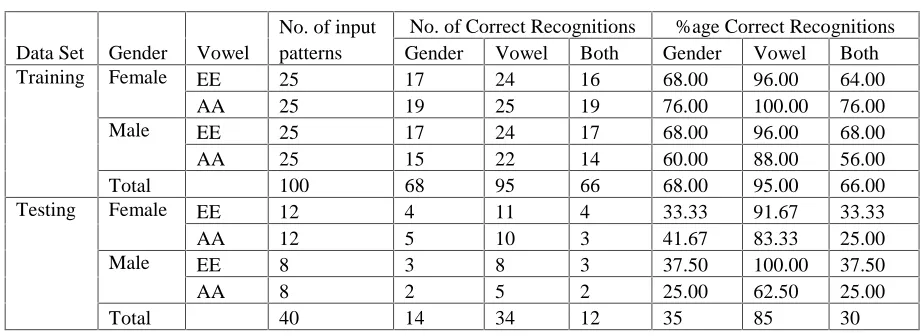
Table 6 shows the results of training and testing. Table 6(a) shows the recognition rates of each vowel-gender combination. Table 6(b) and Table 6(c) show the results in the form of number and percentage of correct recognition for each gender and each selected vowel, respectively. The overall result of simultaneous recognition of both gender and Hindi vowels is 66% for the training set and 30% for the test set.
4. DISCUSSION
A CANFIS, by its MIMO architecture, allows recognition of multiple outputs, as a result of generalizing an Adaptive Neuro-Fuzzy Inference System (ANFIS), which has a Multiple-Input Single-Output (MISO) architecture. The use of the CANFIS is, therefore, suitable for simultaneous recognition of multiple outputs, such as gender and vowel, from formant frequencies and pitch extracted from speech. Research work that has been done related to MIMO systems includes, developing an algorithm for modeling highly non-linear systems [13] by modifying the architecture of a CANFIS, and using a MIMO system as an Intelligent controller by the development of a Hybrid Self-organizing Fuzzy and Radial Basis Neural Network Controller [14].
The Recursive Least Squares algorithm has been used for training the CANFIS. This algorithm reduces the time duration required for training as compared to simple error back propagation based on least squares estimation [15].
The overall simultaneous recognition of gender and Hindi vowels obtained is 66% for the training set and 30% for the test set. From Table 6, it may be observed, that, in general, the recognition rate of vowels is far superior as compared to the recognition of gender in this study. The cause of poor GR rate can be attributed to the age group of the speakers in both the training and test sets, i.e., the speakers were all in the age group of 12-17 years, an age when human speakers do not differ
much in the pitch of their voices. In other studies, such as in Lakra et al, 2013, of a similar method using a MISO ANFIS and a higher age group, the GR rate was above 90%.
The results for the recognition of gender can possibly be further improved by identifying and extracting other gender distinguishing features from speech samples and including them as inputs in the training patterns of the CANFIS.
5. CONCLUSIONS
The use of the CANFIS for simultaneous recognition of gender and Hindi vowels from formant frequencies extracted from speech uttered by Indian speakers is a novel approach, which involves grouping of formant frequencies and pitch into fuzzy sets. Each fuzzy set corresponds to a combination of a gender and a Hindi vowel. The concept of grouping into fuzzy sets removes the high variability inherent in speech while considering multiple human speakers. Further, the approach allows recognition of multiple patterns, namely, gender and vowel, simultaneously. This combined approach will find application in automatic speech recognition systems where gender recognition is being used as a preliminary step in a hierarchical decision tree approach, replacing it with a consolidated single-step approach.
REFERENCES:
[1] Avci, E. and Akpolat, Z. H. (2006), Speech recognition using a wavelet packet adaptive network based fuzzy inference system, Expert
Systems with Applications, 31, 495–503.
[2] Fredj, I. B. and Ouni, K. (2013), A novel phonemes classification method using fuzzy logic, Science Journal of Circuits, Systems and
Signal Processing, 2, 1-5.
[3] Wu, J.-T., Tamura, S., Mitsumoto, H., Kawai, H., Kurosu, K. and Okazaki, K. (1991), Neural network vowel-recognition jointly using voice features and mouth shape image, Pattern Recognition 24, 921–927. [4] Parlaktuna, O., Cakici, T., Tora, H. and
Barkana, A. (1994), Vowel and consonant recognition in Turkish using neural networks toward continuous speech recognition, in 7th
Mediterranean Electrotechnical Conf.
Proceedings, Vol. I, Antalya, Turkey, pp.
ISSN:1992-8645 www.jatit.org E-ISSN:1817-3195 [5] Sabah, R. and Ainon, R. N. (2009), Isolated
digit speech recognition in Malay language using neuro-fuzzy approach, in Third Asia Int.
Conf. on Modelling & Simulation Proceedings,
Bandung, Bali, Indonesia, pp. 336-340. [6] Taleb, A. (2012), Speech Recognition by
Fuzzy-Neuro ANFIS Network and Genetic Algorithms, International Conference on
Intelligent Computational Systems
(ICICS'2012) Proceedings, Dubai, pp.41-44.
[7] Rakesh, K., Dutta, S. and Shama, K. (2011), Gender recognition using speech processing techniques in LabVIEW, Int. J. of Advances in
Engineering and Technology, 1, 51-63.
[8] Li, M., Han, K. J., Narayanan, S. (2013), Automatic speaker age and gender recognition using acoustic and prosodic level information fusion, Computer Speech & Language, 27(1), 151-167,
http://dx.doi.org/10.1016/j.csl.2012.01.008. [9] Zourmand, A., Ting, H.-N. and Mirhassani,
S.M. (2013), Gender Classification in Children Based on Speech Characteristics: Using Fundamental and Formant Frequencies of Malay Vowels, Journal of Voice, 27(2), 201-209,http://dx.doi.org/10.1016/j.jvoice.2012.12.006. [10] Lakra, S., Singh, J. and Singh (2013), A. K., Automated pitch-based gender recognition using an adaptive neuro-fuzzy inference system, in IEEE Int. Conf. on Intelligent Systems and Signal Processing Proceedings,
Vallabh Vidyanagar, Gujarat, India, pp. 83-88. [11] Traunmüller, H. (1984), Articulatory and
perceptual factors controlling the age- and sex-conditioned variability in formant frequencies of vowels, Speech Communication, 3(1), 49-61, http://dx.doi.org/10.1016/0167-6393(84)90008-6.
[12] Suomi, K.(1984), On talker and phoneme information conveyed by vowels: A whole spectrum approach to the normalization problem, Speech Communication, 3(3), 199-209, http://dx.doi.org/10.1016/0167-6393(84)90015-3.
[13] Hanafy, T. O. S. (2010), A modified algorithm
to model highly nonlinear systems”,Journal of American Science, 6, 747-759.
[14] Lin, J. and Lian, R.-J.(2011), Intelligent controller for multiple-input multiple-output systems - Part I, International Journal of
Innovative Computing, Information and
Control, 7, 4789-4803.
ISSN:1992-8645 www.jatit.org E-ISSN:1817-3195
Table 1. Description Of Speakers In Training Set And Test Set.
Data Set
Total No. of Speakers
Age Range
12 to 17 years
Outliers (Outside the range
of 12-17 years) Male Female Male Female
Training 50 25 25 4 7
Testing 20 8 12 0 0
[image:6.612.84.534.228.724.2]Total 70 33 37 4 7
Table 2. Selected Hindi Vowels And Their Formant Frequencies.
Hindi vowe l
Equivalent ARPABET vowel
As in the Hind i word
English meanin g
Both Genders Female Male
F1 F2 F3 F1 F2 F3 F1 F2 F3
EE IY (as in beet)
Shre e
Mister 39 6
165 6
262 6
40 1
164 4
267 6
39 0
166 7
257 5 AA AA (as in
hot)
Kaa of (male gender)
51 5
134 9
233 4
53 5
131 9
228 6
49 4
137 9
238 2
Table 3(A). Encoding Of Gender And Selected Vowels
Parameter Parameter Value Encoding
Gender Female 1
Male 2
Vowel EE 1
AA 2
Table 3(B). Fuzzy Sets Of 2 Genders And 2 Vowels Along With Their Encodings
Fuzzy Set Name (F-Female, M-Male)
Combination of Encoding of each Fuzzy Set
Gender Vowel Gender Vowel
F-EE Female EE 1 1
F-AA Female AA 1 2
M-EE Male EE 2 1
ISSN:1992-8645 www.jatit.org E-ISSN:1817-3195 Table 4. Layer-By-Layer Description Of The CANFIS Used.
Lay er Descriptio n Number of nodes
Input Processing Output Conditio
ns
1 Fuzzificati on: Fuzzificati
on of
frequency inputs
16, one each for the fuzzy sets F1, F2, F3, Pitch, and for each
of 2
vowels of each of 2 genders
F1, F2, F3,
Pitch bi
i i ij ij A a c F F 2 1 1 ) (
4
,..,
1
;
4
,
3
,
2
,
1
j
i
where
) ( ,1ij A Fij O
4 ,.., 1 ; 4 , 3 , 2 , 1 j i where Range of Fij depends on the gender and the Hindi vowel 2 Apply fuzzy operator: ANDing of inputs
4, one each for the products of degrees of members hip for each input
ij
O
1,4 ,.., 1 4 , 3 , 2 , 1 j i where , 4 1 , 1 , 2
i ij jj w O
O
4
,..,
1
;
4
,
3
,
2
,
1
j
i
where
, , 2 j wjO 4 ,.., 1 j where
1
0
w
j
3 Aggregate all outputs: Execute the consequent s of the fuzzy rules and calculate the consequent parameters
8, one each for the product of conseque nt parameter s of 2 outputs and 4 weights from Layer 2
,
, 2j wj O 4 ,.., 1 j where kj j kj kj kj kj kj kj kj
c
w
O
t
P
s
F
r
F
q
F
p
f
c
, 3 3 2 1)
(
2 , 1 ; 4 ,.., 1 k j where kj j kj w c O3, 2 , 1 ; 4 ,.., 1 k j where
4 Sum all
products of weights and consequent parameters
2, one each for the sum over the products from Layer 3 correspon ding to each of 2 outputs
kj O3,
2 , 1 ; 4 ,.., 1 k j where
6 1 , 4 j kj jk w c
O 2 , 1 ; 4 ,.., 1 k j where k O4,
ISSN:1992-8645 www.jatit.org E-ISSN:1817-3195
Lay er
Descriptio n
Number of nodes
Input Processing Output Conditio
ns
5 Defuzzific ation: Defuzzify the outputs of the rules from Layer 4 and give the output for each test set of data input at Layer 1
2, for giving the output
k
O
4,
6
1 , 4 , 5
j j k k
w O O
2 , 1 ; 4 ,..,
1
k
j where
k
O
5, [image:8.612.83.528.67.271.2]2 , 1 k where
Table 5. Mse Values Obtained As A Result Of Training The Canfis
Parameter Output MSE Value Training Data Gender 0.2114
Vowel 0.1900
Table 6(a). %age Correct Recognition for Training Set and Test Set.
Data Set Gender Vowel
No. of input patterns
No. of Correct Recognitions %age Correct Recognitions
Gender Vowel Both Gender Vowel Both
Training Female EE 25 17 24 16 68.00 96.00 64.00
AA 25 19 25 19 76.00 100.00 76.00
Male EE 25 17 24 17 68.00 96.00 68.00
AA 25 15 22 14 60.00 88.00 56.00
Total 100 68 95 66 68.00 95.00 66.00
Testing Female EE 12 4 11 4 33.33 91.67 33.33
AA 12 5 10 3 41.67 83.33 25.00
Male EE 8 3 8 3 37.50 100.00 37.50
AA 8 2 5 2 25.00 62.50 25.00
Total 40 14 34 12 35 85 30
Table 6(B). %Age Correct Gender Recognition For Training Set And Test Set, Independent Of Vowel.
Data Set Gender
No. of input patterns
No. of Correct Gender Recognitions
%age Correct Gender Recognition
Training Female 50 36 72
Male 50 32 64
Total 100 68 68
Testing Female 24 12 50
Male 16 2 12.5
[image:8.612.87.524.69.272.2] [image:8.612.75.536.370.538.2]ISSN:1992-8645 www.jatit.org E-ISSN:1817-3195 Table 6(C). %Age Correct Vowel Recognition For Training Set And Test Set, Independent Of Gender.
Data Set Vowel
No. of input patterns
No. of Correct Vowel Recognitions
%age Correct Vowel Recognition
Training EE 50 48 96
AA 50 47 94
Total 100 95 95
Testing EE 20 19 95
AA 20 15 75
Total 40 34 85
Figure 1. Plots Of 50 Selected Speakers Of Formant Frequencies F1, F2 And F3 Vs. Frame Number For The Hindi Vowel EE In Figures (A), (C) And (E), Respectively, And For The Hindi Vowel AA In Figures (B), (D) And (F),
[image:9.612.96.526.92.548.2]ISSN:1992-8645 www.jatit.org E-ISSN:1817-3195
Figure 2. Plots For 25 Selected Male Speakers In Figures (A) And (B), And 25 Selected Female Speakers In Figures (C) And (D), Of Formant Frequencies F1, F2 And F3 Vs. Frame Number For The Hindi Vowels EE And
[image:10.612.92.523.66.427.2]ISSN:1992-8645 www.jatit.org E-ISSN:1817-3195
Figure 3. The Architecture Of The CANFIS Used.
F1 F2 F3 P
F1 F2 F3 P
Layer 1
F1 F2 F3
A1
….
A4 B1….
B4 C1 C4 D1….
D4
w2
………….
w4w1
c11 c12
….
c14 c21 c22….
c24
wk
/
/
Gender Vowel Outputs
Layer 5
Layer 3 Layer 4
Layer 2
Inputs Pitch
ISSN:1992-8645 www.jatit.org E-ISSN:1817-3195
Figure 4. Graphs Of Membership Functions Of Each Of The 4 Combinations Of Two Vowels And Two Genders For The Three Formant Frequencies F1, F2 And F3 In Figures (A), (B) And (C), Respectively, And Graph Of The
ISSN:1992-8645 www.jatit.org E-ISSN:1817-3195
ISSN:1992-8645 www.jatit.org E-ISSN:1817-3195
Figure 6. The Plots In This Graph Are The Same As Those In Fig. 4, Except That The Values In Graphs (C) To (F) From Fig. 5, Have Been Rounded Off And Presented Here. The Figures (C) To (F) Depict Mean Values Rounded To