PAPR REDUCTION TECHNIQUES IN OFDM SYSTEMS
USING DCT AND IDCT
1S. SUJATHA 2P. DANANJAYAN 1
Research Scholar, Department ECE, Pondicherry Engineering College, Pondicherry, India
2
Professor, Department of ECE, Pondicherry Engineering College, Pondicherry, India E-mail: [email protected], [email protected]
ABSTRACT
Orthogonal frequency division multiplexing (OFDM) has gained much popularity in the field of wireless communication because of its ability to transfer the data at higher rate, high bandwidth efficiency and its robustness to multipath. Since OFDM has high Peak to Average Power Ratio (PAPR) as major limitation, many techniques were proposed to reduce it. In this paper, a DCT based modified selective mapping (SLM) technique is proposed to reduce the PAPR of the transmitted signal and its PAPR reduction performance compared with that of IFFT based modified SLM technique, IDCT based modified SLM technique and IDST based modified SLM technique. The proposed technique for PAPR reduction grants an improvement over the existing IFFT.
Keywords: OFDM, PAPR, Selective Level Mapping, Discrete Cosine Transform, IDCT, IDST.
1. INTRODUCTION
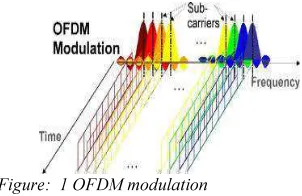
[image:1.595.89.240.602.700.2]Orthogonal Frequency Division Multiplexing (OFDM) is a multi-carrier modulation technique for high data rate wireless communication because of its robustness to frequency selective fading, high spectral efficiency and less computational complexity [1, 2]. OFDM separates the available spectrum into a number of overlapping but orthogonal narrowband sub-channels as shown in Figure 1, and hence the OFDM converts a frequency selective channel into a non-frequency selective channel. The prime advantage of OFDM lies in its ability to cope with severe frequency-selective fading due to multi-path without complex equalization filters. One of the major drawbacks of OFDM transmission is high Peak to Average Power Ratio (PAPR).
Figure: 1 OFDM modulation
High PAPR signals are usually undesirable for it usually strains the analog circuitry. A large PAPR brings disadvantage like an increased complexity of
the analog to digital conversion and digital to analog conversion and reduces the efficiency of RF
Power amplifier PAPR of OFDM signal increases with increase in the number of subcarriers which causes poor efficiency and degrades the system performance of power amplifier [3]. To overcome such effect, many PAPR reduction technique such as coding distortion and distortion less techniques have been proposed for OFDM signals [4]. Distortion less techniques such as Selective Level Mapping(SLM) [5] and Partial Transmit Sequence (PTS) [6] can improve the PAPR statistics with only a small data rate loss but has no inherent error control.
with N sub channels may reach up to a value of N. High PAPR value has some disadvantages for
OFDM modulation. High PAPR results from the nature of the modulation where multiple subcarriers and sinusoids are added together to the signal to be transmitted. When N sinusoids add, the peak magnitude would have a value of N, where the (rms) average might be quite low due to destructive interference between the sinusoids.
High PAPR signals would require a large range of dynamic linearity from the analog circuits, which usually results in expensive devices, and higher power consumption/lower efficiency for example, power amplifier has to operate with larger back off to maintain linearity and needs to be reduced to an acceptable level. In the literature various methods are proposed for the purpose of PAPR reduction. It should be noted that most of the method are based on the same idea of selecting the time domain signal to be transmitted from a set of different representations with the constraint of minimization of PAPR which would degrade the performance of system. This technique can be categorised into Signal scrambling techniques and Signal distortion techniques. The fundamental principle of techniques is to scramble each OFDM signal with different scrambling sequences and select one which has the smallest PAPR value for transmission. This type of approach includes Selective Mapping (SLM) and Partial Transmit Sequences (PTS). SLM method applies scrambling rotation to all sub-carriers independently while PTS method only takes scrambling to part of the sub-carriers. Pepin Magnangana Zoko Goyoro, et al proposed a [3] scheme which consists of DCT matrix transform followed by the SLM using Riemann matrix for the phase sequence to reduce PAPR. However to reduce PAPR and computational complexity further DCT based modified SLM technique is proposed in this paper.
.
DCT based modified selective mapping technique is used to reduce the PAPR. This method combines Discrete Cosine Transform (DCT) with modified Selective Level Mapping (SLM). In DCT based modified SLM Inverse Discrete Sine Transform (IDST) and Inverse Discrete Cosine Transform (IDCT) are also used along with IFFT
The paper is organized as follows. Section 2 briefly introduces PAPR of OFDM signals, Section3 gives an overview of SLM technique is described. The detailed description of DCT based
OFDM technique is shown in Section 4 and 5. The discussions and simulation results are presented in
Section 6. Finally, conclusions are given in Section7.
2. PAPR OF OFDMSIGNALS
The PAPR of transmitted OFDM is defined as the ratio between the maximum instantaneous power and the average power, defined by:
( )
( )
2
2
m a x x t
P A P R
E x t
=
(1)
Where
x
(t) denotes an OFDM signals after IFFT, and E [.] denotes expectation. Let us denote the data block of length N as a vector Y= [Y0, Y1, Y2…YN-1] T where N is equal to the number of
subcarriers and (.)T denotes transpose. The duration of a data symbol in X modulates one of a set of subcarriers, {fm, m=0, 1,…., N-1}.The N subcarriers
are chosen to be orthogonal, that is fm=m∆f, where
∆f=1/NT and NT is the duration of an OFDM data block .The complex envelope of the transmitted OFDM signal is given by
( )
t = 1 N-1Y ej2πkΔftk N k=1
x
∑(2)
where Yk is the data symbol carried by the kth
subcarrier.
According to the limit central theorem, when N is large, both real and imaginary part of s(t) is Gaussian distributed. The Cumulative Distributed Function (CDF) of the signal is
F (z) = 1 – e-z (3) If there are N subcarriers in an OFDM system, and all the sampling values are complete independent, the CDF of the system is given by the equation:
(
)
( )
N(
1 exp( )
)
NP PAPR≤z =F z = − −z (4) So in case of no over sampling, the
(
)
(
0)
0
1
1
N PAPR
P PAPR
>
PAPR
= −
−
e
(5)where PAPR0 is the clipping level. This equation is
read as the probability that the PAPR of a symbol block exceeds some clip level PAPR0.
SLM is one of the probabilistic techniques adopted to reduce the PAPR of the OFDM signal. Hence it can achieve PAPR reduction without distorting the signal and will not cause any loss of data. The main disadvantage of SLM is that the complexity is high. Now there are many extension schemes for reducing the complexity of SLM [13-16].
Selective Level Mapping
As shown in Figure 2, In SLM technique the input data is partitioned into Y data block of length N .Then the OFDM data block is multiplied element by element with phase sequence E(u)=[e
u,0,e u,1,….e u,N-1]T where u=1,2,…………U , U
phase rotated OFDM data block Yu is obtained.
Figure.2 Selective level mapping scheme
All phase rotated OFDM data blocks represent the same information as the unmodified OFDM data block provided that the phase sequence is known.
( )
1
j2 k ft k mY t
Y e ke
N
π ∆
=
(6)Among the phase rotated OFDM data blocks one with the lowest PAPR is selected and transmitted. The information about the selected phase sequence should be transmitted to the receiver as side information. At the receiver, reverse operation should be performed to recover the unmodified OFDM data block. In ordinary SLM technique, there is no restriction on the construction of phase sequence s. However, we set a structural limitation on the phase sequence for modified SLM.
3.1 DCT Transform
The peak value of the auto correlation is the average power of input sequence. DCT conceptually extends the original N-point data sequence to 2N-point sequence by doing mirror – extension of the N-point data sequence. Since the both end of data is always continuous in the DCT, the lower order of components will be dominated in the transform domain signal after converted by DCT. The DCT is a Fourier-like transform, which was first proposed by Ahmed et al. [17] [20]. The idea to use the DCT transform is to reduce the autocorrelation of the input sequence to reduce the peak to average power problem and the transmitted signal does not require any side information at the receiver. In the section, we briefly review DCT transform. The 1D discrete cosine transform (1D DCT) A[k] of a sequence a[n] of length N is defined as:
[ ]
(
2 1)
1 cos
0 2
n k N
A k a k n a n
N
π
+
−
= ∑
= (7)
For k = 0,1 . . . N- 1 , the inverse DCT is defined as
[ ]
(
2 1)
1
cos 0
2
n k N
a n n a k A k
N π
+
−
= ∑
= (8)
n= 0, 1… N-1 where a[k] is defined as:
1
0 [ ]
1 , 2 ,... 1 2
k f o r
N a k
f o r k N
N
=
=
= −
(9)
The basis sequences of the 1D DCT are real, discrete-time sinusoids defined by:
(
2 1)
, c o s
2
n k
C n k
N N
π +
=
(10)
The DCT basis consists of the following N real sequences.
,0 , ,1 , ... , 1
C n C n C n N
N N n − (11)
The equation (7) is expressed in matrix
N
A
=
C a
(12)Where A and a are both the vector with Nx1 and CN
is a DCT transform matrix with N x N.
The row (or column) of the DCT matrix CN are orthogonal matrix vectors. Then we can use
OFDM signal this is the root cause to reduce PAPR.
3.2 DCT with Modified Selective Level Mapping
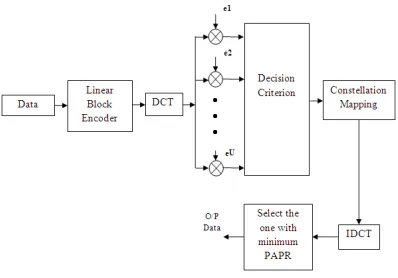
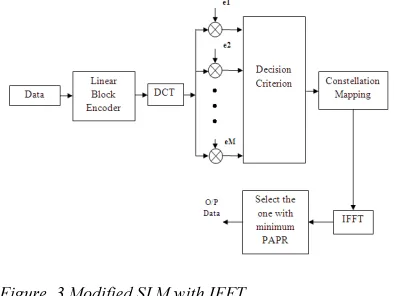
[image:4.595.88.285.367.515.2]DCT along with Selective Level Mapping become an efficient PAPR reduction technique by integrating SLM and DCT matrix transform. PAPR is reduced by modifying the OFDM signal without any distortion, but still the complexity of SLM is high. For every OFDM frame, SLM technique requires ‘n’ IFFT operation and this operation makes the system complicated. So as to prevail over system complexity of SLM, modified SLM is proposed. The modified SLM reduces IFFT block and also the PAPR. This technique comprises of an IFFT block at the transmitter end and the decision of selecting data with lowest PAPR is accomplished using a decision algorithm before IFFT. The algorithm for modified SLM is given as follows,
Figure. 3 Modified SLM with IFFT
Algorithm
i. Let X1, X2,…, Xn be the Binary information
blocks.
ii. Assume W as the encoding code word. iii. Every block is encoded into w using Hamming
encoder.
iv. A control bit is appended to w and extended hamming code of 8-bits is calculated.
v. The error table and coset leader is computed. vi. Vectors w+e1, w+e2, …, w+e16 are
constructed for (every code word)
Calculate
A
=
X
2+
Y
2+
Z
2.vii. Code word that has minimumA is chosen and transformed into OFDM signal through constellation mapping and IFFT.
The block diagram of DCT with modified SLM using IFFT is shown in Fig. 2 and the corresponding output signal is described by assume,
[
]
Tn
s
s
s
s
1 1 0,
−⋅
⋅
⋅
=
as a discrete timeOFDM signal vector. Then, the IFFT of vector s takes the form as,
QS
s
=
(13) where, Q symbolizes the IFFT matrix and it can be
represented as, [13]
Q =
− − − − n n n j n n j n n j n j e e e e / ) 1 )( 1 ( 2 / ) 1 ( 2 / ) 1 ( 2 / 2 1 1 1 1 1 π π π π L M O M M L L (14)
Thus, as column matrix IFFT matrix Q can be expressed as,
[
0 1 1]
−
= Q Q Qn
Q L (15)
In this proposed system, DCT with modified selective level mapping technique is considered to reduce the PAPR in OFDM system. The sequence of process is given below.
i. At the transmitter end, the source data is forwarded to the linear block encoder
ii. To the outcome of encoder DCT is applied and the transformed data is processed by modified SLM unit
iii.The modified algorithm illustrated in algorithm-1 is invoked
iv. The information with low PAPR is selected and output is generated
3.3. LINEAR BLOCK CODES
PAPR can be obtained out by a decision algorithm before IFFT and IDCT.
Consider an [n, k] Linear code C with parity-check matrix H, where n is the length and k is the dimension of W. Since Hwt=0 for any codeword w ∈ W, any vector X∈ e+w has the same
syndrome as e, that is [2]
(
)
t t t
Hx
=
H e
+
w
=
He
(16)A binary information sequence is divided into blocks of 4 bits. Each message block is encoded into a codeword W which is 7 bits by a [7, 4] hamming encoder. The parameters of the binary hamming codes are typically expressed as a function of a single integer u ≥2 (for u=3, we have a (7, 4) Hamming code) not necessarily prime, it is any positive integer. A hamming code on GF (2) has code length n=2u-1, message length k=2u-1-u, redundancy n-k=u and error connecting capability t=1bit.
Hamming codes are only single error correcting. To improve the error detection and connection capability by adding parity check digit. The resulting code is called the extended binary hamming code. Suppose that w is a code over the alphabet {0,1}. Let w be the code obtain by adding a single character to the end of each word in w in such a way that every word in w. has even weight. The parity check matrix of [8, 4] extended hamming code w is H:
(17)
(17)
According to the formula S= eH T, the syndromes which are corresponding to the non-error and one non-error patterns could be obtained. And other seven two errors patterns could be obtained from the other syndromes. So the standard array of c. is constructed. The standard array an [n, k] binary linear code C is a X×Y array and for extended array an [8, 4] for binary linear code c. is also X×Y array. where X=2u-K, Y=2K. At last sixteen vectors are constructed as w +e1, w +e2 ... w+ e16, where e1 =0 and e1, e2, --- e16 are properly selected as the coset leaders of the standard array in terms of their PAPR. Then the Decision criterion is used to calculate the value of A. Finally, the scrambled codeword with the
[image:5.595.305.488.207.325.2]minimum A is selected and then transformed to an OFDM signal by constellation mapping and IFFT.
Table 1 Standard array of [n, k] linear code
In this array there are M rows and each row is a coset w denotes the codeword and e denotes the error in transmission. This criterion is used for each codeword to calculate the value. Finally the codeword with the minimum value is selected and then transformed to an OFDM signal by constellation mapping and IFFT. At the receiver, the received signal is converted into r by FFT and constellation de-mapping. The syndrome calculated from r is used for estimating the coset leader e chosen at the transmitter. The codeword c is obtained by calculating w= e+r and then is converted into a message sequence of k bits.
The block diagram is shown in Figure 2. Instead of using the modified SLM with IFFT, the proposed technique examines the performance enhancement of modified SLM with IDCT.
3. MODIFIED SLM WITH INVERSE
DISCRETECOSINETRANSFORM
OFDM system is employed considering orthogonal basis of complex exponential function set. But, OFDM can also be implemented using a single set of Cosinusoidal function as an orthogonal basis. This Cosinusoidal function is integrated along with a DCT, and hence this scheme is termed as DCT-OFDM and the output signal is given as, [2]
1 2
( ) c o s
0
n
i n
x n d s Di i
n i T
s π
−
∑
=
=
(18)
In equation (18) 0
,
1,
1 −n
ds
ds
ds
L
represent themodulation constellation. Ts symbolize the
sampling interval. Di takes the value as,
1 0
2
1 , 2 . . . 1 1
i
D i i n
=
=
= −
(19)
[image:6.595.88.287.214.353.2]The system that uses modified SLM with Inverse Discrete Cosine Transform (IDCT) is picturized in Fig. 3.
Figure 3: Modified SLM with IDCT
5. MODIFIED SLM WITH INVERSE
DISCRETE SINE TRANSFORM (IDST)
The OFDM system can also be established via a single set of Sinusoidal functions as an orthogonal basis. This system is incorporated using a discrete Sine transform (DST). Therefore, this scheme is described as DST-OFDM scheme. According to this scheme the output signal can be elucidated as, [2]
1
0
2
( )
sin
n
i i
i s
i n
x n
ds D
n
T
π
−
=
=
∑
(20)
The OFDM system that uses modified SLM with Inverse Discrete Sine Transform (IDST) is illustrated in figure-4
Figure 4: Modified SLM with IDCT
In this work, the data stream is transformed by DCT. It can linearly transform data into the frequency domain, where the data can be represented by a set of coefficients. The advantage of DCT is that the energy of the original data may be concentrated in only a few low frequency components of DCT depending on the correlation in the data.and then the transformed data is processed by the SLM unit where each data block is multiplied by C different number of phase sequence vectors.
If the data passed by DCT matrix before IDCT, the autocorrelation coefficient of IDCT input sequence is reduced with low complexity and no side information is required because the matrices can be generated to recover the original data at the receiver and the data is transmitted with lowest PAPR.
6. SIMULATION RESULTS AND
DISCUSSION
The analysis of the modified SLM with DCT, IFFT, IDCT and IDST has been carried out using MATLAB software. The entire simulation parameters considered for this analysis is summarized in Table 1 as follows.
Table 2: Simulation parameters
Simulation parameter Type/value
Number of subcarriers(N) 128,256,512,1024 Modulation Scheme QAM
Phase weighting factor(e) 16,64
Coding technique Linear block coding
In the OFDM System under consideration, modified SLM technique is applied to the uncoded information in the sub blocks, which is modulated by QAM modulation. The performance evaluation is done in terms of CCDF.
[image:6.595.87.282.569.714.2]Figure 5: CCDF of PAPR of conventional SLM system
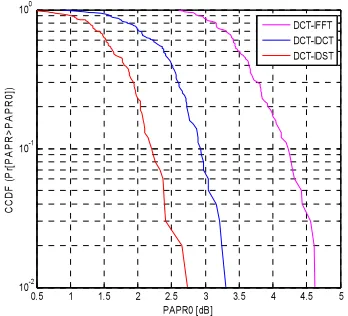
Figures 6, 7, 8 and 9 shows the performance of modified SLM with IFFT, IDCT and IDST for different subcarriers N= 128,256,512 and 1024. It gives the better PAPR reduction at N=128 compared to all other subcarriers. The Figure 6 shows the performance results of modified SLM with Linear coding for subcarrier when N=128 .the graph shows the comparison of PAPR using three techniques IFFT= 4.1db, IDCT=2.3db and IDST=1.6db. From the result the performance of IDCT and IDST is improved when compared to IFFT. As the IDCT and IDST matrix are real and orthogonal. The symmetry of an orthogonal matrix indicates that algorithms for the forward and inverse transform computation will be the same. Hence it performs fast multiplication and reduces the complexity. The results of modified SLM with IFFT, modified SLM with IDCT and modified SLM with IDST are compared to find the best technique to obtain reduced PAPR OFDM system. It is observed that PAPR value is reduced using the proposed technique compared to existing technique.
0 0.5 1 1.5 2 2.5 3 3.5 4 4.5 10-2
10-1 100
PAPR0 [dB]
C
C
D
F
(P
r[
P
A
P
R
>
P
A
P
R
0
])
DCT-IFFT DCT-IDCT DCT-IDST
Figure 6: Comparison of CCDF of PAPR of OFDM system with modified SLM when N=128
0 0.5 1 1.5 2 2.5 3 3.5 4 4.5 10-2
10-1 100
PAPR0 [dB]
C
C
D
F
(
P
r[
P
A
P
R
>P
A
P
R
0
])
[image:7.595.312.493.312.445.2]DCT-IFFT DCT-IDCT DCT-IDST
Figure 7: Comparison of CCDF of PAPR of OFDM system with modified SLM when N=256
0 0.5 1 1.5 2 2.5 3 3.5 4 4.5 10-2
10-1 100
PAPR0 [dB]
C
C
D
F
(
P
r[P
APR
>
P
AP
R
0
])
DCT-IFFT DCT-IDCT DCT-IDST
Figure 8: Comparison of PAPR of OFDM system with modified SLM when N=512
0.5 1 1.5 2 2.5 3 3.5 4 4.5 5 10-2
10-1 100
PAPR0 [dB]
C
C
D
F
(P
r[
P
A
P
R
>
P
A
P
R
0
])
DCT-IFFT DCT-IDCT DCT-IDST
Figure 9: Comparison of PAPR of OFDM system with modified SLM when N=1024
7.CONCLUSION
[image:7.595.312.486.500.658.2] [image:7.595.96.274.510.659.2]Cosine Transform (DCT) based modified Selective Level Mapping (SLM) as an effective technique to reduce Peak to Average Power Ratio (PAPR) in OFDM. In that, instead of using the modified SLM with Inverse Fast Fourier transform (IFFT), this technique examines the performance enhancement of modified SLM with Inverse Discrete Cosine Transform (IDCT) and Inverse Discrete Sine Transform (IDST). PAPR analysis is made using three techniques. The technique is simulated in MAT lab. Modified SLM technique with DCT improves the performance of OFDM signal with respect to PAPR.As there is an increasing demand for efficient frequency spectrum utilization .OFDM proves invaluable demand to next generation communication system.
REFERENCES:
[1]. S. H. Muller and J. B. Huber.,” A novel peak power reduction scheme for OFDM “In proceedings of IEEE international Symposium on personal, Communication (PIMRC), 1090-1094, 1997.
[2]. M.Paul and H.P.Kuchembecher., “On the reduction of the out of band radiation of OFDM signals” .In Proceedings of IEEE international Conference on Communication (June 1998), 1304-1308 (1998).
[3]. Pepin Magnangana Zoko Goyoro, Ibrahim James Moumouni., Sroy Abouty,” SLM Using Riemann Sequence Combined with DCT Transform for PAPR Reduction in OFDM Communication Systems”, World Academy of Science, Engineering and Technology 64 2012 [4]. Osama A. Omer and Ahmed Abdel-Reheem.,” Adaptive Hybrid PAPR Reduction in OFDM System”, International Journal of Future Computer and Communication, Vol. 2, No. 3, June 2013.
[5]. M.Breiling, S.H Muller, and J.B Huber., (2001).” SLM peak power reduction without explicit side information “, IEEE Communication Letters, (June 2001), 226-1228.
[6]. A.D.S Jayalath and C.Tellambura., ”Adaptive PTS approach for reduction of peak –to – average power ratio of OFDM signals”, Electronics letters,(July 2000),226-1228,2000. [7]. R. W. Bauml, R. F. H. Fisher, and J. B. Huber,
Reducing the Peak-to-Average Power Ratio of Multicarrier Modulation by Selected Mapping,” IEE Electronics Letters, vol. 32, no. 22, pp. 2056–2057, Oct.1996..
[8]. Xiang, Wei, Julian Russell, and Yafeng Wang., “ICI reduction through shaped OFDM in coded MIMO-OFDM systems.” International Journal on Advances in Telecommunications 3.3 and 4 (2011): 194-205.
[9]. Moussa Diallo, Rodrigue Rabineau, Laurent Cariou and Maryline H´elard, “On improved DCT based Channel Estimation with very low complexity for MIMO-OFDM systems”, proceedings of vehicular technology, 2009
[10]. S. Litsyn and G.Wunder, “Generalized bounds on the crest-Factor distribution of OFDM signals with applications to code design,” IEEE Trans. Information Theory, vol. 52, no. 3, pp. 992–1006, Mar. 2006. [11]. Arslan and Huseyin, "Channel estimation for
wireless OFDM systems." IEEE Surveys and Tutorials 9.2 (2007): 18-48.
[12]. MRAN BAIG and VARUN JEOTI, “On the PAPR Reduction In OFDM Systems: A Novel ZCT Precoding Based SLM Technique”, Journal of Engineering Science and Technology Vol. 6, No. 3 (2011) 357 – 368.
[13]. Zhongpeng Wang, “Combined DCT and Companding for PAPR Reduction in OFDM Signals”, Journal of Signal and Information Processing, 2011, 2, 100-104.
[14]. P.Mukunthan and P. Dananjayan, “Modified PTS with FECs for PAPR reduction of OFDM signals”, International Journal of Computer Applications, vol. 11, no. 3, pp. 38-43, December 2010.
[15]. K,.Sathananthan and C.Tellambura,. “Novel adaptive modulation scheme to reduce both PAR and ICI of an OFDM signal”, Proceedings in 6th International symposium on DSP for Communication Systems,(Sydney, Australia),pp. 229-233, Jan, 2002.
[16]. Keyvan Kasiri, Iraj Hosseini, Omid Taheri, Mohammad Javad Omidi, and P. Glenn Gulak, “A Preprocessing Method for PAPR Reduction in OFDM systems by Modifying FFT and IFFT Matrices”, The 18th Annual IEEE International Symposium on Personal, Indoor and Mobile Radio Communications, (PIMRC'07), 2007. [17]. N.T.Ahmed, Natarajan and K.R.Rao,”
[18]. R.W. Bäuml, R.F.H. Fischer, and J.B. Huber, “Reducing the peak-to-average power ratio of multicarrier modulation by selected mapping”, Electron Letter, vol.32, no.22, pp.2056-2057, 1996.
[19]. Hernandez, Eugenio and Guido Weiss. “A first course on wavelets” Boca Raton, FL: CRC Press, 1996 PP.20-30, 432-442. [20]. Ken Cabeen and Peter Gent,” Image
compression and the discrete cosine transform, Math 45 College of the Redwoods.
[21]. W.B.Pennebaker and J.L.Mitchell,” Image data compression standard,” Newyork: International Thomson Publishing, 1993. [22]. T.Tadashi Kasezawa,” Blocking artifacts
reduction using discrete cosine transform,” Trans.consumer Electron., vol.43, no.1, Feb.1997.
[23]. T. Jiang and Y. Imai, “An Overview: Peak-To-Average Power Ratio Reduction Techniques for OFDM Signals,” IEEE Transactions on Broadcasting, Vol. 54, No. 2, 2008, pp. 257- 268.
[24]. S. H. Han and J. H. Lee, “An Overview of Peak-to-Average Power Ratio Reduction Techniques for Multicarrier Transmission,” IEEE Transaction on Wireless Communication, April 2005, pp. 56-65. [25]. X. Huang, J. H. Lu, J. L. Zhen, et al.,
“Companding Transform for Reduction in Peak-to-Average Power of OFDM Signals,” IEEE Transactions on Wireless Communications, Vol. 3, No. 6, 2004, pp. 2030-2039.
[26]. J. Kim and Y. Shin, “An Effective Clipping Companding Scheme for PAPR Reduction of OFDM Signal,” IEEE International Conference on Communications 2008, Beijing, 2008, pp. 668-672.
[27]. X. D. Zhu, G. X. Zhu and T. Jiang, “Reducing the Peak-to- Average Power
Ratio Using Unitary Matrix
Transformation,” IET Communications, Vol. 3, No. 2, 2009, pp.161-171.
[28]. I. Sohn, “RBF Neural Network Based SLM Peak-to- Average Power Ratio Reduction in OFDM Systems,” ETRI Journal, Vol. 29, No. 3, 2007, pp. 402-404.
![Table 1 Standard array of [n, k] linear code](https://thumb-us.123doks.com/thumbv2/123dok_us/8912723.960167/5.595.305.488.207.325/table-standard-array-n-k-linear-code.webp)