International Journal of Emerging Technology and Advanced Engineering
Website: www.ijetae.com (ISSN 2250-2459,ISO 9001:2008 Certified Journal, Volume 4, Issue 6, June 2014)
724
An Analysis of MANET Routing Protocols with Effective
Resource Management
Umesh Kumar Singh
1, Lokesh Laddhani
2, Kailash Chandra Phuleriya
3Institute of Computer Science, Vikram University, Ujjain, M.P., (INDIA)
Abstract--A mobile ad hoc network (MANETs) is a network formed by a set of mobile hosts which communicate among themselves by means of the wireless mediums. This type of self organizing network combines wireless communication with a high degree node mobility. In such networks, the system resources are limited: the terminals are constrained in energy, bandwidth, storage, and processing capabilities. As a result of the decentralized and possibly large scale network structure, resource management becomes an outstanding design issue for MANETs. In this research paper, we firstly study different MANETs routing protocols then we compare the performance of some selected routing protocols using comparative software Origin. Finally we addressing the result of this study and also define the future aspects.
Keywords-- Ad Hoc Networks, MANETs, Routing Protocol, Resource Management and Origin.
I. INTRODUCTION
A MANET is a collection of mobile nodes sharing a wireless channel without any centralized control or established communication backbone. MANET has dynamic topology and each mobile node has limited resources such as battery, processing power and onboard memory [1]. MANETs were initially proposed for military applications and currently their use has been enlarged. Examples of application include emergency disaster relief, digital sensors positioned to take measurements in a region, battle field communication, people sharing information during a lecture or conference, and so on [3-4].The primary challenge in building a MANET is providing each device to continuously maintain the information required to properly route traffic. Such networks may operate by themselves or may be connected to the larger Internet. Active research work for mobile ad hoc networks is carrying on mainly in the fields of Medium Access Control (MAC), routing, resource management, power control, and security.
Research in MANETs is well established with many works improving on requirement of networks [2-7], each give an overview of some of the difficulties of implementing MANETs.
Three well-known problems in MANETs are the lack of reliable packet delivery due to interference and movement of nodes, limited bandwidth due to channel restrictions, and limited node lifetime due to small battery size. All the above mentioned problems are depends on the deferent resources are used in MANETs. So today the mostly need of MANETs technology is to develop an efficient resource management routing protocol. In this paper, we investigate resource management, with an emphasis on power, reliability, scalability etc on MANETs
In the rest of this paper is organized as follows: Section II presents the characteristics of Routing protocol. Section III discusses the MANET resources. Section IV we compare Routing Protocol Design and some routing protocols. Section V we performed Comparative analysis and shown comparative results. Finally we provide a conclusion to our work.
II. CHARACTERISTICS OF MANETS
MANETs inherit common characteristics found in wireless networks in general, and add characteristics specific to ad hoc networking. The MANETs generally have the following characteristics [8-9]:
1.Autonomous and Infrastructure less: A MANET does not depend on any established infrastructure or centralized administration each node operates in a distributed peer-to-peer mode, acts as an independent router, and generates independent data.
2.Dynamic Network Topology: Each node is free to move about while communicating with other nodes. The topology of such an ad hoc network is dynamic in nature due to constant movement of the participating nodes, causing the intercommunication patterns among nodes to change continuously.
International Journal of Emerging Technology and Advanced Engineering
Website: www.ijetae.com (ISSN 2250-2459,ISO 9001:2008 Certified Journal, Volume 4, Issue 6, June 2014)
725 4.Resource and Energy Constrained Device: Most mobile
devices are equipped with cheap and slow processors and limited storage capability. In addition, mobile devices generally rely on batteries as their power source. The use of complex algorithms there may not be possible. 5. Limited Physical Security: The use of wireless
communication and the exposure of the network nodes increase the possibility of attacks against the network. Due to the mobility of the nodes, the risk that nodes are physically compromised by theft, loss, or other means will probably be bigger than for traditional network nodes.
6.Bandwidth -constrained, variable capacity links.
III. MANET RESOURCES
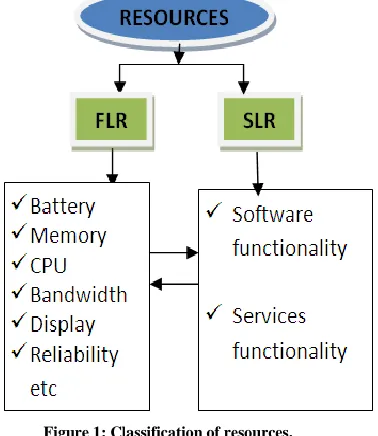
In this section we differentiate resources of MANET and its relationship. Following figure 1 shows the classification of resource. This classification is used to manage different
resources of MANET. In this time MANETs
[image:2.612.317.572.191.415.2]communication importantly needs to develop a new approach that mange all the classified resources
Figure 1: Classification of resources.
In the above figure 1, MANET resources can be categorized in two categories;
1. First level Resources (FLR): such resources are Power,
CPU Capacity, Bandwidth, Memory etc.
2. Second Level Resources (SLR): in this level resources
are, required software services etc
IV. MANET ROUTING PROTOCOLS
[image:2.612.84.273.396.614.2]According several researchers Mobile Ad Hoc Networks, routing protocol design mechanism can be classified in several types [7-11]. These classifications are shown in figure 2.
Figure 2: Basic classifications of Routing Protocols.
A. Proactive (Table-Driven), Reactive & Hybrid Routing Protocols: In Proactive protocols, nodes maintain one or more routing tables about nodes in the network. It is updating the routing table information either from time to time. Reactive protocols seek to set up routes on-demand. If a node wants to initiate communication with a node to which it has no route, the routing protocol will try to establish such a route. The source node initiates route discovery process by flooding route query within the network. When the destination is reached, route reply request will be sent back to the source. Once the route has been found, it is maintained until either destination becomes inaccessible or the route is no longer desired then route discovery process will be invoked again. Hybrid protocols seek to combine the proactive and reactive approaches.
B. Topology and Destination based Routing Protocols:
Topology-based protocols use the principle that every node in a network maintains large scale topology information (principle is used in link-state protocols). Destination-based protocols only maintain topology information needed to know the nearest neighbors (principle is used in distance-vector protocols).
Destination -based Topology -based
Multi-channel Single-channel
Routing Protocol
Proactive
Reactive
Hybrid
Uniform
Non-uniform
Unicast
Multicast
International Journal of Emerging Technology and Advanced Engineering
Website: www.ijetae.com (ISSN 2250-2459,ISO 9001:2008 Certified Journal, Volume 4, Issue 6, June 2014)
726 C. Single and Multi channel Routing Protocols: It is also
possible to divide protocols according to
communications model. In this allocation protocols are for multi-channel (TDMA, CDMA) or single-channel (CSMA) use.
D. Uniform and Non-uniform Routing Protocols: In uniform protocols there is no hierarchy in network, all nodes send and response to routing control messages at the same manner. In non-uniform protocols the control traffic burden is reduced by separating nodes in dealing with routing information. It is possible to divide non-uniform protocols into two categories: Protocols focuses routing activity on a subset of its neighbors and protocols in which the network is topologically partitioned.
E. Uni-cast, Multicast and Geo-cast Routing Protocols:
[image:3.612.49.567.336.464.2]Protocols can be divided according the type of cast. Protocols can operate at uni-cast, multicast or geo-cast situations. In uni-cast one source transmits routing messages to one destination. Uni-cast protocols are the most common in ad hoc networks. Multicast protocols construct a routing tree or a mesh from one source to several destinations. These protocols are also needed to keep up the information of joins and leaves to multicast group. Geo-cast protocols deliver data packets for a group of nodes which are situated on specified geographical area.
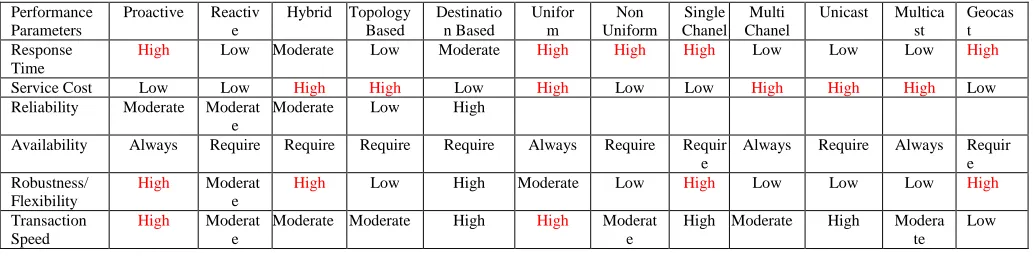
Table 1
Shows the comparisons of different routing protocols design Mechanisms
Performance Parameters
Proactive Reactiv e
Hybrid Topology Based
Destinatio n Based
Unifor m
Non Uniform
Single Chanel
Multi Chanel
Unicast Multica st
Geocas t Response
Time
High Low Moderate Low Moderate High High High Low Low Low High
Service Cost Low Low High High Low High Low Low High High High Low
Reliability Moderate Moderat e
Moderate Low High
Availability Always Require Require Require Require Always Require Requir e
Always Require Always Requir e Robustness/
Flexibility
High Moderat
e
High Low High Moderate Low High Low Low Low High
Transaction Speed
High Moderat
e
Moderate Moderate High High Moderat e
High Moderate High Modera te
Low
In the above table we compare several routing mechanism using some parameters like Response Time,
Service Cost, Reliability, Availability, Robustness/
Flexibility and Transaction speed. Based on this comparison we select some routing protocols for studies. These protocols are; OLSR, TORA, DSDV, AODV, and DSR.
OLSR: OLSR is a proactive or table driven, link-state routing protocol. Link-state routing algorithms choose best route by determining various characteristics like link load, delay, bandwidth etc. Link-state routes are more reliable, stable and accurate in calculating best route and more complicated than hop count. To update topological information in each node, periodic message is broadcast over the network.
Multipoint relays are used to facilitate efficient flooding of control message in the network. Route calculations are done by multipoint relays to form the rout from a given node to any destination in the network. The OLSR protocol is developed to work independently from other protocols.
Conceptually, OLSR contain three generic elements: a mechanism for neighbour sensing, a mechanism for efficient flooding of control traffic, and a specification of how to select and diffuse sufficient topological information in the network in order to prove optimal routes [12-14].
International Journal of Emerging Technology and Advanced Engineering
Website: www.ijetae.com (ISSN 2250-2459,ISO 9001:2008 Certified Journal, Volume 4, Issue 6, June 2014)
727 DSDV: Destination-Sequenced Distance-Vector Routing Protocol (DSDV) is a table-driven routing scheme. Each entry in the routing table contains a sequence number, the sequence numbers are generally even if a link is present; else, an odd number is used.
The number is generated by the destination, and the emitter needs to send out the next update with this number. Routing information is distributed between nodes by sending full dumps infrequently and smaller incremental updates more frequently [16]. DSDV protocol guarantees loop free paths. Extra traffic is avoided. DSDV maintains only the best path instead of maintaining multiple paths to every destination. This protocol requires a regular update of its routing tables, which uses up battery power and a small amount of bandwidth. Whenever the topology of the network changes a new sequence number is necessary.
AODV: Ad hoc On-demand Distance Vector Routing (AODV) is a novel algorithm for the operation of ad hoc networks. Each mobile node operates as a specialized router and routes are obtained as needed i.e. on-demand with little or no reliance on periodic advertisements. The new routing algorithm is quite suitable for a dynamic self starting network as required by users wishing to utilize ad hoc networks. AODV provides loop free routes even while repairing broken links. Because the protocol does not require global periodic routing advertisements, the demand on the overall bandwidth available to the mobile nodes is substantially less than in those protocols that do necessitate such advertisements. AODV can be called as a pure on demand route acquisition system, in this nodes do not lie on active paths neither maintain any routing information nor participate in any periodic routing table exchanges. Further, a node does not have to discover and maintain a route to another node until it needs to communicate. To maintain the most recent routing information between nodes the concept of destination sequence numbering will be used. Each ad hoc node maintains a monotonically increasing sequence number counter which is used to supersede stale cached routes.
DSR: Dynamic source routing protocol (DSR) is an on
demand, source routing protocol, whereby all the routing information is maintained (continually updated) at mobile nodes. DSR allows the network to be completely self-organizing and self-configuring, without the need for any existing network infrastructure or administration. The protocol is composed of the two main mechanisms of "Route Discovery" and "Route Maintenance", which work together to allow nodes to discover and maintain routes to arbitrary destinations in the ad hoc network.
An optimum path for a communication between a source node and target node is determined by Route Discovery
process. Route Maintenance ensures that the
communication path remains optimum and loop-free according the change in network conditions, even if this requires altering the route during a transmission. The fundamental approach of this protocol during the route creation phase is to launch a route by flooding Route Request packets in the network. The destination node, on getting a Route Request packet, responds by transferring a Route Reply packet back to the source, which carries the route traversed by the Route Request packet received. DSR uses no periodic routing messages like AODV, thereby reduces network bandwidth overhead, conserves battery power and avoids large routing updates.
V. COMPARATIVE RESULTS
The main goal of this paper is to analyse the performance of different MANETs routing protocol with different parameters. In our comparative analysis, we collect the result of different sources [15, 17, 18, 19, 20, and 21] and final this result also compare in ORIGIN software. For calculating the performance of different routing protocol (OLSR, ZRP, DSDV, AODV, and DSR). We require both qualitative as well as quantitative metrics. Some of the quantitative metrics are used to compare the performance of different routing protocols which are as follows:
1. Packet delivery ratio- It is the ratio of total number of packets successfully delivered to the destination nodes to the total number of packets send by the source nodes. It basically describes the percentage of packets that reach the destination.
2. Average End to End delay- It is the total time taken by all the packets to reach the destination.
International Journal of Emerging Technology and Advanced Engineering
Website: www.ijetae.com (ISSN 2250-2459,ISO 9001:2008 Certified Journal, Volume 4, Issue 6, June 2014)
728 A. Packet Delivery Ratio (PDR):
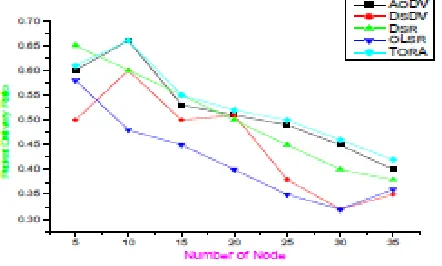
[image:5.612.327.561.202.376.2]Figure 5.1: Packet Delivery Ratio vs. Number of Nodes The figure 5.1 describes the Packet Delivery Ratio vs. Number of Nodes. Based on the above Figure 3, the performance AODV and TORA is better as comparison of DSDV, DSR and OLSR when the number of nodes increases.
Figure 3: Packet Delivery Ratio vs. Number of Nodes
The figure 3 describes the Packet Delivery Ratio vs. Number of Nodes. Based on the above, the performance AODV and TORA is better as comparison of DSDV, DSR and OLSR when the number of nodes increases.
[image:5.612.60.281.231.364.2]B. Node to Node Delay:
Figure 4: Node to Node Delay vs. Number of Nodes
The figure 4 describes the Average Node to Node Delay vs. Number of Nodes. The red line indicates DSDV performance which is more efficient than AODV, DSR, OLSR and TORA performance with respect to Node to Node Delay.
In terms of the scalability of the network by increasing the number of nodes, DSDV performs better than AODV, DSR, OLSR and TORA; because it selects the only nodes have the secure path with strongest link as the next hop towards the destination.
C. Uses Power Comparison:
Figure 5: Energy vs. Number of Nodes
The figure 5 describes the Energy vs. Number of Nodes. According the results of above graph we find that no such schemes are suitable for energy saving because the numbers of nodes are increase the behaviour of such schemes is changed. But the result of TORA routing protocol is better as compared to other Routing Protocols.
VI. CONCLUSION
[image:5.612.65.277.460.616.2]International Journal of Emerging Technology and Advanced Engineering
Website: www.ijetae.com (ISSN 2250-2459,ISO 9001:2008 Certified Journal, Volume 4, Issue 6, June 2014)
729 REFERENCES
[1] Ammar Odeh, Eman Abdel Fattah and Muneer Alshowkan, “Performance Evaluation Of AODV And DSR Routing Protocols In Manet Networks”, International Journal of Distributed and Parallel Systems (IJDPS) Vol.3, No.4, year (July 2012).
[2] Madhu Lakshmi, Ashwani Kumar, Nitin Arora, “Green Networking in Practice: Performance evaluation of Routing Protocols for ad-hoc Networks based on Energy Consumption”, IJAIEM, ISSN 2319 – 4847, Volume 2, Issue 7, pp.164-167, year (july-2013).
[3] C. E. Perkins, “Ad hoc networking: an introduction. Addison-Wesley Longman Publishing Co.”, Inc., Boston, MA, USA, year-2001.
[4] G. Vijaya Kumar, Y.Vasudeva Reddyr, Dr.M.Nagendra, “Current Research Work on Routing Protocols for MANET: A Literature Survey”, International Journal on Computer Science and Engineering Vol. 02, No. 03, pp. 706-713 Year-2010.
[5] Mohamed Belkheir, Zeyad Qacem, Merahi Bouziani and Abderrahmane Ghelamellah, An Energy Optimization Algorithm for Mobile Ad Hoc Network, JSCSE, e-ISSN: 2251-7545, Vol.2,o.10,pp.20-26, year-2012.
[6] Gerald Kaefer, Reiner Schmid, GuenterProchart, and ReinholdWeiss, Framework forDynamic Resource-Constrained Service Composition for Mobile Ad Hoc Networks, This workis part ofthe PalCom project. http://www.ist-palcom.org/.
[7] Swati Jaiswal, Satya Prakash, Neeraj Gupta, Devendra Rewadikar, Performance Optimization in Ad-hoc Networks, IJCTEE, ISSN 2249-6343, Volume 1 , Issue 2,pp. 130-135, year-2011.
[8] Dr.S.S.Dhenakaran and A.Parvathavarthini, “An Overview of Routing Protocols in Mobile Ad-Hoc Network”, International Journal of Advanced Research in Computer Science and Software Engineering Research Paper, Volume 3, Issue 2, ISSN: 2277 128X, pp. 251- 259, Year (February 2013).
[9] Jameela AI-Jaroodi, “Routing Security in Open/Dynamic Mobile Ad Hoc Network”, the International Arab Journal of Information Technology, vol. 4, No. 1, pp. 17-26, year-2007.
[10] S. Gowrishankar, T.G. Basavaraju, M. Singh, Subir Kumar Sarkar, “Scenario based Performance Analysis of AODV and OLSR in Mobile Ad hoc Networks”, Proceedings of the 24th South East Asia Regional Computer Conference, November 18-19, 2007, Bangkok, Thailand.
[11] Autonomic Communication and Knowledge Plane Resource management in autonomic communication, S-38.4030.
[12] T.H. Clausen, ”The optimized link state routing protocol evaluating through experiments and simulation” mind pass center for distributed system, Aalborg university ,Denmark
[13] Kuldeep Vats, “Simulation and performance analysis of OLSR routing protocol using OPNET” IJARCSSE Volume 2, Issue 2, February 2012 .
[14] Kuldeep Vats, Monika Sachdeva, Dr. Krishan Saluja, Amit Rathee, Simulation and Performance Analysis of OLSR Routing Protocol Using OPNET, International Journal of Advanced Research in Computer Science and Software Engineering, Volume 2, Issue 2, February 2012 ISSN: 2277 128X.
[15] Sona Malhotra, Naveen Kumar, Performance Evaluation of Routing Protocols for Mobile Ad hoc Networks through Simulation, American International Journal of Research in Science, Technology, Engineering & Mathematics, ISSN (Print): 2328-3491, ISSN (Online): 2328-3580, ISSN (CD-ROM): 2328-3629, pp. 190-198. [16] C.E. Perkins and P. Bhagwat. “Highly dynamic Destination
sequenced distance vector routing (DSDV) for mobile computers”, Proc. Of ACM SIGCOMM, 1994.
[17] Abdul Hadi Abd Rahman, Zuriati Ahmad Zukarnain, “Performance Comparison of AODV, DSDV and IDSDV Routing Protocols in Mobile Ad Hoc Networks” European Journal of Scientific Research ISSN 1450-216X Vol.31 No.4 (2009), pp.566-576.
[18] MONALI SAHOO, AJAY LALA, ASHISH CHAURASIA, IMPLEMENTATION AND PERFORMANCE ANALYSIS EVALUATION OF A NEW MANET ROUTING PROTOCOL IN NS-2 , International Journal of Smart Sensors and Ad Hoc Networks (IJSSAN), ISSN No. 2248-9738 (Print), Vol-2,Iss-3,4, 2012,pp. 31-34.
[19] Nehal Jadeja, Roma Patel, Performance Evaluation of AODV, DSDV and DSR Routing Protocols Using NS-2 Simulator, ernational Journal of Engineering Research and Applications (IJERA) ISSN: 22489622 www.ijera.com Vol. 3, Issue 2, March -April 2013, pp.1825-1830.
[20] Durgesh Wadbude, Vineet Richariya, An Efficient Secure AODV Routing Protocol in MANET, International Journal of Engineering and Innovative Technology (IJEIT) Volume 1, Issue 4, April 2012, ISSN: 2277-3754, pp.274-279.