A Cost Effective Automatic Online Bus
Information System using RFID and ZigBee
P. Prudhvi Kiran#1, R.Daniel, Associate Professor*2 ,K.Venkata Prasad#3 #
Department of Information Technology, Jawaharlal Nehru technological University-Kakinada First-Third University Vignan's Institute of Information Technology, Visakhapatnam, Andhra Pradesh, India.
*
Department of Information Technology,
Vignan's Institute of Information Technology, Visakhapatnam, Andhra Pradesh, India.
Abstract— Nowadays, transportation plays a very important role for students in the day to day life of the educational institutions, these institutes are mostly located out of cities. Need of monitoring the travel time and driver information are the major components of traveller information system in the institutions. The travel time of buses varies depending on some parameters such as Bus Drivers doesn't follow time schedules, negligence and beyond the speed limits. Monitoring the bus travel time information can give many advantages such as reducing accidents leaded by over speed, time delay, and miscellaneous activities of drivers.
In this paper, a cost effective idea is proposed, i.e., integration of Radio Frequency Identification (RFID) with Zigbee. When compared with existing RFID and other technologies, the proposed system gives more reliable, cost effective and fast means of long distance objects identification.
Keywords— RFID, Zigbee, Driver, ATIS, Database, and Bus.
I.INTRODUCTION
As the world enters the 21st century, the quality of education continues to be a major factor in a nation’s ability to succeed and excel. Travel time information becomes a major component of Advanced Traveller Information System (ATIS) [2]. Transportation facilities is essential for students in educational institutions because many of the educational institutions are out of city. Due to this many college/schools bus drivers not following time schedule. As the time is said to be eternal, logging the timings of the transport means like a bus is essential in all educational institutions. Especially in educational institutions both driver information and bus information is logged by the gate keeper and maintains manual reports. This manual process may not accurate to monitor the bus and driver information for right arrival times of the buses in the campuses of educational institutes. This generates many disadvantages like :
1. Wrongly recorded travel in and out timings may happen in the manual entry processes.
2. Difficult to identify which driver driving in which bus when the institute having large number of buses.
3. Miscellaneous driver activities may leaded by over speed, time delay and other activities.
There is a need of monitoring the travel time and driver information. So that, in this paper a cost effective idea is proposed by integration of Radio Frequency Identification (RFID) with Zigbee. There are many RFID and other related technologies giving solutions to above mentioned problems, they are mainly having the following drawbacks:
1. Very high cost- using RFID the read range is increases from antenna to tag, increases cost.
2. These technologies may not accurate and reliable. 3. Small and Middle range managements of educational institutes may not show interest in using costly technologies.
By keeping the above mentioned drawbacks, a cost effective idea is proposed by integration of Radio Frequency Identification (RFID) with Zigbee. This proposed system employs the wireless communication [3] device Zigbee concept along with RFID technology in a cost effective, long distance object detection and easily deployable manner for this task of logging Bus and Driver information in detail and this can be used anywhere where the transportation need is met with. When the read rage of RFID devices increases, the cost of that device also increases. The Important module of this system is ‘in time, out time’, and in which bus the driver is recorded daily. Monitoring this information can give many advantages like reducing accidents leaded by over speeding and monitoring driver activities even many more. With technological advancement of the world all the manual works are replaced by automation. In this case now-a-days logging information is also mostly done in tech manner and only in very few cases hand written log books can be seen. There are many advanced technologies are existed for accomplishing this task but as per our knowledge of survey they are costly, less available and hard to deploy in all situations.
Since this time, RFID technology has been evolving to change the way people live and work. Many previous research projects have explored the possibility of integrating RFID in different areas, from toll collection [4], agriculture [5], access control [6], supply chain [7], logistics [8], healthcare [9], and library [10].
Processes of proposed System:
Fig. 1 shows the complete processes of proposed system. When the bus arrived at the gate the guard will scan the RFID card of the bus and next he will scan that bus driver’s card which is given previously. Then the details of the bus and the driver details will be sent to the database and stored in the form. This can be reviewed by the transport administrator and can be printed/stored in .xls form.
Fig.1. processes diagram of proposed system
Advantages of proposed system over existing systems:
- It very Low cost device compared to other existing technologies for long distance object detection. - The maintenance of this system is very easy,
because there no much hardware and software components.
- This is Controller less device. - Operated by a simple JAVA / C code - Data can be monitored through web enabled
device with in network.
- Future enhancements can be done easily. - It can be easily deployed anywhere.
- All economical ranges of educational institutions can afford.
In Section II, related work in RFID applications Zigbee is discussed. The proposed system architectures are introduced in Section III. System implementation and methodology is presented in Section IV. The experimental results are discussed in section V. Finally, a brief conclusion and future work are given in Section VI.
II.RELATED WORK
In this section, RFID applications and smart environment researches are reviewed.
RFID applications there are three major components of an RFID system: the reader, the antenna, and the tags [14]. Each tag is associated with a unique number. When a tag is in the detection range of the reader, the number is read. Two types of tags can be found: active tags with a longer detection range and passive tags with a shorter detection range [14]. An RFID tag is usually attached to an object and the information of the object along with the RFID number are recorded in the database. Whenever the RFID tag is sensed, the object can thus be identified.
The papers to be discussed here are more advanced applications. One of the papers deploys a large amount of RFID tags in an office, a conference venue or other public places. The user can use mobile devices to receive desired information like locations or maps, also the user can leave a message to a certain person. Besides, the maps can be retrieved by the rescue crew in emergency through a tag [15]. RFID was also applied to home cooking. First, RFID
tags are attached to ingredients and utensils. The system can automatically provide video instructions to the user according to the detected movements of the user. The user needs not check the cook book step by step [16].
Another paper proposed a client-server architecture that can remotely control home appliances via mobile devices. Massive RFID tags are distributed in the environment for location awareness. The advantages of this system are less power consumption and design complexity [17]. In medical care, there is an RFID application related to medicine taking. RFID tags are attached to medicine bottles and the reader is placed in the drawer storing the medicine. The system can help the elderly people to record their medicine-taking data and determine whether they have taken the right medication with right dosage [18]. On the other hand, the assessment of independent living ability for the elderly can also be done by the RFID technology. RFID tags are attached to the tools used in our daily life. Readers are placed on different body parts of the elder. Home activities of the elder can thus be recorded [19-20]. Above-mentioned researches were keen to use the RFID technology to provide the users with convenient services[21]. Although the RFID tags deployed in the public areas can help reach the goal, the tag price is still too high to make it feasible in real applications. In addition, using RFID to detect user's activities requires the user to carry RFID readers. This is very inconvenient to the user. Hopefully, the RFID reader can become much smaller and light-weighted in the near future.
Ref. [22] presents a novel bus priority control system for the Advanced Public Transportation System (APTS) based on wireless sensor networks and ZigBee. Authors of [23] reported the use of ZigBee RF nodes for data packet transmission in an intra-car wireless environment.
III.PROPOSED SYSTEM ARCHITECTURE
There are two levels of architectures are proposed to develop this system, they are
1. Hardware architecture
2. Web Enable Software architecture
Hardware Architecture:
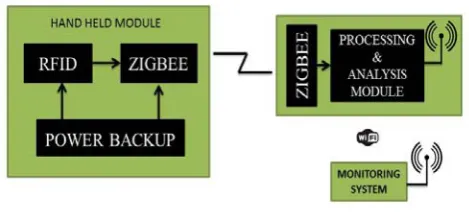
Fig.2 Proposed Hardware Architecture
And also the GND pins are directly connected between them. In this system every bus is equipped with a RFID card near the driver’s window, so that it will be easy to the gate guard to scan the RFID card with our hand held scanner (reader). And even for the every driver a RFID card is given, whereas the driver name also have to be in the log. The specification of this module is 125kHZ.
ZIGBEE: ZigBee has been developed to meet the growing demand for capable wireless networking between numerous low power devices. This new level of communication permits finely-tuned remote monitoring and manipulation [24-25]. This is one of the familiar components of wireless sensors based on an IEEE 802.15 standard. ZIGBEE[14] is a specification for wireless personal area networks (WPANs) operating at 868 MHz, 902-928 MHz, and 2.4 GHz. A WPAN is a personal area network (a network for interconnecting an individual's devices) in which the device connections are wireless[18].
Using ZIGBEE, devices in a WPAN can communicate at speeds of up to 250 Kbps while physically separated by distances of up to 50 meters in typical circumstances and greater distances in an ideal environment here we are using two ZIGBEE modules. One acts as receiver and another as a transmitter. Probably the receiver is at the PC and the transmitter will be at the hand held device. Whenever the reader in the device scans the RFID tag of the bus/driver then the details in that card are read by the RFID reader and the transmitter ZIGBEE will send them to the receiver ZIGBEE and then to the PC from there i.e. to the database.
Power Backup: consists of 12v battery charging with 15 v DC adapter The output of this connected to the RFID module and Zigbee module and its charging capacity is 5hrs.
Processing and Analysis Module: It is main system where the program will run and all the recorded details are stored. As this system is connected in the network through Wi-Fi, one can access this from anywhere. The detailed web enabled architecture is shown in fig.3.
Monitoring System: Through Wi-Fi the data can be
accessed from processing and analysis module which can be viewed/printed.
Web Enable Software Architecture
The layer wise software architecture show in Fig.3.This system consist of e four layers.
1. Interface layer 2. Middleware layer 3. Communication layer 4. Physical Layer
Fig.3 Web Enabled RFID and ZIGBEE Architecture
Communication Layer: This layer provides Three stages of communication:
1. between rfid and zigbee within hand held device. 2. between zigbee of hand held device and zigbee which connected to processing module.
3. between processing module and monitoring system through Wi-Fi.
Processing Layer: This layer having system programming, database user interface, application code, and XML interface.
System programming: Serial communication patterns are used here. Serial communication is the process of sending data one bit at a time, sequentially, over a communication channel or computer bus. This is in contrast to parallel communication, where several bits are sent as a whole, on a link with several parallel channels. Basically we worked on windows-XP operation system.
Application code:As java is a concurrent,
class-based, object-oriented, and specifically designed to have as few implementation dependencies as possible, all our control code is written in java. And database connectivity is established from Oracle server software.
XML Interface: Extensible Mark-up Language (XML) is
a mark-up language that defines a set of rules for encoding documents in a format that is both human-readable and machine-readable. Design goals of XML emphasize simplicity, generality, and usability over the Internet.
Database user interface: A database is an organized collection of data. The data are typically organized to model relevant aspects of reality in a way that supports processes requiring this information. The interface is designed in such a way for example, modelling the availability of rooms in hotels in a way that supports finding a hotel with vacancies. Interface developed in such a way that survey can also be done
.
IV.METHODOLOGY
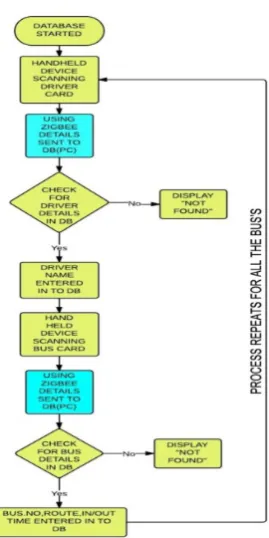
The proposed system working processing methodology for the developed of system is explained in the following algorithm and flow chart.
Algorithm :
Step 1: Data base and other program modules starts with switching on the system.
Step 2: Hand held device is checked for charging and kept ready.
Step 3: When bus arrived at the institue gate , the watch man goes to bus with hand held device and shows it to driver and bus RFID cards.
Step 4: The hand held device sends this information to processing module.
Step 5: If the RFID card data of the driver and bus are matching with database data, then the driver report and bus report tables are updated.
Step 6: Once the driver and bus report tables are updated , then the final report table updated with fields like bus no., route name, driver name, etc.,.
Flow chart :
Fig.4 Flowchart for execution processes of proposed system
V.EXPERMENTAL RESULTS
Development of Hand Held Device:
The detailed pictorial description about the construction of hand held device shown in Fig. 5.
Fig.5. Development Stages
Database Tables:
The enrolled details of driver and bus with their respective RFID TAG numbers are stored in the Oracle data base as shown in the Fig. 6 and Fig. 7.
Fig. 6 Driver enrolment details.
Fig. 7 Bus enrolment details.
Report:
Fig.7 shows the live data displayed at remote PC, called as a monitoring system located at the office room. The report gives an automatic in and out timings along with the current driver information, so that there is no need of maintaining hand written logs.
Fig. 8 Driver enrolment details.
The results shown in the above figure indicating that if any bus not arrived in specified time to the campus are automatically visualized in red mark, so that the respective action can be taken by the management on driver.
Results and Discussions:
VI.CONCLUSIONS
The RFID and Zigbee are emergent technologies which are used in wide range of applications. In this paper generated an effective solution called "Automatic Bus and Driver Online Information System " by integrating both RFID and ZigBee. This system has given the reliable and low cost results when compared with other related existing technologies. The design, implementation, and maintenance of this system is very easy because there no much hardware and software complexity. In future the entire system will be automated based on web enabled processor that can give more effective results.
ACKNOWLEDGMENT
I consider it as a privilege to thank all those people who helped me a lot for successful completion of this paper. First of all I would like to thank our beloved CEO of VIIT Mr. K.Pavan Krisna who has given me a lot of support and freedom during my work. I would like to thank Principal of Vignan’s Institute of Information Technology Dr. K. Alice Mary, for her encouragement to me during the work. I would like to thank our ever-inspiring Head of the Department of Information Technology, Mr. B. Prasad, for his spontaneous response to every request though he was busy with his hectic schedule of administration and teaching. I would like to express my deep sense of thanks to all my Teaching Staff for enlightening me with constructive suggestions for solving my problems patiently and helping me to improve the quality of work.
REFERENCES
[1] Roy S, Jandhyala V, Smith JR, Wetherall DJ, Otis BP, Chakraborty R, Buettner M, Yeager DJ, Ko Y-C, Sample AP. RFID: From supply chains to sensors nets. Proceedings of the IEEE, vol. 98, no. 9, September 2010.
[2] Ran HeeJeong, and Laurence R. Rilett (2004) “The Prediction of Bus Arrival Time Using AVL Data”, Transportation Research Board 83rd Annual Meeting, Washington D.C.
[3] Liu H, Bolic M, Nayak A, Stojmenovic I. Taxonomy and challenges of the integration of RFID and wireless sensor networks.IEEE Network. November / December 2008, 26- 32
[4] J. Bohn, “Prototypical Implementation of Location-Aware Services Based on a Middleware Architecture for Super-Distributed RFID Tag Infrastructures,” Proc. 19th International Conference on Architecture of Computing Systems (ARCS06), 2006, pp.155-166. [5] Y. Nakauchi, T. Suzuki, A. Tokumasu, and S. Murakami, “Cooking
Procedure Recognition and Support System by Intelligent Environments,” Proc. IEEE Workshop on Robotic
Intelligence in Informationally Structured Space (RIISS '09), 2009, pp.99-106.
[6] M. Darianian, and M. Peter Michael, “Smart Home Mobile RFID- Based Internet-of-Things Systems and Services,” Proc. 2008 International Conference on Advanced Computer Theory and Engineering, 2008, pp.116-120.
[7] E. Becker, V. Metsis, R. Arora, J. Vinjumur, Y. Xu, and F. Makedon, “Smart Drawer: RFID-Based Smart Medicine Drawer for Assistive Environments,” Proc. 2nd International Conference on PErvsive
Technologies Related to Assistive Environments (PETRA’09), 2009.
[8] M. Stikic, T. Hunh, K. V. Laerhoven, and B. Schiele, “ADL Recognition Based on the Combination of RFID and Accelerometer Sensing,” Proc.Second International Conference on Pervasive Computing Technologies for Healthcare (Pervasive Health 2008), 2008, pp.258-263.
[9] T. K. Nguyen, et al., A low-power CMOS direct conversion receiver with 3-dB NF and 30 kHz flicker-noise corner for 915-MHz band IEEE 802.15.4 ZigBee standard, Vol. 54, 2006
[10] X. Su, C. Chu, B.S. Prabhu, and R. Gadh “On the Identification Device Management and Data Capture via WinRFID Edge Server”, IEEE Systems Journal, 1(2), Dec 2007, 95- 104.
[11] Mark Cracknell( 2007) “Image detection in the real world ” , Intelligent Transportation Systems ITS’07 Aalborg.
[12] Mark Cracknell (2008) “Image detection in the real world ” , Intelligent Transportation Systems World Congress ITS WC 2008, New York.
[13] Qing-Jie Kong, Yikai Chen, and Yuncai Liu,(2009) "A fusion-based system for road- network traffic state surveillance: a case study of shanghai," IEEE Intelligent Transportation Systems Magazine, vol. 1, no. 1, pp. 37-42,
[14] Sheng, Q.Z., Li, X. and Zeadally, S. (2008) “Enabling Next-Generation RFID Applications: Solutions and Challenges”, IEEE Computer, Vol 41 No 9, pp 21-28,
[15] “RFID Journal,” http://www.rfidjournal.com/, last accessed September 9, 2010.
[16] ZigBee Alliance, ZigBee Specification, ZigBee Document 053474r06, version 1.0, 2005.
[17] P. Brennan, S. Daugherty, A. Hughes and S. Vemuru (2008) “Designing a Wireless Personnel Tracking System”, ASEE NCS Conference Agenda.
[18] EPCglobal Specification for RFID Air Interface, "Radio-frequency identity protocols class-1 generation-2 UHF RFID protocol for communications at 860 MHz - 960 MHz," version 1.0.9, Jan. 2005.
[19] OECD, Implementing Sustainable Urban Travel Policies –National Reviews, ECMT(European Conference of Ministers ofTransport), 2003, Paris.
[20] A. Aguiar, F. Nunes, M. Silva, D. Elias, Personal Navigator for a Public Transport System using RFID Ticketing, In Motion '09: Pervasive Technologies for Improved Mobility and Transportation Conference, Japan 2009.
[21] M. Mudigondal, A. Ramani, V. Subramanian, Applications of RFID in Public Transport System to Aid the Visually Challenged, IEEE Indicon, Conference, December 2005Chennai (India). [22] Z. Wu; H. Chu; Y. Pan; X. Yang; Bus priority control system based
on wireless sensor network (WSN) and zigbee, in Vehicular Electronics and Safety, 2006. ICVES 2006. IEEE
International Conference on, Dec. 2006, Page(s): 148–151. [23] H. M. Tsai, C. Saraydar, T. Talty, M. Ames, A. Macdonald, O. K.
Tonguz; Zigbee- based intra-car wireless sensor network, in Communications, 2007. ICC ’07. IEEE International Conference on, June 2007, Page(s): 3965–3971.
[24] S.S.Riaz Ahamed; The Role of ZigBee Technology in Future Data Communication System, Journal of Theoretical and Applied Information Technology, Vol.5, No.2, 2009.