Volume 8, No. 5, May – June 2017
International Journal of Advanced Research in Computer Science RESEARCH ARTICLE
Available Online at www.ijarcs.info
Fuzzy Mean Shift Algorithm for Low Level Feature based Image Retrieval with
Relevance Feedback
S. Janarthanam
Assistant Professor, Dept. of Computer Science, Gobi Arts & Science College
Erode, Tamilnadu, India
Dr S. Sukumaran
Associate professor, Dept. of Computer Science, Erode Arts & Science College
Erode, Tamilnadu, India
Abstract— Effective searching and retrieval of images primarily based on their content is the inflexible in digital image processing. This work introduces a fuzzy rule-based algorithm absolutely resolve with the real content material of an image and the shade constancy. The Proposed fuzzy imply shift set of rules has been taken into consideration for the accurate remotion of the illuminant, except showing a high-quality colour enhancement on pictures. A deterministic centroid initialization method used to cluster the segmented blocks. The overall performance analysis has accomplished with the measures inclusive of Root Mean Square Error and Number of iterations. Motif co-occurrence matrix is the traditional pattern co-occurrence matrix calculates the probability of the occurrence of equal pixel colour among each pixel and taken into consideration of the characteristic of the image. The design of fuzzy rule-based system is trivial obligations are concerned in the selection generated features of images gathered from SIFT, SURF or PCA algorithms. The ensuing key factors decreased by means of statistics clustering, parameter less version of the mean shift algorithm.
Keywords-cluster;color features; fuzzysets; pattern extraction; similarity; relevance feedback; image retrieval
I. INTRODUCTION
The trouble of searching and retrieving an image from a large, dispensed, unstructured repository based at the picture’s contents has attracted the eye of researchers from the Image Processing and Computer Vision network. Finding an image from a huge set of snap shots is extremely hard work. One solution is to label pix manually is very pricey, time ingesting and infeasible for lots packages. Furthermore, the labeling procedure depends on the semantic accuracy in describing the image. Therefore, much content material primarily based photograph retrieval structures are evolved to extract low stages functions for describing the photo content material [1]. Content based seek will examine the real contents of the photo content material refers to colors, shapes, textures, or some other data can be derived from the photo itself [2]. The content material based image retrieval techniques aim to reply to a query image with comparable resultant photos received from the photograph database.
The databases are pre-processed for extracting, storing and indexing the corresponding photo capabilities based totally on the question request [4, 5]. The query picture processed for extracting functions are in comparison with functions of database images with the aid of utilizing appropriate similarity measures for retrieving query similar photographs [3]. Clustering is probably greater advantage for reducing the searching time of pictures inside the database. Various clustering techniques [6] like Side-facts, kernel mapping, hierarchical, metric to know are utilized in image retrieval. However, cutting-edge research placed a sizeable hollow among visual abilities and semantic features used by humans to provide an explanation for pix. In order to bridge the semantic hole, a few researchers have proposed strategies for handling and decreasing photo capabilities, and extract beneficial capabilities from a characteristic vector. In order to reduce the semantic hole, the proposed photo retrieval device used with relevance remarks to decorate the retrieval normal performance. Each photograph in the image retrieval device is represented by way of its competencies along with functions deal with texture abilities and shape capabilities. These
organizations of abilities are stored in the characteristic vector. Therefore each photo managed through the CBIR system is associated with feature vectors [8]. As a result, the storage region required for function vectors is proportional to the amount of pics inside the database. In addition, when evaluating the function vectors, the CBIR gadget understand the photos inside the database are similar to every other [7]. Even so, researchers are managing problems while running with large photo database because of the fact so much time is spent to assess big feature vectors that require big quantity of memory to run the CBIR machine. Due to this trouble, characteristic discount strategies are employed as a way to alleviate the garage and time necessities of large characteristic vectors.
fast of fuzzy rule encoding the know-how important to take a desire about the well-perfect set of regulations to be applied to an image below attention and converts the RF into an optimization set of policies via more efficient and computationally-powerful strategies. To restate the troubles of locating the image fits a given person query optimizes the requested photograph features.
The rest of this paper is organized as follows. Section 2 presents the proposed work and introduces the image dataset used and the techniques for color consistency and Relevance Feedback. A section 3 detail the image features used and in Section 4 shows the design of the fuzzy system and the section 5 displays the experimental results obtained by experimental tests and comparing techniques. Finally, the conclusions are presented in Section 6.
II. PROPOSED APPROACH
A. Feature representation
This paper proposed the technique for the mixture of shade, texture and form features collectively covered two essential steps. First one is prepared to crop the principle item a part of the query and database photographs primarily based on top-hat rework as a form detector [10]. Second step is protected a set of rules for extracting capabilities from element image. Color Local Binary Patterns (CLBP) and neighborhood variance are used as feature exactors on this step. According to the scale of massive picture databases, the proposed pre-processing algorithm reduces computational complexity earlier than retrieving.
Figure 1. The CBIR Block Diagram
Figure1. Block Diagram of CBIR
The proposed set of rules compares non- similarity amount between query image and each class to brush aside near classes [11]. The performance of the proposed technique is evaluated by making use of image units in terms of precision, recall and compared by way of other domain of the CBIR algorithms. The Figure.1 Shows the block diagram of CBIR. Low noise sensitivity, rotation invariant, grey scale invariant, shift invariant and Low computational complexity are the other benefits of proposed approach are proven inside the result phase.
B. Preprocessing
The pre-processing algorithms are crucial inside the small target detection. Irrespective of the approach chosen, the pre-processing to carry out the duties of improving the isolated
points, small targets occupy single isolate pixel of the photograph plane, retaining the edge statistics and giving a susceptible reaction within the homogenous area [14]. The proposed pre-processing set of rules evaluated at the image orientation and dense matching issues. The principal idea is (i) to limit typical failure causes [15] because of modifications inside the illumination situations or low assessment blobs areas and (ii) to enhance the performances of reconstruction strategies. The pipeline is grounded on the evaluation of many distinct present day algorithms aiming to provide solutions at unique problems and adapt the maximum promising algorithm for creating an ad-hoc method and a typical answer to improve the image first-rate.
The pre-processing step of CBIR systems concentrates on improving the translation of the image information and to enhance the characteristic extraction and picture looking. Spatial modifications in picture appearance like textures can be cut up into smaller segments, leading to over-segmentation. The segmentation set of rules can also integrate collectively small areas of different functions like color or texture leading to the hassle of underneath segmentation. Problems may additionally arise while a few function within the picture, although great in length when blended collectively, are scattered over the photo are lost at some stage in segmentation. Hence the prevailing research images propose picture retrieval techniques based on contents.
C. Top Hat Transform
The groups of image operations procedure the image based on shapes are referred as morphological operations. In morphological operations the output picture is created with help of structuring element to the input. In every pixel of the output is based totally on a comparison of the corresponding pixel within neighbours [13]. Top-hat transform is an operation extracts small factors and details from given photos. There exist two sorts of top-hat remodel, the white top-hat remodel is defined because the distinction between the enter image and its establishing with the aid of some structuring element Equation 1. The black pinnacle-hat transform is defined dually as the distinction among the closing and the enter picture Equation 2.
1
I
(
I
S
)
(1)
T
= −
2
(
)
)
(2)
T
=
I
•
S
−
I
Where I means the input image and S is the structure element. T1 shows the white top-hat transform output and T2 shows the black top-hat transform output. Also, o denotes the opening operation and ● denotes closing operation [12].
D. Color Model
The CBIR is the easy and powerful techniques to deal with the color and form characteristic based retrieval. Consider the typical performance, the numerous lengths of photographs database, the accuracy of retrieval and the capacity to advantage a correct ranking for the retrieved photos. Color features are the maximum vital visible capabilities, at the identical time as texture has no fee without the association of color [16]. The proposed method extract the color contents of every image from every database picture and then the database images are clustered [17].
For the selection to acquire chromatic improvement of our technique has the MISO (Multiple Input, Single Output) machine, together with inputs computed from the scene under evaluation output. The work has been divided into number
Images Query Image
Feature Extraction Extracted Feature
Similarity Index
Compare Image Feature
segments. Thw protocol determines the hairy rules, in line with functions computed from a hard and fast of education pics. On the alternative hand, in a attempting out mode, given a check picture, the incredible set of rules is selected in step with the rule evaluation in inference fashions, Mamdani [18] and Larsen [19]. The courting of the colour intensity underneath a mild supply in a picture is given by means of
( , )
( , ) ( , )
(3)
i i i
f x y
=
G x y R x y I
Where fi(x,y) is the pixel intensity at the position (x,y), G(x,y) is a geometry factor, Ri(x,y) is the reflectance of the object, Ii is the illuminant, and i corresponds to the color channel. Once a color constancy algorithm is applied over an image fi(x,y), the outcome, oi(x, y), just depends on G(x, y) and Ri(x, y). Color constancy algorithms assume that the output images oi(x, y) =G(x, y) Ri(
( , )
( , )
( , )
( , )
i(4 )
i i
i
f x y
o x y
G x y R x y
I
=
=
x, y) I’, are influenced by a white light source, where I’ = {1,1, 1}is the illuminant in the output. Then, the relation between the output and the input as shown by equation 4 as,
All pixel intensities are scaled in step with the illumination computed the use of Eq. (4). Finlayson et al. [20] advanced this algorithm the usage of a 99 of percent within the histogram for every colour channel for the estimation of the illuminant enables to improve the retrieval accuracy with user relevance remarks.
E. Relevance feedback
Relevance feedback is an effective technique in CBIR structures, a good way to enhance the performance. It reduces semantic stage characteristic and excessive diploma semantics. The idea in the lower back of relevance remarks results is initially once more from a given question and to use applicable outcomes to carry out a new query [21]. The User remarks to the gadget are divided in additives brief term getting to know and long term studying. In long time studying past query and comments are stored and based totally at the query offers result in short time period mastering session. In short term studying each consultation has mutual end result unbiased of proceedings [22].
III. FEATURE EXTRACTION
Feature extraction is maximum critical step within the procedure of the CBIR. Features are categorized into three kinds are low, middle and excessive degree. Low level features are color, texture and Mid stage function is form and High degree function is semantic gap of items [23]. Color is by means of far the most common visual feature used in CBIR, normally due to the simplicity of extracting colour information from pix. Texture and shape also are key element of human visual perception. Like color, this makes it an essential feature to take into account when querying image databases.
A. Color feature
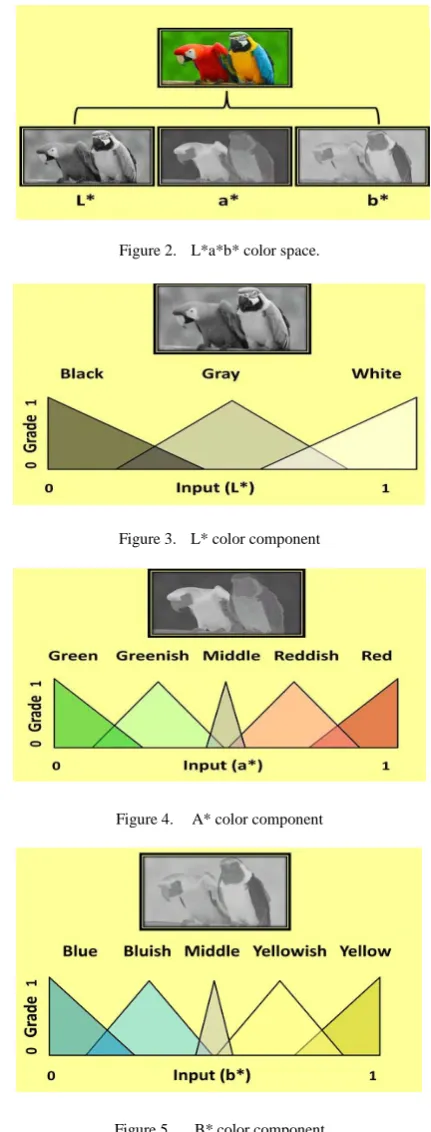
Colour characteristic is the maximum giant one in looking collections of shade images of arbitrary hassle depend. Colour performs very important position within the human visible notion mechanism. All strategies for representing colour function of a photograph can be labeled into establishments shade histograms and statistical strategies of color illustration proven inside the Figures 2 to 5.
[image:3.595.323.539.51.618.2][image:3.595.331.540.57.314.2]
Figure 2. L*a*b* color space.
Figure 3. L* color component
Figure 4. A* color component
Figure 5. B* color component
B. Texture feature
The Texture gives us facts on structural association of surfaces and items at the picture. Texture is not described for a separate pixel; it depends on the distribution of intensity over the photograph. Texture possesses periodicity and scalability residences; it can be defined by using main guidelines, evaluation, and sharpness. Texture analysis plays an essential position in assessment of pics supplementing the coloration feature. The most frequently used statistical features encompass, in spatial domain Gabor filter has been observed to be suitable for the feel representation and discrimination. For representing texture functions of pix became grey level co-occurrence matrices (GLCM) proposed through Haralick et al. [25]. Authors advised 14 descriptors, consisting of the angular 2d moment, evaluation (variance, difference moment), correlation, and others. Each descriptor represents one texture belongings. Therefore, many works as an instance as described in [26], are dedicated to choosing the ones statistical descriptors derived from the co-prevalence matrices that describe texture in the quality manner.
The Gaussian kernel is defined in 2-D as,
2 2
2 2
1
2 ( , , ) exp( ) (5)
2 2
x y G D x yσ
πσ σ
+
= −
In [27], first off, reworking color space from RGB version to HSI version, and then extracting shade histogram to form coloration characteristic vector, extracting the texture feature by means of the usage of gray co-incidence matrix and Applying Zernike moments to extract the shape features. Finally, combining the colour, texture and form features to form the fused characteristic vectors of entire image. Experiments on generally used picture datasets display that the proposed scheme achieves a very good performance in phrases of the precision, as compared with other strategies. Filtered photograph encompasses a few self-repeating design and highlights the texture characteristic.
C. Shape feature
Along with color and texture traits, shape of objects used for evaluation Methods for representing and describing shapes may be divided into groups: external methods, represent the area in term of its external traits, and internal constitute the location in terms of its internal traits. Shape capabilities are categorized into two types: boundary descriptors and place descriptors. Further they are labeled as (a) structural and (b) global. The international boundary descriptors encompass numerous signatures, Fourier descriptors and wavelet descriptors.
In [28] the proposed local matching of neighborhood capabilities is blended to do specific retrieval of item pics in an interactive way. First authors extracted multiple nearby features includes scale invariant feature rework (SIFT), nearby color moments and object contour fragments to sufficiently constitute the visual appearances of gadgets; To improve the SIFT set of rules, a robust method is proposed for picture retrieval based on the mixing of key factors and edges records in [29]. The method is powerful to translation, rotation and partial occlusion of the object a relevance to each vertex as a way to do away with the least important vertex. Once a vertex is eliminated, its neighboring vertices should be connected. This procedure is repeated until we acquire simplification of desired form of the relevance degree K is defined because it follows tables:
1 2 1 2
1 2
1 2
( , )
( , ) (6)
2 ( ( ) ( ))
s s ls s K s s
l s l s
β π =
+
Where β(S1, S2) is the normalized angle in radians between two
segments S1; S2 and l(S1), l(S2) are the length functions for
segments normalized with respect to the total length of the polygonal curve C. The lowest value of K (S1; S2) corresponds
to the least contribution to the curve C of arc S1∪S2
IV. SYSTEM DESIGN
.
A. Feature Selection and Similarity Matching
The fuzzy rule based system selection consists of query pre-processing, function vector assessment and relevance feedback [30]. The query pre-processing module presents the choice of sub-place containing the applicable abilities with gadgets. Once the sub-region is extracted, the object indoors that sub-location is decided through the use of the proposed set of suggestions. The quit end result of making use of question desire absolutely and primarily fuzzy rule based algorithms simplified with the aid of the usage of discrete curve evolution manner [31]. Similarity identification is well-known weight using the query mechanism in the searching system insists the following set of guidelines and set of regulations.
Input: A color image with luminance of pixels Ic; Output: the feature vector described a shape
• Ig ⇐ Compute Luminance (using Ic) // it converts color into gray level image
• Principal corners ⇐ SURF operator (Ig) // detection of object's corners
• Scs ⇐ Spatial Sampling (Ic)
• Color Descriptor ⇐Compute Color Descriptor (Scs) // descriptors based on color system model
• Features Vector⇐ Compute Descriptor (Principal Corners, Color Descriptor) // the sub-region descriptor includes a color vector and the principal corner's position.
• Sub region ⇐ MCM(Ic,Sp) // applying the SIFT algorithm over regions.
• Convex Hulls (points[ ]) // compute the convex hull • {if (query sub-region(image [][])) // apply boundary
detection
• Operator to sub-region (operator (image [][] ))}
IcNEW ⇐ Transformation from Sub region To Image (Sub region) // transformation of the irregular convex sub-region of the original image to a new normalized one8.
• Features Vector ⇐ Compute Descriptor (Principal Corners, Color Descriptor, Convex Regions) // the convex region descriptor is obtained.
• Features Vector ⇐ Discrete Curve Evolution (Simplified Polygon) // removal of the least important polygon vertexes
B. fuzzy mean shift algorithm
utilized in our proposed machine is known as Min-max ratio [32]. According to this degree, the similarity (S (A, B)) among two fuzzy units is given through
1
1
min ( ( ), ( )
( , )
max ( ( ), ( )
(7)
NA B i
N
A B i
u i u i
S A B
u i u i
=
=
=
∑
∑
Where uA(i) and uB(i) are the membership values of the ith bin of histograms HA and HB, respectively. For an identical
pair of fuzzy sets, the memberships are equal and the similarity value will be equal to 1. According to the Figure 1, after function extraction some other crucial step is similarity evaluating, to retrieve database images that are in the direction of the question. The extracted characteristic vectors are probabilistic and sum of all dimension values are one. N this recognize, after gaining knowledge of about distance and similarity standards, the log-chance ratio is selected as distance measure for similarity comparing step [33]. Log-chance ratio among probabilistic feature vector (A, B) is computed.
Where L is the log-chance ratio and K is quantity of dimensions of the A and B vectors. To claim database pix maximum closely matching the query, the log-likelihood ratio is computed between query and every database image extracted function vectors. Finally, the full similarity amount is considered sum of computed ratios.
. . . .
( , ) ( Q CLBP, I CBIR) ( Q VAR, I VAR) (9)
L Q I =L F F +L F F
Where L (Q, I) is established the similarity quantity among query photo Q and database photo I. FCLBP and FVAR are extracted characteristic vectors which might be evaluated based totally on LBPP,R and VARP,R
Initialization:
. For fuzzy mean shift set of regulations for retrieving the exceptional matched pics as given underneath,
Extract the feature vector *fi from the initial detection region in the first cluster.
Use the fuzzy cluster algorithm Eqns. (2-3) to get the cluster prototypes v*jand the corresponding μ*ij
While k is no larger than the number of the frames do Set y
.
Construct the reference fuzzy coding histogram* q according to Eq.(4).
Set the frame number k =1.
0 yk−1
as the tracking position of the pervious frame . Set the iteration number t =1.
Set ρ0 to be a sufficiently large number. While t≤Nmax do
Extract the feature vector fi from the region centered at y0 in this frame.
Using Eq. (9) to get the corresponding memberships μij and construct the fuzzy coding histogram p (y0
If descriptor ∈ cluster Centers then
Add cluster number into variable similar Groups; end
) according to Eq.(7).
end
Remove distinctive values of similar Groups; For each cluster ∈ similar Groups do
get dictionary [cluster] value passing cluster number; Add these values into similarImageIDs; end
Remove distinctive values of similar Images IDs; Show similar images;
V. EXPERIMENTAL RESULTS
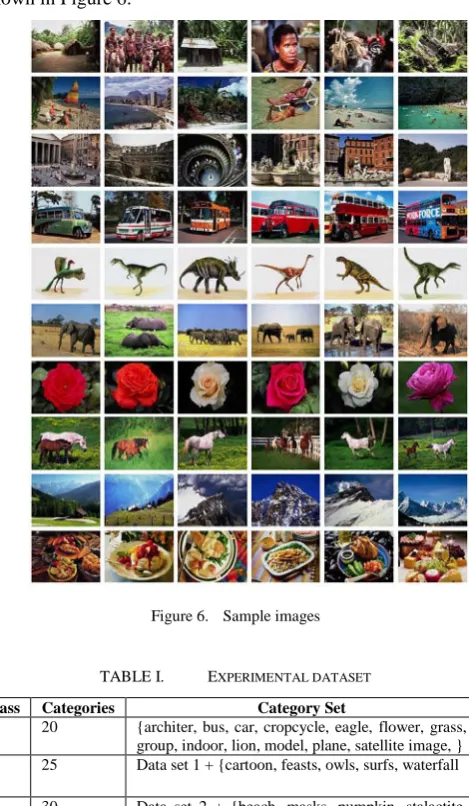
[image:5.595.64.188.98.159.2]The proposed method has been implemented using Matlab 7.3 and tested on a general-purpose WANG database containing 1,000 images of the Corel stock photo, in JPEG format of size 384x256 and 256x386. The experimental data came from the collection of the Corel image database and the Web images. We prepared seven datasets composed of different kinds of categories, as shown in Table I. Each category contains 200 images and some sample images are shown in Figure 6.
Figure 6. Sample images
TABLE I. EXPERIMENTAL DATASET
Class Categories Category Set
1 20 {architer, bus, car, cropcycle, eagle, flower, grass, group, indoor, lion, model, plane, satellite image, } 2 25 Data set 1 + {cartoon, feasts, owls, surfs, waterfall
3 30 Data set 2 + {beach, masks, pumpkin, stalactite, tiger}
4 35 Data set 3 + {Ancestor DinoArt, blue sky, doors, mountain, sculpt}
5 40 Data set 4 + {baseball, basketball, billiards ball, tennis, volleyball}
1
( , )
log(
)
(8)
N
k k k
k
L A B
A
A
B
=
[image:5.595.315.550.304.707.2]A. Performance evaluation
The parameters are to enhance the effectiveness and performance of algorithm under the set of guidelines. To take a look at the effectiveness of the set of guidelines, the subsequent degree is used. i) Root Mean Square Error RMSE; is given through the versions most of the times of each cluster and their cluster centroid. Smaller values imply clusters of immoderate awesome. To examine the performance of the set of policies, the subsequent measures are used. ii) Number of iterations; gives the kind of iterations that the set of suggestions requires to achieve the convergence after initialization. iii) CPU time; gives the complete CPU time taken via the usage of the initialization and clustering levels Truncated criterion texture abilities are widely talking used for perfectly content material stuff based image retrieval. The parameters like Precision, Recall and Accuracy are used to evaluate the general universal performance of the retrieval device. Precision (P) may be defined because of the truth the ratio of the variety of retrieved relevant images to the entire fashion of retrieved photos. The accuracy of the retrieval is measured through using precision as,
No.of relevant images retrieved
Precision(p) (10)
No.of images retrieved
=
No . of Relevant Images Retrieved Recall(R) =
Total . Number . of Relevant Images in Database (11)
The Accuracy rate has been calculated using the standard formula. Precision+Recall Accuracy= 2 (12)
It measures the retrieval accuracy to all relevant images in the database to specific query while Accuracy measures the retrieval accuracy of images in the database.
TABLE II. EVALUATION METRICS
S.No Method Precision Recall Accuracy
1 SIFT 0.225 0.722 0.4735
2 SURF 0.241 0.708 0.4745
3 PCA 0.330 0.598 0.4640
4 Proposed FMS 0.342 0.536 0.4390 5 FMS with RF 0.380 0.635 0.5075
Evaluation metrics values are computed by 33 queries in Corel dataset, the best result values are bolded. Table II shows the average value of all performance measures for different clustering methods. Table III and IV shows the performance measure and efficiency of the proposed method for retrieving the images.
TABLE III. THE PERFORMANCE MEASURES ON CLUSTER CLASSES Clus
ter
Measures Class1 Class2 Class3 Class 4 Class 5 50 Iterations RMSE CPU Time 53 1.6058 4.3585 39 1.8444 4.6437 49 1.1524 3.4393 48 1.4969 3.487 55 1.4792 4.3799 100 Iterations RMSE CPU Time 58 1.2382 5.7344 56 1.1407 5.4194 68 0.9171 3.5537 53 1.0507 4.5607 84 1.1342 5.5406 150 Iterations RMSE CPU Time 53 0.6859 5.744 67 0.5203 5.5529 67 0.5453 3.6789 52 0.5274 4.6808 77 0.6387 5.6142 200 Iterations RMSE CPU Time 71 0.4384 5.942 86 0.2769 5.6137 64 0.3709 3.875 48 0.3338 5.0932 66 0.4232 5.639
TABLE IV. EFFICIENCY COMPARISON OF THE PROPOSED ALGORITHM WITH EXISTING METHODS
Method No.of Clusters
No.of Iterations
RMSE CPU Time
Proposed Method + Relevance Feedback 50 100 150 200 138.63 167.13 153.5 134.38 1.67 1.35 0.83 0.55 2.46 2.57 2.62 3.05 Proposed Method 50 100 150 200 64.75 86.75 92.75 97.63 1.52 1.12 0.61 0.39 2.82 2.89 2.97 3.08 SIFT 50 100 150 200 95.63 128.88 135.38 105.25 1.7 1.4 0.83 0.59 3.51 4.22 4.31 4.48 SURF 50 100 150 200 48.88 60.57 66.98 67.36 1.64 1.32 0.69 0.38 3.88 4.25 4.96 5.00 PCA 50 100 150 200 49.88 63.88 65.13 67.38 1.54 1.12 0.62 0.4 3.92 4.81 4.92 5.09
This analysis shows that Fuzzy mean shift algorithm with Relevance Feedback has a faster convergence rate with a least Root Mean Square Error (RMSE) value, but it takes a slight increase in CPU time for the number of clusters taken.
VI. CONCLUSION
In this research art work special techniques in CBIR succeeds to acquire robust, reliable and excessive degree of retrieval accuracy tool. The experimental results on WANG database show the proposed method achieves the excessive overall performance with precious discount in huge type of extracted capabilities. Moreover the relevance feedback mechanism to enhance the proposed method is capable of improve the accuracy of retrieval dramatically. In Future addition with the neural community logics the delimiters has the efficiency to ignore the noises that facilitates to maximize the retrieval accuracy.
REFERENCES
[1] V. Castelli, and L. Bergman, Image Databases: Search and Retrieval of Digital Imagery, Wiley-Interscience, USA, 2002.
[2] Ritendra Datta, Dhiraj Joshi, Jia Li and James Wang, “Image Retrieval: Ideas, Influences, and Trends of the New Age”, Proceedings of the 7th ACMSIGMM international workshop on Multimedia information retrieval, Hilton, Singapore November 10-11, 2005.
[3] J. Li, J.Z. Wang, and G. Wiederhold, “IRM: Integrated Region Matching for Image Retrieval,”in Proc. of the 8th ACM Int. Conf. on Multimedia, pp. 147-156, Oct. 2000.
[4] Y. Chen and J. Z. Wang, “A Region-Based Fuzzy Feature Matching Approach to Content- Based Image Retrieval,” in IEEE Trans. on PAMI, vol. 24,No.9, pp.1252-1267, 2002.
[5] A. Natsev, R. Rastogi, and K. Shim, “WALRUS: A Similarity Retrieval Algorithm for Image Databases,” in Proc. ACM SIGMOD Int. Conf. Management of Data,pp. 395–406, 1999.
[6] Datta R, Joshi D, Li J, Wang J Z, ”Image retrieval: ideas, influences, and trends of the new age”, ACM Computing Surveys, Volume 40, No. 2,April 2008.
Journal of Visual Communication and Image Representation, 23(2): p. 293-302, 2012.
[8] Iqbal, K., M.O. Odetayo, and A. James, Content-based image retrieval approach for biometric security using colour, texture and shape features controlled by fuzzy heuristics. Journal of Computer and System Sciences, 78(4): p. 1258-1277, 2012.
[9] T. M. Lehmann, M. O. Guld, T. Deselaers, D. Keysers, H. Schubert, K. Spitzer, H. Ney, and B. B. Wein, “Automatic categorization of medical images for content-based retrieval and data mining,” Comput. Med. Imag.Graph., vol. 29, pp. 143–155, 2005.
[10] Farshad Tajeripour, Mohammad Saberi, and Shervan Fekri-Ershad, “Developing a Novel Approach for Content Based Image Retrieval Using Modified Local Binary Patterns and Morphological Transform” The International Arab Journal of Information Technology, Vol. 12, No. 6, pp. 574-581, Nov 2015.
[11] Guang L., Zuo L., Lei Z., and Yong X., “Image Retrieval based on Micro-Structure Descriptor,” Pattern Recognition, vol. 44, no. 9, pp. 2123-2133, 2011.
[12] Malik F. and Baharudin B., “Effective Image Retrieval Based on Experimental Combination of Texture Features and Comparison of Different Histogram Quantization in the DCT Domain,” the International Arab Journal of Information Technology, vol. 11, no. 3, pp. 258-267, 2014.
[13] Chen T., Wu H., Rahmani R., and Hughes J., “A Pseudo Top-Hat Mathematical MorphologicalApproach to Edge Detection in Dark Regions,”Pattern Recognition, vol. 35, no. 1, pp. 199-210, 2002.
[14] Hari Babu Srivastava, Vinod Kumar, H.K. Verma, and S.S. Sundaram, “Image Pre-processing Algorithms for Detection of Small/Point Airborne Targets” Defence Science Journal, Vol. 59, No. 2, pp. 166-174, March 2009.
[15] Apollonio, F., Ballabeni, A., Gaiani, M., Remondino, F., “Evaluation of feature-based methods for automated network orientation”. ISPRS Archives of the Photogrammetry, Remote Sensing and Spatial Information Sciences, Vol. XL-5, pp. 47-54, 2014.
[16] Jehad Alnihoud, “Content based image retrieval system based on self-organizing map, fuzzy color histogram, and subtractive fuzzy clustering”, The international Arab Journal of information technologies ,Vol.9, No. 5, pp. 452- 458, September 2012.
[17] Nikhil Chaturvedi, Saurabh Agarwal and Punit Kumar Johari, “A Novel Approach of Color-Texture based CBIR Using Fuzzy Logic” International Journal of Database Theory and ApplicationVol.7, No.4 , pp. 79-86,2014
[18] E.H. Mamdani, Advances in the linguistic synthesis of fuzzy controllers, Int. J.Man Mach. Stud. 8 (6) ,pp 669–678, 1976.
[19] M. Jamshidi, N. Vadiee, T. Ross, Fuzzy Logic and Control: Software and Hardware Applications, 2nd ed., Prentice Hall, Englewood Cliffs, NJ, 1993.
[20] G.D. Finlayson, S.D. Hordley, C. Lu, M.S. Drew, “Removing shadows from images”, in: European Conference on Computer Vision (ECCV 2002), pp. 823–836,2002.
[21] Apostolos Marakakis, Nikolaos Galatsanos2, Aristidis Likas3 “Relevance Feedback for Content-Based Image Retrieval Using Support Vector Machines and Feature Selection”, Springer-Verlag Berlin Heidelberg ,ICANN s, Part I, LNCS 5768, pp. 942–951, 2009
[22] Mit Patel, Keyur Bhrahmbhatt, Kanu Patel “Feature based Image retrieval based on clustering, classification techniques using low level image features”, IJAERD, Volume 1,Issue 5,May 2014, e-ISSN: 2348 – 4470,2014.
[23] Pooja Kamavisdar, Sonam Saluja, Sonu Agrawal, “A Survey on Image Classification Approaches and Techniques”, International Journal of Advanced Research in Computer and Communication Engineering, Vol. 2, Issue 1, Jan 2013.
[24] D.N.D.Harini, Dr.D.Lalitha Bhaskari “Image Mining Issues and Methods Related to Image Retrieval System”, International
Journal of Advanced Research in Computer Science, 2 (4), July-August, 224-229,2011.
[25] Haralick, R.M., Shanmugam, K., and Dienstein, I., ‘Textural Features for Image Classification’, IEEE Trans.Systems, ManCybernetics. vol. 3, no. 6, pp. 610– 621,1973.
[26] Coulibaly Kpinna Tiekoura, Brou Konan Marcellin, Achiepo Odilon, Babri Michel, Aka Boko, “SimCT: A Measure of Semantic Similarity Adapted to Hierarchies of Concepts” , International Journal of Computer Science & Information Security, Vol. 14, No. 1, pp. 37-44 April 2016.
[27] Jiayin Kang and Wenjuan Zhang, ‘A Framework for Image Retrieval with Hybrid Features’, 24th Chinese Control and Decision Conference (CCDC), 2012, pp: 1326 – 1330, 2012.
[28] Haojie Li, Xiaohui Wang, Jinhui Tang and Chunxia Zhao, ‘Combining global and local matching of multiple features for preciseitem image retrieval’, Multimedia Systems vol. 19, pp. 37–49,2013.
[29] Liang-Hua Chen, Yao-Ling Hung, and Li-Yun Wang (2012), ‘An Integrated Approach to Image Retrieval’, Telecommunications and Signal Processing (TSP), 2012 35th International Conference on, pp: 695 – 699, 2012.
[30] Roshan Koju, Prof. Dr. Shashidhar Ram Joshi, “Performance Evaluation of Slant Transform based Gray Image Watermarking against Common Geometric Attacks” International Journal of Computer Science & Information Security, Vol. 14, No. 1, pp. 137-146 January 2016.
[31] M. A. Medina, A. Chávez-Aragón, O. Starostenko, A Novel hybrid method for image retrieval by ontological descriptions of sub-regions, Journal WSEAS Transactions on Systems (4) 3, pp.1301-1306,2004.
[32] X. Shaoping, L.Chunquan, J. Shunliang, Similarity measures for content-based image retrieval based on intuitionistic fuzzy set
theory, ACADEMY PUBLISHER, July –
2012
[33] Ojala T., Pietikainen M., and Maenpaa T., “Multi Resolution Gray-Scale and Rotation Invariant Texture Classification with Local Binary Patterns,” IEEE Transactions on Pattern Analysis and Machine Intelligence, vol. 24, no. 7, pp. 971- 987, 2002.
AUTHORS PROFILE
Mr. S. Janarthanam (S’ 86) received the Bachelor, Master and Philosophy degrees in Mathematics, Computer Science all from the from the Bharathiar University, Coimbatore in 2006, 2009 and 2013 respectively. At present he is pursuing the Ph.D. degree at Erode Arts and Science College. Now he is working as an assistant professor in Computer Science at Gobi Arts & Science College, Erode, and Tamilnadu, India. He is member in International Association of Engineers from 2013 and student member in the Institute of research engineers and doctors from2015 and also he attained membership in Computer Science teacher Association (ACM), USA from 2015onwards. He published 12 papers in International and National journals and 15 papers in the international and national conferences. His current research interests include Software Testing, Digital Image Processing and Data Mining.