Available Online at www.ijcsmc.com
International Journal of Computer Science and Mobile Computing
A Monthly Journal of Computer Science and Information Technology
ISSN 2320–088X
IMPACT FACTOR: 6.199IJCSMC, Vol. 8, Issue. 9, September 2019, pg.239 – 244
Study on Cloud Computing Security
from Single to Multi-Clouds
D.VINOTHKUMAR
1; DR. A.V.SENTHILKUMAR
2¹PG Student, PG & Research Department of Computer Applications, Hindusthan College of Arts and Science Coimbatore, Tamilnadu, India
²Director & Professor, PG & Research Department of Computer Applications, Hindusthan College of Arts and Science, Coimbatore, Tamilnadu, India
1
[email protected]; [email protected]
_______________________________________________________________________________________
Abstract-- The project entitled as “CLOUD COMPUTING SECURITY FROM SINGLE AND MULTI-CLOUDS”. Cloud computing has increased in many organizations due to remote data access. It provides benefits in such as low cost and easy accessibility of data. The security factor of cloud computing is a major concern in the cloud computing environment, as users store sensitive information with cloud storage but these providers may be untrusted. While dealing with “single cloud” providers has become less popular with customers due to risks of service availability failure and the possibility of malicious activities in the single cloud. This led to the movement towards “multi-clouds”, “interclouds” or “cloud-of-clouds” has emerged. This work is a genuine attempt to promote the use of multi-clouds due to its ability to reduce security risks that affect the cloud computing user. ________________________________________________________________________________________
I. INTRODUCTION
Cloud computing is the delivery of different services through the Internet. These resources include tools
and applications like data storage, servers, databases, networking, and software. Cloud computing is a popular
option for people and businesses for a number of reasons including cost savings, increased productivity, speed and
efficiency, performance, and security.
Cloud computing is named as such because the information being accessed is found remotely in the cloud
or a virtual space. Companies that provide cloud services enable users to store files and applications on remote
II. EXISTING SYSTEM & PROPOSED SYSTEM EXISTING SYSTEM
Cloud providers should address privacy and security issues as a matter of high and urgent priority. Dealing with “single cloud” providers is becoming less popular with customers due to potential problems such as service
availability failure and the possibility that there are malicious insiders in the single cloud. In recent years, there has been a move towards “multi-clouds”, “inter-cloud” or “cloud-of-clouds”.
DRAW BACKS OF EXISTING SYSTEM
Cloud providers should address privacy and security issues as a matter of high and urgent priority.
Dealing with “single cloud” providers is becoming less popular with customers due to potential problems such as service availability failure and the possibility that there are malicious insiders in the single cloud.
PROPOSED SYSTEM
Managing Multi server Project focuses on the issues related to the data security aspect of cloud computing.
As data and information will be shared with a third party, cloud computing users want to avoid an un-trusted cloud
provider. This work aims to promote the use of multi-clouds due to its ability to reduce security risks that affect the
cloud computing user. Although cloud service providers can offer benefits to users, security risks play a major role
in the cloud computing environment.
In addition, the potential for migration from a single cloud to a multi-cloud environment is examined and research
related to security issues in single and multi-clouds in cloud computing is surveyed.
ADVANTAGES
Data Integrity
Service Availability.
The user runs custom applications using the service provider’s resources
Cloud service providers should ensure the security of their customers’ data and should be responsible if any security risk affects their customers’ service infrastructure.
III. MODULES
The project titled “CLOUD COMPUTING SECURITY FROM SINGLE AND MULTI CLOUD” is
used to potential for migration from a single cloud to a multi-cloud environment is examined and research related to
Upload Files:
In this Module the user can login and upload the document containing the format and details saved to the
Database. While uploading the document Main Server Database and Common Server Database should be saved.
Download Files:
In this Module If the user views the Main Server Details and click and Download the Document.
View Files:
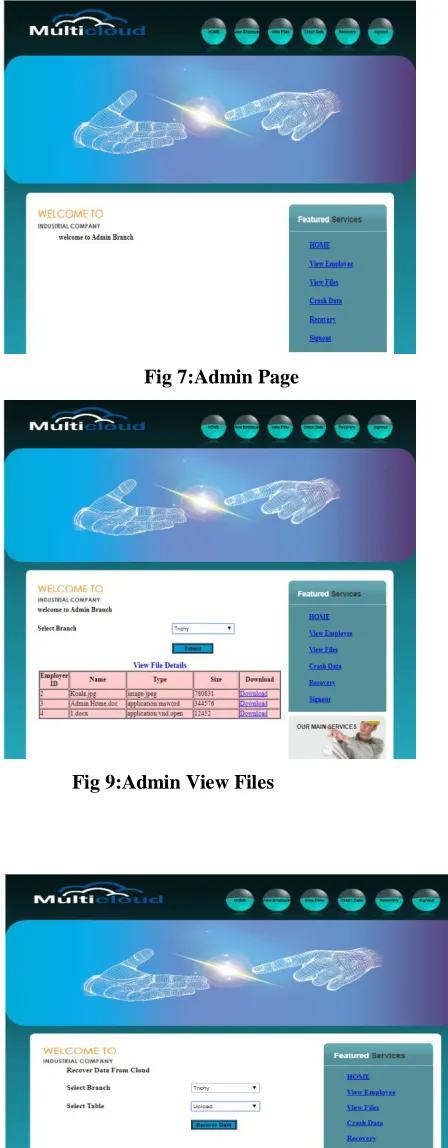
This module allows the admin to view the files which are uploaded by the users into the cloud.
Crash Data:
Another major concern in cloud services is service availability. Cloud Service mentions in its licensing agreement that it is possible that the service might be unavailable from time to time. The user’s Data may terminate for any reason at any time if any user’s files break the cloud storage policy. In addition, if any damage occurs to any
Cloud service and the service fails, in this case there will be no charge to the for this failure. Administrator Should
Maintain the Failure Data.
Recovery:
A repair operation retrieves data from existing surviving clouds over the network and reconstructs the lost
data in a new cloud. Today’s cloud storage providers charge users for outbound data, so moving an enormous
amount of data across clouds can introduce significant monetary costs. It is important to reduce the repair traffic.
IV. INPUT DESIGN & OUTPUT DESIGN
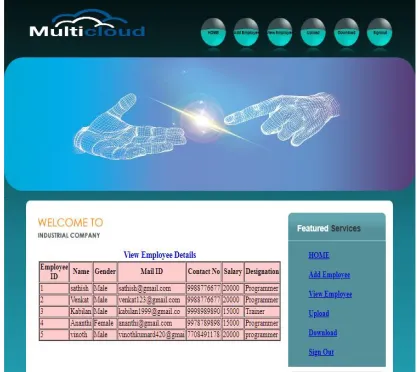
Fig 3:User Add Employee Fig 4: User View Employee
Fig 7:Admin Page Fig 8:Admin View Employee Details
V. CONCLUSION
The “Cloud Computing Security from Single to Multi-Clouds” has been developed to satisfy all proposed
requirements. The process is maintained more simple and easy. The system is highly scalable and user friendly.
Almost all the system objectives have been met. The system has been tested under all criteria. The system minimizes
the problem arising in the existing manual system and it eliminates the human errors to zero level. The design of the
database is flexible ensuring that the system can be implemented. It is implemented and gone through all validation.
All phases of development were conceived using methodologies. User with little training can get the required report.
The software executes successfully by fulfilling the objectives of the project. Further extensions to this system can
be made required with minor modifications.
REFERENCES
[1]. Professional PHP6, By Ed Lecky-Thompson, Steven D. Nowicki, and Thomas Myer.
[2]. Learning PHP, MySQL, and JavaScript: A Step-by-Step Guide to Creating Dynamic Websites, By Robin Nixon.
[3]. PHP Solutions: Dynamic Web Design Made Easy, By David Powers.
[4]. Beginning PHP and MySQL: From Novice To Professional, By W. Jason Gilmore.
[5]. Head First PHP & MySQL, By Lynn Beighley and Michael Morrison.
[6]. Core PHP programming By Leon Atkinson.
[7]. PHP Object-Oriented Solutions By David Powers.
[8]. www.w3schools.com
[9]. www.php.net/manual/en/tutorial.php [10].www.tutorialspoint.com
[11].www.tizag.com/php