Light scattering by cometary dust: Large-particle contribution
Evgenij Zubko1,2
1Department of Physics, P.O. Box 64, FIN-00014, University of Helsinki, Finland 2Astronomical Institute of Kharkov National University, 35 Sumskaya St., Kharkov, 61022, Ukraine
(Received January 11, 2012; Revised February 12, 2012; Accepted February 13, 2012; Online published March 12, 2013)
Using the discrete dipole approximation (DDA) and a model of agglomerated debris particles, we study the contribution of large particles on the light scattering by cometary dust. The numerical simulations show that moderately and highly absorbing particles larger than 3μm do not significantly affect the backscattering phenomena observed at visible wavelengths in comets at phase anglesα ≤ 30◦, such as the brightness surge and the negative polarization branch. Weakly and non-absorbing particles may play some role even if they are larger than 3μm; but they are not abundant species in comets. However, the contribution of large particles on polarizations at phase anglesα >30◦can be significant, even though they are highly absorbing; simultaneously, the phase dependence of brightness remains insensitive to the contribution of large particles.
Key words:Comets, backscattering, enhancement of brightness, negative polarization, discrete dipole approxi-mation.
1.
Introduction
Photometry of comets at small phase angles α < 30◦ shows an enhancement of their brightness withα decreas-ing toward 0◦ (e.g., Kiselev and Chernova, 1981; Meech and Jewitt, 1987; Joshiet al., 2011). In the same range of α, polarimetry reveals generally negative values for the de-gree of linear polarization; therefore, this phenomenon is often referred to asnegative polarization(e.g., Chernovaet al., 1993; Levasseur-Regourd et al., 1996). Note that the degree of linear polarization is defined as follows: P = (I⊥−I)/(I⊥+I), where,I⊥andIare the intensities of electromagnetic radiation vibrating perpendicular to and in the scattering plane respectively. Thus,negative polariza-tionimplies I > I⊥. The degree of linear polarization in comets is substantially positive atα >30◦.
Analysis of photometric observations of comets is a com-plicated problem due to their sporadic activity. In the range of small phase anglesα <30◦, the brightness linearly in-creases asα decreases (Meech and Jewitt, 1987; Joshiet al., 2011). Thus, comets do not produce aphotometric op-position effect, i.e., a non-linear decrease of apparent mag-nitude near backscattering. Note that the opposition effect is a distinctive feature for asteroids of various types (e.g., Belskaya and Shevchenko, 2000). This phenomenon also appears in C-type dark asteroids; however, the angular pro-file of intensity becomes non-linear only at extremely small phase anglesα <2–3◦. For largerα, comets and dark aster-oids have similar photometric behavior (Meech and Jewitt, 1987).
Interestingly, the full angular profile of the negative
po-Copyright cThe Society of Geomagnetism and Earth, Planetary and Space Sci-ences (SGEPSS); The Seismological Society of Japan; The Volcanological Society of Japan; The Geodetic Society of Japan; The Japanese Society for Planetary Sci-ences; TERRAPUB.
doi:10.5047/eps.2012.02.003
larization in comets nearly coincides with that of dark C-type asteroids (e.g., Chernova et al., 1993); i.e., it has a parabolic shape with a minimum of polarization Pmin ≈
−1.7% that is located at phase angleαmin =10–11◦. Such
resemblance has been interpreted to mean the objects have similar physical properties of dust particles in these two dramatically different objects (e.g., Myers and Nordsieck, 1984; Joshiet al., 2003). However, the degree of linear polarization dramatically varies throughout the cometary coma. Specific features in the coma, such as jets and the circumnuclear halo have remarkably different polariz-ing properties that are different from the rest of the comet (e.g., Hadamcik and Levasseur-Regourd, 2003). It is only when averaging all these different regions that the polariza-tion properties of comets and C-type asteroids are similar; therefore, this similarity appears to be coincidental (Zubko, 2011).
Photo-polarimetry can provide clues to the physical prop-erties of dust in comets. For instance, the negative polariza-tion has a strong dependence on absorppolariza-tion of dust parti-cle material; whereas, the appearance of this polarimetric feature itself constrains the imaginary part of the refractive index Im(m)from being not higher than approximately 0.1 (Zubkoet al., 2009; Zubko, 2011). Therefore, when ob-serving variations of the negative polarization throughout cometary coma, one can discriminate areas with high con-centration of weakly absorbing Mg-rich silicates or highly absorbing carbonaceous materials. These two materials are known to be highly abundant species within comets (e.g., Fomenkova, 1999; Jessberger, 1999).
An important question that, to our knowledge, has not been rigorously addressed in the literature so far, concerns the contribution of large grains on the light scattering by cometary dust. This research was designed to fill this gap, and we carry out a quantitative investigation on the relative
140 E. ZUBKO: LIGHT SCATTERING BY LARGE COMETARY PARTICLES
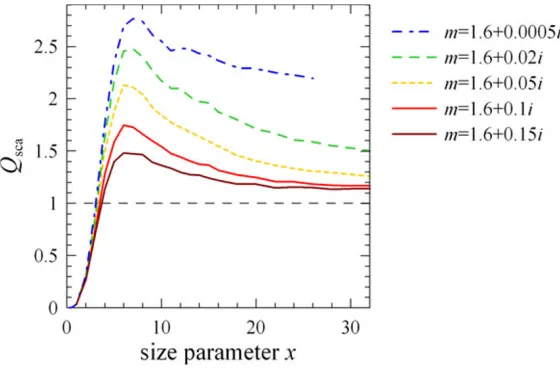
Fig. 1. Scattering efficiencyQscaas function of size parameterxof agglomerated debris particles having different material absorption.
contribution of dust grains with sizes larger than approxi-mately 3μm on the light scattered from comets. Though this chosen specification of large particles does seem to be random, as will be shown latter in Section 3, it has a sig-nificant practical consequence for fast, realistic numerical simulations of light scattering by cometary dust.
2.
Size Distribution of Cometary Dust and
Con-tribution of Dust Particles with Different Sizes
on the Scattered Light
In situmeasurements of comet 1P/Halley with VeGa-1
and2spacecrafts revealed that the dust particles span the range of mass from at least 10−16to 10−6 g (Mazetset al.,
1986). Taking into account the material density of cometary dust being 0.3–3 g/cm3 (e.g., H¨orzet al., 2006), one can
see that the size of dust particles spans five orders of mag-nitude from 10−2to 102μm. However, it is expected that the size of dust grains in comets exceed this upper limit of one hundred microns. Cometary dust was found to obey the power-law size distributionr−a, wherer is the radius of the particle and the power indexa varies with the mass of the dust particles from 1.5 (in the case of 10−16 g) to
3.4 (for 10−6g) (Mazetset al., 1986). Such a size
distribu-tion implies that the number of smaller grains significantly dominates over that of larger ones.
The relative contribution of dust particles on the photo-polarimetric properties of comets depends upon not only their number density but also on their scattering efficien-cies, which depend on the ratio of the particle size to the wavelengthλof the incident light. This ratio often is quan-tified by the so-calledsize parameter x, which is defined as
x =2πr/λ(e.g., Bohren and Huffman, 1983). For irregu-lar particles, we attribute radiusrto a sphere circumscribing the target particle.
If the particle is much smaller than the wavelength of the incident lightλ (i.e., x 1; for spherical particles, this case is referred to asRayleigh scattering), the intensity of the scattered light depends on particle radius asr6 (e.g.,
Bohren and Huffman, 1983). In practice, this means that a decrease of size by 2 times makes the light scattered by the particle dimmer by 64 times. Even though, due to the
size distributionr−3.5, the number of half-sized particles
may be about 11 times greater, it is evident that this greater number density cannot compensate for the overall decrease of intensity of their scattered light. As a consequence, the contribution of dust particles, which are significantly smaller thanλ, becomes inconsequential to the total signal. The situation changes dramatically as the radius of the target particle approaches the wavelength, i.e.,x becomes greater than 5–6. In order to give a quantitative assessment of this phenomenon, we analyze the size dependence of the scattering efficiency Qsca, which is dimensionless and
de-fined as the ratio of the scattering cross sectionCscadivided
by the geometric cross sectionGof the target particles (e.g., Bohren and Huffman, 1983). When Qsca = 1, the
parti-cle scatters the same amount of electromagnetic energy flux that flows through its geometric cross section. However, particles whose sizes are comparable with the wavelength have scattering efficiencies that can significantly exceed 1, making such particles extremely efficient at light scatter-ing. This is true for all particle morphologies. For instance, Fig. 1 shows scattering efficiencies as a function of size pa-rameterxof model agglomerated debris particles (shown in Fig. 2) that were constructed to analyze photo-polarimetric observations of comets (e.g., Zubko et al., 2009, 2011a; Zubko, 2011). In all cases, the scattering efficiency has a maximum atx ∼ 6–7. For weakly absorbing particles (e.g., m = 1.6+0.0005i), the scattering efficiency Qsca
is as high as∼2.8. Though an increase of the imaginary part of the refractive index Im(m) substantially decreases this maximum amplitude,Qsca remains greater than 1. As
particle size is increased further, e.g. x > 7, Qsca clearly
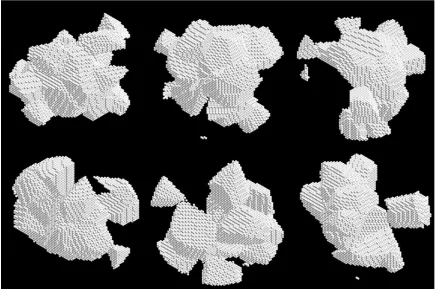
Fig. 2. Examples of agglomerated debris particles.
3.
Numerical Simulation of Light Scattering by
Irregularly Shaped Particles
In order to give a quantitative assessment of the spec-ulations presented in Section 2, we compute light scatter-ing by polydisperse agglomerated debris particles usscatter-ing the DDA (e.g., Zubkoet al., 2010; and references therein). In the DDA, a target is modeled with an array of small con-stituent volumes that together reproduce the shape and in-ternal optical properties of the original particles. These con-stituent volumes are chosen to be significantly smaller than the wavelength of the incident light. Under such condi-tion, light scattering by these constituent volumes can be ex-pressed analytically with theRayleigh approximation(e.g., Bohren and Huffman, 1983). Owing to such a replacement, one can reduce the light-scattering problem to a system of linear algebraic equations. Note that we use our well-tested implementation of the DDA to perform the calculations of this manuscript (e.g., Zubkoet al., 2010).
An important parameter specifying the DDA applicabil-ity is the size of the cubic lattice d. In application to ir-regular particles, the DDA provides accurate numerical re-sult under the conditionkd|m| ≤ 1 (Zubkoet al., 2010); wherek=2π/λis the wavenumber. Throughout this study, the parameterkd|m|remains less than 0.85, giving an addi-tional reliability for the numerical results.
One optional restriction on constituent volumes is that they are located in a regular cubic lattice to allow use of the fast Fourier transformation (FFT), which dramatically accelerates computations (Goodmanet al., 1991). In order to achieve a maximum gain in the FFT use, the size of the cubic lattice along each coordinate axis should take the form 2L, whereL is an integer. We use two sizes of cubic
lattice, namely, 64×64×64 and 128×128×128 cells, depending on the target particle size. The computations in the larger cubic lattice are about 8 times slower and consume 8 times more memory than those of the smaller cubic lattice.
We generate agglomerated debris particles by starting with a perfect sphere and using the following algorithm. A spherical volume is filled with a regular cubic lattice that is considered as the initial matrix of the irregular particles. In a cubic lattice with a size of 64×64×64 elements, the initial matrix consists of 137,376 cells; whereas, 128×128×128 lattice contains 1,099,136 cells. All the cells forming this initial matrix are divided into two groups: cells belonging to the surface layer and cells internal to the surface layer. The surface layer is chosen to be thin: its depth is equal to 1% of the initial matrix radius. Among surface dipoles, we choose randomly 100 cells that are considered as seed cells of empty space. In the set of internal cells, we randomly choose 21 seed cells of material and 20 of empty space. Then, step-by-step, each cell distinct from the seed cells is marked with the same optical properties as that of the nearest seed cell. Sample images of the shapes generated with such algorithm are shown in Fig. 2.
par-142 E. ZUBKO: LIGHT SCATTERING BY LARGE COMETARY PARTICLES
ticles is equal to 0.61 of the projected area corresponding to the circumscribing sphere.
One important question is how the packing density of the model particles compares with that of cometary parti-cles measuredin situ. An analysis of the microcraters in the aluminum foil covering theStardust sample collector reveals the material density of cometary dust particles be-ing in the range 0.3–3 g/cm3 (e.g., H¨orz et al., 2006). If
we assume the bulk material density for refractory species in comets, i.e., organics and Mg-rich silicates (Fomenkova, 1999; Jessberger, 1999), is in the range 1.5–3.5 g/cm3, one can estimate the material density in the agglomerated de-bris particles being in the range from 0.35 to 0.83 g/cm3. These values are consistent with theStardust findings. In application to comets, agglomerated debris particles would be classified as those having fluffy morphology.
We compute light scattering by agglomerated debris par-ticles having five different refractive indices m = 1.6+ 0.0005i, 1.6+0.02i, 1.6+0.05i, 1.6+0.1i, and 1.6+0.15i. Weakly absorbing cases have an imaginary part of refrac-tive index Im(m)≈0 that is representative of Mg-rich sil-icates (e.g., Dorschneret al., 1995); whereas, highly ab-sorbing cases with Im(m) = 0.1–0.15 can be attributed to organic materials (e.g., Khareet al., 1990; Jenniskens, 1993). As was already mentioned, both are abundant species in comets. Note that, in the current paper, ag-glomerated debris particles are assumed to be homogenous, i.e., refractive indexm does not vary throughout a parti-cle volume. This is an approximation as cometary dust is chemically (and, therefore, optically) inhomogeneous (e.g., Fomenkova, 1999; Jessberger, 1999). However, the re-fractive index of homogenous agglomerated debris parti-cles can be interpreted in terms of a complex refractive in-dex for mixture of Mg-rich and organic materials. The real part of refractive index of Mg-rich silicates Re(m) ≈ 1.6 (Dorschneret al., 1995) is somewhat similar to that is found in organic materials (Khareet al., 1990; Jenniskens, 1993); whereas, imaginary part Im(m) differs dramatically, 0 ver-sus 0.1–0.15. Therefore, the mixture of Mg-rich silicates and organic materials could yield a complex refractive in-dices likem=1.6+0.02iandm=1.6+0.05i.
It is important to warn the reader from a direct com-parison of the results for agglomerated debris particles presented below with photo-polarimetric observations of comets. In comets, we deal with a mixture of dust particles having completely different optical properties; whereas, in the given paper, we consider those constituents sepa-rately one from another. Furthermore, the considered list of the cometary materials is surely not a complete. For instance, organic materials reveal wide variety in their re-fractive index, depending upon circumstances of formation (e.g., Jenniskens, 1993). Moreover, if a comet was observed at heliocentric distances larger than 3 AU, one needs to take into consideration an abundance of water-ice particles; their refractive index ism=1.313+0i, in visible.
For each refractive index, we consider a wide range of size parameterx of the agglomerated debris particles that varies from 1 to 32, except for the case of m = 1.6 + 0.0005i, when the upper limit is restricted to 26 due to DDA convergence limitations. In the range ofx = 1–16,
the increment of x is 1; whereas, for x = 16–32(26), it is 2. We use a small initial matrix for the simulation of light scattering by particles withx ≤15, otherwise a large initial matrix is used. For incident red light illumination with λ = 0.633 μm, the given range of x corresponds approximately to particles sizes from 0.2μm to 6.5μm (5.2 μm form = 1.6+0.0005i); whereas, the threshold size parameterx=15 represents particles with size of 3μm.
Light-scattering properties of irregularly shaped parti-cles are averaged over a minimum of 500 particle shapes. Light scattering by each sample particle is computed for only one random orientation of the incident electromagnetic wave, but we average the scattered field over 100 scattering planes, evenly distributed around the propagation direction of the incident light. Such averaging improves the statistical reliability of the numerical results, with minimal computa-tional effort. The averaging is continued over addicomputa-tional sample particles until fluctuations of the standard deviation of the degree of linear polarization over the entire range of phase angleαis less than 1% (Zubkoet al., 2010). The ac-tual number of sample particles considered for each set of parameters very often exceeds 500.
4.
Results and Discussion
Obtaining statistically reliable numerical simulations of light scattering by cometary dust particles requires signifi-cant computational resources. These efforts are not evenly distributed throughout the particle sizes. For example, us-ing four modern quad-core processors, the computation of the average light scattering by agglomerated debris parti-cles withm =1.6+0.05i takes only approximately three days for the 15 smallest sizes in the range ofx = 1–15; whereas, the other 9 sizes in the range ofx = 16–32 re-quire up to four weeks of calculations. Therefore, computa-tional efforts are primarily applied to incorporate particles with sizes exceedingx>15, which corresponds to particle sizes greater than 3μm atλ = 0.633 μm. However, the specific size distribution of cometary dust together with an enhanced efficiency of particles comparable to wavelength discussed in Section 2, may make the contribution of parti-cles larger than 3μm relatively insignificant. If this is the case, then vast resources can be preserved by not perform-ing these calculations for the larger particles.
This problem can be investigated using two polydisperse systems of agglomerated debris particles. One of them is formed by particles of all sizes available for the given refractive index, i.e.,x =1–32 (26), and the other one has a more limited range of sizes withx = 1–15. The extent of these size ranges differs by about a factor of two. A comparative analysis of the light scattering from these two systems allows us to evaluate the impact of large particles on the total light scattering.
We make this comparison for different values of the index
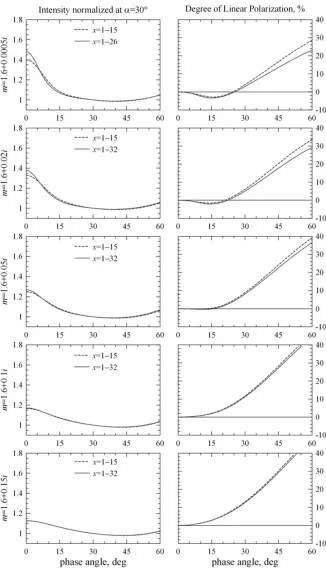
ain the power-law size distributionr−a. Figures 3–5 show results fora=1.5, 2.5, and 3.5, respectively. These values ofa are consistent within situmeasurements of cometary dust, which correspond to a wide range of particle mass from 10−16 to 10−6 g. Assuming the material density to
be in the range from 0.35 to 0.83 g/cm3, the mass of our
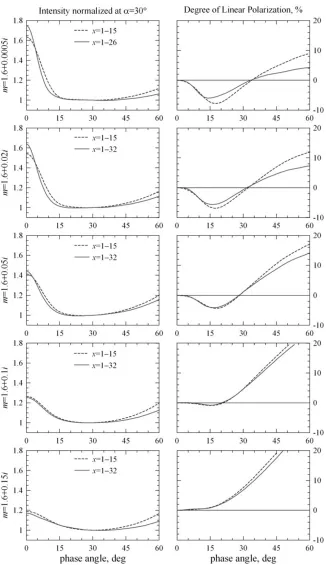
Fig. 3. Phase dependence of intensityI(left) and degree of linear polarizationP(right) for agglomerated debris particles averaged over size and having a power-law size distribution witha=1.5. The solid line corresponds to the case when particles of all available sizes are incorporated (x =1–26, 32); whereas, the dashed line shows results only for small particles (x=1–15). Each of the five different rows represents different material absorption spanning the range of the imaginary part of refractive index Im(m) from 0.0005 throughout 0.15.
mass range,in situmeasurements yield the indexa =1.5– 3 (Mazetset al., 1986). Note also that the indexa is not necessarily constant in comets. Polarimetric observations of comets suggest that the indexamay be time-dependent and vary throughout the coma (e.g., Zubkoet al., 2011a).
Figures 3–5 show intensity (left) and degree of linear po-larization (right) of the scattered light as function of phase
144 E. ZUBKO: LIGHT SCATTERING BY LARGE COMETARY PARTICLES
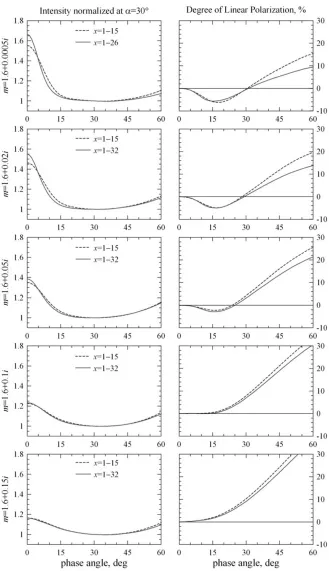
Fig. 4. Similar to Fig. 3 but for a power-law size-distribution indexa=2.5.
indices varying fromm=1.6+0.0005itom=1.6+0.15i. Everywhere, the solid line corresponds to the case when the full size range is considered, and the dashed line corre-sponds to the truncated size range where the larger particles are not included.
As one can see in Fig. 3 (a =1.5), the angular profiles of the light-scattering intensity from the full and the lim-ited polydisperse systems are nearly coincident throughout the phase-angle rangeα=5–45◦. However, for highly
de-Fig. 5. Similar to de-Fig. 3 but for a power-law size-distribution indexa=3.5.
pendence of cometary brightness on phase angle is always obtained with considerable uncertainty. Therefore, the rela-tively small errors resulting from the elimination of the con-tribution of large particles would not affect significantly the interpretation of photometric observations of active comets. Unlike intensity, the degree of linear polarization ap-pears more sensitive to the contribution of large particles at a = 1.5. Indeed, the divergence of the polarization curves for the full and limited polydisperse systems atm=
146 E. ZUBKO: LIGHT SCATTERING BY LARGE COMETARY PARTICLES
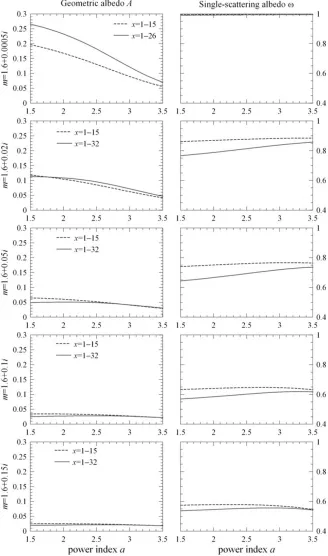
Fig. 6. Geometric albedoA(left) and single-scattering albedoω(right) for agglomerated debris particles averaged over size as function of the index in power-law size distributiona. The solid line corresponds to the case when particles of all available sizes are incorporated (x=1–26, 32), and the dashed line corresponds to results only for small particles (x=1–15). The five different rows show the effect of material absorption.
the material absorption remarkably reduces the difference between the polarization curves. Nevertheless, for phase anglesα > 30◦, the errors are greater than observation er-rors (i.e., ±1%). As follows from Fig. 3, an increase of Im(m) efficiently reduces the negative polarization branch and completely washes it out when Im(m)≥0.1; this find-ing is consistent with the results of Zubkoet al.(2009). The resemblance in polarization of the full and the limited
sys-tems at small phase anglesα ≤ 30◦ appears regardless of whether the negative polarization phenomena are present.
Increasing the indexa in the power-law size distribution
r−a increases the number density of small particles and,
through Fig. 3 (a =1.5), Fig. 4 (a =2.5), and Fig. 5 (a=
3.5). In particular, an increase of the indexafrom 1.5 to 2.5 (compare Figs. 3 and 4) already substantially improves the agreement between the angular profiles of intensity of light scattered from the full and the limited systems. At Im(m)≥
0.05, the curves are nearly coincident throughout all phase angles, i.e., α = 0–60◦. In the case of weakly absorbing particles with Im(m) ≤ 0.02, there remains a difference in the intensity curves at very small phase angles α < 5◦. Further increasing indexa to 3.5 makes the agreement between the intensity curves even better as compared to
a=2.5 (compare Figs. 5 and 4).
As one can see from Figs. 3–5, the polarization curves of the full and the limited polydisperse systems become more similar as the indexa increases. It especially holds for the range of small phase angles α ≤ 30◦, where the curves are practically indistinguishable ata = 2.5 and 3.5 (see Figs. 4 and 5). At larger phase anglesα >30◦, an accurate numerical simulation of the degree of linear polarization in comets may require the inclusion of the large-particle contribution. This contribution is significant if the cometary dust consist primarily of weakly absorbing materials with Im(m)≤0.02 and/or obey the power-law size distribution with the indexa ≤ 2.5. Though this may not be the case for the whole comet, these conditions may hold for some specific parts of the coma, like the innermost circumnuclear haloes (Zubkoet al., 2009, 2011a, b).
Two other important characteristics of cometary dust are the scattering and the geometric albedo. The single-scattering albedoω is defined as a ratio of the scattering cross section Csca over the extinction cross section Cext
(e.g., Bohren and Huffman, 1983). This quantifies the rate of energy of the incident radiation that is elastically scattered into the surrounding space. The single-scattering albedo takes values between 0 (an idealistic case of full ab-sorption of the incident radiation) and 1 (full scattering). Unlike the single-scattering albedoω, the geometric albedo
Arelates the intensity of light backscattered by a target to that by a white Lambert disk of the same geometric cross-section (e.g., Hanner, 2003). The geometric albedo A is defined as follows: A = (S11(0)π)/(k2G); where S11(0)
is the element of Mueller matrix atα = 0◦ (e.g., Bohren and Huffman, 1983), andG is the geometric cross section of the target particle. It is important to stress that the geo-metric albedo Aplays an important role as it helps to esti-mate thedust production rateof comets from their photo-metric observations in continuum (e.g., Newburn and Spin-rad, 1989). Note that thedust production rateis equal to the mass of dust ejected from a comet per unit time. It is widely believed that cometary dust is quite dark in the vis-ible and its average geometric albedo does not exceed 0.05 (e.g., Newburn and Spinrad, 1989; Hanner, 2003).
Figure 6 shows the geometric albedo A (left) and the single-scattering albedoω(right) as functions of the indexa
in the power-law size distributionr−a. When the absorption
is not low, at Im(m)≥0.02, there is very good quantitative agreement throughout the entire range ofabetween the two distributions, so the limited system provides adequate ac-curacy for the geometric albedo A. However, in the case ofm = 1.6+0.0005i, the particles withx > 15
signifi-cantly affect the geometric albedoA, and their contribution is necessary.
The average geometric albedo in cometsA≈0.05 could be immediately achieved with the agglomerated debris par-ticles havingm =1.6+0.02i and 1.6+0.05i. The parti-cles withm =1.6+0.0005i are too bright in appearance; whereas, particles withm=1.6+0.1i and 1.6+0.15i are up to a few times darker than average cometary dust. In our simulations, we consider homogeneous particles, but real cometary dust is substantially inhomogeneous by chemical composition and a realistic simulation of light scattering by comets must take into account this fact. Our understand-ing suggests that weakly absorbunderstand-ing Mg-rich silicates dom-inate in only about 25% of all dust particles and the rest of cometary particles consist of highly absorbing, primarily carbonaceous materials (e.g., Fomenkova, 1999; Jessberger, 1999). The mixture of these two types of particles may eas-ily reproduce the average geometric albedo in comets. For instance, one particle with A = 0.14 and three dark par-ticles with A = 0.02 yield an average geometric albedo
A=0.05, which is consistent with what is assumed for the whole comet. Nevertheless, taken independently, neither of those two components is consistent with the light-scattering properties of comets.
As one can see in Fig. 6, the single-scattering albedoωof the full system can be quite well reproduced with the lim-ited system atm=1.6+0.0005iand 1.6+0.15i; whereas, the intermediate refractive indices may require the contribu-tion of the large particles. However, agreement inωis im-proved as the indexaincreases and, so, ata≥3, the limited polydisperse system may provide adequate accuracy. Note also that omitting the large particles systematically overesti-mates the single-scattering albedo. Thus, the data obtained for the limited system could be considered as an upper limit forω.
5.
Conclusion
Numerical simulation of light scattering by irregularly shaped particles shows that if the target particles obey a power-law size distribution similar to what has been ob-served for cometary dust, then the relative contribution of particles withx >15 is generally weak and, therefore, in various realistic circumstances, it can be inconsequential. For instance, backscattering phenomena, such as the inten-sity surge and the negative polarization, as well as the ge-ometric albedo A, can be accurately reproduced with parti-cles limited tox ≤15 when the target particles have mod-erate or high absorption material Im(m)≥0.02. Moreover, even in the case of weakly absorbing particles Im(m)≈0, one can obtain reliable results for backscattering phenom-ena if the power-law indexa exceeds 2.5. Accurate com-putations of the geometric albedoAat Im(m)≈0 requires the contribution of large particles withx > 15 throughout the entire range of the indexa =1.5–3.5.
Unlike within the backscattering regime, simulation of polarimetric properties of comets at non-small phase angles α > 30◦, in general, needs to include the contribution of large particles, except maybe for the cases of highly absorbing particles with Im(m)=0.1–0.15 when the index
148 E. ZUBKO: LIGHT SCATTERING BY LARGE COMETARY PARTICLES
α, the intensity is much less sensitive to the contribution of the large particles, so the photometric properties of comets can be reproduced with particles of the limited sizes.
An important practical outcome of the present work is that omitting particles withx >15 dramatically speeds up the DDA computations. This feature substantially simpli-fies the numerical simulation of light scattering by cometary dust. Note that the threshold size parameter x = 15 cor-responds to the size of dust particles being 3 μm in red light (λ = 0.633μm) and 2μm in blue light (λ = 0.433 μm). Our finding also is valid in the opposite sense: if the cometary dust particles consist of primarily highly absorb-ing materials, such as carbonaceous materials, then most of the visible light coming from comets is scattered by parti-cles whose sizes are less than 3μm. However, this does not exclude the possibility of the presence of a small fraction of weakly absorbing particles.
Acknowledgments. This research was partially supported by the Academy of Finland (contract 127461) and by the NASA program for Outer Planets Research (grant NNX10AP93G). I would like to thank Dr. Gorden Videen (Army Research Laboratory, USA), Prof. Karri Muinonen (University of Helsinki, Finland), and Prof. Yuriy Shkuratov (Kharkov National University, Ukraine) for their valuable comments on this work. I am also thankful to Prof. J. H. Hough and an anonymous reviewer for their constructive reviews.
References
Belskaya, I. N. and V. G. Shevchenko, Opposition effect of asteroids,
Icarus,147, 94–105, 2000.
Bohren, C. F. and D. R. Huffman,Absorption and Scattering of Light by Small Particles, 530 pp., Wiley, New York, 1983.
Chernova, G. P., N. N. Kiselev, and K. Jockers, Polarimetric characteristics of dust particles as observed in 13 comets—Comparisons with asteroids,
Icarus,103, 144–158, 1993.
Dorschner, J., B. Begemann, T. Henning, C. Jaeger, and H. Mutschke, Steps toward interstellar silicate mineralogy. II. Study of Mg-Fe-silicate glasses of variable composition, Astron. Astrophys., 300, 503–520, 1995.
Fomenkova, M. N., On the organic refractory component of cometary dust,
Space Sci. Rev.,90, 109–114, 1999.
Goodman, J. J., B. T. Draine, and P. J. Flatau, Application of fast-Fourier-transform techniques to the discrete-dipole approximation,Opt. Lett., 16, 1198–1200, 1991.
Hadamcik, E. and A. C. Levasseur-Regourd, maging polarimetry of cometary dust: different comets and phase angles,J. Quant. Spectr. Rad. Trans.,79–80, 661–678, 2003.
Hanner, M. S., The scattering properties of cometary dust,J. Quant. Spectr. Rad. Trans.,79–80, 695–705, 2003.
H¨orz, F., R. Bastien, J. Borg, J. P. Bradley, J. C. Bridges, D. E. Brown-lee, M. J. Burchell, M. Chi, M. J. Cintala, Z. R. Dai, Z. Djouadi, G.
Dominguez, and 32 colleagues, Impact features on Stardust: Implica-tions for comet 81P/Wild 2 dust,Science,314, 1716–1719, 2006. Jenniskens, P., Optical constants of organic refractory residue,Astron.
Astrophys.,274, 653–661, 1993.
Jessberger, E. K., Rocky cometary particulates: their elemental isotopic and mineralogical ingredients,Space Sci. Rev.,90, 91–97, 1999. Joshi, U. C., K. S. Baliyan, and S. Ganesh, Polarization studies of comet
C/2000 WM1 (LINEAR),Astron. Astrophys.,405, 1129–1135, 2003. Joshi, U. C., S. Ganesh, and K. S. Baliyan, Near opposition photometry
of comet C/2007 N3 (Lulin),Mon. Not. R. Astron. Soc.,412, L58–L62, 2011.
Khare, B. N., W. R. Thompson, C. Sagan, E. T. Arakawa, C. Meisse, and I. Gilmour, Optical constants of kerogen from 0.15 to 40 mm: comparison with meteoritic organics, inProc. Lunar Planet. Sci. Conf. 21, 627–628, 1990.
Kiselev, N. N. and G. P. Chernova, Phase functions of polarization and brightness and the nature of cometary atmosphere particles,Icarus,48, 473–481, 1981.
Levasseur-Regourd, A. C., E. Hadamcik, and J. B. Renard, Evidence for two classes of comets from their polarimetric properties at large phase angles,Astron. Astrophys.,313, 327–333, 1996.
Mazets, E. P., R. L. Aptekar, S. V. Golenetskii, Yu. A. Guryan, A. V. Dyachkov, V. N. Ilyinskii, V. N. Panov, G. G. Petrov, A. V. Savvin, R. Z. Sagdeev, I. A. Sokolov, N. G. Khavenson, V. D. Shapiro, and V. I. Shevchenko, Comet Halley dust environment from SP-2 detector measurements,Nature,321, 276–278, 1986.
Meech, K. J. and D. C. Jewitt, Observations of Comet P/Halley at mini-mum phase angle,Astrophys. J.,187, 585–593, 1987.
Myers, R. V. and K. H. Nordsieck, Spectropolarimetry of comets Austin and Churyumov-Gerasimenko,Icarus,58, 431–439, 1984.
Newburn, R. L. and H. Spinrad, Spectrophotometry of 25 comets—Post-Halley updates for 17 comets plus new observations for eight additional comets,Astron. J.,97, 552–569, 1989.
Zubko, E., Interpretation of similarity in the negative polarization of comets and C-type asteroids in terms of common properties of aster-oidal and cometary dust,Earth Planets Space,63, 1077–1085, 2011. Zubko, E., Light scattering by irregularly shaped particles with sizes
com-parable to the wavelength, inLight Scattering Reviews, Vol. 6: Light Scattering and Remote Sensing of Atmosphere and Surface, edited by A. A. Kokhanovsky, pp. 39–74, Springer-Verlag, Berlin, 2012. Zubko, E., H. Kimura, Yu. Shkuratov, K. Muinonen, T. Yamamoto, H.
Okamoto, and G. Videen, Effect of absorption on light scattering by agglomerated debris particles,J. Quant. Spectr. Rad. Trans.,110, 1741– 1749, 2009.
Zubko, E., D. Petrov, Ye. Grynko, Yu. Shkuratov, H. Okamoto, K. Muinonen, T. Nousiainen, H. Kimura, T. Yamamoto, and G. Videen, Validity criteria of the discrete dipole approximation,Appl. Opt.,49, 1267–1279, 2010.
Zubko, E., R. Furusho, K. Kawabata, T. Yamamoto, K. Muinonen, and G. Videen, Interpretation of photo-polarimetric observations of comet 17P/Holmes,J. Quant. Spectr. Rad. Trans.,112, 1848–1863, 2011a. Zubko, E., G. Videen, Yu. Shkuratov, K. Muinonen, and T. Yamamoto, The
Umov effect for single irregularly shaped particles with sizes compara-ble with wavelength,Icarus,212, 403–415, 2011b.