R E S E A R C H
Open Access
Stepanov-like pseudo almost
automorphic solution to a parabolic
evolution equation
Desheng Ji
1*and Yueming Lu
2*Correspondence:
1School of Mathematical Science,
Heilongjiang University, Xue Fu Road, Harbin, 150080, P.R. China Full list of author information is available at the end of the article
Abstract
In this paper, the parabolic evolution equationu(t) +A(t)u(t) =f(t) in a reflexive real Banach space is considered. Assuming strong monotonicity, pseudo almost
automorphy and other appropriate conditions of the operatorsA(t) and Stepanov-like pseudo almost automorphy of the forced termf(t), we obtain the Stepanov-like pseudo almost automorphy of the solution to the evolution equation by using the almost automorphic component equation method. This paper extends a known result in the case whereA(·) andfare almost automorphic in certain senses. Finally, a concrete example is given to illustrate our results.
MSC: Primary 34G20; secondary 43A60
Keywords: almost automorphic solution; pseudo almost automorphic solution; parabolic evolution equation; monotone operators
1 Introduction
The concept of almost automorphy is a generalization of almost periodicity. It has been introduced by Bochner in relation to some aspects of differential geometry [–]. Since then this notion has been generalized in different directions. For example, Veech [] has studied almost automorphic functions on groups, Zaki [] provided a clear presentation of the study of (weakly) almost automorphic functions in a Banach space. N’Guérékata introduce asymptotically almost automorphic functions and presented these topics before in his monographs [, ].
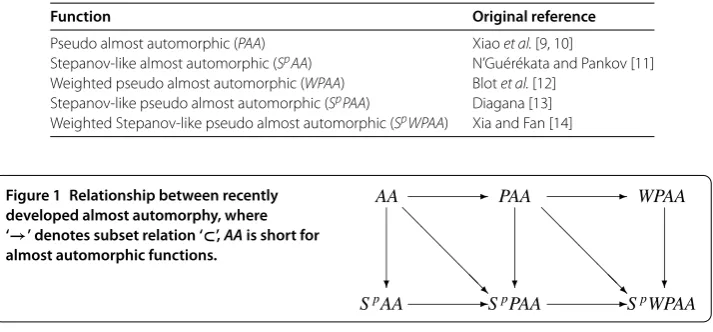
Recently, more general types of almost automorphy are developed (see Table and the references cited therein). For clarity, the relationship between the various almost automor-phy is depicted in Figure . It is worth mentioning that Zheng and Ding [] have showed the completeness ofWPAAfunction space, which is important progress in this area.
With the development of the theory of almost automorphy, its applications have at-tracted a great deal of attention of many mathematicians due to their significance and applications in physics, mathematical biology, control theory, and so on. The existence and uniqueness of (pseudo) almost automorphic type solution has been one of the most attracting topics in the context of various kinds of abstract differential equations [, , ], functional differential equations [, ], integro-differential equations [, ] and
Table 1 Recent development of almost automorphy
Function Original reference
Pseudo almost automorphic (PAA) Xiaoet al.[9, 10]
Stepanov-like almost automorphic (SpAA) N’Guérékata and Pankov [11]
Weighted pseudo almost automorphic (WPAA) Blotet al.[12] Stepanov-like pseudo almost automorphic (SpPAA) Diagana [13]
Weighted Stepanov-like pseudo almost automorphic (SpWPAA) Xia and Fan [14]
Figure 1 Relationship between recently developed almost automorphy, where ‘→’ denotes subset relation ‘⊂’,AAis short for almost automorphic functions.
fractional differential equations [–]. For more on these studies, we refer the reader to the references cited therein.
The abstract parabolic evolution equation can be applied to many self-organized mod-els in the real world, such as semiconductor model, forest kinematic model, chemotaxis model, Lotka-Volterra competition model, and so on. The study of fixed point, almost periodic, and almost automorphic type solution of a parabolic evolution has practical sig-nificance. Let X be a separable reflexive embedded real Banach space. In this paper, we consider a Stepanov-like pseudo almost automorphic solution to a parabolic evolution equation of the form
u(t) +A(t)u(t) =f(t), t∈R, ()
where the operatorA(t) : X→X∗is strongly monotone, semicontinuous,A(·) is operator valued pseudo almost automorphic and the forced term f ∈Lploc(R; X∗) (≤p<∞) is Stepanov-like pseudo almost automorphic.
LetB(·) andg(·) be the almost automorphic components ofA(·) andf(·), respectively. We call
v(t) +B(t)v(t) =g(t), t∈R ()
the almost automorphic component equation of (). N’Guérékata and Pankov [] have studied the almost automorphic solution to (). Since Stepanov-like pseudo almost auto-morphy is more general than almost autoauto-morphy (see Figure ), this paper is an extension of their results.
This paper is organized as follows. In Section , we present the preliminaries on almost automorphic type functions as well as some examples. We explore in Section some prop-erties of uniformly continuous (Stepanov-like) pseudo almost automorphic functions, which are auxiliary for our main results in Section . Finally, an example is given to il-lustrate our results.
2 Almost automorphic type functions
Let X be a real Banach space with the norm · .C(R, X) denotes the space of all con-tinuous functions fromRinto X, andBC(R; X) consists of the bounded ones inC(R, X). Equipped with the sup-normx∞=supt∈Rx(t),BC(R; X) is a Banach space.Cu(R; X) denotes the set of all uniformly continuous functions inC(R; X). Lploc(R; X) ={f :R→
X|f is measurable and Kf(t)pdt< +∞for each compact subsetK⊂R}.
2.1 (Pseudo) almost automorphic functions
Definition .[] A functionf∈C(R, X), is said to be almost automorphic in Bochner’s sense if for every sequence of real numbers{sn}, there exists a subsequence{sn}such that
g(t) := lim
n→∞f(t+sn)
is well defined for eacht∈R, and
lim
n→∞g(t–sn) =f(t)
for eacht∈R. Denote byAA(X) the set of all such (Bochner) almost automorphic func-tions.
If the convergences in this definition are uniform onR, thenf is almost periodic in the classical Bochner sense.
Theorem .([], Theorem ..)
(i) Iff ∈AA(X),then the rangeRf:={f(t) :t∈R}is relatively compact inX,thusf is
bounded;
(ii) (translation invariance)Iff ∈AA(X),thenταf ∈AA(X)whereταf(·) =f(·–α);
(iii) Equipped with the sup-norm · ∞,AA(X)is a Banach space.
Remark . The functiongin Definition . is measurable but not necessary continuous. However, if the convergences above are uniformly on compact intervals,i.e.in the Fréchet spaceC(R, X), thengis continuous, which implies thatf is uniformly continuous onR (cf.[], Theorem .). In the sequel, we will denote byAAu(X) the closed subspace of all functionsf∈AA(X) withg∈C(R, X).
Example . The function
t→cos –sint–sinπt
Definition .[] A sequencex∈l∞(X) is said to be almost automorphic if for any se-quence of integers{sn}, there exists a subsequence{sn}such that
lim
n→∞mlim→∞xp+sm–sn=xp
for eachp∈Z.
Example .([], p.) Letθbe an irrational real number. Forn∈Z,cosπnθ is never zero, and one can define
f(n) =sgn cosπnθ=
⎧ ⎨ ⎩
+, cosπnθ> ;
–, cosπnθ< .
The sequence{fn}is almost automorphic but not almost periodic. Define the function
f(t) =f(n) + (t–n)f(n+ ) –f(n), ∀t∈[n,n+ ].
Then the functionf ∈AAu(R).
Definition .[] A functionφ∈BC(R; X) is named an ergodic perturbation if
lim T→+∞
T
T
–T
φ(t) dt= .
We denote the set of all such functions byPAP(X).
Definition .[, ] A functionf ∈C(R; X) is called pseudo almost automorphic if it has the decomposition
f =g+φ,
whereg∈AA(X) andφ∈PAP(X). Denote byPAA(X) the set of all such pseudo almost automorphic functions. The functionsgandφare called the almost automorphic compo-nent and ergodic perturbation off, respectively.
Obviously, bothPAP(X) andPAA(X) are translation invariant. The following theorem was given by Basit, Zhang and Xiaoet al.[, ] independently.
Theorem .
(i) PAA(X) =AA(X)⊕PAP(X),i.e. the decomposition in Definition.is unique.
(ii) Letf∈PAA(X)andgbe its almost automorphic component.Then
{g(t) :t∈R} ⊂ {f(t) :t∈R}.
(iii) PAA(X)is a Banach space equipped with the sup-norm · ∞.
Example . Letα∈[,∞) andγ ∈(,∞). It is not difficult to show that
f(t) =cos
–sint–sinπt+
e–γ|t|
( +|t|)α, t∈R
2.2 Stepanov-like (pseudo) almost automorphic functions
This subsection is devoted to (pseudo) almost automorphic functions in the sense of Stepanov. We let ≤p<∞in this subsection.
Definition . [] The Bochner transform fb(t,s), t ∈ R, s ∈[, ], of a function
f:R→X, is defined byfb(t,s) =f(t+s).
Definition .[] The spaceBSp(X) of Stepanov bounded functions, with exponentp, consists of all measurable functionsf :R→Xsuch thatfb∈L∞(R;Lp(, ; X)). This is a Banach space with the norm:
fSp= fb
L∞(R;Lp(,;X))=sup
t∈R
t+
t
f(τ) pdτ
/p .
Definition .
(i) [] The spaceASp(X)of Stepanov-like almost automorphic functions consists of allg∈BSp(X)such thatgb∈AAu(Lp(, ; X)).
(ii) [] The spacePAPp(X)of Stepanov-like ergodic perturbation functions consists of allφ∈BSp(X)such thatφb∈PAP(Lp(, ; X)).
(iii) [] The spacePAAp(X)of Stepanov-like pseudo almost automorphic functions consists of allf∈BSp(X)such thatf =g+φwhereg∈ASp(X),φ∈PAPp
(X). We
still callgandφthe almost automorphic component and ergodic perturbation off, respectively.
Theorem .([], Theorem . and Remark ., and [], Theorems . and .)
(i) ASp(X)andPAAp(X)are Banach spaces with the norm ·
Sp;
(ii) ASp(X)⊃AA(X);
(iii) PAAp(X)⊃PAA(X).
Example .
(i) [] Let{fn} ⊂Rbe an almost automorphic sequence, and∈(,). Letf(t) =fnif
t∈(n–,n+)andf(t) = otherwise. Thenf ∈ASp(R)for allp∈[,∞)but
f ∈/AA(R).
(ii) For a discontinuous Stepanov-like pseudo almost auromorphic function, we refer the readers to [], Example ..
3 Uniformly continuous (Stepanov-like) pseudo almost automorphic functions
As the examples in Section indicated, pseudo almost automorphic functions may be not uniformly continuous and the ones in the sense of Stepanov may even be not continuous. It is interesting to investigate these functions under uniform continuity condition. Moreover, these results turn out to be useful in the next section when we deal with equation ().
Proposition . Let ≤p<∞. Suppose f ∈PAAp(X)∩Cu(R; X)and f =g+φ where
g∈ASp(X)andφ∈PAPp
(X).Then g andφare also in Cu(R; X).
Proof Sincef ∈Cu(R; X), for any> there exists aδ=δ() > such that
For allt∈R, by Theorem .(ii), there exists a sequence{tn} ⊂Rsuch thatfb(tn,·)→
gb(t,·) inLp(, ; X) asn→ ∞. Then there exists a subsequence{tnk} ⊂ {tn} such that
fb(t
nk,·)→g
b(t,·) almost everywhere in [, ] ask→ ∞. So we can choose a finiteδ-net
{s,s, . . . ,sm}of the interval [, ] such thatfb(tnk,sj) converges tog
b(t,sj) asn→ ∞for
eachj∈ {, , . . . ,m}. Let the integerK=K() > satisfy
fb(tnk+p,sj) –f
b(t
nk,sj) <, ∀k>K,∀j= , , . . . ,m,∀p∈N.
For eachs∈[, ], there exists aj(s)∈ {, , . . . ,m}such that|s–sj(s)|<δ. Then for any
k>Kandp∈N, we have
fb(tnk+p,s) –f
b(t
nk,s) ≤ f
b(t
nk+p,s) –f
b(t
nk+p,sj(s))
+ fb(tnk+p,sj(s)) –f
b(t nk,sj(s))
+ fb(tnk,sj(s)) –f
b(t nk,s)
< .
This implies that{fb(t
nk,·)}is a Cauchy sequence inC([, ]; X) under the sup-norm.
Obviously, it converges togb(t,·).
For arbitrarys,s∈[, ] satisfying|s–s|<δ, we have
g(t+s) –g(t+s) = lim k→∞
f(tnk+s) –f(tnk+s) ≤.
Since theδis independent oft, it follows thatgis uniformly continuous onR. Therefore,
so isφ=f –g.
In view of Theorem .(iii) thatPAAp(X)⊃PAA(X), we get the following result.
Corollary . Let f ∈PAA(X)∩Cu(R; X)and f =g+φwhere g∈AA(X)andφ∈PAP(X).
Then g andφare also in Cu(R; X)
Under the uniform continuity condition, we find that a Stepanov-like pseudo almost automorphic function space reduces to a pseudo almost automorphic function space.
Proposition . Let f ∈Cu(R; X)and≤p<∞.Then the following statements hold:
(i) f∈ASp(X)implies thatf ∈AA(X);
(ii) f∈PAPp(X)implies thatf ∈PAP(X);
(iii) f∈PAAp(X)implies thatf∈PAA(X).
Proof Statement (i) is given by Dinget al.in [].
Now supposef ∈PAPp(X) is uniformly continuous onR. Letfn(t) =n
n
f(t+s) dsfor eacht∈R,n∈N. It is easy to see thatfn∈BC(R; X) converges uniformly tof onRas
n→ ∞. SincePAP(X) is a closed subspace ofBC(R; X), we only need to show thatfn∈
When <p<∞, let /p+ /p= . For anyT> , using the Hölder inequality, we have
The argument for the casep= is simpler in the same way. Thus, statement (ii) has been proved.
Supposef ∈PAAp(X)∩Cu(R; X) andf =g+φwhereg∈ASp(X) andφ∈PAPp(X). It follows from Proposition . that g andφ are both inCu(R; X). Then statement (iii) is
implied by statements (i) and (ii).
Definition . A sequence{xn} ⊂Xis named an ergodic perturbation sequence if
lim
Proof SincePAP(X) is translation invariant, we may assumea= .
Suppose the sequence{fi}is not inPAP(Z;R). Then there exist an> and a strictly
Because of the uniform continuity off, there exists a positiveδ(<l) such that
For the mean off(·)on [–nkl,nkl], we have
Lettingk→ ∞in the formula above, we get
lim
4 Pseudo almost automorphic monotone evolution equation
Let X be a separable reflexive embedded real Banach space; this means that there is a Hilbert space H such that the embedding X⊂H⊂X∗is dense and continuous, and that the bilinear form (y,x) (y∈X∗,x∈X) coincides with the scalar product on H whenever
x,y∈H. We shall use the following notation for the norms:xis an X-norm,y∗is an
X∗-norm, and|x|His an H-norm.
In this section, we consider the equation
u(t) +A(t)u(t) =f(t), ()
whereA(t) : X→X∗andf:R→X∗.
For the existence and uniqueness of solution to () on the whole lineR, we refer to the following conditions:
(H) (compactness condition) the embeddingX⊂His compact;
(H) for eacht∈Rthe operatorA(t) : X→X∗is semicontinuous,i.e., the function
(H) (strong monotonicity) there exist two constantsγ andqsuch thatγ > ,
(H) for anyv∈Xand any bounded setU⊂Xthe family of functions {(A(·)u,v),u∈U}is equicontinuous on any compact subinterval ofR.
Condition (H) is imposed for simplicity and estimates of solutions [], p., and we will see it is not a necessary restriction of (); in the case we will consider (see Corollary . below).
In what followspstands for the conjugate exponentp+p = .
Suppose thatf ∈Lploc (a,b; X∗). Then a functionu: (a,b)→Xis a (weak) solution to () ifu∈Lploc(a,b; X) and the derivativeuis to be understood in the weak sense []. From () and (H), it follows thatu∈Lploc (a,b; X∗). Hence,u∈C((a,b); H) (see []). Moreover, for any such functionu:
t
t
u(t),u(t)dt= u(t)
H–u(t) H
, [t,t]⊂[a,b].
The following lemma comes from [], Theorem .. and Remark ...
Lemma . Under the conditions(H)-(H),suppose that f ∈BSp(X∗).Then()has a unique solution u such that u∈BSp(X)∩BC(R; H).Moreover,there is a bound of the form
u∞≤C
fSp
, uSp≤Cf
Sp
,
where Cand Care increasing functions on[,∞)that depend only on constants involved
in(H).
In [], p., Pankov introduced the spaceYp,X(≤p<∞) of all operatorsAfrom X into X∗satisfying inequality
Ax∗≤axp–+a,
wherea> anda∈Rare constants depending on the operator. For any two operators
AandAinYp,X, we define their sum by (A+A)x=Ax+Ax,∀x∈Xand the product of a scalarλ∈RandA∈Yp,Xby (λA)x=λAx,∀x∈X. Obviously,Yp,Xis a vector space. For allA∈Yp,X, we define the norm
AYp,X=sup
x∈X
Ax∗
+xp–.
It is easy to show that equipped with this norm,Yp,Xis a Banach space.
Remark . If the functionA(·)∈BC(R;Yp,X), then the conditions (H) and (H) will be satisfied. In fact,
A(t)v ∗≤ A(t) Y
p,X
vp–+ .
So we can choosec=c=A(·)∞ in the condition (H). Givenv∈X, a bounded set
U⊂Xand a compact subintervalJofR, for any> , there exists aδ> such that
A(t) –A(t) Y p,X<·
It follows that for allu∈Uandt,t∈J,|t–t|<δ,
A(t)u,v
–A(t)u,v≤ A(t) –A(t) Yp,X
+up–v<.
Thus, the condition (H) is satisfied.
Theorem . (Main result) Under the conditions (H)-(H), suppose that A(·) ∈
PAA(Yp,X)∩Cu(R;Yp,X) and f ∈ PAAp
(X∗). Then () has a unique solution u such that u∈PAAq(H)∩BC(R; H)∩BSp(X) and its almost automorphic component is in AAu(H)∩BSp(X).
LetA(·) =B(·) +(·),f =g+φ, whereB(·) andgare the almost automorphic components ofA(·) andf respectively. We call the equation
v(t) +B(t)v(t) =g(t) ()
the almost automorphic component of ().
We claim that under the conditions of Theorem ., conditions (H)-(H) still hold whenA(t) is replaced withB(t).
Firstly, we show thatB(t) is semicontinuous,i.e., for eacht∈Rand anyv,w, and u
in X the functionλ→(B(t)(v+λw),u) is continuous. By Theorem .(ii), there exists a sequence{tn} ⊂Rsuch thatlimn→∞A(tn) =B(t) inYp,X. SinceA(tn) is semicontinuous, the functionλ→(A(tn)(v+λw),u) is continuous for eachn∈N. We have
A(tn)(v+λw),u
–B(t)(v+λw),u
≤ A(tn)(v+λw) –B(t)(v+λw) ∗u
≤ A(tn) –B(t) Yp,X
+v+|λ|wp–u,
which implies thatλ→(A(tn)(v+λw),u) converges toλ→(B(t)(v+λw),u) uniformly on any compact interval ofR. Soλ→(B(t)(v+λw),u) is continuous onR.
Using thetand{tn}in the paragraph above, we have
A(tn)v–B(t)v ∗≤ A(tn) –B(t) Y
p,X
+vp–→, asn→ ∞,∀v∈X. Thus, for anyvandwin X,
B(t)v–B(t)w,v–w
=B(t)v–A(tn)v–B(t)w–A(tn)w,v–w+A(tn)v–A(tn)w,v–w
≥B(t)v–A(tn)v,v–w–B(t)w–A(tn)w,v–w+γ|v–w|qH.
Noting that (B(t)v–B(t)w,v–w) is independent ofnabove, we get
B(t)v–B(t)w,v–w≥γ|v–w|pH
It follows from Corollary . thatB(·)∈AAu(Yp,X). By Remark ., conditions (H) and (H) hold forB(t).
Now, for the almost automorphic component (), we have the following result, which is due to N’Guérékata and Pankov [], Theorem ..
Lemma . Under the conditions of Theorem., ()has a unique solution v such that v∈AAu(H)∩BSp(X).
Remark . For eacht∈R, the operatorB(t) is assumed to be continuous from X into X∗ in [], Section . The semicontinuity is weaker than continuity but Lemma . still hold under this weaker condition. For this, we advise the readers to refer to [], p., and the proof of [], Theorem ..
To prove Theorem ., a natural idea is that if () has a solutionuinPAAP(H), then its almost automorphic component should be the solutionv∈AAu(H) of (),i.e.,u–vis an ergodic perturbation in the sense of Stepanov.
Proof of Theorem. It follows from Lemma . and Remark . that () has a unique solutionusuch thatu∈BSp(X)∩BC(R; H).
Integrating the inequality above fromttot+ yields
From Lemma . we know bothuandvare bounded with values in H and also bounded inBSp(X), then so isz=u–v.
For the first term on the left hand side of inequality (), we have
For the second term on the right hand side of inequality (), we have
where the Minkowski inequality is used in the last inequality.
Combining inequalities () and (), we obtain
By Corollary ., we know that:R→Yp,Xis uniformly continuous. Then it follows from Proposition . that the sequence
Thus, inequality () implies that
lim
LettingT→+∞and substituting (), (), and () into inequality (), we obtain
lim
By the Hölder inequality, it is easy to see that
Thus we obtain from ()
lim
andf(t), respectively, in (). It is easy to show that under the above transformation con-ditions (H)-(H) still hold. Now, we show thatt→[u→A(t)u–A(t)]∈PAA(Yp,X)∩
SincePAA(Yp,X) andCu(R;Yp,X) are linear spaces andA(·)∈PAA(Yp,X)∩Cu(R;Yp,X), to showt→[u→A(t)u–A(t)]∈PAA(Yp,X)∩Cu(R;Yp,X), we only need to showt→[u→
A(t)]∈PAA(Yp,X)∩Cu(R;Yp,X).
For anyA∈Yp,X,u→AYp,X=supx∈X+Aup∗– =
A∗
+p– ≤ AYp,X. For anyt,t∈R,
we have
u→A(t)
–u→A(t) Y
p,X= u→
A(t) –A(t)
Y
p,X
≤ A(t) –A(t) Y p,X.
Thus,A(·)∈Cu(R;Yp,X) implies thatt→[u→A(t)]∈Cu(R;Yp,X) also.
We writeu→A(t) = [u→B(t)] + [u→(t)] for eacht∈Rand claim thatt→
[u→B(t)]∈AA(Yp,X) andt→[u→(t)]∈PAP(Yp,X).
Suppose there exist a sequence{tn} ⊂Rand a functionB˜:R→Yp,Xsuch that
B(t+tn)→ ˜B(t) and B˜(t–tn)→B(t)
inYp,Xfor eacht∈Rasn→ ∞. Thus, for eacht∈R, we have
u→B(t+tn)
–u→ ˜B(t) Y
p,X= u→
B(t+tn) –B˜(t)
Y
p,X
≤ B(t+tn) –B˜(t) Yp,X→,
asn→ ∞.
Similarly, we can showu→ ˜B(t–tn) converges tou→B(t) inYp,Xfor eacht∈Ras
n→ ∞. Thus,t→[u→B(t)]∈AA(Yp,X).
The function t→[u→(t)] is bounded, becauseu→(t)Yp,X ≤ (t)Yp,X ≤
∞<∞for anyt∈R. Moreover, since(·)∈PAP(Yp,X),
lim T→+∞
T
T
–T
u→(t) Y
p,Xdt≤Tlim→+∞
T
T
–T
(t) Y
p,Xdt= .
Thus,t→[u→(t)]∈PAP(Yp,X).
So far we have shownt→[u→A(t)]∈PAA(Yp,X)∩Cu(R;Yp,X).
Noting that u→AYp,X =A∗ for each A∈ Yp,X, one can show t→ A(t)∈
PAA(X∗)∩Cu(R; X∗) as in the case of the functiont→[u→A(t)] above with only some
adaption of notations.
From the proof of [], Lemma ., we get the following lemma.
Lemma . Under conditions(H)-(H),suppose further that A(·) :R→Yp,Xis bounded
and uniformly continuous and f ∈BSp(X∗)satisfies
lim δ→
t+δ
t
f(s) p∗ds= ()
Corollary . Under the conditions of Theorem.,suppose further that f satisfies()
uniformly with respect to t∈R.Then the solution u of ()in Theorem.is in PAA(H)∩
Cu(R; H)∩BSp(X).
Proof From Theorem ., we know that u ∈PAAq(H). Lemma . implies that u ∈
Cu(R; H). Then it follows from Proposition .(iii) thatu∈PAA(H).
Remark . A sufficient condition for () is that the ergodic perturbationφ off is es-sentially bounded. By the Minkowski inequality, we have
t+δ
t
f(s) p∗ds
p
≤ t+δ
t
g(s) p∗ds
p
+
t+δ
t
φ(s) p∗ds
p
. ()
Due to Stepanov-like almost automorphy ofg, the range of its Bochner transform is pre-compact in the spaceLp(, ; X∗). Hence, the first term on the right hand side of inequality () converges to uniformly onRasδ→. Sinceφ is essentially bounded, the second term on the right hand side of inequality () also converges to uniformly onRasδ→. Thus, () holds uniformly onR.
Becauset→A(t) is inPAA(X∗) (and thus bounded, so is its ergodic perturbation), Corollary . still hold without condition (H) thatA(t) = .
5 An example
Let⊂Rnbe a bounded domain, and denote X =W,p(), H =L(), X∗=W–,p(). We consider the operator
A(t)u= – n
i=
ai(t)
∂ ∂xi
a
∂u
∂xi
,
whereai∈PAA(R)∩Cu(R;R) has a strictly positive infimum, anda:R→Ris a contin-uous monotone increasing function such that
c·
|ξ|p– ≤a(ξ)·ξ≤c·
|ξ|p+ , ()
wherecandcare positive constants. It is not difficult to see thatA(t) : X→X∗is a mono-tone continuous operator. Moreover, () implies (H) andu→ ∂
∂xia( ∂u
∂xi)∈Yp,X. Noting
thatYp,Xis a Banach space, one can obtainA(·)∈PAA(Yp,X) and is uniformly continuous. If p –n<, then X⊂H, and this embedding is compact []. We assume additionally that the functionasatisfies the inequality
a(ξ) –a(η)·(ξ–η)≥α|ξ–η|q, α> ,p≥q≥. ()
Then there exists a constantγ > such that
A(t)v–A(t)w,v–w≥γv–wq
W,q≥γv–w q
Lq()≥γv–wqH
for allt∈R,vandwin X. Thus (H) holds forA(·).
Corollary . Suppose f ∈PAAp(X∗)and all the conditions above for A(·)hold.Then the
equation
ut+A(t)u=f(t,x) ()
has a unique solution u such that u∈PAAq(H)∩BC(R; H)∩BSp(X)and its almost
auto-morphic component in AAu(H)∩BSp(X)is the solution of the equation
vt– n
i=
˜ ai(t)
∂ ∂xi
a
∂v
∂xi
=g(t,x),
wherea˜iand g are the almost automorphic components of aiand f,respectively.Moreover,
if f satisfies
lim δ→
t+δ
t
f(s,·) pX∗ds=
uniformly with respect to t∈R,then u∈PAA(H)∩Cu(R; H)∩BSp(X).
Remark . In the caseai(t)≡ anda(ξ) =|ξ|p–ξ,
–A(t)u= n
i= ∂ ∂xi
∂u
∂xi
p–∂u
∂xi
is typical in nonlinear elliptic operators.
Moreover, ifp= , then () is a standard heat equation.
Competing interests
The authors declare that they have no competing interests. Authors’ contributions
All authors have read and approved the final manuscript. Author details
1School of Mathematical Science, Heilongjiang University, Xue Fu Road, Harbin, 150080, P.R. China.2Department of
Applied Mathematics, Harbin University of Science and Technology, Xue Fu Road, Harbin, 150080, P.R. China. Acknowledgements
The authors would like to express their gratitude to the editors and anonymous reviewers for their valuable suggestions, which improved the presentation of this paper.
Received: 28 June 2015 Accepted: 9 October 2015 References
1. Bochner, S: Continuous mappings of almost automorphic and almost periodic functions. Proc. Natl. Acad. Sci. USA 52, 907-910 (1964)
2. Bochner, S: A new approach to almost-periodicity. Proc. Natl. Acad. Sci. USA48, 2039-2043 (1962)
3. Bochner, S, Von Neumann, J: On compact solutions of operational-differential equations, I. Ann. Math.36, 255-290 (1935)
4. Veech, WA: Almost automorphic functions on groups. Am. J. Math.87, 719-751 (1965)
5. Zaki, M: Almost automorphic solutions of certain abstract differential equations. Ann. Mat. Pura Appl. (4)101, 91-114 (1974)
6. N’Guérékata, GM: Almost Automorphic Functions and Almost Periodic Functions in Abstract Spaces. Kluwer Academic, New York (2001)
7. N’Guérékata, GM: Topics in Almost Automorphy. Springer, New York (2005)
9. Liang, J, Zhang, J, Xiao, TJ: Composition of pseudo almost automorphic and asymptotically almost automorphic functions. J. Math. Anal. Appl.340, 1493-1499 (2008)
10. Liang, J, N’Guérékata, GM, Xiao, TJ, Zhang, J: Some properties of pseudo-almost automorphic functions and applications to abstract differential equations. Nonlinear Anal.70, 2731-2735 (2009)
11. N’Guérékata, GM, Pankov, A: Stepanov-like almost automorphic functions and monotone evolution equations. Nonlinear Anal.68, 2658-2667 (2008)
12. Blot, J, Mophou, GM, N’Guérékata, GM, Pennequin, D: Weighted pseudo almost automorphic functions and applications to abstract differential equations. Nonlinear Anal.71, 903-909 (2009)
13. Diagana, T: Existence of pseudo-almost automorphic solutions to some abstract differential equations with
Sp-pseudo-almost automorphic coefficients. Nonlinear Anal.70, 3781-3790 (2009)
14. Xia, Z, Fan, M: Weighted Stepanov-like pseudo almost automorphy and applications. Nonlinear Anal.75, 2378-2397 (2012)
15. Ding, HS, Liang, J, Xiao, TJ: Weighted pseudo almost automorphic functions and WPAA solutions to semilinear evolution equations. J. Math. Anal. Appl.409, 409-427 (2014)
16. Chang, YK, Zhao, ZH, Nieto, JJ, Liu, ZW: Pseudo almost automorphic and weighted pseudo almost automorphic mild solutions to a partial functional differential equation in Banach spaces. J. Nonlinear Sci. Appl.5, 14-26 (2012) 17. Lee, H, Alkahby, H: Stepanov-like almost automorphic solutions of nonautonomous semilinear evolution equations
with delay. Nonlinear Anal.69, 2158-2166 (2008)
18. Mishra, I, Bahuguna, D: Weighted pseudo almost automorphic solution of an integro-differential equation with weighted Stepanov-like pseudo almost automorphic forcing term. Appl. Math. Comput.219, 5345-5355 (2013) 19. Xia, Z: Weighted pseudo almost automorphic solutions of hyperbolic semilinear integro-differential equations.
Nonlinear Anal.95, 50-65 (2014)
20. Chang, YK, Zhang, R, N’Guérékata, GM: Weighted pseudo almost automorphic mild solutions to semilinear fractional differential equations. Comput. Math. Appl.64, 3160-3170 (2012)
21. Chang, YK, Zhang, MJ, Ponce, R: Weighted pseudo almost automorphic solutions to a semilinear fractional differential equation with Stepanov-like weighted pseudo almost automorphic nonlinear term. Appl. Math. Comput. 257, 158-168 (2015)
22. Xia, Z, Wang, D: Pseudo almost automorphic solution of semilinear fractional differential equations with the Caputo derivatives. Fract. Calc. Appl. Anal.18, 951-971 (2015)
23. N’Guérékata, GM: Topics in almost automorphic and almost periodic functions in Banach spaces. Far East J. Math. Sci. 17, 337-344 (2005)
24. Zhang, C: Almost Periodic Type Functions and Ergodicity. Kluwer Academic, New York (2003)
25. Basit, B, Zhang, C: New almost periodic type functions and solutions of differential equations. Can. J. Math.48, 1138-1153 (1996)
26. Xiao, TJ, Liang, J, Zhang, J: Pseudo almost automorphic solutions to semilinear differential equations in Banach spaces. Semigroup Forum76, 518-524 (2008)
27. Diagana, T: Existence of pseudo-almost automorphic solutions to some abstract differential equations with
Sp-pseudo almost automorphic coefficients. Nonlinear Anal.70, 3781-3790 (2009)
28. Ding, HS, Liang, J, Xiao, TJ: Some properties of Stepanov-like almost automorphic functions and applications to abstract evolution equations. Appl. Anal.88, 1079-1091 (2009)
29. Pankov, A: Bounded and Almost Periodic Solutions of Nonlinear Operator Differential Equations. Kluwer Academic, Dordrecht (1990)
30. Showalter, RE: Monotone Operators in Banach Spaces and Nonlinear Partial Differential Equations. Am. Math. Soc., Providence (1997)