Same Domain Different Discourse Style
A Case Study on Language Resources for Data-driven Machine Translation
Monica Gavrila, Walther v. Hahn, Cristina Vertan
University of Hamburg Hamburg, Germany
{gavrila, vhahn}@informatik.uni-hamburg.de, [email protected]
Abstract
Data-driven machine translation (MT) approaches became very popular during last years, especially for language pairs for which it is difficult to find specialists to develop transfer rules. Statistical (SMT) or example-based (EBMT) systems can provide reasonable translation quality for assimilation purposes, as long as a large amount of training data is available. Especially SMT systems rely on parallel aligned corpora which have to be statistical relevant for the given language pair. The construction of large domain specific parallel corpora is time- and cost-consuming; the current practice relies on one or two big such corpora per language pair. Recent developed strategies ensure certain portability to other domains through specialized lexicons or small domain specific corpora. In this paper we discuss the influence of different discourse styles on statistical machine translation systems. We investigate how a pure SMT performs when training and test data belong to same domain but the discourse style varies.
Keywords:Statistical machine translation, Discourse style, evaluation of Machine Translation, Linguistic analysis of training data, Moses.
1.
Introduction
Data-driven machine translation (MT) approaches became very popular during last years, especially for language pairs for which it is difficult to find specialists to develop trans-fer rules. Statistical (SMT) or example-based (EBMT) sys-tems can provide reasonable translation quality for assimi-lation purposes, as long as a large amount of training data is available. Especially SMT systems rely on parallel aligned corpora which have to be statistical relevant for the given language pair. Given the intrinsic features of natural lan-guage as ambiguity, vagueness and polysemy parallel cor-pora have to be domain dependent. Within one domain, words tend to have with higher probability a certain mean-ing and therefore the disambiguation process in the auto-matic alignment step is more precise. The construction of large domain specific parallel corpora is time- and cost-consuming; the current practice relies on one or two big such corpora per language pair. Recent developed strategies ensure certain portability to other domains through special-ized lexicons or small domain specific corpora.
For European languages two parallel corpora are largely used: JRC-Acquis1 (parallel corpora for all combinations of 23 languages) and Europarl2, which focuses in its last version on 21 EU3-Languages. Recently corpora with mod-erate size were added in Europarl, involving some of the languages from the countries that joined the community af-ter EU-Enlargements in 2004 and 2007.
While the portability to other domains received a lot of at-tention in the recent years e.g. in (Niehues and Waibel, 2010), less research was performed to analyze how dis-course style within same domain may affect the translation quality. In (Calude., 2002) the behavior of a rule-based
sys-1
http://optima.jrc.it/Acquis/.
2
http://www.statmt.org/europarl/.
3
EU = European Union
tem is tested across several text genres. However the chosen text genres are quite different (news, scientific, novel). Ex-periments across different genres have also been presented in (Monz, 2011). This paper showed that a phrase-based baseline system can benefit from using POS information by building lexically anchored local models. Test data of different genres have been also used in (Habash and Sa-dat, 2006): one is a mix of news, editorials and speeches, whereas the second, like the training data, is purely news. However. the focus of the paper is on Arabic preprocessing schemes for statistical MT.
In this paper we discuss the influence of different discourse styles on statistical machine translation systems. We inves-tigate how a pure SMT performs when training and test data belong to same domain but the discourse style varies. The paper is organized as follows: in section two we de-scribe the experimental set-up, the data we used and the parameter setting for the SMT system. We introduce the broader framework within we tested the system as ratio-nale for broader discourse style variability. We include also a linguistic analysis of the used corpora. Sections three is dedicated to the presentation of the evaluation results and discuss the variation of automatic metrics. Finally we present conclusions and further work in section four.
2.
Experimental Set-up
2.1. The ATLAS -System
Current content management systems (CMSs) do not em-bed advanced techniques from language technology and in-formation retrieval. The ICT PSP EU project ATLAS - Ap-plied Technology for Language-Aided CMS4- aims to fill this gap by providing three innovative Web services within a web content management system (WCMS). The Web ser-vices: i-Librarian, EUDocLib and i-Publisher are not only
4
thematically different but offer also different levels of intel-ligent information processing.
The ATLAS WCMS makes use of state-of-the art text tech-nology methods in order to extract information and cluster documents according to a given hierarchy. A text summa-rization module and a machine translation engine as well as a cross-lingual semantic search engine are embedded. The system is addressing for the moment seven languages (Bulgarian, Croatian, English, German, Greek, Polish and Romanian) from four language families. However, the cho-sen framework allows additions of other languages at a later point.
Machine translation (MT) is a key component of the AT-LAS WCMS, and it will be embedded in all three services of the system. The development of the engine is particu-lar challenging as the translation should be used in differ-ent domains and on differdiffer-ent text-genres. Additionally the considered language-pairs belong most of them to the less resourced group, for which bilingual training and test ma-terial is available in limited amount.
The machine translation engine is integrated in two distinct ways into the ATLAS platform:
1. for i-Publisher (meta service for generating web sites) the MT is serving as a translation aid tool for pub-lishing multilingual content. Text is submitted to the translation engine and the result is subject to the hu-man post processing
2. for i-Librarian and EuDocLib (on-line content man-agement systems generated with i-Publisher) the MT-engine provides a translation for assimilation, which means that the user retrieving documents in different languages will use the engine in order to get a clue about the documents, and decide if he will store them. If the translation is considered as acceptable it will be stored into a database.
The integration of an MT engine into a web based content management system in general and the ATLAS system in particular, presents from the user point of view two main challenges:
1. the user may retrieve documents from different do-mains. Domain adaptability is a major issue in ma-chine translation, and in particular in corpus-based methods. Poor lexical coverage and false disambigua-tion are the main issues when translating documents out of the training domain
2. the user may retrieve documents from various time pe-riods. As language changes over time, language tech-nology tools developed for the modern languages do not work, or perform with higher error rate on di-achronic documents.
With the current available technology it is not possible to provide a translation system which is domain and language variation independent and works for a couple of heteroge-neous language pairs. Therefore our approach envisage a system of user guidance, so that the availability and the foreseen system-performance is transparent at any time.
Given the fact that the ATLAS platform deals with lan-guages from different language families, and that the en-gine should support at least several domains an interlingua approach is not suitable. Building transfer systems for all language pairs is also time consuming and does not make the platform easily portable to other languages. Given the user and system requirements corpus based MT-paradigms are the only ones to be considered.
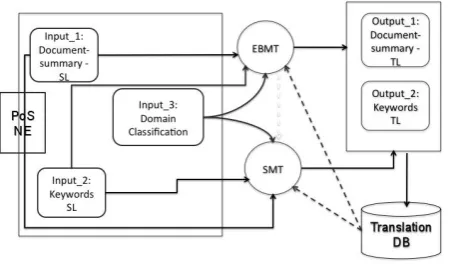
For the MT-Engine of the ATLAS -System we decided on a hybrid architecture combining EBMT (Gavrila, 2011) and SMT at word-based level (no syntactic trees will be used) (Koehn et al., 2007)). For the SMT-component part-of-speech (PoS) and domain factored models as in (Niehues and Waibel, 2010) are used, in order to ensure domain adaptability. An original approach of our system is the in-teraction of the MT-engine with other modules of the sys-tem:
The document categorization module assigns to each docu-ment one or more domains. For each domain the system administrator has the possibility to store information re-garding the availability of a correspondent specific training corpus. If no specific trained model for the respective do-main exists, the user is provided with a warning, telling that the translation may be inadequate with respect to the lexical coverage.
The output of the summarization module is processed in such way that ellipses and anaphora are omitted, and lexical material is adapted to the training corpus.
The information extraction module is providing informa-tion about meta-data of the document including publicainforma-tion age. For documents previous to 1900 we will not provide translation, explaining the user that in absence of a training corpus the translation may be misleading.
The domain and dating restrictions can be changed at any time by the system administrator when an adequate training model is provides. The described architecture is presented in Figure 1.
Figure 1: System architecture for the ATLAS-engine.
to be processed. This involves: parliamentary speeches, laws or news and normal regulation. As for most part of the involved languages JRC-Acquis is the only available large parallel corpora within the law domain, we investi-gated to which extent documents within same domain but with different discourse structure can be processed by the translation engine
2.2. The Machine Translation Engine
The SMT system follows the description of the baseline architecture given for the EMNLP 2011 Sixth Workshop on SMT5. The system uses Moses6, an SMT system that allows the user to automatically train translation models for the language pair needed, considering that the user has the necessary parallel-aligned corpus. More details about Moses can be found in (Koehn et al., 2007).
While running Moses, we used SRILM (Stolcke, 2002) for building the language model (LM) and GIZA++ (Och and Ney, 2003) for obtaining word alignment information. The training data has been ’cleaned’7, in the sense of removing all sentences longer than 40 tokens8
The tuning step was realized using two different data-types:
1. 1500 sentences from JRC-Acquis (same domain and discourse type as the training data);
2. 1500 sentences from the EU-Constitution corpus9 (same domain as the training data, but discourse style identical with the test data). The Eu-Constitution cor-pus (EUconst) is a parallel corcor-pus collected from the European Constitution, which includes 21 languages (Tiedemann, 2009).
2.3. Test and Training Data
The training data is part of the JRC-Acquis corpus for Ger-man - English. JRC-Acquis is a freely available parallel corpus in 22 languages, which consists of European Union documents of legal nature. From the two types of sen-tence alignments available (Vanilla and HunAlign10), we used the Vanilla11 alignments. The same alignments have been also used in (Ignat, 2009). In order to reduce possible errors, only one-to-one alignments have been considered for the experiments presented in this paper. More details on the JRC-Acquis corpus can be found in (Steinberger et al., 2006). The corpus is not (manually) corrected. Therefore, translation, alignment or spelling errors can have an influ-ence on the output quality. The corpus contains 1190025 sentences containing 236965 unique tokens.
We used test data from three different corpora:
• JRC-Acquis itself (Case A) - see Section 2.4.1..
5www.statmt.org/wmt11/baseline.html - last accessed on July
14th, 2011.
6
www.statmt.org/moses/ - last accessed on July 14th, 2011.
7For more information about the ’cleaning’ step please see the
MT system description on www.statmt.org/wmt11/baseline.html.
8A token can be a lexical item, a punctuation sign, a number,
etc.
9
http://opus.lingfil.uu.se/EUconst.php.
10http://mokk.bme.hu/resources/hunalign/.
11See http://nl.ijs.si/telri/Vanilla/ - last accessed January 12th,
2011.
• EU-Constitution (Case B) - see Section 2.4.2..
• Europarl (Case C) - see Section 2.4.3.. More details on the corpus can be found in (Koehn, 2005).
The test and tuning data has been extracted from the middle of each of the corpora used. More information about the training, tuning and test data is presented in Table 112.
Data No. sent. Voc. size Average sent. length
Training JRC-Acquis 1,190,025 236,965 9.03 Test JRC-Acquis 2,000 4,044 23.16
Test EUconst 2,000 4,329 19.19
Test Europarl 2,000 8,034 27.41
Tuning JRC-Acquis 1,500 4,308 29.10
Tuning EUconst 1,500 3,699 17.17
Table 1: Data description (No.=number, Voc.=vocabulary, sent.=sentence)
2.4. Linguistic Analysis of the Input Data
In our experiments we considered German as source lan-guage (SL) and English as the target one (TL).
In the following paragraphs we describe in detail morpho-logical and syntactic features of the three corpora. The fo-cus is set on the source language.
2.4.1. JRC-Acquis
From the morphological point of view, we remark a strong nominal style, interspersed capitalizing and the presence of rare words (e.g. ”jeglichen”) There is a high density of compounds and long compounds (up to 4 (derivated) nouns) are quite frequent, such as ”Erstattungsbetr¨age”, ”Durchf¨uhrungsvorschriften”, etc. Quite difficult for MT systems is the presence of spontaneous composition (such as ”Weltzuckermarkt”) and of compounds with similar el-ements which are difficult to decompose (”Ausfuhrerstat-tungsh¨ochstbetrag”). Semantic decomposition (”x of y by z”) often fails because of unclear semantics: ”(((Aus-fuhr)erstattung)s((h¨ochst)(betrag)))”. Some unusual plu-rals with botanic terms are also present.
From the point of view of syntax following features are rel-evant for the texts being part of the corpus:
• Many bracketed sections with references to laws, named entities, and numbers;
• Calendar date indications;
• A strong dependency from the case of the preposi-tions, caused by the high number of prepositional structures (prepositional objects, adjuncts and comple-ments);
• Asyntactic headlines (”Artikel 2”);
12The third column ”Vocabulary size” counts the number of
• Long distance dependencies, partly with unclear structure;
Example: ”DIE KOMMISSION DER EU-ROP ¨AISCHEN GEMEINSCHAFTEN gest¨utzt auf den Vertrag ..., gest¨utzt auf die Verordnung ...in Erw¨agung nachstehender Gr¨unde: (1) - (10) HAT FOLGENDE VERORDNUNG ERLASSEN:”13 The whole phrase/paragraph has a length of 50 lines with 30 intermediate full stops, 531 words (431 words without the last part after the colon) and 15 sub-phrases in a frame of 4 syntactic sub-phrases. In the first long phrase the subj-NP consists of several complete sentences. A formal analysis of the whole phrase from full stop to full stop is impossible, because the VP follows only in the end of the paragraph after 14 interposed moderately syntactic structures. The recognition of the internal structure is rather difficult.
• Asyntactic phrases (partly ellipses);
• Foreign language segments, partly with foreign char-acters;
• Officialese syntax (e.g. ”Sind diese Bedingungen nicht erf¨ullt,” instead of: ”wenn diese ...” or ”Um zu ¨uberpr¨ufen”);
• Ambiguity even in officialese syntax;
• Typing errors.
2.4.2. EUconst
Although quite close to the topic of JRC-Acquis the mor-phological features of this corpus are quite different. There are few technical terms except legal terms. Compared to JRC-Acquis there are much less and shorter compounds, few spontaneous compounds and more internationalisms (e.g. ”Kommission”, ”Parlament”, ”Union” etc., but with national inflectional morphology).
Also the syntactical analysis reveals new phenomena:
• Largely syntactic phrases, partly excessively struc-tured;
• Passive style;
• Numerous modal verbs: ”sollen”, ”sollten”, ”k¨onnen”, d¨urfen”;
• Significantly more enumerations;
• Highly structured text by headings and numbered paragraphs;
• Excessive hierarchical nested structures of conjunc-tions or disjuncconjunc-tions;
• Predominance of relative clauses against conjunc-tional clauses.
13
Capitals in the original
2.4.3. Europarl
The morphological features in Europarl are quite different form JRC-Acquis and EUconst, as the corpus records spon-taneous speech.
Following features are worth to be mentioned:
• Meta signs in brackets;
• Persons are addressed by their names;
• Idioms with deviant inflexion;
• Multi-word expressions;
• Foreign language elements or mixed language expres-sions (i.e. ”Naming-and-Shaming-Verfahren”);
• Moderate number of officialese compounds;
• Frequently demonstrative pronouns instead of articles;
• Enumerations in the text are always written verbally (”erstens”), no numbers as in the previous corpora;
• Metaphoric expressions and idioms prevent literal translations (segment by segment): ”Finanzvehikel”;
• Rare compounds from abbreviations: ”PPE-DE-Fraktion”.
While syntactically comparing Europarl with JRC-Acquis and EUconst, we could notice the use of direct questions and/or exclamations, of personal pronouns (”ich”,”mir” etc.) and of shorter phrases, due to spoken style. Other particularities which are worth mentioning are14:
• Strong pronominal coherency chains ([noun] it it -it);
• Syntactic parentheses and syntactic ambiguities;
• Longer asyntactic segments (ellipses);
• Many metalinguistic elements;
• Rhetorical idioms.
2.4.4. Linguistic comparison of the three corpora
We structure the comparison along three criteria:
1. Differences in the syntactic construction:
JRC-Acquis and EUconst are juridical texts; however the EU-Constitution German text follows more the German style and aesthetics of written texts, while JRC-Acquis has an impersonal style. With this respect some of the syntacti-cal construction in EU-Constitution are not retrieved in the JRC-Acquis texts. Europarl has a spoken discourse style however with some particularities: sentences are less ellip-tic as in spontaneous speech, and are relatively short. All of the three texts contain many metalinguistic segmen-tation signals. Headers, paragraphs, and enumerations are not syntactically framed but marked by line feeds.
14
2. Differences in the Lexicon:
With respect to the vocabulary, JRC-Acquis is full of terminology, one sentence containing several specific terms. Problematic are the big number of spontaneous domain specific compound words. These words are usually used once or twice in text i.e. they are not statistically relevant and usually a proper alignment is therefore missing. The terminology in Europarl is quite different from the one in JRC-Acquis and Eu-Constitution. It is parliamentary, interspersed with some technical terms of the subject, which is being discussed. Speakers always respect quick understandability by the listeners. We found only a moderate number of spontaneous compounds, but frequently personal addressing and personal statements.
3. Comparison of phrase length:
Regarding the phrase length, the following phenomena could be noticed:
• JRC-Acquis: 50 lines have 30 full stops, 5 logical, 19 syntactic phrases;
• EUConst: 50 lines have 16 full stops and 18 phrases;
• Europarl: 50 lines have 26 full stops and 21 logical and syntactic phrases.
3.
Results and Discussion
We performed several experiments, all having the JRC-Acquis as training data. We considered German as source language (SL) and English as the target one (TL). The choice is motivated by the following reasons:
• the linguistic analysis of source language phenomena (availability of a native speaker);
• the availability for the given language pair of three dif-ferent corpora belonging to same domain, but having different discourse style.
We evaluated our translations using two automatic evalua-tion metrics: BLEU and NIST. The choice of the metrics is motivated by the available resources (software) and the re-sults reported in the literature. Due to lack of data and fur-ther translation possibilities, the comparison with only one reference translation is considered in these experiments. Although criticized, BLEU (bilingual evaluation under-study) is the score mostly used in the last years for MT evaluation. It measures the number of n-grams, of different lengths, of the system output that appear in a set of refer-ence translations. More details about BLEU can be found in (Papineni et al., 2002).
The NIST Score, described in (Doddington, 2002), is sim-ilar to the BLEU score in that it also uses n-gram co-occurrence precision. If BLEU considers a geometric mean of the n-gram precision, NIST calculates the arithmetic mean. Another difference is that n-gram precisions are weighted by the n-gram frequencies.
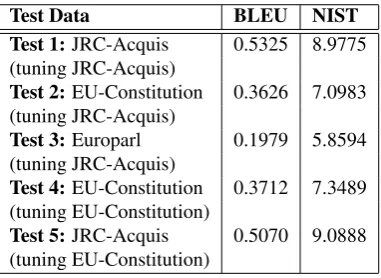
The obtained results are presented in Table 2.
Test Data BLEU NIST
Test 1:JRC-Acquis 0.5325 8.9775 (tuning JRC-Acquis)
Test 2:EU-Constitution 0.3626 7.0983 (tuning JRC-Acquis)
Test 3:Europarl 0.1979 5.8594 (tuning JRC-Acquis)
Test 4:EU-Constitution 0.3712 7.3489 (tuning EU-Constitution)
Test 5:JRC-Acquis 0.5070 9.0888 (tuning EU-Constitution)
Table 2: BLEU and NIST scores for different test and tun-ing data-sets
From the above table it can observed that there is a strong variation of the BLEU score even when the discourse genre variation is not so large (Test 1vs. Test 2). A tuning with data from the new discourse brings only slight improve-ment (Test 4). The radical decrease of the BLEU score in
Test 3corresponds to a complete different discourse style in the test corpus. The number of out-of-domain-words (6.82% inTest 1; 14,09% inTest 2and 18,48% inTest 3) are not directly proportional with the decrease of the BLEU score. This is a clear indication for deeper linguistic phe-nomena which influence the translation quality.
Out-of-vocabulary words (OOV-words) and sentences al-ready included in the training data influence the evaluation results. An overview of such aspects is shown in Table 3.
Data OOV-words Sent. in the training data
Test JRC-Acquis 6.82 38.20
Test EUconst 14.09 20.70
Test Europarl 18.48 0.00
Tuning JRC-Acquis 4.99 38.67 Tuning EUconst 10.46 22.93
Table 3: Data analysis (The results are in %.)
OOV-words in the tuning data means new words are added to the training data. Sentences already in the tuning data means that part of the training data is doubled. The dif-ference between the total number of sentences in the tun-ing data and the number of sentences already in the corpus is here more relevant, as this represents new information added to the training data.
The results of the automatic analysis are in-line with the differences in discourse style between the training and test data. However this experiment shows also the limitations of current automatic metrics. It s impossible to say which linguistic differences among the training and test data de-termine the decrease of BLEU score.
4.
Conclusion and Further Work
More important is the choice of data with same discourse genre. We intend to realize a linguistic analysis of the trans-lation results and to extend our experiments to the reverse translation direction. Further experiments should consider test data from different domain but similar discourse style and employment of domain adaptation methods.
5.
Acknowledgements
The present work is part of the EU-Project ATLAS, sup-ported through the ICT-PSP-Programme of the EU Com-mission for ”Multilingual Web”.
6.
References
Andreea S. Calude. 2002. Machine translation of various text genres. InProceedings of the 7th Language and So-ciety Conference of the New Zealand Linguistic SoSo-ciety, page 12pp, Hamilton,New Zealand, November.
George Doddington. 2002. Automatic evaluation of ma-chine translation quality using n-gram co-occurrence statistics. In Proceedings of the second international conference on Human Language Technology Research, pages 138–145, San Francisco, CA, USA. Morgan Kauf-mann Publishers Inc.
Monica Gavrila. 2011. Constrained recombination in an example-based machine translation system. In Vin-cent Vondeghinste Mikel L. Forcada, Heidi Depraetere, editor, EAMT-2011: the 15th Annual Conference of the European Association for Machine Translation, pages 193–200, Leuven, Belgium, May. EAMT. Ac-cepted for oral presentation (Research Track). ISBN 9789081486118.
Nizar Habash and Fatiha Sadat. 2006. Arabic prepro-cessing schemes for statistical machine translation. In HLT-NAACL 2006: Proceedings of the Human Language Technology Conference of the North American Chapter of the ACL, pages 49–52, New York, NY, USA, June. Camelia Ignat. 2009. Improving Statistical
Align-ment and Translation Using Highly Multilingual Corpora. Ph.D. thesis, INSA - LGeco- LICIA, Strasbourg, France, June, 16th. It can be found on: http://sites.google.com/site/cameliaignat/home/phd-thesis - last accessed on 3.08.09.
Philipp Koehn, Hieu Hoang, Alexandra Birch, Chris Callison-Burch, Marcello Federico, Nicola Bertoldi, Brooke Cowan, Wade Shen, Christine Moran, Richard Zens, Chris Dyer, Ondrej Bojar, Alexandra Constantin, and Evan Herbst. 2007. Moses: Open source toolkit for statistical machine translation. InProceedings of the An-nual Meeting of the Association for Computational Lin-guistics (ACL), demonstration session, pages 177–180, Prague, Czech Republic, June.
Philipp Koehn. 2005. Europarl: A parallel corpus for sta-tistical machine translation. In Proceedings of the MT Summit.
Christof Monz. 2011. Statistical machine translation with local language models. InProceedings of the 2011 Con-ference on Empirical Methods in Natural Language Pro-cessing, pages 869–879, Edinburgh, Scotland, UK, July 27-31.
Jan Niehues and Alex Waibel. 2010. Domain adaptation in statistical machine translation using factored translation models. InProceedings of EAMT 2010, Saint-Raphael. Franz Josef Och and Hermann Ney. 2003. A
system-atic comparison of various statistical alignment models. Computational Linguistics, 29(1):19–51.
Kishore Papineni, Salim Roukos, Todd Ward, and Wei-Jing Zhu. 2002. Bleu: a method for automatic evaluation of machine translation. InProceedings of the 40th An-nual Meeting on Association for Computational Linguis-tics, Session: Machine translation and evaluation, pages 311 – 318, Philadelphia, Pennsylvania. Publisher: Asso-ciation for Computational Linguistics Morristown, NJ, USA.
Ralf Steinberger, Bruno Pouliquen, Anna Widiger, Camelia Ignat, Tomaz Erjavec, Dan Tufis, and Daniel Varga. 2006. The jrc-acquis: A multilingual aligned paral-lel corpus with 20+ languages. In Proceedings of the 5th International Conference on Language Resources and Evaluation (LREC’2006), pages 2142–2147, Genoa, Italy, May, 24-16.
Andreas Stolcke. 2002. Srilm - an extensible language modeling toolkit. InProc. Intl. Conf. Spoken Language Processing, pages 901–904, Denver, Colorado, Septem-ber.