ISSN (Online) : 2319 - 8753
ISSN (Print) : 2347 - 6710
International Journal of Innovative Research in Science, Engineering and Technology
An ISO 3297: 2007 Certified Organization Volume 4, Special Issue 9, July 2015National Conference on Emerging Technology and Applied Sciences-2015 (NCETAS 2015) On 21st & 22nd February, Organized by
Modern Institute of Engineering and Technology, Bandel, Hooghly-712123, West Bengal, India
Power and Delay Analysis of a 4 to 1
Multiplexer Implemented in different Logic
Style
Debika Chaudhuri
1, Atanu Nag
2*, Sukanta Bose
3,
Suchismita Mitra
1, Hemanta Ghosh
1Department of Electronics & Communication Engineering, Modern Institute of Engineering & Technology, Hooghly,
West Bengal, India1
Department of Physics, Modern Institute of Engineering & Technology, Hooghly, West Bengal, India 2
CEGESS, BESU, Shibpur, West Bengal, India3
ABSTRACT: Power dissipation is the most commonly concerned issue in the low power VLSI design circuits. The aim of the paper is to reduce power or energy dissipation. We have used the technique of adiabatic switching based on different logic to achieve VLSI circuit design with low power. It is proposed by implementing pmos and nmos transistors as pull up and pull down network. In this paper the power dissipation of various adiabatic 4:1 multiplexers (DCVSL, MDCVSL) is calculated and then simulated using T-SPICE tool. We have also implemented the multiplexing technique using Transmission Gate Logic (TGL). From the calculated result it is obvious that the multiplexer using adiabatic logic and TGL can effectively reduce the power dissipation as compared to the conventional CMOS design. From the results of calculation it is observed that among the discussed logic used for multiplexer implementation TGL exhibits the minimum power dissipation.
KEYWORDS: VLSI, Adiabatic logic, TGL, T-SPICE
I. INTRODUCTION
Due to the restricted power supplied by the batteries the circuitry involved in the modern portable electronic devices must be designed to consume less power avoiding the requirement of expensive and noise cooling supply and power consumption circuits. Now for the purpose of digital design multiplexer is an essential component. Thus diminution of the power dissipation of the multiplexer is one of the major concerns of low power design [1]. Generally, the techniques of power saving needs the scaling of the power supply to undergo significant increase in sub-threshold leakage current. For this some other technique is required which is independent of voltage scaling. It has been established that there is essential connection between computation and power dissipation. There are various methods broadly used for reducing the power dissipation in circuits by reducing supply voltage, load capacitances, switching activities although most of the energy down from dc power supply is absolutely dissipatedin the circuit [2].
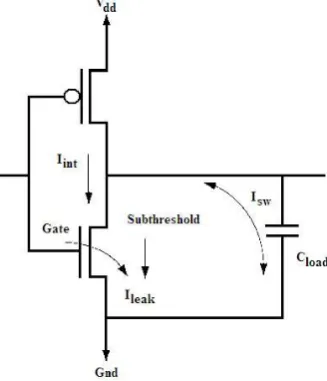
Fig.1 Conventional CMOS logic circuit with pull-up (A) and pull down (/A) network
Fig. 2 Equivalent model during charging process in adiabatic circuits
Adiabatic circuits do not utilize standard power supplies as in cmos circuits it uses pulsed power supply [6]. Figure 3 represents a cmos adiabatic inverter. The adiabatic switching technique is commonly used to minimize the energy loss during the charging and discharging of the load capacitor [7, 8]. In adiabatic circuits all of the capacitors are charged or discharged at a constant current for the minimization of the power dissipation. In this paper we have calculated the power dissipation for DCVSL and MDCVSL adiabatic 4:1 MUX and TGL 4:1 MUX using T-SPICE simulation tool. From our analysis it is obvious that the TGL multiplexer exhibits minimum number of pmos and nmos, minimum delay and minimum power dissipation. So, it can be used to design low power circuits.
ISSN (Online) : 2319 - 8753
ISSN (Print) : 2347 - 6710
International Journal of Innovative Research in Science, Engineering and Technology
An ISO 3297: 2007 Certified Organization Volume 4, Special Issue 9, July 2015National Conference on Emerging Technology and Applied Sciences-2015 (NCETAS 2015) On 21st & 22nd February, Organized by
Modern Institute of Engineering and Technology, Bandel, Hooghly-712123, West Bengal, India
II. MULTIPLEXER DESIGNS
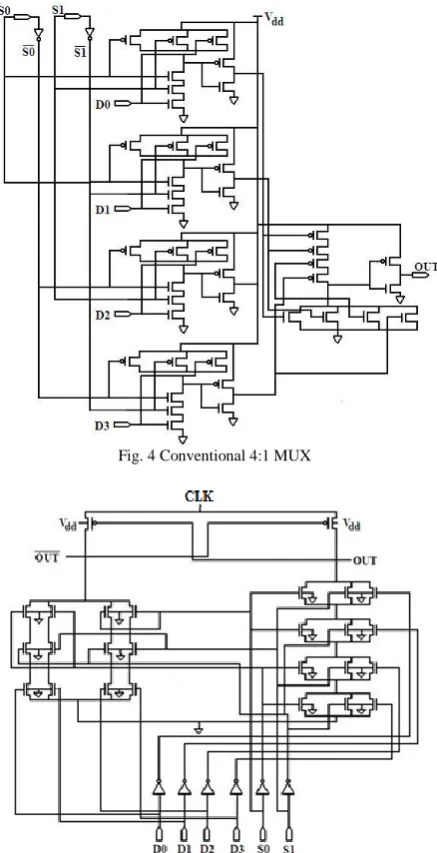
A logic style may affect the size, speed, power consumption and wiring density of a circuit. All these vary considerably from one logic to another and so we have to formulate the proper choice of logic for having an efficient logic with low power circuit performance [9]. In modern digital circuit design multiplexer is an essential component and the need is to implement a logic convenient to produce low power consumption. Figure 4 shows the conventional 4:1 mux whereas figure 5 shows the 4:1 mux implemented by using Differential Cascade Voltage Switch Logic (DCVSL) logic. The advantage of this logic is that the logic implements all functions using nmos only and the pmos serve only as the pull up devices. DCVSL circuit can be divided into two basic components a differential latching circuit and a cascaded complementary logic array [10]. The latch in these logic circuits is being realized with two cross coupled pmos transistors and the cascade complementary logic array is being realized with a nmos logic tree [11].
Fig. 4 Conventional 4:1 MUX
Fig. 5 Schematic design of DCVSL 4:1 Multiplexer [12].
Fig. 6 Schematic design of MDCVSL 4:1 Multiplexer [12].
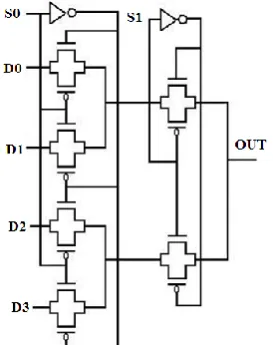
Figure 7 shows the 4:1 mux implemented by using TGL. The advantages of this logic are minimization of the circuit complexity less area requirement and achievement of strong output level without degradation
.
Fig. 7 Schematic design of TGL 4:1 Multiplexer
III. RESULTS & COMPARISON
ISSN (Online) : 2319 - 8753
ISSN (Print) : 2347 - 6710
International Journal of Innovative Research in Science, Engineering and Technology
An ISO 3297: 2007 Certified Organization Volume 4, Special Issue 9, July 2015National Conference on Emerging Technology and Applied Sciences-2015 (NCETAS 2015) On 21st & 22nd February, Organized by
Modern Institute of Engineering and Technology, Bandel, Hooghly-712123, West Bengal, India Table I Comparison of different 4:1 Multiplexer
Parameters Conventional DCVSL MDCVSL TGL
No of MOSFETs 23 PMOS
23NMOS
8 PMOS 30NMOS
8PMOS 32NMOS
8 PMOS 8NMOS
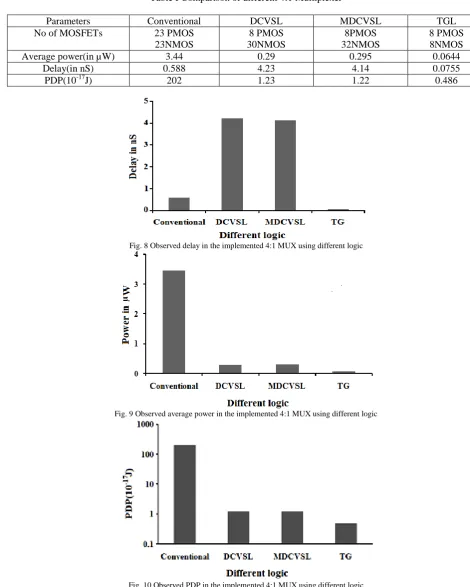
Average power(in µW) 3.44 0.29 0.295 0.0644
Delay(in nS) 0.588 4.23 4.14 0.0755
PDP(10-17J) 202 1.23 1.22 0.486
Fig. 8 Observed delay in the implemented 4:1 MUX using different logic
Fig. 9 Observed average power in the implemented 4:1 MUX using different logic
IV. CONCLUSION
From the analysis we can conclude that for designing low power circuits, adiabatic logic is an efficient technique as compared to conventional cmos logic. TGL 4:1 mux is the most efficient among the implemented ones as it require minimum number mos and thereby possessing low power consumption and minimum delay.
REFERENCES
[1] H.EnChang, J.D.Huang, C.I.Chen,“Input Selection encoding for Low Power Multiplexer Tree,” IEEE Conference on VLSI Design Automation and Test, pp. 1-4, 2007.
[2] M. Pedram, "Power minimization in IC design: principles and applications," ACM Transactions on Design Automation of Electronic Systems, 1(1): pp 3-56, 1996.
[3] J.Rabey,M.Pendram, “Low power Design Methodologies”, Kluwer Academic Publishers,5th edition. pp 5-7, 2002
[4] S.Kim, Ziesler, C.H.Ziesler and M.C.Papaefthymiou, “Charge-Recovery Computing on Silicon,” IEEE Transactions on Computers, 54, pp. 651-659, 2005.
[5] S.M.Kang, Y.Leblebici,“CMOS Digital Integrated Circuits: Analysis and Design” TATA McGRAW-HILL, 2003.
[6] Y.Takahashi, Y.Fukuta, T.Sekine, M.Yokoyama, “2PADCL: Two Phase drive Adiabatic Dynamic CMOS Logic,” IEEE Conference on Circuits and Systems, pp. 1484-1487, 2006.
[7] S. Samanta “Adiabatic Computing” a contemporary review, “4th international conference on computer and devices for communication: codec 09”, 2009.
[8] M.Padmaja, V.N.V. S.Prakash, “Design of a Multiplexer In Multiple Logic Styles for Low Power VLSI,” International Journal of Computer Trends and Technology, 3, pp. 467-471, 2012.
[9] I.Gupta, N.Arora, Prof. B.P. Singh, “Analysis of Several 2:1 Multiplexer Circuits at 90nm and 45nm Technologies,” International Journal of Scientific and Research Publications, 2(2), 2012.
[10] I.Gupta, N.Arora and B P Singh, “An Efficient Design of 2:1 Multiplexer and Its Application in 1-Bit Full Adder Cell,” International Journal of Computer Application and Its Application in 1 Bit Full Adder, 40, 2012.