Proceedings of the 49th Annual Meeting of the Association for Computational Linguistics, pages 450–459,
Optimal Head-Driven Parsing Complexity
for Linear Context-Free Rewriting Systems
Pierluigi Crescenzi
Dip. di Sistemi e Informatica Universit`a di Firenze
Daniel Gildea
Computer Science Dept. University of Rochester
Andrea Marino
Dip. di Sistemi e Informatica Universit`a di Firenze
Gianluca Rossi
Dip. di Matematica Universit`a di Roma Tor Vergata
Giorgio Satta
Dip. di Ingegneria dell’Informazione Universit`a di Padova
Abstract
We study the problem of finding the best head-driven parsing strategy for Linear Context-Free Rewriting System productions. A head-driven strategy must begin with a specified righthand-side nonterminal (the head) and add the remaining nonterminals one at a time in any order. We show that it is NP-hard to find the best head-driven strategy in terms of either the time or space complexity of parsing.
1 Introduction
Linear Context-Free Rewriting Systems (LCFRSs) (Vijay-Shankar et al., 1987) constitute a very general grammatical formalism which subsumes context-free grammars (CFGs) and tree adjoining grammars (TAGs), as well as the synchronous context-free grammars (SCFGs) and synchronous tree adjoin-ing grammars (STAGs) used as models in machine translation.1 LCFRSs retain the fundamental prop-erty of CFGs that grammar nonterminals rewrite independently, but allow nonterminals to generate discontinuous phrases, that is, to generate more than one span in the string being produced. This important feature has been recently exploited by Maier and Søgaard (2008) and Kallmeyer and Maier (2010) for modeling phrase structure treebanks with discontinuous constituents, and by Kuhlmann and Satta (2009) for modeling non-projective depen-dency treebanks.
The rules of a LCFRS can be analyzed in terms of the properties of rank and fan-out. Rank is the
1To be more precise, SCFGs and STAGs generate languages
composed by pair of strings, while LCFRSs generate string lan-guages. We can abstract away from this difference by assuming concatenation of components in a string pair.
number of nonterminals on the right-hand side (rhs) of a rule, while fan-out is the number of spans of the string generated by the nonterminal in the left-hand side (lhs) of the rule. CFGs are equivalent to LCFRSs with fan-out one, while TAGs are one type of LCFRSs with fan-out two. Rambow and Satta (1999) show that rank and fan-out induce an infi-nite, two-dimensional hierarchy in terms of gener-ative power; while CFGs can always be reduced to rank two (Chomsky Normal Form), this is not the case for LCFRSs with any fan-out greater than one.
General algorithms for parsing LCFRSs build a dynamic programming chart of recognized nonter-minals bottom-up, in a manner analogous to the CKY algorithm for CFGs (Hopcroft and Ullman, 1979), but with time and space complexity that are dependent on the rank and fan-out of the gram-mar rules. Whenever it is possible, binarization of LCFRS rules, or reduction of rank to two, is there-fore important for parsing, as it reduces the time complexity needed for dynamic programming. This has lead to a number of binarization algorithms for LCFRSs, as well as factorization algorithms that factor rules into new rules with smaller rank, with-out necessarily reducing rank all the way to two. Kuhlmann and Satta (2009) present an algorithm for binarizing certain LCFRS rules without increas-ing their fan-out, and Sagot and Satta (2010) show how to reduce rank to the lowest value possible for LCFRS rules of fan-out two, again without increas-ing fan-out. G´omez-Rodr´ıguez et al. (2010) show how to factorize well-nested LCFRS rules of arbi-trary fan-out for efficient parsing.
In general there may be a trade-off required between rank and fan-out, and a few recent pa-pers have investigated this trade-off taking
eral LCFRS rules as input. G´omez-Rodr´ıguez et al. (2009) present an algorithm for binarization of LCFRSs while keeping fan-out as small as possi-ble. The algorithm is exponential in the resulting fan-out, and G´omez-Rodr´ıguez et al. (2009) mention as an important open question whether polynomial-time algorithms to minimize fan-out are possible. Gildea (2010) presents a related method for bina-rizing rules while keeping the time complexity of parsing as small as possible. Binarization turns out to be possible with no penalty in time complexity, but, again, the factorization algorithm is exponen-tial in the resulting time complexity. Gildea (2011) shows that a polynomial time algorithm for factor-izing LCFRSs in order to minimize time complexity would imply an improved approximation algorithm for the well-studied graph-theoretic property known as treewidth. However, whether the problem of fac-torizing LCFRSs in order to minimize time com-plexity is NP-hard is still an open question in the above works.
Similar questions have arisen in the context of machine translation, as the SCFGs used to model translation are also instances of LCFRSs, as already mentioned. For SCFG, Satta and Peserico (2005) showed that the exponent in the time complexity of parsing algorithms must grow at least as fast as the square root of the rule rank, and Gildea and ˇStefankoviˇc (2007) tightened this bound to be lin-ear in the rank. However, neither paper provides an algorithm for finding the best parsing strategy, and Huang et al. (2009) mention that whether finding the optimal parsing strategy for an SCFG rule is NP-hard is an important problem for future work.
In this paper, we investigate the problem of rule binarization for LCFRSs in the context of
head-driven parsing strategies. Head-head-driven strategies
be-gin with one rhs symbol, and add one nontermi-nal at a time. This rules out any factorization in which two subsets of nonterminals of size greater than one are combined in a single step. Head-driven strategies allow for the techniques of lexicalization and Markovization that are widely used in (projec-tive) statistical parsing (Collins, 1997). The statis-tical LCFRS parser of Kallmeyer and Maier (2010) binarizes rules head-outward, and therefore adopts what we refer to as a head-driven strategy. How-ever, the binarization used by Kallmeyer and Maier
(2010) simply proceeds left to right through the rule, without considering the impact of the parsing strat-egy on either time or space complexity. We examine the question of whether we can efficiently find the strategy that minimizes either the time complexity or the space complexity of parsing. While a naive algorithm can evaluate allr!head-driven strategies in time O(n·r!), where r is the rule’s rank andn is the total length of the rule’s description, we wish to determine whether a polynomial-time algorithm is possible.
Since parsing problems can be cast in terms of logic programming (Shieber et al., 1995), we note that our problem can be thought of as a type of query optimization for logic programming. Query optimization for logic programming is NP-complete since query optimization for even simple conjunc-tive database queries is NP-complete (Chandra and Merlin, 1977). However, the fact that variables in queries arising from LCFRS rules correspond to the endpoints of spans in the string to be parsed means that these queries have certain structural properties (Gildea, 2011). We wish to determine whether the structure of LCFRS rules makes efficient factoriza-tion algorithms possible.
In the following, we show both the the time- and space-complexity problems to be NP-hard for head-driven strategies. We provide what is to our knowl-edge the first NP-hardness result for a grammar fac-torization problem, which we hope will aid in under-standing parsing algorithms in general.
2 LCFRSs and parsing complexity
In this section we briefly introduce LCFRSs and de-fine the problem of optimizing head-driven parsing complexity for these formalisms. For a positive in-tegern, we write[n]to denote the set{1, . . . , n}.
As already mentioned in the introduction, LCFRSs generate tuples of strings over some finite alphabet. This is done by associating each produc-tionp of a grammar with a functiongthat takes as input the tuples generated by the nonterminals inp’s rhs, and rearranges their string components into a new tuple, possibly adding some alphabet symbols.
tiong: (V∗)f1× · · · ×(V∗)fr →(V∗)f defined by an equation of the form
g(hx1,1, . . . , x1,f1i, . . . ,hxr,1, . . . , xr,fri) =~α .
Here thexi,j’s denote variables over strings in V∗,
and~α = hα1, . . . , αfi is anf-tuple of strings over
g’s argument variables and symbols in V. We say that g is linear, non-erasing if ~α contains exactly
one occurrence of each argument variable. We callr andf the rank and the fan-out ofg, respectively, and writer(g)andf(g)to denote these quantities.
Example 1 g1(hx1,1, x1,2i) = hx1,1x1,2i takes as
input a tuple with two strings and returns a tuple with a single string, obtained by concatenating the components in the input tuple. g2(hx1,1, x1,2i) = hax1,1b, cx1,2di takes as input a tuple with two
strings and wraps around these strings with sym-bols a, b, c, d ∈ V. Both functions are linear, non-erasing, and we haver(g1) =r(g2) = 1,f(g1) = 1
andf(g2) = 2. 2
A linear context-free rewriting system is a tuple G = (VN, VT, P, S), where VN andVT are finite,
disjoint alphabets of nonterminal and terminal sym-bols, respectively. EachA ∈ VN is associated with
a valuef(A), called its fan-out. The nonterminalS is the start symbol, withf(S) = 1. Finally,P is a set of productions of the form
p: A → g(A1, A2, . . . , Ar(g)), (1)
where A, A1, . . . , Ar(g) ∈ VN, and g : (VT∗)f(A1) × · · · × (V∗
T)f(Ar(g)) → (VT∗)f(A) is a linear,
non-erasing function.
Production (1) can be used to transform the r(g) string tuples generated by the nonterminals A1, . . . , Ar(g) into a tuple of f(A) strings gener-ated byA. The valuesr(g)andf(g)are called the
rank and fan-out ofp, respectively, writtenr(p)and f(p). Given that f(S) = 1, S generates a set of strings, defining the languageL(G).
Example 2 Let g1 andg2 be as in Example 1, and letg3() =hε, εi. Consider the LCFRSGdefined by
the productionsp1 : S → g1(A), p2 : A → g2(A)
andp3 : A → g3(). We havef(S) = 1, f(A) =
f(G) = 2,r(p3) = 0andr(p1) =r(p2) =r(G) =
1. We haveL(G) = {anbncndn|n ≥ 1}. For in-stance, the string a3b3c3d3 is generated by means
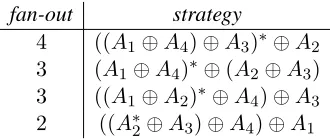
fan-out strategy
4 ((A1⊕A4)⊕A3)∗⊕A
2
3 (A1⊕A4)∗⊕(A2⊕A3)
3 ((A1⊕A2)∗⊕A4)⊕A3
2 ((A∗
[image:3.612.344.509.83.153.2]2⊕A3)⊕A4)⊕A1
Figure 1: Some parsing strategies for productionpin Ex-ample 3, and the associated maximum value for fan-out. Symbol⊕denotes the merging operation, and superscript ∗marks the first step in the strategy in which the highest fan-out is realized.
of the following bottom-up process. First, the tuple
hε, εiis generated byAthroughp3. We then iterate
three times the application ofp2 tohε, εi, resulting
in the tupleha3b3, c3d3i. Finally, the tuple (string)
ha3b3c3d3iis generated byS through application of
p1. 2
Existing parsing algorithms for LCFRSs exploit dynamic programming. These algorithms compute partial parses of the input stringw, represented by means of specialized data structures called items. Each item indexes the boundaries of the segments of w that are spanned by the partial parse. In the special case of parsing based on CFGs, an item con-sists of two indices, while for TAGs four indices are required.
In the general case of LCFRSs, parsing of a pro-duction p as in (1) can be carried out in r(g)−1
steps, collecting already available parses for nonter-minalsA1, . . . , Ar(g) one at a time, and ‘merging’
these into intermediate partial parses. We refer to the order in which nonterminals are merged as a pars-ing strategy, or, equivalently, a factorization of the original grammar rule. Any parsing strategy results in a complete parse of p, spanning f(p) = f(A)
segments of wand represented by some item with
2f(A) indices. However, intermediate items ob-tained in the process might span more than f(A)
segments. We illustrate this through an example.
Example 3 Consider a linear non-erasing function
g(hx1,1, x1,2i,hx2,1, x2,2i,hx3,1, x3,2i,hx4,1, x4,2i)
= hx1,1x2,1x3,1x4,1, x3,2x2,2x4,2x1,2i, and a
pro-ductionp : A → g(A1, A2, A3, A4), where all the
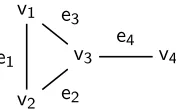
v1
v2
v3 v4
e1 e3
e2
[image:4.612.87.175.72.127.2]e4
Figure 2: Example input graph for our construction of an LCFRS production.
A3, andA2. In this case, after we have collected the
first three nonterminals, we have obtained a partial parse having fan-out 4, that is, an item spanning 4 segments of the input string. Alternatively, we could first mergeA1 andA4, then mergeA2 andA3, and
finally merge the two obtained partial parses. This strategy is slightly better, resulting in a maximum fan-out of 3. Other possible strategies can be ex-plored, displayed in Figure 1. It turns out that the best parsing strategy leads to fan-out 2. 2
The maximum fan-out f realized by a parsing strategy determines the space complexity of the parsing algorithm. For an input stringw, items will require (in the worst-case) 2f indices, each taking
O(|w|) possible values. This results in space com-plexity ofO(|w|2f). In the special cases of parsing
based on CFGs and TAGs, this provides the well-known space complexity of O(|w|2) and O(|w|4),
respectively.
It can also be shown that, if a partial parse hav-ing fan-out f is obtained by means of the combi-nation of two partial parses with fan-outf1 andf2,
respectively, the resulting time complexity will be
O(|w|f+f1+f2)(Seki et al., 1991; Gildea, 2010). As
an example, in the case of parsing based on CFGs, nonterminals as well as partial parses all have fan-out one, resulting in the standard time complexity of
O(|w|3) of dynamic programming methods. When
parsing with TAGs, we have to manipulate objects with fan-out two (in the worst case), resulting in time complexity ofO(|w|6).
We investigate here the case of general LCFRS productions, whose internal structure is consider-ably more complex than the context-free or the tree adjoining case. Optimizing the parsing complexity for a production means finding a parsing strategy that results in minimum space or time complexity.
We now turn the above optimization problems into decision problems. In the MINSPACE STRAT
-EGYproblem one takes as input an LCFRS produc-tion p and an integer k, and must decide whether there exists a parsing strategy forpwith maximum fan-out not larger thank. In the MINTIMESTRAT -EGYproblem one is givenpandkas above and must decide whether there exists a parsing strategy for psuch that, in any of its steps merging two partial parses with fan-outf1andf2and resulting in a
par-tial parse with fan-outf, the relationf+f1+f2 ≤k holds.
In this paper we investigate the above problems in the context of a specific family of linguistically mo-tivated parsing strategies for LCFRSs, called head-driven. In a head-driven strategy, one always starts parsing a productionpfrom a fixed nonterminal in its rhs, called the head ofp, and merges the remain-ing nonterminals one at a time with the partial parse containing the head. Thus, under these strategies, the construction of partial parses that do not include the head is forbidden, and each parsing step involves at most one partial parse. In Figure 1, all of the dis-played strategies but the one in the second line are head-driven (for different choices of the head).
3 NP-completeness results
For an LCFRS productionp, letHbe its head non-terminal, and let A1, . . . , An be all the non-head
nonterminals inp’s rhs, withn+ 1 =r(p). A head-driven parsing strategy can be represented as a per-mutationπover the set[n], prescribing that the non-head nonterminals inp’s rhs should be merged with H in the order Aπ(1), Aπ(2), . . . , Aπ(n). Note that there aren!possible head-driven parsing strategies.
To show that MIN SPACE STRATEGY is NP-hard under head-driven parsing strategies, we reduce from the MINCUTLINEARARRANGEMENT prob-lem, which is a decision problem over (undirected) graphs. Given a graphM = (V, E)with set of ver-ticesV and set of edgesE, a linear arrangement ofM is a bijective functionhfromV to[n], where
|V|=n. The cutwidth ofMat gapi∈[n−1]and with respect to a linear arrangementhis the number of edges crossing the gap between thei-th vertex and its successor:
cw(M, h, i) =|{(u, v)∈E|h(u)≤i < h(v)}|.
p: A→g(H, A1, A2, A3, A4)
g(hxH,e1, xH,e2, xH,e3, xH,e4i,hxA1,e1,l, xA1,e1,r, xA1,e3,l, xA1,e3,ri,hxA2,e1,l, xA2,e1,r, xA2,e2,l, xA2,e2,ri,
hxA3,e2,l, xA3,e2,r, xA3,e3,l, xA3,e3,r, xA3,e4,l, xA3,e4,ri,hxA4,e4,l, xA4,e4,ri) =
h xA1,e1,lxA2,e1,lxH,e1xA1,e1,rxA2,e1,r, xA2,e2,lxA3,e2,lxH,e2xA2,e2,rxA3,e2,r,
xA1,e3,lxA3,e3,lxH,e3xA1,e3,rxA3,e3,r, xA3,e4,lxA4,e4,lxH,e4xA3,e4,rxA4,e4,r i
Figure 3: The construction used to prove Theorem 1 builds the LCFRS productionpshown, when given as input the graph of Figure 2.
The cutwidth ofMis then defined as
cw(M) = min
h i∈max[n−1] cw(M, h, i).
In the MINCUTLINEARARRANGEMENTproblem, one is given as input a graphMand an integerk, and must decide whethercw(M)≤k. This problem has been shown to be NP-complete (Gavril, 1977).
Theorem 1 The MIN SPACE STRATEGY problem
restricted to head-driven parsing strategies is NP-complete.
PROOF We start with the NP-hardness part. Let M = (V, E) and k be an input instance for MIN CUT LINEAR ARRANGEMENT, and let V =
{v1, . . . , vn} and E = {e1, . . . , eq}. We assume
there are no self loops inM, since these loops do not affect the value of the cutwidth and can therefore be removed. We construct an LCFRS productionpand an integerk′as follows.
Productionphas a head nonterminalHand a non-head nonterminalAifor each vertexvi ∈V. We let
Hgenerate tuples with a string component for each edgeei ∈ E. Thus, we havef(H) = q.
Accord-ingly, we use variables xH,ei, for eachei ∈ E, to denote the string components in tuples generated by H.
For each vi ∈ V, let E(vi) ⊆ E be the set of
edges impinging on vi; thus |E(vi)| is the degree
of vi. We let Ai generate a tuple with two string
components for each ej ∈ E(vi). Thus, we have
f(Ai) = 2· |E(vi)|. Accordingly, we use variables
xAi,ej,l and xAi,ej,r, for each ej ∈ E(vi), to de-note the string components in tuples generated by Ai (here subscripts l and r indicate left and right
positions, respectively; see below).
We set r(p) = n + 1 and f(p) = q, and define p by A → g(H, A1, A2, . . . , An), with
g(tH, tA1, . . . , tAn) = hα1, . . . , αqi. HeretH is the tuple of variables forHand eachtAi,i∈[n], is the tuple of variables forAi. Each stringαi,i ∈[q], is
specified as follows. Letvs andvtbe the endpoints
ofei, withvs, vt∈V ands < t. We define
αi = xAs,ei,lxAt,ei,lxH,eixAs,ei,rxAt,ei,r .
Observe that whenever edgeei impinges on vertex
vj, then the left and right strings generated by Aj
and associated withei wrap around the string
gen-erated byHand associated with the same edge. Fi-nally, we setk′ =q+k.
Example 4 Given the input graph of Figure 2, our
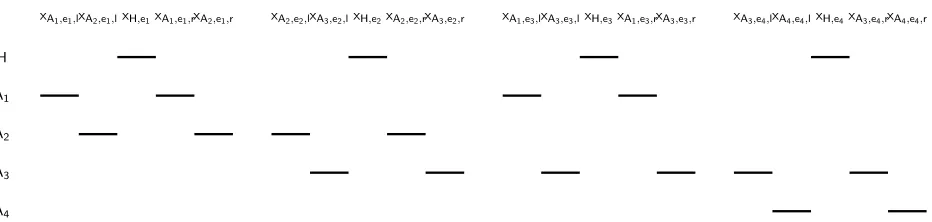
reduction constructs the LCFRS production shown in Figure 3. Figure 4 gives a visualization of how the spans in this production fit together. For each edge in the graph of Figure 2, we have a group of five spans in the production: one for the head nontermi-nal, and two spans for each of the two nonterminals corresponding to the edge’s endpoints. 2
Assume now some head-driven parsing strategy π for p. For eachi ∈ [n], we defineDπi to be the partial parse obtained after step i in π, consisting of the merge of nonterminals H, Aπ(1), . . . , Aπ(i). Consider some edgeej = (vs, vt). We observe that
for anyDπi that includes or excludes both nontermi-nalsAs andAt, theαj component in the definition
ofpis associated with a single string, and therefore contributes with a single unit to the fan-out of the partial parse. On the other hand, ifDπ
i includes only
one nonterminal betweenAsandAt, theαj
compo-nent is associated with two strings and contributes with two units to the fan-out of the partial parse.
We can associate withπ a linear arrangementhπ
of M by letting hπ(vπ(i)) = i, for each vi ∈ V.
xA1,e1,lxA2,e1,lxH,e1xA1,e1,rxA2,e1,r xA2,e2,lxA3,e2,lxH,e2xA2,e2,rxA3,e2,r xA1,e3,lxA3,e3,lxH,e3xA1,e3,rxA3,e3,r xA3,e4,lxA4,e4,lxH,e4xA3,e4,rxA4,e4,r
H
A1
A2
A3
[image:6.612.73.539.82.193.2]A4
Figure 4: A visualization of how the spans for each nonterminal fit together in the left-to-right order defined by the production of Figure 3.
we have the following relation, for everyi∈[n−1]:
f(Diπ) = q+cw(M, hπ, i).
We can then conclude thatM, kis a positive instance of MINCUT LINEAR ARRANGEMENTif and only ifp, k′is a positive instance of M
INSPACESTRAT -EGY. This proves that MIN SPACE STRATEGY is NP-hard.
To show that MIN SPACE STRATEGY is in NP, consider a nondeterministic algorithm that, given an LCFRS production p and an integer k, guesses a parsing strategyπforp, and tests whetherf(Dπi)≤
kfor eachi∈[n]. The algorithm accepts or rejects accordingly. Such an algorithm can clearly be
im-plemented to run in polynomial time.
We now turn to the MIN TIMESTRATEGY prob-lem, restricted to head-driven parsing strategies. Re-call that we are now concerned with the quantity f1+f2+f, wheref1 is the fan-out of some partial
parseD,f2is the fan-out of a nonterminalA, andf
is the fan out of the partial parse resulting from the merge of the two previous analyses.
We need to introduce the MODIFIEDCUTWIDTH problem, which is a variant of the MIN CUT LIN -EARARRANGEMENTproblem. LetM = (V, E)be some graph with|V| = n, and let hbe a linear ar-rangement forM. The modified cutwidth ofM at positioni∈[n]and with respect tohis the number of edges crossing over thei-th vertex:
mcw(M, h, i) =|{(u, v)∈E|h(u)< i < h(v)}|.
The modified cutwidth ofM is defined as
mcw(M) = min
h maxi∈[n] mcw(M, h, i).
In the MODIFIED CUTWIDTHproblem one is given as input a graph M and an integer k, and must decide whether mcw(M) ≤ k. The MODIFIED CUTWIDTH problem has been shown to be NP-complete by Lengauer (1981). We strengthen this result below; recall that a cubic graph is a graph without self loops where each vertex has degree three.
Lemma 1 The MODIFIED CUTWIDTHproblem
re-stricted to cubic graphs is NP-complete.
PROOF The MODIFIED CUTWIDTH problem has been shown to be NP-complete when restricted to graphs of maximum degree three by Makedon et al. (1985), reducing from a graph problem known as bisection width (see also Monien and Sudborough (1988)). Specifically, the authors construct a graph G′of maximum degree three and an integerk′from an input graphG= (V, E)with an even numbern of vertices and an integerk, such thatmcw(G′)≤k′ if and only if the bisection widthbw(G)ofGis not greater thank, where
bw(G) = min
A,B⊆V |{(u, v)∈E|u∈A∧v∈B}|
withA∩B =∅,A∪B =V, and|A|=|B|. The graphG′has vertices of degree two and three only, and it is based on a grid-like gadgetR(r, c); see Figure 5. For each vertex ofG,G′ includes a com-ponentR(2n4,8n4+8). Moreover,G′has a compo-nent called anH-shaped graph, containing left and right columns R(3n4,12n4 + 12) connected by a middle barR(2n4,12n4 + 9); see Figure 6. From each of thenvertex components there is a sheaf of
2n2 edges connecting distinct degree 2 vertices in the component to 2n2 distinct degree 2 vertices in
x
x x1
x2
x3
x4 x5
x x1 x2 x5
[image:7.612.134.481.73.154.2]x3 x4
Figure 5: TheR(5,10)component (left), the modification of its degree 2 vertexx(middle), and the corresponding arrangement (right).
the middle bar of theH-shaped graph. Finally, for each edge(vi, vj) ofGthere is an edge inG′
con-necting a degree 2 vertex in the component corre-sponding to the vertexvi with a degree 2 vertex in
the component corresponding to the vertexvj. The
integerk′ is set to3n4+n3+k−1.
Makedon et al. (1985) show that the modified cutwidth of R(r, c) is r −1 whenever r ≥ 3 and c ≥ 4r + 8. They also show that an optimal lin-ear arrangement forG′has the form depicted in Fig-ure 6, where half of the vertex components are to the left of theH-shaped graph and all the other ver-tex components are to the right. In this arrangement, the modified cutwidth is attested by the number of edges crossing over the vertices in the left and right columns of the H-shaped graph, which is equal to
3n4−1 +n 22n
2+γ = 3n4+n3+γ−1 (2)
where γ denotes the number of edges connecting vertices to the left with vertices to the right of the H-shaped graph. Thus, bw(G) ≤ k if and only if mcw(G′)≤k′.
All we need to show now is how to modify the components ofG′in order to make it cubic.
Modifying the vertex components All vertices
x of degree 2 of the components corresponding to a vertex in G can be transformed into a vertex of degree 3 by adding five vertices x1, . . . , x5
con-nected as shown in the middle bar of Figure 5. Ob-serve that these five vertices can be positioned in the arrangement immediately after x in the order x1, x2, x5, x3, x4 (see the right part of the figure).
The resulting maximum modified cutwidth can in-crease by2 in correspondence of vertex x5. Since
the vertices of these components, in the optimal arrangement, have modified cutwidth smaller than
2n4+n3+n2, an increase by 2 is still smaller than the maximum modified cutwidth of the entire graph, which is3n4+O(n3).
Modifying the middle bar of the H-shaped graph
The vertices of degree 2 of this part of the graph can be modified as in the previous paragraph. Indeed, in the optimal arrangement, these vertices have mod-ified cutwidth smaller than 2n4 + 2n3 +n2, and an increase by 2 is still smaller than the maximum cutwidth of the entire graph.
Modifying the left/right columns of the H-shaped
graph We replace the two copies of component
R(3n4,12n4 + 12) with two copies of the new componentD(3n4,24n4+ 16) shown in Figure 7, which is a cubic graph. In order to prove that rela-tion (2) still holds, it suffices to show that the modi-fied cutwidth of the componentD(r, c)is stillr−1
wheneverr≥3andc= 8r+ 16.
We first observe that the linear arrangement ob-tained by visiting the vertices ofD(r, c)from top to bottom and from left to right has modified cutwidth r−1. Let us now prove that, for any partition of the vertices into two subsetsV1andV2with|V1|,|V2| ≥
4r2, there exist at leastrdisjoint paths between ver-tices ofV1 and vertices ofV2. To this aim, we
dis-tinguish the following three cases.
• Any row has (at least) one vertex inV1and one
vertex inV2: in this case, it is easy to see there
exist at leastr disjoint paths between vertices ofV1and vertices ofV2.
• There exist at least3r‘mixed’ columns, that is, columns with (at least) one vertex inV1and one
vertex inV2. Again, it is easy to see that there
Figure 6: The optimal arrangement ofG′.
ofV1and vertices ofV2(at least one path every three columns).
• The previous two cases do not apply. Hence, there exists a row entirely formed by vertices ofV1 (or, equivalently, ofV2). The worst case
is when this row is the smallest one, that is, the one with (c−32−1) + 1 = 4r+ 7vertices. Since at most 3r −1 columns are mixed, we have that at most (3r −1)(r −2) = 3r2 −7r + 2 vertices of V2 are on these mixed columns.
Since |V2| ≥ 4r2, this implies that at least r columns are fully contained inV2. On the other hand, at least4r+7−(3r−1) =r+8columns are fully contained in V1. If the V1-columns
interleave with theV2-columns, then there exist at least2(r−1)disjoint paths between vertices ofV1and vertices ofV2. Otherwise, all theV1
-columns precede or follow all theV2-columns (this corresponds to the optimal arrangement): in this case, there arer disjoint paths between vertices ofV1and vertices ofV2.
Observe now that any linear arrangement partitions the set of vertices inD(r, c)into the setsV1,
consist-ing of the first4r2 vertices in the arrangement, and V2, consisting of all the remaining vertices. Since there arerdisjoint paths connectingV1andV2, there
must be at leastr−1edges passing over every vertex in the arrangement which is assigned to a position between the(4r2+ 1)-th and the position4r2 + 1
from the right end of the arrangement: thus, the modified cutwidth of any linear arrangement of the vertices ofD(r, c)is at leastr−1.
We can then conclude that the original proof of Makedon et al. (1985) still applies, according to
relation (2).
Figure 7: TheD(5,10)component.
We can now reduce from the MODIFIED CUTWIDTH problem for cubic graphs to the MIN TIMESTRATEGYproblem restricted to head-driven parsing strategies.
Theorem 2 The MINTIMESTRATEGYproblem
re-stricted to head-driven parsing strategies is NP-complete.
PROOF We consider hardness first. Let M and k be an input instance of the MODIFIED CUTWIDTH problem restricted to cubic graphs, where M = (V, E) and V = {v1, . . . , vn}. We construct an
LCFRS productionpexactly as in the proof of The-orem 1, with rhs nonterminals H, A1, . . . , An. We
also setk′= 2·k+ 2· |E|+ 9.
Assume now some head-driven parsing strategyπ forp. After parsing step i ∈ [n], we have a partial parse Diπ consisting of the merge of nonterminals H, Aπ(1), . . . , Aπ(i). We write tc(p, π, i) to denote the exponent of the time complexity due to stepi. As already mentioned, this quantity is defined as the sum of the fan-out of the two antecedents involved in the parsing step and the fan-out of its result:
tc(p, π, i) = f(Diπ−1) +f(Aπ(i)) +f(Diπ).
Again, we associate withπ a linear arrangement hπ ofM by lettinghπ(vπ(i)) =i, for eachvi ∈ V.
As in the proof of Theorem 1, the fan-out of Diπ is then related to the cutwidth of the linear
[image:8.612.374.480.214.266.2]menthπ ofMat positioniby
f(Dπi) = |E|+cw(M, hπ, i).
From the proof of Theorem 1, the fan-out of nonter-minal Aπ(i) is twice the degree of vertexvπ(i),
de-noted by|E(vπ(i))|. We can then rewrite the above equation in terms of our graphM:
tc(p, π, i) = 2· |E|+cw(M, hπ, i−1) +
+ 2· |E(vπ(i))|+cw(M, hπ, i).
The following general relation between cutwidth and modified cutwidth is rather intuitive:
mcw(M, hπ, i) =
1
2 ·[cw(M, hπ, i−1) +
− |E(vπ(i))|+cw(M, hπ, i)].
Combining the two equations above we obtain:
tc(p, π, i) = 2· |E|+ 3· |E(vπ(i))|+ + 2·mcw(M, hπ, i).
Because we are restricting M to the class of cubic graphs, we can write:
tc(p, π, i) = 2· |E|+ 9 + 2·mcw(M, hπ, i).
We can thus conclude that there exists a head-driven parsing strategy for p with time complexity not greater than 2· |E|+ 9 + 2·k = k′ if and only ifmcw(M)≤k.
The membership of MODIFIEDCUTWIDTHin NP follows from an argument similar to the one in the
proof of Theorem 1.
We have established the NP-completeness of both the MIN SPACE STRATEGY and the MIN TIME STRATEGYdecision problems. It is now easy to see that the problem of finding a space- or time-optimal parsing strategy for a LCFRS production is NP-hard as well, and thus cannot be solved in polynomial (de-terministic) time unless P = NP.
4 Concluding remarks
Head-driven strategies are important in parsing based on LCFRSs, both in order to allow statistical modeling of head-modifier dependencies and in or-der to generalize the Markovization of CFG parsers
to parsers with discontinuous spans. However, there aren!possible head-driven strategies for an LCFRS production with a head andnmodifiers. Choosing among these possible strategies affects both the time and the space complexity of parsing. In this paper we have shown that optimizing the choice according to either metric is NP-hard. To our knowledge, our results are the first NP-hardness results for a gram-mar factorization problem.
SCFGs and STAGs are specific instances of LCFRSs. Grammar factorization for synchronous models is an important component of current ma-chine translation systems (Zhang et al., 2006), and algorithms for factorization have been studied by Gildea et al. (2006) for SCFGs and by Nesson et al. (2008) for STAGs. These algorithms do not result in what we refer as head-driven strategies, although, as machine translation systems improve, lexicalized rules may become important in this setting as well. However, the results we have presented in this pa-per do not carry over to the above mentioned syn-chronous models, since the fan-out of these models is bounded by two, while in our reductions in Sec-tion 3 we freely use unbounded values for this pa-rameter. Thus the computational complexity of opti-mizing the choice of the parsing strategy for SCFGs is still an open problem.
Finally, our results for LCFRSs only apply when we restrict ourselves to head-driven strategies. This is in contrast to the findings of Gildea (2011), which show that, for unrestricted parsing strategies, a poly-nomial time algorithm for minimizing parsing com-plexity would imply an improved approximation al-gorithm for finding the treewidth of general graphs. Our result is stronger, in that it shows strict NP-hardness, but also weaker, in that it applies only to head-driven strategies. Whether NP-hardness can be shown for unrestricted parsing strategies is an im-portant question for future work.
Acknowledgments
References
Ashok K. Chandra and Philip M. Merlin. 1977. Op-timal implementation of conjunctive queries in rela-tional data bases. In Proc. ninth annual ACM sympo-sium on Theory of computing, STOC ’77, pages 77–90. Michael Collins. 1997. Three generative, lexicalised models for statistical parsing. In Proc. 35th Annual Conference of the Association for Computational Lin-guistics (ACL-97), pages 16–23.
F. Gavril. 1977. Some NP-complete problems on graphs. In Proc. 11th Conf. on Information Sciences and Sys-tems, pages 91–95.
Daniel Gildea and Daniel ˇStefankoviˇc. 2007. Worst-case synchronous grammar rules. In Proc. 2007 Meeting of the North American chapter of the Association for Computational Linguistics (NAACL-07), pages 147– 154, Rochester, NY.
Daniel Gildea, Giorgio Satta, and Hao Zhang. 2006. Factoring synchronous grammars by sorting. In Proc. International Conference on Computational Linguistics/Association for Computational Linguistics (COLING/ACL-06) Poster Session, pages 279–286. Daniel Gildea. 2010. Optimal parsing strategies for
Lin-ear Context-Free Rewriting Systems. In Proc. 2010 Meeting of the North American chapter of the Associa-tion for ComputaAssocia-tional Linguistics (NAACL-10), pages 769–776.
Daniel Gildea. 2011. Grammar factorization by tree de-composition. Computational Linguistics, 37(1):231– 248.
Carlos G´omez-Rodr´ıguez, Marco Kuhlmann, Giorgio Satta, and David Weir. 2009. Optimal reduction of rule length in Linear Context-Free Rewriting Systems. In Proc. 2009 Meeting of the North American chap-ter of the Association for Computational Linguistics (NAACL-09), pages 539–547.
Carlos G´omez-Rodr´ıguez, Marco Kuhlmann, and Gior-gio Satta. 2010. Efficient parsing of well-nested linear context-free rewriting systems. In Proc. 2010 Meeting of the North American chapter of the Association for Computational Linguistics (NAACL-10), pages 276– 284, Los Angeles, California.
John E. Hopcroft and Jeffrey D. Ullman. 1979. Intro-duction to Automata Theory, Languages, and Compu-tation. Addison-Wesley, Reading, MA.
Liang Huang, Hao Zhang, Daniel Gildea, and Kevin Knight. 2009. Binarization of synchronous context-free grammars. Computational Linguistics, 35(4):559–595.
Laura Kallmeyer and Wolfgang Maier. 2010. Data-driven parsing with probabilistic linear context-free rewriting systems. In Proc. 23rd International Con-ference on Computational Linguistics (Coling 2010), pages 537–545.
Marco Kuhlmann and Giorgio Satta. 2009. Treebank grammar techniques for non-projective dependency parsing. In Proc. 12th Conference of the European Chapter of the ACL (EACL-09), pages 478–486. Thomas Lengauer. 1981. Black-white pebbles and graph
separation. Acta Informatica, 16:465–475.
Wolfgang Maier and Anders Søgaard. 2008. Treebanks and mild context-sensitivity. In Philippe de Groote, editor, Proc. 13th Conference on Formal Grammar (FG-2008), pages 61–76, Hamburg, Germany. CSLI Publications.
F. S. Makedon, C. H. Papadimitriou, and I. H. Sudbor-ough. 1985. Topological bandwidth. SIAM J. Alg. Disc. Meth., 6(3):418–444.
B. Monien and I.H. Sudborough. 1988. Min cut is NP-complete for edge weighted trees. Theor. Comput. Sci., 58:209–229.
Rebecca Nesson, Giorgio Satta, and Stuart M. Shieber. 2008. Optimalk-arization of synchronous tree adjoin-ing grammar. In Proc. 46th Annual Meetadjoin-ing of the Association for Computational Linguistics (ACL-08), pages 604–612.
Owen Rambow and Giorgio Satta. 1999. Independent parallelism in finite copying parallel rewriting sys-tems. Theor. Comput. Sci., 223(1-2):87–120.
Benoˆıt Sagot and Giorgio Satta. 2010. Optimal rank re-duction for linear context-free rewriting systems with fan-out two. In Proc. 48th Annual Meeting of the Asso-ciation for Computational Linguistics, pages 525–533, Uppsala, Sweden.
Giorgio Satta and Enoch Peserico. 2005. Some com-putational complexity results for synchronous context-free grammars. In Proceedings of Human Lan-guage Technology Conference and Conference on Empirical Methods in Natural Language Processing (HLT/EMNLP), pages 803–810, Vancouver, Canada. H. Seki, T. Matsumura, M. Fujii, and T. Kasami. 1991.
On multiple context-free grammars. Theoretical Com-puter Science, 88:191–229.
Stuart M. Shieber, Yves Schabes, and Fernando C. N. Pereira. 1995. Principles and implementation of de-ductive parsing. The Journal of Logic Programming, 24(1-2):3–36.
K. Vijay-Shankar, D. L. Weir, and A. K. Joshi. 1987. Characterizing structural descriptions produced by various grammatical formalisms. In Proc. 25th An-nual Conference of the Association for Computational Linguistics (ACL-87), pages 104–111.
Hao Zhang, Liang Huang, Daniel Gildea, and Kevin Knight. 2006. Synchronous binarization for machine translation. In Proc. 2006 Meeting of the North Ameri-can chapter of the Association for Computational Lin-guistics (NAACL-06), pages 256–263.