Quantifying student learning within the ‘zone of proximal development’:
Application in an accelerated program
Steven J. O’Bryan, First Year College, Victoria University, Australia
Abstract: The capacity for educators to effectively scaffold lessons to maximise student learning in the ‘zone of proximal development’ has for decades been acknowledged as a pre-requisite for academic success. However, no research has attempted to critically evaluate unit curriculum and quantify its effectiveness in guiding students to learn within their individual zone of proximal development. This seems even more important in an accelerated program, where the rapid pace may exacerbate student feelings of anxiety and/or boredom and negatively influence learning outcomes. The proposed research initiative aims to develop a novel method of assessing student learning in the zone of proximal development and apply it to an accelerated program. This information has many important applications including empowering educators to; 1) personalise the learning experience, 2) evaluate the effectiveness of teaching methods, 3) evaluate the capacity for educators to effectively scaffold lessons, and 4) critically review and guide alterations to unit curricula.
Introduction
The recent implementation of accelerated learning programs across all tertiary courses at Victoria University means that students complete one unit at a time over a four week intensive ‘block’. This includes all tutorials, practical classes and assessments which have previously been completed throughout the traditional twelve-to-sixteen week semester system. Although accelerated programs may have some institutional advantages (Tatum, 2010), the shortened time frame could make it difficult for students to engage with and critically evaluate content. Thus, the fast pace of accelerated programs may induce higher levels of anxiety and/or boredom in students compared to longer traditional learning programs, which may have negative consequences on the capacity for students to achieve the desired learning outcomes. This poses a challenge to educators to motivate their students to participate in self-directed learning activities and to adopt effective active-learning strategies, so that lessons can be effectively scaffolded and students can reach their ‘zone of proximal development’ (Vygotsky, 1980).
Vygotsky’s theory of cognitive development, known as the ‘zone of proximal development’ (ZPD) (Vygotsky, 1980), is defined as:
“the distance between the actual development level as determined by independent problem solving and the level of potential development as determined through problem solving under adult guidance or in collaboration with more capable peers” (p.86).
with a level of guidance that reaches slightly beyond their current capabilities (Shabani, Khatib, & Ebadi, 2010). The theory is that tasks that promote cooperative learning, steer the student to engage with more capable partners and to actively construct that knowledge into their own way of independent thinking - a process referred to by Vygotsky as ‘internalisation’ and similar to Blooms higher orders of learning including evaluating and synthesizing knowledge (Bloom, Engelhart, Furst, Hill, & Krathwohl, 1956). Tasks which fall below the ZPD exhibit a low level of challenge and a high level of competency for the student, and are thus likely to result in the student becoming bored and disengaged. At the other end of the spectrum, tasks which fall above the ZPD exhibit a high level of challenge and low level of competency, meaning that students are likely to become anxious and confused (Figure 1). Thus, it is critical that educators effectively scaffold lessons and allocate tasks that fall within the ZPD, to optimize cognitive development.
Figure 1. Vygotsky’s ‘zone of proximal development’.
With increased student demand for flexibility in learning, more universities are adopting accelerated learning programs (Daniel, 2000; Christensen & Eyring, 2011). Accelerated learning programs are defined as:
“a specifically designed short-term course in which the same learning outcomes can be achieved in the same number of class hours as a traditional course but delivered in a shorter course duration” (Serdyukov, 2008).
be amplified in an accelerated learning environment compared to the traditional format, elevating the importance of effectively scaffolding lessons. Apart from active learning strategies, Brown (1992) illustrates that another critical ingredient to the success of an accelerated program is that students are supplied with a syllabus prior to face-to-face lessons and develop a base understanding of the explored content. Subsequently, students are able to have a higher level of engagement with the content during face-to-face teaching time, leading towards a deeper understanding and a higher order of learning. Thus, student success in an accelerated program and the capacity for their learning within the ZPD, is likely dependent on their level of engagement with preliminary content which is commonly delivered in an online interactive format.
Aims and Importance of the Research
The aim of this research initiative is to develop a method to quantify the effectiveness of a tertiary unit taught in an accelerated four week program in guiding students to learn within their individual zone of proximal development. Such information would empower educators to; 1) personalise the learning experience, 2) evaluate the effectiveness of teaching methods, 3) evaluate the capacity of educators to effectively scaffold lessons, and 4) critically review and guide alterations to unit curricula.
Proposed Method
Participants
The proposed research will be cross-sectional and quantitative in nature. Students enrolled in the first year unit Exercise Physiology at Victoria University in semester two 2019 will be invited to participate in the research initiative. It is estimated that the total sample size will be approximately 100 - 150 based off an acceptance rate of ~30% (semester two 2018 enrolments ~350). Descriptive data that may elucidate co-variables (e.g. highest level of previous education, gap in learning, related work experience, grade in pre-requisite units) will be collected via questionnaires.
Brief Unit Description
The Exercise Physiology unit is taught in a blended learning format over a four week ‘block’. Week one to three consists of 3 x 3 hour face-to-face sessions, 3 x 1.5 hour online ‘pre-class’ sessions, and 3 x 1.5 hour online ‘post-class’ sessions, with a new major topic explored each week. Week four consists of 2 x 3 hour face-to-face sessions, 2 x 1.5 hour online ‘pre-class’ sessions, and 2 x 1.5 hour online ‘post-class’ sessions, which are primarily dedicated to assessments. Overall, the unit consist of 11 face-to-face sessions and 22 online sessions, equalling a total of a 66 learning hours per block.
research project proposal. Overall, each week/topic is scaffolded to progress students from the base of blooms taxonomy (i.e. remember, understand and explain) to the peak (i.e. analyse, evaluate and create) (Bloom et al., 1956).
Procedure
At the conclusion of each week/topic, students will be asked to rate their perceived levels of competency and challenge for the various learning objectives on a 7 point Likert scale. Students will also be asked to rate their level of engagement with the self-directed learning activities (e.g. pre-class and post-class activities) and their overall level of anxiety/confidence and boredom/engagement.
Data Analysis and Statistics
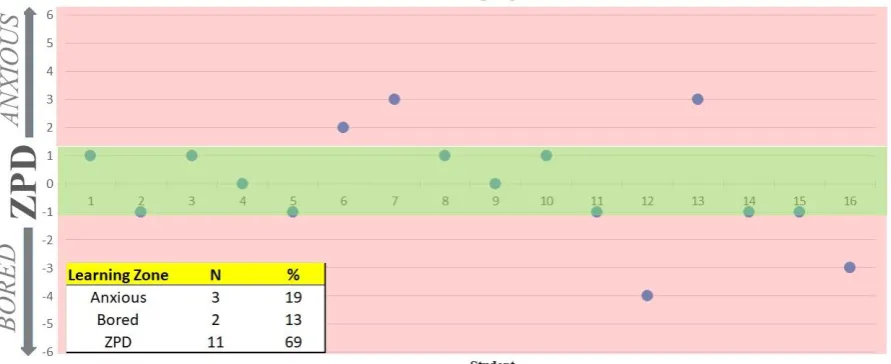
The individual zone of proximal development will be quantified and defined from the Likert scale as a score of ± 1 between the level of challenge and the corresponding level of competency for each learning objective, the week/topic overall, and for the entire unit at the end of the block. As such, students with a ZPD score of 0 ± 1 will be defined as learning within their ZPD, students with a score of > +1 will be defined as learning above their ZPD (i.e. anxious) and students with a score of < -1 will be defined as learning below their ZPD (i.e. bored). A frequency distribution analysis will then be performed. A hypothetical example of this is illustrated in Figure 2. One-way repeated measures ANOVA will analyse overall differences in competency, challenge, and the ZPD score, between learning objectives and weeks/topics. A multiple regression analysis will also determine the relationship between various dependant variables (level of engagement with self-directed online activities, grade on pre-requisite unit, level of relevant work experience, gap in learning) and the primary independent variable (learning in the ZPD).
Figure 2. Illustrative example of the proposed method to quantify student learning in the zone of proximal development (ZPD).
Questions for Audience Discussion
Does making the data identifiable influence the validity of student responses to the questionnaire?
Should academic grades be a primary focus and measure of student ‘success’, or is our role as educators to create an environment where all students learn within their own ZPD?
Does student perception of competency/challenge accurately reflect their level of competency/challenge? Is there a more robust way to investigate whether a student is learning in the ZPD?
References
Bloom, B., Engelhart, M., Furst, E., Hill, W., & Krathwohl, D. (1956). Taxonomy of Educational Objectives: The Classification of Educational Goals, Handbook I: Cognitive Domain. New York, US: D McKay.
Brown, D. H. (1992). Teaching Literature in the Intensive Weekend Format. Retrieved from
https://eric.ed.gov/?id=ED354519
Christensen, C. M., & Eyring, H. J. (2011). The innovative university: Changing the DNA of higher education from the inside out: Hoboken: John Wiley & Sons.
Daniel, E. L. (2000). A review of time-shortened courses across disciplines. College Student Journal, 34(2), 298-309.
Scott, P. A. (1996). Attributes of high-quality intensive course learning experiences: Student voices and experiences. College Student Journal, 30, 69-77.
Serdyukov, P. (2008). Accelerated learning: what is it? Journal of Research in Innovative Teaching, 1(1), 35-59.
Shabani, K., Khatib, M., & Ebadi, S. (2010). Vygotsky's Zone of Proximal Development: Instructional Implications and Teachers' Professional Development. English language teaching, 3(4), 237-248.
Tatum, B. C. (2010). Accelerated education: Learning on the fast track. Journal of Research in Innovative Teaching, 3(1), 35-51.