ISSN: 2319-8753
I
nternational
J
ournal of
I
nnovative
R
esearch in
S
cience,
E
ngineering and
T
echnology
(An ISO 3297: 2007 Certified Organization)
Vol. 3, Issue 5, May 2014
Determination of Mechanical Strength For
High Grade Concrete By Partial Replacement
Of Artificial Sand
Abhishek Kulkarni
1, Kalyani Bhutada
2, Ajay Shelorkar
3B.E. Student, Department of Civil Engineering, NDMVP'S KBTCOE, Nashik, Maharashtra, India
1B.E. Student, Department of Civil Engineering, NDMVP'S KBTCOE, Nashik, Maharashtra, India
2Sr. Lecturer, Department of Civil Engineering, NDMVP'S KBTCOE, Nashik, Maharashtra, India
3Abstract: The construction industry today is one of the booming, employment and resource generating field in India.
The increase in construction activities gives rise to vast demand for availability of materials used. But today due to the high construction activity the demand for river sand has increased to a greater pace as it being the primary material for the construction activity. The problem of sand mining is affecting the construction activity in our country. Excessive quarrying has caused the depletion of natural sand and causing flood problems. The government of India has therefore in some stated banned the use of natural sand. This ban has been affecting the construction process many a times the construction is stopped due to the unavailability of natural sand. The only option to this problem is the use of artificial sand or manufactured sand. The material is obtained by mechanically crushing the large rocks. The sand obtained is thus cheap, easily available and has shown better results as compared to the natural sand. The promotion of artificial sand will not only conserve the depleting natural resources but also give rise to speed and hassle free availability of material which will ultimately result in speed completion of work in given time and achieve economy in most of the aspect. The tests were conducted to show strength parameters of the concrete. It was found that compressive strength of the concrete increases with artificial sand. While in case of flexural strength the river sand holds good.
Keywords: Artificial sand, River sand, High grade concrete, mechanical properties
I. INTRODUCTION
The concrete is used for the centuries and there has been vast development in the grades and the types of materials in the increase of its strength. The construction being the growing industry the demand for the sand is increasing. The research has done in various times have proven the suitability of artificial sand being more efficient then river sand. With the present scenario where the availability of natural sand is a big concern the only option left is the use of artificial sand. In present the attempt is to discuss the mechanical properties of the concrete prepared by the traditional natural sand and that by the artificial sand for the high grade concrete (M50). The replacement has been made in a percentage manner i.e. (0%,25%,50%,75%,100%). The economical aspect is also covered.
II. LITERATURE REVIEW
Shanmugapriya et al. (2012) concluded from experimental researchers that compressive and flexural strength of concrete can be improved by partial replacement of cement by silica fume and manufactured sand for natural fine aggregates. They suggested that optimum replacement of natural sand by manufactured sand is 50%.
ISSN: 2319-8753
I
nternational
J
ournal of
I
nnovative
R
esearch in
S
cience,
E
ngineering and
T
echnology
(An ISO 3297: 2007 Certified Organization)
Vol. 3, Issue 5, May 2014
Dr.T. Felix Kala (2013) experimentally proved that with the mechanical strength of the high grade concrete can be increased by the use of granite power and the behaviour of granite aggregates with admixtures in concrete possesses the higher properties like concrete made by river sand.
M.Adams Joe et al. (2013) experimentally found that found that 50% replacement of fine aggregate by M-Sand give maximum result in strength and durability aspects than the conventional concrete.
Dr.S.Elavenil et al.(2013) experimentally found that compared to concrete made from river sand, high fines concrete generally had higher flexural strength, improved abrasion resistance, and higher unit weight & lower permeability due to fillings the pores with micro fines.
Jayaraman et al. (2013) found that for M30 grade concrete the compressive strength, tensile strength and flexural strength were carried out. The specimens are tested for 7 days, 14 days and 28 days with each proportion of nano silica and M-Sand mix. The Replacement of cement with 0.75% of nanosilica gives more strength than the M-sand mix and also the durability has been increased compared to the M-Sand.
Nimitha Vijayaraghavan et al. (2013) carried out Compressive Strength for 3, 7 and 28 days with varying proportion of manufactured sand replacement. The conclusion was in 100% replacement of natural sand by crushed sand, the compressive strength was maximum.
Gobinath. R et al. (2013) carried out Compressive strength of concrete for 7, 14 and 28 days. The conclusion was made that Compressive strength obtained for conventional concrete cubes and concrete cast using M Sand and glass fibers indicates that the strength properties of M Sand are adequate.
III. MATERIALS USED
A. Cement:
The Ordinary Portland Cement-53 grade was used. The physical properties determined in the laboratory. The cement satisfies the requirements of IS: 12269-1987 specifications.
Sr.No. Characteristics Experimental Value Value as specified by IS : 12269-1987
1. Specific gravity 3.15 3.15
2 Fineness of cement as retained on 90 μ. IS sieve
0.40 10.00 Max
Table 1: Physical Properties Of Cement
B. Coarse aggregates:
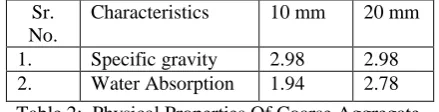
The crushed stone aggregate was collected from Gadgadsangvi near Nasik. The coarse aggregate was used in the experimentation were about 20 mm and 10 mm size aggregate and tested as per IS: 2386-1963 (III) specifications. Physical properties of coarse aggregates as determined in a laboratory are given in Table 2.
Sr. No.
Characteristics 10 mm 20 mm
1. Specific gravity 2.98 2.98 2. Water Absorption 1.94 2.78 Table 2: Physical Properties Of Coarse Aggregate C. Natural Sand:
The natural sand confirming to zone I as per IS: 383-1970 was used for the experimentation after washing it with water.
The specific gravity of this natural sand was found to be 2.83. The water absorption values obtained for the sand used was found to be 2.78%
D. Artificial Sand:
ISSN: 2319-8753
I
nternational
J
ournal of
I
nnovative
R
esearch in
S
cience,
E
ngineering and
T
echnology
(An ISO 3297: 2007 Certified Organization)
Vol. 3, Issue 5, May 2014
E. Admixture:
Flowcon 155M is used for increasing the workability of concrete mix even in case of less water cement ratio. The admixture was used by percentage of mass of cement (1.2% by mass), The same was adopted for all five mix proportion for maintaining the slump during the fresh concrete condition.
IV. EXPERIMENTAL PROGRAM
A. Compressive Strength Test:
Compressive strength test is the most common test conducted on concrete, because it is easy to perform and most of the desirable characteristic properties of concrete are quantitatively related to its compressive strength. Compressive strength was determined by using Compression Testing Machine (CTM) of 3000 KN capacity. The compressive strength of concrete was tested using 150 x150x150 mm cube specimens. The test was carried out by placing a specimen between the loading surfaces of a CTM and the load was applied until the specimen fails. Three test specimens were cast and used to measure the compressive strength for each test conditions and average value was considered.
B. Flexural Strength Test: Flexural strength is a measurement that indicates the resistance of a material to deformation when placed under a load.
The values needed to calculate flexural strength are measured by experimentation, with rectangular samples of the material placed under load in a 2 point testing setup. The strength of a material in bending, expressed as the stress on the outermost fibres of a bent test specimen, at the instant of failure. In a conventional test, flexural strength expressed in MPa is equal to(equ.1),
2PL∕ bd ……… (1)
C. Details of Concrete Mix:
The proportion for the mix is as given in table 3 for M50 grade of concrete.
Table 3: Reference Mix of Concrete Mix proportions
Properties and materials 100% Manufactured Sand(C1)
(75:25) Sand (C2)
(50:50) Sand (C3)
(25:75) Sand (C4)
100% Natural Sand (C5)
Cement (OPC53) 450 450 450 450 450
20mm 700 700 700 700 700
10mm 337 337 377 337 337
Artificial sand 880 649 426 211 0
River sand 0 216 426 628 826
Water 160 160 160 160 160
ISSN: 2319-8753
I
nternational
J
ournal of
I
nnovative
R
esearch in
S
cience,
E
ngineering and
T
echnology
(An ISO 3297: 2007 Certified Organization)
Vol. 3, Issue 5, May 2014
V. EXPERIMENTAL RESULT
Abbreviations used:
C1-100% Manufactured, C2-(75:25) Sand, C3- (50:50) Sand, C4-(25:75)Sand,C5- 100% Natural Sand P-1, P-2, P-3 represent the prism for the Flexural Test.
Table 4: Compressive Strength
Table 5: Flexural Strength Sr.No Type of Mix 7 Days
Strength(N/mm2)
28 Days Strength (N/mm2)
56 Days
Strength(N/mm2)
1. C1 55.81 72.25 78.02
2. C2 55.82 62.84 77.80
3. C3 53.42 70.885 76.8
4. C4 62.09 66.53 68.9
5. C5 55.52 68.8 67.28
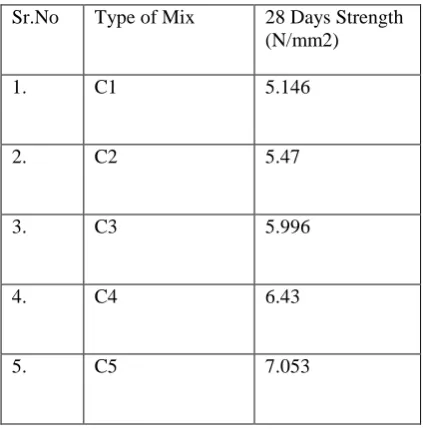
Sr.No Type of Mix 28 Days Strength (N/mm2)
1. C1 5.146
2. C2 5.47
3. C3 5.996
4. C4 6.43
ISSN: 2319-8753
I
nternational
J
ournal of
I
nnovative
R
esearch in
S
cience,
E
ngineering and
T
echnology
(An ISO 3297: 2007 Certified Organization)
Vol. 3, Issue 5, May 2014
VI. OBSERVATIONANDDISCUSSION
It has been observed that the compressive strength of artificial sand based HGC increases with the increase in percentage of artificial sand replacement with natural sand. Table 3 shows the variation of compressive strength of HGC with different percentage of replacement of artificial sand content of 0 %(i.e.,100%natural sand), 25 % ,50 % ,75% and 100% for 7days,28 days ,56 days as the artificial sand increases from 0% to 100% , the compressive strength for 56 days increases about 67.28 MPa,68.9 MPa ,76.8 MPa , 77.80 MPa and 78.02 MPa resp. Table 4 shows the flexural strength of HGC for 56 days decreases for 0%, 25% ,50% ,75% and 100% artificial sand replacement as 7.053 MPa,6.43 MPa,5.996 MPa,5.47 MPa and 5.146 MPa respectively.
Graph No.1: Compressive Strength
Graph No.2: Flexural Strength 0 10 20 30 40 50 60 70 80 90
0 10 20 30 40 50 60
Str e n gth DAYS
Compressive strength
C1 C2 C3 C4 C5 0 1 2 3 4 5 6 7 8C1 C2 C3 C4 C5
Fl e xu ral Str e n gth o f Co n cr e te (28 D ay s) in m p a
Types of Sample of Prism
P1
P2
ISSN: 2319-8753
I
nternational
J
ournal of
I
nnovative
R
esearch in
S
cience,
E
ngineering and
T
echnology
(An ISO 3297: 2007 Certified Organization)
Vol. 3, Issue 5, May 2014
The experimental set up and samples are shown in fig.(a) and fig.(b) respectively.
Fig.(a) Testing setup
Fig.(b) Sample of slump cone test
VII. CONCLUSION
It was found that the artificial sand can used as a suitable and economical alternative for the natural sand as it gives the required strength and shows better results in compressive strength. In case for the flexural strength the river sand still holds good. The results show slight up gradation in results for the flexural strength. The end conclusion is made out that natural sand being costly and hard to procure the artificial sand holds a great potential as a replacement.
VIII. ACKNOWLEDGEMENT
ISSN: 2319-8753
I
nternational
J
ournal of
I
nnovative
R
esearch in
S
cience,
E
ngineering and
T
echnology
(An ISO 3297: 2007 Certified Organization)
Vol. 3, Issue 5, May 2014
REFERENCES
[1] Ajay P., Dr.Jadhao Pradip D., Strength Appraisal Of High Grade Concrete By Using High Reactive Metakaolin, International Shelorkar Journal Of Innovative Research In Science, Engineering And Technology, Vol. 2, Issue 3, March 2013
[2] Dr.T. Felix Kala, Effect Of Granite Powder On Strength Properties Of Concrete, International Journal Of Engineering And Science., Vol.2, Issue 12 , Pp 36-50, Issn(E): 2278-4721, Issn(P):2319-6483, May 2013
[3] Priyanka A. Jadhav, Dilip K. Kulkarni, Effect Of Replacement Of Natural Sand By Manufactured Sand On The Properties Of Cement Mortar, International Journal Of Civil And Structural Engineering, Volume 3, No 3, 2013
[4] M.Adams Joe, A.Maria Rajesh, P.Brightson, M.Prem Anand, Experimental Investigation On The Effect Of M-Sand In High Performance Concrete, American Journal Of Engineering Research (Ajer), Volume-02, Issue-12, Pp-46-51,2013
[5] Dr.S.Elavenil And B. Vijaya, Manufactured Sand, A Solution And An Alternative To River Sand And In Concrete Manufacturing, Journal Of Engineering, Computers & Applied Sciences (Jec&As) , Volume 2, No.2, ,February 2013
[6] A. Jayaraman, V. Senthil Kumar, Optimization Of Fully Replacement Of Natural Sand By M-Sand In High Performance Concrete With Nanosilica, International Journal Of Emerging Technology And Advanced Engineering, Volume 3, Issue 11, November 2013
[7] Nimitha Vijayaraghavan And A S Wayal, Effects Of Manufactured Sand On Compressive Strength And Workability Of Concrete, International Journal For Structural And Civil Engineering Research, Vol.2,No.4, November 2013
[8] Gobinath. R, Vijayan. V, Sivakumar. N, Prakash. P, Suganya. S, Dhinesh. A, Strength Of Concrete By Partially Replacing The Fine Aggregate Using M-Sand, Scholars Journal Of Engineering And Technology (Sjet), Sch. J. Eng. Tech., 2013
[9] Shanmugapriya T And Uma R N, Optimization Of Partial Replacement Of M-Sand By Natural Sand In High Performance Concrete With Silica Fume, International Journal Of Engineering Sciences & Emerging Technologies, Vol. 2, Pp. 73-80.,2012
[10] Mahendra R Chitlange and Prakash S Pajgade , Strength Appraisal Of Artificial Sand As Fine Aggregate, In Sfrc Asian Research Publishing Network Journal Of Engineering And Applied Sciences, Vol. 5, Pp. 34-38.,2010
[11] N.K.Deshpande, Dr.S.S.Kulkarni and H.Pachpande , International Journal of Engineering Research and Applications (IJERA) ISSN: 2248-9622 , Vol. 2, Issue 5, September- October 2012, pp.038-042
[12] M. G. Shaikh And S. A. Daimi, Durability Studies Of Concrete Made By Using Artificial Sand With Dust And Natural Sand, International Journal Of Earth Sciences And Engineering ,Issn 0974-5904, Volume 04, No 06 Spl, October 2011, Pp 823-825
[13] Chandana Sukesh, Katakam Bala Krishna, P.Sri Lakshmi Sai Teja, S.Kanakambara Rao, Partial Replacement of Sand with Quarry Dust in Concrete, International Journal of Innovative Technology and Exploring Engineering (IJITEE) ISSN: 2278-3075, Volume-2, Issue-6, May 2013