International Journal of Advanced Research and Development
International Journal of Advanced Research and Development ISSN: 2455-4030, Impact Factor: RJIF 5.24
www.advancedjournal.com
Volume 2; Issue 1; January 2017; Page No. 74-78
ITS for
Learning computer networks
Mones M Al-Hanjori, Mohammed Z Shaath
Faculty of Engineering & Information Technology, Al-zhar University, Gaza, Palestine Abstract
Intelligent Tutoring Systems (ITS) has a wide influence on the exchange rate, education, health, training, and educational programs. In this paper we describe an intelligent tutoring system that helps student study computer networks. The current ITS provides intelligent presentation of educational content appropriate for students, such as the degree of knowledge, the desired level of detail, assessment, student level, and familiarity with the subject. Our Intelligent tutoring system was developed using ITSB authoring tool for building ITS. A preliminary evaluation of the ITS was done by a group of students and teachers. The results were acceptable.
Keywords: intelligent tutoring system, computer network, ITSB, student learning
1. Introduction
Intelligent Tutoring Systems are computer-based coaching programs that apply artificial intelligence [16]. ITS are more
advanced, allowing students to improve their skills by completing tasks as part of the interactive lecture hall environment. ITS can answer questions and provide personalized support to the student. ITS, as opposed to other educational technologies, to assess each student's response in order to assess his/her knowledge and skills. ITS can modify
teaching strategies; give explanations, examples,
demonstrations and practical exercises where you need them
[17].
The main goal of this intelligent tutoring system was to make available the benefits of one-on-one tuition in a cost effective way to the students of Computer Network.
The ITS system was mainly envisioned for coaching undergraduate students of Computer Network, but it can be likewise effective in other education environments, as well. Our current ITS provide adaptation of the teaching material based on the student performance and the data collected during the learning session.
The eminence of the adaptation delivered by the system is influenced by numerous factors, for example the precision of the pinpointing tools that gather and process data, the student model that is used to accumulation the data and the coaching rules [2,3].
2. Literature Review
Individual tutoring is definitely an old paradigm and remains one of the most active methods of land on the instructions. Experiments showed that specialized human guardians can create a vast volume of training benefits [1, 2]. The dawn of
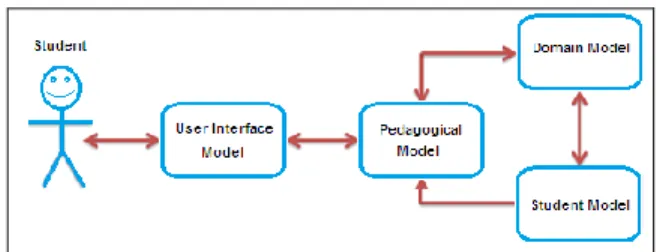
computers has displayed the aptitude of computers to be an encouraging another mentors rights experts, as they appear a untiring and profitable regarding human tutors. Intelligent tutoring is observed today as one of the greatest new advances in the field of instructive technology. The notion of intelligent tutoring systems (ITS) originated in the late 1960s, the ITS is an influential software that organize different kinds of knowledge models, such as the domain model, student model,
the student model, and user/teacher interface model. ITS is a multi-area and thus even the resources to construct them need to be gotten from many sources of research, such as artificial
intelligence, software development, human-computer
interface, education, and cognitive science [3].
Some of the ITS that were developed: ITS for teaching advanced topics in information security [17], development and
evaluation of the Oracle Intelligent Tutoring System (OITS)
[36], ITS for learning Computer Theory [37], e-learning system [12], ADO-Tutor: Intelligent Tutoring System for leaning
ADO.NET [38], an agent based ITS for Parameter Passing in
Java Programming [24], and Predicting learners performance
using NT and ITS [28], CPP-Tutor for C++ Programming
Language [31], a comparative study between Animated
Intelligent Tutoring Systems (AITS) and Video-based Intelligent Tutoring Systems (VITS) [20], authors in [41]
developed a stomach disease Intelligent Tutoring System, authors in [16] presented an Intelligent Tutoring System for
diabetes, in [21] the authors built an Intelligent Tutoring
System for Learning Java Objects that will help students to study Java objects, ITS teaching grammar English tenses [18],
Java Expression Evaluation[19], Linear Programming [25, 27], an
Knowledge-based Intelligent Tutoring System for Teaching
Mongo Database [40], Design and Development of an
Intelligent Tutoring System for C# Language [39],
effectiveness of e-learning [22], effectiveness of the CPP-Tutor [23], teaching AI searching algorithms [30, 32], teaching database [26], and ITS for Teaching the 7 Characteristics for Living
Things [42].
3. ITS Architecture
International Journal of Advanced Research and Development
In this paper we used the Intelligent Tutoring System Builder (ITSB) tool in the construction of an intelligent tutoring system for learning computer network.
ITSB designed development tool using Delphi Embarcadero XE8 2015; ITSB Development Tool consists of two systems. Teacher form system through which materials are added, questions and answers, etc. And the students of the system through which to learn of course, the materials and response exercises [29].
3.1 Domain Model Architecture
The domain model contains information about computer Network to explain the course; intelligent training system uses a domain model to solve problems or solutions to policy issues. The model presents the materials and the teachings in a simple and it creates a lot of problems for each lesson taking into account, the individual differences. When a student responds to the problem, determines whether good or bad, as well as it evaluate the student.
The material of computer Network includes the followings
[4-15]:
Introduction to Computer Network
Security Mechanisms and Principles
Encryption, Perfect Secrecy, One-Time Pad
Cryptographic Hash Functions
Hashing Applications and Constructions
Secret Sharing
Block Ciphers
Block Cipher Modes
Message Authentication Codes
Prime Finding and other "Crypto" Math
Diffie-Hellman Key Exchange and Crypto Groups
Pedersen Commitment, PK Encryption, DDH
Malleability of El Gamal, IND-CCA2.
3.2 Student Model Architecture
The student model is applied to the domain model. It focuses on the student's cognitive and emotional states with respect to their evolution, as well as the fact that the learning process in advance. While the student is working step-by-step through the problem-solving process, the system engages tracking process model. Before a student can use the ITS system, a profile for that student should have been created and stored in the database. Furthermore, information like student name, student number, last date the ITS visited, score, level of difficulties, lessons finished etc.
3.3 Pedagogical Module Architecture
Pedagogical model works as teaching strategies or academic plan. This model needs information on the points specified in the student's interaction. Based on this information, the Pedagogical model can generate tutorial action early interaction activities. But the system needs to understand what the right way or how to present the same work for different students that they may have different skills, cognitive thinking.
3.4 User Interface Model
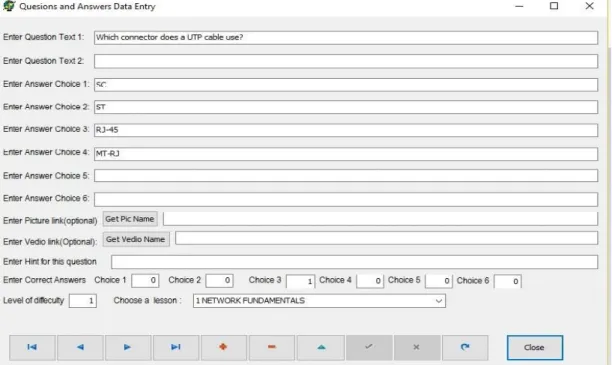
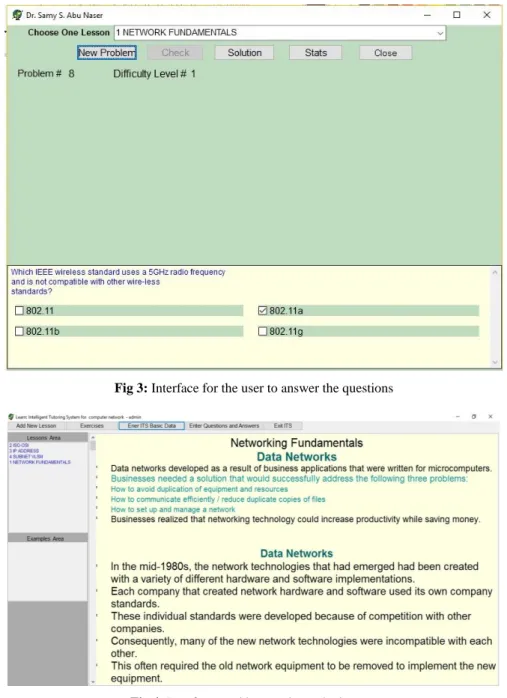
The user interface module is the communicating component of the IT’S which controls interaction between the learner and the system, as shown in Figure 1. In both directions, it interprets between the system's internal representation and an interface language that is comprehensible to the learner. The current IT’S for computer network has two main interfaces: user interface and teacher interface. The teacher interface allows the teacher to enter the lessons, questions, answers (as in Figure 2), level of difficulties for each question. The user Interface consists of the lesson form (as in Figure 4) and question form (as seen in Figure 3).
International Journal of Advanced Research and Development
Fig 3: Interface for the user to answer the questions
Fig 4: Interface used by user learn the lessons
4. Evaluation
The evaluation was conducted to test the intelligent tutoring system for teaching computer networks. Evaluation was to allow a group of students taking the course to try: lessons, examples, exercises and answers and train themselves on the network course using IT’S. The next step was to obtain the views of each student. Some of the students views of ITS was easy, efficient friendly, useful to learn another material using ITS.
5. Conclusion
This paper introduces the design and development of an ITS for teaching computer Networks. This paper also shows how the different emphases on the components of the ITS; It provides examples of different architectures to support ITS. It also reflects the different disciplines developed. Students read the problem and then begin to provide the answer in the form of multiple choices. Their solutions are automatically evaluated.
An evaluation of the intelligent tutoring system for teaching
computer networks was carried out and the results were as expected.
International Journal of Advanced Research and Development
77
References
1. Akkila, A. N. and S. S. Abu Naser (2017). "Teaching the right letter pronunciation in reciting the holy Quran using intelligent tutoring system." International Journal of Advanced Research and Development 2(1): 64-68. 2. Abu Hasanein, H. A. and S. S. Abu Naser (2017). "An
intelligent tutoring system for cloud computing.". 3. Abu Naser, S. (2008). "An Agent Based Intelligent
Tutoring System For Parameter Passing In Java Programming." Journal of Theoretical & Applied Information Technology 4(7).
4. Abu Naser, S. S. (1999). "Big O Notation for Measuring Expert Systems complexity." Islamic University Journal Gaza 7(1): 57-70.
5. Abu Naser, S. S. (2001). "A comparative study between
animated intelligent tutoring systems AITS and video-based intelligent tutoring systems VITS." Al-Aqsa Univ. J 5(1): 72-96.
6. Abu Naser, S. S. (2006). "Intelligent tutoring system for teaching database to sophomore students in Gaza and its effect on their performance." Information Technology Journal 5(5): 916-922.
7. Abu Naser, S. S. (2008). "Developing an intelligent tutoring system for students learning to program in C++." Information Technology Journal 7(7).
8. Abu Naser, S. S. (2008). "Developing visualization tool for teaching AI searching algorithms." Information Technology Journal, Scialert 7(2): 350-355.
9. Abu Naser, S. S. (2012). "A Qualitative Study of LP-ITS: Linear Programming Intelligent Tutoring System."
International Journal of Computer Science &
Information Technology 4(1): 209.
10. Abu Naser, S. S. and I. S. Zaqout (2016). "Knowledge-based systems that determine the appropriate students major: In the faculty of engineering and information technology." World Wide Journal of Multidisciplinary Research and Development 2(10): 26-34.
11. Abu Naser, S. S. and S. H. ALmursheidi (2016). "A Knowledge Based System for Neck Pain Diagnosis." World Wide Journal of Multidisciplinary Research and Development (WWJMRD) 2(4): 12-18.
12. Abu Naser, S. S., et al. (2008). "A Proposed Expert System For Guiding Freshman Students In Selecting A Major In Al-Azhar University, Gaza." Journal of Theoretical & Applied Information Technology 4(9).
13. Abu Naser, S., et al. (2011). "Human Computer
Interaction Design of the LP-ITS: Linear Programming Intelligent Tutoring Systems." International Journal of Artificial Intelligence & Applications (IJAIA) 2(3).
14. AbuEloun, N. N. and S. S. Abu Naser (2017).
"Mathematics intelligent tutoring system." International Journal of Advanced Scientific Research 2(1).
15. AbuEl-Reesh, J. Y. and S. S. Abu-Naser (2018). "An Intelligent Tutoring System for Learning Classical Cryptography Algorithms (CCAITS)." International Journal of Academic and Applied Research (IJAAR). 16. Abu-Naser, S. S. (2008). "JEE-Tutor: An Intelligent
Tutoring System for Java Expression Evaluation." 17. Abu-Naser, S. S. (2016). "ITSB: An Intelligent Tutoring
System Authoring Tool." Journal of Scientific and
Engineering Research 3(5): 63-71.
18. Abu-Naser, S., et al. (1995). "& Beattie, GA (2000)." Expert system methodologies and applications-a decade review from: 9-26.
19. Abu-Naser, S., et al. (2011). "An intelligent tutoring system for learning java objects." International Journal of Artificial Intelligence and Applications.
20. Alawar, M. W. and S. S. Abu Naser (2017). "CSS-Tutor: An intelligent tutoring system for CSS and HTML." International Journal of Academic Research and Development 2(1): 94-98.
21. Al-Bastami, B. G. and S. S. Abu Naser (2017). "Design and Development of an Intelligent Tutoring System for C# Language." EUROPEAN ACADEMIC RESEARCH 6(10): 8795.
22. Albatish, I., et al. (2018). "ARDUINO Tutor: An
Intelligent Tutoring System for Training on
ARDUINO." International Journal of Engineering and Information Systems (IJEAIS) 2(1): 236-245.
23. Al-Bayed, M. H. and S. S. Abu Naser (2017). "An intelligent tutoring system for health problems related to addiction of video game playing." International Journal of Advanced Scientific Research 2(1): 4-10.
24. Al-Bayed, M. H. and S. S. Abu-Naser (2018).
"Intelligent Multi-Language Plagiarism Detection
System." International Journal of Academic Information Systems Research (IJAISR) 2(3): 19-34.
25. Aldahdooh, R. and S. S. Abu Naser (2017).
"Development and Evaluation of the Oracle Intelligent Tutoring System (OITS)." EUROPEAN ACADEMIC RESEARCH 6(10): 8711-8721.
26. Alhabbash, M. I., et al. (2016). "An Intelligent Tutoring System for Teaching Grammar English Tenses." EUROPEAN ACADEMIC RESEARCH 6(9): 7743-7757.
27. Al-Hanjori, M. M., et al. (2017). "Learning computer
networks using intelligent tutoring system."
International Journal of Advanced Research and Development(2): 1.
28. Almurshidi, S. H. and S. S. Abu Naser (2017). "Design and Development of Diabetes Intelligent Tutoring System." EUROPEAN ACADEMIC RESEARCH 6(9): 8117-8128.
29. Almurshidi, S. H. and S. S. Abu Naser (2017).
"Stomach disease intelligent tutoring system." International Journal of Advanced Research and Development 2(1): 26-30.
30. Al-Nakhal, M. A. and S. S. Abu Naser (2017).
"Adaptive Intelligent Tutoring System for learning
Computer Theory." EUROPEAN ACADEMIC
RESEARCH 6(10): 8770-8782.
31. Anderson, J., et al. (2005). "Adaptation of Problem
Presentation and Feedback in an Intelligent
Mathematics Tutor." Information Technology Journal. 32. Azaab, S., et al. (2000). "A proposed expert system for
selecting exploratory factor analysis procedures." Journal of the College of Education 4(2): 9-26.
33. Baker, J., et al. "& Heller, R.(1996)." Information Visualization. Information Technology Journal 7(2). 34. Baker, J., et al. (1996). "Information Visualization."
International Journal of Advanced Research and Development
78
Information Technology Journal 7(2): pp: 403-404. 35. Buhisi, N. I. and S. S. Abu Naser (2009). "Dynamic
programming as a tool of decision supporting." Journal of Applied Sciences Research.
36. Chen, R.-S., et al. (2008). "Evaluating structural equation models with unobservable variables and measurement error." Information Technology Journal. 37. El Agha, M. I., et al. (2018). "SQL Tutor for Novice
Students." International Journal of Academic
Information Systems Research (IJAISR) 2(2): 1-7. 38. El Haddad, I. A. and S. S. Abu Naser (2017).
"ADO-Tutor: Intelligent Tutoring System for leaning ADO. NET." EUROPEAN ACADEMIC RESEARCH 6(10): 8810-8821.
39. Elnajjar, A. E. A. and S. S. Abu Naser (2017). "DES-Tutor: An Intelligent Tutoring System for Teaching DES Information Security Algorithm." International Journal of Advanced Research and Development 2(1): 69-73.
40. Hamed, M. A. and S. S. Abu Naser (2017). "An intelligent tutoring system for teaching the 7 characteristics for living things." International Journal of Advanced Research and Development 2(1): 31-45. 41. Hilles, M. M. and S. S. Abu Naser (2017).
"Knowledge-based Intelligent Tutoring System for Teaching Mongo Database." EUROPEAN ACADEMIC RESEARCH 6(10): 8783-8794.
42. Hissi, H. E.-., et al. (2008). "Medical Informatics:
Computer Applications in Health Care and
Biomedicine." Journal of Artificial Intelligence 3(4). 43. Li, L., et al. (2011). "Hybrid Quantum-inspired genetic
algorithm for extracting association rule in data mining." Information Technology Journal 12(4). 44. Mahdi, A. O., et al. (2016). "An intelligent tutoring
system for teaching advanced topics in information security." World Wide Journal of Multidisciplinary Research and Development 2(12): 1-9.
45. Naser, S. (2009). "Evaluating the effectiveness of the CPP-Tutor an intelligent tutoring system for students learning to program in C++." Journal of Applied Sciences Research 5(1): 109-114.
46. Ng, S., et al. (2010). "Ad hoc networks based on rough set distance learning method." Information Technology Journal 10(9).
47. Owaied, H. H., et al. (2009). "Using rules to support case-based reasoning for harmonizing melodies." Journal of Applied Sciences 11(14): pp: 31-41.
48. Shaath, M. Z., et al. (2017). "Photoshop (CS6) intelligent tutoring system." International Journal of Academic Research and Development 2(1): 81-87. 49. Sulisel, O., et al. (2005). "Growth and Maturity of
Intelligent Tutoring Systems." Information Technology Journal 7(7): 9-37.
50. Khella, R. A. and S. S. Abu-Naser (2018). "An Intelligent Tutoring System for Teaching French." International Journal of Academic Multidisciplinary Research (IJAMR) 2(2): 9-13.
51. Marouf, A., et al. (2018). "An Intelligent Tutoring System for Learning Introduction to Computer
Science." International Journal of Academic
Multidisciplinary Research (IJAMR) 2(2): 1-8.
52. Mosa, M. J., et al. (2018). "ASP. NET-Tutor: Intelligent Tutoring System for leaning ASP. NET." International Journal of Academic Pedagogical Research (IJAPR) 2(2): 1-8.
53. Qwaider, S. R. and S. S. Abu-Naser (2018). "Excel Intelligent Tutoring System." International Journal of Academic Information Systems Research (IJAISR) 2(2): 8-18.
54. Akkila, A. E.-D. N. and S. S. Abu Naser (2018). ITS-Tutor for Teaching Rules of Tajweed the Holy Quran, Al-Azhar University, Gaza, Palestine.
55. Akkila, A. N. and S. S. Abu-Naser (2018). "Rules of Tajweed the Holy Quran Intelligent Tutoring System."
International Journal of Academic Pedagogical
Research (IJAPR) 2(3): 7-20.
56. Abu Ghali, M. J., et al. (2018). "An Intelligent Tutoring System for Teaching English Grammar."