Cross-Modality Feature Learning for
Three-Dimensional Brain Image
Synthesis
Yawen Huang
Department of Electronic and Electrical Engineering
University of Sheffield
This dissertation is submitted for the degree of
Doctor of Philosophy
Declaration
I hereby declare that the work contained in this thesis are original and have not been submitted in whole or in part for any other degree or qualification. This thesis is my own work and includes nothing which is the outcome of work done in collaboration except where specifically clarified in the texts and acknowledgements. Some parts of the work presented in this thesis have been, or are due to be published in the following articles.
• Y. Huang, and L. Shao. Task-Driven Bidirectional Fault-Aware Adversarial Networks for Three-dimensional Brain Image Analysis.To be submitted, 2018.
• Y. Huang, and L. Shao. Simultaneous Super-Resolution and Cross-Modality Synthesis in Magnetic Resonance Imaging.To be submitted, 2018.
• Y. Huang, L. Shao, and A. F. Frangi. Cross-Modality Image Synthesis via Weakly-Coupled and Geometry Co-Regularized Joint Dictionary Learning.IEEE Transactions on Medical Imaging (TMI), 2017.
• Y. Huang, L. Shao, and A. F. Frangi. Simultaneous Super-Resolution and Cross-Modality Synthesis of 3D Medical Images using Weakly-Supervised Joint Convolutional Sparse Coding. In Proceedings of the IEEE Conference on Computer Vision and Pattern Recognition (CVPR), July 2017.
• Y. Huang, L. Shao, and A. F. Frangi. DOTE: Dual Convolutional Filter Learning for Super-Resolution and Cross-Modality Synthesis in MRI. InInternational Conference on Medical Image Computing and Computer-Assisted Intervention (MICCAI), pages 89–98, 2017.
• Y. Huang, F. Zhu, L. Shao, and A. F. Frangi. Color Object Recognition via Cross-Domain Learning on RGB-D Images. InIEEE International Conference on Robotics and Automation (ICRA)(oral), 2016, pp. 1672–1677.
• Y. Huang, L. Beltrachini, L. Shao, and A. F. Frangi. Geometry Regularized Joint Dictio-nary Learning for Cross-Modality Image Synthesis in Magnetic Resonance Imaging. In
MICCAI Workshop on Simulation and Synthesis in Medical Imaging (SASHIMI)(oral), Springer, 2016, pp. 118–126.
• Y. Huang, L. Beltrachini, L. Shao, and A. F. Frangi. Magnetic Resonance Imaging Cross-Modality Synthesis. InInternational Society for Magnetic Resonance in Medicine (ISMRM), no. 4220, 2016.
• D. Wang, Y. Huang, and A. F. Frangi. Region-Enhanced Joint Dictionary Learning for Cross-Modality Synthesis in Diffusion Tensor Imaging. InMICCAI Workshop on Simulation and Synthesis in Medical Imaging (SASHIMI), Springer, 2017, pp. 41–48.
Yawen Huang August 2018
Acknowledgements
I would like to acknowledge my supervisors Prof. Ling Shao and Prof. Geraint W Jewell for their expert supervisions and continuous encouragements over the past four years. It has been a great pleasure and honor working under the guidance of Prof. Ling, whose profession, foresight and patience for works pulling at me. I am very grateful to him for teaching me not just about some technical skills or the art of communicating ideas, but for teaching me how to think.
A special thanks to Prof. Alejandro F. Frangi for shaping how I think about research and being able to provide considerable intellectual input into the research that I have done to date. I would like to thank my friends and colleges: Dr. Simon Jones, Dr. Ruomei Yan, Dr. Di Wu, Dr. Fan Zhu, Dr. Mengyang Yu, Dr. Yang Long, Dr. Ziyun Cai, Dr. Feng Zheng, Dr. Zeike Taylor, Dr. Ali Gooya, Dr. Leandro Beltrachini, Dr. Jose Pozo, Dr. Nishant Ravikumar, Dr. Marco Pereanez, Dr. Serkan Cimen, Dr. Bo Dong, Redzuan Bin Abdul Manap, Bingzhang Hu, Yi Zhou, Yunbai Wang, Le Zhang, Yuanjun Lu, Junyu Jiang, Tiantian Dou, and Danyang Wang (who is my best friend). I would also like to thank many other reviewers for their helpful comments and discussions.
I am also very grateful to my thesis examiners Prof. Jianguo Zhang and Dr. Wei Liu, who offered insightful discussions and constructive suggestions for my research. Many special thanks are due to them for serving on reading my thesis, chairing my oral examination and providing valuable feedbacks to refine my thesis.
I would like to thank my assessors Dr. Charith Abhayaratne and Dr. Xiaoli Chu for their invaluable suggestions and comments for assessing my confirmation review report and viva during my first year PhD study.
I specially thank Dr. Thomas Walther in our department for his kind support and suggestions. I also owe a great deal to the postgraduate administrators, Ms. Hilary J. Levesley and Ms. Frances G. Bright.
Thank you to the head of the department Prof. Geraint W Jewell, who has supported me and helped me when I was in trouble. I am very grateful to Prof. Geraint for his continued support and explicit decision during the most difficult times.
I also would like to thank the departmental Learned Society Fund and the British Machine Vision Association for their financial support of my conference trips through my PhD.
Finally, I would like to thank my parents for their selfless love, unconditional support and immense encouragement in the past 26 years.
Abstract
Multi-modality medical imaging is increasingly used for comprehensive assessment of complex diseases in either diagnostic examinations or as part of medical research trials. Different imaging modalities provide complementary information about living tissues. However, multi-modal examinations are not always possible due to adversary factors such as patient discomfort, increased cost, prolonged scanning time and scanner unavailability. In addition, in large imaging studies, incomplete records are not uncommon owing to image artifacts, data corruption or data loss, which compromise the potential of multi-modal acquisitions. Moreover, independently of how well an imaging system is, the performance of the imaging equipment usually comes to a certain limit through different physical devices. Additional interferences arise (particularly for medical imaging systems), for example, limited acquisition times, sophisticated and costly equipment and patients with severe medical conditions, which also cause image degradation. The acquisitions can be considered as the degraded version of the original high-quality images. In this dissertation, we explore the problems of image super-resolution and cross-modality synthesis for one Magnetic Resonance Imaging (MRI) modality from an image of another MRI modality of the same subject using an image synthesis framework for reconstructing the missing/complex modality data. We develop models and techniques that allow us to connect the domain of source modality data and the domain of target modality data, enabling transformation between elements of the two domains. In particular, we first introduce the models that project both source modality data and target modality data into a common multi-modality feature space in a supervised setting. This common space then allows us to connect cross-modality features that depict a relationship between each other, and we can impose the learned association function that synthesizes any target modality image. Moreover, we develop a weakly-supervised method that takes a few registered multi-modality image pairs as training data and generates the desired modality data without being constrained a large number of multi-modality images collection of well-processed (e.g., skull-stripped and strictly registered) brain data. Finally, we propose an approach that provides a generic way of learning a dual mapping between source and target domains while considering both visually high-fidelity synthesis and task-practicability. We demonstrate that this model can be used to take any arbitrary modality and efficiently synthesize the desirable modality data in an unsupervised manner.
We show that these proposed models advance the state-of-the-art on image super-resolution and cross-modality synthesis tasks that need jointly processing of multi-modality images and that we can design the algorithms in ways to generate the practically beneficial data to medical image analysis.
Table of contents
List of figures xv
List of tables xix
Nomenclature xxi
1 Introduction and Literature Review 1
1.1 Background . . . 1
1.2 Imaging Modalities . . . 2
1.3 Challenges . . . 4
1.4 Dictionary Learning . . . 6
1.5 Convolutional Sparse Coding . . . 8
1.6 Datasets . . . 10
1.7 Related Work . . . 12
1.7.1 Nature Image Domain . . . 12
1.7.2 Medical Image Domain . . . 13
1.8 Thesis Outline . . . 15
1.9 Contributions . . . 15
2 Feature-Clustered and Normalized Joint Sparse Representation 17 2.1 Introduction . . . 18
2.2 Background . . . 21
2.2.1 Image Degradation Model . . . 21
2.2.2 Dictionary Learning . . . 22
2.3 Method . . . 22
2.3.1 Data Description . . . 23
2.3.2 Gradient Feature Representation . . . 23
2.3.3 Cross-Modality Dictionary Learning . . . 25
2.4 Experiments . . . 29
2.4.1 Dictionary Size . . . 30
2.4.2 Sparsity . . . 31
2.4.3 MRI Super-Resolution . . . 32
2.4.4 Simultaneous Super-Resolution & Cross-Modality Synthesis . . . 32
2.5 Conclusions . . . 34
3 Dual Convolutional Filter Learning 39 3.1 Introduction . . . 39
3.2 Background . . . 40
3.2.1 Convolutional Sparse Coding . . . 40
3.2.2 Dual Learning . . . 41
3.2.3 Problem Formulation . . . 41
3.3 Method . . . 42
3.3.1 Dual Convolutional Filter Learning . . . 42
3.3.2 Optimization . . . 43
3.3.3 Synthesis . . . 45
3.4 Experimental Results . . . 45
3.4.1 Experimental Setup . . . 45
3.5 Conclusions . . . 47
4 Weakly-Supervised Joint Convolutional Sparse Coding 51 4.1 Introduction . . . 52
4.2 Preliminaries . . . 53
4.2.1 Problem Formulation . . . 54
4.2.2 Notation . . . 55
4.3 Weakly-Supervised Joint Convolutional Sparse Coding . . . 55
4.3.1 Hetero-Domain Image Alignment . . . 55
4.3.2 Objective Function . . . 56
4.3.3 Optimization . . . 58
4.3.4 Synthesis . . . 61
4.4 Experimental Results . . . 62
4.4.1 Brain MRI Super-Resolution . . . 63
4.4.2 Simultaneous Super-Resolution and Cross-Modality Synthesis . . . . 63
Table of contents xiii
5 Geometry Constrained Dictionary Learning 69
5.1 Geometry Regularized Joint Dictionary Learning . . . 69
5.1.1 Introduction . . . 70
5.1.2 Method . . . 71
5.1.3 Experiments . . . 75
5.1.4 Summary . . . 77
5.2 Weakly-Coupled and Geometry Co-Regularized Joint Dictionary Learning . . 78
5.2.1 Introduction . . . 78
5.2.2 Method . . . 80
5.2.3 Experiments . . . 91
5.2.4 Discussions . . . 99
5.2.5 Conclusions . . . 100
6 Task-Driven Bidirectional Fault-Aware Adversarial Networks 103 6.1 Introduction . . . 104
6.2 Related Work . . . 106
6.2.1 Cross-Modality Synthesis . . . 106
6.2.2 Medical Image Analysis . . . 108
6.3 Task-Driven Bidirectional Fault-Aware Adversarial Networks . . . 109
6.3.1 Preliminaries . . . 109
6.3.2 Problem Formulation . . . 109
6.3.3 Jointly-Adapted Bidirectional Loss . . . 110
6.3.4 Fault-Aware Discriminator . . . 112 6.3.5 Objective Function . . . 113 6.4 Implementation . . . 114 6.4.1 Network Structures . . . 114 6.4.2 Training Details . . . 115 6.5 Experiments . . . 115 6.5.1 Experimental Setup . . . 115 6.5.2 Segmentation-Driven Synthesis . . . 119 6.6 Conclusions . . . 120
7 Conclusions and Future Directions 123 7.1 Conclusions . . . 123
7.2 Future Works . . . 124
7.2.1 Discrimination Capability . . . 125
7.2.3 4D Cardiac Data . . . 126
References 127
List of figures
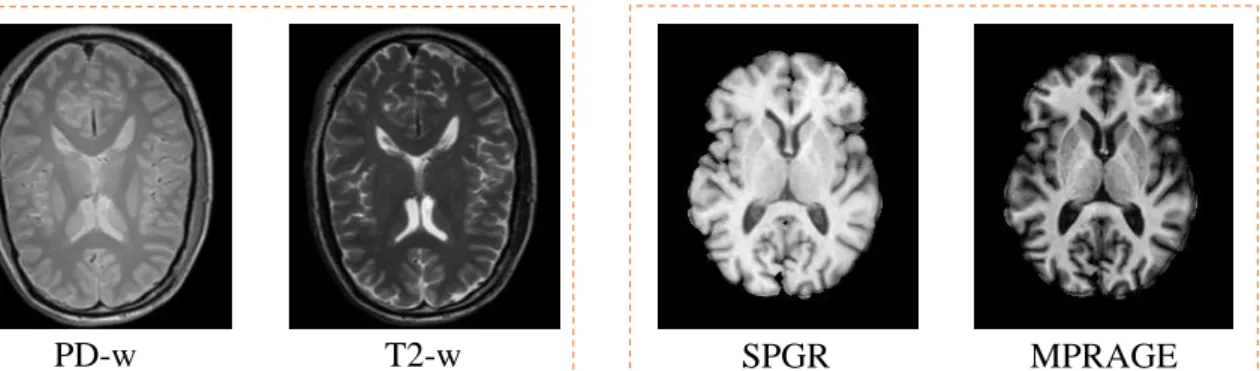
1.1 Example of different imaging modalities - PD-w, T2-w, SPGR and MPRAGE images. . . 1 1.2 An example of our synthesized result using the patch-based joint dictionary
learning method. . . 2 1.3 histogram matching model. . . 4 1.4 A patch-based cross-modality synthesis schema. . . 5 1.5 Illustration of the example PD-w and T2-w MR images from the IXI dataset.
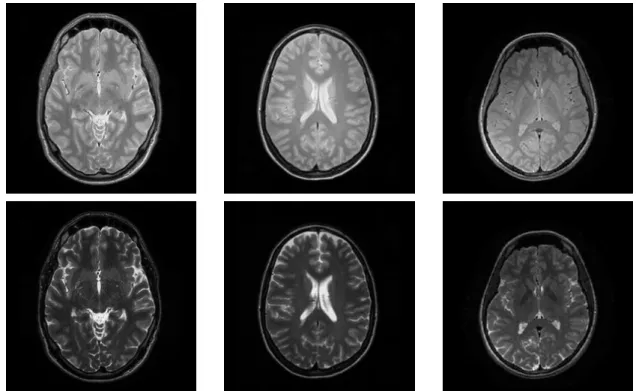
In each panel, the first row shows the PD-w image while the second row shows the corresponding T2-w data. . . 10 1.6 Illustration of the example T1-w and T2-w MR images from the NAMIC
dataset. In each panel, the first row shows the T1-w image while the second row shows the corresponding T2-w data. . . 11 2.1 The degradation model. . . 21 2.2 Illustration of the SiSCS model. Step 1: Feature collection. Step 2:
Cross-modality dictionary learning. Step 3: Globally redundant synthesis. . . 24 2.3 Example of the clustering-based global redundancy model including
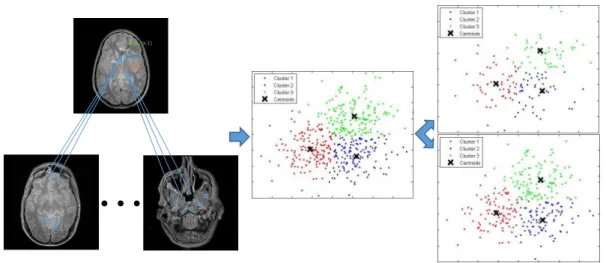
cross-modal matching and self-similarity. For each reference patch in the test image, groups of similar patches including cross-modal matching and self-similarity can be found based on K-means clustering (we collect three clusters here). . . 27 2.4 Comparison of the SR results with ground truth. . . 31 2.5 Axial views of synthesized HR T2-w examples based on the LR PD-w inputs
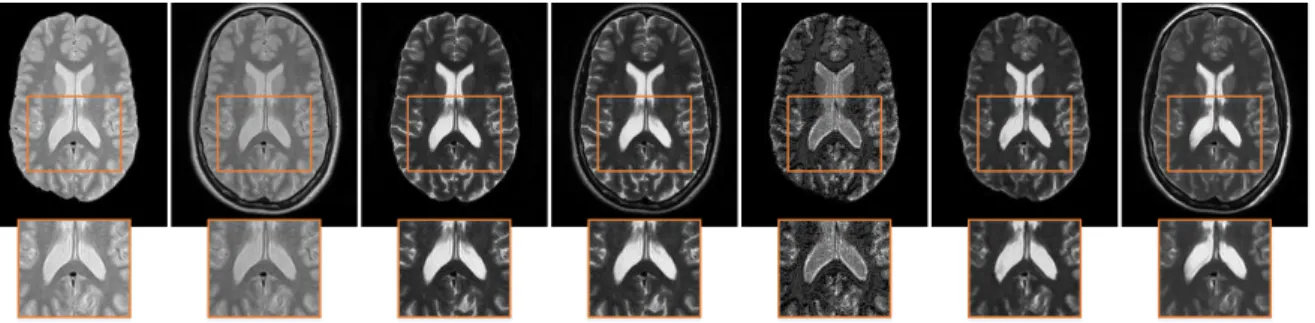
using different methods (zoom in for details). . . 33 2.6 Visual comparison of synthesized results using different methods on the
NAMIC dataset (zoom in for details). . . 34 2.7 Synthesis result of a pathological case comparison between SiSCS and other
2.8 Boxplots of error measures (PSNRs, SSIMs) for SR reconstructions with
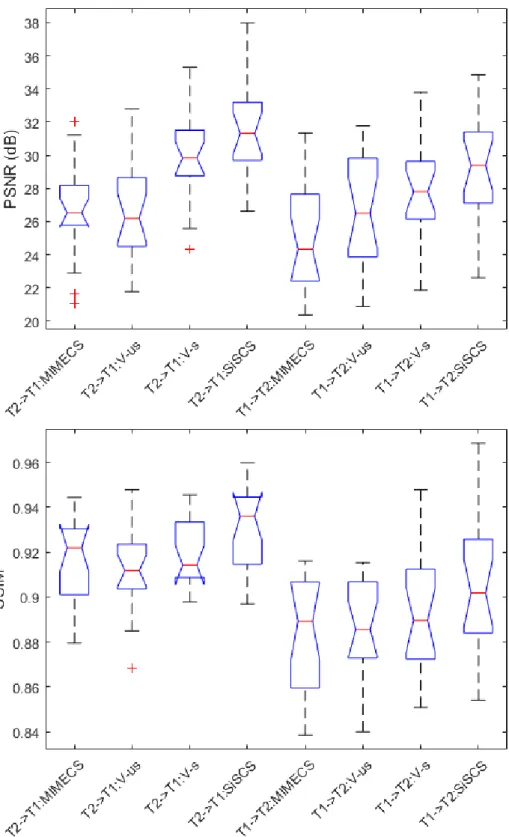
different methods. . . 36
2.9 Synthesis performance comparison between SiSCS and other stat-of-the-art methods on the NAMIC dataset. . . 37
3.1 Flowchart of the proposed method for MRI cross-modality synthesis. . . 42
3.2 Example SR results and the corresponding PSNRs and SSIMs. . . 48
3.3 Error measures of SR results on the IXI dataset. . . 49
3.4 Visual comparison of synthesized results using MIMECS and DOTE. . . 50
3.5 CMS results: DOTE vs. MIMECS on the IXI dataset. . . 50
4.1 Flowchart of the proposed method (WEENIE) for simultaneous SR and cross-modality synthesis. . . 55
4.2 Example SR results and corresponding PSNRs, SSIMs (zoom in for details). . 63
4.3 Performance comparisons of different SR approaches. . . 64
4.4 Visual comparison of synthesized results using different methods. . . 65
4.5 SRCMS results: WEENIE vs. MIMECS on IXI dataset. . . 66
5.1 Comparison of the synthesized results with ground truth. . . 77
5.2 Overview of the proposed cross-modality image synthesis method. Squares within the 3D images represent the extracted 3D patches with size of 5×5×5. The first step is to project the extracted paired/unpaired patches into a common feature space denoted by circles for source modality data and triangles for target modality data respectively. Then, we measure the divergence of the distribution of the maximum mean discrepancy (MMD) over all matched pairs from the first step to seek the intrinsic pairs in the reproducing kernel Hilbert space (RKHS). After that, to better preserve the modality-specific information, we adopt the Laplacian eigenmaps to capture the local geometric structure for each domain and denoted by geometric co-regularization term. Finally, the expected dictionary pairs can be trained based on the processed features. . . . 81
5.3 Synthesized results generated using SC, MIMECS, 0, GC, WAG-MMD and WAG (zoom in for details). . . 93
5.4 Cross-modality synthesis results: MIMECS, SC, WAG, WAG-MMD, WAG-GC and WAG-0 on the IXI dataset. . . 94
5.5 Example cross-modality synthesis results generated by MIMECS, SC, Ve-S, Ve-US and WAG on the NAMIC dataset. . . 97
5.6 Cross-modality synthesis results: MIMECS, SC, WAG, Ve-S and Ve-US on the NAMIC dataset. . . 98
List of figures xvii
6.1 Flowchart of the proposed method (T-GAN) for cross-modality synthesis. G
and F are the dual mapping functions which are used to establish domain exchange among the source domainX and the target domainY,XandYare the 3D volumes belongs toX andY respectively, ˆXand ˆYrepresent the first generated results whileXandYare their dual generations,DCG andDCF are
the discriminators corresponding toGandF,Lcdenotes the cycle-consistent
GAN,dk is the MK-MMD-based jointly-adapted regularizer,CX andCY are
the task-driven results. . . 110 6.2 Visual comparison for PD-w→T2-w with/without skull stripping MRI brain
image cross-modality synthesis. . . 117 6.3 Quantitative performance of PD-w→T2-w with/without skull stripping MRI
brain image cross-modality synthesis. . . 118 6.4 Visual comparison for PD-w→T2-w with/without skull stripping MRI brain
image cross-modality synthesis. . . 120 6.5 Quantitative analysis of T2-w→T1-w MRI brain image cross-modality
List of tables
2.1 Effects of Dictionary Size on SR Reconstruction and Simultaneous Super-Resolution and Cross-Modality Synthesis using All Slices of the IXI dataset. . 30 2.2 Performance Measures of SR Resolution and Simultaneous Super-Resolution
and Cross-Modality Synthesis for Different Sparsity Values using All slices of the IXI dataset. . . 31 2.3 Average Assessment Measures for Image Synthesis of Nine Pathological Cases 35 3.1 Quantitative evaluation: DOTE vs. other SR methods. . . 46 3.2 Quantitative evaluation: DOTE vs. DOTEnodual. . . 46 3.3 CMS results: DOTE vs. other synthesis methods on the NAMIC dataset. . . . 47 4.1 Quantitative evaluation (PSNR and SSIM): WEENIE vs. other SR methods on
95 subjects of the IXI dataset. . . 65 4.2 Quantitative evaluation (PSNR and SSIM): WEENIE vs. other synthesis
methods on the IXI dataset. . . 67 4.3 Quantitative evaluation (PSNR and SSIM): WEENIE vs. other synthesis
methods on the NAMIC dataset. . . 67 5.1 Performance measures of the synthetic images using JDL, GRiDLE (δ = 0),
and GRiDLE. . . 76 5.2 Comparison of methods used for synthesizing MPRAGE based on SPGR. . . 77 5.3 The number of selected paired/unpaired images. . . 92 5.4 PSNRs and SSIMs of the WAG-synthesized images resulting from different
paired/full set ratios during dictionary training. . . 95 5.5 Performance measures of the WAG-synthesized images resulting from different
paired/full set ratios during dictionary training. . . 95 5.6 Performance measures of the WAG-synthesized images resulting from different
5.7 Averaged PSNRs and SSIMs of the synthesized images using different methods on the NAMIC dataset. . . 96 5.8 Paired t-test on the WAG improvements using the IXI dataset. . . 99 5.9 Independent t-test on the performance benefits using the IXI dataset. . . 99 5.10 Independent t-test on the performance benefits using the NAMIC dataset. . . 99 6.1 Quantitative evaluation (PSNR (dB) and SSIM): T-GAN vs. other synthesis
methods on the IXI dataset. . . 119 6.2 Quantitative evaluation (PSNR (dB) and SSIM): T-GAN vs. other synthesis
methods on the NAMIC dataset. . . 119 A.1 Quantitative evaluation (PSNR (dB) and SSIM): SiSCS, DOTE, WEENIE,
Nomenclature
Acronyms / Abbreviations
ADMM Alternating Direction Method of Multipliers BCCB Block Circulant with Circulant Block
BP Basis Pursuit
CNN Convolutional Neural Network CSC Convolutional Sparse Coding CSF Cerebral Spinal Fluid
CT Computerized Tomography DFT Discrete Fourier Transform DFT Discrete Fourier Transform DL Dual Learning
DTI Diffusion Tensor Imaging
FCSC Fast Convolutional Sparse Coding FFT Fast Fourier Transform
GAN Generative Adversarial Network GLA Generalized Lloyd Algorithm GM Grey Matter
K-SVD K-Singular Value Decomposition LF Low-Frequency
MK-MMD Multi-Kernel Maximum Mean Discrepancy MMD Maximum Mean Discrepancy
MOD Method of Optimal Directions MRA Magnetic Resonance Angiography MRI Magnetic Resonance Imaging NL Non-Local
NN Nearest Neighbor
NP-hard Non-deterministic Polynomial-time Hardness PCA Principal Component Analysis
PSNR Peak Signal to Noise Ratio
QCQP Quadratically Constrained Quadratic Programing RKHS Reproducing Kernel Hilbert Space
sMRI Structural Magnetic Resonance Imaging SR Super-Resolution
SSIM Structural Similarity Index T1-w T1-weighted
PD-w Proton Density-weighted T2-w T2-weighted
Chapter 1
Introduction and Literature Review
1.1
Background
The importance of medical imaging for clinical diagnosis, treatment of disease, and medical research has steadily risen over the last decades. Images of difference modalities are usually generated in medical imaging (Fig. 1.1), for example, magnetic resonance imaging (MRI), computed tomography (CT), and positron emission tomography (PET). The resolution and modality diversity of medical acquisitions is constantly improving, but this comes at the cost of expensive equipment, patient comfort, and scanner time availability. Especially for high-quality and multi-modality images, precise and high-resolution scanners are required to extract the most useful data. In real life, these uncertainties may lead to incomplete records owing to image artifacts or corrupted or lost data.
Although multi-modality medical imaging plays an important role in the prevention, de-tection, treatment and even new technology is being developed to improve human health and welfare, the process of estimating a modality transformation regarding anatomical and/or
func-PD-w T2-w
Introd
SPGR MPRAGE
Fig. 1.2 An example of our synthesized result using the patch-based joint dictionary learning method.
tional contrasts between scans is remained, for the most part, unsolved. Despite the fact that the previous effort of researchers focused on the synergy of different modalities, for example, the hybrid positron emission tomography/magnetic resonance imaging [14], no satisfactory algorithms exist that works with simultaneous high-resolution image reconstruction and cross-modality synthesis. The goal of this thesis is to synthesize high-quality image while converting the input modality data to the target modality ones. An example of our synthesized result using the patch-based joint dictionary learning method is shown in Fig.1.2.
1.2
Imaging Modalities
Medical imaging includes a multitude of imaging modalities such as Magnetic Resonance Imaging, X-ray Computed Tomography, Ultrasound, Positron Emission Tomography, Electrical
1.2 Imaging Modalities 3
Impedance Tomography, etc. Recently, researches have been focused on recovering the missing modalities potentially existing in different modalities of MRI to capture diversified characteristics of the underlying anatomy, especially in the brain research [127,153].
MRI is a non-ionizing, non-invasive andin vivomedical imaging technique used in radiology to create a detailed cross-sectional image of the anatomy and the physiological processes of human body. The acquisitions are generated by forming strong magnetic fields, electric field gradients, and radio waves while avoiding ionizing radiation that can be potentially harmful to the patient. MRI has various modalities for providing useful anatomical and functional diagnostic information, where the contrast of each modality depends on the magnetic properties and number of hydrogen nuclei. By acquiring the comprehensive information, both clinicians and researchers are all likely to benefit from the advances in multi-modality MRI. The clinical applications of such multi-modality MRI exist, containing the assessment of active lesions in multiple sclerosis with MRI.
MRI offers the anatomical information between soft tissues which is usually used to observe/analyze brain activity. The contrast in MR images can be selected for by running different sequences with different weightings. Particularly, there are three main parameters: T1-weighted, T2-weighted, and proton density-weighted. T1-weighted (T1-w) images highlight the differences of longitudinal relaxation time in brain tissue, while T2-weighted (T2-w) images reflect transverse relaxation time, and proton density-weighted (PD-w) images depend on the levels of hydrogen protons within the volume of interest. Tissues with high fat content (e.g. white matter) appear bright and compartments filled with water (e.g. cerebral spinal fluid or CSF) appear dark in T1-w MRI. This is particularly good to depict anatomy. Conversely, in T2-w MRI, compartments filled with water (e.g. CSF) appear bright and those with high fat tissue content (e.g. white matter) appear dark. This is useful for depicting pathology as several lesions (e.g. edema, tumor, infarction, inflammation, and infections) are associated with increased water content. The spoiled gradient recalled (SPGR) pulse sequence spoils the transverse steady state through semi-randomly changing the phase of the RF pulse, leading primarily to PD-w or T1-w contrast. The SPGR sequence is characterized by superior tissue contrast between gray matter and white matter in the brain. As the time of the acquired images can be controlled in a reasonable range, the contrast and spatial resolution of the acquisitions allow the diagnosis to be made with accuracy. The magnetization-prepared rapid gradient-echo (MPRAGE) sequence is designed by using a magnetization-prepared 180 degree inversion pulse for structural brain imaging. The acquisition with T1-w dominance has the improved delineation between gray matter and white matter. The MPRAGE sequence provides high tissue contrast and image quality especially for depicting more focal lesions. Several other contrast mechanisms associate to water diffusion, tissue perfusion, etc.
4 Introduction and Literature Review
Histogram Matching
Fig. 1.3 histogram matching model.
Although the abundance of multiple MRI is clinically advantageous, acquisitions suffer from a number of practical problems. In addition, we investigated most of the multi-modality MRI datasets mainly from the brain imaging. To increase diagnosis capabilities and produce more reliable results, synthesizing the desirable modality MRI from the available brain data is the subject of this thesis.
1.3
Challenges
Synthesizing the unavailable data from the available MRI studies is a common necessity in the medical imaging community and hence attracted the considerable amount of research in the past [121,127]. Nonetheless, such a cross-modality synthesis problem is not satisfactorily solved in many real-life cases and also poses some challenges. Many applications [150] use subject-specific knowledge to synthesize the desired target modality data from the given source modality images. One common criticism is that in a supervised setting the training process becomes more difficult since collecting multi-modality medical images is both time consuming and expensive. These methods are usually restricted to just considering strictly paired data to the entire dataset. Unfortunately, most datasets are non-normalized (containing unpaired single modality data) and it is imperative to apply them to supply auxiliary support about the training requirement. A more recent, but harder, problem, is the cross-modality synthesis in a weakly-supervised or an unweakly-supervised manner. This is a difficult route and challenge arising when the
1.3 Challenges 5 Problem PD-w Input T2-w Output Cross-Modality Learning
Fig. 1.4 A patch-based cross-modality synthesis schema.
methods attempt to correlate the source modality data and the target modality data. It may feel natural to learn two modalities data in isolation and then compose them to form a relationship. In other words, addressing cross-modality feature learning task jointly needs to formulate an integrated framework that automatically explores the intermediate representations between both modalities during training, without having to explicitly define which two subjects should be aligned while processing the modality-specific image to support the synthesis task. Besides the interplay between different modality subjects and the quantity of data collected, additional problems contain the imaging conditions, the use of histogram matching model (shown in Fig. 1.3), the use of patch-based approaches (shown in Fig. 1.4), effective cross-modality feature representations, and method complexity. Also, how might the researcher even want to utilize the synthesized results in the following applications, e.g., registration, and segmentation. Making the synthesized data not only work but actually be effective of key consideration. A high-level overview of the challenges are given in the following:
1. the lacking of modality-specific information (i.e., missing certain modality data is critical to the feature learning of an algorithm)
2. the lacking of paired data 3. domain discrepancy
4. the relationship between different modality data 5. cross-modality feature learning
6. the fidelity of the synthesized results 7. higher-resolution requirement
8. the validity and effectiveness of the synthesized data
1.4
Dictionary Learning
In computer vision, feature representation is a crucial problem for understanding and learning images. To capture the compact and succinct representation in visual data, a popular way is to adopt dictionary learning to achieve sparse representation using only a few active code elements for representing images. Dictionary leaning for sparse coding has shown promising results in numerous tasks, such as image reconstruction [22,102,105,121,164], object recognition [66, 71,180,185], image super-resolution [43,167,171,178], image denoising [28,89,130,166], and visual classification [81,169,170,181] to name a few.
Dictionary learning-based sparse and redundant representation was first introduced by Olshausen and Field [116] for modeling the spatial receptive fields of simple cells in the mammalian visual cortex. It assumes an ability to represent natural signals (like images) as a linear combination of a few non-zero coefficients of an overcomplete (i.e. the number of basis atoms is greater than the dimension of the data) dictionary. The property of overcomplete is to provide the flexibility in matching data leading to a better approximation of the statistical distribution of the signal. Subsequently, extensive works on the dictionary learning model (according to different criteria) have been investigated in an attempt to understand it better and achieve or improve upon state-of-the-art results. Referring to the most classical ones of dictionary learning, the method of optimal directions (MOD) [37] and the K-Singular Value Decomposition (K-SVD) [1] algorithms have led to the dramatical improvements in infilling missing pixels and image compression tasks.
The MOD method was presented by Enganet al.[37] for designing frames to be used for signal compression. This is done by minimizing the representation error to find a dictionary with the corresponding sparse matrix. Similar to the Generalized Lloyd Algorithm (GLA) [45], the MOD is solved by iteratively optimizing over sparse coding and dictionary update steps. Given a set of training dataX= [x1,x2, ...xn], the purpose of the MOD algorithm is to learn a reconstructive dictionary Dfor obtaining the sparse representation Γ ofX, which can be
formulated by arg min D,Γ ∥X−DΓ∥2F s.t.∥γi∥0≤T ∀i, (1.1)
whereγi∈Γdenotes the column vector ofΓ,∥·∥is thel0-norm constraint counting the number of non-zero elements inΓ,∥·∥F represents the Frobenius norm defined as∥A∥F ,
q
∑i∑jA2i,j,
1.4 Dictionary Learning 7
The resulting optimization problem is highly non-convex, and there is no direct way to find the approximate solution. Instead, an iterative procedure was used in [37] to get a local minimum at best.
While significant steps have been taken to develop the sparsification theory using the MOD, similar problems on the K-SVD algorithm have received competitive attention to efficiently train a generic dictionary for sparse representation. In [1], the K-SVD method was introduced to efficiently learn an overcomplete dictionary from a set of training data. Through learning the dictionary instead of choosing off-the-shelf bases, the K-SVD has been shown to work well in image reconstruction and denoising [34]. The linear decomposition of a signal or an image allows more flexibility to adapt the representation to the data, leading to notable results for various visual inference applications [36,103,104,120,161,162]. The K-SVD algorithm is consistent with most of the previous work that relies on iteratively solving sub-problems with the purpose of achieving the optimal solution through an iterative approximation. Despite the wide applications and appealing properties of such an iterative approximation method, the high non-convexity of optimizing the objective function in Eq. (1.1) under thel0-sparsity penalty measure leads to a general NP-hard (Non-deterministic Polynomial-time hard) problem. Recent results [30,86] suggest a convexification of the problem posed in Eq. (1.1) by replacing the
l0-norm with an withl1-norm regularization to enforce sparsity, in which this procedure is also known as Basis Pursuit (BP) [20], or the Lasso [146]. Eq. (1.1) can be rewritten as a joint optimization problem using thel1-sparsity penalties on the representations:
arg min D,Γ
∥X−DΓ∥2F
s.t.∥γi∥1≤T ∀i,
(1.2)
Generally, Eq. (1.2) can be formulated in the form of Lagrange multipliers as
arg min D,Γ
∥X−DΓ∥2F+λ∥Γ∥1, (1.3)
whereλ is a regularization parameter to balance the sparsity in the objective function.
The optimization problem in Eq. (1.2) is convex in eitherDorΓare fixed, and therefore of
iteratively minimizing between sparse coding and dictionary learning. Specifically, whenDis fixed, one optimizes with respect to the sparse codesΓupdate (known as a Lasso problem);
when Γ is fixed, solving D becomes to a least square problem with a standard quadratic
constraint (known as the quadratically constrained quadratic programming (QCQP) problem). Given the training data X, we first need to initialize Dwith a Gaussian random matrix. Then, an iterative algorithm can be performed alternatively overΓandD:
1. WithDfixed, sparse coding coefficientsΓcan be calculated as
Γ=arg min Γ
∥X−DΓ∥2F+λ∥Γ∥1, (1.4)
2. WithΓfixed, dictionaryDcan be updated by
D=arg min D ∥X−DΓ∥ 2 F s.t.∥D∥22≤1 ∀i, (1.5)
Once the optimization is completed, i.e., iteration between step 1 and step 2 until converge, we can get the learned dictionary on which the sparse codes have a stable linear decomposition for image reconstruction.
1.5
Convolutional Sparse Coding
Convolutional Sparse Coding (CSC) [10,175] has been demonstrated as a promising direction for learning the convolutional image representations in machine learning and computer vision. The concept of CSC is closely related to classic patch-based feature learning and image recon-struction methods [1,11,86]. However, feature representation with a patch-based mechanism is highly redundant and may lead to the loss of shifted copies (i.e., overlapped samples) of the same features in the overlapped area of adjacent patches. A more elegant way to solve the above problem, i.e. removing much of the overhead of the patch-based sparse coding, is to use a convolution image formation model for consistently capturing the sparsely-distributed convolutional features. Through decomposing all training data into the defined number of sparse feature maps by the corresponding filters, CSC can avoid missing any latent structures of the underlying signal and thus naturally keep the consistency prior in the decomposition procedure. Recently, CSC has proven essential for many important applications in a wide range of computer vision problems [2,34,92,108,190]. For example, robust feature learning [77], as part of hierarchical networks in high-level computer vision tasks [77,175], and low-level image reconstruction [18,142]. In addition, CSC-based methods have been proposed to solve many practical applications including super-resolution [51], cross-modality synthesis [65], inpaiting [57], demosaicing [23] and reconstruction [57].
To take the property of shift invariance into account, CSC models local interactions through the convolution operator to sparsely encode the whole image. This is done by directly repre-senting an image as the summation of convolutions of the feature maps and the corresponding filters, thus avoiding the sparse decomposition on every single vector. Given a set of input
1.5 Convolutional Sparse Coding 9
vectors{x}Nn=1, CSC can be expressed as the following optimization problem:
arg min d,z 1 2 x− K
∑
i=1 di∗zi 2 2 +β K∑
i=1 ∥zi∥1 s.t.∥di∥1≤1 ∀i∈ {1, ...,K}, (1.6)where each vectorized input image xcan be denoted as the sum of sparse feature maps zi
convolved with the corresponding filtersdiof fixed spatial support,∗represents the convolution
operator processed on the vectorized inputs. Thel2-norm constraint ondiensures the learned
filters do not absorb the system energy, and therefore of removing the scaling ambiguity. Rather than averaging in patch-based model, CSC directly approximates the whole image as in the objective of Eq. (1.6) to avoid inconsistent reconstruction.
Despite the benefit of convolutional implementation of sparse coding to solve the inconsis-tency problem, CSC also brings some difficulties in optimization. Zeileret al.[175] proposed to solve the objective function by an alternation way with the auxiliary variablet, where one solves a set of convex subproblems until convergence andtis used to separate the convolution from thel1regularization. Similar to the solution of conventional sparse coding problem, CSC alternatively updates between processing the subproblemdgiven a fixedz, and the subproblem
zgiven a fixed d. A shortcoming of this method, however, is the computational overhead associated with the iterative subproblems. Bristowet al.[10] introduced a fast CSC algorithm through exploiting the property of block circulant with circulant block (BCCB) matrix solving in the Fourier domain. It has been shown the remarkable improvements in efficiency by utilizing Parseval’s theorem for solving Eq. (1.6). Following [10], we can reformulate Eq. (1.6) as a constrained optimization problem by involving two auxiliary variablestandsin the Fourier domain: arg min d,z,s,t 1 2 ˆ x− K
∑
i=1 ˆ di⊙zˆi 2 2 +β K∑
i=1 ∥ti∥1 s.t.∥si∥22≤1∀i∈ {1, ...,K} si=SΦTdˆi ∀i∈ {1, ...,K} ti=zi ∀i∈ {1, ...,K}. (1.7)where the symbolˆapplied to any vector denotes the frequency representation of a vectorized signal, for example, ˆx= [F(x1)T, ...,F(xN)T]and F(·) is the Fourier transform operator,⊙
denotes the Hadamard (component-wise) product,S projectsdonto a corresponding small spatial support,Φrepresents the Discrete Fourier Transform (DFT) matrix,siandtiare two
PD
-w Subje
cts
T2
-w Subjects
Fig. 1.5 Illustration of the example PD-w and T2-w MR images from the IXI dataset. In each panel, the first row shows the PD-w image while the second row shows the corresponding T2-w data.
slack variables allowing for an explicit and efficient solution to Eq. (1.7) by splitting the objective into several subproblems.
1.6
Datasets
Two distinct datasets were used in this dissertation. The first dataset is taken from the Informa-tion eXtracInforma-tion from Images (IXI)1[126] including 578 Magnetic Resonance (MR) images from normal and healthy subjects. The images have been collected at three different hospitals (i.e., Hammersmith Hospital using a Philips 3T system, Guy’s Hospital using a Philips 1.5T system, and Institute of Psychiatry using a GE 1.5T system) and stored in NIFTI format. The acquisition protocol for each subject contains: T1-weighted, T2-weighted, Proton Density (PD)-weighted images; Magnetic Resonance Angiography (MRA) images; and Diffusion-(PD)-weighted images (15 directions). Some examples collected from the IXI dataset are shown in Fig.1.5.
1.6 Datasets 11 T1 -w Subject s T2 -w Subjects
Fig. 1.6 Illustration of the example T1-w and T2-w MR images from the NAMIC dataset. In each panel, the first row shows the T1-w image while the second row shows the corresponding T2-w data.
The second dataset: National Alliance for Medical Image Computing (NAMIC)2includes 20 cases. Subjects from the NAMIC dataset were part of a schizophrenic study, specifically, ten are Normal Controls, and ten are Schizophrenic. The data acquisition protocol for each subject has Structural Magnetic Resonance Imaging (sMRI), Diffusion Tensor Imaging (DTI) and Resting State fMRI. In this work, we focus on the structural MRI volumes which are PD-w, T1-w, and T2-w images. Specifically, MR images were acquired with using a 3T GE system at BWH in Boston, MA. The MR image acquisition protocol for each subject has two pulse sequences: contiguous spoiled gradient-recalled acquisition (fastSPGR) (TR=7.4ms, TE=3ms, TI=600, 10 degree flip angle, 25.6cm2 field of view, matrix=256×256, 1×1×1 mm voxel size); XETA (eXtended Echo Train Acquisition) provides a series of contiguous T2-w data (TR=2500ms, TE=80ms, 25.6 cm2field of view, 1 mm slice thickness, 1×1×1 mm voxel size). Some examples sampled from the NAMIC dataset are shown in Fig.1.6.
1.7
Related Work
With the goal to transfer the modality information from the source domain to the target domain, recent developments in cross-modality synthesis, such as texture synthesis [32,44,59], face photo-sketch synthesis [42,158], and multi-modal retrieval [110,138], have shown promising results. In this thesis, we focus on the problems of image super-resolution and cross-modality synthesis, so only review related methods on these two aspects. To synthesize a target modality image from a source modality image, several approaches have been suggested in the literature with state-of-the-art results [14,72,153]. Most of these methods can be broadly referred to as the nature image domain and the medical image domain roughly subdivided based on the type of images.
1.7.1
Nature Image Domain
In the nature image domain, the purpose of image super-resolution (SR) is to reconstruct an high-resolution (HR) image from its low-resolution (LR) counterpart. According to the image priors, image SR methods can be grouped into two main categories: interpolation-based, external or internal data driven learning methods. Interpolation-based SR works, including the classic bilinear [90], bicubic [78], and some follow-up methods [131,179], interpolate much denser HR grids by the weighted average of the local neighbors. Most modern image SR methods have shifted from interpolation to learning based. These methods focus on learning a compact dictionary or manifold space to relate LR/HR image pairs, and presume that the lost high-frequency (HF) details of LR images can be predicted by learning from either external datasets or internal self-similarity. The external data driven SR approaches [16,40,168] exploit a mapping relationship between LR and HR image pairs from a specified external dataset. In the pioneer work of Freemanet al.[40], the NN of an LR patch is found, with the corresponding HR patch, and used for estimating HF details in a Markov network. Changet al.[16] projected multiple NNs of the local geometry from the LR feature space onto the HR feature space to estimate the HR embedding. Furthermore, sparse coding-based methods [128,168] were explored to generate a pair of dictionaries for LR and HR patch pairs to address the image SR problem. Wanget al.[155] and Huanget al.[60] further suggested modeling the relationship between LR and HR patches in the feature space to relax the strong constraint. Recently, an efficient CNN based approach was proposed in [27], which directly learned an end-to-end mapping between LR and HR images to perform complex nonlinear regression tasks. For internal dataset driven SR methods, this can be built using the similarity searching [125] and/or scale-space pyramid of the given image itself [61].
1.7 Related Work 13
In parallel, various cross-modality synthesis methods have been proposed for synthesizing unavailable modality data from available source images. One of the well-established modality transformation approaches is the example-based learning method generated by Freemanet al.[41]. Given a patch of a test image, several NNs with similar properties are picked from the source image space to reconstruct the target one using Markov random fields. In addition, Hertzmannet al. provided image analogies [59], which transfers the texture information from a source modality space onto a target modality space. Gatys et al.[44] introduced a CNN algorithm of artistic style, that new images can be generated by performing an image pre-search in high-level image content to match generic feature representations of example images.
1.7.2
Medical Image Domain
In the medical imaging community [127,150,153], synthesis algorithms can be summarized into a main family, i.e., example-based methods roughly subdivided in accordance with the size of the training set. Particularly, image SR can be treated as a way of synthesis which attempts to improve image resolution by algorithms instead of carrying out during the acquisition stage. Image SR effectively solved the problem of long acquisition and breath-hold from the requirement of high quality images, therefore the accuracy of clinical diagnosis can be increased while the images are acquired in a reasonable time.
Example-based methods learn the source-target mapping from a very small number of source-target image pairs (e.g. several or even a pair of images) by extracting multiple image patches from the source image and assuming the same sparse codes are shared between source and target modality spaces. One of the well-established cross-modality synthesis approaches in this category is applied to facilitate multi-modal image registration in correlative microscopy [15]. Kroonet al. [82] mapped between T1-w and T2-w magnetic resonance images by simply using the peaks in a joint histogram of registered image pairs to transform between source and target image representations. Techniques based on sparse representations have been presented, which separately learn two corresponding dictionaries from registered image pairs and synthesize the target MRI modality data from the patches of the source MRI modality [127]. Specifically, Royet al.[127] used sparse coding for desirable MR contrast synthesis assuming that cross-modality patch pairs have same representations and can be directly used for training dictionaries to estimate the contrast of the target modality. Similar work was also used in [67]. In [4], a canonical correlation analysis-based approach was proposed to yield a feature space that can get underlying common structures of co-registered data for better correlation of dictionary pairs. Recently, Joget al. [72] proposed a nonlinear regression-based image synthesis approach that used registered image pairs to train a random forest regressor for predicting the target from the source image intensity.
Some example-based methods learn the source-target mapping assuming that a large set of source-target modality image pairs (e.g. the whole dataset) is available. These approaches vary on how to generate a model (e.g. learning a dictionary, a manifold or a network) that relates to the number of the patches of the registered image pairs. In measuring the similarity between training and test data of the same modality, Ye et al. [172] proposed an iterative patch-based modality propagation approach. For each patch of the test image, a global search was performed comparing the input patch with each patch in the training dataset. The nearest neighbors to the input patch were found in the source domain; the target modality image was synthesized with the corresponding target modality patches. Rather than learning the mapping between both domains in the original data space, coupled dictionary learning [168] can alleviate simple cross-modality heterogeneity in the projected feature space. As an extension, semi-coupled dictionary learning was presented by advancing a linear mapping to model the relationship on the sparse representations from both domains. Burgoset al.[14] introduced another framework called pseudo CT synthesis for generating CT-like image from the T1-w or T2-w input using multi-atlas deformable registration and tissue contrast fusion. In [150], a location-sensitive deep network [150] has been put forward to explicitly utilize the voxel image coordinates by incorporating image intensities and spatial information into a deep network for synthesizing purposes. Instead of using coupled image pairs as training data, matching feature representations and learning spatial relations with joint sparse coding [153] has shown great potential in synthesizing images across modalities. To improve the quality of the synthesized images across different modalities, Huanget al. [65] proposed to first align weakly-supervised data and then generate super-resolution cross-modality data simultaneously using joint convolutional sparse coding scheme. Inspired by this strategy, we integrate paired and unpaired training data by constructing correspondences across different modalities and leverage weakly-coupled data effectively.
As argued in [153], collecting a large number of multi-modality images is both time-consuming and expensive, and sometimes even impractical in medical imaging. It would be preferable to use an unsupervised approach to deal with input data instead of ensuring data to be coupled invariably. Most of the methods, especially the full-set-based approaches, require con-siderable amounts of co-registered training data in both source and target domains. Motivated by this and the above works, we propose several more practical cross-modality image synthesis solutions that link source-target domains in either a fully supervised setting or a weakly-coupled fashion, which outperform existing state-of-the-art methods on our experiments.
1.8 Thesis Outline 15
1.8
Thesis Outline
This dissertation begins with works that address the core algorithmic problem of designing cross-modality synthesis methods to assist comprehensive assessment of complex diseases in either diagnostic examinations or as part of medical research trials. In particular, we develop both supervised and weakly-supervised approaches that process and align the two modalities and train their parameters on datasets of multi-modality brain MRI acquisitions. The rest of this thesis is organized as follows.
In Chapter 2, we consider the problem of collecting features in MRI by their modality-specific properties learned with full supervision. Chapter 3 presents a novel dual convolutional filter learning algorithm for the cross-modality synthesis of brain MRI data, with the key contribution being an algorithm for bringing state-of-the-art 3D method for robust synthesis. Chapter 4 deals with the challenging task of weakly-supervised learning useful for both image super-resolution and cross-modality synthesis. In Chapter 5, we first introduce a geometry regularized joint dictionary learning method in a supervised setting, which is designed to work on brain image for synthesizing the missing/complex modality data. Another part of the model included in Chapter 5 extends the proposed geometrical regularization approach to a weakly-supervised scheme for cross-modality synthesis. Chapter 6 constructs an unsupervised deep learning architecture for automatically synthesize the application/post processing-efficient high-resolution or required modality data with dual learning during training. Finally, Chapter 7 concludes this thesis and discusses future works. The parallel contrast experiments are involved in Appendix A.
1.9
Contributions
In this dissertation, we develop models for the cross-modality synthesis of the three-dimensional brain image. In particular, we develop several learning-based architectures that process and align the two modalities and train models on different public multi-modality brain datasets. Most contributions in this dissertation have first appeared as my publications, which are summarized below3:
1. Chapter 2: Simultaneous super-resolution and cross-modality synthesis in magnetic resonance imaging.
2. Chapter 3: Dual convolutional filter learning for super-resolution and cross-modality synthesis in MRI [64].
3A more detailed account of contributions appears in Section 7.1. Other publications such as [66] are beyond the scope of this dissertation and thus not discussed here.
3. Chapter 4: Simultaneous super-resolution and cross-modality synthesis of 3D medical images using weakly-supervised joint convolutional sparse coding [65].
4. Chapter 5: Geometry regularized joint dictionary learning for cross-modality image synthesis in magnetic resonance imaging [62]. Cross-Modality Image synthesis via weakly-coupled and geometry co-regularized joint dictionary learning [63].
5. Chapter 6: Task-driven bidirectional fault-aware adversarial networks for three-dimensional brain image analysis.
Chapter 2
Feature-Clustered and Normalized Joint
Sparse Representation
Multi-modality Magnetic Resonance Imaging (MRI) has enabled significant progress to both clinical diagnosis and medical research. Applications range from different diagnosis to novel insights into disease mechanisms and phenotypes. However, there exist many practical sce-narios where acquiring high-quality multi-modality MRI is restricted, for instance, owing to limited scanning time. This imposes constraints on multi-modality MRI processing tools, e.g. segmentation and registration. Such limitations are not only recurrent in prospective data acquisition, but also when dealing with existing databases with either missing or low quality imaging data. In this chapter, we explore the problem of synthesizing high-resolution images corresponding to one MRI modality from a low-resolution image of another MRI modality of the same subject. This is achieved by introducing the cross-modality dictionary learning scheme and a patch-based globally redundant model based on sparse representations. We use high-frequency multi-modality image features to train dictionary pairs, which are robust, compact, and correlated in this multimodal feature space. A feature clustering step is inte-grated into the reconstruction framework speeding up the search involved in the reconstruction process. Images are partitioned into a set of overlapping patches to maintain the consistency between neighboring pixels and increase speed further.Extensive experimental validations on two multi-modality databases of real brain MR images show that the proposed method outperforms state-of-the-art algorithms in two challenging tasks: image super-resolution and simultaneous SR and cross-modality synthesis. Our method was assessed on both healthy subjects and patients suffering from schizophrenia with excellent results.
2.1
Introduction
Magnetic Resonance Imaging (MRI) has advanced both clinical diagnosis and biomedical research in the neurosciences. MRI has widely been used given its non-invasiveness and the versatility associated with multi-modality imaging protocols that unravel both brain structure and function. Each MRI sequence (hereafter called an MRI modality) is based upon different image contrast mechanisms that relate to complementary properties of brain tissue structure and function and help to unravel anatomical differences and physiologic alterations of brain tissue in health and disease [121].
Despite these benefits, acquiring a full battery of MRI modalities faces constraints associated with increased scanning costs, limited availability of scanning time, and patient comfort, among others. Also, as MRI technologies improve, enhanced resolution or new contrast mechanisms can be utilized. However, in longitudinal imaging cohorts, its benefits will not be available retrospectively for earlier time points in the study, imposing a natural limitation on the dataset. This brings an additional complexity to image analysis and interpretation as the imaging protocol can change. Finally, many reasons can lead to incomplete records for a subject who took part in a large imaging study owing to imaging artifacts, acquisition errors, and lost or corrupted data sets. In all such scenarios, it would be desirable to have a mechanism to synthesize the high-resolution missing data in a different modality with the available MRI modality. However, most of the existing methods tackling this problem either focuses on image super-resolution (SR) or cross-modality synthesis, but not on solving both problems jointly.
Image SR aims to reconstruct a high-resolution (HR) image from a low-resolution (LR) counterpart. It is an under determined inverse problem since a multiplicity of solutions exist for the LR input. To solve such a problem, solution space is often constrained by involving strong prior information. In the early years of studies, some simple interpolation-based smooth methods [50,58,87,140] were proposed to zoom up LR images. However, Van Ouwerkerk [151] pointed out that such interpolation methods cannot recover detailed information lost in the down-sampling procedure, and even may blur sharp edges. SR techniques were then proposed [16,47,117,124,128,133,168], which take the degradation model (e.g. blurring, noise, and down-sampling effects) into account, to reconstruct the image with much higher accuracy. Such methods estimate the HR image by learning co-occurrence priors between the LR and HR image pairs [168]. For instance, Freemanet al. [41] presented a learning-based approach to estimate an HR image from an LR input via Markov Network and Bayesian Belief Propagation. Although the resolution can generally be improved effectively, corners, edges, and ridges are still blurred. Based on such a strategy, Sunet al. [141] addressed the above problem by a computationally intensive process of analysis of millions of LR-HR patch pairs. Neighbor Embedding was then proposed for single-image SR [16]. This consists of projecting
2.1 Introduction 19
the local geometry from the LR feature space onto the HR feature space to estimate the HR embedding. Although a small dataset was used in the training process (partly to solve the massive computational load) results were confined to the small number of neighbors. To adequately recover the general image structure and its details, Non-Local Means (NL means) [106, 107] was presented to reconstruct the HR image with noise suppression exploiting image self-similarities. However, for strong denoising levels, images are visually over-smooth. Recently, sparse representations were exploited for solving the SR problem. For example, Yang
et al. [168] adopted a joint dictionary learning framework for mapping LR and HR image pairs into a common representation space. Ruedaet al. [128] took advantage of this model and applied it to address the SR problem in brain MRI. A common drawback shared by both methods is that they only consider local image information in the image synthesis leading to suboptimal reconstructions.
In parallel to the SR technique, researchers have been developing methods to solve the problem of cross-modality image synthesis. This problem can be tackled either by transforming MRI intensities across modalities or by synthesizing tissue contrast in the target domain based on patches of the source domain. Histogram matching is a simple way of transforming image intensities from one modality onto another or to normalize histogram ranges across subjects [7,24,113,123,134]. Applications such as segmentation and registration can benefit from histogram normalization and/or transformation to reduce the dependency of the results to intensity variations across individuals or imaging protocols. Although this method is widely used in neuroimaging (e.g. [7, 24, 113, 123, 134]), it has demonstrated its weakness for converting data with inconsistent intensities and apparent errors [127]. An alternative approach to reconstruct a target MRI modality from a source MRI modality (or more generally, from any other imaging modality) is the example-based image synthesis [127]. In this approach, two dictionaries are independently trained on corresponding patches from registered image pairs of the source and target modalities, respectively. Then the target image is synthesized from the source data based on a reconstruction algorithm that links the patches to reconstruct the source image to the corresponding patches in the target dictionary. Such approaches have also been applied with very promising results to the related problems of label fusion [145] and image hallucination [124]. The procedure to reconstruct the target image imposes that the same code that optimally reconstructs the source patches from the source dictionary must be applied directly to reconstruct the target patches from the target dictionary based on a mapping learned from a set of image pairs. To do so, the most common procedure is to train two dictionaries via random sampling of the registered image patches from two domains and build the correspondence between patches of two modalities. Such methods concatenate both domains according to the intensities of the paired patches, leading to two
separate dictionary learning processes in their respective modalities. In this context, the joint representation of the two domains (juxtaposing the two independently-computed codes) is suboptimal regarding a jointly learned code that exploits the cross-modality correlations. In addition, example-based methods rely on the given cross-modality exemplar pairs, and does not capture the rich variability in image texture across a population of subjects. According to the similarity measurement between training and test data of the same modality, Yeet al.
[172] proposed a patch-based modality propagation method. Through global search, the input patch was compared against the training patches in the dataset. Several nearest neighbors with similar properties were picked from the source domain and corresponding patches in the target modality used for image synthesis. In [14], a pseudo CT synthesis algorithm was proposed, which aims at generating CT-like images from T1-w / T2-w inputs, using multi-atlas registration and tissue contrast fusion. Nguyenet al. [150] proposed a location-sensitive deep network method to integrate image intensities and spatial information into a deep network for cross-modality image synthesis. To verify the effectiveness of synthesized data, Tulderet al. used restricted Boltzmann machines to learn abstract representations from training data for synthesizing the missing image sequences. More recently, a nonlinear regression-based image synthesis approach [72] was proposed to predict the intensities in the target modality. While training, this method used registered image pairs from source and target modalities to learn a random forest regressor for regressing the target modality data. Besides these methods, Vemulapalliet al. proposed an unsupervised approach which relaxed needing registered image pairs during training, to deal with the synthesis problem.
In this chapter, we present a novel MRI Simultaneous Super-Resolution and Cross-Modality Synthesis (SiSCS) method for reconstructing the HR version of the target modality based on an LR image of the source modality while treating each 3D volume as a stack of 2D images. We simultaneously train a cross-modality dictionary pair based on registered patches of the LR source modality and the HR target modality. For an accurate image synthesis, the sparse codes of the LR source modality should be the same as those of the HR ground truth on the premise of high correlation between the paired LR source data and HR target data. We map high-frequency (HF) features of the registered image pairs between source and target modalities into a common feature space to fit the style-specific local structures and resolutions. We introduce patch-based global redundancy, consisting of cross-modal matching and self-similarity, to enhance the quality of image reconstruction based on sparse representations. Prior papers such as [12,34] and follow-up studies [29,106,107,187] have shown that self-similar image properties were used for enabling exact local image reconstruction. However, classical NL means [165] are computationally expensive. To overcome such problem, we present an integrated clustering algorithm into the original redundancy framework for making the data
2.2 Background 21
of the same class correlated, and speeding up the similarity measure from each subclass. In addition, we set patches as the unit to preserve the intrinsic neighbor information of pixels and reduce the computational cost.
In summary, our method offers these four contributions:
1. We normalize the vectors of dictionary pairs in an HF feature space (rather than in the original image space) to a unified range to achieve intensity consistent learning.
2. A novel cross-modality dictionary learning based on a compact representation of HF features in both domains is proposed to derive co-occurrence prior.
3. Simultaneous estimation of the dictionaries corresponding to both modalities, leading to matched representations for a given sparse code.
4. Sparse code pre-clustering provides a globally redundant reconstruction scheme incorpo-rated into the local reconstruction model, enhances the robustness of the synthesis, and speeds up code search.
Extensive experiments on a public dataset of brain MR images show that the proposed method achieves a competitive performance compared to other state-of-the-art algorithms. To the best of our knowledge, this work is the first to undertake SR reconstruction of the specific target MRI modality from an available source MRI LR modality.
2.2
Background
2.2.1
Image Degradation Model
SR image reconstruction, understood as an inverse problem, attempts to recover an HR image in matrix formXH from an LR inputXL. A degradation model (Fig.2.1) is assumed as prior information to solving this inverse problem. In its simplest form, the source LR imageXL is modeled as a blurred and down-sampled counterpart of its HR imageXH by:
XL=S BXH, (2.1)
whereB andS represent the blurring and down-sampling operators, respectively [151].
2.2.2
Dictionary Learning
Dictionary learning has been successfully applied to a number of problems in image pro-cessing, such as image restoration [1,104,129], denoising [29,34,165], and enhancement [39, 129, 168]. In image reconstruction based on dictionary learning, an image is nor-mally treated as the combination of many patches [1, 34, 104, 129, 168] and denoted as
X= [x1,x2, ...,xN]∈Rk×N. An image is approximated as X≈ΦA, where X is the target
matrix being approximated,Φ= [φ1,φ2, ...,φK]∈Rk×Kdenotes a projection dictionary with
K atoms, and A= [α1,α2, ...,αN]∈RK×N is a set of N K-dimensional sparse codes of X with∥A∥0≪K. Representing Eq. (2.1) for sparse reconstruction ofXLregardingΦLcan be
achieved by:
XL≈ΦLA=BS(ΦHA), (2.2)
whereΦLandΦHdenotes an LR dictionary and an HR dictionary, respectively. For each image,
the sparse decomposition is obtained by solving: min
A ∥A∥0 s.t.X=ΦA(or∥X−ΦA∥p≤ε), (2.3) where∥·∥0controls the number of non-zero elements in A, andε is used for managing the reconstruction errors. As shown in [26], the minimization problem as stated in Eq. (2.3) is an NP-hard problem under thel0-norm with thel1-norm to obtain a near-optimal solution [20]. The estimation is then accomplished by minimizing a least squares problem with a quadratic constraint, whose Lagrange multiplier formulation is:
<Φ,A>=arg min
Φ,A∥X−ΦA∥
2
2+λ∥A∥1, (2.4) whereλ is a regularization factor trading off the parametric sparsity and the reconstruction error of the solution.
2.3
Method
The proposed SiSCS method computes an estimation of an HR version of a target MRI modality based on an LR version of a source MRI modality using jointly learned dictionary. SR reconstruction in this work is inspired in earlier work on brain hallucination [124], with an assumption that an HR image can be reconstructed from the LR input with the help by another
2.3 Method 23
HR image using dictionaries of paired data in a sparse representation framework [76,127]. In this work, we partition the images in the training database into a set of overlapping image patches. These image patches are built simultaneously on the source and target spaces by registered source-target image pairs. We propose a cross-modality dictionary learning that enforces the computation of joint sparse codes. Instead of working with the original data of the paired patches, we choose an HF representation of the data in the gradient domain, so the sparse codes promote a high correlation between the two modalities regarding the LR and HR, respectively. In brief, given the test image in matrix formXt (with modalityM1), the proposed method will synthesize an SR imageYt with modality M2 fromXt through a patch-based global redundant reconstruction model regarding the learned cross-modality dictionary pair. The entire framework of SiSCS model is summarized in Fig.2.2.
2.3.1
Data Description
LetX ={X1,X2, ...,Xm}be mtraining images of modalityM1in the source domain, and
Y ={Y1,Y2, ...,Ym}bemtraining images of modalityM2in the target domain. We denote
cross-modality image pairs as {Xi,Yi}, while Xi and Yi are registered. In this work, we
consider the LR input and HR output and define the observed LR counterparts based on the HR images inX as Eq. (2.1). X ={X1,X2, ...,Xm}is then updated asXL =
XL1,XL2, ...,XLm , and cross-modality image pairs can be rewritten as{XLi,Yi}. After that, we build our algorithm
based on these data.
2.3.2
Gradient Feature Representation
A mapping is constructed between each pair of LR and HR images based on HF edges and texture features. This feature scheme is reasonable from the perceptual viewpoint since humans are more sensitive to changes in HF content [16]. It has been shown that HF feature representations of LR images are arguably the most important for forecasting the missing HF components of HR images [168]. Such kind of feature representation also makes the sparse codes of paired data that possess the same information close to each other [16,41,127]. To achieve this, researchers have suggested using a high-pass filter [41]. In this context, we define a feature operatorF to perform feature extraction for the LR image set. For this purpose, we follow [16] and adopt the first-order and second-order gradients to represent features of each LR imageXLi. The derivatives are then defined as [16,168]
f11= [−1,0,1] , f12= [−1,0,1]T f21= [−2,−1,0,1,2] , f22= [−2,−1,0,1,2]T.
1 (1) Feature representation (2) Patch extraction (3) Normalized features 2 3 3 1 (1) Down-sample (2) Feature representation (3) Patch extraction (4) Normalized features Input Output
Fig. 2.2 Illustration of the SiSCS model. Step 1: Feature collection. Step 2: Cross-modality dictionary learning. Step 3: Globally redundant synthesis.
where each LR image results in four filtered images involving horizontal and vertical gradients for both orders byF∗XL, with∗respecting the convolution operator andF takes the form of one the following operator: f11,f12,f21,f22. We then denote the features of LR images as XFi =F∗XLi. On the other hand, for the HR image set, we capture their HF features through directly removing the corresponding low-frequency information, which can be done by