c
MINING ENTITY AND RELATION STRUCTURES FROM TEXT: AN EFFORT-LIGHT APPROACH
BY XIANG REN
DISSERTATION
Submitted in partial fulfillment of the requirements for the degree of Doctor of Philosophy in Computer Science
in the Graduate College of the
University of Illinois at Urbana-Champaign, 2018
Urbana, Illinois Doctoral Committee:
Professor Jiawei Han, Chair & Director of Research Professor Tarek F. Abdelzaher
Professor Heng Ji
ABSTRACT
In today’s computerized and information-based society, text data is rich but often also “messy”. We are inundated with vast amounts of text data, written in different genres (from grammatical news articles and scientific papers to noisy social media posts), covering topics in various domains (e.g., medical records, corporate reports, and legal acts). Can computational systems automatically identify various real-world entities mentioned in a new corpus and use them to summarize recent news events reliably? Can computational systems capture and represent different relations between biomedical entities from massive and rapidly emerging life science literature? How might computational systems represent the factual information contained in a collection of medical reports to support answering detailed queries or running data mining tasks?
While people can easily access the documents in a gigantic collection with the help of data management systems, they struggle to gain insights from such a large volume of text data: document understanding calls for in-depth content analysis, content analysis itself may require domain-specific knowledge, and over a large corpus, a complete read and analysis by domain experts will invariably be subjective, time-consuming and relatively costly. To turn such massive, unstructured text corpora into machine-readable knowledge, one of the grand challenges is to gain an understanding of the typed entity and relation structures in the corpus. This thesis focuses on developing principled and scalable methods for extracting typed entities and relationship with light human annotation efforts, to overcome the barriers in dealing with text corpora of various domains, genres and languages. In addition to our effort-light methodologies, we also contribute effective, noise-robust models and real-world applications in two main problems:
• Identifying Typed Entities: We show how to perform data-driven text segmen-tation to recognize entities mentioned in text as well as their surrounding relational phrases, and infer types for entity mentions bypropagating“distant supervision” (from external knowledge bases) via relational phrases. In order to resolve data sparsity issue during propagation, we complement the type propagation withclustering of function-ally similar relational phrases based on their redundant occurrences in large corpus. Apart from entity recognition and coarse-grained typing, we claim that fine-grained entity typing is beneficial for many downstream applications and very challenging due to the context-agnostic label assignment in distant supervision, and we present prin-cipled, efficient models and algorithms for inferring fine-grained type path for entity
mention based on the sentence context.
• Extracting Typed Entity Relationships: We extend the idea of entity recognition and typing to extract relationships between entity mentions and infer their relation types. We show how to effectively model the noisy distant supervision for relationship extraction, and how to avoid the error propagation usually happened in incremental extraction pipeline by integrating typing of entities and relationships in a principled framework. The proposed approach leverages noisy distant supervision for both entities and relationships, and simultaneously learn to uncover the most confident labels as well as modeling the semantic similarity between true labels and text features.
In practice, text data is often highly variable: corpora from different domains, genres or languages have typically required for effective processing a wide range of language resources (e.g., grammars, vocabularies, and gazetteers). The massive and messy nature of text data poses significant challenges to creating tools for automated extraction of entity and relation structures that scale with text volume. State-of-the-art information extraction systems have relied on large amounts of task-specific labeled data (e.g., annotating terrorist attack-related entities in web forum posts written in Arabic), to construct machine-learning models (e.g., deep neural networks). However, even though domain experts can manually create high-quality training data for specific tasks as needed, both the scale and efficiency of such a manual process are limited. This thesis harnesses the power of “big text data” and focuses on creating generic solutions for efficient construction of customized machine-learning models for mining typed entities and relationships, relying on only limited amounts of (or even no) task-specific training data. The approaches developed in the thesis are thus general and applicable to all kinds of text corpora in different natural languages, enabling quick deployment of data mining applications. We provide scalable algorithmic approaches that leverage external knowledge bases as sources of supervision and exploit data redundancy in massive text corpora, and we show how to use them in large-scale, real-world applications, including structured exploration and analysis of life sciences literature, extracting document facets from technical documents, document summarization, entity attribute discovery, and open-domain information extraction.
ACKNOWLEDGMENTS
I am greatly indebted to my Ph.D. advisor, Jiawei Han, one of the kindest and nicest people I have ever met. His passion and dedication on research has deeply influence me. Even during weekend nights, he spent hours remotely to give me advice on my research projects and plans, and to teach me how to do research, write scientific papers and manage all sorts of things in my Ph.D. career. He spent his sabbatical on campus, working closely with every student and providing detailed advices. Over the past five years, Jiawei did not just prepare me for every step of the Ph.D. degree, but also for an independent academic career by involving me in a comprehensive set of academic activities including grant proposal writing, paper reviewing, PI meetings, guest lectures, student mentoring, and following up with many constructive and timely feedback and advice. He has also been extremely supportive and open-mined, always encouraging me to explore various new problems, to think from a bigger picture, and to learn from other people’s work. Moreover, Jiawei has been always fair, giving credit and generous; he always supported our trips to different conferences (even when we only got short papers or demo papers accepted there). During my last year at UIUC, he spent lots of efforts on my job search, by providing timely feedbacks on my application documents and job talk slides, giving me tips during the whole application process, and connecting me to relevant folks at different places. Even until the final version of this thesis, Jiawei has been providing insightful comments and suggestions. No matter how much I write in this note, it is impossible to express all my gratitude to him.
I would also like to say thank you to all the other thesis committee members, Tarek F. Abdelzaher, Heng Ji and Cheng-Xiang Zhai, for giving me valuable feedback and asking insightful questions during my thesis proposal and defense. I would like to particularly thank Cheng for spending a lot of time to give me detailed comments on this thesis, help improve the content, and also provide lots of tips and advices on my job search process. I am grateful to Heng and Tarek for not only sitting on my dissertation committee, but also advising me through my job application process, answering a lot of questions, and suggesting interesting future directions for my work.
I have had the awesome opportunity to work with numerous great mentors during summer internships. I went back to Beijing, China in my first summer and spent the summer at Microsoft Research Asia (where I stayed for over a year during my college time). I got the chances to know new and industry-scale problems, and learned different ways of thinking about solution and styles of doing research. My second and third summers were at Microsoft
Research Redmond, working with the data management group and ISRC group respectively. I want to thank Tao Cheng, Bolin Ding, Yuanhua Lv, Kuan-san Wang, Yang Song and Hao Ma, for their mentorship and guidance during my internship.
I really appreciate the time working with the amazing peers in the Data Mining group at UIUC. I thank all my friends in the group: Jialu Liu (thank you for all the discussions we had on many research ideas as well as views on future directions of our research), Xiao Yu (I still remember we started collaborating on recommender system projects right after my first project ended, we spent lots of time together doing experiments and writing papers; it turns out working quite well and we got some nice work done before you graduated), Fangbo Tao (it is great to have you in the group that you are actively connecting folks together and bring joy to the group), Hyungsul Kim (thank you for being my very first student mentor and guiding me on how to do research in my first year). I would also like to thank all the master students and junior Ph.D. students that I am honored to work with, including Ellen Wu, Wenqi He, Meng Qu, Qi Zhu, Hongkun Yu, Urvashi Khandelwal, Bradley Sturt and Tobias Lei. All of you did an amazing job on the collaboration projects and I am very grateful to enjoy the research together with you.
Grad school was not just about work. I was fortunate to have wonderful friends around me who made the experience more fun, and less daunting: Gong Chen and Annlin Lee, Ray Wang, Qi Wang, De Liao, Wenzhu Tong; my early officemates, Aston Zhang, Hongwei Wang and Huan Gui. Special thanks to my closest friend and partner, Han Zheng, for being patient and supporting me, and for making future career decisions with me.
Last but not least, many thanks are due to the most amazing parents, who have been extremely supportive during the whole process. They have always been there ready to answer my video calls to hear my news, provide encouragement and advice, celebrate my successes, help me recover fast after failures, and cheer me up.
TABLE OF CONTENTS
CHAPTER 1 INTRODUCTION . . . 1
1.1 Overview and Contributions . . . 2
1.2 Overall Impact . . . 11
CHAPTER 2 BACKGROUND . . . 13
2.1 Entity Structures . . . 13
2.2 Relation Structures . . . 15
2.3 Distant Supervision from Knowledge Bases . . . 16
2.4 Mining Entity and Relation Structures . . . 17
2.5 Common Notations . . . 18
CHAPTER 3 LITERATURE REVIEW . . . 19
3.1 Hand-crafted Methods . . . 20
3.2 Traditional Supervised Learning Methods . . . 21
3.3 Weakly-supervised Extraction Methods . . . 22
3.4 Distantly-supervised Learning Methods . . . 24
3.5 Learning with Noisy Labeled Data . . . 24
3.6 Open-domain Information Extraction . . . 25
3.7 Contributions of this Thesis . . . 25
I
Identifying Typed Entities
27
CHAPTER 4 ENTITY RECOGNITION AND TYPING WITH KNOWLEDGE BASES . . . 284.1 Proposed Method: Overview and Motivation . . . 28
4.2 Problem Definition . . . 31
4.3 Relation Phrase-Based Graph Construction . . . 32
4.4 Clustering-Integrated Type Propagation on Graphs . . . 38
4.5 Experiments . . . 45
4.6 Related Work . . . 50
4.7 Discussion . . . 52
4.8 Summary . . . 54
CHAPTER 5 FINE-GRAINED ENTITY TYPING WITH KNOWLEDGE BASES 55 5.1 Proposed Method: Overview and motivation . . . 55
5.2 Preliminaries . . . 58
5.3 The AFET Framework . . . 60
5.4 Experiments . . . 65
5.6 Discussion and Case Analysis . . . 69
5.7 Summary . . . 71
II
Extracting Typed Relationships
72
CHAPTER 6 JOINT EXTRACTION OF TYPED ENTITIES AND RELATION-SHIPS WITH KNOWLEDGE BASES . . . 736.1 Proposed Method: Overview and Motivation . . . 73
6.2 Preliminaries . . . 77
6.3 The CoType Framework . . . 78
6.4 Experiments . . . 89
6.5 Related Work . . . 95
6.6 Discussion . . . 96
6.7 Summary . . . 97
III
Conclusions and Future Directions
98
CHAPTER 7 APPLICATION DISCUSSION AND CONCLUSIONS . . . 997.1 Effort-Light StructMine: Summary . . . 99
7.2 Applications . . . 101
7.3 Incorporating Rules from Domain Experts: Heterogeneous Supervision . . . 111
7.4 Conclusion . . . 113
CHAPTER 8 VISION AND FUTURE WORK . . . 115
8.1 Indirect Supervision: Leveraging Knowledge from Auxiliary Tasks . . . 115
8.2 Pattern-enhanced Embedding Learning for Relation Extraction . . . 116
8.3 Extracting Implicit Patterns from Massive Unlabeled Corpora . . . 117
8.4 Enriching Factual Structure Representation . . . 118
CHAPTER 1: INTRODUCTION
The success of data mining technology is largely attributed to the efficient and effec-tive analysis of structured data. However, the majority of existing data generated in our computerized society is unstructured or loosely-structured, and is typically “text-heavy”.
Figure 1.1: An illustration of entity and relation structures extracted from some text data. The nodes correspond to entities and the links represent their relationships.
People are soaked with vast amounts of natural-language text data, ranging from news articles, social media posts, online ad-vertisements, scientific publications, to a wide range of textual information from vari-ous domains (e.g., medical notes and corpo-rate reports). Big data leads to big opportu-nities to uncover structures of real-world en-tities (e.g., person, company, product) and relations (e.g., employee of, manufacture) from massive text corpora. Can machines automatically identify person, organization and location entities in a news corpus and use them to summarize recent news events (Fig. 1.1)? Can we mine different relations between proteins, drugs and diseases from
massive and rapidly emerging life science literature? How would one represent entity and relation structures hidden in a collection of medical reports to support answering precise queries or running data mining tasks?
While accessing documents in a gigantic collection is no longer a hard thing with the help of data management systems, people, especially those who are not domain experts, struggle to gain insights from such a large volume of text data: document understanding calls for in-depth content analysis, content analysis itself may require domain-specific knowledge, and over a large corpus, a complete read and analysis by domain experts will invariably be subjective, time-consuming and relatively costly. Moreover, text data is highly variable: corpora from different domains, genres or languages have typically required for effective processing a wide range of language resources (e.g., grammars, vocabularies, gazetteers). The “massive” and “messy” nature of text data poses significant challenges to creating tools for automated processing and algorithmic analysis of content that scale with text volume.
relation structures from unstructured text corpora, with a focus on overcoming the barriers in dealing with text corpora of various domains, genres and languages. State-of-the-art information extraction (IE) approaches have relied on large amounts of task-specific labeled data (e.g., annotating terrorist attack-related entities in web forum posts written in Arabic), to construct machine-learning models (e.g., deep neural networks). However, even though domain experts can manually create high-quality training data for specific tasks as needed, both the scale and efficiency of such a manual process are limited. My thesis research harnesses the power of “big text data” and focuses on creating generic solutions forefficient construction of customized machine-learning models for factual structure extraction, relying on only limited amounts of (or even no) task-specific training data.
The main directions of our work are: (1)entity recognition and typing, which automatically identifies token spans of real-world entities of interests from text and classifies them into a set of coarse-grained entity types; (2) fine-grained entity typing, which assigns the most appropriate type path in a given type hierarchy to entity mention based on their sentence context; and (3) relation extraction, which determine what kind of relations is expressed between two entities based on the sentences where they co-occur. We provide scalable algorithmic approaches that leverage external knowledge bases as sources of supervision and exploit data redundancy in massive text corpora, and we show how to use them in large-scale, real-world applications, including structured exploration and analysis of life sciences literature, extracting document facets from technical documents, document summarization, entity attribute discovery, and open-domain information extraction.
1.1 OVERVIEW AND CONTRIBUTIONS
This thesis studies how to automate the process of extracting typed entity and relation structures from a large corpus with light human efforts (i.e., Effort-Light StructMine), that is, with no task-specific manual annotation on the corpus. In contrast to existing knowl-edge base population approaches (e.g., Google Knowledge Vault [1], NELL [2], KnowItAll [3], DeepDive [4]) that harvests facts incrementally from the whole Web to cover common knowl-edge in the world, my approach aim to generate a structured (typed) view of all the entities and their relationships in a given corpus, to enable semantic, holistic and fast analysis of all content in the full corpus. Thus the extraction of a corpus-specific entity/relation structures is distinct from, but also complements the task of knowledge base population. As a re-sult, the application of effort-light StructMine techniques for extracting entity and relation structures focuses on establishing only corpus-specific factual knowledge (e.g. identifying the entities and relations disambiguated for that corpus), a task that is outside the scope of
general knowledge bases or graphs.
Challenges. We have witnessed the great success of machine-learning approaches in yielding state-of-the-art performance on information extraction when abundant amounts of training data are available. In contrast to rule-based systems, supervised learning-based systems shift the human expertise in customizing systems away from the complex handcrafting of extraction rules to the annotation of training data and feature engineering. The resulting effectiveness of supervised learning systems largely depends on the amount of available an-notated training data and complexity of the task. When the quantity of anan-notated data is limited and the complexity of the task is high, these factors become bottlenecks in ex-tracting corpus-specific entity/relation structures. Recent advances in bootstrapping pattern learning (e.g., NELL [2], KnowItAll [3], OpenIE [5]) aim to reduce the amount of human involvement—only an initial set of annotated examples/patterns is required from domain experts, to iteratively produce more patterns and examples for the task. Such a process, however, still needs manual spot-checking of system intermediate output on a regular basis to avoid error propagation, and suffers from low coverage on “implicit relations”, i.e., those that are not overtly expressed in the corpus and so fail to match textual patterns generated by the systems.
Human labeling effort
Feature engineering effort
Weakly-supervised learning methods Hand-crafted methods Supervised learning methods Distantly-supervised learning methods
CMU NELL, 2009 - present
UW KnowItAll, Open IE, 2005 - present Max-Planck YAGO, 2008 - present
Stanford CoreNLP, 2005 - present UT Austin Dependency Kernel, 2005 IBM Watson Language APIs
UCB Hearst Pattern, 1992 NYU Proteus, 1997
Stanford: Snorkel, MIML-RE 2012 - present U Washington: FIGER, MultiR, 2012 Effort-Light StructMine (this thesis)
(KDD’15, 16, 17, WWW’15, 17, 18, EMNLP’16, 17…)
Figure 1.2: Overview of the related work. Our method, effort-light StructMine, has relied on lightest efforts on human laboring and feature engineering when compared with prior arts.
Corpus-specific Models
Text Corpus Entity & RelationStructures
News articles PubMed papers Knowledge Bases (KB)
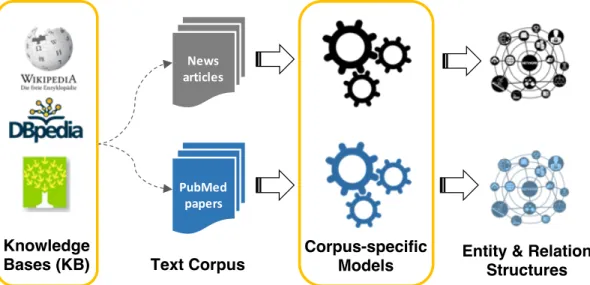
Figure 1.3: Illustration of the proposed framework. Effort-light StructMine leverages existing structures stored in external knowledge bases to automatically generate large amounts of corpus-specific, potentially noisy training data, and builds corpus-specific models for extracting entity and relation structures.
Proposed Framework. Our solution to effort-light StructMine aims to bridge the gap between customized machine-learning models and the absence of high-quality task-specific training data. It leverages the information overlap between background facts stored in external knowledge bases (KBs) (e.g., Freebase [6], BioPortal [7]) and the given corpus to automatically generate large amounts of (possibly noisy) task-specific training data; and it exploits redundant text information within the massive corpus to reduce the complexity of feature generation (e.g., sentence parsing). This solution is based on two key intuitions which are described below.
First, in a massive corpus, structured information about some of the entities (e.g., entity types, relationships to other entities) can be found in external KBs. Can we align the corpus with external KBs to automatically generate training data for extracting entity and relation structures at a large scale? Such retrieved information supports the automated annotation of entities and relations in text and labeling of their categories, yielding (possibly noisy) corpus-specific training data (Figure 1.3). Although the overlaps between external KBs and the corpus at hand might involve only a small proportion of the corpus, the scale of the automatically labeled training data could still be much larger than that of manually annotated data by domain experts.
Second, text units (e.g., word, phrase) co-occur frequently with entities and other text units in a massive corpus. Can we exploit the textual co-occurrence patterns to characterize the semantics of text units, entities, and entity relations? For example, having observed
that “government”, “speech”, “party” co-occur frequently with politician entities in the training data, the next time these text units occur together with an unseen entity in a sentence, the algorithm can more confidently guess that entity is a politician. As such patterns become more apparent in a massive corpus with rich data redundancy, big text data leads to big opportunities in representing semantics of text unit without complex feature generation.
To systematically model the intuitions above, effort-light StructMine approaches the struc-ture extraction tasks as follows: (1) annotate the text corpus automatically with target fac-tual structure instances (e.g., entity names, entity categories, relationships) by referring to external KBs, to create a task-specific training data (i.e., distant supervision); (2) extract shallow text units (e.g., words, n-grams, word shapes) surrounding the annotated instances in local context; (3) learn semantic vector representations for target instances, text units, and their category labels based on distant supervision and corpus-level co-occurrence statis-tics, through solving joint optimization problems; and (4) apply learned semantic vector representations to extract new factual instances in the remaining part of the corpus. The resulting framework, which integrate these ideas, has minimal reliance on human efforts, and thus can be ported to solve structure extraction tasks on text corpora of different kinds (i.e., domain-independent,language-independent,genre-independent).
The thesis is organized into two main parts: (1) identifying typed entities, and (2) ex-tracting entity relationships. We summarize the main problems of each part in the form of questions in Table 1.1.
Part Research Problem Chapter
I: Identifying Typed Entities
Entity Recognition and Typing: How can we identify
token spans of real-world entities and their types from text? 4
Fine-grained Entity Typing: How can we assign
fine-grained types to mentions of entities in text? 5
II: Extracting Typed Entity Relationships
Joint Extraction of Entities and Relations: What types of entities are mentioned in text and what typed of relationships are expressed between them?
6
1.1.1 Part I: Identifying Typed Entities
Real-world entities are important factual structures that can be identified from text to represent the factual knowledge embedded in massive amounts of text documents, and can server as fundamental building blocks for many downstream data mining and natural lan-guage processing tasks such as knowledge base construction and recommender systems. At a macroscopic level, how can we extract entities of types of interests from text with minimal reliance on labeled training data? At a microscopic level, how can we determine the fine-grained categories of an entity based on the context where it occurs? Our work proposes effective and distantly-supervised methods for recognizing and typing entities from text by leveraging external knowledge bases and exploiting rich data redundancy in large corpora. With the entities and their coarse-grained types extracted, we further look into how to assign more fine-grained entity types given the context and noisy distant supervision.
Entity Recognition and Typing
How can we identify token spans of real-world entities and their categories from text?
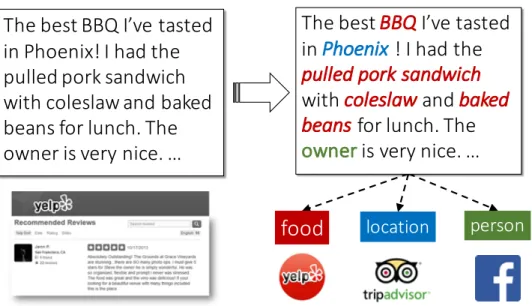
One of the most important factual structures in text is entity. Recognizing entities from text and labeling their types (e.g.,person,location) enables effectives structured analysis of unstructured text corpora (Chapter 4). Traditional named entity recognition (NER) systems are usually designed for several major types and general domains, and so require additional steps for adaptation to a new domain and new types. Our method, ClusType [8], aims at identifying typed entities of interests from text without task-specific human supervision. While most existing NER methods treat the problem as sequence tagging task and require significant amounts of manually labeled sentences (with typed entities), ClusType makes use of entity information stored in freely-available knowledge bases to create large amounts of (yet potentially noisy) labeled data and infers types of other entities mentioned in text in a robust and efficient way.
We formalize the entity recognition and typing task as a distantly-supervised learning problem. The solution workflow is: (1) detect entity mentions from a corpus; (2) map can-didate entity mentions to KB entities of target types; and (3) use those confidently mapped {mention, type} pairs as labeled data to infer the types of remaining candidate mentions. ClusType runs data-driven phrase mining to generate entity mention candidates and relation phrases (thus having no reliance on pre-trained name recognizer), and enforces the principle that relation phrases should be softly clustered when propagating type information between
The best
BBQ
I’ve tasted
in Phoenix
! I had the
pulled pork sandwich
with
coleslaw
and
baked
beans
for lunch. The
owner
is very nice. …
food
location
person
The best BBQ I’ve tasted
in Phoenix! I had the
pulled pork sandwich
with coleslaw and baked
beans for lunch. The
owner is very nice. …
Figure 1.4: An example for illustration of entity recognition and typing.
their argument entities. We formulate a joint optimization to integrate type propagation via relation phrases and clustering of relation phrases.
Contributions:
• Problem: We study the problem of distantly-supervised entity recognition and typing in a domain-specific corpus, where only a corpus and a reference knowledge base are given as input.
• Methodology: We develop an efficient, domain-independent phrase segmentation al-gorithm for extracting entity mentions and relation phrases. Entity types can be estimated for entity mentions by solving the clustering-integrated type propagation. • Effectiveness on real-world corpora: Our experiments on three datasets of different
genres – news, reviews and tweets – demonstrate that ClusType achieves significant improvement over the state-of-the-art.
Impact:
• ClusType system was transferred to US Army Research Lab, Microsoft and National Institute of Health.
• It was taught in a graduate class at University of Illinois at Urbana-Champaign, covered as a major part of the keynote at ACL 2015, and presented in conference tutorials at SIGKDD, WWW and SIGMOD [9, 10].
Fine-grained Entity Typing
How can we assign fine-grained types to mentions of entities in text?
ClusType provides a data-driven way to identify typed entities from text with the helps from external knowledge bases. It is able to distinguish types of entities at a coarse-grained level (e.g., location versus organization) based on the context surrounding the entity mention. However, many downstream applications will benefit if one can assign type to an entity mention from a much larger set of fine-grained types (for example, over 100) from a tree-structured hierarchy. Fine-grained entity typing allows one entity mention to have multiple types, which together constitute a type path in the given type hierarchy, depending on the local context. This task require in-depth modeling of local context and thus becoming very challenging for relation phrase-based method like ClusType.
How can we build models to automatically estimate the fine-grained type path for entity mention, without heavy reliance on human supervision? This is the problem we address in Chapter 5. When external knowledge bases are available for generating fine-grained labels, a key issue with such distant supervision is that it assign types to entity mentions in a context-agnostic way – one entity (e.g., Barack Obama) can have multiple entity types (e.g., person, politician, writer) in KB but within a specific context only some of these types may describe the entity properly. While prior arts follow supervised learning methods to train typing models on noisy distant supervision, we propose noise-aware embedding approaches [11, 12] todenoise the set of labels given by distant supervision as we are learning the embeddings for text features. Such weakly-supervised learning setting yields model the
root
person location organization politician artist businessman
author actor singer
..
.
Entity types fromknowledge base
Entity:
Donald Trump
S1:Donald Trump
Entity Types:person,artist,actor,
author, businessman,politician
ID Sentence
S1 Donald Trumpseasons presiding over a game show, spent 14 television NBC’s The Apprentice
correlation between “true” labels and features in a more reliable way and thus can produce more effective feature embeddings for prediction.
Contributions:
• Problem: The first systematic study of noisy labels in distant supervision for entity typing problem.
• Methodology 1: An embedding-based framework, PLE [11], to model and measure semantic similarity between text features and type labels, and is robust to noisy labels. • Methodology 2: A novel rank-based optimization problem is formulated to model noisy
type label and type correlation [12].
• Effectiveness on real data: The proposed methods achieve significant improvement over the state of the art on multiple fine-grained typing datasets, and demonstrate the effectiveness on recovering true labels from the noisy label set.
Impact:
• It was taught in a graduate class at University of Illinois at Urbana-Champaign, and presented in conference tutorials at WWW and SIGMOD [9, 10].
1.1.2 Part II: Extracting Typed Entity Relationships
Our studies on entity structure mining (Part I) provide the basic building blocks of entity relationships, i.e., the entity arguments mentioned in text. To further structure the text corpus the next step is to identify typed relationships between entities based on the local context in sentences (i.e., relation extraction). Identifying typed relationships is key to structuring content from text corpora for fa wide range of downstream applications. For example, when an extraction system finds a “produce” relation between “company” and “product” entities in news articles, it supports answering questions like “what products does company X produce?”. Once extracted, such relationship information is used in many ways,
e.g., as primitives in knowledge base population and question-answering systems. Traditional relation extraction systems have relied on human-annotated corpora for training supervised learning models. Here we ask: how can we design a domain-independent relation extraction system that can apply to text corpora from different domains in the absence of human-annotated, domain training data? To address this question, we propose a distant-supervised relation extraction method in Chapter 6, which is able to reference existing relationship information stored in external KBs as a source of supervision and integrates the extraction models for both entities and relationships.
Donald Trump located at protest Women’s March Washington D.C. Washington United States president of located at located at aim at Person Location Organization Event
The Women’s March was a worldwide protest on January 21,
2017. The protest was aimed at Donald Trump, the recently
inaugurated president of the United States. The first protest was
planned in Washington, D.C., and was known as the Women‘s March
on Washington.
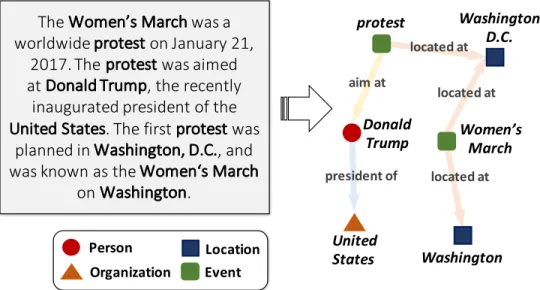
Figure 1.6: An illustration of the joint entity and relationship extraction problem.
Joint Extraction of Entities and Relationships
What types of entities are mentioned in text and what typed of relationships are expressed between them?
With facts about entities, their types and the relationships between them stored in ex-ternal knowledge bases, one can automatically generate large amounts of (potentially noisy) labeled training data for building entity recognition models (Part I) and relation extraction models. Prior arts focusing on this task have two major limitations: (1) partition the rela-tion extracrela-tion process into several subtasks and solve them incrementally (thus there are errors propagating cascading down the pipeline); and (2) ignore the noises brought in during the automatic label generation process and directly train machine learning models over the noisy labeled data.
To overcome these challenges, we study the problem of joint extraction of typed entities and relationships with knowledge bases. Given a domain-specific corpus and an external knowledge base, we aim to detect relation mentions together with their entity arguments from text, and categorize each in context by relation types of interests. Our method, Co-Type [13], approaches the joint extraction task as follows: (1) it designs a domain-agnostic text segmentation algorithm to detect candidate entity mentions with distant supervision (i.e., minimal linguistic assumption); (2) models the mutual constraints between the types of relation mentions and the types their entity arguments to enable feedbacks between the two subtasks; (3) model the true type labels in a candidate type set as latent variables and require only the most confident type to be relevant to the mention. CoType achieved the
state-of-the-art relation extraction performance under distant supervision, and demonstrates robust domain-independence across various datasets.
Contributions:
• Methodology: We propose a novel distant supervision framework, CoType, to extract typed entities and relationships in domain-specific corpora with minimal linguistic assumption.
• Effectiveness on real data: Experiments with three public datasets demonstrate that CoType improves the performance of state-of-the-art systems of entity typing and relation extraction significantly, demonstrating robust domain-independence.
• It was taught in a graduate class at University of Illinois at Urbana-Champaign and presented in conference tutorials at WWW, CIKM and SIGMOD.
• Software and demo system: We open sourced the CoType software and datasets used in our experiment, and further developed a demo system to facilitate exploring and analyzing over the typed entity and relation structures extracted using CoType from PubMed papers.
Impact:
• The work was selected as 2017 SIGMOD Research Competition finalist.
• The open-sourced software on GitHub receives over 100 subscriptions from users. • The typed entities and relationships extracted from 21 millions PubMed publications
was adopted by researchers at Stanford Medical School to facilitate the development of drug re-purposing and adverse drug event discovery techniques.
1.2 OVERALL IMPACT
The core of the thesis focuses on developing effective, human effort-light and scalable methods for extracting typed entities and relationships from massive, domain-specific text corpora. Our contributions are in the area of text mining and information extraction, within which we focus on domain-independent and noise-robust approaches using distant supervi-sion (in conjunction with publicly-available knowledge bases). The work has broad impact on a variety of applications: knowledge base construction, question-answering systems, struc-tured search and exploration of text data, recommender systems, network analysis, and many other text mining tasks. Finally, our work has been used in the following settings:
• Used in real world:
– Our entity recognition and typing technique (ClusType [14]) has been transferred to U.S. Army Research Lab, Microsoft Bing Ads and NIH Big Data to Knowledge Center to identify typed entities of different kinds from low-resource, domain-specific text corpora. ClusType is also used by Stanford sociologists to identify scientific concepts from 37 millions of scientific publications in Web of Science database to study innovation and translation of scientific ideas.
– A biomedical knowledge graph (i.e., Life-iNet [15]) constructed automatically from millions of PubMed publications using our effort-light StructMine pipeline is used by researchers at Stanford Medical school to facilitate drug re-purposing. It yields significant improvement of performance on new drugs and rare diseases. – Our effort-light StructMine techniques (ClusType, PLE, CoType) is adopted by veterinarians at Veterinary Information Network Inc. (VIN) to construct the first veterinary knowledge graph from multiple sources of information including research articles, books, guidelines, drug handbooks and message board posts. • Taught in classes and conference tutorials: Our methods on entity recognition
and typing (ClusType), fine-grained entity typing (PLE [11], AFET [12]), and relation extraction (CoType [13]) are being taught in graduate courses, e.g., University of Illinois at Urbana-Champaign (CS 512), and are introduced as major parts of the conference tutorial in top data mining and database conferences such as SIGKDD, WWW, CIKM and SIGMOD.
• Awards: The thesis work on effort-light StructMine has been awarded a Google PhD fellowship in 2016 (sole winner in the category of Structured Data and Data Manage-ment in the world) and a Yahoo!-DAIS Research Excellence Award, and a C. W. Gear Outstanding Graduate Student Award from University of Illinois.
Next, we present background in mining structured factual information and introduce useful factual structure notions and definitions.
CHAPTER 2: BACKGROUND
In this chapter we introduce the key definitions and notions in information extraction and knowledge graph construction that are useful for understanding the methods and algorithms described in this thesis. At the end of this chapter we give a table with the common notations and their descriptions.
2.1 ENTITY STRUCTURES
We start with the definition of common text structures, followed by entity, and other entity-related concepts (e.g., entity mention, entity types).
Phrase: A phrase is a group of words (or possibly a single word) that functions as a constituent in the syntax of a sentence, a single unit within a grammatical hierarchy. Phrase acts as a semantic unit in a sentence with some special idiomatic meaning or other significance (e.g., “machine learning”, “watch TV”, “before that happened”, “too slowly”).
Noun Phrase: A noun phrase (or nominal phrase) is a phrase which has a noun as its head (i.e., the word that determines the syntactic category of that phrase). It usually consists of groups made up of nouns – a person, place, thing or idea – and the modifiers such as determiners, adjectives, conjunctions. When looking at the structure of language, we treat a noun phrase the same way we treat a common noun. Like all nouns, a noun phrase can be a subject, object, or complement in a sentence.
Example 2.1 (Noun Phrase) In the sentence “The quick, brown fox jumped over the lazy dog”, there are two noun phrases: “the quick, brown fox” and “the lazy dog”. “the quick, brown fox” is the subject of the sentence and “the lazy dog” is the object.
Proper Name: A proper name is a noun phrase that in its primary application refers to a unique entity (e.g., University of Southern California, Computer Science, United States), as distinguished from a common noun which usually refers to a class of entities (e.g., city, person, company), or non-unique instances of a specific class (e.g., this city, other people, our company). When a noun refers to a unique entity, it is also called proper noun.
Entity: In information extraction and text mining, an entity (or named entity) is a real-world object, such as persons, locations, organizations, products, scientific concepts, etc., that can be denoted with a proper name. It can be abstract or have a physical existence.
Examples of named entities include Barack Obama, Chicago, University of Illinois. An entity is denoted as e in this thesis.
Remark 2.1: Ambiguous Proper Names for Named Entity
In the expression of “named entity”, the word named restricts the scope to those entities for which one or many strings stands consistently for some referent. In practice, one named entity may be referred by many proper names and one proper name may refer to multiple named entity. For example, the entity, automotive company created by Henry Ford in 1903, can be referred to using proper names “Ford” or “Ford Motor Company”, although “Ford” can refer to many other entities as well.
Entity Mention: An entity mention, denoted by m, is a token span (i.e., a sequence of words) in text that refers to a named entity. It consists of the proper name and the token index in the sentence.
Example 2.2 (Entity Mention) In the sentences “I had the pulled pork sandwich
withcoleslaw and baked beans for lunch. Thepulled pork sandwich is the best Ive tasted in Phoenix!”, the entity mentions are bold-faced. The proper name “pulled pork sandwich” appear twice in the sentence, corresponding to the same named entity but different entity mentions (thus will have different entity mention IDs).
Entity Type: An entity type (or entity class, entity category), is a conceptual label for a collection of entities that share the same characteristics and attributes (e.g.,person,artist, singer, location). Entities with the same entity types are similar to one another. Entity type instances refer to entities that are assigned with the specific entity type. In many applications, a set of entity types of interests are usually pre-specified by domain experts via providing example entity type instances. There also exists cases that entity types are related to each other (vs. mutually exclusive), forming a complex, tree-structured type hierarchy.
Example 2.3 (Entity Types in ACE Shared Task) The Automatic Content Extrac-tion (ACE) Program [16] was to develop informaExtrac-tion extracExtrac-tion technology to support automatic processing of natural language data. In the Entity Detection and Tracking (EDT) task of ACE, it focuses on seven types of entities: Person, Organization, Location, Facility, Weapon, Vehicle, and Geo-Political Entity. Each type was further divided into subtypes (for instance,Organizationsubtypes includeGovernment, Commercial, Education, Non-profit, Other).
2.2 RELATION STRUCTURES
This section introduces the basic concepts on relations. We start with the definition of relation, followed by definitions of relation instance and mention.
Relation: a relation (or relation type, relation class), denoted as r, is a (pre-defined) pred-ication about two or more entities. For example, from the sentence fragment “Facebook co-found Mark Zuckerberg” one can extract the FounderOf relation between entities Mark Zuckerberg and Facebook. In this thesis, we focus on binary relations, that is, relations between two entities.
Example 2.4 (Relations in ACE Shared Task) Much of the prior work on extract-ing relations from text is based on the task definition from ACE program [16]. A set of major relation types and their subtypes are defined by ACE. Examples of ACE major relation types include physical (an entity is physically near another entity),
personal/social(a person is a family member of another person),employment/affiliation (a person is employed by an organization).
Relation Instance: A relation instance denotes a relationship over two or more entities in a specific relation. When only considering binary relations, a relation instance can be represented as a triple with a pair of entities ei and ej, and their relation type r, i.e., (ei, r,
ej). For example,
Entity Argument: The two entities involved in a relation instance are referred to as entity arguments. The former one is also referred to as head entity while the later is also referred to as tail entity.
Relation Mention: A relation mention, z, denotes a specific occurrence of some relation instance in text. It records the two entity mentions for the pair of entity arguments, the relation type between these two entities, and the sentence s where the relation mention is found, i.e.,z = (mi, r, mj;s).
Example 2.5 (Relation Mention) Suppose we are given two sentences: “Obama was born in Hawaii, USA” (s1) and “Barack Obama, the president of United States” (s2). There are two relation mentions between entities Barack Obama and United States: z1 = (Obama, BirthPlace, USA; s1) and z2 = (Barack Obama, PresidentOf, United States; s2). Although the entity arguments are the same, the two relation mentions have different relation types based on the sentence context.
2.3 DISTANT SUPERVISION FROM KNOWLEDGE BASES
Knowledge bases are emerging as a popular and useful way to represent and leverage codified knowledge for a variety of use cases. For example, codifying the key entities and relationships of a particular domain can greatly accelerate a variety of tasks from providing semantic and natural language search over more traditional business intelligence data, to providing enabling query expansion and matching, to discovery and exploration of related entities and relations extracted from a large corpus of unstructured documents.
In information extraction, the term “knowledge base” is most frequently used with large collections of curated, structured knowledge, such as WikiData [17], Freebase [6], YAGO [18], DBpedia [19] or CYC [20]. It is also applied when such structured knowledge is automatically extracted, such as NELL [2], SnowBall [21] or OpenIE [5]. We use it to refer to any collection of relation triples, no matter their source or underlying ontology, if any. This can include subject-verb-object triples automatically extracted from large text corpora or curated from domain experts.
Fact: A fact in knowledge base (KB) can refer to either a binary relation triple in the form of
(ei, r, ej) or an is-A relation between an entity and a concept, such asFacebook is acompany.
Formally, A knowledge base, Ψ, consists of a set of entities EΨ and curated facts on both relation instancesIΨand entity typesTΨ (i.e., is-A relation between entities and their entity types). The set of relation types in the KB is denoted as RΨ.
Example 2.6 (Freebase) Curating a universal knowledge graph is an endeavor which is infeasible for most individuals and organizations. Thus, distributing that effort on as many shoulders as possible through crowdsourcing is a way taken by Freebase [6], a public, editable knowledge graph with schema templates for most kinds of possible entities (i.e., persons, cities, movies, etc.). After MetaWeb, the company running Freebase, was acquired by Google, Freebase was shut down on March 31st, 2015. The last version of Freebase contains roughly 50 million entities and 3 billion facts. Freebases schema comprises roughly 27,000 entity types and 38,000 relation types a. types
a
Example 2.7 (DBpedia) DBpedia is a knowledge graph which is extracted from struc-tured data in Wikipedia [19]. The main source for this extraction are the key-value pairs in the Wikipedia infoboxes. In a crowd-sourced process, types of infoboxes are mapped to the DBpedia ontology, and keys used in those infoboxes are mapped to properties in that ontology. Based on those mappings, a knowledge graph can be extracted. The most recent version of the main DBpedia (i.e., DBpedia 2016-10, extracted from the English Wikipedia based on dumps from October 2016) contains 6.6 million entities and 13 billion facts about those entities. The ontology comprises 735 classes and 2,800 relations.
2.4 MINING ENTITY AND RELATION STRUCTURES
Here we describe the basic tasks in mining factual structures from text corpora, followed by short introduction on related information extraction tasks.
Entity Recognition and Typing: Entity recognition and typing (or named entity recog-nition) addresses the problem of identification (detection) and classification of pre-defined types of entities, such as organization (e.g., “United Nation”), person (e.g., “Barack Obama”), location (e.g., “Los Angeles”), etc. The detection part aims to find the to-ken span of entities mentioned in text (i.e., entity mention) and the classification part aims to assign the suitable type to entity mention based on its sentence context.
Fine-grained Entity Typing: The goal of fine-grained entity typing is to classify each en-tity mention m (based on its sentence context s) into a pre-defined set
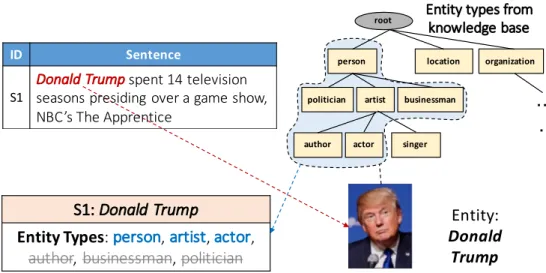
Figure 2.1: Illustration example for fine-grained entity typing. of types where the types are
correlated and organized into a tree-structured type hierar-chy Y. Each entity mention with be assigned with an en-tity type path – a path in the given type hierarchy that may not end at a leaf node. For example, in Figure 2.1, the en-tity mention “Donald Trump” is assigned with the type path “person-artist-actor” based on the given sentence.
Relation Extraction: The task of relation extraction aims to detect and classify pre-defined relationships between entities recognized in text. In the corpus-level relation ex-traction setting, all sentences {s} where a pair of entities (ei, ej) (proper names) occur are collected as evidences for determining the appropriate relation type r. In the mention-level relation extraction, the correct label for a relation mention m is determined based on the sentence it occurs, i.e., s. In particular, a label (class) called “None” is included into the label set so as to classify a false positive candidate as “no relation”.
2.5 COMMON NOTATIONS
We provide the most common notations and their brief definitions in Table 6.4. More specific notations used to explain proposed methods are introduced in the corresponding chapters.
Notation Definition
s sentence
d, D document, corpus
e entity
t, T entity type, entity type set
m entity mention
r,R relation type, relation type set
(ei, r, ej) relation instance of type r between entitiesei and ej
z relation mention
E finite set of entities in a corpus
Z finite set of relationships between entities in a corpus
G= (E,Z) directed, labeled graph that represents StructNet Ψ knowledge base (e.g., Freebase, DBpedia)
EΨ set of entities in KB TΨ entity types in KB
IΨ set of relation instances in KB RΨ relation types in KB
Y tree-structured entity type hierarchy
CHAPTER 3: LITERATURE REVIEW
This chapter provides an overview of prior arts and related studies in mining typed entities and relationships from text. Methods are categorized and organized based on the amounts of human labeled data required in the model training process, which also demonstrate the trajectory of research on reducing human supervision in entity and relation structure mining. We also review techniques developed for learning with noisy labeled data as well as open-domain information extraction, followed by a summary of our contributions.
The existing methods on mining entity and relation structures can be roughly catego-rized along two dimensions – (1) the amount of human supervision required and (2) the extraction task (problem formulation) it is solving. Table 3.1 gives a few examples for each category. A method can be fully hand-crafted, supervised, weakly supervised or distantly supervised. The second dimension is that the problem formulation of the task can be either sequence labeling (e.g., CRFs), transdutive classification (e.g., pattern bootstrapping, and label propagation), and inductive classification (e.g., SVM). More in-depth discussion about the literature related to concrete tasks and the proposed approaches can be found in each chapter.
Method Category Prior Work on Entity Extraction
Prior Work on Relation Extraction
Hand-crafted
meth-ods DIPRE [22], FASTUS [23] Hearst Pattern [24] Supervised learning
methods
Sequence tagging models like CRFs, HMMs, CMMs [25, 26]
Inductive classifiers like SVM, kernel methods [27, 28], and var-ious deep neural networks Weakly-supervised
methods
KnowItAll [29], SEISA [30], Gupta et al. [31], semi-supervised CRFs [32]
SnowBall, NELL [33]
Distantly-supervised
methods [34, 35, 36]
Mintzet al. [37], MIME-RE [38], [39]
Open-domain extrac-tion methods
Liberal IE [40], OpenIE
sys-tems [5, 41, 42, 43] OpenIE systems [5, 41, 42, 43] Table 3.1: A few examples to give an idea about the categories of methods developed based on the amount of human supervision and the task.
… cities such as NPList … New York Los Angeles Dallas City “The tour includes
major cities such as [New York], [Los Angeles], and [Dallas]” NPList[0]
NPList[1] … City
Text Entities
Figure 3.1: An illustration of hand-crafted extraction methods for extracting entity structures.
3.1 HAND-CRAFTED METHODS
One straightforward way of finding entities and relationships in text is to write a set of textual patterns or rules (e.g., regular expression) for the different types of entities (or relationships between entities), with each pattern using some clue to identify the type of entity and relation. For example, in Figure 3.1, the pattern “city such as NPList” is designed to extract a list of cityentities from text. The NPList matches different noun phrases such as “New York”. Therefore, from the sentence in Figure 3.1, this pattern is able to extract three entity mentions of city type, i.e., ‘New York”, “Los Angeles” and “Dallas”. Such patterns can be further enhanced with various lexical and syntactic constraints including part-of-speech tags and dependency parse structures.
Hand-crafted systems often rely on extensive lists of people, organizations, locations, and other entity or relation types. Many such lists are now available from the Web. These lists can be quite helpful, and for some entity types they are essential because good contextual patterns are not available, but they should be used with some caution. Systems which are primarily list based will suffer when new names arise, either because of changes in the input texts or the passage of time. Also, large lists may include entries which are proper names but more often are capitalized forms of common words. By building up a set of rules for each entity or relation type, it is possible to create a quite effective extraction system. However, obtaining high performance on corpus of specific domain, genre or language does require some degree of skill. It also generally requires an annotated corpus which can be used to evaluate the rule set after each revision; without such a corpus there is a tendency after a certain point for added rules to actually worsen overall performance.It requires human experts to define rules or regular expressions or program snippets for performing the extraction. That person needs to be a domain expert and a programmer, and possess descent linguistic understanding to be able to develop robust extraction rules.
3.2 TRADITIONAL SUPERVISED LEARNING METHODS
If the creation of a high-quality entity and relation extractor by hand requires an annotated corpus, it is natural to ask whether extraction models can be trained automatically from such a corpus. Such supervised methods for training an fully-supervised extraction model will be considered in this section.
3.2.1 Sequence Labeling Methods
Many statistical learning-based named entity recognition algorithms treat the task as a sequence labeling problem. Sequence labeling is a general machine learning problem and has been used to model many natural language processing tasks including part-of-speech tagging, chunking and named entity recognition. It can be formulated as follows. We are given a sequence of observations, denoted as x = (x1, x2, ..., xn). Usually each observation is represented as a feature vector. We would like to assign a label yi to each observation
xi. While one may apply standard classification to predict the label yi based solely on xi, in sequence labeling, it is assumed that the label yi depends not only on its corresponding observation xi but also possibly on other observations and other labels in the sequence. Typically this dependency is limited to observations and labels within a close neighborhood of the current position i.
To map entity recognition to a sequence labeling problem, we treat each word in a sentence as an observation. The class labels have to clearly indicate both the boundaries and the types of named entities within the sequence. Usually the BIO notation, initially introduced for text chunking, is used. With this notation, for each entity type T, two labels are created,
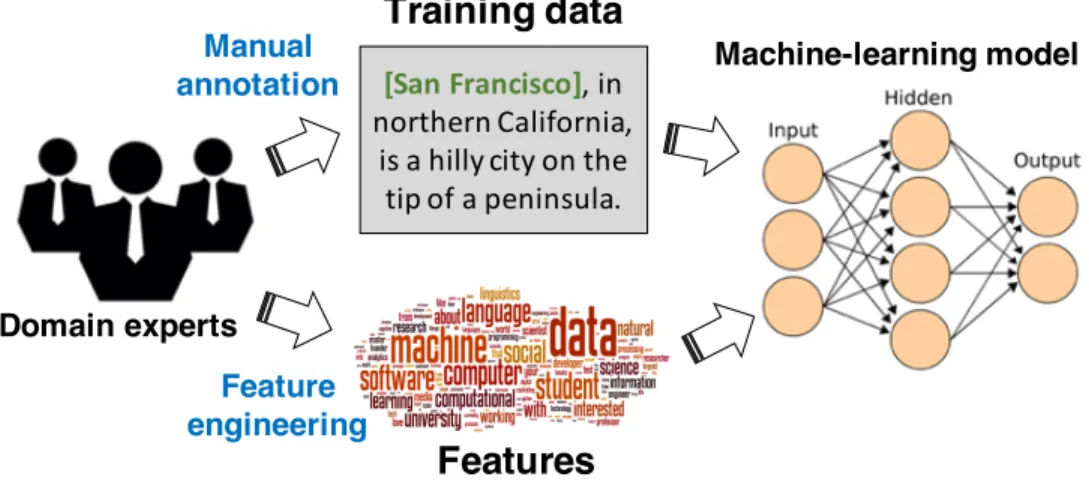
[San Francisco], in northern California,
is a hilly city on the tip of a peninsula.
Features
Machine-learning model Domain expertsTraining data
Manual annotation Feature engineeringnamely, B−T and I−T. A token labeled with B-T is the beginning of a named entity of typeT while a token labeled with I−T is inside (but not the beginning of) a named entity of type T. In addition, there is a label O for tokens outside of any named entity.
Such supervised methods [26, 44] use fully annotated documents and different linguistic features to train sequence labeling model. To obtain an effective model, the amount of labeled data is significant [26], despite of semi-supervised sequence labeling [32].
3.2.2 Supervised Relation Extraction Methods
Instead of creating and refining these patterns by hand, we can build a relation extractor from an annotated corpus. We will need a corpus which has been annotated both for entity mentions and for relations. We then want to convert relation tagging into a classification problem. To handle a single type of relation, we will train a classifier which classifies each pair of entity mentions appearing in the same sentence as either having or not having this relation. To handle n relation types, we can train an n + 1-way classifier. Alternatively, we can create two classifiers: a binary classifier which determines whether the entities bear some relation, and an n-way classifier (applied to instances which are passed by the first classifier) which determines which relation is involved. To apply this to new data, we first run an entity tagger and then apply the relation classifier to every pair of entities.
Traditional systems for relation extraction [45, 46, 47] partition the process into several subtasks and solve them incrementally (i.e., detecting entities from text, labeling their types and then extracting their relations). Such systems treat the subtasks independently and so may propagate errors across subtasks in the process. Recent studies [48, 49, 50] focus on joint extraction methods to capture the inherent linguistic dependencies between relations and entity arguments (e.g., the types of entity arguments help determine their relation type, and vice versa) to resolve error propagation.
3.3 WEAKLY-SUPERVISED EXTRACTION METHODS
Weakly-supervised methods utilize a small set of typed entities or relation instances as seeds, and extract more entities or relationships of target types, which can largely reduce the amount of required labeled data.
3.3.1 Semi-supervised Learning
Supervised methods spare us the task of writing rules by hand but still require substantial labor to prepare an annotated corpus. Can we reduce the amount of corpus which we need to
annotate? This is possible through semi-supervised learning methods, including in particular those based on co-training [51, 52]. Semi-supervised methods make use of limited amounts of labeled data together with large amounts of unlabeled data. The basic observation, already made use of in the long-range features of the supervised tagger, is that multiple instances of the same name have the same type. Some of these instances may occur in contexts which are indicative of a particular name type, and these may be used to tag other instances of the same name. In semi-supervised learning we apply these principles repeatedly: starting from a few common names of each type, we look for the contexts in which each of these names appears. If a context appears only with names of one type, we treat this as a predictive context; we look for other names which appear in this context and tag them with the predicted type. We add them to the set of names of known type, and the process repeats.
This is an example of co-training. In co-training, we have two views of the data - two sets of features which can predict the label on the data. In our case the two views are the context of a name and the “spelling” of a name (this includes the complete name and the individual tokens of the name). For each view, we are able to build a model from the labeled data; then we can use this model to label the unlabeled data and associate a confidence with each label. We build a model based on the first view, generate a label for each unlabeled datum, and keep the most confident labels, thus growing the labeled set. Then we do the same using the second view. Gradually the labeled set grows and the models are refined.
3.3.2 Pattern-based Bootstrapping
Pattern-based bootstrapping [31, 53] derives patterns from contexts of seed entities or relation instances, and uses them to incrementally extract new entities / relationships and new patterns unrestricted by specific domains, but often suffers low recall and semantic drift [36].
Iterative bootstrapping, such as probabilistic method [51] and label propagation [54] softly assign multiple types to an entity name and iteratively update its type distribution, yet cannot decide the exact type for each entity mention based on its local context.
The DIPRE system [22] was one of the first systems for weakly-supervised, pattern-based relation extraction, and one of the first designed to operate on the Web. The context patterns were based on character sequences before, between, and after the entities, and so could make use of both lexical contexts and XML mark-up contexts. The patterns were associated with particular web sites. There was no ranking of patterns or entity pairs; instead, some heuristics were used to insure that the patterns were sufficiently specific. The entire procedure was demonstrated on the bookauthor relation. The Snowball system [21]
introduced several improvements, including the use of name types, the ranking of patterns and entity pairs (as described above, using negative examples) and more relaxed patten matching. It was applied to the companyheadquarters relation, a functional relation.
3.4 DISTANTLY-SUPERVISED LEARNING METHODS
Distantly supervised methods [37, 39, 38, 34, 35, 36] avoid expensive human labels by leveraging type information of entity and relation mentions which are confidently mapped to entries in KBs. Linked mentions are used to type those unlinkable ones in different ways, including training a contextual classifier [34], learning a sequence labeling model [36] and serving as labels in graph-based semi-supervised learning [35].
In the context of distant supervision, label noise issue has been studied for other informa-tion extracinforma-tion tasks such as relainforma-tion extracinforma-tion [55]. In relainforma-tion extracinforma-tion, label noise is introduced by the false positive textual matches of entity pairs. In entity typing, however, label noise comes from the assignment of types to entity mentions without considering their contexts. The forms of distant supervision are different in these two problems. Recently, [56] has tackled the problem of label noise in fine-grained entity typing, but focused on how to generate a clean training set instead of doing entity typing.
3.5 LEARNING WITH NOISY LABELED DATA
Our proposed framework incorporates embedding techniques used in modeling words and phrases in large text corpora [57, 58, 59] ,and nodes and links in graphs/networks [60, 61]. Theses methods assume links are all correct (in unsupervised setting) or labels are all true (in supervised setting). CoTypeseeks to model the true links and labels in the embedding process (e.g., see our comparisons with LINE [60], DeepWalk [61] and FCM [62] in Sec. 6.4.2). Different from embedding structured KB entities and relations [63, 64], our task focuses on embedding entity and relation mentions in unstructured contexts.
In the context of modeling noisy labels, our work is related to partial-label learning [56, 65, 66] and multi-label multi-instance learning [38], which deals with the problem where each training instance is associated with a set of noisy candidate labels (whereonly one is correct). Unlike these formulations, our joint extraction problem deals with both classification with noisy labels and modeling of entity-relation interactions. In Sec 6.4.2, we compare our full-fledged model with its variantsCoType-EM andCoType-RM to validate the Hypothesis on entity-relation interactions.
3.6 OPEN-DOMAIN INFORMATION EXTRACTION
Traditional techniques for mining entity and relation structures usually work on a corpus from a single domain, e.g.articles describing terrorism events, because the goal is to discover the most salient relations from such a domain-specific corpus. In some cases, however, our goal is to find all the potentially useful facts from a large and diverse corpus such as the Web. This is the focus of open information extraction, first introduced in [5], then followed by several other open IE systems [41, 42, 43].
Open information extraction does not assume any specific target relation type. It makes a single pass over the corpus and tries to extract as many relations as possible. Because no relation type is specified in advance, part of the extraction results is a phrase that describes the relation extracted. In other words, open information extraction generates (ei, r, ej) tuples whereris not from a finite set of pre-defined relation types, but can be arbitrary predicate or relation phrases. In [5], Banko and Etzioni introduced an unlexicalized CRF-based method for open information extraction. The method is based on the observation that although different relation types have very different semantic meanings, there exists a small set of syntactic patterns that cover the majority of semantic relation mentions. It is therefore possible to train a relation extraction model that extracts arbitrary relations. The key is not to include lexical features in the model.
Extracting textual relation between subjective and objective from text has been exten-sively studied [41] and applied to entity typing [35]. Faderet al. [41] utilize POS patterns to extract verb phrases between detected noun phrases to form relation assertion. Schmitz et al. [42] further extend the textual relation by leveraging dependency tree patterns. These methods rely on linguistic parsers that may not generalize across domains. They also do not consider significance of the detected entity mentions in the corpus (see comparison with NNPLB [35]). There have been some studies on clustering and and canonicalizing synony-mous relations generated by open information extraction [67]. These methods either ignore entity type information when resolving relations, or assume types of relation arguments are already given.
3.7 CONTRIBUTIONS OF THIS THESIS
There have been extensive studies on extracting typed entities and relations in text (i.e., context-dependent extraction). Most existing work follows an incremental diagram—they first perform entity recognition and typing [44, 26] to extract typed entity mentions, and then solve relation extraction [45, 47] to identify relation mentions of target types. Work
along both lines can be categorized in terms of the degree of supervision. While supervised entity recognition systems [25, 44] focus on a few common entity types, weakly-supervised methods [31, 34] and distantly-supervised methods [8, 58, 36] use large text corpus and a small set of seeds (or a knowledge base) to induce patterns or to train models, and thus can apply to different domains without additional human annotation labor. For relation extraction, similarly, weak supervision [68, 3] and distant supervision [69, 70, 38, 71, 39, 37] approaches are proposed to address the domain restriction issue in traditional supervised systems [45, 28, 47]. However, such a “pipeline” diagram ignores the dependencies between different sub tasks and may suffer from error propagation between the tasks.
Some recent efforts have been done on integrating entity extraction with relation ex-traction by performing global sequence labeling for both entities and relations [48, 49, 72], incorporating type constraints between relations and their arguments [50], or modeling fac-tor graphs [73]. However, these methods require human-annotated corp